

You're in China, the trip is going better than planned, and the stay period is starting to feel short. Whether you can buy more time depends entirely on how you entered — with a visa, visa-free, or on the transit policy — so this guide answers it that way: three straight answers first, then where to apply, the document that trips people up, what happens while your passport is being processed, and an honest look at what overstaying actually costs.
Can you extend? Three answers for three entries
You entered with a visa. Yes, extension is a real mechanism. For visas with a stay period of up to 180 days, you can apply to extend, and applications with reasonable, well-founded grounds are granted. Two hard limits shape what's possible: the extension applies to this entry only — it adds no entries and doesn't stretch the visa's validity — and your total extended time can't exceed the stay period originally printed on the visa.
You entered visa-free. Your 30 days come from a policy, not a visa sticker — the visa-free scheme admits you for stays of up to 30 days for tourism, business and family visits — and the policy's answer on longer trips is blunt: a trip you already know will run past 30 days should start with a visa, arranged before travel. But if a genuine, legitimate reason appears after you've entered — the policy's design isn't to trap people — you apply to the public security bureau's exit-entry administration for a stay permit. Planning a long trip on visa-free entry and hoping to sort it out later is the one strategy that doesn't work; see how the visa-free rules frame this.
You entered on 240-hour transit. Same shape, higher bar: sudden illness, force majeure and similar events outside your control justify a stay permit, applied for before your time limit runs out. Wanting more sightseeing doesn't qualify — the details are in our transit guide.

Where and when to apply
The office is the exit-entry administration of the public security bureau at county level or above, in the city where you're staying — and the deadline matters more than the address: applications go in no later than seven days before your stay period expires, a rule set by the entry-exit law itself (official text, in Chinese). In practice, don't treat day minus-seven as the target; big-city exit-entry halls run appointment systems and queues, and arriving with buffer turns a stressful errand into a boring one. If you can't locate your local office, the immigration authority's 24-hour hotline +86-12367 can point you there in English.
Documents — and the one people forget
The core set is short: the application form, your passport, photos that meet the spec, and material supporting the reason for your extension — a doctor's note, a changed itinerary, whatever backs your story honestly.
The sleeper requirement is accommodation registration. Every foreigner in China is registered where they stay: hotels file it automatically at check-in, but if you're in a friend's apartment or a rental, you or your host were supposed to register with the local police station within 24 hours of moving in. The exit-entry office sits inside the same system, so an unregistered private stay surfaces exactly when you least want it to. If that's you, go to the local police station and fix the registration before you file the extension — better to be late by weeks than absent.
While it's processing: the receipt is your passport
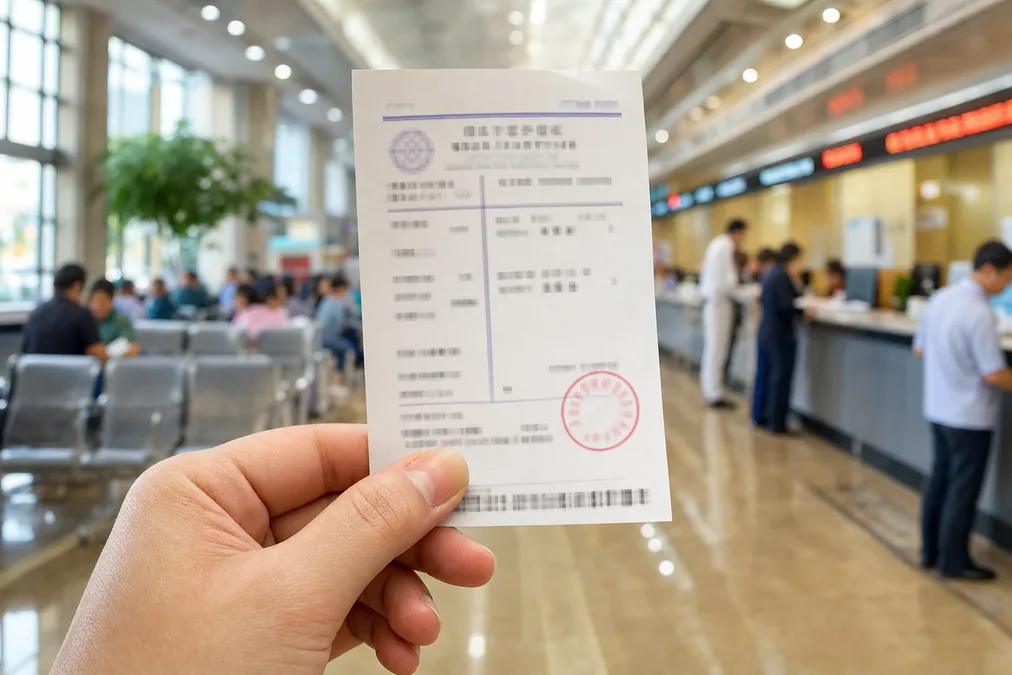
File a complete application and you get an acceptance receipt, valid for up to seven days, and the decision comes within the receipt's window. That receipt matters more than it looks: while your passport sits with the office, the receipt is your proof of legal stay in China — keep it on you the way you'd keep the passport. For hotel check-ins and travel during those days, plan conservatively: the receipt covers your legal status, but anything that needs the physical passport — new bookings, domestic flights — is smoother if you simply schedule it after collection. Ask the officer when you file; they'll tell you exactly what the receipt covers locally.
On fees: they exist, they're moderate, and they vary — the office posts the current schedule, so budget for a fee and confirm the number at the counter rather than trusting any blog's figure, including ours.
Overstaying: the real price
Not a scare story, just the law. Overstaying is illegal residence, and the response scales: a warning in minor cases, and in serious ones a fine of 500 yuan per day capped at 10,000 yuan, or detention of five to fifteen days. The longer tail is the record: a history of illegal stay in China within the past five years disqualifies you from the visa-free transit scheme, and a clean file is an asset for every future visa application. If you're reading this already close to the line, the move is simple: apply for the extension or stay permit before the deadline — the mechanism above exists precisely so that honest overruns never become overstays.
Frequently Asked Questions
I have a visa with a 90-day stay period — can it be extended?
Yes, the mechanism covers you: extensions are available for visas with stay periods up to 180 days, granted on reasonable grounds. The ceiling is symmetry — your total extension can't exceed the original stay period printed on the visa, so a 90-day stay can, at most, roughly double. Apply before the seven-day mark with material that backs your reason.
Can a student visa be extended for a month or two?
For short-term study — the X2 visa — yes, the same stay-extension route applies: file before the deadline with your school's letter as the supporting material. Long-term students on X1 are usually living on a residence permit rather than a visa stay period, which is a different renewal process — your school's international office deals with it routinely and should be your first stop.
Can I check into hotels or ride trains while my passport is held?
Your legal status is solid: the acceptance receipt proves lawful stay while the passport is with the office. Practicalities are the honest caveat — hotels and ticket systems are built around passports, and acceptance of the receipt alone varies by operator. The low-stress play: keep the receipt with you always, stay put or travel light during the processing days, and put passport-dependent plans on the far side of collection. The processing window is short by design, so there isn't long to bridge.
What if the extension is refused — do I still have time to leave?
Yes, and the system is built to leave you that time: decisions come within the short receipt window, and a refusal means one thing — leave by your original deadline. Book the flight the day you hear, keep the refusal paperwork with your travel documents in case an officer asks at exit, and don't gamble on a second application eating your remaining days. Departing on time with a refusal on file is a non-event; overstaying after one is not.
The timeline, backwards from your deadline
- Know your exact last legal day — count it from your entry stamp and stay period, not from memory.
- Application in hand at the exit-entry office well before the seven-day mark.
- Accommodation registration verified before you file — hotels did it for you; private stays are on you.
- During processing, the receipt is your legal proof — carry it.
If you're still at the planning stage and suspect the trip wants more than 30 days, the cleaner route is a visa from the start — our application guide covers it.
Last updated: August 2026
Read in other languages
Last train times for 10 Chinese metro systems
Every line and station, checked by hand — the same data behind our offline route planner.
Get the WaysChina App
Offline guides, currency converter, essential phrases, and more — all in your pocket.

Related Articles

Do You Need a Visa for China? Check by Nationality
One table answers it: every nationality with a visa-free route into mainland China — 30-day entry, 240-hour transit,...

China's 240-Hour Visa-Free Transit: Who Qualifies and How It Works
Not on China's visa-free list? If you're flying on to a third country, the 240-hour transit policy lets you enter...

Arriving in China: The Arrival Card, Immigration and Customs
Your first hour on the ground, step by step: filing the arrival card online before you fly, what immigration...

How to Apply for a China Visa: Forms, Documents and Timing
The China tourist visa in four steps: the COVA online form, the documents that actually matter, submission-day...