
This article contains affiliate links. If you make a purchase through these links, we may earn a small commission at no extra cost to you. This helps support our work in creating free travel guides.
Yu Garden (豫园, Yùyuán) is a walled Ming-dynasty private garden in Shanghai's old city, and it is the main ticketed sight in the Yu Garden area. The garden opens 9:00 to 16:30, stops letting people in at 16:00, and is closed every Monday except on national public holidays. An adult ticket is 40 yuan in spring and autumn and 30 yuan in summer and winter, sold at the north and south gates or on the official "上海豫园" (Shanghai Yu Garden) mini program, with no advance booking needed. The City God Temple, the Yuyuan Bazaar shopping streets and the Zigzag Bridge sit right next to the garden but are separate places with their own rules: the temple sells its own entry ticket at its gate, while the bazaar lanes, the bridge and Yuyuan Old Street are open for anyone to walk through. This page sorts out which is which, what to see inside the walls, how to get there by metro, and how to avoid the two traps most visitors fall into: arriving on a Monday, or arriving after 16:00.
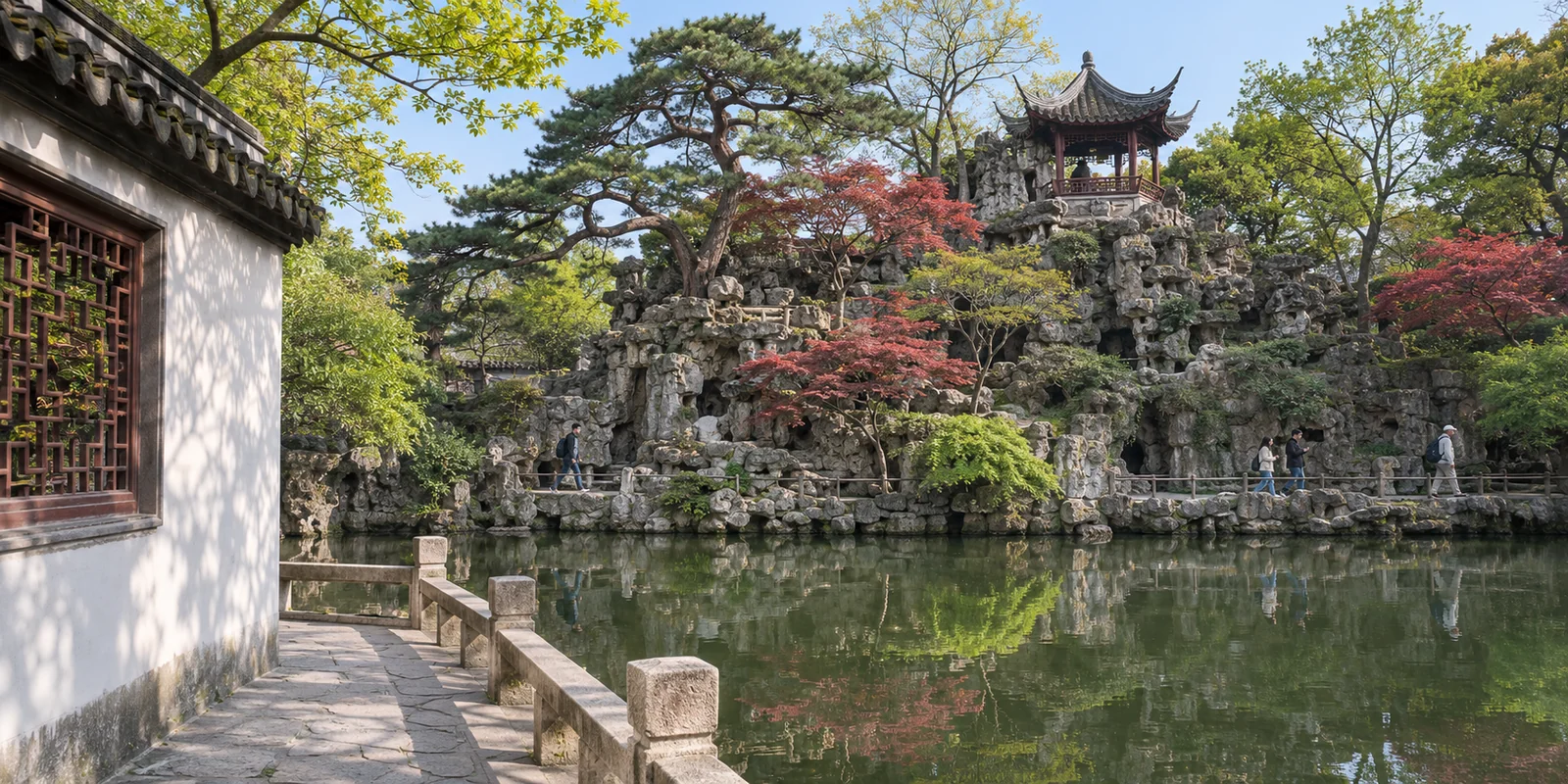
Yu Garden at a glance: hours, tickets and the Monday closure
The short version: plan the garden for any day from Tuesday to Sunday, and get there before mid-afternoon. Here are the details.
- Opening hours: 9:00 to 16:30, last entry 16:00. That is early by city standards, and it is the most common reason people find the gates shut after a late lunch.
- Monday: the garden is closed every Monday, unless the Monday falls on a national public holiday; around Chinese New Year the garden posts its own schedule, so check the official notice if you are visiting then.
- Adult tickets: 40 yuan in peak season (1 April to 30 June and 1 September to 30 November) and 30 yuan in off-peak season (July, August and 1 December to 31 March).
- Discounts: half price for young people aged 6 to 18, full-time students below bachelor level, and visitors aged 60 and over, with proof (ask at the window whether your passport counts, because many Chinese sites set their own rules on discounts for foreign visitors); children 1.3 metres tall or under, or aged 6 or under, go in free with an adult.
- What you can walk for free: the Yuyuan Bazaar lanes, the Zigzag Bridge and Yuyuan Old Street around the garden have no ticket gate, so you can wander them and look at the teahouse from outside without paying. The bazaar is open 24 hours a day.
- What is separate: the City God Temple has its own gate and its own hours, 8:30 to 16:30 every day. It sells its own entry ticket at the gate, priced as posted there; your garden ticket does not cover it.
Put simply: the garden is the main ticketed site, with a wall around it; the temple is a working Taoist temple that sells its own ticket at its own entrance; and the bazaar is an always-open shopping district built around both that you can walk through freely. During the lantern festival, the ticketed lantern zone is an extra charge on top. Many people walk through the bazaar, see the teahouse on the pond, and think they have "done" Yu Garden without ever going through the garden gate. If you want to see the rockeries, halls and the famous stone, you need the ticket.
💡 Tip: If Monday is your only free day in central Shanghai, do the bazaar, the Zigzag Bridge and the City God Temple that day, and swap the garden for something else. The temple is open every day of the year.
How to buy a Yu Garden ticket
You do not need to reserve. The garden's own visitor page says tickets are sold at the ticket windows by the north and south gates, and online through the official "上海豫园" WeChat mini program, and that no advance booking is required. You can read the rules yourself on the Yu Garden official visitor information page (in Chinese).
For a first-time foreign visitor, the ticket window is the easiest route. The official site does not say whether the mini program accepts a foreign passport, so check inside the mini program before you rely on it. Have your passport with you anyway, and carry it if you are claiming the senior or student discount, because those need proof. On ordinary weekdays the window queue tends to move quickly, so buying online may not save you much.
There are two gates, and they are not the same:
- North Gate (北门), at 168 Fuyou Road: for tour groups and individual visitors. Coming from the metro exits on Renmin Road, this is likely to be the first gate you reach.
- South Gate (南门), at 279 Yuyuan Old Street: individual visitors only, at the foot of the Zigzag Bridge. If you are already in the bazaar looking at the teahouse, this is the one in front of you.
A few rules worth knowing before you queue. There is no luggage storage at the garden, so do not come straight from the station with a suitcase. Smoking (including e-cigarettes), drinking alcohol, flying drones and climbing on the rockeries or old buildings are all banned inside, and pets are not allowed except guide dogs.
What to see inside Yu Garden
Yu Garden began as the private garden of a Ming-dynasty official, Pan Yunduan, who started building it in 1559 beside his family home; it took more than twenty years and was designed by the garden-maker Zhang Nanyang. After a five-year restoration that started in 1956, it opened to the public in September 1961, and today it covers about 30 mu (a traditional Chinese land unit), down from more than 70 mu originally. It is listed as a national-level protected heritage site.
A Chinese classical garden is not a park with lawns. It is a set of small courtyards, halls, ponds, rock piles and covered walkways, packed together so that every few steps you get a different framed view. Paths twist, doorways are round or shaped like vases, and the same pond shows up from three different angles. That is the point, so slow down rather than hunting for a "main sight". The places below are the ones worth finding.
Sansui Hall and the Grand Rockery
Coming in from the North Gate, the first big building is Sansui Hall (三穗堂, the Hall of Three Ears of Grain), about 9 metres tall and the main hall of the garden. Behind it, across a pond, is the Grand Rockery (大假山), a 14-metre artificial hill of piled rock built under Zhang Nanyang, the garden's Ming designer. It is the best spot for the classic photo of rock, water and pavilion together. Look out too for a pair of iron lions in front of one of the walkways, cast in 1290 during the Yuan dynasty.
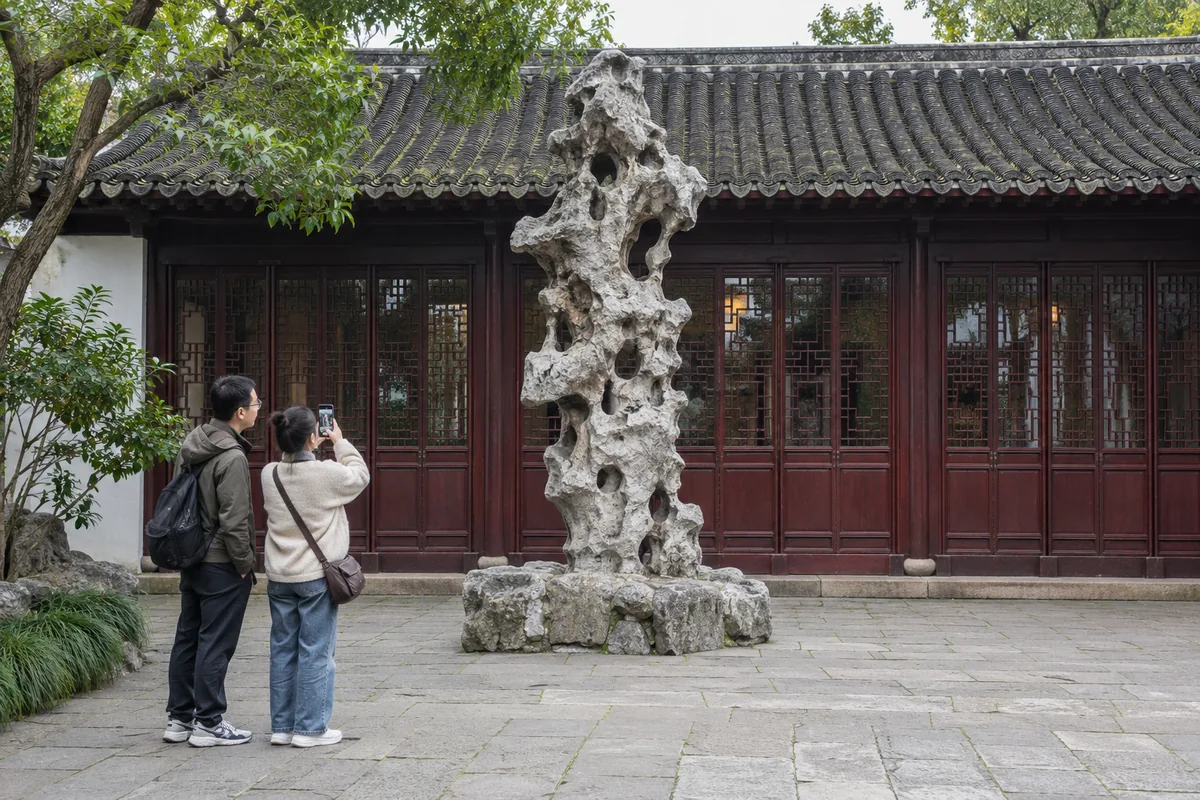
The Exquisite Jade Rock
The Exquisite Jade Rock (玉玲珑, Yù Línglóng) is the object the garden is proudest of. The official site calls it the garden's treasure and one of the three famous ornamental stones of the Jiangnan region; tradition says it was meant for the imperial garden of the Song emperor Huizong, which would make it about a thousand years old. It is a tall, thin rock worn full of holes, the shape Chinese collectors prized most. Pan Yunduan built the Hall of Jade Magnificence (玉华堂), his study, facing it so he could look at it every day. If you stand at the front of the hall, you see the stone from the spot the owner chose.
Hall of Heralding Spring and the long water corridor
The Hall of Heralding Spring (点春堂) was the northern headquarters of the Small Swords Society, a rebel group that rose up in Shanghai from 1853 to 1855, and it now displays objects from that period. Nearby, the Jade-Collecting Water Corridor (积玉水廊) runs for about 100 metres along the water; the garden describes it as the longest water corridor in any classical garden south of the Yangtze. It is a good place to walk when it rains, since it is covered all the way.
The Inner Garden
The Inner Garden (内园) is a separate small garden built in 1709 and joined to Yu Garden during the restoration of the late 1950s, which is why people call it a garden inside a garden. It is easy to miss because it feels like a separate corner, so check the garden map at the gate and make sure you walk through it before you leave.
How long to spend
The garden does not publish a suggested visit time. How long you need depends on how you visit: walking the main loop from Sansui Hall past the Grand Rockery and the Exquisite Jade Rock to the Inner Garden is quicker than stopping in every hall and waiting for crowds to clear for photos. A simple way to plan: if you arrive by 14:30, you have about two hours before the garden closes at 16:30, which is enough for an unhurried visit. Leave separate time for the bazaar, the Zigzag Bridge and the City God Temple outside.
The garden has also tried evening opening: in August 2025 it launched a guided night tour that takes small groups of 20 along a route of about 350 metres past the Grand Rockery and the Exquisite Jade Rock. Check the official Yu Garden site or mini program to see whether it is running when you visit and how to book it, and whether it is charged separately from the daytime ticket.
Outside the garden: City God Temple, Zigzag Bridge and the bazaar
Yu Garden sits in the north-east of the old city, with the bazaar and the City God Temple right next to it to the south-west; locals describe the whole area as "temple, market and garden" in one block. On a map it looks like one attraction. On the ground it is three different things: the garden and the temple each sell their own ticket, and the bazaar lanes around them are open to walk through.
The City God Temple
The Shanghai City God Temple (上海城隍庙, Chénghuáng Miào) is a working Taoist temple, first built in the Yongle era of the Ming dynasty (1403 to 1424), at 249 Middle Fangbang Road. A "city god" is a local guardian spirit; Chinese cities traditionally had a temple to theirs, and people still come here to burn incense and pray for health, money and exams. The temple has twelve halls, including the Hall of Fortune (财神殿) and the main City God Hall, in about 3,000 square metres.
It is open every day of the year from 8:30 to 16:30, and on the first and fifteenth days of each lunar month it opens early at 6:00. The temple sells its own entry ticket at its gate, separate from the garden ticket; check the price posted at the gate or call the temple on 021-6328 4494. The temple's own site, shchm.com, posts its opening notices. Inside, dress modestly, keep your voice down, and ask before photographing anyone who is praying.
One source of confusion: people often say "City God Temple" (城隍庙) when they mean the whole shopping area around it, and taxi drivers and signs use the name the same way. If someone tells you "the City God Temple is free", they mean the streets around it; the temple halls have their own ticket.
The Zigzag Bridge and Huxinting Teahouse
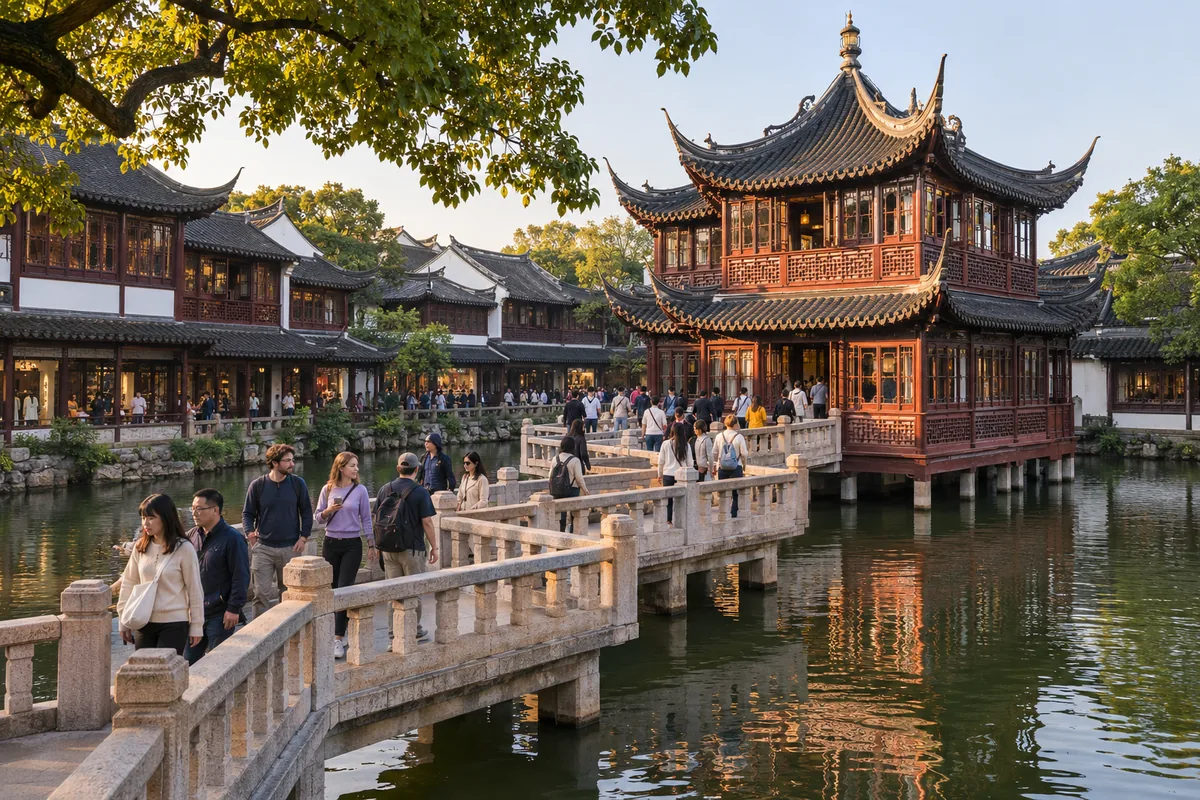
The Zigzag Bridge (九曲桥, Jiǔqū Qiáo, "nine-turn bridge") crosses the pond just outside the garden's south wall, and in the middle of it stands the Huxinting Teahouse (湖心亭, "mid-lake pavilion"). The pavilion was first built by the garden's founder, rebuilt by merchants in 1784, and became Shanghai's first commercial teahouse in 1855. After almost two years of repairs it reopened in July 2025.
Crossing the bridge is free. Going into the teahouse means buying tea; menu prices, opening hours and any minimum order are posted at the door, so look at the menu before you sit down. The bridge turns sharply several times. The usual explanation is that evil spirits can only travel in straight lines; in practice the turns also make you slow down and look at the water from different angles. On busy days the bridge becomes the tightest point in the whole area, which is why police manage it on holidays (more on that below).
Yuyuan Bazaar and Yuyuan Old Street
The Yuyuan Bazaar (豫园商城, Yùyuán Shāngchéng), at 265 Middle Fangbang Road, is a shopping and dining district built in traditional-style buildings with curved roofs, open 24 hours a day. It is a commercial area, not part of the historic garden. Expect souvenir shops, tea and silk stores, jewellery halls, snack stands and restaurants, with a lot of the same goods repeated from shop to shop. Prices for souvenirs are set by each shop, and it is fine to walk away if a price seems high.
Yuyuan Old Street (豫园老街) is the pedestrian street along the south side, where the South Gate is. The area is at its prettiest after dark, when the roof lines are lit up, and since it never closes you can come back in the evening after the garden has shut.
The bazaar is also famous for snacks such as soup dumplings. We keep food advice in one place: see our Shanghai food guide for what to order and how.
The Yuyuan Lantern Festival
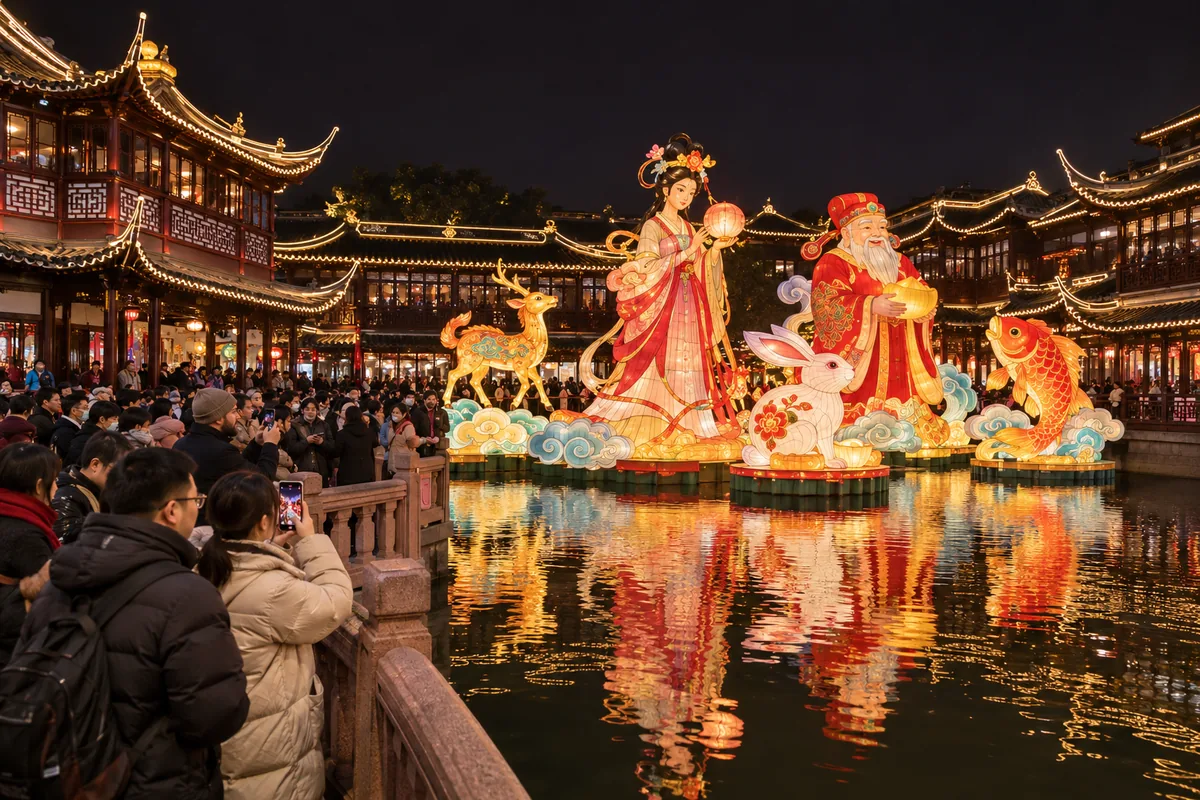
Every year around Chinese New Year the whole Yu Garden area is hung with large painted lanterns. The Yuyuan Lantern Festival has been run officially by Yuyuan Garden Malls (the bazaar's operator) since 1995, and it was added to China's national list of intangible cultural heritage in 2011.
The 2026 festival ran from 26 January to 3 March, 36 nights in total, with no lights on New Year's Eve (16 February). It was spread over six lantern zones: one ticketed folk-art lantern zone at Yu Garden, and five free zones at the BFC (Bund Finance Center), Gucheng Park, Middle Fangbang Road, Fuyou Road and the Bund. The ticketed zone cost 80 yuan for adults and 50 yuan for children in 2026, sold through the "豫园商城" (Yuyuan Garden Malls) WeChat service account and the main ticketing platforms, with entry from 16:00 to 22:00 on ordinary days and from 14:00 on Fridays to Sundays, the Spring Festival holiday and the Lantern Festival day. The city government's English site published those details in mid-January; see its 2026 Yuyuan Lantern Festival announcement for the format.
Dates, prices and zones change each year, and for the next festival, check the official announcement from around early January before you plan around it. If you are in Shanghai during the festival, two practical points. First, the free zones are worth a walk on their own if you do not want to pay or queue. Second, the evening crowds are very heavy and the police may run one-way systems (see the crowds section below), so go on a weekday evening if you can, and give yourself more time than you think. The garden itself keeps its own daytime hours and posts its schedule for the Chinese New Year period separately.
Getting to Yu Garden by metro and bus
The garden has no car park of its own and asks visitors to come by public transport. The easiest way is the metro to Yuyuan Garden station (豫园站) on Line 10 or Line 14.
Use Exit 1, Exit 4 or Exit 7: these are the exits signed for Yu Garden. Exits 1 and 4 come up at South Henan Road and Renmin Road, and Exit 7 at Renmin Road and South Sichuan Road. From there it is a short walk south into the bazaar; follow the signs for 豫园 (Yuyuan). The North Gate on Fuyou Road is the closest garden entrance from this side.
Shanghai's metro gates accept foreign bank cards tapped directly at the barrier, so you do not need to buy a ticket or set up an app first. For lines, transfers and the last trains home, see our Shanghai metro map and route planner.
the WaysChina appThe garden also lists ordinary city buses, including routes 11, 26, 64 and 926, if you are staying near one of their stops. The hop-on hop-off double-decker City Sightseeing buses stop here too: Tourist Line 1 runs between People's Square, the Bund, City God Temple/Yu Garden and Xintiandi, and Tourist Line 3 links the Bund, Yu Garden and the Oriental Pearl Tower. A one-day pass is 60 yuan and covers all the operator's lines for 24 hours after first use. You can buy it at stops along the route, in the operator's WeChat mini program, or on platforms such as Klook; a screenshot does not count as a ticket, so keep the actual QR code.
Yu Garden is close enough to the Bund to walk between them, and most people combine the two in one afternoon: garden first (before 16:00), then the riverfront for sunset and the evening lights. For the riverfront itself, the ferry and the observation decks, see our Shanghai skyline guide.
A short walk through the old city
Yu Garden sits inside Shanghai's old walled town, now called the Laochengxiang (老城厢, "old city") historic area. It is the oldest residential district in Huangpu, roughly the area inside the ring formed by Renmin Road and Zhonghua Road. That ring road traditionally marks the line of the old city wall. Yu Garden, the City God Temple, Chenxiang Pavilion, Dajing Pavilion and the surviving northern stretch of the old city wall are all inside it.
If you have half an hour after the garden, walk west along Middle Fangbang Road (方浜中路), the old main street that runs past the temple; it was one of the free lantern zones in 2026. Away from the rebuilt bazaar the lanes get quieter and more lived-in. Chenxiang Pavilion (沉香阁), a small Buddhist temple, and Dajing Pavilion (大境阁), beside the surviving stretch of the old city wall, are both a short walk from the garden; their opening hours and entry fees are posted at each gate, so check there on the day. Treat this part as an easy walk rather than a list of sights.
Avoiding the crowds
Yu Garden had more than 2.7 million visitors in 2024, close to a quarter of them from outside China, so it is rarely empty. On big holidays such as Chinese New Year and May Day, police treat the Zigzag Bridge and the square in front of it as the main pinch point and may run one-way walking routes and let people in in waves. During the 2025 Spring Festival the busiest hours were from 14:00 to 19:00.
The metro station is also managed on peak days. During the 2026 National Day holiday the Line 14 entrances at Yuyuan Garden station were closed from 16:00 each day, while Line 10 kept running. During the 2025 lantern festival, Exits 1, 4 and 7 were switched to one-way at peak times. Before a holiday visit, check the latest Shanghai police notice for station closures, because the arrangements change each time.
The simple fix is to arrive at 9:00 when the garden opens, on a Tuesday to Friday, and leave the bazaar for the evening. Just remember that "come early on a quiet weekday" does not include Monday.
Frequently asked questions
Is Yu Garden open on Mondays?
No. The garden is closed every Monday, except when the Monday is a national public holiday. The bazaar around it and the City God Temple stay open on Mondays, so you can still visit the area, just not the garden itself.
Are Yu Garden and the City God Temple the same place?
No. They are neighbours. Yu Garden is a ticketed classical garden; the City God Temple is a Taoist temple with its own entrance and hours; and the Yuyuan Bazaar is the shopping district that connects them. People often use "City God Temple" for the whole area, which adds to the confusion. Your garden ticket covers only the garden.
How long do you need at Yu Garden?
There is no official figure, and it depends on whether you walk the main loop or stop in every hall. The garden closes at 16:30 with last entry at 16:00, so arriving by 14:30 gives you about two hours inside. Leave separate time for the bazaar, the Zigzag Bridge and the City God Temple.
When is the Yuyuan Lantern Festival?
It is held around Chinese New Year. The 2026 festival ran from 26 January to 3 March. For the next edition, check the Shanghai government's English site or the Yuyuan Garden Malls account from around early January for the latest details.
Summary
Yu Garden is the main ticketed sight, a walled garden; the City God Temple sells its own ticket at its own gate, priced as posted there; and the bazaar lanes, the Zigzag Bridge and Yuyuan Old Street are open to walk freely. The lantern festival's ticketed zone is a separate charge in season. Go Tuesday to Sunday, arrive before 16:00, buy your ticket at the North or South Gate window, and leave your luggage at the hotel. Inside, find the Grand Rockery, the Exquisite Jade Rock and the Inner Garden. Take Line 10 or 14 to Yuyuan Garden station and use Exit 1, 4 or 7, then walk on to the Bund for the evening. To fit Yu Garden into a full trip, see our Shanghai travel guide and the 3-day Shanghai itinerary. If you want more classical gardens after this one, the Suzhou guide covers the best of them, an easy day trip away.
Last updated: November 2026
Fact-checked sources
- Official Shanghai Municipal Government 12 pages
- Official Yu Garden (official site) 9 pages
- Official bmy.com.cn
- Official wuhouci.net.cn
- Official tangparadise.cn
- Official drc.xizang.gov.cn
- Official hqpalaceglobal.com
- Official Shanghai City God Temple (official site)
Show 3 more sources
- Official Meet in Shanghai (Shanghai Culture and Tourism Bureau) 2 pages
- Official Shanghai Metro
- Official enghunan.gov.cn
Last verified: 2026-11-03
Read in other languages
Getting to the sights by metro
The Bund
Iconic waterfront promenade facing the Lujiazui skyline.
- East Nanjing Road
- Tiantong Road
- Yuyuan Garden
Oriental Pearl Tower
468m TV tower with glass-floor observation deck.
- Lujiazui
Shanghai Tower
China's tallest building (632m), 118F observation deck.
- Lujiazui
Yu Garden
Ming-era classical garden next to the City God Temple market.
- Yuyuan Garden
- Lujiabang Road
Shanghai Disneyland
Mainland China's first Disney resort. Take Line 11 to Disney Resort.
- Disney Resort
Nanjing Road Pedestrian Street
1km pedestrian shopping street connecting Bund and People's Square.
- East Nanjing Road
- People's Square
People's Square
Central plaza and museum hub (Shanghai Museum, Urban Planning Exhibit).
- People's Square
- Dashijie
Xintiandi
Restored shikumen block, now a wine-and-dine hotspot.
- Site of the First CPC National Congress·Xintiandi
- Site of the First CPC National Congress·South Huangpi Road
- Madang Road
Tianzifang
Shikumen alley arts district with cafes, boutiques, and galleries.
- Dapuqiao
- Madang Road
Jing'an Temple
Gold-roofed Buddhist temple in the heart of West Nanjing Rd.
- Jing'an Temple
- Changshu Road
Lujiazui
Pudong's financial district — Shanghai Tower, SWFC, Jin Mao.
- Lujiazui
Shanghai Museum
Top bronze, ceramics, and calligraphy collection. Free entry.
- People's Square
- Dashijie
Longhua Temple
Shanghai's oldest temple (242 AD); famous spring peach blossoms.
- Longhua
- Middle Longhua Road
Zhujiajiao Water Town
1700-year-old water town; take Line 17 to Zhujiajiao.
- Zhujiajiao
Shanghai Pudong International Airport
Shanghai's main international airport (PVG); also served by the 430 km/h Maglev to central Pudong.
- Pudong Airport Terminal 1&2
Shanghai Hongqiao International Airport
Shanghai's secondary airport (SHA) for domestic and short-haul international; integrated with Hongqiao Railway in one mega-hub.
- Hongqiao Airport Terminal 2
- Hongqiao Airport Terminal 1
Shanghai Hongqiao Railway Station
China's busiest high-speed rail station; integrated with Hongqiao Airport in one mega-hub.
- Hongqiao Railway
Shanghai Railway Station
Shanghai's historic main rail station (the 'New North Station'); conventional and selected high-speed services.
- Shanghai Railway
Shanghai metro: last train times by station
Every line and station, checked by hand — the same data behind our offline route planner.
Get the WaysChina App
Offline guides, currency converter, essential phrases, and more — all in your pocket.

Related Articles
3 Days in Shanghai: A Day-by-Day Itinerary by Metro, with What to Book
A 3-day Shanghai route that stays on one side of the river each day: the Bund, Lujiazui and Yu Garden, a flex third...
Shanghai Disneyland Guide: Passport Tickets, Line 11, Food Rules and Lines
Shanghai Disneyland for first-timers: buying a real-name ticket with your passport, the date price calendar, Metro...
Shanghai Travel Guide: How Many Days, What to Book Ahead, and How to Get Around
How many days Shanghai needs, the best seasons, how to get in from both airports, which sights need booking, where...
Shanghai Skyline: Free Viewpoints, Which Observation Deck, Light Times and the Ferry
Where to see the Shanghai skyline for free, which of the four Lujiazui decks to go up, when the Bund lights go off,...