
This article contains affiliate links. If you make a purchase through these links, we may earn a small commission at no extra cost to you. This helps support our work in creating free travel guides.
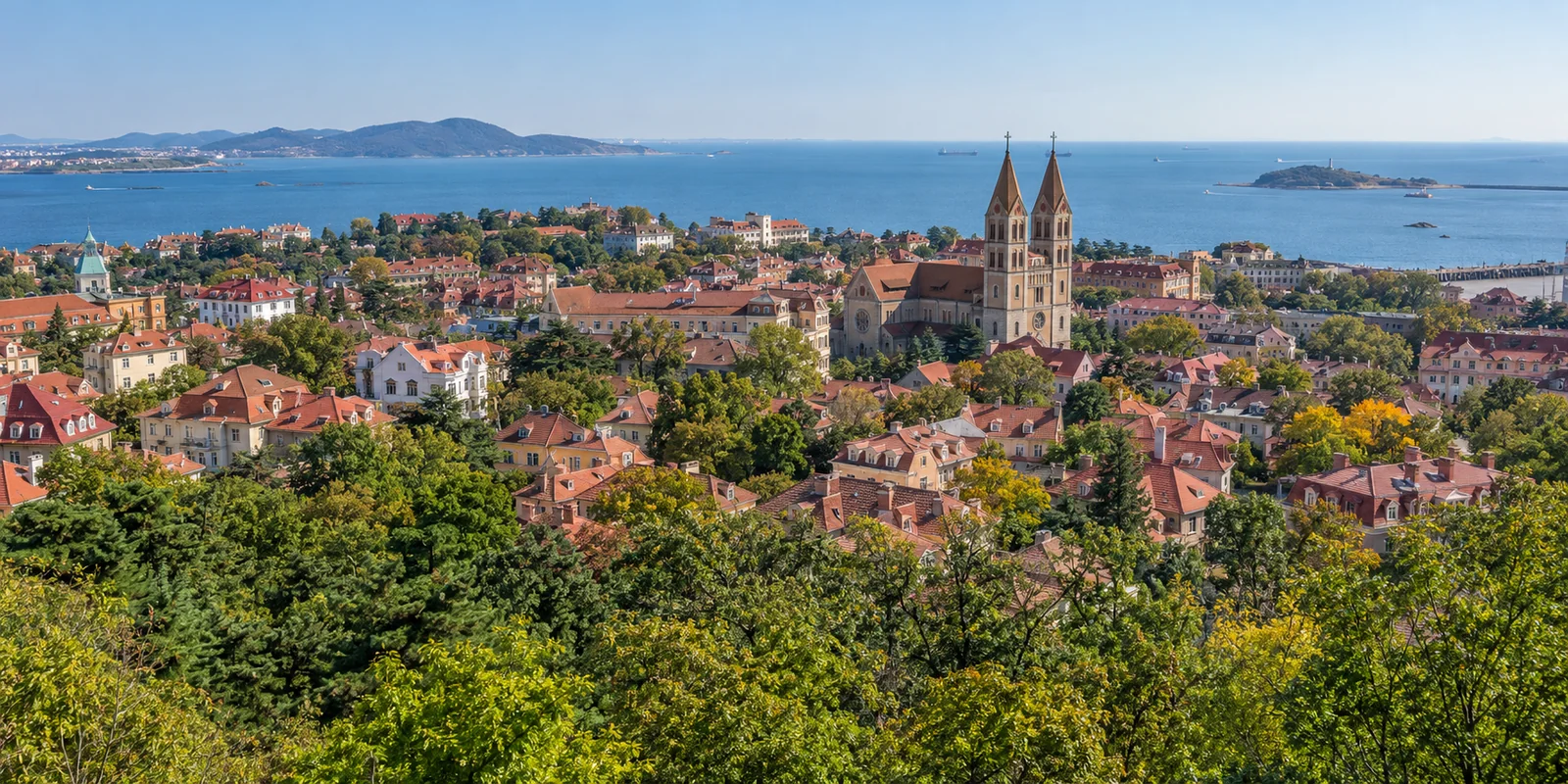
Qingdao (青岛, Qīngdǎo) is worth two full days, or three if you add Laoshan (崂山, Láoshān), the granite mountain that drops into the sea east of the city. It is a seaside city with an old town built by Germans, so your two days go to the red-roofed streets, the Tsingtao Beer Museum, the Badaguan villa district and the beaches. September is the best month: it is warm and the sea is still open for swimming, without the peak crowds of July and August. June is warm too, but only No. 1 Bathing Beach is open before 1 July, and October turns cool, which is good for walking but not for swimming. Fast trains take a little over 3 hours from Beijing and a little under 5 from Shanghai. Below: which station to book, how to reach town from the airport, what is closed right now, how Laoshan's ticket zones work, and a plan for two or three days.
How many days Qingdao needs and when to go
Two days covers the city properly: one for the old town and one for the museum, Badaguan and the seafront. The third day goes to Laoshan, because the mountain is at the far east end of the city and you cannot fit it around anything else. With only one day, stay in the old town, walk the seafront as far as Badaguan and leave the mountain for another trip.
It helps to picture the city as one long south coast. The old town and Qingdao Station are at the west end. Going east you pass the beaches and Badaguan, then May Fourth Square and the Olympic Sailing Center, then Shilaoren beach, and finally Laoshan. The airport is far to the north, and the West Coast district, with Qingdao West station and Golden Beach, is on the other side of the bay.
Here is how the year looks. The temperatures are long-term monthly averages across day and night, so afternoons feel warmer.
- September (the best time): about 22°C on average, and the sea is at its best for swimming. Typhoon season runs from July to September, so leave a spare day in your plans.
- June: about 21°C on average, and warm enough for the beach. Only No. 1 Bathing Beach is open for swimming before 1 July, and the water is cooler than in September.
- October: about 17°C on average, which is good walking weather but cool for swimming. Early October is the National Day holiday, which fills everything: on 2 October 2026 the Laoshan south and east line bookings were full by 10:30 in the morning. See our Golden Week survival guide before you book those dates.
- July and August (peak beach season): this is the warmest and wettest stretch, with August averaging about 26°C and each month getting about 159 mm of rain, far more than any other month. Beaches, hotels and the beer festival are all at their busiest. Typhoons can shut the coast too. When outer bands of Typhoon Bavi reached the city on 12 July 2026, beaches including Zhanqiao, Shilaoren and Golden Beach closed, and Laoshan stayed shut until the morning of 16 July.
- April and May: about 12°C in April and 17°C in May, cool and pleasant for walking, and too cold for most people to swim.
- November to March (quiet season): about 10°C in November, then close to freezing by January, which averages 0.2°C. The wind off the sea makes it feel colder than the number. See the winter question in the FAQ below, and our guide to winter travel in China.
For swimming, the official season is what counts. In 2026 No. 1 Bathing Beach opened from 1 June to 31 October, and all nine public bathing beaches offered swimming from 1 July; there is no official opening from November to May. If you are coming for the beach, check the dates for your year.
Getting to Qingdao: trains, flights and visas
Which railway station to book
Qingdao has several stations far apart, and your ticket names one of them. Pick the station first, then the train.
| Station | Where it is | Book it when |
|---|---|---|
| Qingdao (青岛站) | Taian Road in Shinan district, in the old town; Zhanqiao pier is a short walk away | You are sleeping in the old town and the train time is reasonable |
| Qingdao North (青岛北站) | Licang district, north of the center; Metro Lines 1, 3 and 8 stop here | You want a faster train from Beijing, Jinan or Qufu, or you are going to May Fourth Square on Line 8 |
| Hongdao (红岛站) | Hongdao Economic Zone; some trains on the Jinan line start or end here | Only when no train to the two stations above fits, because it is far from the sights |
| Qingdao West (青岛西站) | West Coast New Area | You are staying on the West Coast, or you accept a long transfer for the fastest train from Shanghai or Qufu |
12306, China's official railway booking site and app, also lists a station called Qingdao Airport (青岛机场), with about 2 trains from Beijing South on one sample travel day (12 November 2026). It is easy to confuse with the airport terminal, so check how far it is from your flight in a map app before you book it for a connection.
The table below shows trains by station on the sample day. Timetables change, so check your own date on 12306.
| Route | Trains | Departures | Fastest | Typical (median) | 2nd class (¥) |
|---|---|---|---|---|---|
| Beijing South → Qingdao | 13 (G) | 07:00–17:23 | 3 h 31 min (G71) | 4 h 51 min | 327–380 |
| Beijing South → Qingdao North | 5 (G) | 11:32–19:36 | 3 h 07 min (G71) | 3 h 34 min | 348–374 |
| Beijing South → Qingdao Airport | 2 (G) | 07:34–11:32 | 3 h 07 min (G883) | 3 h 23 min | 312–347 |
| Beijing South → Qingdao West | 1 (G) | 07:22 | 3 h 50 min (G1099) | 3 h 50 min | – |
| Qingdao → Beijing South | 12 (G) | 08:29–19:16 | 3 h 12 min (G74) | 4 h 40 min | 315–367 |
| Qingdao North → Beijing South | 5 (G) | 06:49–18:51 | 3 h 03 min (G72) | 3 h 14 min | 348–364 |
| Hongdao → Beijing South | 1 (G) | 19:08 | 3 h 10 min (G892) | 3 h 10 min | 339 |
| Shanghai Hongqiao → Qingdao | 4 (D 3 · G 1) | 14:11–16:32 | 5 h 09 min (D2162) | 6 h 07 min | 308–568 |
| Shanghai Hongqiao → Qingdao North | 4 (D 3 · G 1) | 09:04–15:32 | 4 h 45 min (D2162) | 5 h 37 min | 300–312 |
| Shanghai Hongqiao → Qingdao West | 6 (D 5 · G 1) | 06:52–15:37 | 4 h 39 min (G688) | 4 h 55 min | 272–299 |
| Shanghai → Qingdao North | 2 (G 1 · D 1) | 07:05–08:41 | 4 h 55 min (D2146) | 5 h 40 min | 298–591 |
| Qingdao → Shanghai Hongqiao | 5 (D 4 · G 1) | 06:36–15:10 | 5 h 19 min (D2164) | 6 h 04 min | 314–626 |
| Qingdao North → Shanghai Hongqiao | 8 (D 6 · G 2) | 06:52–18:19 | 4 h 54 min (D2911) | 5 h 15 min | 286–620 |
| Hongdao → Shanghai Hongqiao | 3 (D) | 08:35–16:01 | 4 h 51 min (D2125) | 5 h 51 min | 298–338 |
| Jinan → Qingdao | 25 (G 20 · D 5) | 05:48–20:35 | 2 h 09 min (G6909) | 2 h 42 min | 110–165 |
| Jinan → Qingdao North | 17 (G 14 · Z 1 · K 1 · D 1) | 01:21–20:07 | 2 h 02 min (G6935) | 2 h 35 min | 133–249 |
| Jinan East → Qingdao North | 20 (G 15 · D 5) | 07:49–21:40 | 1 h 24 min (G71) | 2 h | 109–156 |
| Jinan West → Qingdao | 12 (G 10 · D 2) | 07:13–19:15 | 2 h 06 min (G2061) | 3 h 01 min | 119–171 |
| Jinan → Hongdao | 2 (G) | 07:39–12:10 | 2 h 10 min (G3213) | 2 h 50 min | 154–240 |
| Jinan East → Hongdao | 4 (G) | 07:49–13:18 | 1 h 45 min (G6955) | 1 h 50 min | 147–264 |
| Qingdao → Jinan | 29 (G 24 · D 5) | 05:30–19:42 | 2 h 12 min (G6902) | 2 h 45 min | 134–162 |
| Qingdao North → Jinan East | 22 (G 17 · D 5) | 05:59–21:47 | 1 h 22 min (G72) | 2 h 02 min | 130–273 |
| Qufu East → Qingdao | 5 (G) | 07:17–18:06 | 3 h 15 min (G6994) | 3 h 46 min | 199–218 |
| Qufu East → Qingdao North | 10 (G) | 07:17–18:26 | 2 h 18 min (G5576) | 2 h 50 min | 160–205 |
| Qufu East → Hongdao | 5 (G) | 08:26–11:59 | 2 h 09 min (G5590) | 2 h 29 min | 151–234 |
| Qufu East → Qingdao West | 5 (G) | 08:26–18:26 | 1 h 45 min (G5590) | 2 h 04 min | 132–158 |
| Qingdao → Qufu East | 6 (G) | 07:16–18:14 | 3 h 17 min (G944) | 3 h 39 min | 193–211 |
| Qingdao North → Qufu East | 9 (G) | 07:58–18:35 | 2 h 11 min (G5571) | 2 h 36 min | 147–240 |
| Hongdao → Qufu East | 2 (G) | 14:52–16:56 | 1 h 57 min (G5589) | 2 h 24 min | 151–234 |
What this means for each starting city:
From Beijing. Beijing South is the main departure station. About 13 trains are scheduled to Qingdao station on the sample day, the fastest 3 h 31 min and the typical one 4 h 51 min, at 327–380 yuan in second class depending on the train. About 5 go to Qingdao North, the fastest 3 h 07 min, at 348–374 yuan. The gap between fastest and typical is more than an hour, so compare journey times before you click. A ticket that saves you 90 minutes is usually worth more than arriving at the closer station.
From Shanghai. From Shanghai Hongqiao, Qingdao West has the most trains, about 6 on the sample day, the fastest 4 h 39 min, at 272–299 yuan in second class. Qingdao North has about 4, the fastest 4 h 45 min, at 300–312 yuan, and Qingdao station has about 4, the fastest 5 h 09 min, at 308–568 yuan depending on the train. Qingdao North is the best all-round choice from Shanghai: it is faster than Qingdao station, it has morning trains (from 09:04, while Qingdao station's only start at 14:11), and its fares stay in a narrow range. The old town is still around Qingdao station, so from Qingdao North you finish with a metro or taxi ride. Qingdao West is quicker on paper, but it leaves you on the wrong side of the bay. On most routes G trains are the fastest high-speed trains and D trains are a step slower, but not here: G826, G986 and G988 take more than 6 h 25 min and cost 568–626 yuan, roughly double the D trains, which are quicker. Choose by journey time and price, not by the letter.
From Jinan. This is the busiest corridor. Jinan East to Qingdao North has about 20 trains on the sample day, the fastest G71 at 1 h 24 min, at 109–156 yuan in second class. Jinan station to Qingdao station has about 25 trains, the fastest 2 h 09 min, at 110–165 yuan, and Jinan West to Qingdao station has about 12, the fastest 2 h 06 min, at 119–171 yuan. Some G trains on this line take more than 3.5 hours and cost more, so sort by duration here too.
From Qufu. Use Qufu East, because Qufu station only has conventional trains. Qufu East has about 10 trains to Qingdao North, the fastest 2 h 18 min, at 160–205 yuan in second class. Trains to Qingdao station take at least 3 h 15 min, so avoid them unless nothing else fits. Qingdao West is the quickest, the fastest at 1 h 45 min, and Hongdao has about 5 trains, the fastest 2 h 09 min, but both leave you far from the old town.
To buy tickets, you need your passport details and an account on the official 12306 site or app; our train booking guide walks through it, and the high-speed train guide explains seats and stations.
Flying in: Jiaodong Airport and Metro Line 8
Qingdao Jiaodong International Airport (TAO, 胶东机场) had 210 passenger routes as of August 2026, 29 of them international or regional. Korea has the most flights listed, with routes to Seoul, Busan, Daegu, Cheongju and Jeju, averaging 41 a day in the winter schedule. Southeast Asia has seven destinations including Bangkok, Singapore and Kuala Lumpur, and the Vancouver route resumed on 2 October 2026 as Shandong's only direct passenger flight to North America. For flights to Japan, check your airline's current schedule.
Getting to town is simple now. Metro Line 8 opened in full on 22 September 2026, so you ride from the airport through Qingdao North to May Fourth Square without changing trains, in about 40 minutes on the fastest service. Express trains only run early in the morning and late in the evening, so daytime regular trains take longer; check the Qingdao Metro app for times. Older guides that tell you to change at Qingdao North are out of date. Regular Line 8 trains into the city leave Jiaozhou North, the far end of the line, from 05:45 to 22:00, so they reach the airport a little later, and five late express trains leave the airport between 21:42 and 23:15. Going back, regular trains leave May Fourth Square from 06:10 to 22:15, and the early express trains leave at 05:07, 05:22 and 05:42, which helps with a morning flight. For the old town, get off at May Fourth Square or at Qingdao North and use your map app to choose the next line or a taxi.
If you land after the last train, ask the arrivals information desk about airport buses, or take a taxi from the official rank.
Visas: 30-day visa-free entry and the 240-hour transit rule
Many visitors need no visa for a short trip. China's unilateral visa-free policy lets citizens of 50 countries, including Japan, South Korea, the UK, Canada and Australia, stay up to 30 days. For 48 of those countries it is set to run until 31 December 2026, so confirm the current end date if you travel after that. The United States is not on that list, so US citizens need a visa or the 240-hour rule below. Our guide to whether you need a visa for China covers this in full.
If your country is not on that list, 240-hour visa-free transit may work. Qingdao has two entry points for it: Jiaodong Airport and the Qingdao passenger seaport. Citizens of the 57 eligible countries need a confirmed onward ticket to a third country or region, not back to where they came from. You can travel between the 24 permitted provinces during your stay, and Shandong is one of them. The 240 hours are counted from 00:00 on the day after you arrive. The details and traps are in our 240-hour transit guide.
The old town: German buildings and the Beer Museum
The old town is the reason Qingdao looks unlike other Chinese cities. Germany held the area in the early 1900s, and the red tile roofs, stone churches and villas date from that time. The Shinan district tourism bureau's classic walk runs from Zhanqiao along Zhongshan Road (中山路) to Anna Villa, St Michael's Cathedral, Taixingli (太兴里) and Picaiyuan (劈柴院). It is the right order, and it takes half a day at an easy pace with stops. Taixingli and Picaiyuan are old courtyard-style blocks, and Picaiyuan is now a tourist food lane.
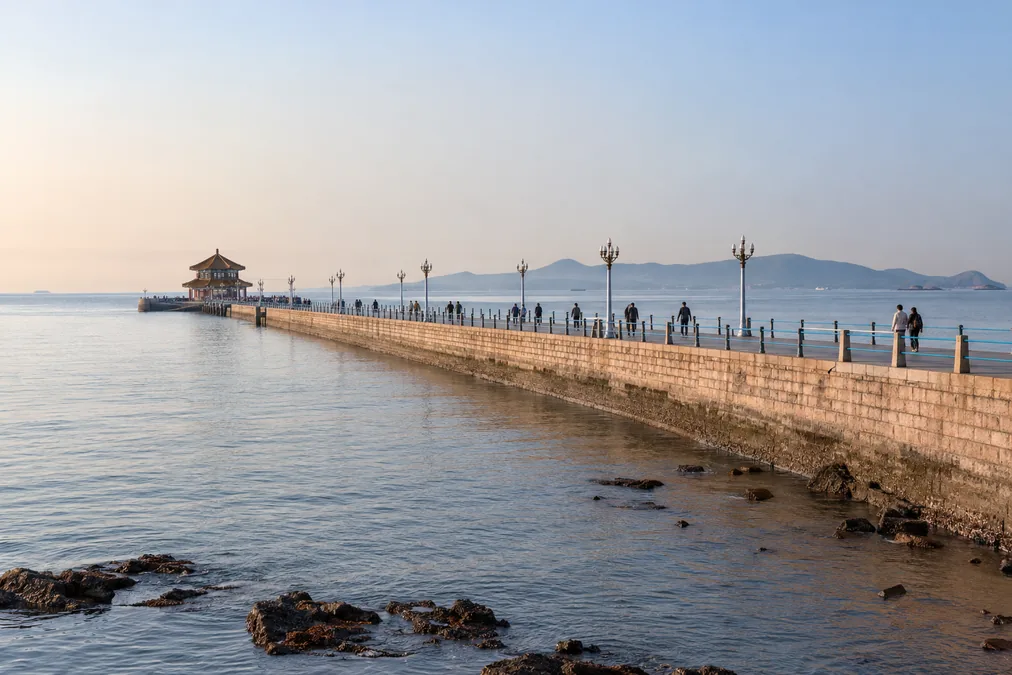
Zhanqiao pier (栈桥, Zhànqiáo). This is Qingdao's oldest pier, first built in 1892 and 440 meters long, with the Huilan Pavilion (回澜阁) on the breakwater at its south end. As of November 2026 the pavilion and the area around it have been closed for restoration since 13 October, with the work expected to finish in mid-December. Read the city notice and check whether it has reopened before you go. Until then you can still see the pier from the seafront, and how far you can walk along it depends on where the fencing stands on the day.
Former German Governor's Residence Museum (青岛德国总督楼旧址博物馆). This is the best German building to go inside. It was built from 1905 to 1907, mixing German Wilhelmine style with Jugendstil (the German form of art nouveau), and it is a national protected monument. It stands at 26 Longshan Road. The city's 2024 listing gives April to October 9:00–17:00 at 20 yuan and November to March 9:00–16:30 at 13 yuan, closed Mondays except on public holidays. Those prices are from 2024, so check the museum's WeChat account or ask your hotel to call +86 532 8286 8838 for you before you plan around them.
Tsingtao Beer Museum (青岛啤酒博物馆). The brewery was founded in the German period, and this is the museum most visitors enjoy, even those who are not beer drinkers. You must book a timed slot online: tickets are sold in time slots with real-name entry, and once a slot is full there are no tickets at the door. Foreign visitors can use WeChat to follow the museum's service account "青岛啤酒博物馆" and choose Ticketing under the ticket guide (购票指南), which accepts Visa, Mastercard, JCB and American Express; bring the original passport you booked with. From 1 April to 31 October the standard ticket is 60 yuan for adults, and it covers halls A and B, two small glasses of beer (0.15 liters each, one unfiltered and one draft) and a bag of beer nuts. For November to March, check the ticket page for the current price.
In the same April to October period, visitors aged 60 to 69 pay half (30 yuan), and full-time students aged 23 or under pay 50 yuan. Visitors aged 70 and over enter free, and so do children 1.4 meters or shorter when with an adult. The museum's rules do not say whether the senior discounts cover foreign visitors, so confirm when you book.
Museum hours depend on the season, and the last entry is what matters. From November to April it opens 8:30–17:30 with last entry at 16:30, in May, June, September and October 8:00–18:30 with last entry at 17:30, and in July and August 7:30–19:30 with last entry at 18:30. Check the museum's ticket page before you book.
| Sight | Ticket | Hours |
|---|---|---|
| Former German Governor’s Residence Museum | Apr–Oct: ¥20 / Nov–Mar: ¥13 | 09:00–17:00 (Apr–Oct) / 09:00–16:30 (Nov–Mar) · closed Mondays (open on public holidays) |
| Tsingtao Beer Museum | Apr 1–Oct 31: adult ¥60, students ¥50, seniors ¥30 · covers halls A and B, two 0.15 L glasses of beer (one unfiltered, one draft) and a bag of beer nuts · other tickets: four halls ¥120 (adult), three halls ¥100 | 08:30–17:30 (Nov–Apr), last entry 16:30 / 08:00–18:30 (May–Jun, Sep–Oct), last entry 17:30 / 07:30–19:30 (Jul–Aug), last entry 18:30 |
St Michael's Cathedral (圣弥厄尔大教堂) and the Protestant Church (基督教堂). The twin-spired Catholic cathedral is the old town's main landmark, and the square in front of it is a popular photo spot. The Protestant Church is a short walk from Signal Hill. The outsides are free to look at from the street. For going inside, ticket prices and opening times are posted on site, so check on the day and avoid Sunday mornings, when services may be held.
Signal Hill (信号山). A small hill with a rotating viewing platform at the top, it gives you the classic view over the red roofs of the old town. Check the entry fee and closing time at the gate. Go late in the afternoon if you can, when the light on the roofs is best.
Little Qingdao (小青岛) and Xiaoyushan (小鱼山). Little Qingdao is a small island park at 2 Qinyu Road, and Xiaoyushan is a hilltop park. City notices from a few years ago list both as free to enter, so confirm at the gate. Both are good short stops if you have an extra hour, and Xiaoyushan gives a second view of the roofs and the sea.
The seafront: Badaguan, the beaches and the Sailing Center
East of the old town the coast runs past the beaches and Badaguan to May Fourth Square. That is too far to walk in one go. Walk from Zhanqiao to the first beach and on through Badaguan if you like walking, then take the metro or a taxi to May Fourth Square.
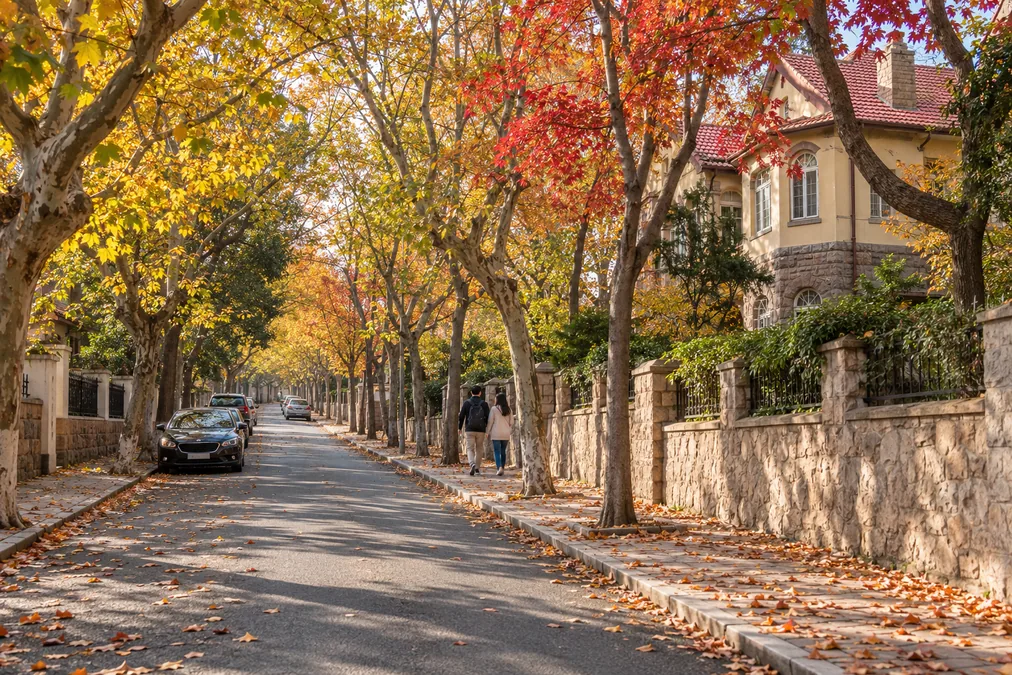
Badaguan (八大关, Bādàguān, "Eight Great Passes"). This is a garden district of villas from the 1930s on the south side of Taiping Hill, between Taiping Cape and Huiquan Cape. It covers 66.6 hectares and has more than 300 buildings in the styles of dozens of countries, and it takes its name from eight streets named after ancient mountain passes. You walk it as an ordinary neighborhood of tree-lined streets, so plan on one to two hours and no fixed route. Some individual villas open as attractions and may charge, which you can check at the door. Autumn is the best time, when the street trees change color.
The beaches. Nine public bathing beaches are open for swimming from 1 July: No. 1, No. 2 and No. 3 Bathing Beaches, Zhanqiao, Shilaoren (石老人), Golden Beach (金沙滩), Silver Beach (银沙滩), Lingshan Bay and Yangkou. No. 1 Bathing Beach is the easy choice from the old town, and it is also the most crowded. Shilaoren, further east, suits you if you are staying in the newer part of the city. Golden Beach is on the West Coast, so treat it as a half-day trip across the bay.
The flag system is simple: green means safe to swim, yellow means take care and red means stay out of the water. Swim only during the open season and inside the marked swimming zone, stay out when the beach is closed, and never swim after drinking. Daily opening hours vary by beach, so check the board at the entrance. Jellyfish can drift in during warm months, so look for posted notices and ask the lifeguards on the day.
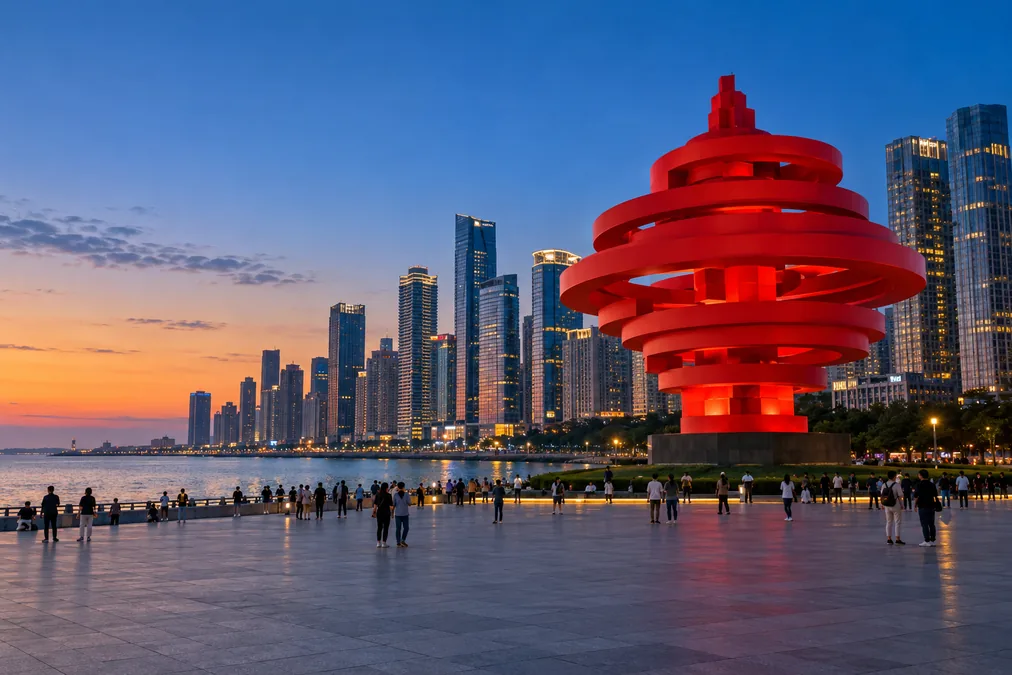
May Fourth Square (五四广场) and the Olympic Sailing Center (奥帆中心). May Fourth Square was built in 1996, covers 10 hectares and commemorates the May Fourth Movement, the student protests of 1919; the big red spiral sculpture there is the photo everyone takes. The Olympic Sailing Center is just across the water on Fushan Bay, a 45-hectare site that hosted the sailing events of the 2008 Olympics. Both are open waterfront spaces, and the evening is the best time to come. The Fushan Bay light show runs on weekend and holiday evenings; check this year's schedule.
Laoshan: tickets, zones and how to spend a day
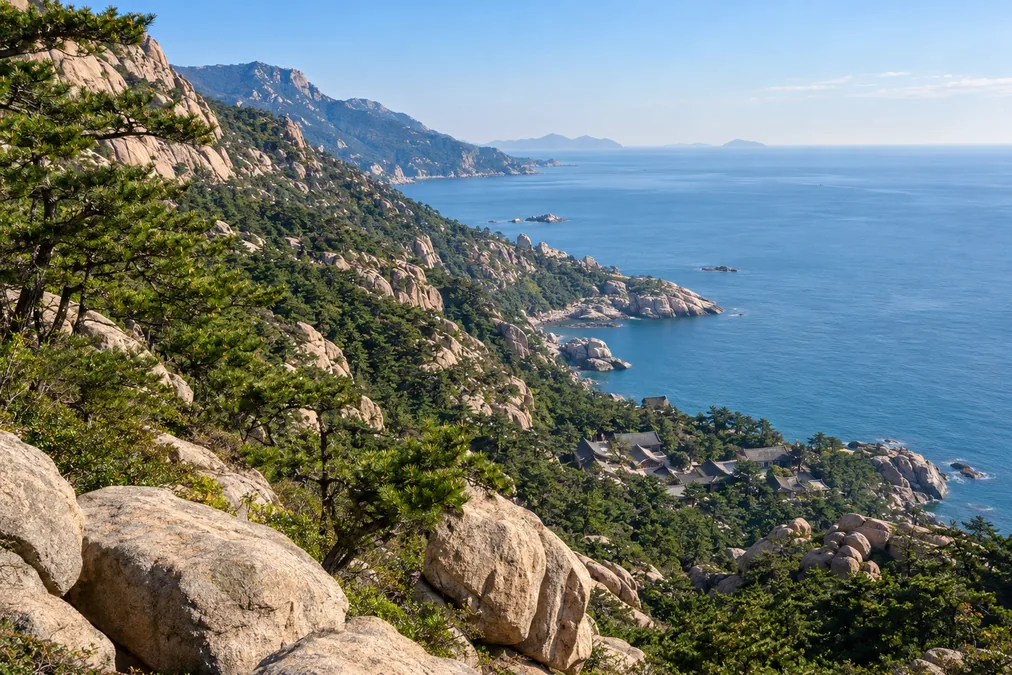
Laoshan takes more planning than anything else in Qingdao. It is a large mountain area with six official zones, separate tickets and a booking system with daily limits, and the official advice is at least three days to see it all. You have one day, so choose one part.
Pick your zone
The six zones are Taiqing, Jufeng, Huayan, Yangkou, Jiushui and Hualou. The official suggestions for one day are:
- Taoist temple and seaside village: Taiqing (太清), on the south line. This is the best choice for a first visit, and the ticket is South line without Jufeng.
- A real hike: Jufeng (巨峰), the summit area, also on the south line. Buy Jufeng only, or South line including Jufeng if you also want Taiqing.
- Families, and a cable car with sea views: Yangkou (仰口) and Huayan (华严), which you reach on the east line. The ticket is still South line without Jufeng, because these two zones have no ticket of their own.
- Quiet valleys and streams: Jiushui (九水) and Hualou (华楼), on the north line, with the Jiushui ticket.
What is closed right now
The Jufeng and Yangkou cableways normally run 8:30–17:00, and you pay for them separately from the entry ticket. Check the price at the cableway ticket office.
Ticket prices
Use the current list, published in June 2026; older prices still circulating online are wrong. Peak season now runs from 1 April to 31 December, and only January to March is low season. The prices below are a gate ticket plus a sightseeing bus ticket, and the bus is how you move between sights inside the area.
- South line including Jufeng (南线含巨峰): covers Jufeng, Taiqing, Huayan and Yangkou. 90 yuan gate in peak season (60 in low season) plus 60 yuan bus, valid two days.
- South line without Jufeng (南线不含巨峰): covers Taiqing, Huayan and Yangkou. 90 yuan gate (60 low) plus 40 yuan bus, valid two days.
- Jufeng only (巨峰): 80 yuan gate (50 low) plus 40 yuan bus, valid that day.
- Jiushui (九水): covers Jiushui and Hualou. 60 yuan gate (40 low) plus 30 yuan bus, valid that day.
- All-in-one ticket (一票制): covers all six zones. 140 yuan gate (90 low) plus 70 yuan bus, valid three days, which only makes sense if you are coming back.
Taiqing Palace (太清宫), the main Taoist temple, costs another 27 yuan, which you buy at the palace itself. Hualou alone is 10 yuan if you do not hold a Jiushui ticket.
The name South line (南线) confuses people going to Yangkou, because you arrive from the east. If you buy at the Yangkou ticket point, still ask for 南线不含巨峰. Since you reach Yangkou by public bus, confirm at the window whether you need the sightseeing bus part of the ticket.
Discounts apply to visitors too. People aged 60 and over enter free with valid ID and pay half for the bus; ages 7 to 18 and full-time students pay half the gate price and full bus fare; children 6 and under, or 1.4 meters and under, pay nothing. The scenic area's English site lists a passport as valid ID for these.
| Ticket | Covers | Gate: peak Apr–Dec / low Jan–Mar | Sightseeing bus | Valid |
|---|---|---|---|---|
| South line including Jufeng (南线含巨峰) | Jufeng, Taiqing, Huayan, Yangkou | ¥90 / ¥60 | ¥60 | 2 days |
| South line without Jufeng (南线不含巨峰) | Taiqing, Huayan, Yangkou | ¥90 / ¥60 | ¥40 | 2 days |
| Jufeng only (巨峰) | Jufeng | ¥80 / ¥50 | ¥40 | same day |
| Jiushui (九水) | Jiushui, Hualou | ¥60 / ¥40 | ¥30 | same day |
| All-in-one ticket (一票制) | Jufeng, Taiqing, Huayan, Yangkou, Jiushui, Hualou | ¥140 / ¥90 | ¥70 | 3 days |
How to book with a foreign passport
Laoshan uses real-name online booking, opening 7 days ahead, with a daily limit for each zone. You can book on the WeChat accounts "崂山风景区" and "青岛崂山风景名胜区", or on Ctrip (携程), Meituan and Douyin.
The difficulty for foreign visitors is that the WeChat booking form asks for a Chinese ID number, and the official pages do not say whether a passport works online. So try this order:
- Ask your hotel front desk whether they can book it for you.
- Try a travel agency app, and confirm that it accepts passport details.
- If you are going to Yangkou, use the ticket kiosk there, which was reported to take passports and several languages, but confirm that it is working first. Other zones may not have one.
On a day when the south and east lines are full, the scenic area points people to the north line, Jiushui and Hualou. The Laoshan service line is +86 532 96616 if you need to confirm anything, and 12345 takes price complaints. If all this feels like too much, a guided day tour is the other way in: search for Laoshan on Klook and check that entry tickets are included.
Getting there and timing your day
All three lines start with public transport, then a scenic bus or local bus:
- South line (Taiqing, Jufeng): Metro Line 4 to Dahedong (大河东) station, Exit A, then the scenic sightseeing bus.
- North line (Jiushui, Hualou): the Blue Valley Express line (蓝谷快线) to Beijiushui (北九水) station, Exit B, then the sightseeing bus.
- East line (Yangkou, Huayan): the Blue Valley Express line to Puli (浦里) station, Exit A, then bus 620 or 926 to Yangkou.
Give it about an hour or more each way from the old town, and confirm the time in your map app. A taxi saves changes but not much time at busy hours.
Start early, because the cut-offs come sooner than you expect. The scenic area is open 7:00–17:30 according to an October 2026 city tourism guide, and ticket sales end at 15:30; its English site gives 7:00–17:00 in winter, so from November plan to be out by 17:00 and confirm on the day. Sightseeing buses stop leaving Dahedong for Jufeng at 14:30 and for Taiqing at 15:30, and stop leaving Taiqing Square for Yangkou at 15:00. Aim to be at the Dahedong bus stop by 9:00.
The rules are strict: no entry at night, no camping or open fires, no swimming and no pets. Bring water and shoes with grip, because the granite steps get slippery in the wet.
The Qingdao International Beer Festival
The 36th festival ran from 17 July to 15 August 2026, for 30 days, across three sites: the Golden Beach Beer City on the West Coast, the Century Square Beer City in Laoshan district, and the old town around Shangjieli and Dabaodao. Entry to all three sites was free, and you pay for what you drink and eat inside. Dates for the 37th festival in 2027 had not been announced as of November 2026, so expect a similar midsummer period and check official city news before you book flights.
The West Coast site is the big one, with 7.18 million visits and more than 3,040 metric tons of beer in 2026. It is also a long way from the old town, across the bay. If you only want a taste of it, the old town site is the easy option from a hotel there. Hotels fill up during the festival, so book your room early. If you miss the festival, the festival calendar lists other events around China, and the Beer Museum is open all year.
What to eat in Qingdao
Come for the seafood and the local beer. These are the things to try.
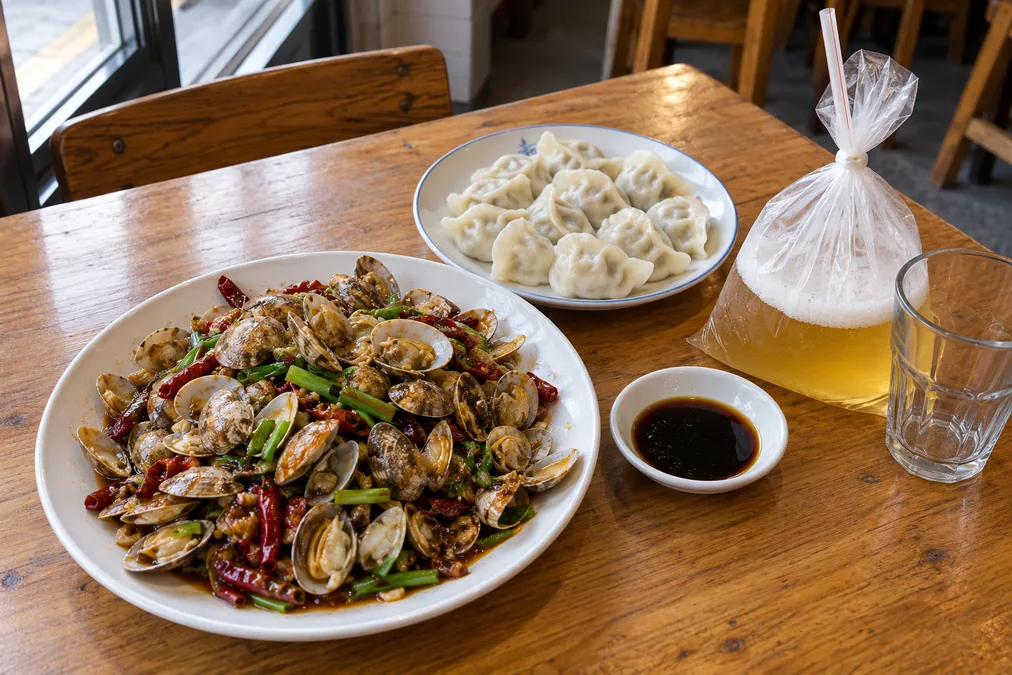
- Spicy stir-fried clams (辣炒蛤蜊, là chǎo gé lí): the city's everyday dish, small clams fried hot with chili and served in a big pile with cold beer.
- Mackerel dumplings (鲅鱼水饺, bà yú shuǐ jiǎo): boiled dumplings stuffed with Spanish mackerel. They are soft and light, and a good option if you do not want to pick through shells.
- Bagged beer (袋装啤酒, dài zhuāng pí jiǔ): fresh draft beer poured from a tap at the corner shop into a plastic bag, which you carry off and drink through a straw or pour into a cup. Try it once, mostly for the fun of it.
- Whole seafood: crab, prawns, scallops and sea snails, usually picked from a tank and cooked to order.
Seafood prices are where visitors get caught out, so do three things before anything is cooked. Ask the price per jin (斤, 500 grams), have the staff weigh your seafood in front of you, and confirm the cooking charge. Qingdao's market regulator told restaurants in September 2023 that seasonal seafood such as crab and sea cucumber must show a price and unit of measure, that vague "seasonal price" (时令价) labels are not allowed, and that no extra or unlisted charges can be added. National rules say the same: no charging above the marked price and no unlisted fees. If a menu has no prices, walk out and find another restaurant. Avoid anyone on the street who offers to take you to a cheap seafood place, a trick covered in our guide to tourist scams.
If you do get overcharged, keep the receipt and take photos of the menu and the bill. For non-emergency disputes and travel complaints, call 12345, the local government service line. The market regulator's complaint channel is 12315. Ask your hotel to help with the call if you need Chinese. For ordering help, see how to order food with zero Chinese.
Getting around Qingdao: metro, taxis and payment
After Line 8 opened in full, the Qingdao metro has 8 lines, 176 stations and 365 km of track, which makes it the backbone for most of your trip. In the old town you walk. Between the old town, May Fourth Square and Qingdao North, use the metro or a taxi.
The simplest way to pay is to link a foreign card to Alipay before you travel, using our Alipay guide, then scan to buy tickets at the machines. WeChat Pay works the same way, and the machines have an English screen. Choose your destination and the machine shows the fare before you pay.
Your other options:
- Ride code: the Qingdao Metro app has a ride code, a QR code you scan at the gate instead of buying a ticket, which works through WeChat, Alipay and UnionPay.
- Foreign card: a 2025 guide says eight transport hubs, including the airport, Qingdao Station and Qingdao North, plus stations such as May Fourth Square and Taidong, have card machines that take Visa, Mastercard and JCB for tickets and top-ups; confirm at the station.
- Tapping a foreign card at the gate: there is no official statement that this works here, so do not count on it, and check at the service counter if you want to try.
A one-day pass is 15 yuan and a three-day pass is 35 yuan, according to the same 2025 guide, so check at the service counter. Passes only pay off if you take several long rides, such as a Laoshan day. For how metros work in China in general, see our metro guide.
For taxis, DiDi is the easiest way, because the app shows the destination to the driver and you pay through it. Our guide to taxis and ride-hailing has the details. Hills and one-way streets in the old town mean a short ride can take longer than it looks on the map.
For everything else, mobile payment works almost everywhere. Foreign cards work at a smaller group of larger businesses: the central bank's Qingdao branch counted more than 5,300 key merchants accepting them as of October 2025, along with more than 1,000 currency exchange points. Carry a little cash for small shops and market stalls.
A 2-day or 3-day Qingdao itinerary
Book two things first: the Beer Museum slot and, if you are going, your Laoshan ticket. Everything else falls around them.
Day 1: the old town
In the morning, walk from the Zhanqiao seafront along Zhongshan Road to St Michael's Cathedral and on to Taixingli and Picaiyuan for lunch. After lunch, visit the Governor's Residence (not on a Monday, unless it is a public holiday) and walk up Signal Hill for the view of the roofs in the late afternoon. Have seafood for dinner, and agree the price first.
Day 2: the Beer Museum and the seafront
Take a morning slot at the Beer Museum, which needs about two hours. Then take a taxi to Badaguan and walk its streets down to the beach. Swim at No. 1 Bathing Beach in season, or walk the shore in cooler months. Finish at May Fourth Square and the Olympic Sailing Center at dusk. If you are flying out, Line 8 runs straight from May Fourth Square to the airport.
Day 3: Laoshan
Take Metro Line 4 to Dahedong early and spend the day on the south line with Taiqing Palace, or choose another zone from the list above. Be back at a bus stop well before the last services. If it rains hard or the wind is strong, swap this day with Day 2, because the mountain can close at short notice.
Connecting to Mount Tai and Qufu
Qingdao fits well at the end of a Shandong trip. A good order is Beijing, Tai'an for Mount Tai, Qufu for Confucius's hometown, then Qingdao, and on to Shanghai. Tai'an to Qufu East takes as little as 18 minutes on about 26 G trains on the sample day. Qufu East to Qingdao North takes from 2 h 18 min. Qingdao North to Shanghai Hongqiao has about 8 trains, the fastest 4 h 54 min. Our Mount Tai and Qufu guide covers that part of the route. For the two big cities at either end, see the Beijing guide and the Shanghai guide. If you would rather book these legs in English with a foreign card, an agency such as Trip.com sells the same train tickets as 12306.
Where to stay
- The old town, near Qingdao Station and Zhongshan Road: best for a first visit and two days. You can walk to the pier, the cathedral and Signal Hill. Rooms and streets are older.
- Around May Fourth Square: best if you want a modern hotel, a Line 8 ride to the airport and the evening waterfront. You will need the metro or a taxi to reach the old town.
- Shilaoren and the east coast: best for a beach stay and for getting to Laoshan earlier. It is far from the old town, so it suits a longer trip.
Compare rooms on Booking.com and book early for July, August and the National Day holiday. At a hotel, registering as a foreign guest happens at the front desk with your passport. Our guide to hotel booking and registration rules explains what to do if a hotel turns you away. The guide to types of accommodation in China helps if you are choosing between a hotel and an apartment.
Qingdao FAQ
Should I go to Qingdao Station or Qingdao North?
Choose Qingdao Station if you are staying in the old town, because Zhanqiao pier is a short walk from it. Choose Qingdao North if it gives you a much faster train, or if you are staying around May Fourth Square, because Line 8 runs straight there. From Qufu East the difference is about an hour: the fastest train takes 2 h 18 min to Qingdao North and 3 h 15 min to Qingdao station. Your ticket shows the exact station, so check it again before you take a taxi on departure day.
Is Qingdao worth visiting in winter?
Yes, for a short trip if you like quiet cities and old buildings, but not if you are coming for the beach. January averages 0.2°C and December 2.7°C, and the sea wind makes it feel colder. There is no official swimming season from November to May, though you can still walk on the sand. The old town, the Beer Museum and hot seafood all still work. The museum's last entry is 16:30 from November to April. Laoshan is cheaper from January to March, with the south line gate ticket at 60 yuan instead of 90. Pack for wind, and see our guide to clothing by season.
How do I buy Laoshan tickets, and is one day enough?
Tickets go on sale online 7 days ahead and each zone has a daily limit, so book early. Ask your hotel to book first, then try a travel agency app, because the WeChat form asks for a Chinese ID number. Choose your ticket by zone: South line without Jufeng for Taiqing, Huayan and Yangkou; add Jufeng for the summit; Jiushui for Jiushui and Hualou. Pay for Taiqing Palace separately at the palace. One day is enough for one zone or two nearby ones, but not for the whole mountain, which the official advice puts at three days or more.
When is the Qingdao Beer Festival?
The 2026 festival ran from 17 July to 15 August at three free-entry sites. Dates for 2027 had not been published as of November 2026, so check official city news in early summer.
In short: give Qingdao two days, or three with Laoshan, and aim for September, with June or October as good alternatives if swimming matters less. Book your train by station, not by the letter on the train, and take Line 8 from the airport. Reserve the Beer Museum and Laoshan before you arrive, and check whether Huilan Pavilion and the Taiqing cableway have reopened. Then pick your hotel, starting with the old town if this is your first visit.
Last updated: November 2026
Fact-checked sources
- Official China Railway 12306 5 pages
- Official data.jma.go.jp 2 pages
- Official whlyj.qingdao.gov.cn 13 pages
- Official qdlaoshan.cn 11 pages
- Official qingdao.gov.cn 6 pages
- Official m.guanhai.com.cn 2 pages
- news.qingdaonews.com
- Official gzw.qingdao.gov.cn
Show 18 more sources
- 163.com
- Official China Visa Application Service Center
- Official Chinese embassies and consulates 2 pages
- Official Ministry of Foreign Affairs 2 pages
- Official National Immigration Administration 3 pages
- Official tsingtaomuseum.com 2 pages
- Official qdtb.qingdao.gov.cn 2 pages
- qing5.com
- Official qdjt.qingdao.gov.cn
- Xinhua News
- Official amr.qingdao.gov.cn
- Official Chinese central government (gov.cn) 2 pages
- Official Beijing Municipal Government 2 pages
- Official zwgk.mct.gov.cn
- Official samr.gov.cn
- Official site.qd-metro.com
- China Services Info (China Daily)
- regional.chinadaily.com.cn
Last verified: 2026-11-01
Read in other languages
Last train times for 10 Chinese metro systems
Every line and station, checked by hand — the same data behind our offline route planner.
Get the WaysChina App
Offline guides, currency converter, essential phrases, and more — all in your pocket.

Related Articles

Quanzhou Travel Guide: World Heritage Temples, Day Trip from Xiamen and What to Eat
One or two days in Quanzhou: which of its three stations to book from Xiamen, what the 22 World Heritage sites are,...

Huangshan Travel Guide: Getting There, Tickets, Cable Cars and the Summit
How to reach Huangshan by high-speed train, book the 3-day mountain ticket with a passport, pick a cable car route,...
Xiamen Travel Guide: Gulangyu Ferry, How Many Days, Getting There and Fujian Day Trips
Two to three days in Xiamen: which pier and route to use for the real-name Gulangyu ferry, Xiamen North vs Xiamen...

Mount Tai and Qufu Travel Guide: How to Plan 2–3 Days, with Jinan
How to plan Mount Tai and Qufu in two or three days: stations, hiking routes, tickets, cable cars, sunrise, the...