

The hour between the plane door and the arrivals hall follows the same script at every Chinese airport: arrival card, immigration counter, baggage, customs channel. None of it is hard, and most of it can be prepared before you board — the arrival card, the step travelers stress over most, has been fillable online since late 2025. Here's the walk-through, in the order you'll actually experience it, plus what not to have in your suitcase when you reach the last step.

The arrival card: fill it before you fly
Every foreign visitor files an arrival card, and the modern way is to do it before the trip. Since November 2025, you can complete it online through the National Immigration Administration's website, the "NIA 12367" app, WeChat or Alipay mini-programs, or by scanning the filling code — the official form lives at s.nia.gov.cn/ArrivalCardFillingPC and filing is completely free. That "free" matters: fake lookalike sites exist that charge for the same form, so type the address from an official source rather than clicking an ad (the rollout was announced by Chinese missions abroad — official notice, in Chinese).
Didn't get to it before landing? No real penalty — you'll find QR codes to scan and smart kiosks in the immigration hall, and paper cards still exist as the final fallback. Made a mistake in the online form? File it again through the same channel — it's the submission that reaches the border system that counts, and the airport kiosks let you redo it on the spot.
A few categories skip the card entirely — among them holders of Chinese permanent residence, group-visa entries, cruise passengers returning with their ship, and transit passengers staying inside the port area under 24 hours. If you're a regular tourist, assume you're filing.
At the immigration counter
Queues split into foreigner and Chinese-passport lanes — follow the overhead signs, and if you're entering under the 240-hour transit policy, look for its dedicated lane. At the counter: passport, a glance at your arrival card record, usually fingerprints — Chinese law provides for collecting biometric data from entry-exit travelers — and sometimes a few questions. The questions are what they look like: where are you coming from, why are you here, where will you stay. Officers verify that your story matches your entry basis and can turn away travelers whose stated purpose doesn't fit, so the official advice is to keep supporting material — hotel bookings, return flight, an invitation if you have one — easy to pull up. Answer plainly; this is pattern-matching, not an interrogation.
One obligation starts ticking as soon as you're through: where you sleep gets registered. Hotels do it automatically at check-in, but if you're staying in a private home or rental, you or your host must register with the local police station within 24 hours.
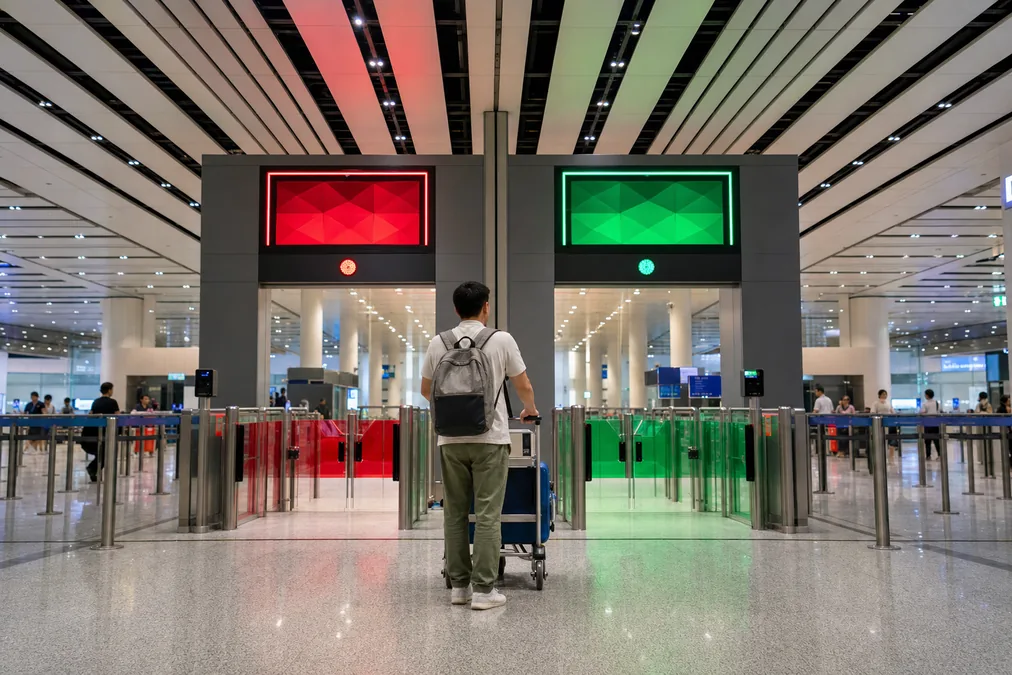
Customs: picking the right channel
After baggage claim comes the channel choice: green for nothing to declare, red if you're carrying anything that needs declaring. Two rules cover most tourists. Health first: the health declaration form was scrapped back in 2023 — you only approach customs health staff if you actually have symptoms of infectious illness, like fever or vomiting, or a diagnosed condition. Money second, and the two rules work differently: the yuan you may carry across the border is capped at 20,000 per person per crossing, while foreign cash is allowed in but has to be declared in writing at the red channel once it is worth more than 5,000 US dollars — the pair most likely to catch out cash-heavy travelers. Duty-free allowances for alcohol and tobacco exist too; the current numbers are posted at the channel entrance, so check the signage if you're carrying either in quantity.
What not to have in the suitcase
China's prohibited-items list for animal and plant products is stricter than most arrivals expect, and it's where well-meaning gifts get confiscated:
- Meat in any form — raw, cooked, cured, vacuum-packed, including organ products. The salami and jerky in your bag count.
- Fresh fruit and vegetables — the apple from the plane included.
- Dairy and eggs — milk products of animal origin and egg products.
- Living things and what grows them — cut flowers, seeds and seedlings, soil. Pets are the one exception: one dog or cat per person, with quarantine certificate and vaccination proof.
Prescription medication is a different category: medicines for your own use, in reasonable quantities, are everyday luggage — keep them in original packaging, bring the prescription or a doctor's note for anything unusual, and declare at the red channel if you're carrying large amounts or anything containing controlled substances. When in doubt, declaring costs minutes; not declaring can cost the medication. Drones and professional camera gear sit in a regulatory gray zone that shifts — check current rules for your destination city before packing one.
Through the doors: your first hour
Once you're out, three errands set up the whole trip: connectivity, money, transport. Sort a local eSIM or SIM with our SIM and eSIM guide, decide how much paper money you actually need with the cash question, and get mobile payments working with the Alipay setup guide. And one clock worth knowing about: if you entered under a visa-free policy, your stay is counted from midnight after your arrival day — the arrival evening is free.
Frequently Asked Questions
Can I fill in the arrival card online before my trip?
Yes — that's now the intended way. The online form opened in November 2025 and takes submissions before you travel, through the immigration administration's website, its 12367 app, or WeChat and Alipay mini-programs. Use the official site and pay nothing: filing is free, and any site charging a fee for the arrival card is an imitation.
I'm only transiting — do I still clear immigration and file the card?
If you stay airside and fly on within 24 hours, no visa is needed whatever your nationality, and that kind of direct transit is among the arrival-card exemptions. At a growing set of major airports, direct transit within 24 hours skips border-check formalities entirely. The moment you want to leave the airport, it becomes a real entry: under the 240-hour transit policy you'll clear immigration and fill in a temporary entry card at the border — the full rules are in our transit guide.
Do I need to declare prescription medicine?
Personal-use quantities in original packaging are normally carried through the green channel without ceremony. Declare at the red channel when something about your supply invites questions: large quantities, injectables, or anything containing controlled substances — and carry the prescription or a doctor's letter so the answer to any question is in your hand. For a specific medication you're unsure about, ask the airline or a Chinese consulate before flying rather than gambling at the channel.
Is a health declaration still required?
Not by default — the blanket health declaration was abolished in November 2023. The remaining duty is symptom-based: if you arrive with signs of infectious illness such as fever, cough, vomiting or rash, or a diagnosed infectious disease, you must proactively declare to customs health staff and cooperate with quarantine checks. Healthy travelers just walk through.
The landing checklist
- Arrival card filed online before departure — on the official, free site.
- Passport and bookings easy to reach for the counter questions.
- No meat, fruit, dairy or seeds in the bag; yuan within the 20,000 cap, and foreign cash either under 5,000 dollars or declared.
- Staying somewhere that isn't a hotel? Police registration within the first day.
Before any of this matters, make sure your entry route itself is settled — visa, visa-free or transit — in our nationality lookup.
Last updated: August 2026
Read in other languages
Last train times for 10 Chinese metro systems
Every line and station, checked by hand — the same data behind our offline route planner.
Get the WaysChina App
Offline guides, currency converter, essential phrases, and more — all in your pocket.

Related Articles

Do You Need a Visa for China? Check by Nationality
One table answers it: every nationality with a visa-free route into mainland China — 30-day entry, 240-hour transit,...

China's 240-Hour Visa-Free Transit: Who Qualifies and How It Works
Not on China's visa-free list? If you're flying on to a third country, the 240-hour transit policy lets you enter...

How to Apply for a China Visa: Forms, Documents and Timing
The China tourist visa in four steps: the COVA online form, the documents that actually matter, submission-day...

Travel Insurance for China: Do You Need It, and Which Clauses Matter
China doesn't require travel insurance, but hospitals charge visitors as they go and evacuation costs a fortune....