

This article contains affiliate links. If you make a purchase through these links, we may earn a small commission at no extra cost to you. This helps support our work in creating free travel guides.
Five things cover most of what a visitor needs to know about health care in China. There are no vaccinations required for entry from most countries. Hospitals are graded, and "三甲" (sān jiǎ, third-level grade A) is the top tier — that's where you go. You pay first and claim from your insurer afterwards, unless your insurer bills the hospital directly. Antibiotics need a prescription — pharmacies won't sell them at the counter. And in an emergency you call 120, which is free to call and answers 24 hours a day. The rest of this guide fills those in: what to sort out before you fly, how a hospital visit actually works, what pharmacies will and won't sell you, and how to keep the bill manageable.
Before you go: vaccines, the health declaration, your medicines
Vaccines. China's border health law lets customs ask arriving travellers to declare their health, take a temperature check and, depending on circumstances, show proof of vaccination — but it sets no general vaccination requirement for ordinary visitors. The one firm rule is for people arriving from countries where yellow fever is present, who must show a vaccination certificate. Beyond that, what to get is a conversation with your own travel clinic: routine boosters, and hepatitis A and typhoid are the usual suggestions for anyone eating widely. Book that appointment six weeks out, since some courses need time.
The health declaration. The old health declaration form was dropped at the start of November 2023, so you don't fill anything in on arrival; you are, though, required to tell customs if you have symptoms of an infectious disease — fever, cough, breathing difficulty, vomiting, diarrhoea, a rash — or a diagnosed one. Our guide to arriving in China walks through the rest of the border.
Your own medicines. Ordinary prescription and over-the-counter medicines for personal use are fine in reasonable quantities, and customs can inspect them, so bring what you need for the trip rather than a stockpile; medicines that aren't approved for sale in China can't legally be used or passed on here, so don't plan to resupply anyone. The important exception is controlled medicines. If you take a narcotic painkiller or a Class I psychotropic — ADHD medicines containing methylphenidate are the common example — you may bring them only with a doctor's diagnosis letter and your passport, and only up to the maximum of a single prescription: for most forms that's up to 3 days' supply, 7 days for controlled-release forms, and 15 days for methylphenidate prescribed for a child's ADHD, with Class II psychotropics allowed in somewhat larger amounts; customs advises carrying the prescription and diagnosis and declaring at the border. Keep everything in its original packaging with the pharmacy label, and carry the prescription, in English, with the generic drug names. The limit is per prescription, so a long trip on a controlled medicine needs planning before you fly: ask your embassy or a hospital international department whether a continuation prescription is realistic for your medicine, rather than assuming you can top up here or carrying more than the limit.
Hospitals: grades, registration, and what a visit costs
Chinese hospitals carry a level — first, second or third — set by size and role, and a grade from an inspection, with grade A (甲, jiǎ) the best; third-level grade A, 三甲, is the top of the system, and it's what the big teaching hospitals in every major city are. For a visitor the practical reading is simple: go to a 三甲 hospital. Most private and international hospitals don't carry or advertise one of these grades, so judge them on their own terms; the international ones are excellent but priced accordingly, and our guide to English-speaking hospitals in China names the ones worth knowing.
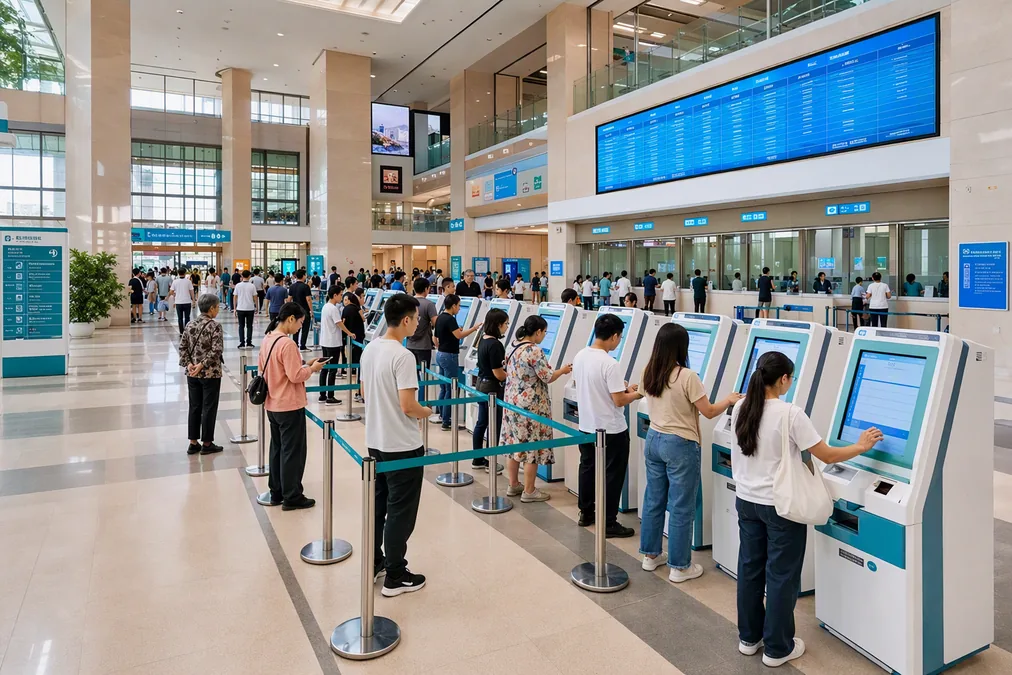
A public hospital visit starts with registration, 挂号 (guàhào): you pick a department and a doctor grade and pay a visit fee, then wait to be called. Big hospitals push you toward their WeChat account or app for this, with self-service kiosks and a manned window as the fallback; you'll need your passport at every step, and the ordinary clinic will mostly be in Chinese, which is why international departments exist. The visit fee is set by the city. In Beijing, which replaced the old registration fee with a "medical service fee" in 2017, a third-level hospital charges 50 yuan for an ordinary clinic, 60 for an associate chief physician, 80 for a chief physician, 100 for a named specialist, 70 for emergency, and 100 yuan per bed-day for admission; second- and first-level hospitals are cheaper, with an ordinary clinic at 30 and 20 yuan respectively. Shanghai's public hospitals have a new ceiling since April 2026 — 25 yuan for an ordinary outpatient consultation at a third-level hospital, 18 at a second-level and 10 at a first-level, with a 30 yuan emergency consultation at the third level and surcharges for senior doctors. Tests, imaging and medicines are billed on top, each paid at the cashier before you collect the result or the drug. It's a lot of walking between counters, and it's cheap.
Emergencies and 120
Call 120 for anything that can't wait or can't be moved — it's the national ambulance line, available around the clock and free to call, and in Shanghai the city's guidance is to call again if nothing has arrived in 20 minutes. The ambulance itself is charged: Beijing's tariff is 50 yuan for the first 3 km, 7 yuan per kilometre after that, and a 40 yuan charge for emergency treatment by the crew. You'll normally be asked to pay for it when you reach the hospital rather than at the roadside; Shanghai's guidance says the same, that payment is usually made after arrival. If you can get to a hospital yourself, walk into the emergency department (急诊, jízhěn). Beijing's emergency rooms sort arrivals into four levels — level 1 (life-threatening) is treated immediately, level 2 (critical) within ten minutes, level 3 (urgent) ahead of level 4, and level 4 (non-urgent) waits its turn — so a minor complaint on a busy night can mean a long wait, and a daytime clinic is the better choice when it's safe to wait. What to say when you call, and which lines speak English, are in our guide to emergency numbers in China.

Pharmacies
Pharmacies (药店, yàodiàn) are everywhere, marked by a green cross, and some large ones in big cities are open 24 hours; prices vary from shop to shop, and it's worth keeping the receipt. China splits medicines into prescription drugs, which pharmacies may sell only against a doctor's prescription and must keep off the open shelves, and over-the-counter drugs, which you choose yourself. Over-the-counter packs carry an oval "OTC" mark: red-orange for Class A, sold only in pharmacies, and dark green for Class B, which supermarkets and convenience stores may also stock. The rule that surprises visitors is antibiotics: any antibiotic not on the over-the-counter list needs a prescription from a licensed doctor, and the same goes for injectables, psychiatric medicines and hormones — Shanghai's official guidance for foreigners says plainly that antibiotics can't be bought at the counter. If you think you need one, a hospital clinic visit is the route, and given the fees above it's a cheap one.
For everyday problems the pharmacist will help if you can name the category — painkiller, antihistamine, something for diarrhoea, a cold and flu remedy, rehydration salts — so type the category into a translation app rather than the brand you use at home, which the shop won't stock. Brands and doses differ, so read the leaflet with your app before taking anything. Many pharmacies also sell traditional Chinese medicine; there's nothing wrong with trying it, but don't swap it for a medicine you rely on.
Paying, and making your insurance work
You can't use China's public health insurance, so as a visitor you're a self-paying patient at resident prices; you settle each charge as you go and claim it back from your insurer with the receipts, unless the insurer has a direct-billing agreement with that hospital, in which case you show the insurance card and your passport and the hospital bills the insurer. Beijing's official medical guide for foreigners lists cash, major foreign credit cards including Visa, Mastercard and American Express, UnionPay debit cards, and WeChat Pay or Alipay as accepted from international patients; smaller cities may want cash or mobile payment, so keep some yuan on you. For an admission, expect a deposit up front — the US embassy's medical page describes deposits as standard practice and warns that evacuation to the United States can run well past 50,000 US dollars. Three habits make the claim painless: get an official receipt (发票, fāpiào) for every payment, ask for a printed diagnosis and treatment record, and call your insurer's assistance line as early as possible, because the assistance team can often tell you which hospital they bill directly and open a case before you've paid anything. If you haven't bought cover yet, World Nomads is one option built for this kind of trip; what to look for in a policy is in our guide to travel insurance for China.
Language
Public hospital international departments are the answer to the language problem: Peking Union Medical College Hospital (PUMCH) in Beijing, for example, lists English, Japanese, French, Korean, Russian and German, and West China Hospital in Chengdu staffs its international centre with foreign-language speakers. Elsewhere, a translation app with a typed list of your symptoms, your allergies and your medicines does most of the work, and your embassy keeps lists of translators and English-speaking doctors if you need a person rather than a phone.
Frequently asked questions
Do I need vaccinations to travel to China?
Not as an entry requirement, for most travellers: the border health law lets customs ask for a vaccination certificate only in particular circumstances, and sets no general requirement. Travellers arriving from a yellow-fever country must show a certificate. Ask your travel clinic about routine boosters, hepatitis A and typhoid.
Can I bring my prescription medication into China?
Ordinary medicines, yes, in personal-use quantities and ideally in original packaging with the prescription. Controlled medicines — narcotic painkillers and Class I psychotropics such as methylphenidate — only with a diagnosis letter and passport, and only up to a single prescription's maximum, which is 3 days' supply for most forms, 7 for controlled-release, and 15 for a child's ADHD methylphenidate; declare them at customs.
Can I buy antibiotics in China without a prescription?
No. Antibiotics outside the over-the-counter list are prescription-only in pharmacies, along with injectables, psychiatric medicines and hormones, and pharmacies face fines for selling prescription drugs without one. See a doctor at a hospital clinic; the visit fee is small and the prescription is filled on site.
Do Chinese hospitals accept foreign insurance?
Two ways. Any hospital will treat you as a self-paying patient and give you receipts to claim with; direct billing, where the hospital settles with your insurer, happens only where the two have an agreement, and you'll need to show the insurance card and your passport. Private international hospitals and big international departments are where those agreements exist — Shanghai United Family, for instance, lists direct billing with more than 40 global insurers.
Staying healthy while you're here
Most illness on a China trip is an upset stomach, and most of that is avoidable. Drink boiled or bottled water — China's disease control centre recommends boiling tap water before drinking because of possible contamination in the pipes — and use the kettle in your room. Look for the smiley-face hygiene rating at restaurant doors and eat where turnover is high; the details are in our guide to food safety in China. In summer, heat is the real risk in cities like Chongqing, Wuhan and Xi'an, so drink more than you think you need and rest at midday; in northern winters, dry indoor air and cold outdoor air make a cough last, so pack lip balm and a scarf. On bad-air days a mask helps, and the air quality reading is in any weather app. Sleep off the jet lag before you plan a big walking day, and pack a small kit — rehydration salts, your usual painkiller, plasters, any regular medicine — so the first bad night doesn't need a pharmacy run.
Last updated: September 2026
Read in other languages
Last train times for 10 Chinese metro systems
Every line and station, checked by hand — the same data behind our offline route planner.
Get the WaysChina App
Offline guides, currency converter, essential phrases, and more — all in your pocket.

Related Articles

Food Safety in China: Tap Water, Street Food, Allergies, Halal and Vegetarian
Eating safely in China: why the official advice is to boil tap water, how to pick a street food stall, what the...

Is China Safe? Safety Tips for Travellers, from Scams to the Laws You Might Break
China is safe for visitors, including solo and women travellers. What to actually watch — theft, scams, traffic —...

Tourist Scams in China: How to Spot Them and What to Do If You're Caught
The scams aimed at visitors to China — tea ceremony, art student, fake taxis, "broken" meters, swapped QR codes,...