

This article contains affiliate links. If you make a purchase through these links, we may earn a small commission at no extra cost to you. This helps support our work in creating free travel guides.
China doesn't require travel insurance to let you in. For visa-free entry, the documents border officers suggest carrying are things like tickets, hotel bookings and an invitation letter, and insurance isn't among them; tourist-visa application checklists don't normally ask for it either, but check your consulate's list. Chinese public hospitals charge visitors the same as residents and expect you to pay as you go, unless your insurer has a direct-billing deal with that hospital. And the one cost that can ruin you isn't the hospital, it's the flight home: the US embassy puts a medical evacuation to the United States at well over 50,000 US dollars. So: not mandatory, but the pay-first system and the evacuation risk make it worth buying. Here's what it costs to go without, which clauses actually matter in China, how a claim works, and how to buy.
Do you need it? A two-minute decision
| Your situation | Buy? | Why |
|---|---|---|
| Your home health plan or credit card covers you abroad, including evacuation | Check the wording, then maybe not | Confirm China is included, that evacuation is covered, and that it pays hospitals directly or reimburses fast |
| Your home plan covers treatment abroad but not evacuation | Yes — a medical-and-evacuation policy | Evacuation is the expensive part and the one you can't pay out of pocket |
| No cover abroad at all | Yes, comprehensive | You're paying every hospital charge yourself until reimbursed |
| Hiking, skiing, cycling, motorbike hire | Yes, with the activity named in the policy | Standard policies often exclude these; a claim after a mountain fall is not the moment to find out |
| Long trip, expensive flights, non-refundable bookings | Yes, with cancellation and interruption cover | A lost passport or an illness can cost you a week of bookings |
If you're in the first row, do the check properly: many home plans cover "emergency treatment" abroad but not the flight home, and many credit-card policies only cover trips paid for with that card and cap medical costs low. Ask the two questions that matter in China — will you pay a Chinese hospital directly, and is evacuation included — and if either answer is no, buy a policy.

What it costs without insurance
Start with the reassuring part. Public hospital charges are set by the city and are low: in Beijing's top-tier hospitals the visit fee is 50 yuan for a standard outpatient visit, 70 yuan for emergency, and 100 yuan per bed-day for admission, before tests and medicines; Shanghai's ordinary outpatient consultation at a top-tier public hospital is capped at 25 yuan and an emergency consultation at 30 yuan under the tariff in force since April 2026. An ambulance in Beijing is 50 yuan for the first 3 km, 7 yuan per kilometre after that, and a 40 yuan emergency treatment charge — and calling 120 itself is free, though the ride is charged. The consultation for a stomach bug or a sprained wrist costs less than dinner; tests and medicines are extra, but still modest.
Now the part that argues for a policy. Private international hospitals, where the English is fluent and the wait is short, price like Western private care: Shanghai East International Medical Center's published schedule lists a consultation at 1,000–1,500 yuan and an emergency visit at 1,500–2,200 yuan, before any test or treatment. Admission to any hospital usually means a deposit up front — the US embassy describes deposits before admission as standard practice — and a serious illness means days of charges paid at the cashier before you go home. Then the evacuation figure above, which no traveller can reasonably carry on a card. Those two lines are the whole argument: everyday care is cheap enough to self-insure, the rare catastrophe is not.
The clauses that matter in China
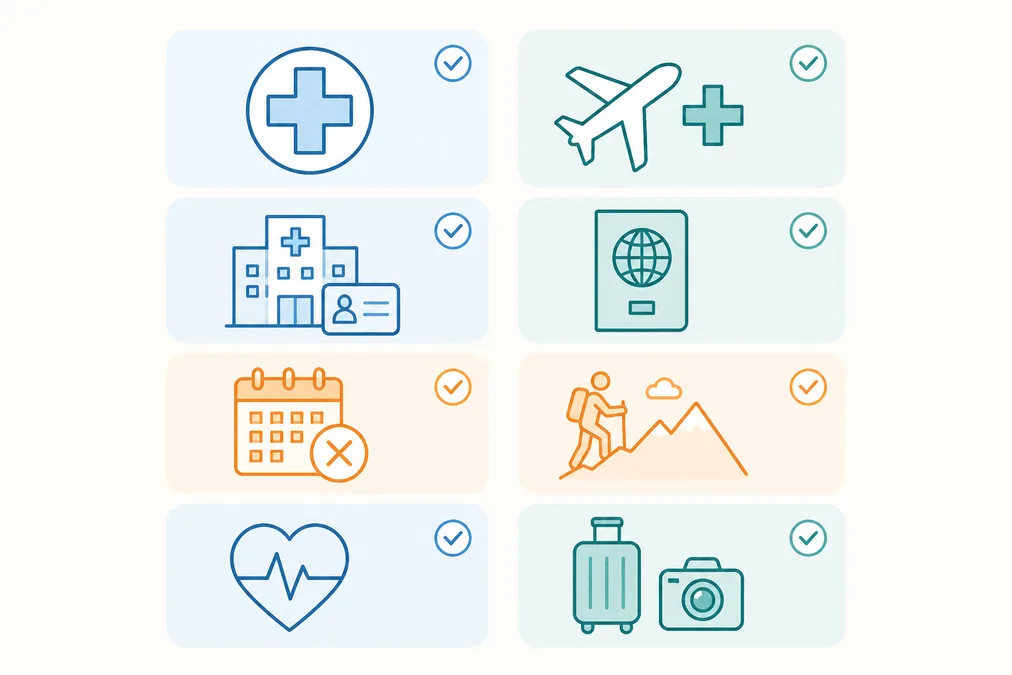
- Medical expenses, with a high limit. The limit should be sized for a week in a private international hospital plus surgery, not for a doctor's visit. If the policy quotes a figure that looks small next to a Western hospital bill, it's small here too.
- Medical evacuation and repatriation. Non-negotiable, for the reason above. Check that the insurer decides on evacuation with the treating doctor and pays the provider directly; you can't front that cost.
- Direct billing in China, and with which hospitals. Direct billing only works where the insurer and the hospital have an agreement; then you show the insurance card and your passport and the hospital bills the insurer, and otherwise you pay and claim. The big names have these networks — Shanghai United Family lists direct billing with more than 40 global insurers, the International Medical Center clinic in Beijing with more than 50, West China Hospital in Chengdu with 20-plus partners and foreign-currency settlement. Ask your insurer for its China network before you buy; our list of English-speaking hospitals in China shows which ones advertise it.
- A 24-hour assistance line you can reach from China. Some insurer apps and websites don't load on Chinese networks. Get the phone number and the email, and save both.
- Travel documents. Replacing a lost passport means embassy fees, extra nights and sometimes a new flight; see what the policy pays and what proof it wants. Our lost passport guide shows how many steps are involved.
- Cancellation and interruption. Sized to your non-refundable spend: flights, tours, high-speed rail, hotels. In China the trigger is usually a lost passport or a hospital stay, either of which can cost you a week of bookings.
- Activities. Hiking above a stated altitude, skiing, cycling and riding a scooter are commonly excluded or limited; if your trip includes them, buy a policy that names them.
- Pre-existing conditions. Declare them. An undeclared condition is one of the commonest reasons a large claim is refused.
- Baggage and electronics. Useful but secondary; check the per-item limit against your phone and camera.
If something happens: how to claim from China
Insurers pay on paper, so the job during the trip is collecting the right paper. For theft or loss, report it to the police and get the written case acceptance receipt, the 受案回执 (shòu'àn huízhí), which police are required to issue to anyone who reports; this is the document a Chinese police station produces, and it's what your insurer means by "police report". For medical treatment, keep every official receipt (发票, fāpiào) and ask the hospital for a printed diagnosis and treatment summary; international departments such as Peking Union Medical College Hospital's (PUMCH) in Beijing work in English and have their own direct-billing procedures — ask them for the summary in English. Outside international departments, receipts and records are in Chinese; ask the assistance line whether it accepts them as they are or wants a translation, and get that sorted before you fly home. Call the assistance line as soon as you can — before treatment for anything non-urgent — because that's when they can arrange direct billing or a guarantee of payment (the insurer's promise to the hospital that it will pay), and a claim opened early is paid faster. Photograph every document the day you get it, and keep a note of dates, names and amounts. One distinction worth knowing: a dispute with a merchant — a fake product, a tour not delivered — isn't an insurance matter at all; that goes to the 12315 consumer complaints line. Our emergency numbers guide covers the police station visit itself.
How to buy
Buy before you leave home; policies bought after departure usually exclude anything that's already gone wrong and sometimes exclude the first days of cover. Choose single-trip if this is your one big trip of the year, and an annual multi-trip policy if you travel more than a few times — the second is often better value and saves a purchase each time. Compare on the clauses above rather than on price: a cheap policy that caps evacuation, or leaves you unsure how it pays a Chinese hospital — direct billing or reimbursement, and how fast — is not cheap. For long or open-ended trips, SafetyWing sells rolling monthly cover that's simple to extend from abroad; World Nomads is built around covering active trips and lets you add named activities; and Allianz Travel Insurance offers single-trip plans with cancellation cover for a fixed itinerary. Whichever you pick, ask how it pays a Chinese hospital before you buy, read the medical, evacuation and direct-billing sections in full, and note the assistance phone number somewhere that doesn't need an internet connection. Buy from home rather than in China: a policy bought from a seller here is governed by Chinese rules, and any dispute is handled in China, in Chinese.
China-specific notes
Save the assistance number and email as plain text; don't rely on the insurer's app working here. At a hospital, the front desk will look at your policy before deciding whether to bill directly, so carry the physical card or a screenshot of the policy page with the policy number. A public ambulance is billed at the city tariff; a private hospital's own ambulance is billed by that hospital, so if a private hospital dispatches one for you, ask what it costs. And keep some cash and a card that works: Beijing's official guide for foreign patients lists Visa, Mastercard, American Express, UnionPay (China's own card network) and WeChat Pay or Alipay as accepted at the hospitals it covers, but the US embassy notes that visitors still often run into payment trouble, and a policy that reimburses later still needs you to pay now.
Frequently asked questions
Is travel insurance mandatory for China?
No. Visa-free entry doesn't require it — the documents officials suggest carrying are things like tickets, hotel bookings and an invitation letter — and tourist-visa checklists don't normally ask for it either; check your consulate's list. Whether to buy it is a financial decision, and the pay-first hospital system plus the cost of evacuation make it an easy one for most visitors.
Will Chinese hospitals make me pay before treating me?
For anything non-urgent, yes — you pay at the cashier before each step, at resident prices in public hospitals, and claim it back later unless your insurer bills the hospital directly. For admission, expect to be asked for a deposit. In a genuine emergency, treatment normally comes first and the bill follows — but don't count on that for anything short of life-threatening.
How much does travel insurance for China cost?
It depends on your age, trip length, home country, the medical and evacuation limits you choose, any activities you add and whether you declare pre-existing conditions, so quotes vary a lot; get two or three quotes for the same trip and compare the evacuation limit and the direct-billing network, not just the premium. As a rule, a policy priced far below the others has left something out, and in China that something is usually evacuation or the medical limit.
Something was stolen from me in China. What documents does the insurer want?
The police case acceptance receipt, 受案回执, from the station where you reported it, plus receipts or photos for what was taken; for a passport, add the Passport Loss Certificate from the Exit-Entry office and the embassy's replacement paperwork. Report on the day it happens; a late report is one of the commonest reasons a theft claim is questioned.
If your trip is under the 30-day visa-free rules, our guide to China's visa-free entry covers what else to have ready; and for the medical system you'd be claiming against, start with health and medical care in China.
Last updated: September 2026
Read in other languages
Last train times for 10 Chinese metro systems
Every line and station, checked by hand — the same data behind our offline route planner.
Get the WaysChina App
Offline guides, currency converter, essential phrases, and more — all in your pocket.

Related Articles

Do You Need a Visa for China? Check by Nationality
One table answers it: every nationality with a visa-free route into mainland China — 30-day entry, 240-hour transit,...

China's 240-Hour Visa-Free Transit: Who Qualifies and How It Works
Not on China's visa-free list? If you're flying on to a third country, the 240-hour transit policy lets you enter...

Arriving in China: The Arrival Card, Immigration and Customs
Your first hour on the ground, step by step: filing the arrival card online before you fly, what immigration...

How to Apply for a China Visa: Forms, Documents and Timing
The China tourist visa in four steps: the COVA online form, the documents that actually matter, submission-day...