

This article contains affiliate links. If you make a purchase through these links, we may earn a small commission at no extra cost to you. This helps support our work in creating free travel guides.
Eating in China is safe, and it's the best part of the trip. The realistic risk is a day or two of upset stomach from a change of diet, not food poisoning, and even that is avoidable with a few habits. Four things cover most of it: drink boiled or bottled water rather than from the tap; choose street food that's cooked in front of you and sold fast; look for the smiley face by the restaurant door, which is the inspector's rating; and if you have an allergy, carry it written in Chinese, because restaurant menus don't list allergens. Below: the water question with the official facts, how to pick street food, how the hygiene rating works, and how to eat with an allergy, halal, vegetarian or vegan — plus what to do if you do get sick.
Tap water
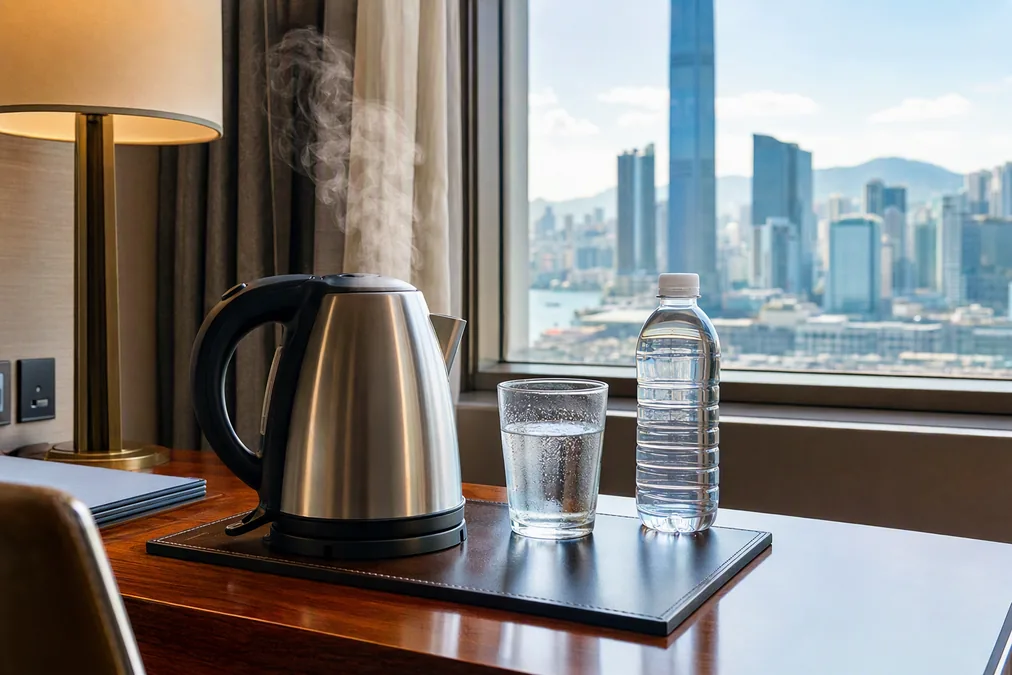
The short version: the water leaving the treatment plant meets a strict national standard; the pipes between the plant and your tap are the uncertain part; so boil it or buy it. China's drinking-water standard, GB 5749-2022, took effect in April 2023 and sets 97 quality indicators, and Beijing's water utility has applied it since then. The city publishes quarterly test results: for April to June 2026, Beijing's treated water passed all 43 routine indicators, with no coliform bacteria detected and cloudiness and mineral hardness well inside the limits. Shanghai's utility monitors from source to tap and states that water at the tap consistently meets Shanghai's own water-quality standard. And yet the official advice is still to boil: Chinese Center for Disease Control and Prevention (China CDC) notes that although the plant treats the water, the distribution network can contaminate it on the way, and boiling for one to three minutes kills bacteria and drives off the chlorine taste, so it recommends drinking boiled water.
What that means in practice. Nearly every hotel room has a kettle; boil and let it cool, or buy bottled water, which costs little and is sold everywhere. Restaurants serve hot water or tea by default and many hand you sealed bottled water. Ice in cafés and hotel bars is almost always made from purified water and is fine; ice from a street stall's cooler, less certain. Brushing your teeth with tap water is a judgment call — locals do, and the risk is small; if your stomach is sensitive, use the kettle. A purifier bottle rated for bacteria and viruses works well here if you'd rather not buy plastic.
Street food: how to choose a stall
Street food in China is not a gamble if you use the same test locals use: heat, turnover and cleanliness of the person, in that order. Anything cooked to order in a hot wok, deep-fried, grilled over charcoal or steamed while you wait is as safe as a restaurant meal — the heat does the work. A queue of locals means the ingredients turned over today. A vendor with clean hands, tongs and a covered ingredient tray is running a real business. Be more careful with things that sit at room temperature — cut fruit on a tray, cold noodles left out at midday in summer, seafood that isn't on ice — and with anything reheated rather than freshly cooked. Watch the oil: dark, smoking oil in the fryer is a sign it hasn't been changed. Our guide to the best street food cities in China tells you where to start.
The smiley face at the door
By the entrance or the counter of most restaurants there's a laminated notice with a cartoon face on it. That's the food safety inspector's grade, and it's worth a glance. Under the national scheme, each inspection gives the restaurant a "dynamic" grade shown as a big laugh, a smile or a straight face, and the year's inspections roll up into an annual grade of A, B or C; the notice has to be displayed prominently at the entrance and can't be altered or covered. Shanghai uses its own version: a smile, a straight face or a frown for the latest check, and an annual A to D, where D means the place has had a poisoning incident or been ordered to close. Shenzhen shows A, B and C as a laugh, a smile and a straight face, and its regulator advises diners to prefer higher-graded places. Read it the obvious way: a laughing face or an A is good, a straight face is the lowest routine grade, "fair", and a frown means walk on. In Shanghai the notice also carries a QR code that shows the latest inspection result.
Allergies
This is the section to read twice if you have a serious allergy, because China is harder than home in one specific way: restaurants aren't required to label allergens. A new national labelling standard makes allergen declaration mandatory on packaged food for eight groups — cereals containing gluten, crustaceans, fish, eggs, peanuts, soybeans, milk and tree nuts — but it only takes effect on 16 March 2027, it doesn't cover restaurant dishes or loose food, and sesame is not on the mandatory list. So on this trip, assume nothing is labelled and ask every time.
Know the hidden ones. Peanut appears as peanut oil in stir-fries across the south, as crushed peanuts on noodles and cold dishes, and in sauces. Sesame is everywhere — sesame paste on noodles and hotpot dipping sauces, sesame oil finishing cold dishes, seeds on bread. Shellfish — shrimp, crab and molluscs — hides in shrimp paste, oyster sauce and the stock under many "vegetable" dishes. Soy and wheat are in soy sauce, which is in nearly everything savoury. Egg binds dumpling fillings and noodles. Tree nuts show up in Xinjiang and Yunnan cooking. MSG (味精, wèijīng) is common and is not an allergen in the medical sense, but if it disagrees with you, "不要味精" (bú yào wèijīng) is a normal request.
Write a card. On your phone and on paper, in Chinese, like this: 我对花生过敏,吃了会有生命危险。请问这道菜有没有花生或花生油? — "I am allergic to peanuts and it is life-threatening. Does this dish contain peanuts or peanut oil?" For any other allergen, use the generic form 请问这道菜有没有__? (qǐngwèn zhè dào cài yǒu méiyǒu __ — "does this dish contain __?"), drop the "or peanut oil" clause, and put your allergen in the blank: 坚果 (jiānguǒ, tree nuts), 芝麻 (zhīma, sesame), 虾 (xiā, shrimp), 蟹 (xiè, crab), 虾蟹类 (xiā xiè lèi, shrimp, crab and other crustaceans), 贝类 (bèilèi, clams, mussels, oysters and other molluscs), 海鲜 (hǎixiān, all seafood), 鱼 (yú, fish), 鸡蛋 (jīdàn, egg), 牛奶 (niúnǎi, milk), 小麦 (xiǎomài, wheat), 大豆 (dàdòu, soy). Show it to the server and, if it's serious, ask them to show the kitchen; staff take a written card far more seriously than a spoken sentence in a language they don't share. Carry your medication, and know that 120 is the ambulance number and free to call. Big-city international restaurants and hotel dining rooms will usually be able to answer allergen questions in English; small local places will not, and the card is what makes them possible.
Halal, vegetarian and vegan
Halal (清真, qīngzhēn) food is easy to find in every city, thanks to the Hui and Uyghur communities, China's two largest Muslim minorities. Look for the two characters 清真 on the sign, often with Arabic script and a green colour scheme. In Shanghai a restaurant may only use the word "halal" on its sign or packaging if it holds a halal sign plate issued by the city's ethnic affairs authority, and Beijing's rules likewise require halal businesses to be registered and to display an official halal plaque — so in those cities the official plaque is the thing to look for, not just the word. Lanzhou beef noodle shops (兰州拉面) and Xinjiang restaurants are the reliable halal standbys nationwide; in small towns the Lanzhou noodle shop is often the only halal option, while the north-west — Xinjiang, Ningxia, Gansu, Qinghai — is halal by default. To ask, use "附近有清真餐厅吗?" (fùjìn yǒu qīngzhēn cāntīng ma — is there a halal restaurant nearby?) or, at the table, "是清真的吗?" (shì qīngzhēn de ma — is this halal?). Our guide to halal food in China goes city by city.
Vegetarian and vegan eating is possible everywhere and easy once you know the traps: meat stock (高汤, gāotāng) under vegetable dishes and soups, lard (猪油, zhūyóu) in some fried dishes and pastries, oyster sauce (蚝油, háoyóu) on greens, and small bits of pork in "vegetable" dishes as flavouring. Say "我吃素" (wǒ chī sù, I'm vegetarian) and add "不要肉,不要高汤" (bú yào ròu, bú yào gāotāng — no meat, no meat stock); for vegan, add "不要鸡蛋,不要牛奶" (no egg, no milk). Buddhist temple restaurants (素斋, sùzhāi) are fully vegetarian and often vegan, and every big city has modern vegetarian restaurants. Tofu dishes, stir-fried greens, eggplant, mushrooms and cold cucumber salad are dependable orders. The detail is in our vegetarian and vegan guide to China.
Ordering when you can't read the menu
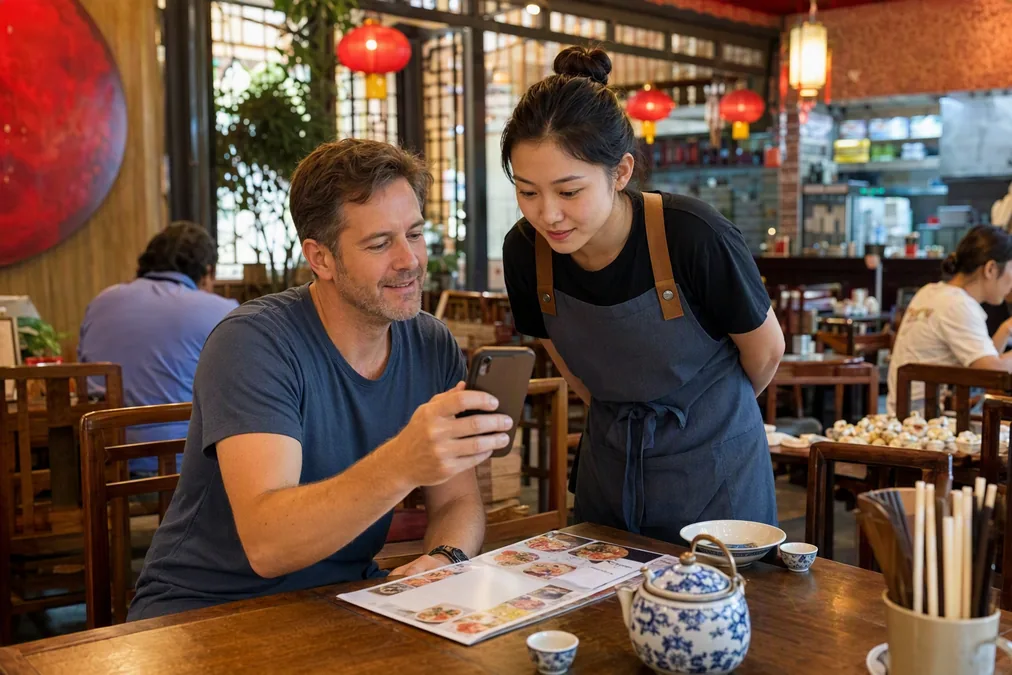
Most restaurants in cities have picture menus or a QR-code menu on the table, and a camera-translation app reads either well enough to order from; the app also lets you type "no chilli" and show it. A handful of phrases go a long way: 不要辣 (bú yào là, not spicy), 微辣 (wēi là, mildly spicy), 不要香菜 (bú yào xiāngcài, no coriander), 不要花生 (bú yào huāshēng, no peanuts), 打包 (dǎbāo, to take away). Put your restrictions on one card in Chinese — allergy, halal, vegetarian, whatever applies — and hand it over before ordering; a card is read, a spoken phrase is guessed at. Our guide to ordering food with zero Chinese has the full toolkit. And if you'd like someone to show you the ropes on the first evening, a food tour booked through a platform such as Klook pairs you with a guide who knows the stalls and can order for you — a good way to learn the street-food test before you apply it alone.
If you get sick
An upset stomach in the first days is usually your gut adjusting, not the food's fault. Rest, drink more than you think you need — rehydration salts from any pharmacy, or clear soup, tea and bottled water — and eat plain food for a day: rice porridge (粥, zhōu) is what locals reach for. A pharmacy will usually sell you rehydration salts and an anti-diarrhoeal over the counter; describe the category to the pharmacist by translation app rather than a home brand name, and read the leaflet with the app. Our health and medical care guide covers what pharmacies can and can't sell you. See a doctor if there's blood, a high fever, symptoms lasting more than two or three days, or signs of dehydration, and for anyone who can't keep fluids down — especially a child or an older traveller — that's a hospital visit rather than a wait. Call 120 for anything severe; the line is nationwide, 24 hours and free to call, and you'll be asked for your address, the patient's age and the main symptoms. Which number does what is in our emergency numbers guide. If you believe a specific restaurant made you ill, the consumer complaints line 12315 and its website 12315.cn handle food safety complaints; keep the receipt and, if you can, a photo of the dish.
Frequently asked questions
Can you drink tap water in China?
Not straight from the tap. The water leaving the plant meets a national standard with 97 indicators and Beijing publishes quarterly test results showing a pass, but the official advice is to boil it because of possible contamination in the pipes. Use the kettle in your room or buy bottled water; both are easy.
Is street food in China safe?
Yes, if you pick stalls the way locals do: cooked to order over real heat, a queue that shows the ingredients moved today, and a vendor with clean hands and covered trays. Be more careful with food that sits out at room temperature and with fryer oil that's dark and smoking. Most stomach trouble on a trip comes from a change of diet rather than a bad stall.
How do I say "I'm allergic to peanuts" in Chinese?
我对花生过敏 — wǒ duì huāshēng guòmǐn. Add 吃了会有生命危险 (chī le huì yǒu shēngmìng wēixiǎn, "it's life-threatening if I eat it") if it's serious, and show it written rather than saying it. Restaurants aren't required to label allergens — the new packaged-food allergen rule doesn't start until March 2027 and doesn't cover restaurants anyway — so the written card is your protection.
Is halal food easy to find in China?
Yes, in every city. Look for 清真 on the sign; Lanzhou beef noodle shops and Xinjiang restaurants are reliable everywhere. In Beijing and Shanghai, halal businesses must be registered and display an official halal plaque from the city's ethnic affairs authority — in Shanghai a place without the plate may not even put 清真 on its sign — so the plaque is the thing to check.
Last updated: September 2026
Read in other languages
Last train times for 10 Chinese metro systems
Every line and station, checked by hand — the same data behind our offline route planner.
Get the WaysChina App
Offline guides, currency converter, essential phrases, and more — all in your pocket.

Related Articles

Health and Medical Care in China: Vaccines, Hospitals, Pharmacies and Paying
How health care works for a visitor to China: no entry vaccines for most, which medicines you can bring, how...

Is China Safe? Safety Tips for Travellers, from Scams to the Laws You Might Break
China is safe for visitors, including solo and women travellers. What to actually watch — theft, scams, traffic —...

Tourist Scams in China: How to Spot Them and What to Do If You're Caught
The scams aimed at visitors to China — tea ceremony, art student, fake taxis, "broken" meters, swapped QR codes,...