

This article contains affiliate links. If you make a purchase through these links, we may earn a small commission at no extra cost to you. This helps support our work in creating free travel guides.
Scams aimed at foreign visitors in China are few in type and easy to recognise once you've seen the pattern: a friendly stranger who chooses where you go next, a car that isn't a real taxi, a QR code you didn't ask for, a ticket that isn't from the official window. None of them start with force — each needs you to agree to something first — so the moment to walk away is before you say yes. Below: the tell for each, the two you're most likely to meet, and what to do if you've already been caught, including which money you can realistically get back.
The scams, the tell, and what to do
| Scam | How it starts | The tell | What to do |
|---|---|---|---|
| Tea ceremony / bar bill | Young locals want to practise English, suggest a tea house or bar | They pick the venue; no prices shown | Say you're meeting someone, walk on |
| Art student | "Student" invites you to a free exhibition of their work | Exhibition is a shop; pressure to buy | Decline the invitation; never enter |
| Unlicensed taxi | Someone approaches you inside the airport or station offering a car | Not at the official rank; no meter, no roof light | Use the rank or a ride-hailing app |
| Meter refused / long route | Driver quotes a flat price or takes an odd route | Meter off; "meter broken" | Get out before it moves; if already en route, note the plate and report — you can legally refuse to pay without a meter |
| Counterfeit change | A large note is "checked" and handed back as a fake | Note is switched out of sight | Pay by phone; check notes you receive |
| QR code swap / fake refund | A pasted-over payment code, or a "refund" that needs you to scan first | Code isn't the shop's; refund asks you to pay | Scan only the merchant's own code; refunds never need a scan |
| Fake tickets and guides | A tout near the entrance sells tickets or a tour; "the site is closed today" | Not the official window or app | Buy from the official channel; check opening hours yourself |
| "Free" massage or photo | Free service offered on the street, bill appears afterwards | No price agreed in advance | Agree a price first or decline |
Where these happen is predictable: the famous pedestrian streets and squares (Wangfujing and Tiananmen in Beijing, Nanjing Road and the Bund in Shanghai), the exits of airports and railway stations, the entrances of major attractions, and nightlife districts. In an ordinary neighbourhood, you can go a whole trip without anyone trying anything. The frequency is low; the reason to know the list is that the two or three attempts you do meet will look exactly like the descriptions above.

The invitation scams: tea, art, "practise English"
The tea ceremony scam is the most famous, and it works because it's pleasant right up to the bill. Two or three well-dressed young people — often students, often women, always with excellent English — start a conversation near a tourist landmark. They're friendly and curious about your country. After ten minutes they suggest a traditional tea house they know, or a bar. The tea is served ceremonially, no menu appears, and the bill is many times what tea costs, with staff between you and the door until it's paid; your new friends either vanish or "pay their share" as part of the act. The art student version swaps the tea house for a gallery where the pressure is to buy paintings. The "practise English" opener is the same scam with a different first line.
The tell is always the same: they choose the next place. Genuinely friendly locals do exist and will happily chat where you are; they don't steer you to a venue. So the rule is simple and doesn't require you to be rude: talk as long as you like, and when a venue is suggested, say you're meeting a friend and go. If you want tea, pick the tea house yourself, ask for a menu with prices, and you'll have a lovely time. If you're already inside and the bill has arrived, don't argue about the price at the table; say clearly that you'll pay only what's on a printed menu, and if you're prevented from leaving, that's no longer a dispute, it's a matter for the police — call 110, and in Shanghai the 110 line answers in English. Outside Shanghai expect Chinese — hand the phone to a bystander or a neighbouring shop, or hold your translation app to the speaker. Most venues back down at that point, because the scam depends on you not calling.
Taxis: unlicensed cars, "broken" meters, long routes
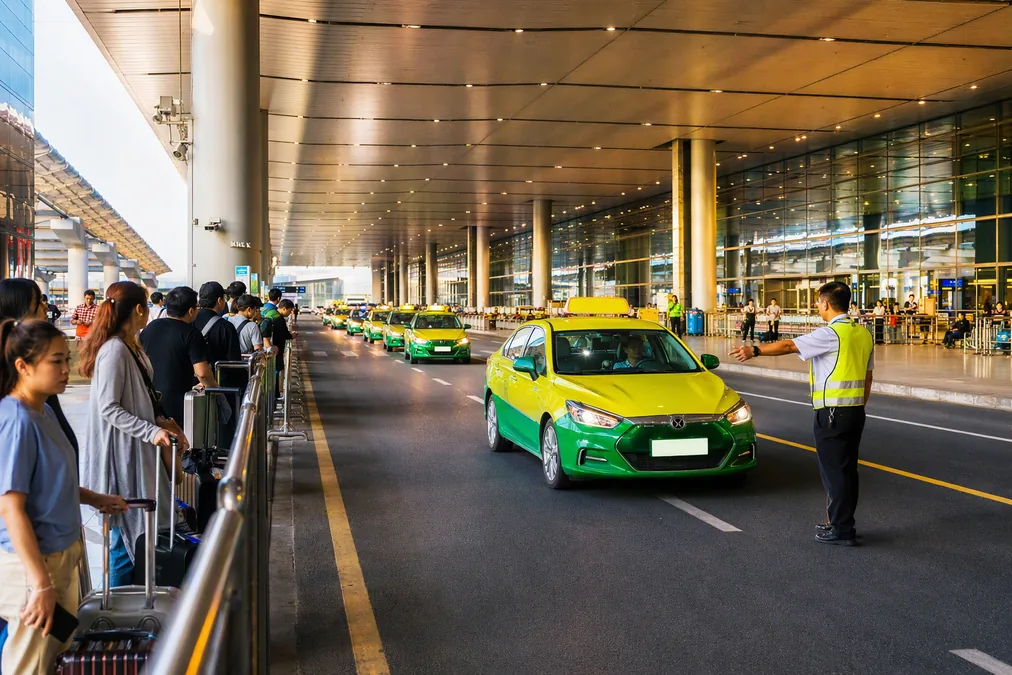
The taxi scams cluster at arrival points. Inside an airport or station, someone asks "Taxi?" and leads you to a private car with a made-up price; the real taxis are outside at the official rank with a queue. The second version is a licensed cab whose driver says the meter is broken or quotes a flat fare, and the third is a real meter and a long way round. The second and third are against the national taxi rules, which require drivers to take a reasonable route to the destination you give, use the meter, charge the published rate and hand you a receipt, and forbid refusing fares, negotiating prices, dropping passengers mid-trip and detours; if the meter isn't used or no receipt is offered, you have the right to refuse payment, and drivers face fines of 200 to 500 yuan for these violations. Beijing's own taxi regulation says the same, down to the driver's duty to give change and to hand over a proper receipt matching what you paid.
What to actually do: use the official rank, or better, a ride-hailing app, where the price is shown before you get in and the route is on your screen. If a driver refuses the meter, get out before the car moves — it's a two-second decision that ends the problem. If you've been overcharged and want to pursue it, note the plate number, the company name on the door and the time, keep the receipt if you got one, and complain to the transport hotline 12328, which handles taxi complaints; in Beijing and Shanghai the 12345 city hotline has English-speaking operators, and elsewhere ask your hotel to call 12328 for you. Our guides to taxis and ride-hailing in China and the DiDi app cover the practical side, including how to match the plate at pickup.
Money: fake notes, swapped QR codes, refund tricks
Counterfeit cash was the classic scam of the cash era and has mostly faded along with cash itself: when nearly every payment is a phone scan, there's nowhere for a fake note to go. It still turns up at the edges — a taxi driver who "checks" your 100-yuan note and hands you back a different one, a market stall giving fake change — so it's worth two habits. Pay by phone where you can (see our guide to using Alipay with a foreign card), and check large notes you're handed against the features the People's Bank of China publishes: on the current 2019-series 50 yuan note the big number on the front shifts between green and blue as you tilt it, the security strip changes from red to green, and the portrait is raised to the touch. If a bank finds a fake in your cash, it will seize it in front of you, stamp it "counterfeit" and give you a seizure receipt; you can ask for a free authenticity check within three working days if you disagree, and the bank keeps the note and does not replace it. So the real rule is: don't accept a note you doubt, because once it's yours it's your loss.
QR code tricks are the modern version. The two you'll hear about are a fake payment sticker pasted over a shop's real code — you pay, the shop never sees it — and the "refund" or "prize" that requires you to scan a code or enter card details first. A refund never requires you to pay or scan anything; a shop's own staff will show you the code on their phone or till if you ask; and a code stuck on a lamppost or a table edge is nobody's. Two more: don't scan a code to pay on a stranger's behalf, however good the story about their app not working — they pocket your cash and the payment never lands; and don't log in to a bank or payment app on a public Wi-Fi network you didn't get from the venue. If you've already sent money to a scammer, call 96110, the police anti-fraud line — and if a number showing 96110 calls you, answer it; it means the police think you may be in the middle of a scam. Then call your bank or the payment app to try to freeze the transfer. Speed matters more than anything else here.
Tickets, guides and "it's closed today"
At the gates of major sights, three versions: a tout selling tickets that turn out to be fake or already used; a "guide" with no licence who charges a premium and takes you to shops; and the helpful stranger who tells you the site is closed today and offers a taxi to somewhere else (a shop, a different "temple", a tea house). Big attractions sell through their own official app, WeChat account or website, often with passport-number booking for foreigners, and many require it — so buy there, or through an established platform such as Trip Com or Klook, which sell the same entry tickets and English-language tours with the price shown up front. If someone says the site is closed, check the official page yourself; it rarely is. A licensed guide carries a guide card (导游证, dǎoyóuzhèng) — ask to see it, and book guides through the attraction or a platform rather than at the gate. For a tour or guide complaint, the tourism hotline you may still see quoted, 12301, was merged into the 12345 city hotline at the end of 2021, so 12345 is the number; for a purchase that was misrepresented or fake, 12315 is the consumer complaints line, with a website at 12315.cn.
If you've been scammed: what to do now
The numbers divide by what happened. Being held, threatened or physically stopped from leaving is a police matter — 110, immediately. A taxi that overcharged or a tour that wasn't as described is a complaint, and the government routes complaints to 12345 rather than 110, which is reserved for crime and danger. An overpriced bill you already paid or a fake product is 12315; if you're not sure which line, 12345 is the catch-all and will pass it on. A fraudulent transfer or a phishing payment is 96110. If you do report a crime — a theft, an extortion at the tea house — go to a police station (派出所, pàichūsuǒ) and ask for the written case acceptance receipt, 受案回执 (shòu'àn huízhí), which the police must issue to anyone who reports; it's the document your insurer means by "police report". Our emergency numbers guide explains what to say and what to expect at the station.
Be realistic about recovery. Money paid by card can sometimes be disputed through your bank as a chargeback, particularly for a fake product or a service not delivered, so keep every receipt and screenshot. Money sent by transfer to a scammer is usually gone unless 96110 or your bank freezes it within minutes. Cash handed over at a tea house is gone; the police will take the report and may visit the venue, and the report supports an insurance claim, but don't plan on a refund. Set your expectation there and you'll spend your energy on the report and the claim rather than on the argument.
Frequently asked questions
What is the "tea ceremony scam" in China?
Friendly young locals near a landmark invite you to a tea house they know; there's no menu, the ceremony is elaborate, and the bill is many times the real price, with staff blocking the door until you pay. The tell is that they choose the venue. Chat as long as you like, and when a place is suggested, say you're meeting someone and leave. If you're already inside and being held, that's a police matter — call 110, which handles crime and threats to your safety.
How do I know a taxi is legitimate?
It's at the official rank, it has a roof light and a company name on the door, and the driver turns on the meter without being asked. National rules require the meter, the published rate and a receipt, and let you refuse to pay if the meter isn't used. Anyone who approaches you inside a terminal offering a car isn't a taxi. A ride-hailing app removes the question entirely: the plate, the price and the route are all on your screen.
I've been scammed in China. What should I do?
Match the number to the problem: 110 if you're being held or threatened; 96110 if you've sent money to a fraudster; 12345 for a dispute over a service or an overcharge; 12315 for a fake or misrepresented purchase. Then get the paper: a police case acceptance receipt for anything you report, plus receipts and screenshots. Card payments can sometimes be charged back; transfers and cash usually can't.
Is counterfeit money common in China?
Much less than it was, because most payments are now by phone and a fake note has nowhere to go. It still appears as change from a driver or a market stall, so pay by phone where you can and check any large note you're handed — the colour-shifting number and security strip are easy to see on the current 2019-series 50 yuan note. A bank that finds a fake will seize it and give you a receipt, not replace it.
Five habits that cover all of it
- Never let a stranger choose the next place you go.
- Agree the price before the service, or see it on a menu — no price, no deal.
- Take the metered taxi from the rank or a ride-hailing car, never the car someone leads you to.
- Pay by phone, scan only the merchant's own code, and treat any "refund" that needs a scan as a scam.
- Buy tickets from the official channel or an established platform, and check "closed today" yourself.
The rest of what keeps a trip smooth — the laws visitors break by accident, night-time judgment, who to call — is in our safety tips for travellers in China.
Last updated: September 2026
Read in other languages
Last train times for 10 Chinese metro systems
Every line and station, checked by hand — the same data behind our offline route planner.
Get the WaysChina App
Offline guides, currency converter, essential phrases, and more — all in your pocket.

Related Articles

Food Safety in China: Tap Water, Street Food, Allergies, Halal and Vegetarian
Eating safely in China: why the official advice is to boil tap water, how to pick a street food stall, what the...

Health and Medical Care in China: Vaccines, Hospitals, Pharmacies and Paying
How health care works for a visitor to China: no entry vaccines for most, which medicines you can bring, how...

Is China Safe? Safety Tips for Travellers, from Scams to the Laws You Might Break
China is safe for visitors, including solo and women travellers. What to actually watch — theft, scams, traffic —...