

This article contains affiliate links. If you make a purchase through these links, we may earn a small commission at no extra cost to you. This helps support our work in creating free travel guides.
China doesn't have one number for everything the way 911 or 112 works at home. You dial by problem: 110 for police, 120 for an ambulance, 119 for fire, 122 for a traffic accident. All four are free to call, work around the clock, and you dial them as they are — no area code, no country code. The two things that trip up visitors are language (outside Shanghai, expect the operator to speak Chinese) and money (the call is free, the ambulance is not). This page gives you the numbers, what to say when someone picks up, what an ambulance costs, and which number to use when it's a complaint rather than an emergency.
The numbers, and the one rule behind them
Save these before you land. If you remember only one, make it 110: it's the police line, it covers crime, traffic incidents, public safety emergencies and urgent calls for help, and if you're not sure which line applies, start with 110.
A few details behind the card. 120 is the medical line: it takes serious injuries and sudden illness 24 hours a day, and in Shanghai the city's own guidance says to call again if the ambulance hasn't arrived in 20 minutes. 119 is fire, but it also takes chemical spills, and Shanghai lists it for building collapses and other major disasters too. For a road accident you can call 122 or 110 — both work, and 122 is free from payphones as well as mobiles.
What about your phone? If your home SIM is roaming on a Chinese network, these short numbers should dial like any local call — confirm that with your carrier before you fly, and switch roaming on. Don't count on a phone with no SIM, or no credit, connecting; if your phone is dead or has no service, hand the problem to the nearest hotel desk, shop or passer-by and ask them to dial. A local number makes all of this easier; see our China SIM card and eSIM guide.

Will the operator speak English?
In Shanghai, yes; elsewhere, plan as if not. Shanghai's 110 line takes calls in English, Japanese, Russian, German, French, Spanish, Arabic and Korean, and the city's 119 and 120 lines offer English. Beijing's multilingual line is 12345, the citizen hotline, which has ten foreign languages including English — but it's for non-urgent matters, and Beijing's own guidance says to dial 110, 119, 120 or 122 for anything urgent. For the emergency lines in other cities there's no published promise of English service. The operator may find an English speaker, but you shouldn't stake your call on it.
That sounds worse than it is, because the fix is simple and works everywhere. Three steps:
- Get a Chinese speaker on the line. A hotel receptionist, a shop owner, a taxi driver, anyone. Point at your phone, say "110" or "120" and the word for help, "帮忙" (bāngmáng). People will step in.
- Have your location ready in Chinese. Screenshot your hotel's address card, or open your map app and be ready to read the street name and a landmark. The address is the single most important thing you'll say.
- Use a translation app for the details. Type "my friend can't breathe" or "someone stole my bag" and show the screen to whoever is helping you. Speaking slowly in English rarely works; a screen does.
What to tell them once you're through
Operators want the same things in every language, in roughly this order. For 110: the exact address (street, building number or a clear landmark), what happened, and your name and a callback number; for a theft or robbery add how many people, what they looked like, which way they went and whether they had a vehicle — and you can ask the operator to keep your identity confidential. For 120: the address, the patient's age and sex, the key symptoms, and your phone number; then send someone to the street or building entrance to guide the crew in, clear the hallway, and gather the patient's medicines — and you'll usually be asked which hospital to go to, where "the nearest" is a fine answer. For 119: the address or landmark, what's burning or leaking and how big it is, whether anyone is trapped or hurt, and your number; then meet the truck at the corner and call again if the situation changes. The Shanghai government's English page on what to do in an emergency is the source for these lists and is worth a bookmark.
Ambulances are not free — but don't let that stop you
Calling 120 costs nothing. The ride does. Beijing sets the tariff for its two ambulance services, 120 and 999, by distance: 50 yuan covers the first 3 km, then 7 yuan per kilometre, plus a 40 yuan pre-hospital emergency care charge when the crew treats you, and if you send an ambulance away after it arrives you still owe the 50 yuan call-out. Beijing's ambulance regulation makes paying the published rate a legal duty of the patient or family, which is also why the crew won't waive it. Other cities set their own rates, so check the local 120 service's published price list if you want the exact figure. Private international hospitals run their own ambulances at their own, higher prices — ask when you call them.
Two practical points. First, the amounts above are small next to what treatment costs, so this is never a reason to hesitate: a delayed ambulance is far more expensive than any ambulance bill. Second, Shanghai's guidance is that you'll usually be asked to pay once you reach the hospital, so have a card or mobile payment ready for the crew or the cashier. Public hospitals charge foreigners the same rates as residents and expect payment before or at the time of treatment, unless your insurer has a direct-billing agreement with that hospital. Beijing's guide for international patients lists cash, foreign credit cards, UnionPay debit cards, and WeChat Pay or Alipay as accepted at its hospitals. Travel insurance with medical cover is what turns "pay now" into "claim later"; providers such as Safetywing sell plans built for trips like this, and our guide to travel insurance for China explains which clauses matter here. For which hospital to ask for, see English-speaking hospitals in China.
Not an emergency? Use the right hotline
A taxi that overcharged you, a tour guide who marched you into a shop, a hotel dispute, a question about your visa — none of these belong on 110, and the operator will tell you so. The State Council drew the line in 2022: 12345 handles non-urgent complaints, questions and requests about government services and local businesses, while 110 is for crime, danger to life or property, and complaints about police officers.
- 12345 — the city hotline. This is your main complaint channel as a visitor. Shanghai's runs 24 hours with 18 foreign languages, aims to respond within a day and to resolve within 5 days for simple cases and 15 for complex ones. Beijing's has ten foreign languages and can be dialled from abroad as +86 10 12345. The old tourism hotline 12301 was shut down at the end of 2021 and tourism complaints now go through 12345, so ignore any guide that still lists 12301.
- 12315 — consumer complaints. Fake goods, a restaurant that made you sick, a shop that won't refund: this is the market regulator's line, with an online platform at 12315.cn.
- 96110 — fraud. If you've been tricked into a transfer or a fake payment, call the anti-fraud line; and if 96110 calls you, pick up, because it means the police think you or someone in your family is being targeted by a scam. More on the tricks aimed at visitors in our guide to tourist scams in China.
- 12328 — taxis and transport. A driver who refused the meter or took the long way round goes here; it's Chinese-language, so for English you're better off routing the complaint through 12345.
- 12367 — immigration. The National Immigration Administration's 24-hour line answers visa and entry questions in English, Japanese, Korean, Russian and Chinese.
- 12110 — text the police. A non-emergency backup for when you can't make a call: you text 12110 followed by the last three digits of the local area code, with the local police notice as the authority on the exact number; in danger, call 110.
- 12395 — on the water. Boat accidents and people overboard go to the maritime rescue line.
One number to strike off your list: 12308. It's the Chinese Foreign Ministry's hotline for Chinese citizens in trouble abroad, not a line for foreigners in China; your equivalent is your own embassy.
After you report: get the receipt
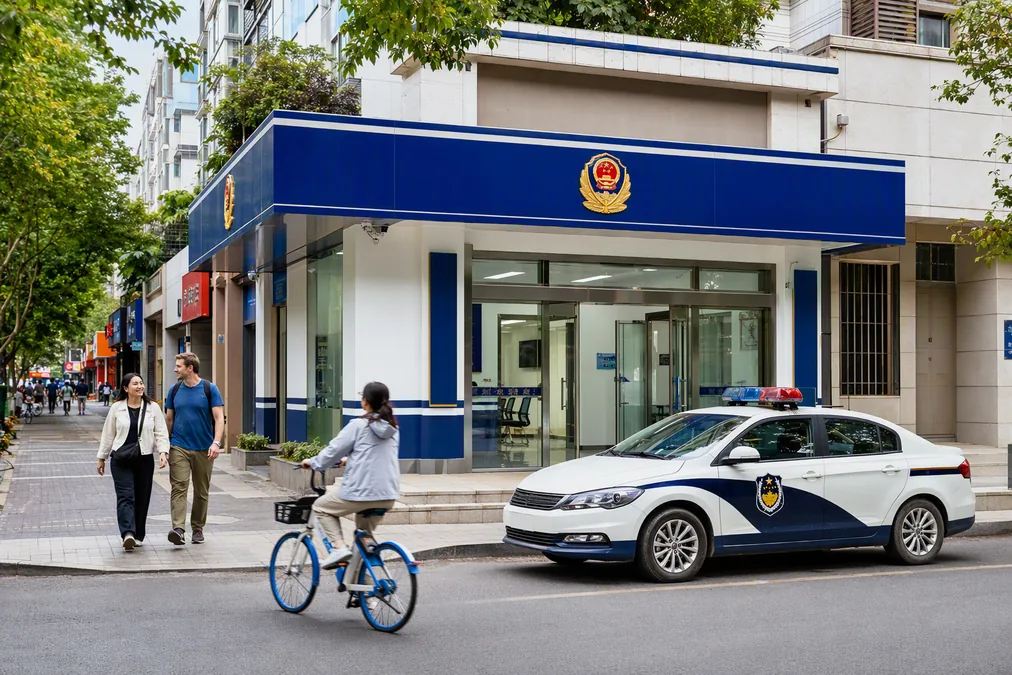
When you report a crime at a police station (派出所, pàichūsuǒ), the officers are required to log it and hand you a written case acceptance receipt, the 受案回执 (shòu'àn huízhí). Ask for it by name if it isn't offered. That slip does three jobs: it's the proof your insurer will ask for on a theft claim; it's the first document in the passport replacement chain (Beijing's process starts with a free report, done on the spot, at the station nearest to where you lost it); and it dates and fixes your account of what happened, which matters if a dispute drags on. Photograph it as soon as you have it.
To find a station, search 派出所 in your map app — every district has several — or ask your hotel to point you to the nearest one; hotels deal with them for guest registration and know the way. If your passport was in the stolen bag, follow our step-by-step guide to a lost passport in China.
When it's an embassy matter
Your embassy is for the things only your own government can do: replacing your passport, visiting you if you're detained, reaching your family, and pointing you to English-speaking lawyers and doctors. It is not a substitute for 110 or 120 — get the immediate danger handled first, then call them. Numbers, after-hours lines and what they will and won't do are in our embassy contacts in China guide.
Frequently asked questions
What are the emergency numbers in China? Is there a 911 or 112?
There's no single number. Dial 110 for police, 120 for an ambulance, 119 for fire and 122 for a traffic accident; all are nationwide, free and available 24 hours, and you dial them without an area code. If you're unsure which applies, 110 is the safe default.
Do Chinese emergency operators speak English?
In Shanghai they do: 110 offers eight foreign languages and 119 and 120 offer English. Elsewhere there is no official English commitment on the emergency lines, so assume Chinese and be ready to hand the phone to a local or show a translated message. Beijing's English-speaking 12345 line is for non-emergencies only.
Do you have to pay for an ambulance in China?
Yes. The call is free but the service is billed: in Beijing it's 50 yuan for the first 3 km, 7 yuan per kilometre after that, and a 40 yuan emergency care charge. Other cities set their own rates, and Shanghai's guidance is that you usually pay once you reach the hospital. It's a small amount compared with treatment, so call.
Will 112 or 911 on a foreign phone connect in China?
There is no official redirect for 112 or 911 in China, so treat those numbers as not working and dial 110 or 120 directly. Confirm with your carrier that roaming is switched on so the local short numbers go through.
A taxi overcharged me or a guide forced me to shop — do I call 110 or 12345?
12345. Overcharging, forced shopping and similar disputes are non-urgent complaints, which the government routes to 12345, while 110 is reserved for crime and danger. Tourism complaints go through 12345 as well, since the old 12301 tourism line was merged into it. If the situation turns threatening — you're being held or physically stopped from leaving — that's 110.
Three minutes before you fly
- Save 110, 120, 119 and 122 in your contacts as "China police", "China ambulance" and so on, and 12345 as "China complaints".
- Screenshot your hotel's address in Chinese and keep it on your lock screen or in your photos.
- Decide your rule of thumb now: danger to a person → 110 or 120; fire → 119; crash → 122; money or service dispute → 12345; scam → 96110.
- Print a card with your name, blood type, allergies and an emergency contact in English and, if you can, Chinese.
Last updated: September 2026
Read in other languages
Last train times for 10 Chinese metro systems
Every line and station, checked by hand — the same data behind our offline route planner.
Get the WaysChina App
Offline guides, currency converter, essential phrases, and more — all in your pocket.

Related Articles

Embassies in China: Emergency Numbers, Consular Districts and What They Can Do
Embassy switchboards, after-hours emergency lines and addresses for nine countries, which consulate covers your...

English-Speaking Hospitals in China: Where to Go in Beijing, Shanghai and Beyond
Three ways to see a doctor in China, the English-speaking hospitals in Beijing, Shanghai, Guangzhou, Shenzhen and...

Lost Passport in China: The Four Steps to Get Home
Lost or stolen passport in China? Report to the police, get a Loss Certificate, replace the passport at your...