

This article contains affiliate links. If you make a purchase through these links, we may earn a small commission at no extra cost to you. This helps support our work in creating free travel guides.
China's high-speed trains are the easiest way to move between cities, and they are much less intimidating than they look from the outside. The whole thing runs on your passport: you book online with your passport number, show the same passport at the station, walk to your coach and sit down. There is no check-in counter, no baggage drop, and the train leaves on the minute. This guide takes you through it in the order you'll meet it — buying the ticket, choosing a seat class, what happens on the day, what you can bring, and how refunds and changes work — so that by the end you can do your first trip without anyone holding your hand.
One bit of vocabulary first, because you'll see it in every search result. Train numbers start with a letter. G trains (高速, gāosù) are the fastest category; D trains (动车, dòngchē) are the same kind of modern train on somewhat slower, often cheaper services; C trains (城际, chéngjì) are short shuttles between neighboring cities. Older conventional trains, including most overnight ones, carry letters like K, T or Z. For a visitor the letter matters less than you'd think: G, D and C are all clean, reserved-seat and punctual. Choose by the departure time and the journey time shown in the search results, not by the letter.
Buying a ticket: two routes that both work
You have two realistic ways to buy, and it's worth knowing both, because each one covers the other's weak spot.
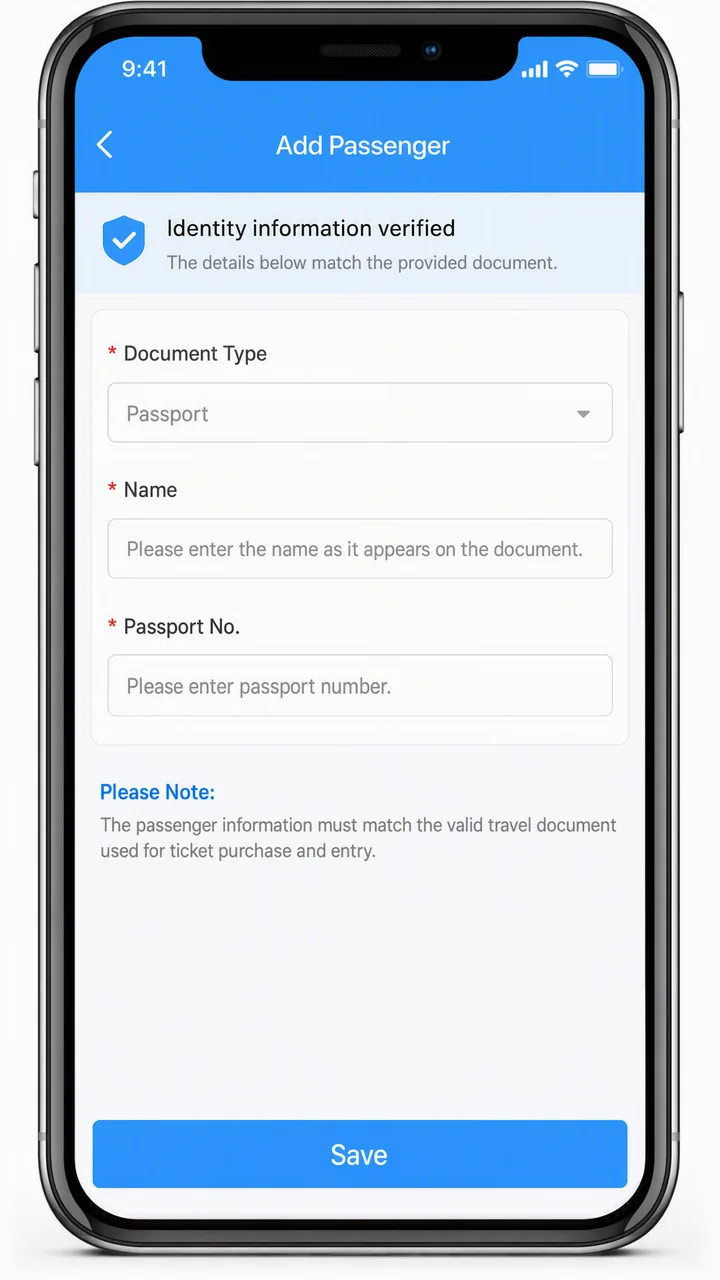
12306 (铁路12306, the official China Railway app and website) sells every ticket on every train at the fare the railway itself sets. It has an English version, and for foreigners that is the one to use: the English site accepts a valid foreign passport and nothing else — other document types have to go through the Chinese site or a station window. The catch is set-up. Before you can buy anything online, 12306 has to verify your identity. Your passenger record sits in one of three states: verified, pending or failed. Only a verified passport can book online. As a foreign passport holder you can verify in two ways — by uploading photos of your passport in the app, or in person at a station ticket window with the passport itself. Do this at home, a week or two before the trip, not the night before you travel. When you enter your name, type it exactly as the English name appears on the passport, keeping every space that's in it and putting a space between your surname and your given names — a mismatch here is the most common reason a verification gets stuck.
Trip.com (and similar agencies) sells the same seats in English with a card checkout, no identity verification, and a support line that answers in English. It charges a service fee on top of the fare, shown on the checkout page before you pay, so treat the price on the confirmation page as the real one. The tickets are real railway tickets tied to your passport, so boarding is identical. Our advice: if you're comfortable with a slightly clunky app and a bit of set-up, use 12306 and save the fee; if you have one shot at a busy train and don't want to troubleshoot, pay the fee. Either way, the full walkthrough is in how to book China train tickets.
A few rules apply whichever route you take. Tickets go on sale 15 days ahead, counting the travel day itself. There is no single nationwide release time — each station publishes its own daily release time, and 12306 keeps a lookup page for it. One passport gets one ticket per train per day, and a single 12306 order holds up to nine tickets, so a family books together in one go. The app sells and changes tickets from 05:00 to 01:00 the next morning (until midnight on Tuesdays), so don't plan a 2 am booking session.
If the train you want shows as sold out, don't give up — use the waitlist (候补, hòubǔ). You pay the fare up front as a deposit, the system keeps trying around the clock as seats are returned, and it keeps trying until, at the latest, 20 minutes before departure; if nothing comes through, the deposit is refunded in full. One waitlist order can cover up to three travel dates and up to 60 trains, and you can have up to six orders open at once. In our experience it comes through far more often than a sold-out sign suggests, because Chinese travelers book early and cancel constantly.
Which seat class to choose
On a high-speed train you'll mostly meet three classes: second class (二等座, èrděngzuò), first class (一等座, yīděngzuò) and business class (商务座, shāngwùzuò). Some trains add a premium class between first and business, and overnight D trains have bunks instead of seats.
Second class is the standard seat — roughly what economy is on a plane, with a bit more legroom — and it's where most travelers sit, including us on trips under about four hours. First class has wider seats, fewer of them in each row, and more recline; on a long daytime run or if you want to work, it's the sweet spot. Business class is the big jump: large seats that recline to nearly flat, a small quiet cabin and, on many trains, a meal served at your seat — at a big premium. Fares for each class appear side by side in the search results, so you can see the exact gap for your route before you decide, and the seat map you get when picking a seat shows the row layout of your specific train.
Children pay by age. A child from their 6th birthday up to their 14th gets a discounted ticket, from 14 they pay full fare, and each adult can bring one child under 6 for free as long as the child doesn't take a seat of their own. A child's ticket costs 50% of the adult fare in second and first class, 80% of it in premium and business class, and 70% of it for a sleeper berth on a high-speed train. The class-by-class detail, including sleepers and older trains, is in China train seat classes explained.
Travel day: from the station door to your seat
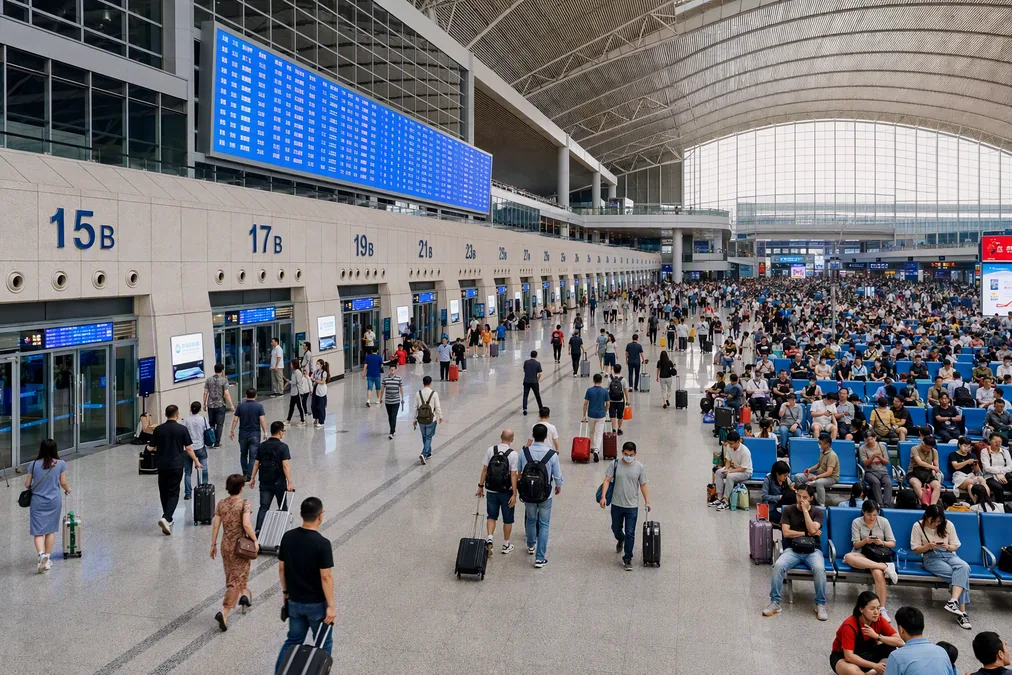
Chinese stations are big, but the flow is always the same, and once you've done it once you'll stop worrying about it.
Getting there. High-speed stations are often outside the old city center, so look up the metro route the night before. In the big cities the metro is the reliable choice; a taxi works too and the meter is honest — in Beijing, for example, the flag fall is ¥13 for the first 3 km, then ¥2.3 per kilometer, plus a ¥1 fuel surcharge per trip — but traffic is the risk, not the fare. Aim to be at the station door 45–60 minutes before departure at a big-city station, and 30 minutes at a small one. That already allows for the manual channel you'll use as a foreign passport holder. It sounds like a lot, but the entrance queue at a big station on a Friday afternoon uses most of it.
Security and ID check. Everyone puts bags through an X-ray at the entrance, airport-style but faster, and drinks are fine. Then comes the identity check, because every ticket is tied to a named passenger and staff compare the ticket record with the person and the document. Chinese travelers scan their ID cards at automatic gates. Those gates can't read a foreign passport, so you go to the manual channel (人工通道, réngōng tōngdào) — a staffed desk or lane, usually at one end of the row of gates — and hand over your passport. This applies at the entrance, at the boarding gate, and again when you leave the station at the other end. Have the passport out, not in a bag.
Nothing to print. Tickets are electronic. The booking confirmation on your phone and the printed "itinerary sheet" you can get from a machine are both just information — neither is a ticket; your passport is the ticket. Note your train number, coach and seat somewhere you can see them quickly.
Waiting hall and boarding. The big departure boards list each train with its boarding gate (检票口, jiǎnpiàokǒu). Find your gate and wait nearby; the board switches that train to "boarding" some minutes before departure, and the gate stops letting people through shortly before the train leaves — so the main thing is to be near the right gate ten minutes early. At the gate, the passport goes to the staffed lane again. Down on the platform, coach numbers are marked on the floor or on overhead screens; stand at yours, because trains stop for only a couple of minutes at through stations.
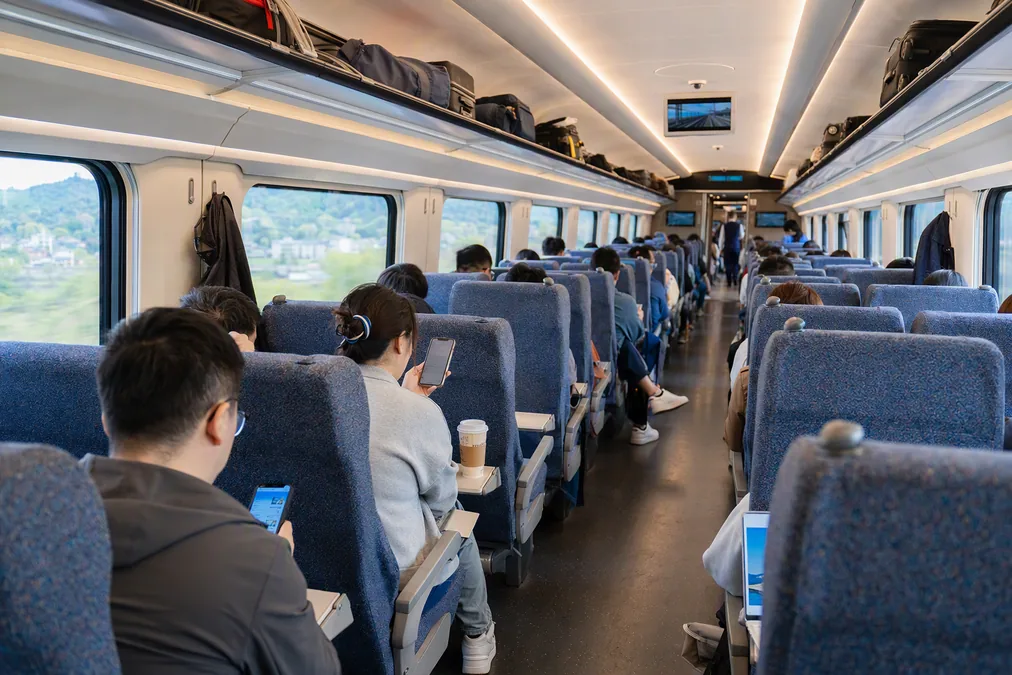
On board. Seats are numbered like a plane's (12A, 12F). Big bags go on the racks at the ends of the coach, small ones overhead. There is hot water at the end of most coaches, a trolley with snacks and boxed meals, and both Western-style and squat toilets. Announcements are in Chinese and English on major routes. For the station-by-station detail and a guide to the signs, see navigating a Chinese train station.
Luggage and what you can't bring
The official allowance is generous and, in practice, rarely weighed:
The rule most travelers actually bump into is size, not weight: on high-speed trains the length, width and height of each piece should add up to no more than 130 cm, and a piece can weigh up to 20 kg. A large suitcase is over that limit and still gets on every day, but it will have to live on the end-of-coach rack, so board early on busy trains to find rack space. Knives with a blade over 60 mm, tools, bats and similar items can't be carried on (some can be sent as consigned luggage), so leave the camping knife at home. Ordinary drinks, toiletries and food are fine. Full detail, including what happens at the X-ray, is in luggage rules in China.
Refunds and changes
If plans change, the railway's rules are more generous than most airlines':
| Refund (退票) · Time before departure | Fee |
|---|---|
| 8 days or more | Free |
| 48 hours – 8 days | 5% |
| 24–48 hours | 10% |
| Under 24 hours | 20% |
| Change (改签) | Fee |
|---|---|
| ≥48 h before departure; or to an earlier train / the same day; or after departure to another train that day | Free |
| 24–48 h before, to a train on a later date | 5% |
| Under 24 h before, to a train on a later date | 15% |
| After departure (same day), to the next day or later | 40% |
Beyond the numbers: a ticket can be changed once only, so don't spend that one change on a guess — change when the new train is certain, and if it isn't yet, wait, because inside eight days a refund costs more than a change. Online, you can refund or change up to 25 minutes before departure; closer than that, only a station ticket window can help. If you booked through Trip.com or another agency, the refund goes through them, at the same railway rates plus whatever their own terms say — read those before you book a ticket you might not use.
Frequently Asked Questions
Can foreigners buy tickets on 12306 with a passport? Do I need to verify in advance?
Yes. A foreign passport is one of the eight document types 12306 accepts for online booking, and the English site takes foreign passports specifically. Verification is the part to do early: only a passport in the "verified" state can buy online, and you get there by uploading passport photos in the app or by showing the passport at a station window. 12306's own English FAQ walks through the steps. If your verification is still pending on the day you need a ticket, buy that one through Trip.com — no verification needed there — and let 12306 catch up for later trips.
How early should I get to the station?
For a big-city station, be at the entrance 45–60 minutes before departure; 30 minutes is enough at a small station. The time goes on the entrance queue and the walk — stations are long — not on any check-in. Those numbers already allow for the manual channel you'll use at the entrance and the gate as a foreign passport holder, which can have its own queue. On a public holiday, add more still.
How much more is first class than second, and is it worth it?
The exact gap depends on the route, and the fares for every class appear side by side in the search results, so look there rather than at any rule of thumb. Our view: on trips under three or four hours, second class is perfectly comfortable and the money is better spent elsewhere; on a long daytime run, or if you want to work at a table, first class earns its price. Business class is a treat rather than a need.
Can I bring power banks and liquids on the train?
Yes to both, and this is where trains differ from planes. On trains, the published limit for a power bank or spare battery is 100 Wh per unit — a capacity rule, with nothing about markings. Liquids aren't limited apart from specific items: alcohol of 24–70% ABV is capped at 3000 mL in total, aerosols at 150 mL per can, and there are small limits on flammable toiletries like nail polish remover. Water, coffee and shampoo all go straight through. Flying domestically is another story: since June 2025 a power bank without a clear CCC (3C) mark is banned from domestic flights altogether, so don't assume the two sets of rules match.
Your first-trip checklist
- Register on 12306 and get your passport verified a week or two before you fly — or plan to book through an agency.
- Book as soon as tickets open, 15 days ahead, for holiday and weekend trains; use the waitlist if it's sold out.
- Second class for short trips, first class for long ones; kids from 6 to 13 get discounts, under-6s ride free on your lap.
- Arrive 45–60 minutes early at a big station, passport in hand; you'll use the manual channel at the entrance and the gate.
- Keep bags under about 130 cm in total dimensions if you can; leave knives at home; power banks and drinks are fine.
- If plans change, refund online up to 25 minutes before departure; it's free if the train is still eight days out.
For which routes to ride first, see our pick of the best high-speed routes for visitors in top train routes in China.
Last updated: August 2026
Read in other languages
Last train times for 10 Chinese metro systems
Every line and station, checked by hand — the same data behind our offline route planner.
Get the WaysChina App
Offline guides, currency converter, essential phrases, and more — all in your pocket.

Related Articles

How to Book China Train Tickets with a Foreign Passport: 12306 vs Trip.com
12306 or Trip.com? Both work with a foreign passport. Here's the whole process from registering and passport...

China Train Seat Classes Explained: Second, First, Business and Sleepers
What second class, first class, business class and the sleeper berths on Chinese trains are actually like, how child...

Top Train Routes
The best high-speed train routes in China, with real journey times, fare ranges, and planning tips for...

How to Navigate a Chinese Train Station with a Foreign Passport
The six steps at every Chinese high-speed station — security, the passport lane, the board, the gate, the platform,...