

This article contains affiliate links. If you make a purchase through these links, we may earn a small commission at no extra cost to you. This helps support our work in creating free travel guides.
Booking a Chinese train ticket with a foreign passport comes down to one choice and five steps. The choice is where you buy: the official 12306 app, which is cheaper but needs your passport verified first, or an agency such as Trip.com, which costs a little more and needs no verification. The five steps are the same either way — register, get verified (12306 only), book, pay, then show your passport at the station. Here's the choice in one table, and the rest of this guide walks through each step so you don't have to do any of it twice.
| 12306 (official) | Trip.com and other agencies | |
|---|---|---|
| Price | The plain railway fare, no fee | Fare plus a service fee, shown at checkout before you pay |
| Language | English version of the app and website | Full English |
| Passport verification | Required before you can buy; do it at home, in advance | Not required; you type in the passport details |
| Payment | The payment page lists what it accepts — check it before you rely on a foreign card | International cards |
| Help | Hotline 12306 (from abroad +86 12306) and email [email protected]; Chinese-first service | English chat and phone support |
| Changes and refunds | In the app, at the railway's own rates | Through the agency, at railway rates plus its own terms |
| Best for | Anyone taking more than a train or two, and anyone who needs the waitlist (see Step 3) | A first ticket in a hurry, or when verification is stuck |
Whichever you pick, the ticket that comes out is the same: an electronic railway ticket tied to your passport, boarded with the passport itself. If you haven't yet decided whether to take the train at all, start with our complete guide to China's high-speed trains; this page assumes you have.
Steps 1–2: Register on 12306 and get your passport verified
Skip this section if you're going to book through an agency. For 12306, budget twenty minutes and do it at least a week before your first train, because the verification step is not instant and you don't want to be sorting it out from a hotel lobby.
- Get the app or use the site. Search for "12306" in your app store — the official one is published by China Railway and is free — or use the English site at 12306.cn. Switch the app to English in its settings if it opens in Chinese.
- Create an account. You'll need a phone number that can receive an SMS code. A foreign number works for many travelers, but if the code never arrives, a Chinese SIM card with a local number fixes it — a data-only travel eSIM won't receive the SMS. A local SIM is worth having anyway for maps and payments (see our SIM and eSIM guide).
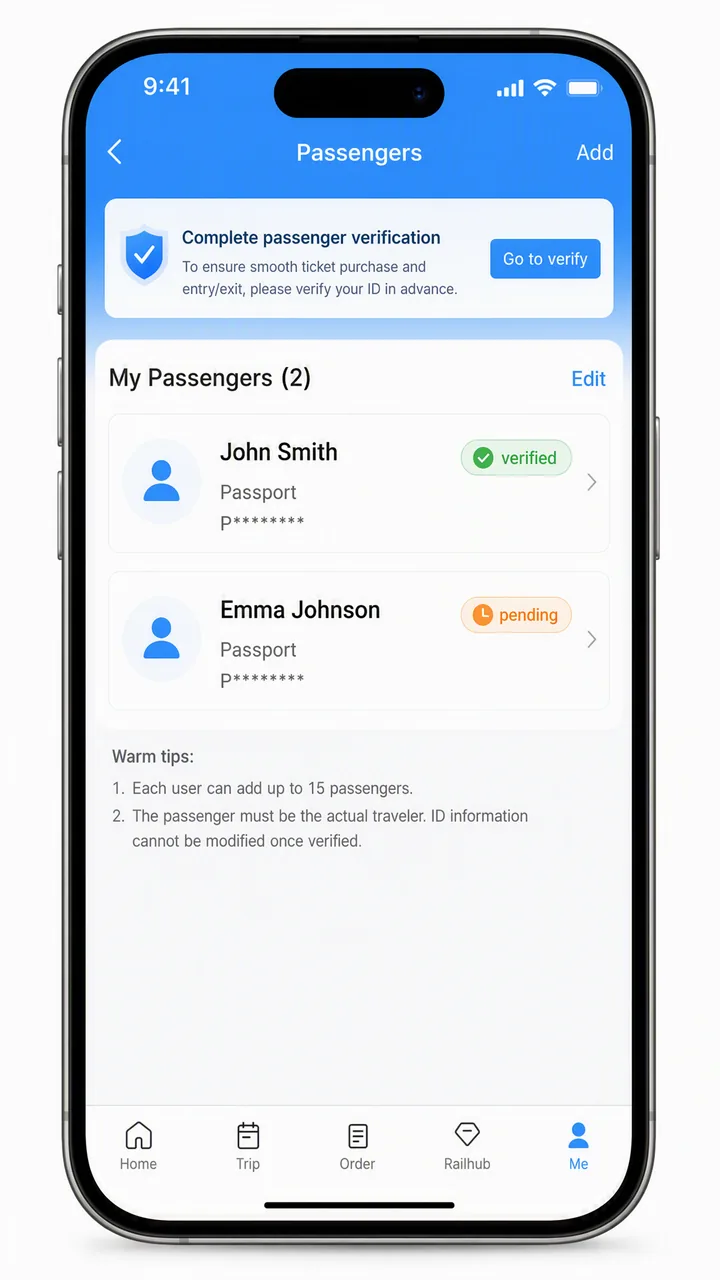
- Add yourself as a passenger with the passport. Choose passport as the document type — a foreign passport is one of the eight document types 12306 accepts for online booking, and on the English site it is the only one. Type the name exactly as the English name is printed on the passport: keep any spaces inside your names, and put a space between the surname and the given names. Don't add titles, don't drop middle names, and don't reorder the names if the passport shows the surname first. Add each travel companion the same way — every passport needs its own verification before it can go on an order.
- Verify. The app asks for photos of the passport. After you submit, your passenger record sits in one of three states — verified (已通过), pending (待核验) or failed (未通过) — and only "verified" can buy tickets online. Look at the passenger list a day later. If it's still pending, or it has failed, there's a second route: take the passport to a railway station ticket window and ask them to verify it there. That works even if you're already in China and the app route has gone nowhere.
💡 Tip: Station windows accept a wider range of documents than the app does — including a police certificate for a lost passport and a temporary travel document issued by your embassy (it must come with a valid visa or stay permit) — so if your passport situation is unusual, go to the window. See what to do if you lose your passport in China if that's you.
Step 3: When to book — presale, release times and the waitlist
Tickets go on sale 15 days before travel, counting the travel day as day one, so a ticket for the 20th appears on the 6th. That's the whole window: you can't book a month out, and for most trains you don't need to. Each departure station releases its tickets at its own time of day rather than at one national moment; 12306 publishes the release time for every station on a lookup page, which is worth a glance if you're chasing a popular train. The app sells and changes tickets from 05:00 to 01:00 the next morning, and on Tuesdays it closes at midnight instead, so an overnight booking attempt just won't go through.
For normal weeks, booking a few days ahead is fine and you'll have a choice of trains. The exceptions are the national holidays — Chinese New Year, the early-May break and the October Golden Week — plus Friday evenings and Sunday evenings on busy routes, when the popular trains sell out within minutes of release. For those, be on the app at the release time on the first day of sale, and if you miss it, use the waitlist rather than refreshing all week. Planning around the crowds is covered in our Golden Week survival guide.
The waitlist (候补, hòubǔ) is 12306's own standby system. When a train shows the waitlist option (候补) instead of a seat count, you add it to a waitlist order, pay the fare up front as a deposit, and the system keeps trying around the clock as other people cancel; it keeps trying until, at the latest, 20 minutes before departure, and any deposit that didn't turn into a ticket comes back in full. One order can cover up to three travel dates and up to 60 trains, and each user can keep up to six orders open at once. Because so many Chinese travelers book early and change later, waitlists on ordinary days come through surprisingly often. The official waitlist lives only in 12306; agencies run their own retry services on their own terms. It's one of the strongest reasons to get 12306 working.
Step 4: Choosing a seat, paying, and the one-ticket rule
Search by city and date, and the results list every train with the fare and the remaining seats for each class. Tap a train, pick the class, pick your passenger from the list, and — on most high-speed trains — choose a seat from a small map that shows which seats are window and which are aisle on that train. If you want to sit together, book everyone in one order. The classes themselves are explained in our seat class guide.
Then pay. 12306's checkout offers Chinese payment methods; whether it accepts your particular foreign card is something to check on the payment page itself rather than assume, and the reliable route for most visitors is an Alipay account with a foreign card linked — set up in our Alipay guide. You have a short window to pay before the seat is released, so have the payment method ready before you search. Two limits to know: one passport can hold one ticket per train per day, and a single order takes up to nine passengers. The first one matters if you try to "hold" two seats on the same train — the system won't let you.
Step 5: Travel day — your passport is the ticket
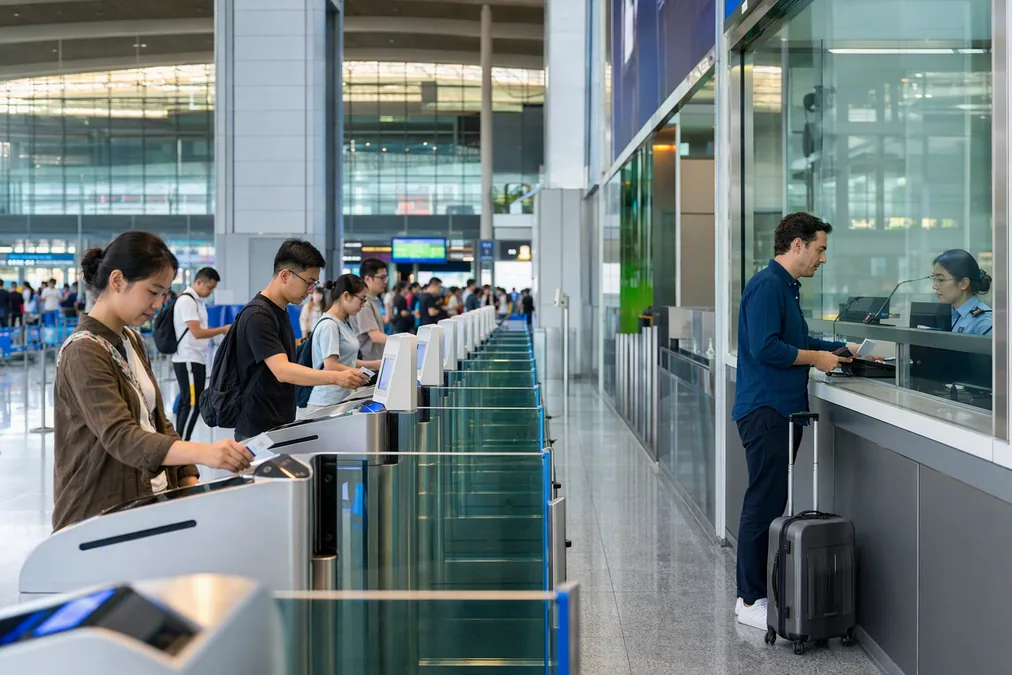
There is nothing to collect. Chinese railway tickets are electronic records tied to the passenger's document, and the document you booked with is what gets you on the train. Two pieces of paper confuse people, so to be clear: the "itinerary information sheet" you can print from a machine, and the reimbursement receipt you can request for expenses, are not tickets and won't get you through a gate. Screenshot your booking (train number, coach, seat, departure time) so you can read it in a hurry, and keep the passport in a pocket.
At the station, Chinese passengers scan an ID card at automatic gates. A foreign passport can't be read by those gates, so at every checkpoint — the station entrance, the boarding gate, and the exit at your destination — you use the manual channel (人工通道, réngōng tōngdào): a staffed lane where an officer looks at the passport and finds your ticket. It's normally at one end of the row of gates and marked in English at big stations. Build in ten extra minutes for it on busy days. The full station walkthrough is in navigating Chinese train stations.
If you need paper for an expense claim, ask for the reimbursement receipt: it's printed at a station ticket window or machine using the passport, within 180 days of the travel date. Station windows and machines print a paper ticket free of charge, while railway agency shops in town charge ¥5 per ticket. It's a receipt, not a boarding document.
After booking: refunds and changes
If you miss a train or plans move, two rules matter. First, refunds and changes are done in the app until 25 minutes before departure; in the last 25 minutes only a station ticket window can help. Second, the fee depends purely on how far ahead you act:
| Refund (退票) · Time before departure | Fee |
|---|---|
| 8 days or more | Free |
| 48 hours – 8 days | 5% |
| 24–48 hours | 10% |
| Under 24 hours | 20% |
| Change (改签) | Fee |
|---|---|
| ≥48 h before departure; or to an earlier train / the same day; or after departure to another train that day | Free |
| 24–48 h before, to a train on a later date | 5% |
| Under 24 h before, to a train on a later date | 15% |
| After departure (same day), to the next day or later | 40% |
A change (改签, gǎiqiān) moves you to another train without refunding and rebooking, but each ticket can be changed only once, and a ticket that was changed after its original departure time can't be refunded afterwards. So if your new plan is still uncertain, refund and rebook rather than using up the single change. Changing to a different destination station is also possible online, but only until 48 hours before departure. Agency bookings follow the same railway fee tiers, with the agency's own handling on top — check its policy before you book a ticket you might not use.
Frequently Asked Questions
How long does 12306's passport verification take? What if it fails?
Expect to wait, and look at the passenger list rather than waiting for a notification: the record shows "pending" until it flips to "verified", and only "verified" can buy online. Don't plan around a fixed turnaround — do it a week or more ahead. If it fails, the usual cause is the name — it must match the passport's English name letter for letter, including the spaces — so fix that and resubmit. If it's still stuck and you're in China, walk into a station with the passport and have it verified at the ticket window. If you're not yet in China and a train is imminent, book that one through an agency and keep the 12306 account for later.
I bought through Trip.com — how do I collect the ticket and get on the train?
You don't collect anything. An agency such as Trip.com books a real railway ticket against your passport, so it's the same electronic ticket you'd have from 12306, and your passport is the boarding document. Walk to the manual channel at the entrance and at the gate, show the passport, and you're through. The confirmation email is for your own reference — nobody at the station needs to see it.
How far in advance can I book a train?
15 days before travel, counting the day of travel itself. Tickets appear at the release time of the departure station, which varies station by station — 12306's release-time page tells you when. For an ordinary weekday train, a few days ahead is plenty; for holiday travel, be there at release on day one.
How much does a refund cost, and how late can I still refund?
Refunding costs nothing if the train is still eight or more days away; from then it's 5% of the fare until 48 hours before departure, 10% between 48 and 24 hours, and 20% inside the last 24 hours, with a minimum charge of ¥2. Online refunds are accepted until 25 minutes before departure; after that, go to a station ticket window. If you missed the train: a change to a later train on the same day is still allowed after departure — ask at the window.
The timeline
- Before you leave home: install 12306, register, add your passport, submit verification. Or decide you'll use an agency.
- 15 days before the train: tickets appear at the departure station's release time; book, or waitlist if sold out.
- Up to 25 minutes before departure: refund or change in the app if plans move (changes during the app's selling hours).
- Travel day: passport in hand, manual channel at the entrance and the gate, coach number from your booking screenshot.
Last updated: August 2026
Read in other languages
Last train times for 10 Chinese metro systems
Every line and station, checked by hand — the same data behind our offline route planner.
Get the WaysChina App
Offline guides, currency converter, essential phrases, and more — all in your pocket.

Related Articles

China High-Speed Trains: The Complete First-Timer's Guide
How China's high-speed trains work for a first-time visitor: booking with a passport, choosing a seat class, the...

China Train Seat Classes Explained: Second, First, Business and Sleepers
What second class, first class, business class and the sleeper berths on Chinese trains are actually like, how child...

Top Train Routes
The best high-speed train routes in China, with real journey times, fare ranges, and planning tips for...

How to Navigate a Chinese Train Station with a Foreign Passport
The six steps at every Chinese high-speed station — security, the passport lane, the board, the gate, the platform,...