

This article contains affiliate links. If you make a purchase through these links, we may earn a small commission at no extra cost to you. This helps support our work in creating free travel guides.
When you search a train on 12306 or Trip.com, the classes appear as a short list of names with a price next to each. Here's what they mean, in one table, and then the detail. The short version: second class is the normal seat and it's good; first class buys more space and quiet; business class is a near-flat seat at a big premium; and on overnight trains you choose between a soft sleeper and a cheaper hard sleeper. China Railway officially runs eleven classes in all, from hard seat to deluxe soft sleeper, but a visitor will only ever meet the handful below.
| Class | What it's like | Price | Child fare (ages 6–13) |
|---|---|---|---|
| Second class 二等座 (èrděngzuò) | The standard seat on every high-speed train; a small recline and a tray table | The base fare | 50% of the adult fare |
| First class 一等座 (yīděngzuò) | Wider seat, fewer seats per row, more recline and legroom, quieter coach | Noticeably more than second — the search results show the exact gap for your route | 50% |
| Premium first 优选一等座 (yōuxuǎn yīděngzuò) / Superior 特等座 (tèděngzuò) — English labels vary by app | A small cabin a step up from first, on some trains only | Your train's fare column shows where it lands | 80% |
| Business class 商务座 (shāngwùzuò) | Large seat reclining to nearly flat, small cabin, meal and drinks served | The most expensive seat by a wide margin | 80% |
| High-speed sleeper 动卧 (dòngwò) | A bunk in a compartment on an overnight D train | Shown per bunk in the search results | 70% |
| Soft sleeper 软卧 (ruǎnwò) | A closed compartment with a door and fewer bunks, on conventional trains | The pricier of the two conventional bunks | 50% |
| Hard sleeper 硬卧 (yìngwò) | Open bays of stacked bunks, no door | The cheaper bunk | 50% |
| Hard seat 硬座 (yìngzuò) | Upright bench seats on conventional trains | The cheapest ticket on the railway | 50% |
Child fares follow age, not height: a child aged 6 to 13 pays the discounted fare, from the 14th birthday it's full fare, and each adult may bring one child under 6 free of charge provided the child doesn't occupy a seat or bunk of their own. Where a class is missing from a train, it simply isn't on that train — a typical daytime G train shows second, first and business; an overnight conventional train may show hard sleeper, soft sleeper and hard seat. The classes that appear in your search results are the only list that matters.
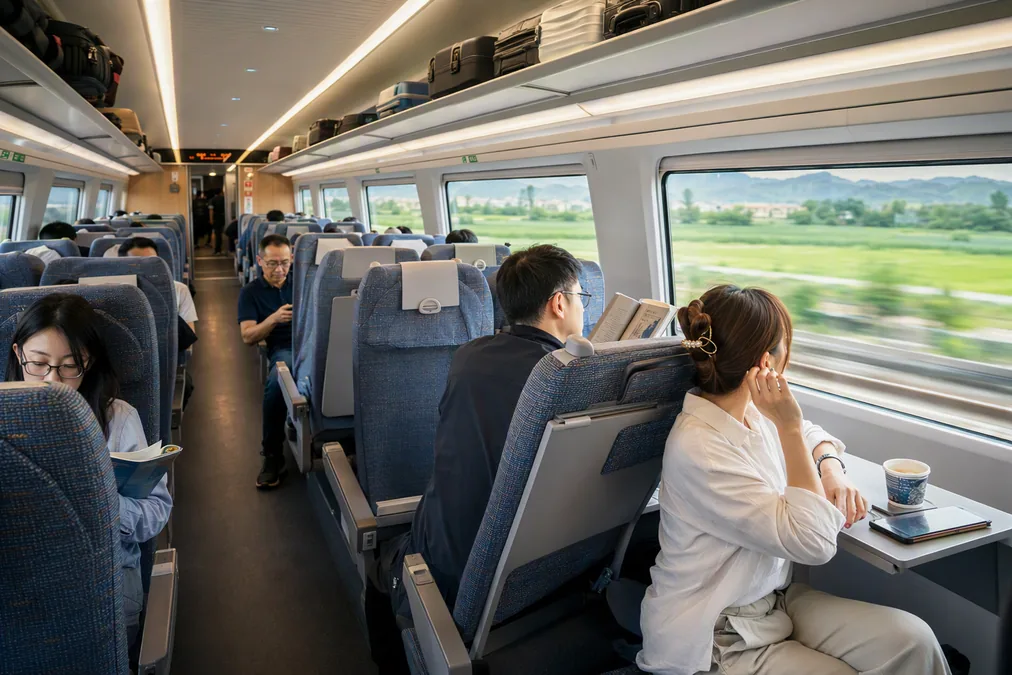
The three high-speed classes, one by one
Second class (二等座)
This is the seat most of China rides in, and it's better than its name suggests. Seats are in rows with a tray table, a small recline and an armrest, in a bright, quiet, air-conditioned coach; luggage goes overhead or on the rack at the end of the coach. The seat map you get when booking shows which seats are window and which are aisle, and how the rows are arranged on your particular train, so there's nothing to memorize. Comfort is close to a decent economy seat on a plane, with more legroom and — the big difference — the freedom to walk to the dining car and the hot-water tap whenever you like. On a trip of up to about four hours, we book second class without a second thought.
First class (一等座)
First class removes the one real complaint about second: the squeeze. Seats are wider, there are fewer of them in each row, they recline further, and the coach is noticeably calmer — fewer people, fewer phone calls. Whether your seat has a power socket depends on the train, not the class — look under the seat or in the armrest once aboard, and don't plan a long trip around it. The fare gap between first and second changes with the route, and both fares sit side by side in the search results, which is the right place to decide. Our rule: for a run of five hours or more, or any trip where you want to open a laptop, first is worth it; for two hours it usually isn't.
Business class (商务座)
Business class is a different product rather than a bigger seat. You get a large leather seat that reclines to nearly flat, in a small cabin at one end of the train, with a meal and drinks brought to you and a quiet that the rest of the train doesn't have. It costs far more than first class, so it's a treat, not a default. Where it shines is a long trip on which you want to sleep for real, or a once-on-the-trip splurge on a scenic run. Some trains also sell a superior class (特等座, tèděngzuò), which is on the railway's official list of classes, or a premium first class (优选一等座, yōuxuǎn yīděngzuò), which appears in the official fare rules alongside it. Think of both as a step between first and business; the fare column for your train shows exactly where. If business is sold out, that's your upgrade.
One thing all three share: the on-board rules are the same — the railway's carry-on limit for a power bank is 100 Wh per unit in every class, hot water is free at the end of the coach, and the trolley and dining car sell the same food to everyone.
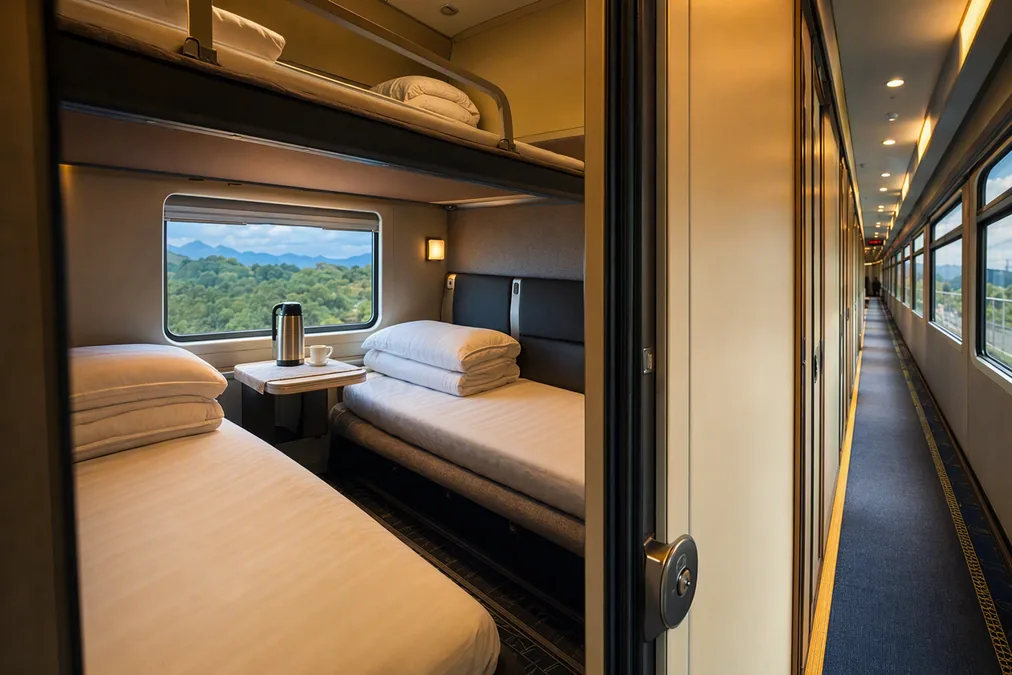
Sleepers and conventional trains
High-speed trains cover most of the routes a visitor wants, but for the long overnight hops — anywhere in the far west, the trip to Lhasa, or simply saving a hotel night — you'll be looking at bunks, and the names change.
High-speed sleeper (动卧, dòngwò) is the bunk on an overnight D train: a compartment with a door on a modern train, leaving in the evening and arriving early morning, so you save a hotel night and a day of travel. Where it exists it's the best overnight option, and it sells out first. On the booking screen you may also see first-class sleeper and second-class sleeper (一等卧 / 二等卧), which are official class names for bunks at two comfort levels.
Soft sleeper (软卧, ruǎnwò) is the closed compartment on a conventional train: a door you can lock, a small table, bedding provided, and a shared toilet at the end of the carriage. It's the comfortable way to do a long conventional route, and the one we'd choose for a first overnight. Deluxe soft sleeper (高级软卧, gāojí ruǎnwò) is a rarer, roomier version on a few flagship trains.
Hard sleeper (硬卧, yìngwò) is the open-bay bunk: no door, bunks stacked higher, a thinner mattress, lights out at a set time. It's cheaper, sociable and safe; people share snacks and will want to know where you're from. The lowest bunk has the most headroom and doubles as everyone's daytime seat; the top bunk is the most private and the hardest to climb into. The fare differs by bunk level, and the booking screen shows each.
Hard seat (硬座) is the upright bench seat on conventional trains — fine for two or three hours, grim overnight. Soft seat (软座, ruǎnzuò) exists on a few trains and is a padded version of the same idea.
Who should pick what
- Short trip, up to about four hours: second class. The difference in comfort barely registers on a trip this short, and the time on board is the same.
- Long daytime trip, five hours or more: first class if it costs no more than about half again the second-class fare on your route (the results page shows both); otherwise second class with a window seat and a snack bag.
- With small children: second or first class, seats booked together in one order. One under-6 per adult rides free on your lap, and the aisle of a Chinese train is a fine place for a toddler to walk. For an overnight, a soft sleeper compartment is a private room for a family. More in traveling with kids in China.
- With big luggage: the class doesn't change the luggage rule — every adult can bring 20 kg free, in pieces whose length, width and height add up to no more than 130 cm on a high-speed train. That's the same weight Air China allows as a free checked bag in domestic economy, but we've never seen it weighed on a train; the real limit is rack space, so board early and use the rack at the coach end. See luggage rules in China.
- Overnight: high-speed sleeper if the route has one, then soft sleeper, then a lower bunk in hard sleeper. Hard seat overnight only if the budget really demands it.
- Want to sleep on a day train: business class, or first class with a neck pillow.
Picking the class when you book, and when it's sold out
On 12306 and on agency sites the classes appear under each train with the remaining seats; tap the one you want and continue to passengers and payment — the booking steps are in how to book China train tickets. If your class shows sold out, you have three options: take another class on the same train, take the next train, or join 12306's waitlist — you pay a deposit, the system keeps trying until, at the latest, 20 minutes before departure, and it refunds the deposit if no seat comes through. A single waitlist order can cover several trains and up to three dates. Some trains also sell "no seat" (无座, wúzuò) tickets, which means standing or sitting on your bag in the space by the doors — fine for an hour, not for four. The waitlist lives on 12306 itself; if you're booking through third-party platforms handle the booking process in English and your class is sold out, use whatever that page offers, or switch to 12306 for the waitlist.
Frequently Asked Questions
Is the difference between first and second class actually big?
It's real but not dramatic. First class gives you a wider seat, more legroom, more recline and a quieter coach; second class gives you a perfectly decent seat in a fuller coach. On a two-hour trip most people can't tell you afterwards which they were in. On a six-hour trip, the extra space and calm are what you remember. Look at the two fares on your route in the search results and decide with that number in front of you rather than with a rule of thumb.
Is business class worth the money?
As a treat, yes; as a habit, no. The lie-flat seat, the small cabin and the service are genuinely good, and on a long run they mean you arrive rested. But the fare gap to first class is large, and first class already solves the comfort problem on most trips. Our suggestion: do it once, on the longest or most scenic leg of your trip, and ride first or second the rest of the time.
How do child fares work, and at what age do kids travel free?
By age, not height. A child who has turned 6 but not yet 14 gets the child fare, from 14 it's full price, and each adult can bring one child under 6 for free as long as the child doesn't take up a seat or bunk of their own; ages count on the travel date, and you declare the child when you book. If you want a seat for the small one, buy a child ticket. The child fare is 50% of the adult fare in second and first class and on conventional trains, 80% in business, superior and premium first, and 70% for a high-speed sleeper bunk. The official wording is on 12306's child ticket page.
Hard sleeper or soft sleeper for an overnight?
Soft sleeper if you can get it and the price doesn't sting: the lockable door, the smaller compartment and the bedding are what let you actually sleep. Hard sleeper if you're on a budget, traveling solo and happy to chat, or if soft is sold out — in which case book a lower or middle bunk and bring earplugs. Either way, the carriage is safe and the staff walk through regularly.
Three sentences to remember
Second class for anything short; first class for long days or work; business as a one-time treat. Overnight, take a bunk with a door if you can afford it. And whatever you choose, the fares are side by side on the booking screen — decide there, with your route's real numbers, then head to the complete high-speed train guide for the rest of the trip.
Last updated: August 2026
Read in other languages
Last train times for 10 Chinese metro systems
Every line and station, checked by hand — the same data behind our offline route planner.
Get the WaysChina App
Offline guides, currency converter, essential phrases, and more — all in your pocket.

Related Articles

China High-Speed Trains: The Complete First-Timer's Guide
How China's high-speed trains work for a first-time visitor: booking with a passport, choosing a seat class, the...

How to Book China Train Tickets with a Foreign Passport: 12306 vs Trip.com
12306 or Trip.com? Both work with a foreign passport. Here's the whole process from registering and passport...
Top Train Routes
The best high-speed train routes in China, with real journey times, fare ranges, and planning tips for...

How to Navigate a Chinese Train Station with a Foreign Passport
The six steps at every Chinese high-speed station — security, the passport lane, the board, the gate, the platform,...