

This article contains affiliate links. If you make a purchase through these links, we may earn a small commission at no extra cost to you. This helps support our work in creating free travel guides.
Every Chinese high-speed station works the same way, from Shanghai Hongqiao with dozens of gates down to a two-platform county stop. There are six steps, and a foreign passport changes only one thing about them: at the three ID checks (two on the way in, one on the way out) you use a staffed lane instead of the automatic gates. At some stations the ID check comes before security rather than after; it's the same two steps either way.
- Entrance security. Bags go through an X-ray, you walk through a scanner. Drinks and food are fine.
- ID check. Chinese ID cards go through automatic gates; a foreign passport goes to the staffed manual channel.
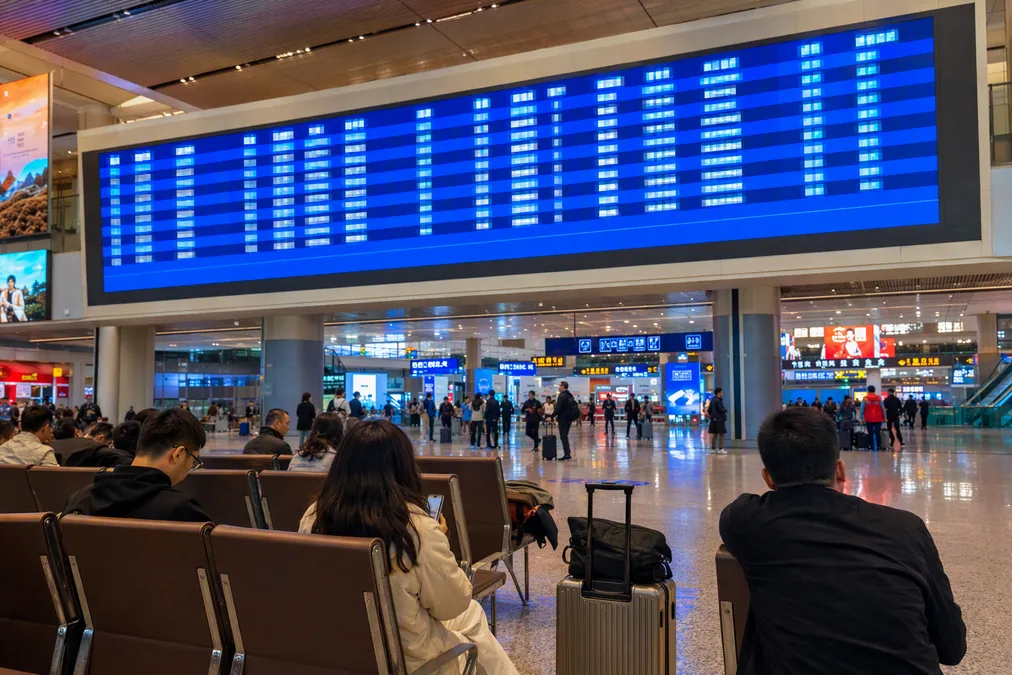
- Waiting hall. Find your train on the board, note the gate number, sit near that gate.
- Boarding gate. Opens some minutes before departure — passport to the manual lane again.
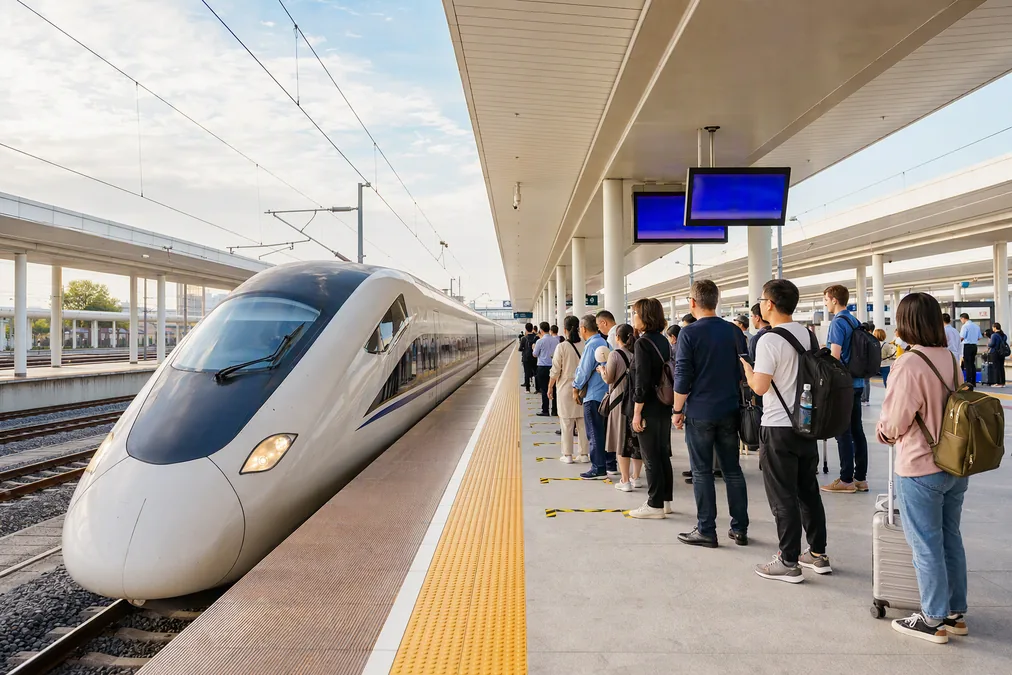
- Platform. Coach (car) numbers are marked on the floor and on screens; stand at yours.
- Seat. Coach and seat number are on your booking; big bags go on the rack at the end of the coach.
How early? There is no check-in, so the only question is how long the queues are. Our rule: be at the station entrance 45–60 minutes before departure at a big-city station, 30 minutes at a small one, and more on public holidays. That already allows for the passport lane. A flight has a hard cutoff — at most Chinese airports, check-in for a domestic departure closes somewhere between 20 and 45 minutes before takeoff — but a train doesn't: the gate simply shuts shortly before the train leaves, and the departure board shows the status. The time you allow is for the entrance queue and the walk, which at the biggest stations can be several hundred meters. And if you do miss the train, go to the ticket window: a change to a later train on the same day is free.
Getting in with a foreign passport
Chinese train tickets are tied to a named person: you buy with a document, and at the station staff check that the ticket record, the person and the document match. There is nothing to print — the ticket exists as a record against your passport, and the passport is what you board with; a printed itinerary sheet or a booking email is not a ticket. Keep the passport in a pocket you can reach with one hand, because you'll show it three times.
The automatic gates read Chinese ID cards and a few other local documents, not foreign passports, so passport holders use the manual channel (人工通道, réngōng tōngdào) — a staffed lane or desk at the end of the row of gates — at the station entrance, at the boarding gate, and again at the exit when you arrive. Look for the sign 人工通道, often with "Manual" or "Staff" in English at big stations; if you can't see it, walk to either end of the gate row. The officer takes the passport, finds your ticket on a screen and waves you through; if the booking doesn't come up, the ticket window (售票处, shòupiàochù) can look it up with your passport. The full list of documents the gates accept is on the railway's entry and exit notice. On a normal day the lane takes a minute; on a Friday evening there can be a short queue of other passport holders and families with small children, which is why the timings above include a cushion.
💡 Tip: The name on the booking has to match the passport exactly for the officer's search to find you. On 12306 that means the English name in passport order, with a space between surname and given names and every space that appears inside the names. If verification of your passport is still pending in the app, you can't book online at all; a station ticket window can verify it in person. Booking is covered step by step in how to book China train tickets.
Finding your train, gate, platform and coach
Check the station on your booking before anything else — big cities have several, far apart (Beijing South and Beijing West, Shanghai Hongqiao and Shanghai station), and going to the wrong one is the most common way visitors miss a train. The departure board in the waiting hall lists every train by number — G, D or C plus digits — with its destination, departure time, boarding gate (检票口, jiǎnpiàokǒu) and a status word. At big stations the board alternates between Chinese and English. Three status words matter: waiting (候车), boarding (正在检票), and stopped (停止检票), which appears shortly before departure and means the gate is closed. Match the train number on your booking to the board; the destination shown may be the train's final stop rather than yours, so the number is what you trust.
Your booking has four things you need: train number, date, coach (车厢, chēxiāng) and seat (座位, zuòwèi). One passport, one ticket per train per day — travel companions each need their own booking. Gates open some minutes before departure, and the board switches to "boarding" when they do; there's no need to queue at the gate before that. Through the gate, follow the signs down to the platform, where coach numbers are painted on the floor and shown on overhead screens. Stand at your number: trains stop for only a couple of minutes at intermediate stations, and walking half a train's length to your coach in that time is stressful. If you do board the wrong coach, walk through inside the train rather than along the platform — except on a 16-coach train made of two coupled sets, where you can't pass between coaches 8 and 9, so get the right half.
Luggage: what you can bring, and where it goes
In practice nobody weighs bags, and the limit you'll actually feel is size: on a high-speed train each piece should measure no more than 130 cm in length, width and height added together, and weigh no more than 20 kg. A big suitcase is over that and still travels every day; it just has to go on the rack at the end of the coach, so board promptly on a busy train to get rack space. Small bags go overhead, a backpack fits at your feet. Security is mostly interested in knives and tools — anything with a blade over 60 mm, bats, hammers and the like can't come through the X-ray as hand luggage, though some can be sent as consigned luggage. Power banks up to 100 Wh are fine on trains. Note that this is looser than flying: since June 2025, domestic flights refuse any power bank without a clear CCC (3C) mark, so a bank that boarded a train happily can be confiscated at an airport. Full list and edge cases in luggage rules in China.
What's at the station and on the train
Water and charging. Free hot water taps (开水, kāishuǐ) are standard — in the waiting hall and at the end of most coaches — which is why so many passengers carry a thermos or an instant-noodle cup. Bring a bottle you can refill. Sockets vary by train, so don't count on one at your seat; a power bank is the reliable answer, and one up to 100 Wh is allowed on board.
Food. Waiting halls have convenience stores and fast-food counters. On the train, a trolley passes with snacks, drinks and boxed meals, and longer trains have a dining car (餐车, cānchē). Bringing your own food is normal and nobody minds; if your route includes a stop of a few minutes, don't leave the train for it.
Toilets. Most coaches have toilets at one end; high-speed trains have both Western-style and squat types, so walk to the next coach if you'd rather have the other one. Station toilets are free and generally clean but rarely supply paper — carry tissues.
Wi-Fi and phones. Station and train Wi-Fi, where it exists, usually needs a Chinese phone number to log in, so don't plan around it; mobile data works for most of the ride, with gaps in tunnels. Announcements are in Chinese and English on major routes.
Families and accessibility. Big stations have a nursing room (母婴室, mǔyīngshì), step-free routes to the platforms, and a priority waiting area for elderly passengers, people with disabilities and families with babies; ask at the service desk (服务台, fúwùtái) near the entrance, where staff can also help you to the platform if you need it. Folding wheelchairs and strollers don't count toward your luggage allowance.
Getting out and onward
At your destination, follow the exit signs (出站, chūzhàn). There's one more ID check on the way out, and the passport goes to the manual lane again. From the exit hall, signs point to the metro (地铁), taxis (出租车) and ride-hailing pickup (网约车).
Metro. Most big high-speed stations sit on the city's metro, and it's the option we'd take first: a fare you know before you ride, no traffic, no touts. Shanghai Hongqiao station, for example, is served by Line 10, which also links both Hongqiao Airport terminals; if you're heading on to Pudong Airport from there, walk through to the Terminal 2 side: Line 2 runs straight through to Pudong Airport, and the faster Airport Link Line leaves Hongqiao Terminal 2 until 22:00. Late trains are the catch — metro lines stop at night and the last train varies by line and direction. We keep a last-train timetable for each city: Beijing, Shanghai, Guangzhou, Shenzhen, Chengdu, Chongqing, Hangzhou, Nanjing, Wuhan and Xi'an. The same timetables work offline in the WaysChina app. How the systems work day to day is in our metro guide.
Taxi and DiDi. Use the official taxi rank, which is signed from the exit and has a queue and a marshal; ignore anyone approaching you inside the station offering a car. Meters are the norm, and night surcharges are official — in Beijing, for example, taxis add 20% per kilometer between 23:00 and 05:00. DiDi works at stations too, with a designated pickup point that the app will name; you'll need mobile data for it. See taxis and ride-hailing in China for how to hail, pay and avoid the few scams.
Arriving late. If your train gets in after the last metro, the official taxi rank at major stations stays open for late arrivals — expect a queue, not an empty rank. If you'd rather not deal with it at 1 am, a hotel within walking distance of the station — most big stations have several — is the easy fix; you can filter by distance to the station on Booking Com.
Frequently Asked Questions
How early do I need to be at the high-speed station?
Be at the entrance 45–60 minutes before departure at a big-city station and 30 minutes at a small one. That covers security, the manual passport lane you'll use at the entrance and the gate, and the walk to the platform. Add time on public holidays and Friday evenings. If you're cutting it fine, the thing to watch is the board: once your train shows "stopped" the gate is closed, and the train won't wait.
I don't have a Chinese ID card — can the gates read my passport?
No. The automatic gates read Chinese ID cards and a few other local documents, and a foreign passport is not one of them, so you go to the manual channel — the staffed lane at the end of the gate row — at the entrance, the boarding gate and the exit. That's the whole difference. The passport itself is your ticket; there's nothing else to show.
Can I bring water, food and alcohol on the train?
Water and food, yes, with no limits that matter to a traveler — there's no liquid rule on trains the way there is at airports. Alcohol is allowed within limits: drinks between 24% and 70% ABV may total up to 3000 mL per person; a bottle of wine or a couple of bottles of baijiu are fine. Aerosols and flammable toiletries have small caps too (150 mL per spray can, for instance). Drinking a beer at your seat is normal.
Will the metro still be running when my train arrives late at night?
Often not — most lines stop somewhere between roughly 22:30 and midnight, and the last train differs by line and direction. Look up the exact time for your line on our last-train pages (linked above) before you board, and if your train gets in after that, go straight to the official taxi rank, which stays open for late arrivals at major stations (expect a queue); night surcharges are normal and metered.
Travel-day pocket list
- Passport in an easy pocket — you'll show it at the entrance, the gate and the exit.
- Booking screenshot: train number, coach, seat, departure time.
- At the entrance 45–60 minutes early at a big station; manual lane, not the gates.
- Find the train number on the board, sit by the gate, move when it says "boarding".
- Coach number on the platform floor; big bags on the end rack.
- Look up your destination's last metro train before you get on.
For everything before the station — choosing a train, seat classes, tickets — start with the complete guide to China's high-speed trains.
Last updated: August 2026
Read in other languages
Last train times for 10 Chinese metro systems
Every line and station, checked by hand — the same data behind our offline route planner.
Get the WaysChina App
Offline guides, currency converter, essential phrases, and more — all in your pocket.

Related Articles

China High-Speed Trains: The Complete First-Timer's Guide
How China's high-speed trains work for a first-time visitor: booking with a passport, choosing a seat class, the...

How to Book China Train Tickets with a Foreign Passport: 12306 vs Trip.com
12306 or Trip.com? Both work with a foreign passport. Here's the whole process from registering and passport...

China Train Seat Classes Explained: Second, First, Business and Sleepers
What second class, first class, business class and the sleeper berths on Chinese trains are actually like, how child...
Top Train Routes
The best high-speed train routes in China, with real journey times, fare ranges, and planning tips for...