
Shanghai food has a reputation problem among visitors: everyone knows the soup dumplings, almost nobody orders anything else. That's a shame, because the local cuisine — sweet, dark, soy-and-sugar rich — is one of China's most approachable for first-timers, and the city makes eating easy: picture menus, QR ordering, and hygiene grades posted at the door. Here's what to eat, where to actually eat it, and how to handle the practical bits from ordering to allergies.
What to eat: the short list that matters
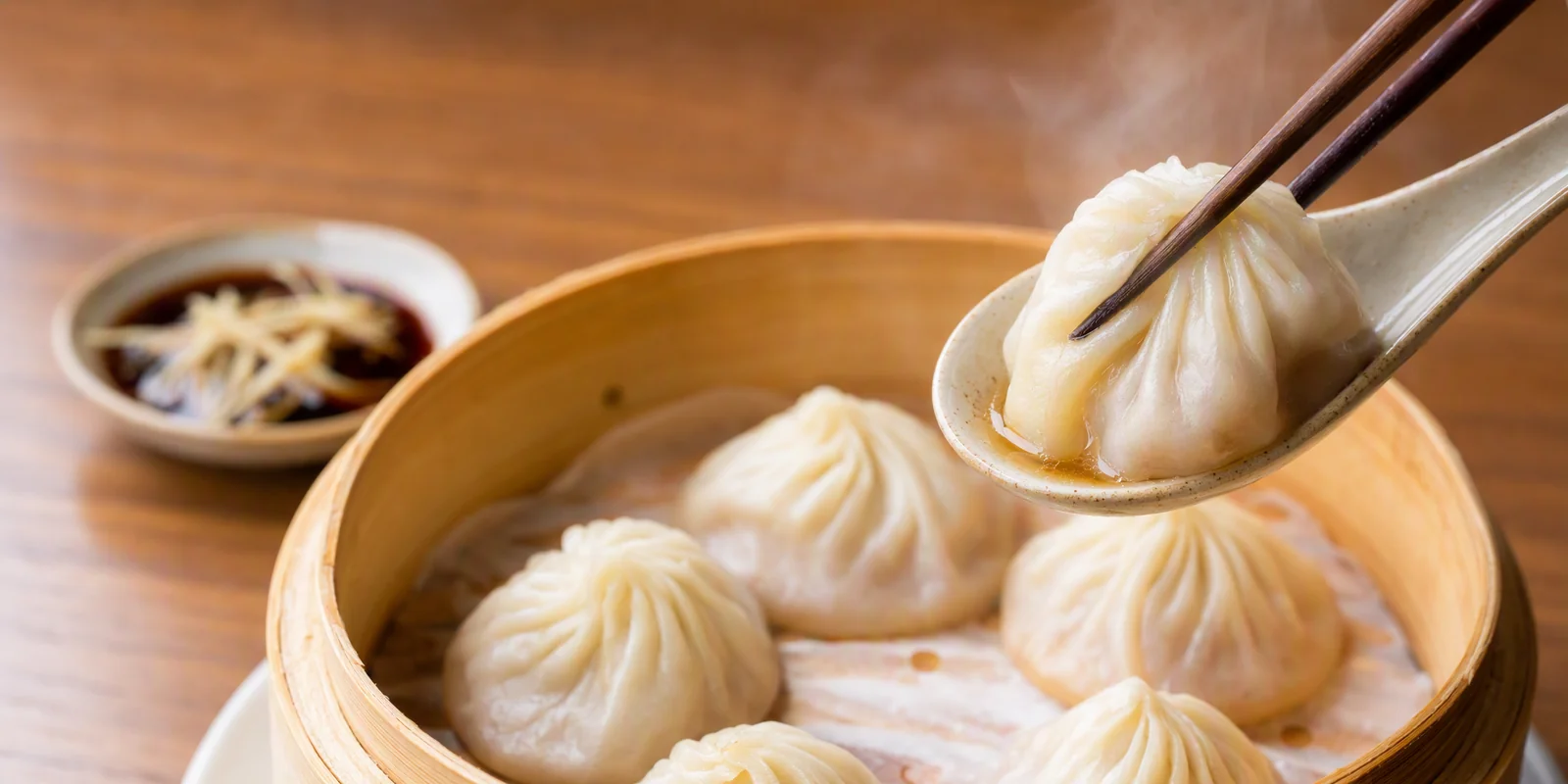
Start with the two dumplings, and learn the difference. Xiaolongbao (小笼包, xiǎolóngbāo) are the delicate steamed ones full of hot soup — the soup comes from cubes of jellied broth that melt during steaming. Eat them the local way: lift one onto your spoon, nip a hole in the wrapper, drink the soup first, then eat the rest. Bite straight in and you'll scald your mouth and lose the point of the dish. Shengjianbao (生煎, shēngjiān) are the heartier cousin: thicker-skinned pork buns pan-fried so the bottom turns crackly while the top stays soft, scattered with sesame and spring onion. They hold even more molten soup — same technique, more caution.
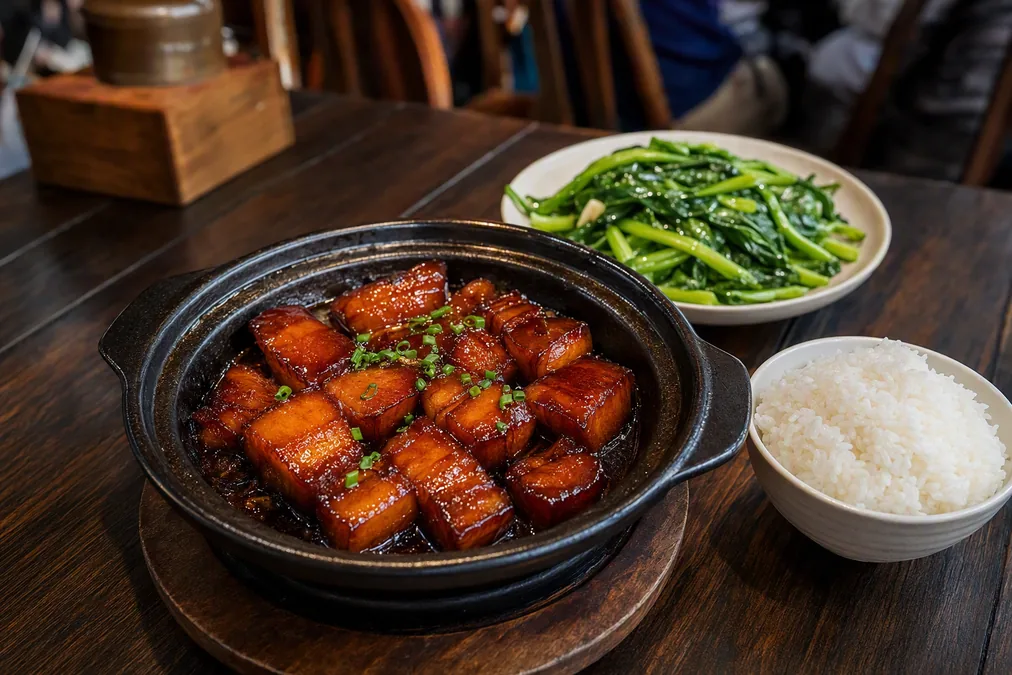
Then go one level deeper into benbang cai (本帮菜, "local cuisine"). The signature move is hongshao — "red-braising" in soy, sugar and wine — and hongshao rou, red-braised pork belly, is the dish to order once even if you order nothing else local. Drunken chicken (cold, rice-wine-steeped), and yan du xian (腌笃鲜) — a spring soup of fresh and salted pork with bamboo shoots — round out the classics. If you're here from roughly October to December, restaurants go crab-mad: hairy crab season is a genuine local event, and also when prices spike hardest.
Where to eat: think in zones, not restaurant names
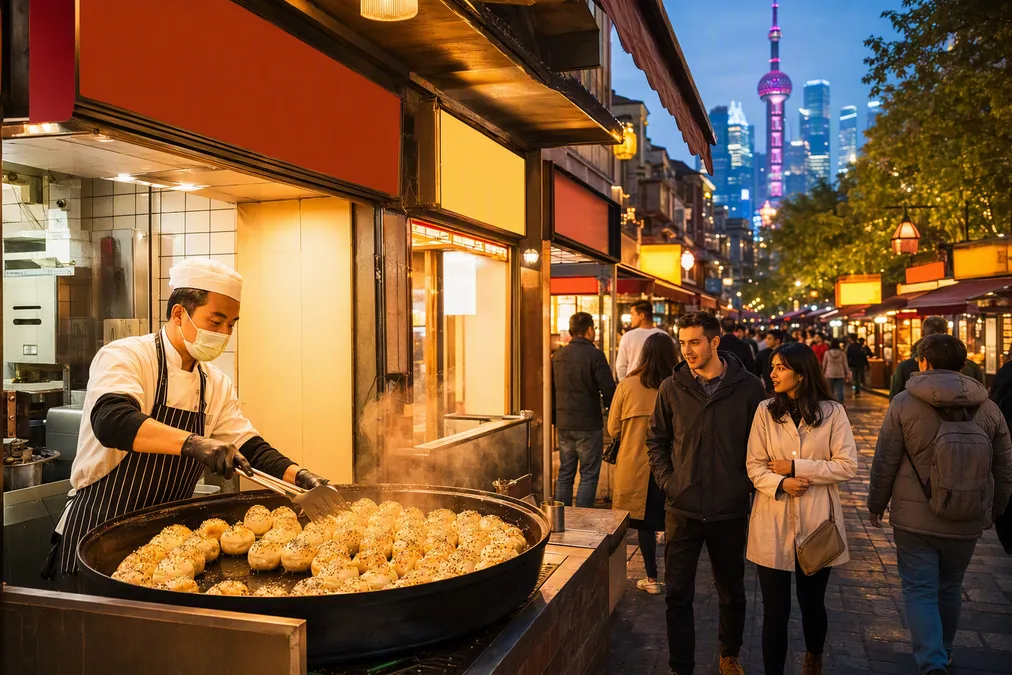
The old town around Yu Garden holds the famous century-old names, and the honest version is: the food is decent, the queues are long, and you're paying for the setting. Go if you're already there for the garden; don't cross town for it. The better eating is in ordinary neighborhoods — the streets around Jinxian Road and South Yunnan Road are the classic local restaurant rows, and the former French Concession is where casual benbang places sit next to coffee shops. And don't dismiss the mall basements: every big shopping center has a lower-level food hall where you can point at real food from a dozen regional chains, pay by QR code, and eat well — it's the reliable fallback when you're tired, hungry and out of decision-making energy. One more play: skip the hotel breakfast at least once. The morning stalls on any residential corner — jianbing (煎饼) egg crepes, youtiao (油条) fried dough sticks, steamed buns, hot soy milk — are the cheapest genuinely local meal in the city, and they're mostly gone by mid-morning.
Ordering and paying, quickly
Most sit-down places now use QR-code ordering — scan the code on the table, and the menu usually has photos even when it has no English. Translation apps handle the rest; our zero-Chinese ordering guide has the full toolkit. For paying: mobile payment — Alipay or WeChat Pay — rules here as everywhere in China; visitors can pay by app, card or cash, and setting up WeChat Pay takes your passport and an overseas mobile number; see the WeChat Pay setup guide. Keep a little cash for market stalls — and if change comes back in worn notes, tilt the 2019-series ¥50 and ¥20 bills: the big numeral on the front shifts color, a quick authenticity check.
Vegetarian, halal, and allergies
Vegetarians have an easier time than the pork-heavy menus suggest. Buddhist vegetarian restaurants — often near temples like Jing'an or Longhua — cook a full mock-meat repertoire, and ordinary places will stir-fry greens, tofu and mushrooms on request; the catch is lard and meat broth hiding in "vegetable" dishes, so say it clearly: wǒ chī sù (我吃素, "I eat vegetarian"). Halal diners should look for the certified sign — in Shanghai, halal food businesses must obtain an official halal plaque from the ethnic-affairs authorities, so the marker is regulated rather than self-declared; Lanzhou beef-noodle shops are the everyday standby, and our halal food guide maps the options. For allergies, don't improvise verbally: show a written card in Chinese naming the allergen — peanut (花生), shellfish (虾蟹), gluten (麸质) — because soy sauce, sesame paste and peanut oil are everywhere in this cuisine and staff can only help if they know exactly what to avoid.
Street food and stomach safety
The rational answer to "is it safe to eat here" is: mostly yes, with a system to help you. Licensed restaurants display a hygiene grade at the door — nationally a dynamic smiley-face rating, and in Shanghai's version a smile means "good", a neutral face "average", and a crying face "poor" — the city's market regulator publishes the scheme. Eat where the smile is big and the turnover is fast. For street stalls, pick the ones with a queue of locals and food cooked hot in front of you. And don't drink tap water — the official advice nationwide is to boil it first, which is why every hotel kettle exists; bottled water is everywhere and cheap. The full picture, including what to do if your stomach loses the argument, is in our food safety guide.
What it costs, roughly
Eating in Shanghai spans the widest price range in China, but the everyday tiers are friendly: a bowl of noodles or a bamboo steamer of dumplings at a local shop costs pocket change, a generous benbang dinner for two at a neighborhood restaurant sits comfortably in the "cheap by Western standards" zone, and mall food halls fall in between. Where money disappears is predictable: hairy crab in season, rooftop views, and anywhere a queue has become the attraction. If a famous spot posts a two-hour wait, the neighborhood version around the corner is usually four-fifths as good at half the price — that trade is almost always worth taking.
Frequently asked questions
What food is Shanghai most famous for?
Xiaolongbao — steamed soup dumplings — with shengjianbao pan-fried buns a close second. Beyond dumplings, the city's own cooking is benbang cuisine: red-braised pork, drunken chicken and other sweet-savory, soy-dark dishes you won't find done as well elsewhere.
Is Nanxiang xiaolongbao worth the queue at Yu Garden?
Nanxiang Mantou Dian — the century-old name that owns the queue — is competent, but you're queueing for history and location more than flavor. If you're visiting Yu Garden anyway and the line is short, join it. Otherwise, any busy neighborhood dumpling shop with a big smiley grade on the door will feed you as well or better, without the hour of your trip.
Is Shanghai good for vegetarians?
Better than its menus first suggest. Buddhist vegetarian restaurants offer full meat-free menus, everyday places will cook vegetable and tofu dishes on request, and the phrase wǒ chī sù gets the point across. The real vigilance is hidden lard and meat broth — state the restriction, don't just pick "vegetable" dishes off the menu.
Is street food in Shanghai safe to eat?
Generally yes if you choose like a local: busy stalls, hot fresh cooking, and for sit-down places the posted hygiene grade — in Shanghai a smiling face marks the top tier. Skip lukewarm food that's been sitting out, and stick to boiled or bottled water.
Last updated: September 2026
Read in other languages
Getting to the sights by metro
The Bund
Iconic waterfront promenade facing the Lujiazui skyline.
- East Nanjing Road
- Tiantong Road
- Yuyuan Garden
Oriental Pearl Tower
468m TV tower with glass-floor observation deck.
- Lujiazui
Shanghai Tower
China's tallest building (632m), 118F observation deck.
- Lujiazui
Yu Garden
Ming-era classical garden next to the City God Temple market.
- Yuyuan Garden
- Lujiabang Road
Shanghai Disneyland
Mainland China's first Disney resort. Take Line 11 to Disney Resort.
- Disney Resort
Nanjing Road Pedestrian Street
1km pedestrian shopping street connecting Bund and People's Square.
- East Nanjing Road
- People's Square
People's Square
Central plaza and museum hub (Shanghai Museum, Urban Planning Exhibit).
- People's Square
- Dashijie
Xintiandi
Restored shikumen block, now a wine-and-dine hotspot.
- Site of the First CPC National Congress·Xintiandi
- Site of the First CPC National Congress·South Huangpi Road
- Madang Road
Tianzifang
Shikumen alley arts district with cafes, boutiques, and galleries.
- Dapuqiao
- Madang Road
Jing'an Temple
Gold-roofed Buddhist temple in the heart of West Nanjing Rd.
- Jing'an Temple
- Changshu Road
Lujiazui
Pudong's financial district — Shanghai Tower, SWFC, Jin Mao.
- Lujiazui
Shanghai Museum
Top bronze, ceramics, and calligraphy collection. Free entry.
- People's Square
- Dashijie
Longhua Temple
Shanghai's oldest temple (242 AD); famous spring peach blossoms.
- Longhua
- Middle Longhua Road
Zhujiajiao Water Town
1700-year-old water town; take Line 17 to Zhujiajiao.
- Zhujiajiao
Shanghai Pudong International Airport
Shanghai's main international airport (PVG); also served by the 430 km/h Maglev to central Pudong.
- Pudong Airport Terminal 1&2
Shanghai Hongqiao International Airport
Shanghai's secondary airport (SHA) for domestic and short-haul international; integrated with Hongqiao Railway in one mega-hub.
- Hongqiao Airport Terminal 2
- Hongqiao Airport Terminal 1
Shanghai Hongqiao Railway Station
China's busiest high-speed rail station; integrated with Hongqiao Airport in one mega-hub.
- Hongqiao Railway
Shanghai Railway Station
Shanghai's historic main rail station (the 'New North Station'); conventional and selected high-speed services.
- Shanghai Railway
Shanghai metro: last train times by station
Every line and station, checked by hand — the same data behind our offline route planner.
Get the WaysChina App
Offline guides, currency converter, essential phrases, and more — all in your pocket.

Related Articles
3 Days in Shanghai: An Itinerary You Can Follow As Written
A day-by-day Shanghai route built on metro logic: museum and Bund on day one, towers and old town on day two, a flex...
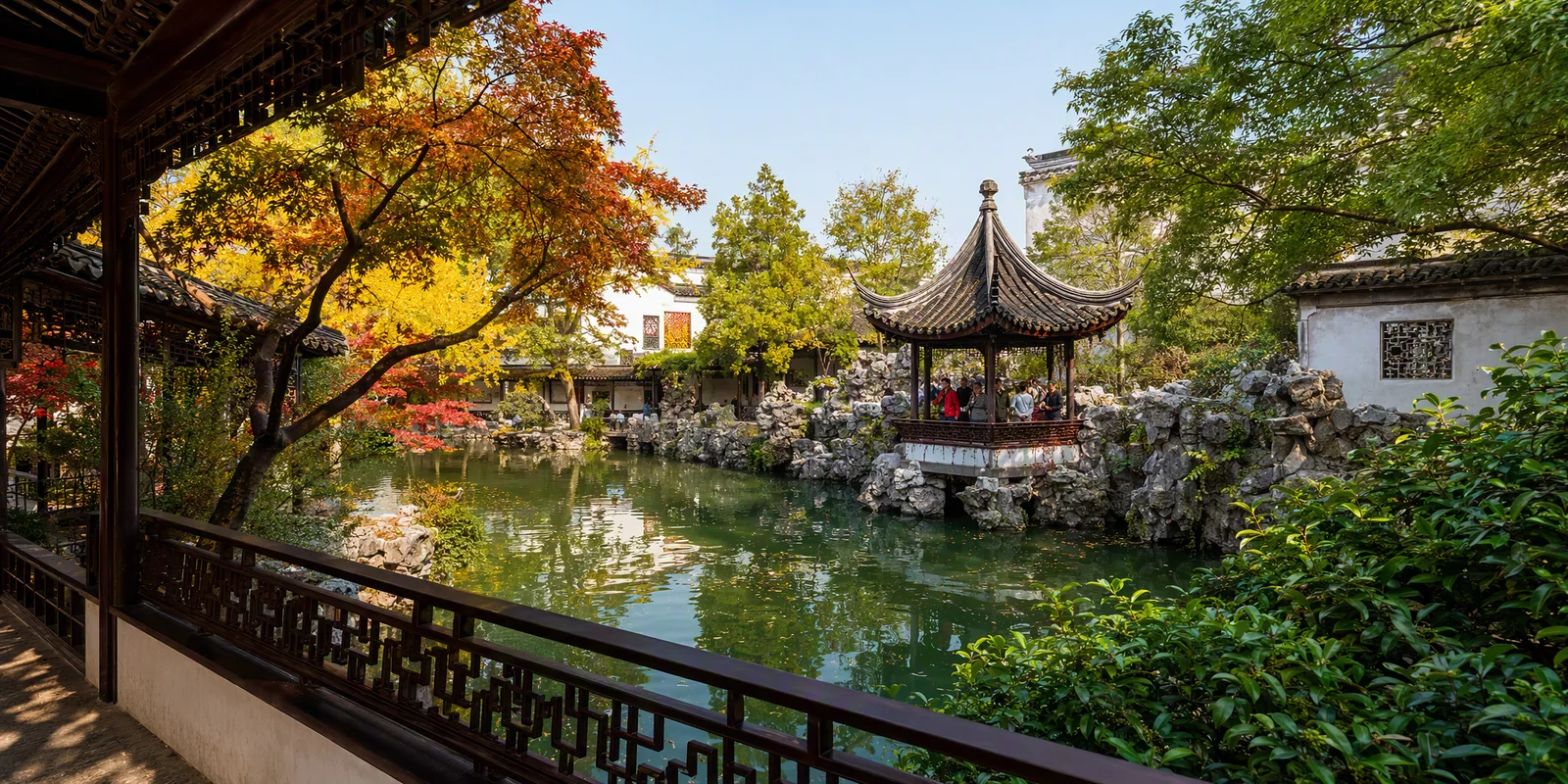
Day Trips from Shanghai: Water Towns, Suzhou and Hangzhou, Honestly Compared
Which Shanghai day trip fits you: metro-reach Zhujiajiao, Suzhou's real-name garden tickets, free West Lake, or an...

Huangshan Guide
How to plan a trip to Mount Huangshan: choosing your route up and down, catching the sunrise, where to sleep on the...
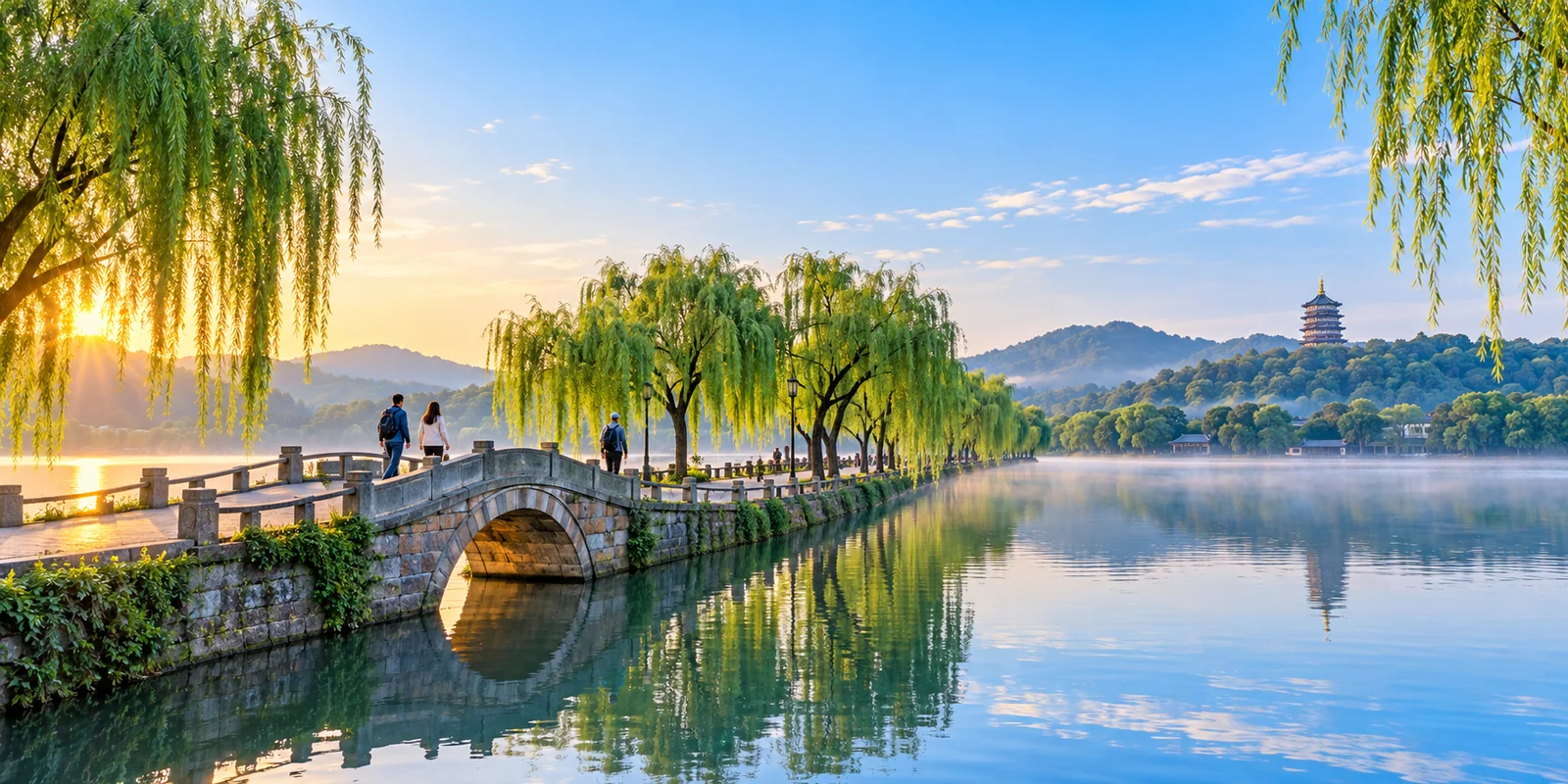
Hangzhou Travel Guide: How Many Days, What's Free at West Lake, and How to Book Lingyin
Two days in Hangzhou: which of the three railway stations to book, how to get around a lake district that limits...