
This article contains affiliate links. If you make a purchase through these links, we may earn a small commission at no extra cost to you. This helps support our work in creating free travel guides.
Suzhou (苏州, Sūzhōu) is the easiest day trip from Shanghai — the fast trains take around half an hour — and the place most people wish they had given a night. The short version: one full day covers two gardens and a canal street; stay overnight for a water town, a quiet evening in the old town, or a garden at opening time before the tour groups. Book your train to Suzhou Station, not Suzhou North. Buy the big gardens' tickets ahead with your passport — the three famous ones use real-name ticketing. Reserve the Suzhou Museum up to a week ahead, or use the walk-in West Hall. Details and two reference tables follow.
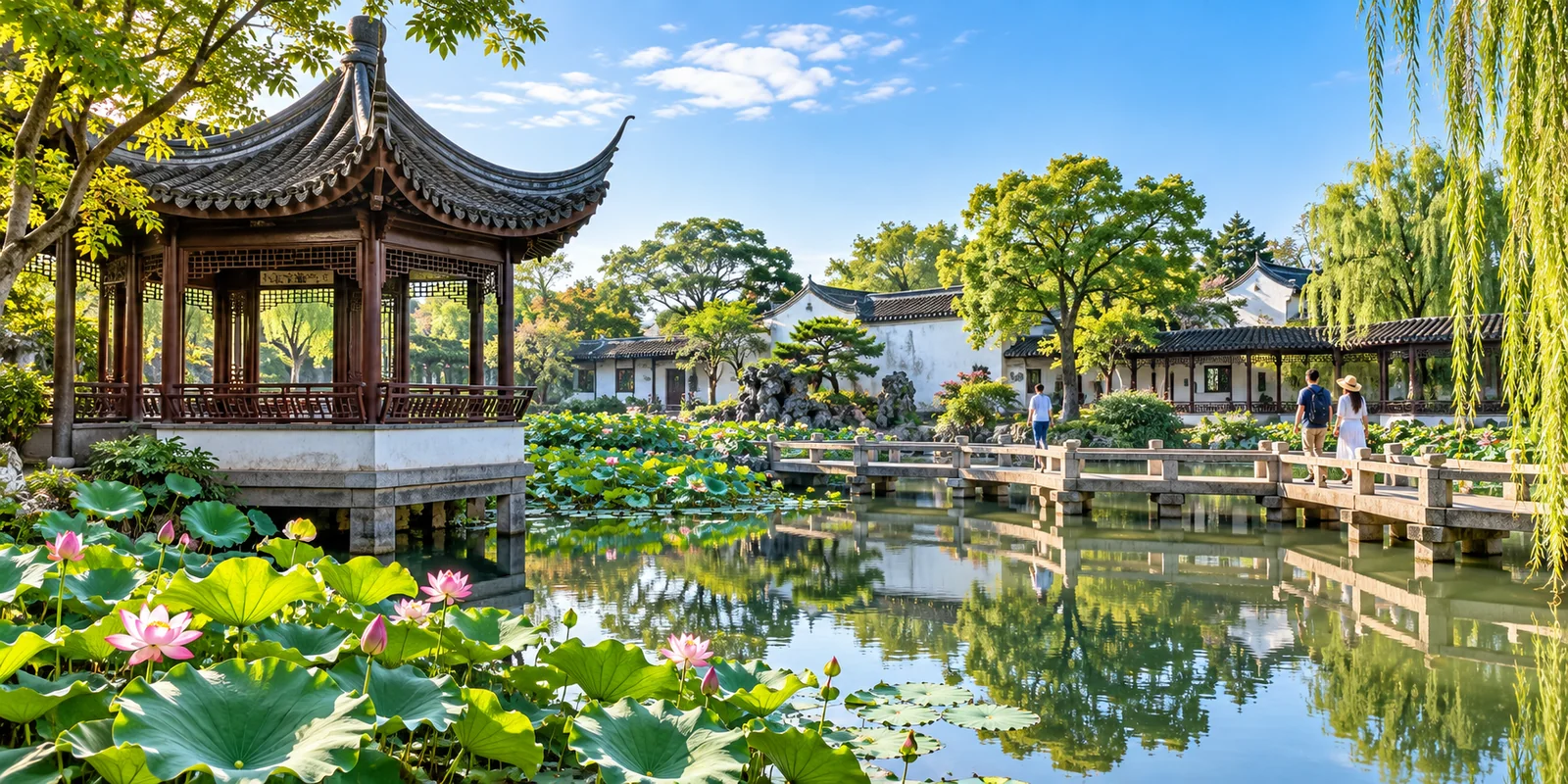
Day trip or overnight, when to come, and how the city is laid out
A day trip works: inside the Humble Administrator's Garden by mid-morning, the Suzhou Museum and Pingjiang Road before lunch, a second garden after it, back in Shanghai for dinner. What you give up is the quiet first hour after opening and the last before closing; a day-tripper is on a train for both. One night fixes that and makes room for a water town. The comparison with Hangzhou and the water towns is in Day trips from Shanghai.
On timing, the garden authority splits the year into a peak season — April, May and July through October — and an off season — January through March, June, November and December — with higher admission in the peak months. It is also a fair guide to the weather: spring and autumn are the pleasant months, July and August are hot and humid, June is the rainy month, and winter is bare but quiet. Avoid the first week of October and the May Day holiday (see the Golden Week survival guide); the wider picture is in when to visit China.
Three areas matter. The old town is a rough rectangle of canals and low tiled roofs, and the famous gardens, the Suzhou Museum and Pingjiang Road all sit in or beside it. Suzhou Railway Station is on its northern edge, so the train drops you next to everything you came for. East of the old town, the Suzhou Industrial Park (SIP) around Jinji Lake (金鸡湖) is the modern business district, not the Suzhou of the photographs. Pingjiang Road (平江路) is free and open around the clock — the natural anchor for an evening if you stay.
Getting there from Shanghai: Suzhou Station or Suzhou North
Take the train, and check which station you book. Suzhou Railway Station (苏州站, "Suzhou" in booking apps) is on the old town's north edge with Metro Lines 2 and 4 underneath. Suzhou North (苏州北站) is about 10 kilometres out on the Beijing–Shanghai high-speed line, served by Line 2 only, and the ride from there into the old town adds roughly half an hour. It is also being rebuilt through the end of 2027 — trains run normally, but you reach the entrance via metro exit 1 and the south square. Ignore the three outlying stations — Suzhou Yuanqu (苏州园区), Suzhou Xinqu (苏州新区) and Suzhou South (苏州南) — unless your hotel is next to one.
From Shanghai Hongqiao there are around fifty trains a day to Suzhou Station, most taking 30 to 35 minutes, plus sixty-odd to Suzhou North, and Shanghai Railway Station adds around eighty more — several departures an hour, so on a normal weekday you need not book far ahead; timetables change with each seasonal adjustment, so check 12306 for your date. On public holidays book the day sales open; the early-evening trains back sell out first.
Tickets are real-name, a foreign passport is accepted on the 12306 website and app, and the English version of 12306 takes only passports. At the station use the staffed lane — the automatic gates cannot read a passport. Sales open 15 days ahead, counting the travel day. The full walk-through, including English-language booking apps, is in how to book train tickets with a foreign passport.
From Hangzhou East, trains to Suzhou Station take roughly an hour and a quarter to two hours; the faster Hangzhou West–Suzhou South link runs well under an hour, but both those stations are far from the old towns, so the slower train still wins — check the current timetable, which changes seasonally. From Nanjing South it is the reverse: Suzhou North is faster and more frequent, then the metro into town — confirm on 12306 for your day. The Hangzhou end is in the Hangzhou guide.
Getting around Suzhou
Inside the old town you walk more than you ride: the northeast corner — Humble Administrator's Garden, Lion Grove, the Suzhou Museum — is one cluster, and Pingjiang Road runs south from it. For anything further, use the metro; city buses exist, but the metro and your feet cover everything in this guide. The stations you need: Zhuozhengyuan Suzhou Museum (拙政园苏博) on Line 6 for the big gardens and the museum, Lindunlu (临顿路) on Lines 1 and 6 for Pingjiang Road, Shantangjie (山塘街) on Line 2, Huqiu (虎丘) on Line 6 for Tiger Hill, and Line 4 out to Tongli. Older guides send you to Beisita (北寺塔) on Line 4 and a kilometre's walk; the Line 6 station is newer and puts you at the museum door.
Paying is where Suzhou differs from Shanghai. In Shanghai you can tap a foreign contactless Visa or Mastercard on the fare gate. Suzhou's gates accept only UnionPay contactless cards and e-CNY hardware wallets, so a foreign bank card does nothing there; instead buy tickets at the station service centre, whose POS terminal takes the major foreign cards, or ride on a phone QR code — Alipay's transit code with a linked foreign card, or WeChat's 城市通 (Chengshitong, "City Pass") mini-program. Ticket machines also take cash — coins and small notes; break notes of 20 yuan and above at the service centre. Fares start at 2 yuan, so old-town hops cost very little; the day passes in the card above pay off only if you ride four or more times a day. Our Alipay setup guide covers linking a card.
Taxis are cheap, and the easy way to reach Lingering Garden, which is not next to a metro station. The starting fare is 13 yuan for the first 3 kilometres including the fuel surcharge, so most old-town rides stay near the minimum. DiDi works with a foreign card; see our taxis and ride-hailing guide. Shared bikes suit hops between neighbourhoods; inside them, walk. The Suzhou Metro's English ticketing page confirms current payment options.
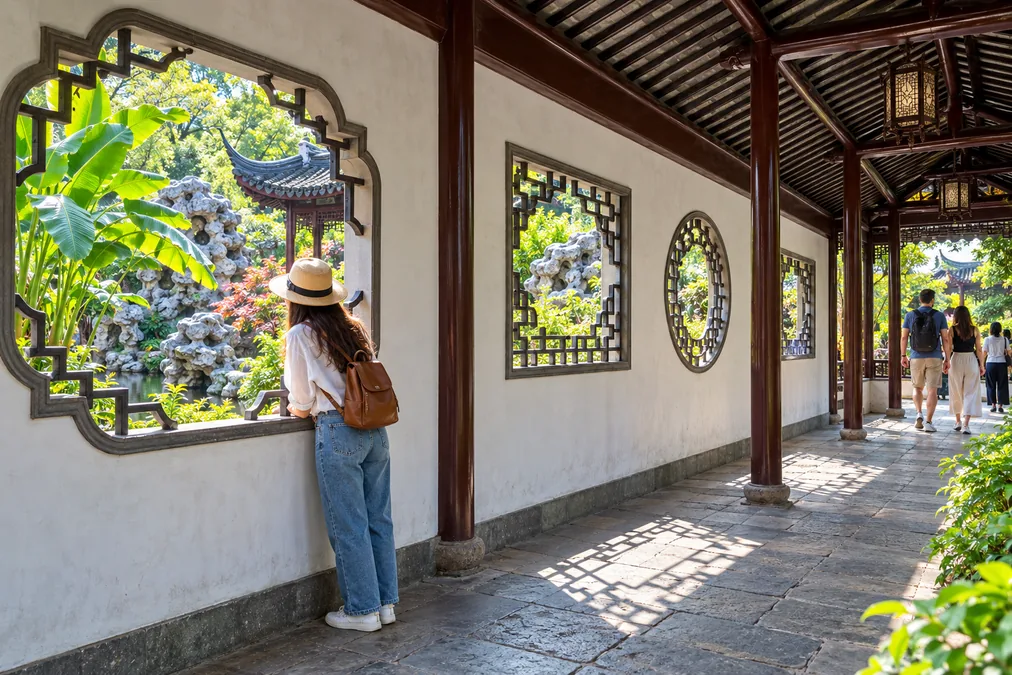
Which gardens to pick — and the real-name rule
Suzhou has dozens of classical gardens; see two, because after the second they blur. Humble Administrator's Garden (拙政园, Zhuōzhèng Yuán) is the biggest and the one everyone pictures — pavilions over water — and the most crowded, so go at opening. Lingering Garden (留园, Liú Yuán), in the west of the old town, is the expert's choice: smaller, denser, built around covered walkways. If you can only see one, see the FAQ. Lion Grove (狮子林, Shīzi Lín), next door to Humble Administrator's, is a giant rockery maze you climb through — the one children like best. For quiet, choose a small garden: Master of the Nets (网师园, Wǎngshī Yuán) in the south, tiny and the most refined; Canglang Pavilion (沧浪亭, "Surging Waves Pavilion"), one of the oldest and rarely busy; or the Garden of Cultivation (艺圃, Yìpǔ) in the northwest, the locals' favourite.
Humble Administrator's, Lingering and Lion Grove are the three Suzhou gardens that still sell real-name tickets: online or at the gate, the ticket is tied to an ID, and for foreign visitors that currently means a passport — the official booking channel is also connected to the international Trip.com app, same-day tickets are sold at the gate, and an online booking is valid only for the day you chose. In peak months the online allocation can be gone days ahead, so buy once your date is fixed. Most other gardens have dropped reservations; you scan and pay at the entrance. Each garden sells its own ticket — do not look for a combined pass. The flagship costs 80 yuan in peak season and 70 in the off season, and the small gardens a fraction of that, down to a flat 10 yuan all year at the Garden of Cultivation. The table below has the rest; the garden bureau's official price page is the reference if anything changes.
| Sight | Ticket | Booking | Hours |
|---|---|---|---|
| Humble Administrator’s Garden | ¥80 peak / ¥70 off-season | Real-name, passport accepted: official platform, Trip.com or the gate the same day (online tickets valid only for the booked day); in peak season book 1–7 days ahead | 07:30–17:30 (Mar–Oct) / 07:30–17:00 (Nov–Feb) · last entry 17:00 / 16:30 · closes 18:00 over Qingming, May Day, Mid-Autumn and National Day · summer 2026: opens 06:45 until Oct 7, 2026 · night tour Tue–Sun 18:30–22:00 (last entry 21:00), separate ticket |
| Lingering Garden | ¥55 peak / ¥45 off-season | Real-name, passport accepted: official platform, Trip.com or the gate the same day (online tickets valid only for the booked day); in peak season book 1–7 days ahead | 07:30–17:30 (Mar–Oct) / 07:30–17:00 (Nov–Feb) · last entry 17:00 / 16:30 · closes 18:00 over Qingming, May Day, Mid-Autumn and National Day |
| Lion Grove | ¥40 peak / ¥30 off-season | Real-name, passport accepted: official platform, Trip.com or the gate the same day (online tickets valid only for the booked day); in peak season book 1–7 days ahead | 07:30–17:30 (Mar–Oct) / 07:30–17:00 (Nov–Feb) · last entry 17:00 / 16:30 · closes 18:00 over Qingming, May Day, Mid-Autumn and National Day |
| Master of the Nets | ¥40 peak / ¥30 off-season · night garden ¥120 | No real-name rule: buy at the gate or scan the QR code | 07:30–17:30 (Mar–Oct) / 07:30–17:00 (Nov–Feb) · last entry 17:00 / 16:30 · night garden Mar–Nov 18:55–22:20, last entry 21:35 |
| Canglang Pavilion | ¥20 peak / ¥15 off-season | No real-name rule: buy at the gate or scan the QR code | 07:30–17:30 (Mar–Oct) / 07:30–17:00 (Nov–Feb) · last entry 17:00 / 16:30 |
| Garden of Cultivation | ¥10 all year | No real-name rule: buy at the gate or scan the QR code | 07:30–17:30 (Mar–Oct) / 07:30–17:00 (Nov–Feb) · last entry 17:00 / 16:30 |
| Tiger Hill | ¥70 peak / ¥60 off-season | No real-name rule: buy at the gate or scan the QR code | 07:30–18:00 (May–Oct) / 07:30–17:30 (Nov–Apr) · last entry 17:30 / 17:00 · closes 18:00 over Qingming |
| Hanshan Temple | ¥20 · bell tolling +¥5 | — | 07:30–16:30 · last entry 15:30 (January 08:00–17:00, last entry 16:30) · sources disagree — check on site |
| Suzhou Museum (main building) | Free | Required, real-name, free: up to 7 days ahead (same day included) on the website, WeChat account or the 苏州博物馆全预约 mini-program; one booking per ID per day. How a foreign passport is handled is not stated — try, and keep the West Hall as fallback | Tue–Sun 09:00–17:00 · last entry 16:00 · closed Mon (open on public holidays) · summer evenings to 20:00 by notice |
| Suzhou Museum West Hall | Free | Not needed — walk in (entry is slowed at peak times) | Tue–Sun 09:00–17:00 · last entry 16:00 · closed Mon (open on public holidays) · Metro Lines 1/3 Shizishan |
Two things from that table. First, the gardens close early: in the warm months last entry at Humble Administrator's is 17:00 and the gates shut at 17:30, and from November to February both are half an hour earlier; Lingering, Lion Grove and the small gardens follow the same pattern. In high summer the flagship has opened as early as 06:45 — check the official page for this year's dates; that first hour is worth the alarm. Second, two gardens open at night. The Master of the Nets night garden — opera, storytelling and music in the courtyards — runs from March to November plus Spring Festival, 18:55 to 22:20 with last entry at 21:35, and each year's dates are announced on the Suzhou Gardens WeChat account, so check there; it costs 120 yuan and is worth it if you stay the night. Humble Administrator's has its own night show, 拙政问雅 (Zhuozheng Wenya), Tuesday to Sunday from 18:30 to 22:00 with last entry at 21:00; it is separately ticketed — check the price on that same account. Trip.com carries the real-name garden tickets in English if you want them sorted before you fly.
Suzhou Museum, the old streets, Tiger Hill and Hanshan Temple
The Suzhou Museum (苏州博物馆) main building, designed by I.M. Pei next to Humble Administrator's Garden, is the one museum here that needs planning: reservation-only, slots released seven days ahead including the day itself, closed Mondays except public holidays, open 09:00 to 17:00 with last entry at 16:00. Reservations go through the official website, WeChat account or mini-program; the rules do not say how a foreign passport is handled, so try a week ahead and have a fallback. The museum's West Hall (苏州博物馆西馆) — a separate, newer building in the western suburbs, a metro ride from the old town and not the I.M. Pei building — is free, needs no reservation, keeps the same Tuesday-to-Sunday 09:00–17:00 hours with last entry at 16:00, and sits at Shizishan station on Lines 1 and 3. The Line 6 station is right outside the main hall, and the museum's visitor guide carries the current booking rules.
Both old streets are free. Pingjiang Road (平江路) begins a few minutes' walk from the museum and runs south along a canal, open at all hours, with only a couple of small museums inside charging admission. Shantang Street (山塘街), by Line 2's Shantangjie station, is the longer canal street towards Tiger Hill: an open street with no gate, so you can walk it at any hour — the official 08:00–17:00 hours apply to the ticketed spots inside it, including one paid mansion — and it is known for its lantern-lit evenings. Pingjiang is the one to see; Shantang is for a second day.
Tiger Hill (虎丘, Hǔqiū) is a low wooded hill topped by a leaning brick pagoda, a short walk from Line 6's Huqiu station; on a one-day trip it competes with Lingering Garden for the afternoon and usually loses. Admission is 70 yuan in peak season and 60 in the off season, and it stays open later than the gardens — 07:30 to 18:00 from May to October, closing at 17:30 the rest of the year. Hanshan Temple (寒山寺) is famous in China for a Tang-dynasty poem about its midnight bell, and in person a modest working temple in a busy suburb — go only if the poem means something to you. Entry is 20 yuan, and ringing the bell yourself costs 5 more. Hours are roughly 07:30 to 16:30 with last entry in mid-afternoon; confirm on the day, as the temple's published hours vary.
Water towns from Suzhou: Zhouzhuang, Tongli and Luzhi
Three canal towns sit within about an hour of the city. Tongli (同里) is the easy one: Line 4 to Tongli station, exit 9, then the T1 tram or bus 725 to the old town; from Suzhou Station the whole trip takes about an hour. The tram's last run back is 19:15 on weekdays, later at weekends and holidays; after that it is the bus or a taxi. One ticket covers the town's gardens and mansions: 100 yuan on the day, or 80 booked at least a day ahead, but the advance ticket is built around Chinese ID cards, so passport holders should expect to buy the same-day ticket at the window. It is a daytime visit — the gardens inside close in the late afternoon, so check hours on arrival.
Zhouzhuang (周庄) is the famous one and the most touristed. No metro: coaches run from Suzhou's bus stations (the north-square station at Suzhou Railway Station or the south bus station), or a taxi takes roughly an hour — ask your hotel which station the Zhouzhuang coaches currently leave from, and when. The ticketing changed in July 2026: the operator announced a single 80-yuan ticket valid for three consecutive days and registered to the holder, while the old 100-yuan price now buys an ID-registered lifetime pass. The same announcement set the hours at 08:00 to 21:00, mansions and museum included — so it is the town for a late-afternoon arrival and an evening stay.
Luzhi (甪直, Lùzhí) is the quiet one and the cheapest: the streets are free, a 52-yuan combination ticket covers six small sights, and a boat costs 150 yuan for up to six people or 240 for up to eight, priced per boat. The paid sights open 08:30 to 17:00, with ticket sales ending at 16:30. Getting there is metro plus bus — Line 1 to Zhongnanjie and bus 528, or from Suzhou North, Line 2 to Jingulu and bus 52 — about an hour; a taxi is simpler for two.
In one line: Tongli for convenience, Zhouzhuang for the evening, Luzhi for quiet. Wuzhen and Xitang, across the border in Zhejiang, are a different plan: there is no convenient direct high-speed train from Suzhou to either, and the practical route to Wuzhen is a direct coach from the Suzhou Tourist Distribution Centre (苏州旅游集散中心) — around eight departures a day, about 90 minutes; check the day's departures in the booking app or at your hotel desk — or a train via Shanghai Hongqiao. The five-town comparison and the Suzhou–water town–Hangzhou loop are in our Jiangnan water towns route.
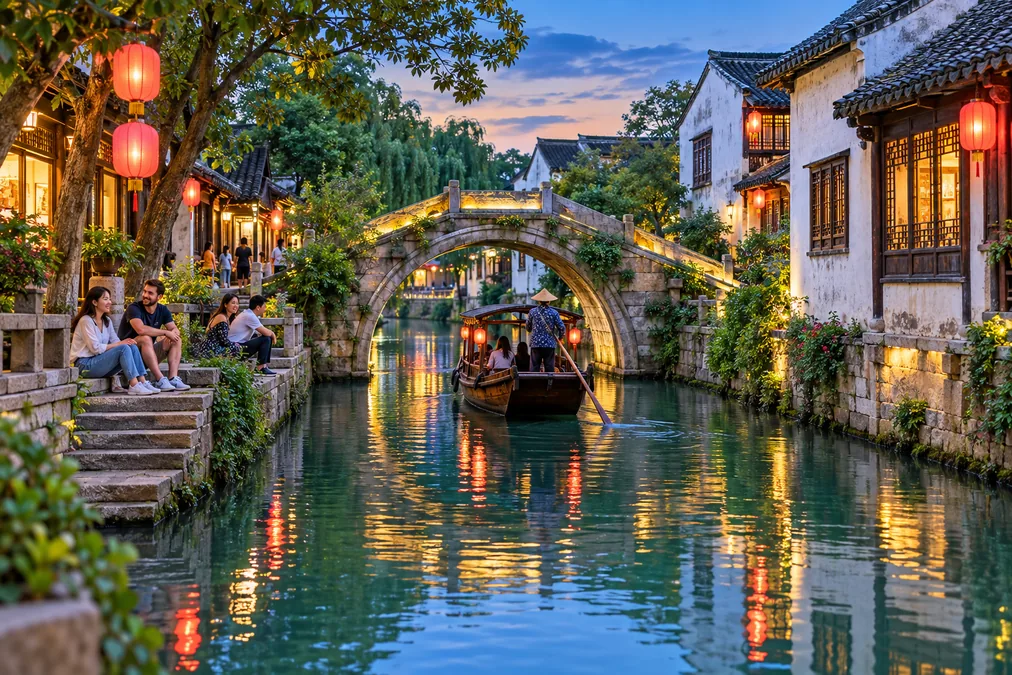
What to eat
Suzhou food (苏帮菜, Sūbāngcài) is sweeter and gentler than most Chinese cooking. The banquet dish is squirrel-shaped mandarin fish (松鼠桂鱼) — fried whole in a sweet-and-sour glaze — ordered once, for the table. The everyday food is noodles: Suzhou-style noodles (苏式面) in clear broth with braised pork or smoked fish on top; the local ritual is 头汤面 (tóutāngmiàn, "first-broth noodles"), eaten early in the morning. Add pan-fried pork buns (生煎) for breakfast and soft rice-flour cakes (糕团) from the old sweet shops. Long-established restaurants carry the words 老字号 (lǎozìhào, "old brand") on the sign and a lunchtime queue of locals; look in the lanes off Pingjiang Road and around Guanqian Street. Silk is the classic purchase — buy it from a department store or museum shop, not a factory tour.
Where to stay
The old town, especially around Pingjiang Road, is the right answer for most visitors: you can walk to the museum and the northeast gardens, the canal street stays open all evening, and the courtyard guesthouses are a stay you cannot have in Shanghai; the trade-off is small rooms. Around Suzhou Railway Station suits the traveller arriving late and leaving early — the trains and two metro lines are underneath you and the old town's north edge is a short walk — convenient rather than charming. Jinji Lake in the Industrial Park has the international chains and the big rooms, but every garden is a metro ride away, so it suits business travellers and families who want a pool. Old-town guesthouses are easy to compare on Trip.com. Book a listed hotel: hotels must register foreign guests, and one that cannot process a passport will turn you away — see hotel booking and registration rules.
One day or two: how to shape it
One day from Shanghai. Early train to Suzhou Station, then Line 4 one stop to Beisita (exit 4) and a kilometre's walk, or Line 2 one stop to Pinghelu and Line 6 two stops to the garden station, and be at Humble Administrator's Garden when it opens. Then the Suzhou Museum if you have a slot, or Lion Grove if not, and down Pingjiang Road for lunch. Afternoon: a taxi to Lingering Garden, or Line 6 to Tiger Hill. Early-evening train back. Buy the two real-name garden tickets and the museum slot before you leave Shanghai — the gates sell same-day tickets while daily capacity lasts; the online quota goes first.
Two days. Day one as above but slower, ending with the Master of the Nets night garden if it is running, or a walk on Pingjiang Road. Day two: a water town in the morning and early afternoon — Tongli by metro, or Zhouzhuang if you want the evening there — then back for Shantang Street's lanterns after dark, or the Garden of Cultivation if you would rather end quietly. For Suzhou inside a longer loop, see the Jiangnan route.
Frequently asked questions
Is Suzhou doable as a day trip from Shanghai?
Yes. The fast trains from Hongqiao take around half an hour and run several times an hour, so you can leave after breakfast and be back for dinner. A night adds the quiet hours at opening and after dark, and a water town without rushing. If you have a night to spare, spend it here rather than on a fourth day in Shanghai.
Do Suzhou's gardens need to be reserved in advance?
Three use real-name tickets: Humble Administrator's Garden, Lingering Garden and Lion Grove. You can book online with your passport or buy at the gate on the day, and online tickets are valid only for the chosen date. In peak months the online quota can run out, so book once your date is fixed. The other gardens sell tickets at the entrance without reservation. The Suzhou Museum's main hall is the strict one — reservation only, up to seven days ahead.
Humble Administrator's Garden or Lingering Garden — if I can only see one?
For big open views over water, and crowds to share them with, take Humble Administrator's Garden. For detail — carved windows, corridors that keep reframing the view, fewer people — take Lingering Garden, which is also cheaper at 55 yuan in peak season against 80. If you cannot decide, take Humble Administrator's at opening time.
Which Suzhou station is closest to the sights?
Suzhou Railway Station (苏州站). It sits on the northern edge of the old town with Metro Lines 2 and 4 underneath, and the gardens are a few stops away; Suzhou North is about 10 kilometres out and adds roughly half an hour on Line 2, so choose it only if your train does not stop at Suzhou Station.
Last updated: September 2026
Read in other languages
Last train times for 10 Chinese metro systems
Every line and station, checked by hand — the same data behind our offline route planner.
Get the WaysChina App
Offline guides, currency converter, essential phrases, and more — all in your pocket.

Related Articles
3 Days in Shanghai: An Itinerary You Can Follow As Written
A day-by-day Shanghai route built on metro logic: museum and Bund on day one, towers and old town on day two, a flex...
Day Trips from Shanghai: Water Towns, Suzhou and Hangzhou, Honestly Compared
Which Shanghai day trip fits you: metro-reach Zhujiajiao, Suzhou's real-name garden tickets, free West Lake, or an...
Shanghai Food Guide: What to Eat, Where to Eat It, and How to Order
Beyond soup dumplings: how to eat xiaolongbao without scalding yourself, where locals actually eat, halal and...

Huangshan Guide
How to plan a trip to Mount Huangshan: choosing your route up and down, catching the sunrise, where to sleep on the...