
This article contains affiliate links. If you make a purchase through these links, we may earn a small commission at no extra cost to you. This helps support our work in creating free travel guides.
Tai chi (太极, tàijí) is one of the easiest authentic experiences to find in China, and one of the most rewarding. You'll see it for free in nearly every public park at dawn — groups of people moving slowly through the same flowing sequence. You can join those sessions, take a structured class for visitors in Beijing or Shanghai, or travel to Chen Village, the place where the whole tradition started. This guide covers what tai chi actually is, how to experience it without speaking Chinese, where to go, and how to behave so you're a welcome guest rather than an awkward tourist.
What Tai Chi Actually Is
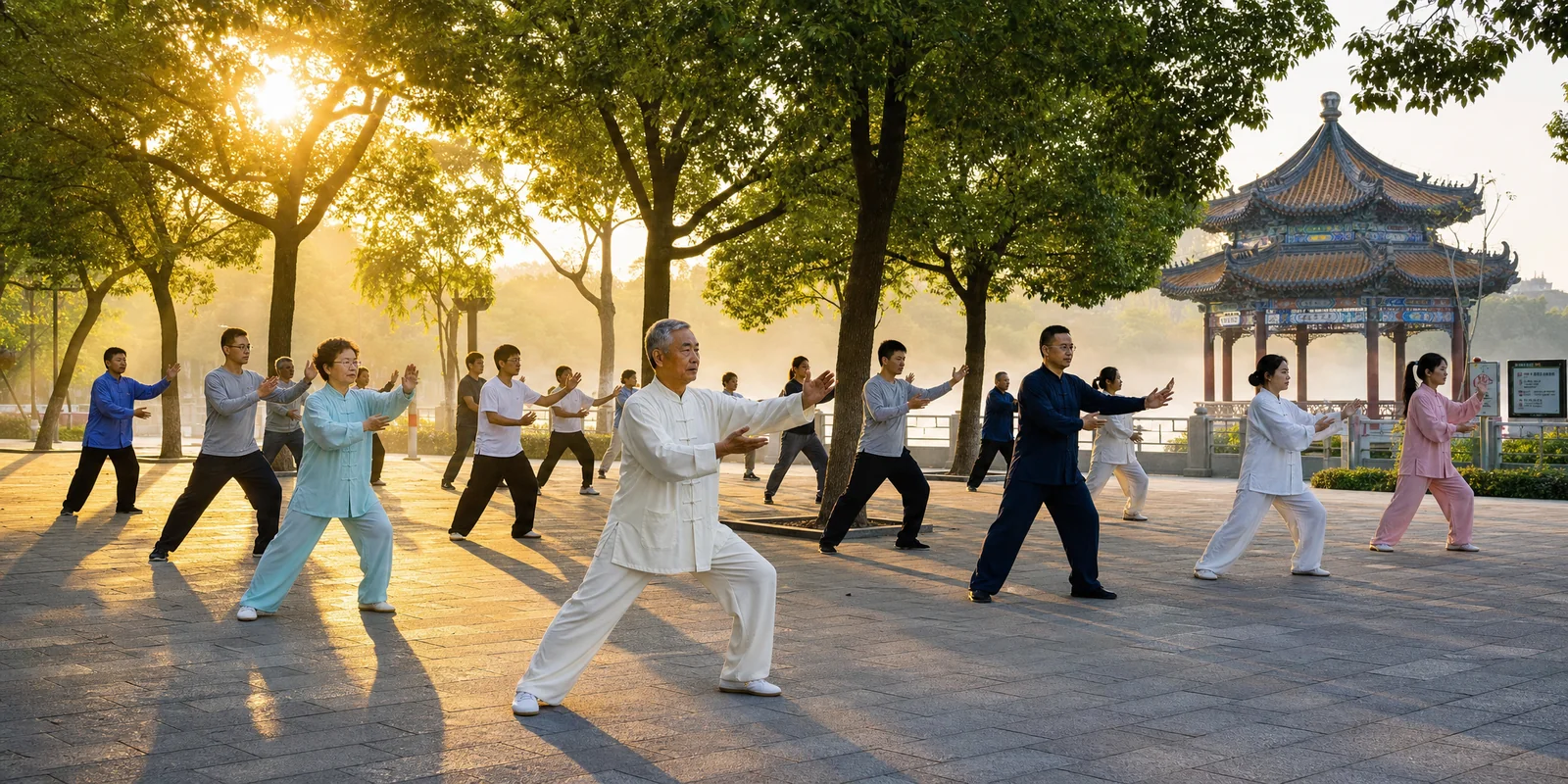
Tai chi is a Chinese martial art that most people now practice for health rather than fighting. The full name is tàijíquán (太极拳), which means "supreme ultimate fist." It grew out of the same philosophical ideas behind the yin-yang symbol: the constant balance between hard and soft, movement and stillness, full and empty.
What you see in the park is the slow, meditative side — controlled weight shifts, circular arm movements, deep steady breathing. Done this way, it's low-impact exercise that improves balance, leg strength, and focus. It's particularly popular with older Chinese people, but you'll see all ages practicing.
There's a martial side too. Every slow movement has a fighting application — a block, a redirect, a throw. Most travelers never get to that layer, and that's fine. But it explains why the postures look the way they do, and why a good teacher cares so much about precise form.
You'll hear about different "styles," usually named after the families that developed them:
- Chen style — the oldest, with a mix of slow movements and sudden explosive bursts. Visually the most dramatic.
- Yang style — the most widely practiced worldwide. Slow, even, and beginner-friendly. This is usually what you see in parks.
- Wu, Sun, and others — smaller styles with their own characteristics.
For a first experience, the style barely matters. What matters is finding a session or class that welcomes beginners.
Morning Tai Chi in the Park: The Free Option
The most authentic — and cheapest — way to experience tai chi is to show up at a city park early in the morning. Practice usually starts between 6:00 and 8:00 AM, when the air is cool and the parks fill with people exercising before work. You don't need to book anything or pay anyone.
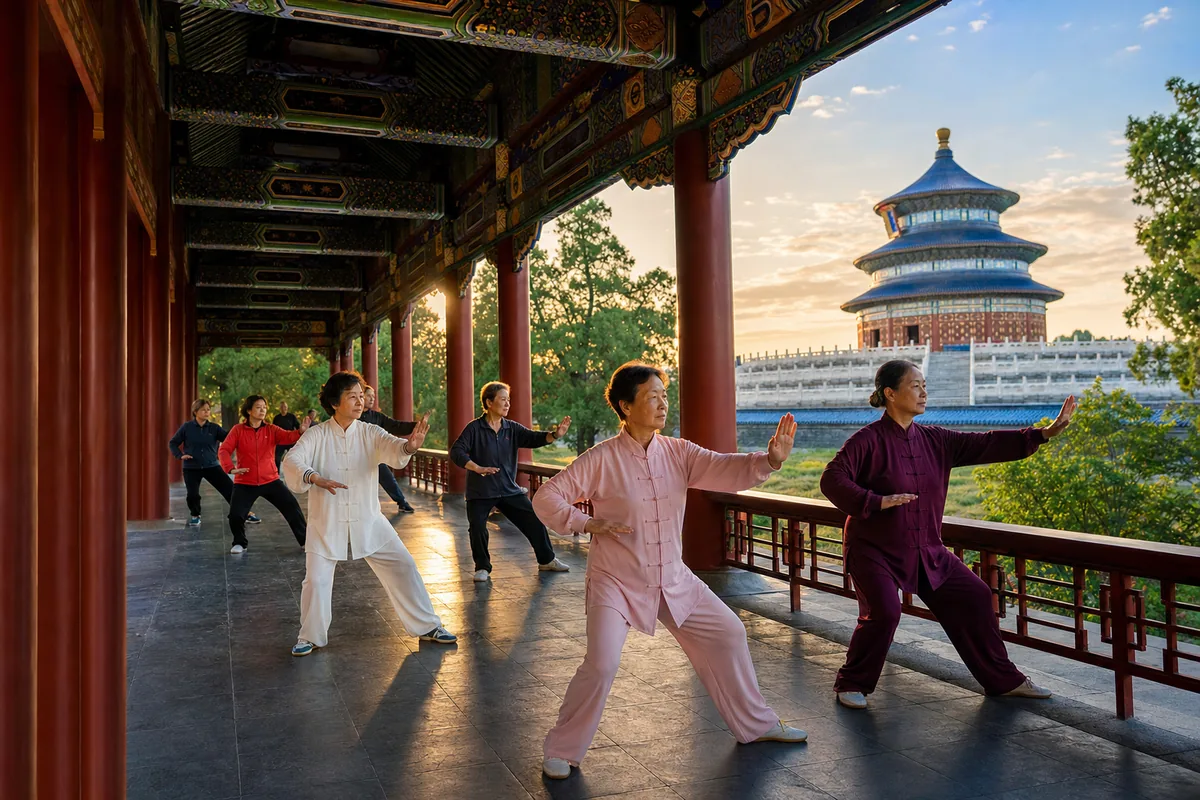
How it works in practice: find a group moving slowly in unison, stand a respectful distance back, and follow along. Most groups won't mind, and some will wave you in. Nobody expects you to know the form. Just move slowly, copy what you can, and don't worry about getting it right.
Good parks to find morning practice:
- Beijing: Temple of Heaven Park (天坛公园) is the famous one — wide covered walkways packed with tai chi, dancing, and music every morning. Jingshan Park and the Temple of Heaven's east gate area are reliable.
- Shanghai: Fuxing Park (复兴公园) in the former French Concession, and Lu Xun Park in Hongkou, both have active morning crowds.
- Hangzhou: The paths around West Lake at dawn.
- Chengdu: People's Park (人民公园), which doubles as a famous teahouse spot.
The catch with park practice is that there's no instruction. People are doing their own routine, not teaching. You'll get the atmosphere and a gentle session, but not real technique. For that, you want a proper class.
Structured Classes for Visitors
If you want to actually learn something — correct stance, the meaning behind the movements, a short sequence you can take home — book a class designed for visitors. These exist in most big cities and range from single drop-in sessions to private lessons.
What to expect from a tourist-friendly class:
- Length: Usually 1 to 2 hours.
- Language: English-speaking instructors or a translator are standard for tourist classes. Confirm when booking.
- Group size: Small groups or private one-on-one sessions.
- Price: Roughly ¥150–¥400 per person for a group session; private lessons cost more.
- Content: Warm-up, basic stances and breathing, then a short beginner form (often the simplified 24-posture Yang form).
You can find these classes through martial arts schools, cultural centers, and the larger tour-booking platforms. Booking through a platform like browse tai chi classes in Beijing and Shanghai on Klook is often the easiest route for a first-timer — listings show the language offered, meeting point, duration, and reviews from other travelers, so you know what you're getting before you pay.
For setting up the mobile payments you'll need to book and pay for almost everything in China, see our guide on using Alipay with foreign cards before you arrive.
Chen Village: The Birthplace
If tai chi is the reason you're traveling, go to the source. Chen Village (陈家沟, Chénjiāgōu) in Henan Province is where Chen-style tai chi — and by extension all modern tai chi — was created, traditionally credited to Chen Wangting in the 1600s. The whole village is built around the art. It's home to training halls, the Chen family ancestral sites, and schools where serious students come to live and train.
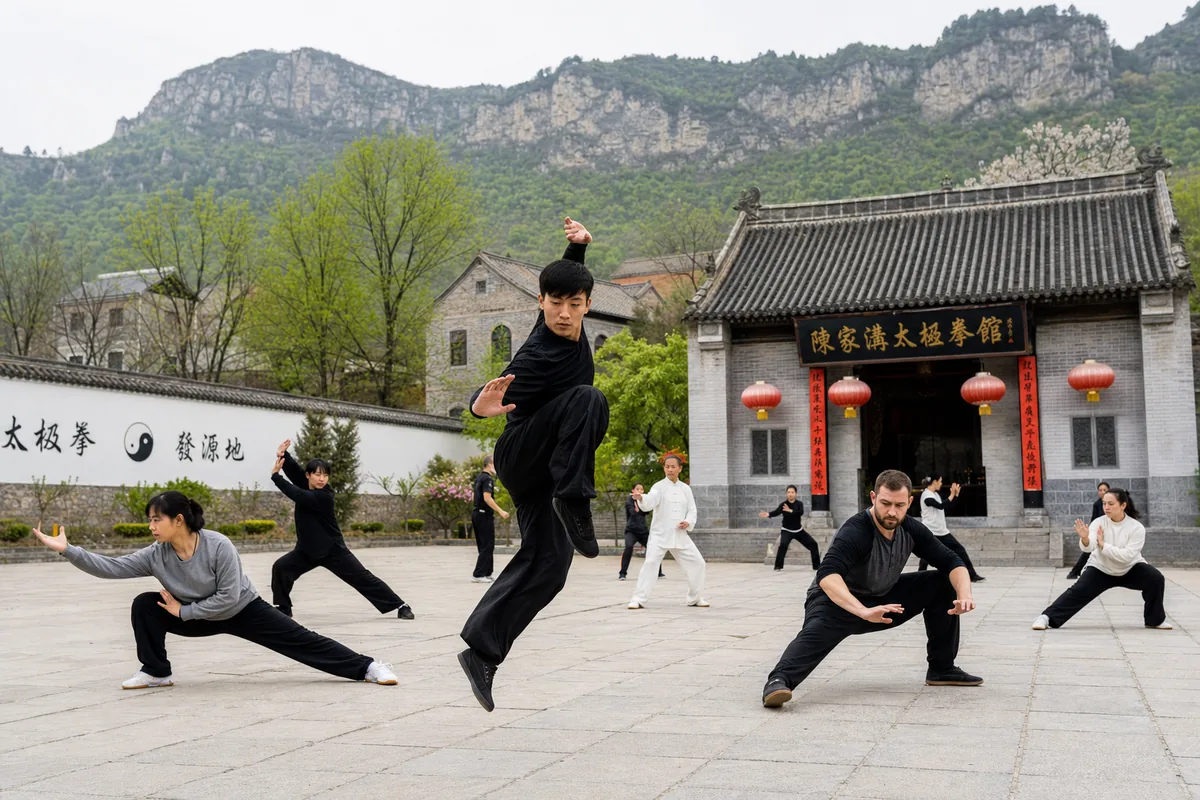
This is not a polished tourist resort. It's a working village in rural Henan, and the experience is genuine because of that. Visitors range from a few hours of walking around and watching practice, to multi-week immersive training where you live on-site, eat with students, and train several hours a day.
Getting there: Chen Village sits near the city of Jiaozuo (焦作), roughly between Zhengzhou and Luoyang. Most travelers reach Zhengzhou or Luoyang by high-speed train first, then continue by local train or taxi. It's a detour, not a quick stop, so build in time.
Other notable tai chi destinations include the Wudang Mountains (武当山) in Hubei, a Taoist sacred site associated with internal martial arts. Wudang has more established programs for foreign students and combines training with mountain scenery and temples, which makes it a popular alternative to Chen Village for a retreat.
Tai Chi Retreats and Longer Programs
Beyond a one-off class, a tai chi retreat means several days to several weeks of daily training, usually with room and board included. These run at schools in Chen Village, Wudang, and various mountain locations.
What a typical retreat involves:
- Two or more training sessions a day (morning and afternoon).
- Shared or private accommodation on-site.
- Simple meals, often vegetarian.
- Training in forms, basics (zhàn zhuāng, standing meditation), and sometimes weapons or push-hands.
Before booking a retreat, check these things directly with the school:
- Language: Is instruction in English, or is there a translator? This is the single most important question.
- Visa: A standard tourist visa covers short stays. For longer training, confirm what your visa allows — see our visa types overview.
- Level: Many retreats welcome complete beginners, but confirm rather than assume.
- Cost and what's included: Get clarity on training, lodging, meals, and any extra fees.
Etiquette and Practical Notes
Tai chi people are generally relaxed and welcoming, but a few habits make you a better guest:
- Watch before you join. In a park, observe a group for a minute before stepping in. Stand at the back, not the front.
- Don't block photographers' subjects. If you're photographing practitioners, be discreet and don't shove a camera in someone's face. A smile and a gesture asking permission goes a long way.
- Respect the teacher. In a formal class or school, the instructor (老师, lǎoshī) is treated with genuine respect. Follow their corrections without arguing, and don't wander off mid-session.
- Arrive on time, or early. Morning practice runs on a tight schedule because people have work. Showing up at 7:55 for a session that ends at 8:00 is pointless.
- Dress practically. Loose comfortable clothing and flat shoes. You don't need a silk "kung fu" outfit — most practitioners wear ordinary sportswear.
A bit of basic Chinese helps in parks and rural schools where English is limited. Our survival phrases guide covers the essentials. "Nǐ hǎo" (hello) and "xièxie" (thank you) cover most polite interactions.
For background on broader do's and don'ts, our cultural etiquette guide is worth a read before any cultural experience in China.
How the Options Compare
| Option | Cost | Instruction | Best for |
|---|---|---|---|
| Morning park practice | Free / small park fee | None — you copy along | Atmosphere, a gentle session, no commitment |
| Tourist class (city) | ¥150–¥400+ | English-friendly, structured | Learning real basics in 1–2 hours |
| Multi-day retreat | Varies widely | Intensive, daily | Serious practice and immersion |
| Chen Village / Wudang | Varies | Authentic, source-level | Dedicated students, pilgrimage-style trips |
The Bottom Line
For most visitors, the best plan is simple: catch a morning session in a city park for the feel of it, and book one structured class if you want to actually learn the movements. Both are easy to fit into a normal trip to Beijing, Shanghai, Chengdu, or Hangzhou. If tai chi is your main reason for coming to China, plan ahead for Chen Village or the Wudang Mountains, sort out language and logistics in advance, and give yourself enough days to make the journey worth it. Either way, you don't need any experience to start — that's the point.
The official background on tai chi styles and history and your destination's tourism bureau can help confirm current schedules and access before you go.
Related Reading
- Kung Fu Experiences — if martial arts are your thing, pair tai chi with a Shaolin or kung fu visit.
- Chinese Tea Ceremony — another calm, traditional experience that pairs well with a morning of tai chi.
- Beijing Complete Guide — for planning around Temple of Heaven Park and the city's morning culture.
- Chinese Medicine & Massage — explore the broader wellness side of traditional Chinese culture.
Last updated: June 2026
Read in other languages
Last train times for 10 Chinese metro systems
Every line and station, checked by hand — the same data behind our offline route planner.
Get the WaysChina App
Offline guides, currency converter, essential phrases, and more — all in your pocket.

Related Articles

Acrobatic Shows in China: Where to Watch and How to Book
Chinese acrobatics combines contortion, balance, and motorcycle stunts into a fast-paced live show. Here's where to...
Chinese Calligraphy Classes: A Beginner's Guide for Travelers
How to take a Chinese calligraphy class as a tourist: what to expect, where to book in Beijing and Shanghai, typical...

Chinese Medicine & Massage
From foot massage parlors to acupuncture clinics and TCM museums, here's how travelers can experience traditional...
Chinese Tea Ceremony: Culture, Types, and Where to Experience It
What the Chinese tea ceremony actually involves, the main tea types you'll taste, and where to book a real session...