

You can visit the Temple of Heaven (天坛, Tiāntán) without booking anything: as a foreign visitor, take your passport to the service window at any park gate and buy a ticket on the spot, with no reservation and no Chinese phone number needed. Buy the through ticket (联票, liánpiào), not just admission. It costs 28 yuan from November to March and 34 yuan from April to October, and it gets you into the Hall of Prayer for Good Harvests, the Echo Wall and the Circular Mound Altar. The park opens early, at 6:30 in winter and 6:00 in summer, but those three sights open only at 8:00 and stop letting people in at 16:30 in winter and 17:30 in summer. So go in the morning, and not on a Monday.
The short answer: price, buying and hours
- Which ticket. The through ticket. Admission alone lets you into the park, but not into the three walled sights that make the visit. The through ticket is 28 yuan in the low season (1 November to 31 March) and 34 yuan in the high season (1 April to 31 October).
- How a foreigner buys it. At the ticket or service window at the gate, with your passport. You can pay in Chinese yuan cash, with a BEIJING PASS card, or with a Visa or Mastercard bank card. Online booking 1–7 days ahead also exists, but it needs a mainland Chinese mobile number.
- Two sets of hours. The park gates open at 6:00 (high season) or 6:30 (low season) and close at 22:00, with last entry at 21:00. The halls inside run 8:00–18:00 in the high season and 8:00–17:00 in the low season, with last entry half an hour before closing.
- Mondays. The halls close on Mondays unless the Monday is a Chinese public holiday; the park itself stays open every day.
- Getting there. Metro Line 5 to Tiantan Dongmen (天坛东门, "Temple of Heaven East Gate"), Exit A, which puts you at the East Gate.
- How long. About two hours for the main sights. Add an hour if you come early for the morning park life.
Unlike the Forbidden City, there is nothing here to book a week ahead. You can decide on the morning itself. If you are still working out how many days to give Beijing and which sights do need booking, start with our Beijing travel guide.
Tickets, the through ticket and the two sets of hours
The sights close on Mondays (except Chinese public holidays); the park itself stays open
The card above has all the numbers. Here is what they mean for your visit.
Admission or through ticket
The Temple of Heaven sells two main tickets. Admission (门票, ménpiào) gets you through the park gates and nothing more. The through ticket adds entry to the three walled sights along the central line: the Hall of Prayer for Good Harvests (祈年殿, Qíniándiàn), the Echo Wall (回音壁, Huíyīnbì) and the Circular Mound Altar (圜丘, Yuánqiū).
With admission only, you can walk the old cypress groves and the covered Long Corridor, and you can see the round blue roofs of the Hall of Prayer from outside its compound wall. You cannot walk up onto its marble terrace, step inside the Echo Wall courtyard or climb the Circular Mound. Those are the reasons people come.
The through ticket is also the cheaper way to see them. Bought on its own, the ticket for the three sights costs 20 yuan, so admission plus that ticket would be 30 yuan in the low season against 28 yuan for the through ticket, and 35 yuan in the high season against 34 yuan. Buy admission only if you are coming for an evening walk, a morning in the park with the locals, or a second visit.
The low-season prices of 10 yuan for admission and 28 yuan for the through ticket apply from 1 November, and the high-season prices of 15 and 34 yuan return on 1 April.
The Divine Music Administration costs extra
The Divine Music Administration (神乐署, Shényuèshǔ), where court musicians once rehearsed the music for the sacrifices, reopened on 10 February 2026. It now holds an exhibition on the ritual music performed at the Temple of Heaven. Its ticket is 10 yuan and is not part of the through ticket, so buy it separately at the gate if you want it. It opens 8:00–17:00 and closes on Mondays. It also closes now and then for events, as it did from 16 to 22 September 2026, so check the park's notices before planning around it. It sits in the western part of the park, so it fits best if you come in by the West Gate or have time to spare.
The Hall of Abstinence
The Hall of Abstinence (斋宫, Zhāigōng), where the emperor fasted before the ceremony, is a walled palace on the west side of the central line. The official guidance says it currently needs no reservation, with crowd control on the spot. It keeps the same hours as the main halls and also closes on Mondays. Ask at the window whether your ticket covers the Hall of Abstinence.
Discounts
Foreign visitors aged 60 or over get in free: show your passport at the window and exchange it for a free ticket. Children under 18 enter free with valid ID, so show the child's passport at the window. The park also sells half-price concession tickets; ask at the window whether you qualify.
Why there are two sets of hours
The Temple of Heaven is a city park built around a group of historic buildings. The park opens early and closes late: 6:00–22:00 in the high season and 6:30–22:00 in the low season, with no one let in after 21:00. The historic sights inside are on a shorter day: the Hall of Prayer, the Echo Wall, the Circular Mound, the Hall of Abstinence and two smaller sights open 8:00–18:00 from April to October and 8:00–17:00 from November to March, and they stop letting people in at 17:30 and 16:30.
Three things follow from this:
- Arriving at 6:30 does not get you into the Hall of Prayer early. It gets you the park before the crowds, with time to watch the morning exercise. The halls still open at 8:00.
- An afternoon visit has a hard stop. In winter, if you walk in at 16:00, you have half an hour to get into the compounds you want. You will have time for one or two compounds, not a relaxed visit, so go straight to the one you care about most.
- Monday is a park-only day. The park opens, but the halls are closed unless it is a Chinese public holiday. If Monday is your only free day, see the park as a walk and save the ticket money.
How to buy a ticket with a passport
There are two ways to buy: in person at the gate, or online in advance. For most short-stay foreign visitors the gate is the easier one.
At the gate (the easy way)
The Beijing Municipal Administration Center of Parks, which runs the Temple of Heaven, says foreign visitors who do not buy online can go to the service window at the park entrance and have staff help them buy a ticket. You need only your passport: no reservation and no phone number. You can pay with Chinese yuan cash, with a BEIJING PASS card, or with a foreign Visa or Mastercard bank card. The park has its own ticket windows as well.
In practice:
- Go to the ticket or service window at the gate you arrive at, before the turnstiles.
- Say "liánpiào" (through ticket) and hold up the number of fingers for how many people. Each person needs their own passport.
- Pay by card or cash. Keep the passport in your hand; you may be asked to show it again at the turnstile.
Tickets for the three main sights can also be bought on the day by scanning a QR code at the park gate when the daily capacity has not been reached, and staff at the service window inside the park can place the order for you. On Chinese holiday weeks, arrive early to be safe.
Online, if you have a Chinese mobile number
Beijing's city-run parks share one ticket system called Visiting Beijing Parks (畅游公园, Chàngyóu Gōngyuán). Its website, bjgyol.com.cn, has an English interface (switch it under "Language" at the top right), and it also runs as a WeChat official account and a mini program. Foreign visitors can register with a passport. The Temple of Heaven's own WeChat official account sells tickets too, and the city's English site says foreigners can buy there with a passport. Tickets can be booked 1–7 days ahead for a timed entry, and you enter by scanning the QR code and showing the passport you booked with.
The catch is the phone number. Beijing's 12345 hotline has answered that online purchase for these parks requires a mainland Chinese mobile number to verify the account, and foreign numbers are not supported yet. If you have a Chinese SIM card with a local number, online booking works and saves a minute in the queue. If you only have a foreign number or a travel eSIM with data only, skip it and buy at the gate. The city government's guide to buying park tickets has the official steps.
If you booked online and cannot go, you can ask for a refund on the same platform within seven days from the visit date; used tickets are not refunded. The park management center's 24-hour hotline is +86 10 6830 0800, but it is in Chinese only.
The same window process works at the Summer Palace, Beihai Park and Beijing's other city-run parks. Our Summer Palace guide covers that one.
Getting there and which gate to use
The Temple of Heaven is a large walled square in the south of central Beijing, with a gate on each side. Which one you use decides which way you walk the central line.
- East Gate (东门). Metro Line 5 to Tiantan Dongmen, Exit A. Many city buses also stop at Tiantan Dongmen. This is the easiest gate by metro and the one closest to the morning activity along the Long Corridor. Hongqiao Market is just across the road.
- West Gate (西门). The park lists Metro Line 8, Tianqiao station, Exit C. Buses 2, 20 and 36 stop at Tiantan Ximen. Tianqiao is on the park's western side, so this is the station to use for the West Gate; it is also the gate nearest the Divine Music Administration.
- South Gate (南门). No metro station is listed for it; buses such as 36 and 53 stop at Tiantan Nanmen. Come here by taxi if you want to start at the Circular Mound and finish at the Hall of Prayer.
- North Gate (北门). Buses such as 6 and 34 stop at Tiantan Beimen. It is the closest gate to the Hall of Prayer, useful if you are short on time.
If you are not sure, use the East Gate. It has the metro, and the walk from there to the Hall of Prayer along the Long Corridor is short.
From Tiananmen. Take Line 1 from Tiananmen East to Dongdan, change to Line 5 heading south, and get off at Tiantan Dongmen. A taxi or DiDi works just as well; ask for 天坛东门 (Tiāntán Dōngmén). If you have just left the Forbidden City, you come out by the north or east gate, which are a long way from Tiananmen East, so a taxi from there is the simplest option. Our China metro guide explains how to pay at the gates with a foreign card.
From Qianmen. Qianmen sits on Line 8, which runs south to Tianqiao for the West Gate. Many people simply take a taxi from the south end of Qianmen Street to the East or North Gate.
The park stays open until 22:00, so you may be leaving late. Check the last train on your line on our Beijing last-train times page. For metro routes and a day plan on your phone without data, the WaysChina app is our offline metro and trip-planning helper, with Beijing among its 10 cities.
Walking the central axis
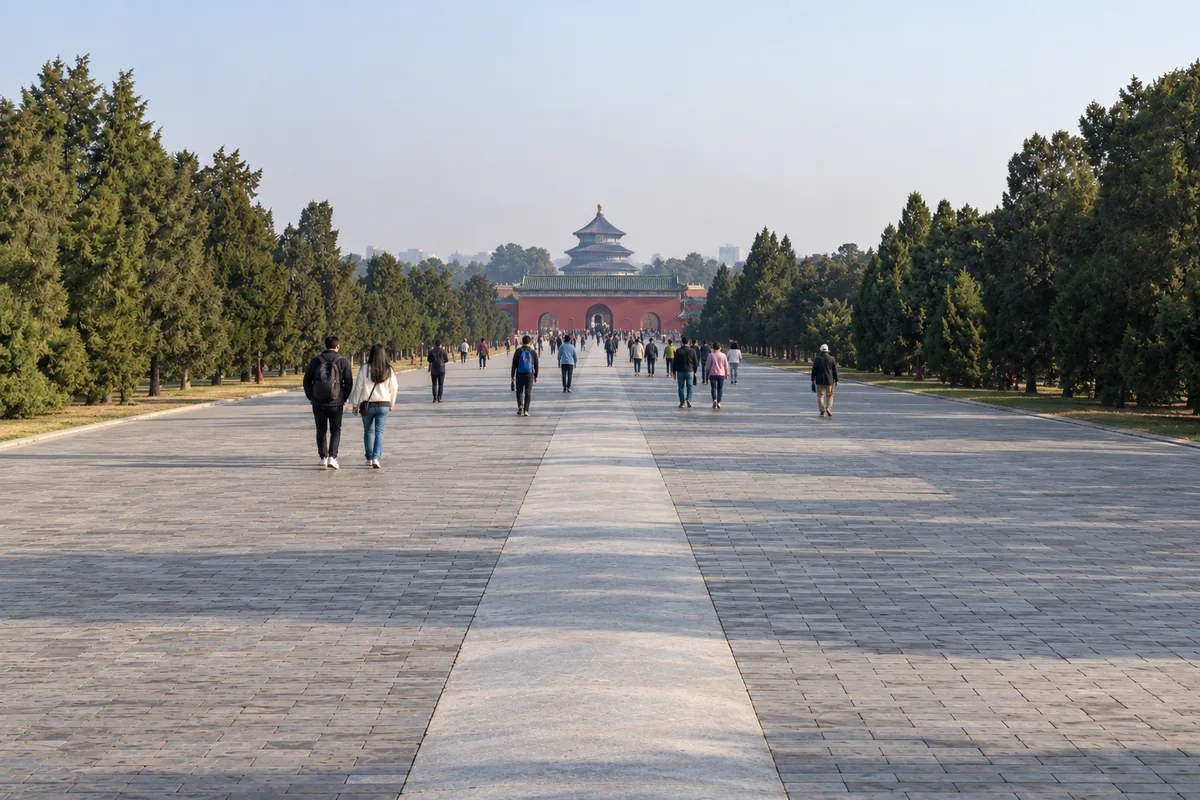
The main sights sit on one straight north–south line. The Circular Mound Altar is at the south end and the Hall of Prayer for Good Harvests at the north end. Between them is the Danbi Bridge (丹陛桥, Dānbìqiáo), a raised stone walkway 360 metres long. You can walk it in either direction. The city's tourism site suggests both: in from the East Gate and north-to-south, or in from the South Gate and walking north along the Danbi Bridge. The main sights take about two hours.
South to north (from the South Gate)
This order saves the biggest building, the Hall of Prayer, for last.
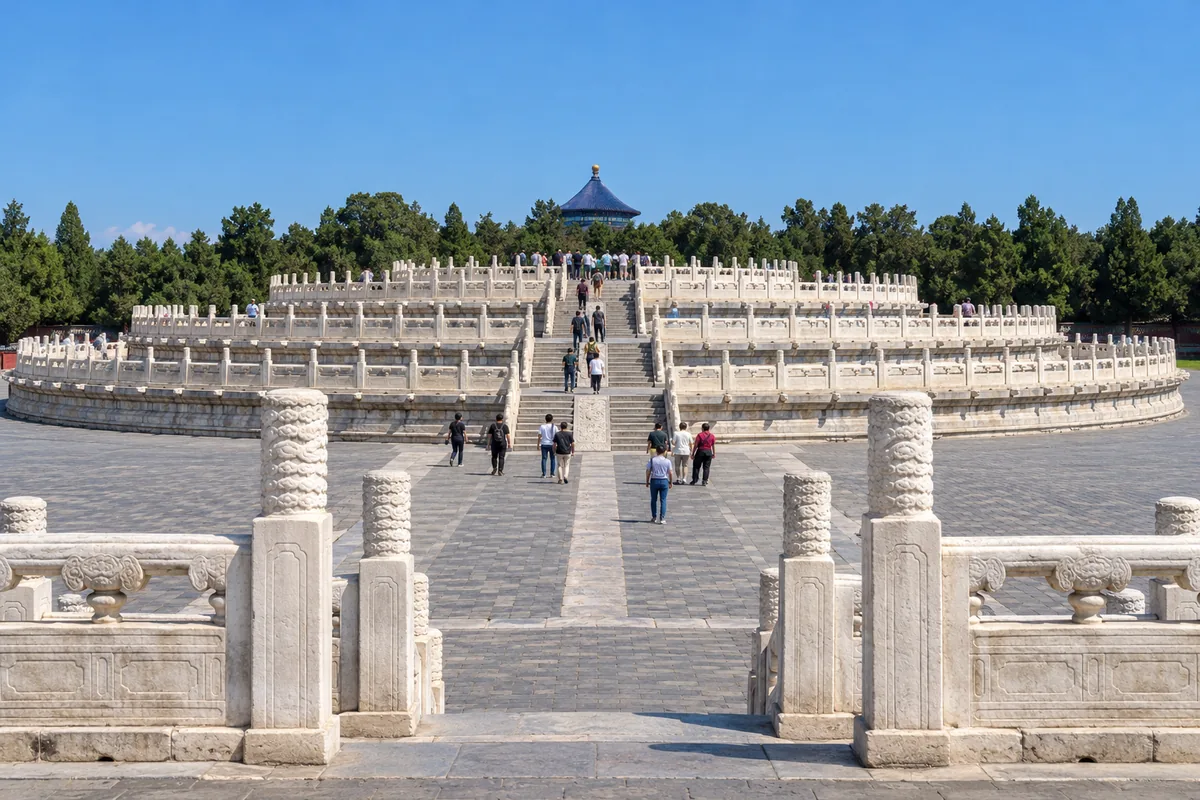
- Circular Mound Altar. Three round terraces of white marble, open to the sky, where the emperor made the sacrifice to Heaven at the winter solstice. There is no building on top. Visitors queue to stand on the round stone at the center of the top terrace.
- Imperial Vault of Heaven and the Echo Wall. Just north of the altar is a small round hall with a blue roof, the Imperial Vault of Heaven (皇穹宇, Huángqióngyǔ), where the spirit tablets were kept. The round wall around its courtyard is the Echo Wall, built so that a whisper along it carries round to the other side. With a crowd in the courtyard, the effect is hard to hear.
- Danbi Bridge. Walk north up the long raised walkway. It rises slowly toward the Hall of Prayer, and the hall gets bigger as you go.
- Hall of Prayer for Good Harvests. The round hall with three blue-tiled roofs on a three-level white marble terrace, 38.2 metres high and 24.2 metres across. Here the emperor prayed for a good harvest each spring. You look in through the doors at the painted wooden columns; you cannot walk inside.
- Out by the East Gate. Leave the hall's compound by its east side, walk through the Long Corridor, and you come out at the East Gate, with Line 5 and Hongqiao Market across the road.
North to south (from the East Gate)
This is the classic route if you come by metro: East Gate, Long Corridor, Hall of Prayer, Imperial Vault of Heaven, Circular Mound, then out by the South Gate. It has one big advantage in the morning. The halls open at 8:00, and if you are at the Hall of Prayer then, you see it before the groups. The downside is that you end at the South Gate, which has no metro, so either take a taxi from there or walk back up the west side of the central line to the Hall of Abstinence and out through the East or West Gate.
Side sights, if you have more time
- Long Corridor (长廊, Chángláng). The long covered walkway between the East Gate and the Hall of Prayer. You pass through it anyway on the East Gate route. In the morning it is full of people playing cards, singing and knitting.
- Hall of Abstinence. West of the Danbi Bridge, with its own moat and walls. Allow 30 to 45 minutes. The city's official seasonal routes include it in winter, summer and spring.
- Divine Music Administration. Near the West Gate. Allow 30 minutes for the music exhibition, and remember the separate ticket.
A full visit with all three side sights is closer to four hours. The city government's Temple of Heaven visitor page sets out seasonal routes that take them in, such as the winter route from the East Gate through the Long Corridor, the Hall of Prayer, the Hall of Abstinence, the Divine Music Administration and the Echo Wall to the South Gate.
The grounds are big, about 273 hectares, and most paths are flat paving. Wear comfortable shoes. In winter it is cold and windy on the open terraces; in summer there is little shade on the Danbi Bridge or the Circular Mound in the middle of the day.
Go early: the park in the morning
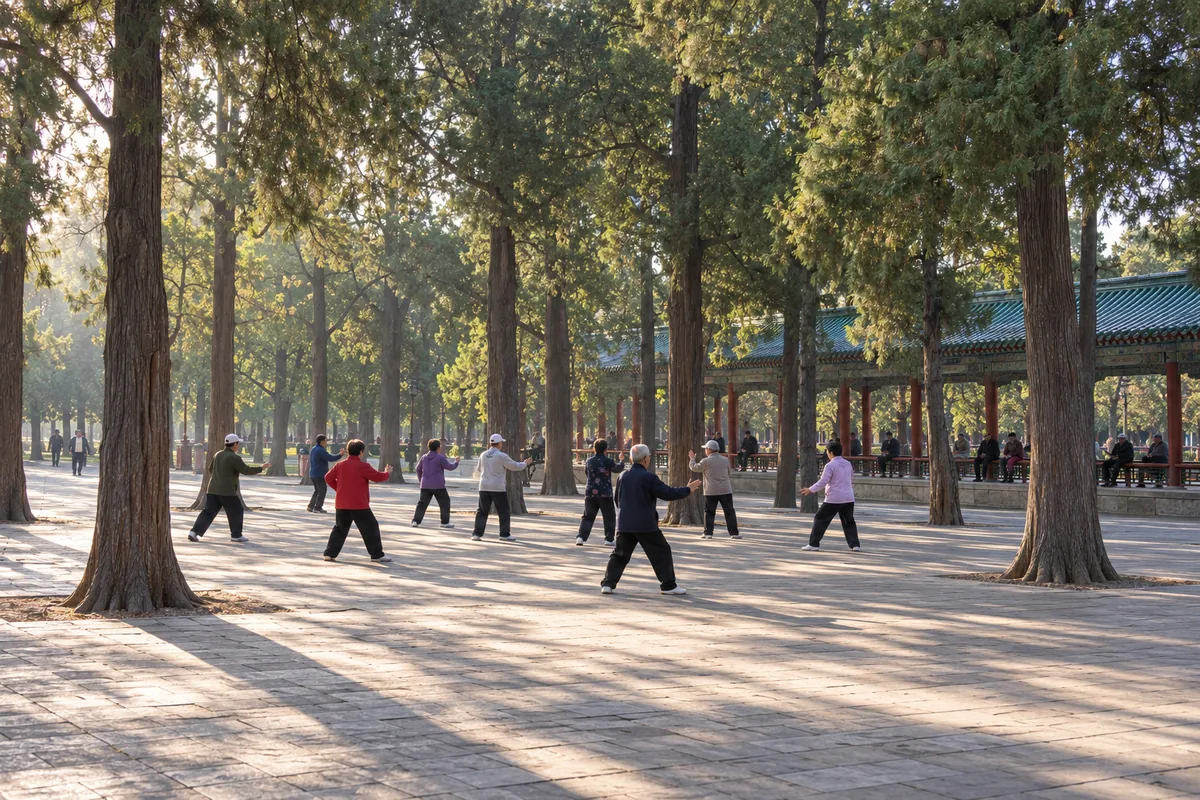
For many Beijing residents, the Temple of Heaven is first of all their local park, and they use it before the halls open. Locals exercise from the park opening until about 8:00: tai chi, dancing, kicking a shuttlecock with the feet (jianzi), flying kites and playing cards. Around 7:00–7:30 is a good time to arrive, Sundays especially, and tour groups tend to come after about 9:30. Most of the people taking part are middle-aged and older, and the activity gathers around the East Gate.
Remember that in the low season the gates open at 6:30, not 6:00, and on cold winter mornings fewer groups meet. What you see on a given day varies; there is no timetable. Expect groups of people doing tai chi under the trees, ballroom dancing to a speaker, choirs singing old songs in the Long Corridor, and circles of card players.
Some practical points:
- Watching is fine. People are used to visitors. Ask with a gesture before photographing someone up close.
- Joining in is often welcome, especially for jianzi or a dance circle, if someone waves you over. For proper tai chi lessons, see our guide to tai chi experiences in China.
- Timing. Arrive around 7:00, watch for an hour, then be at the Hall of Prayer when it opens at 8:00. By the time the tour groups arrive, you are already at the Circular Mound.
- Food. Eat before you come or bring something; the park is not a place for a sit-down breakfast. Our Beijing food guide covers what to eat in the city and where.
How to plan the day
The Temple of Heaven pairs well with three places nearby.
Hongqiao Market (红桥市场, Hóngqiáo Shìchǎng). Directly across the road from the East Gate. It is an indoor market known for pearls, souvenirs and small goods, with bargaining expected. Half an hour to an hour is enough unless you are shopping seriously.
Qianmen Street (前门大街, Qiánmén Dàjiē). The pedestrian street south of Tiananmen Square is free and open all day. It is a good place for lunch after the temple, and you can walk from there north to Tiananmen.
The Forbidden City. It needs a real-name booking with your passport, released seven days ahead at 20:00 Beijing time, and it is closed on Mondays. It is a half-day on its own; see our Forbidden City guide.
A day that works:
- 7:00 East Gate by Line 5; watch the morning park life.
- 8:00 Hall of Prayer as it opens, then south along the Danbi Bridge to the Echo Wall and the Circular Mound.
- 10:00 Back to the East Gate for Hongqiao Market, or a taxi from the South Gate to Qianmen.
- 11:00 to 12:00 Lunch around Qianmen, then walk north through Tiananmen Square. The square needs its own real-name booking, but a valid Forbidden City booking also lets you in; you still go through security.
- Afternoon The Forbidden City with an afternoon-session ticket. Afternoon tickets are checked from 11:00, and the last entry is 15:30 from November to March and 16:00 from April to October, so do not leave lunch too late.
If you cannot get a Forbidden City ticket, swap it for a slow afternoon on Qianmen and in the hutongs (old lanes) nearby. Avoid Mondays for this plan: the Temple of Heaven's halls and the Forbidden City both close. Our 3-day Beijing itinerary shows how this day fits into a full Beijing stay.
A short history
The Temple of Heaven was built in 1420, under the Ming dynasty. For about five centuries, Ming and Qing emperors came here to worship Heaven and pray for good harvests. The northern part of the grounds is round and the southern part square, after the old belief that heaven is round and the earth square. It opened as a public park in 1918, and UNESCO added it to the World Heritage List in 1998, as Temple of Heaven: an Imperial Sacrificial Altar in Beijing. It was an altar for state ceremonies rather than a working temple with monks; for China's active temples and how to visit them, see our guide to temples in China.
Frequently asked questions
Should I buy the admission ticket or the through ticket for the Temple of Heaven?
The through ticket, for nearly everyone. Admission only gets you into the park; the through ticket adds the Hall of Prayer for Good Harvests, the Echo Wall and the Circular Mound, and costs 28 yuan from November to March and 34 yuan from April to October. That is less than buying admission and the 20-yuan ticket for the three sights separately. Buy admission only for a morning or evening walk in the park, or on a Monday when the halls are closed.
How do foreigners buy Temple of Heaven tickets?
Take your passport to the service window at the park gate. Staff help you buy the ticket there, with no reservation and no Chinese phone number, and you can pay with cash, BEIJING PASS, or a Visa or Mastercard bank card. Online booking through Visiting Beijing Parks (bjgyol.com.cn, in English) accepts passports but needs a mainland Chinese mobile number. Foreign visitors aged 60 or over enter free with a passport.
What is the best time to visit the Temple of Heaven?
Early morning, Tuesday to Sunday. Arrive around 7:00 to see local people exercising in the park, then be at the Hall of Prayer for its 8:00 opening, before the tour groups arrive. The gates open at 6:30 from November to March and 6:00 from April to October; the halls are closed on Mondays except public holidays. If you come in the afternoon, be inside the halls before last entry at 16:30 in winter or 17:30 in summer.
How long does it take to see the Temple of Heaven?
About two hours for the central axis from the Hall of Prayer to the Circular Mound. Add an hour if you come early for the morning park life, and up to two more for the Hall of Abstinence and the Divine Music Administration. Allow time for the walk to and from your gate; the park is large and the gates are far apart.
Before you go
Bring your passport and some way to pay: cash, a Visa or Mastercard bank card, or BEIJING PASS. Take Line 5 to Tiantan Dongmen and arrive at the East Gate around 7:00, any day except Monday. Buy the through ticket at the window, watch the morning exercise along the Long Corridor, and be at the Hall of Prayer at 8:00. Walk south over the Danbi Bridge to the Echo Wall and the Circular Mound, then finish with Hongqiao Market or lunch at Qianmen. If you also want the Forbidden City the same day, book an afternoon ticket seven days ahead.
Last updated: October 2026
Fact-checked sources
- Official Beijing Municipal Government 17 pages
- Official s.visitbeijing.com.cn 7 pages
- Official english.visitbeijing.com.cn 2 pages
- Official dpm.org.cn 3 pages
- Official intl.dpm.org.cn
- Official young.dpm.org.cn
Last verified: 2026-10-30
Read in other languages
Getting to the sights by metro
Forbidden City
World's largest imperial palace, home to 24 Ming and Qing emperors.
- Tian'anmen East
- Tian'anmen West
- Beihai North
Tiananmen Square
World's largest public square. Arrive before sunrise for flag ceremony.
- Tian'anmen East
- Tian'anmen West
- Qianmen
Temple of Heaven
Ming-era imperial complex where emperors prayed for good harvests.
- East Gate of Temple of Heaven
- Tianqiao
- Qiaowan
Summer Palace
Imperial garden with Kunming Lake, Long Corridor, and Marble Boat.
- Beigongmen
- Xiyuan
Lama Temple (Yonghe Temple)
Tibetan Buddhist monastery with an 18m Maitreya statue.
- Yonghegong Lama Temple
- Beixinqiao
Bird's Nest (National Stadium)
2008 Olympic main stadium, lit up at night.
- Olympic Park
- Olympic Sports Center
Water Cube (National Aquatics Center)
2008 Olympic swimming venue, blue bubble facade.
- Olympic Park
- Olympic Sports Center
Olympic Forest Park
Largest urban park in Beijing; great for jogging.
- South Gate of Forest Park
- Olympic Park
798 Art Zone
Contemporary art district in converted Bauhaus factories.
- Gaojiayuan
- Jiangtai
Wangfujing
Beijing's most famous shopping street and night market.
- Wangfujing
- Dengshikou
- Dongdan
Nanluoguxiang
Historic hutong lanes lined with boutique shops and cafes.
- South Luogu Alley
- Shichahai
Houhai (Shichahai)
Lake-side hutong district with bars, rickshaws, and Prince Gong's Mansion.
- Shichahai
- Beihai North
Beihai Park
1000-year-old imperial garden with a lake and White Pagoda.
- Beihai North
- Shichahai
- Tian'anmen West
Jingshan Park
Hilltop park directly north of the Forbidden City — best panoramic view.
- Beihai North
- Shichahai
- South Luogu Alley
Qianmen Street
Restored imperial-era pedestrian street with traditional shops.
- Qianmen
- Zhushikou
- Qiaowan
Sanlitun
Trendy nightlife and shopping district; embassies nearby.
- Tuanjiehu
- Agricultural Exhibition Center
- Dongsi Shitiao
Temple of Confucius & Imperial College
Imperial Confucian temple and academy; quiet alternative to Lama Temple.
- Yonghegong Lama Temple
- Andingmen
Beijing Capital International Airport
Beijing's main international airport (PEK), Terminal 3 designed by Norman Foster.
- Capital Airport Terminal 3
- Capital Airport Terminal 2
Beijing Daxing International Airport
Beijing's second international airport (PKX), Zaha Hadid's six-pier starfish terminal.
- Daxing Airport
Beijing South Railway Station
Major high-speed rail terminus for Beijing–Shanghai and Beijing–Tianjin lines.
- Beijing South Railway
Beijing West Railway Station
Major terminus for Beijing–Guangzhou and Beijing–Kunming high-speed lines.
- Beijing West Railway
Beijing metro: last train times by station
Every line and station, checked by hand — the same data behind our offline route planner.
Get the WaysChina App
Offline guides, currency converter, essential phrases, and more — all in your pocket.

Related Articles

Forbidden City: Tickets, Passport Booking, Opening Hours and Route
No same-day tickets: how to book the Forbidden City with a passport, prices by season, Monday closure and last...

Great Wall of China from Beijing: Which Section, Tickets and How to Get There
Mutianyu or Badaling? How to pick a Great Wall section near Beijing, buy tickets with a passport, get there by train...

Summer Palace Beijing: Tickets, Buying with a Passport, Gates and Route
Summer Palace tickets vs the through ticket, buying at the gate with a passport, which gate and metro station to...
Luxury Travel in Beijing: Which VIP and Skip-the-Line Offers Are Real
Luxury travel in Beijing: the Forbidden City has no VIP or fast-track ticket, what third-party "VIP" offers really...