
This article contains affiliate links. If you make a purchase through these links, we may earn a small commission at no extra cost to you. This helps support our work in creating free travel guides.
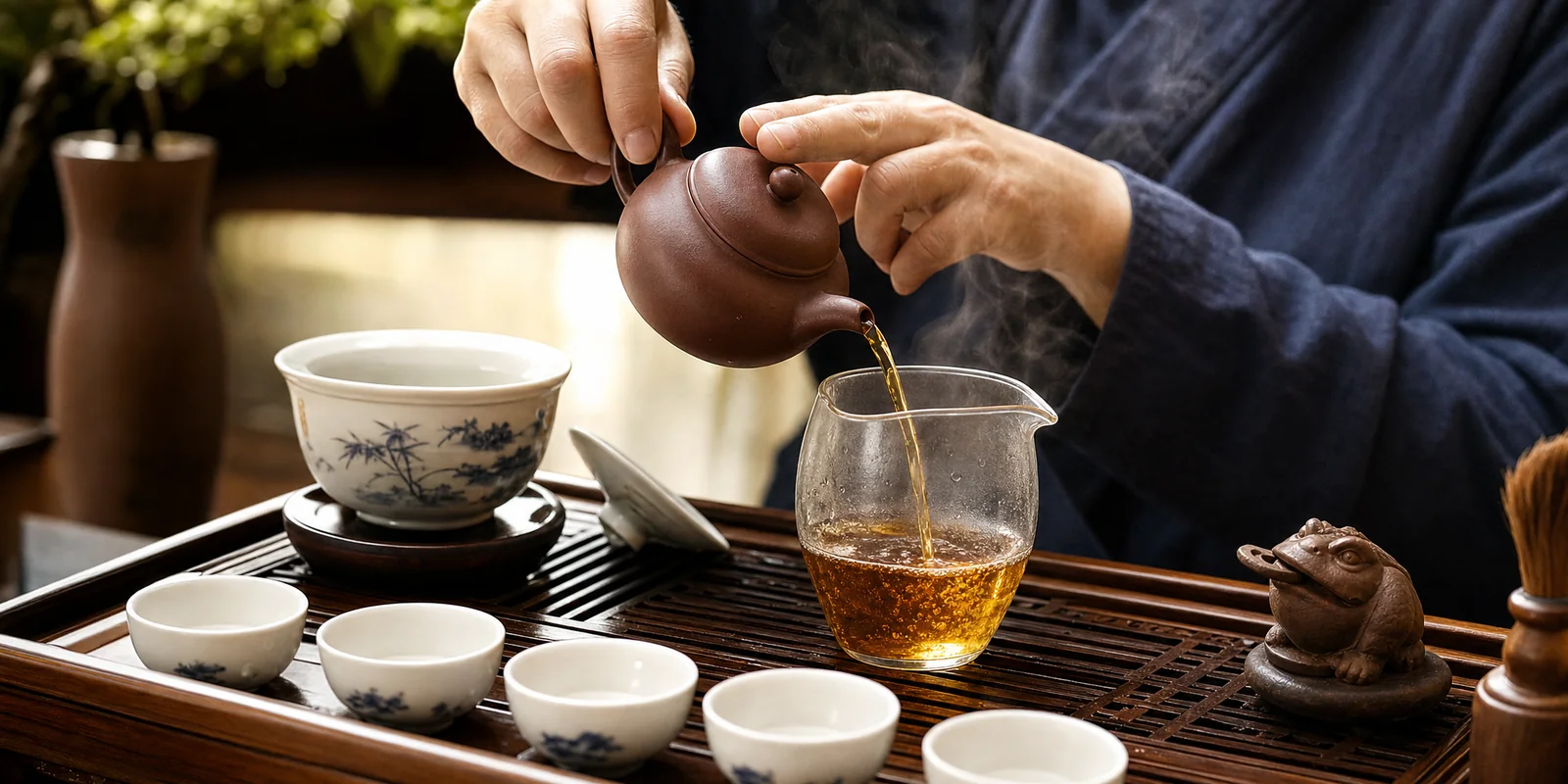
The Chinese tea ceremony isn't a single fixed ritual. It's a family of practices built around one idea: brewing tea slowly and attentively, in small amounts, to taste it properly. The most common style you'll encounter as a visitor is gongfu cha (功夫茶, gōngfu chá), where a host makes many short infusions from the same leaves in a tiny pot. China's tea culture was added to UNESCO's list of intangible cultural heritage in recent years, and you can experience it almost anywhere, from a quiet teahouse in Hangzhou to a noisy park pavilion in Chengdu. This guide covers what the ceremony involves, the teas you'll likely taste, where to go, and how to behave so you feel comfortable rather than lost.
What the Chinese Tea Ceremony Really Is
Tea has been part of Chinese daily life for well over a thousand years, first as medicine, then as a drink for scholars and monks, and eventually as something everyone drinks all day. The "ceremony" most foreigners picture is gongfu cha, which translates roughly to "making tea with skill and effort." It came out of the Chaoshan region in Guangdong and Fujian and spread across the country.
The logic behind it is simple once you see it. Instead of steeping a big mug for several minutes, you use a lot of leaves in a small pot or covered cup, pour hot water over them, and steep for just 10 to 30 seconds. You drink that small cup, then refill the same leaves again and again. A good oolong or pu'er can give you eight to fifteen infusions, and the flavor shifts each time. The point is attention: noticing how the tea changes, the smell of the wet leaves, the warmth of the cup in your hands.
This is different from Japanese tea ceremony (which centers on whisked matcha and highly choreographed movements) and from British afternoon tea. Chinese practice ranges from formal and meditative to relaxed and social. In a Chengdu teahouse, the "ceremony" might just be an old man refilling his own covered cup while playing cards. In a Beijing tea shop, it might be a careful tasting led by a trained host. Both are authentic.
Gongfu cha isn't about fancy equipment or strict rules. It's about brewing small and tasting carefully. Once you understand that, the rest makes sense.
The Main Chinese Tea Types
Chinese tea is sorted by how the leaves are processed, not by flavor alone. All of it comes from the same plant (Camellia sinensis); the differences come from oxidation and handling. Knowing the six broad categories helps you order with confidence and understand what a host is pouring.
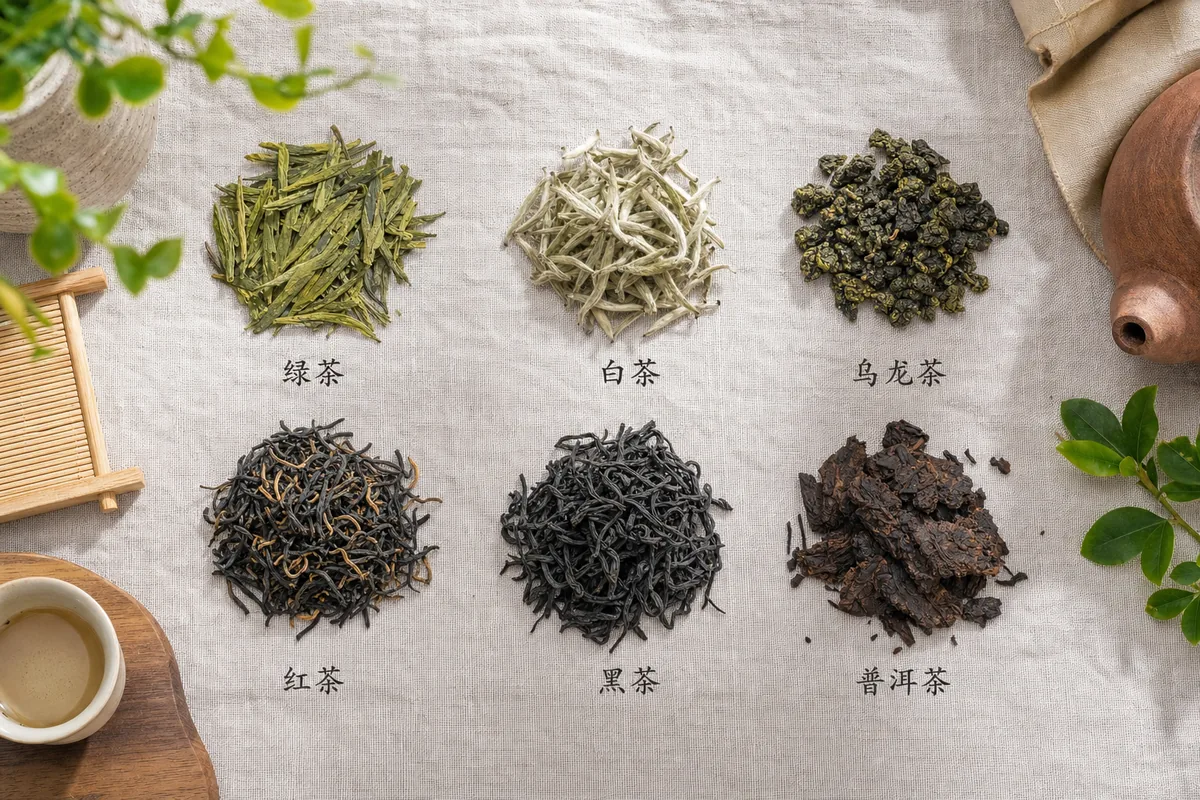
| Type | Chinese name | Character | Well-known example |
|---|---|---|---|
| Green | 绿茶 (lǜchá) | Fresh, grassy, not oxidized | Longjing (Dragon Well), from Hangzhou |
| White | 白茶 (báichá) | Delicate, lightly processed, subtly sweet | Baihao Yinzhen (Silver Needle) |
| Yellow | 黄茶 (huángchá) | Mellow, rare, smooth | Junshan Yinzhen |
| Oolong | 乌龙茶 (wūlóngchá) | Partly oxidized, floral to roasted | Tieguanyin, Da Hong Pao |
| Black ("red") | 红茶 (hóngchá) | Fully oxidized, malty, sweet | Keemun, Lapsang Souchong |
| Dark / fermented | 黑茶 (hēichá) | Aged, earthy, deep | Pu'er (普洱), from Yunnan |
One naming quirk to know: what English calls "black tea" is called "red tea" (红茶, hóngchá) in Chinese, named for the color of the brewed liquid. What Chinese people call "black tea" (黑茶) is the dark, fermented category that includes pu'er. If you ask for "black tea" in English at a tea shop, you'll usually get hóngchá, but it's worth being aware of the gap.
How a Gongfu Tea Session Works
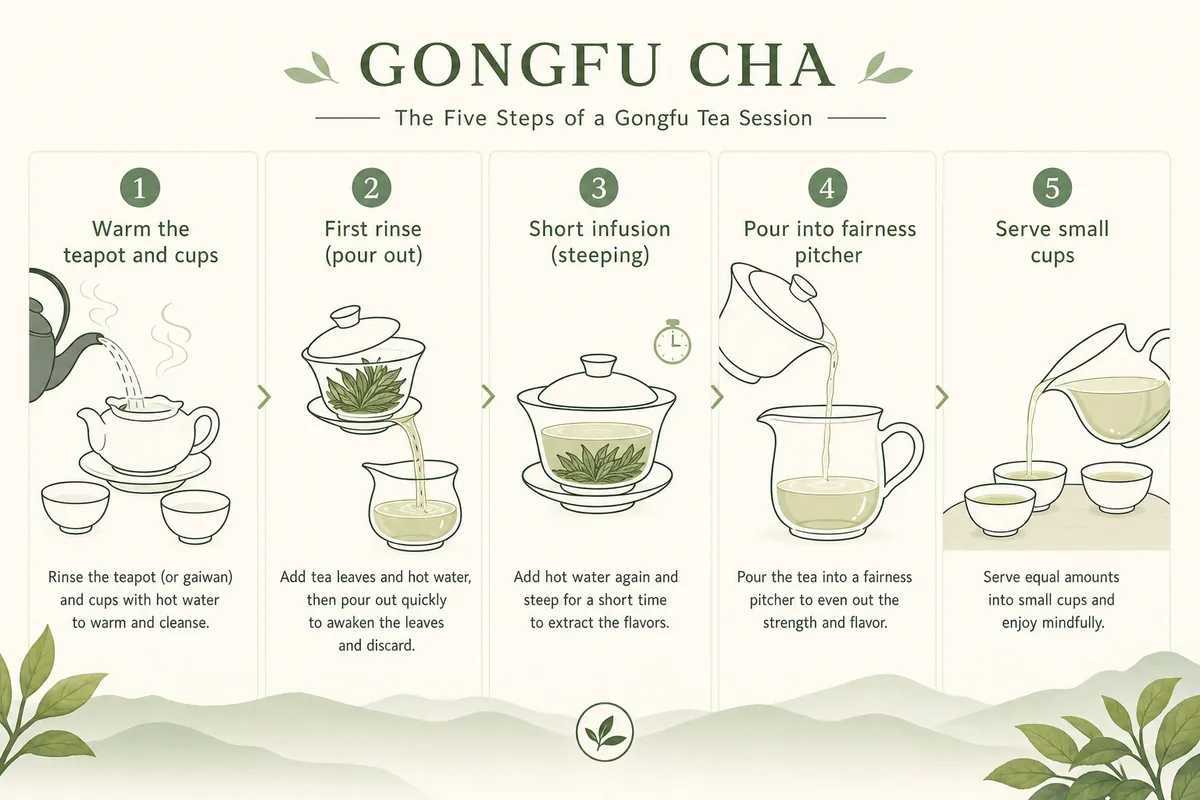
If you sit down for a proper tasting, here's the rough sequence. You don't need to memorize it. A good host walks you through everything, and watching is half the experience.
- Warming the vessels. The host rinses the pot, cups, and pitcher with hot water. This cleans them and brings them up to temperature.
- The first rinse. For many teas, especially oolong and pu'er, the first quick infusion is poured out, not drunk. It wakes up the leaves and rinses off dust. Don't be alarmed when your first pour goes down the drain.
- Short infusions. Hot water goes over the leaves, steeps for a few seconds, and is poured into a small sharing pitcher (公道杯, gōngdào bēi, the "fairness pitcher"), then into your cup. Steeping time grows slightly with each round.
- Smell, then sip. Many sessions use a tall "aroma cup" you smell first, then a small cup you drink from. You take small sips, not gulps.
- Many rounds. The same leaves are refilled repeatedly until the flavor fades. This is normal and expected.
Sessions run anywhere from 20 minutes to over an hour. There's no rush, and that slowness is the point.
Where to Experience Chinese Tea Culture
You have two broad options: a structured tea ceremony class or tasting aimed at visitors, or a local teahouse where you simply sit, order, and absorb the atmosphere. Both are worth doing. Below are the cities where it's easiest to find a good experience.
Hangzhou: the home of Longjing
Hangzhou is the spiritual home of Chinese green tea. The Longjing (龙井, Lóngjǐng) growing villages sit in the hills around West Lake, and you can visit working tea farms in the Meijiawu and Longjing village areas. The China National Tea Museum (中国茶叶博物馆) here is free and genuinely good, with English signage and tasting areas. Spring, when the new leaves are picked, is the most atmospheric time to visit.

Chengdu: tea as a way of life
Chengdu's teahouse culture is the most relaxed and social in the country. At places like the historic Heming Teahouse in People's Park, you pay a modest fee for a covered cup (盖碗, gàiwǎn) of tea and can sit for hours. Servers refill your hot water for free. You'll see locals playing mahjong, getting their ears cleaned, and napping in bamboo chairs. This isn't a formal ceremony, but it's the most honest window into how tea actually fits into Chinese daily life.
Beijing and Shanghai: classes and tastings
Both big cities have plenty of teahouses and tea shops that offer guided tastings and short ceremony classes in English, which makes them the easiest places to book something structured. In Beijing, the Maliandao Tea Street is a whole district of tea wholesalers and shops where tastings are part of buying. In Shanghai, the teahouses around the Yu Garden area and in the former French Concession run beginner-friendly sessions. If you want a hands-on class where you learn to brew gongfu style yourself, these two cities have the most options.
For more cultural classes to pair with a tea session, see our guides to calligraphy classes and cooking classes, both of which work well as a half-day cultural add-on.
Tea Ceremony Etiquette
Tea culture has its own small courtesies. Nobody expects a visitor to get everything right, and hosts are used to explaining. But a few gestures go a long way and will earn genuine warmth.
- The finger tap. When someone pours tea for you, lightly tap two fingers (index and middle) on the table. It's a quiet way of saying thank you without interrupting conversation. Locals do this automatically.
- Receive with both hands. When handed a cup, take it with both hands, or with one hand supported by the other, as a sign of respect.
- Sip, don't gulp. The cups are small for a reason. Three small sips is a traditional rhythm. You're tasting, not quenching thirst.
- Don't fill your own cup first. In a group, pour for others before yourself. If you're the youngest or the guest, expect others to pour for you.
- Hold the gaiwan correctly. If you're given a covered cup, the lid is used to push the leaves back as you sip. The host will show you.
For a broader sense of dining and social customs that overlap with tea settings, our cultural etiquette and taboos guide is worth a read before you go.
Buying Tea to Take Home
Tea makes one of the best souvenirs from China: light, packable, and genuinely useful. A few pointers:
- Buy from a shop that lets you taste before you buy. Any serious tea shop will brew samples for you.
- Loose leaf in sealed bags or tins travels well. Pu'er often comes pressed into cakes, which are sturdy and age well.
- Prices vary enormously by grade. You can get good everyday tea for 100 to 300 yuan per 500g; specialty grades climb far higher. Don't assume the most expensive option is what you'll enjoy most.
- Tea is allowed in both checked and carry-on luggage for international flights, though it's worth checking your destination country's customs rules on agricultural products.
The Bottom Line
The Chinese tea ceremony is less rigid and more welcoming than it sounds. At its core it's just brewing small amounts of good tea slowly enough to actually taste it. Start with a forgiving oolong or green, learn the finger tap and the both-hands habit, and pick the setting that fits your trip: a structured class in Beijing or Shanghai, a green tea farm visit in Hangzhou, or an afternoon doing nothing in a Chengdu teahouse. Book guided sessions in advance to avoid language barriers and inflated prices, and stay alert to the street-invitation scam in major cities. Beyond that, the only real instruction is to slow down and pay attention.
Related Reading
- Hangzhou Complete Guide — plan a visit to China's green tea heartland around West Lake.
- Chengdu Complete Guide — where teahouse culture is most relaxed and social.
- Guide to Chinese Cuisine by Region — pair your tea knowledge with regional food.
- Cultural Etiquette & Taboos — broader social customs that apply at the tea table.
Last updated: June 2026
Read in other languages
Last train times for 10 Chinese metro systems
Every line and station, checked by hand — the same data behind our offline route planner.
Get the WaysChina App
Offline guides, currency converter, essential phrases, and more — all in your pocket.

Related Articles

Acrobatic Shows in China: Where to Watch and How to Book
Chinese acrobatics combines contortion, balance, and motorcycle stunts into a fast-paced live show. Here's where to...
Chinese Calligraphy Classes: A Beginner's Guide for Travelers
How to take a Chinese calligraphy class as a tourist: what to expect, where to book in Beijing and Shanghai, typical...
Chinese Medicine & Massage
From foot massage parlors to acupuncture clinics and TCM museums, here's how travelers can experience traditional...
Chinese Cooking Classes: Where to Learn in China
A practical guide to Chinese cooking classes for travelers — what a class actually involves, real prices, and...