
This article contains affiliate links. If you make a purchase through these links, we may earn a small commission at no extra cost to you. This helps support our work in creating free travel guides.
Getting around Chinese cities by car comes down to two choices: flag a metered street taxi, or book a ride through an app. Both are cheap by Western standards, both are widely available, and both are safe when you use them properly. The main differences are price, language, and how you pay. Street taxis run on fixed government meters and take cash, while ride-hailing apps like DiDi handle everything in-app, often in English, and can be cheaper outside peak hours. This guide covers when to use each, what fares to expect, and the handful of scams worth watching for.
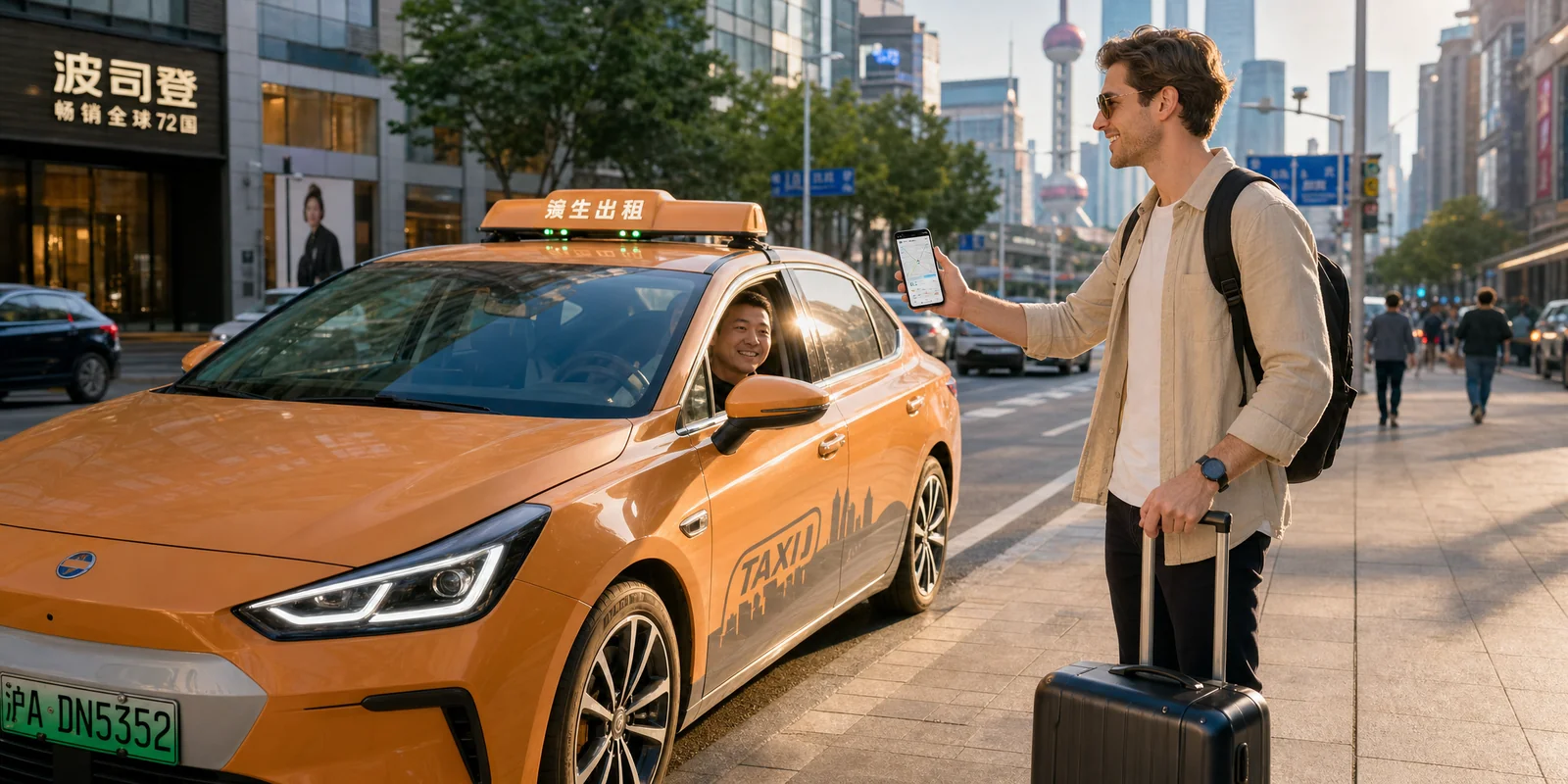
The two options at a glance
For most visitors, the decision is simple. If you have a working phone with data and you can read a map of where you are, ride-hailing is usually easier and removes the language barrier entirely. If your phone is dead, you have no signal, or there is a taxi rank right in front of you, a street taxi is faster and just as legitimate.
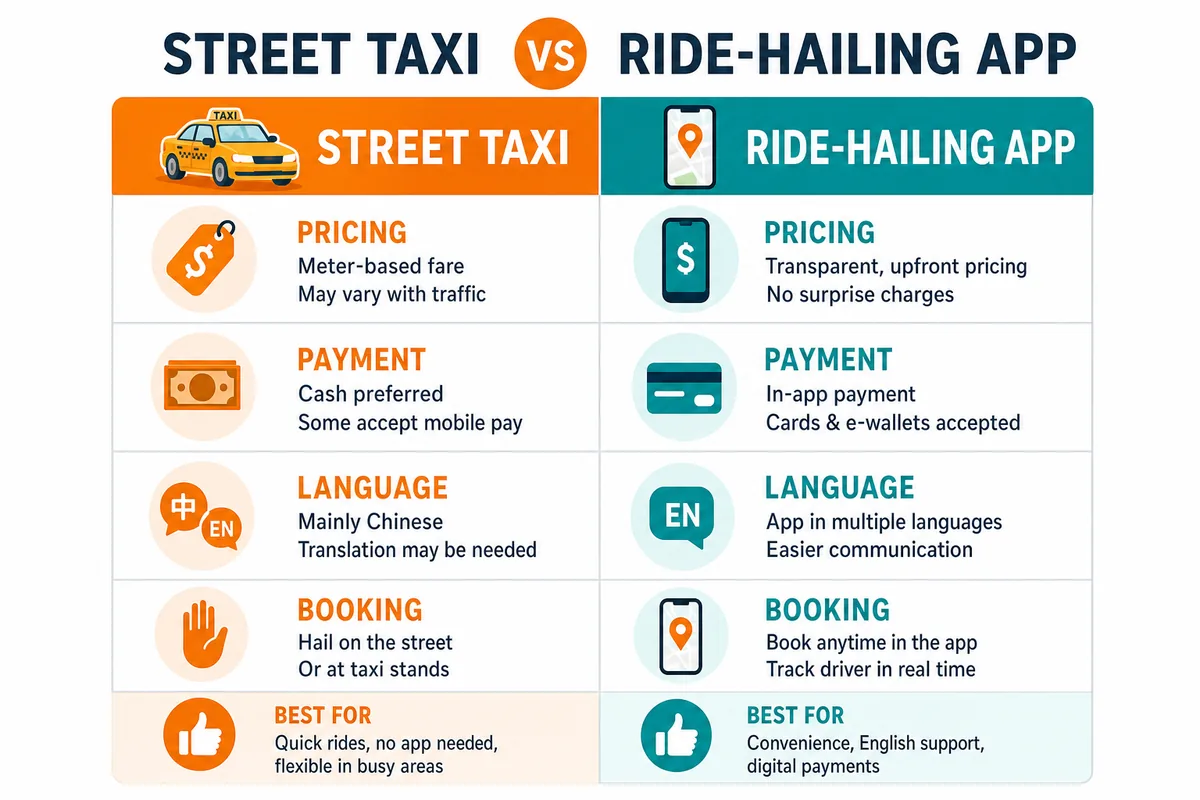
| Street taxi | Ride-hailing (DiDi) | |
|---|---|---|
| Pricing | Fixed city meter, no surge | Lower base fare, but surges in peak/rain |
| Payment | Cash, often Alipay/WeChat QR | In-app: foreign cards, Alipay, WeChat |
| Language | Mandarin only, in most cases | English interface, in-app translation |
| Booking | Hail on street or at a rank | Order in app, driver comes to you |
| Best for | No phone/signal, ranks at stations | Most trips, airport runs, no Mandarin |
As a rough sense of cost, a 10 km daytime trip in Shanghai runs about 45 RMB by street taxi and around 35 RMB on a DiDi economy car, though that DiDi fare can climb toward 60 RMB at rush hour. The trade-off is consistency versus price: meters never surge, apps sometimes do.
How to hail a street taxi
Legitimate taxis (出租车, chūzūchē) are easy to spot once you know the markers. China's transport regulations require licensed cruising taxis to carry a meter, satellite positioning, an emergency alarm, a uniform body color and livery, and a rooftop light with the words "出租汽车" (taxi) in Chinese and English. The roof light shows the car's status, and the fare schedule, passenger notice, operator name, and a service complaint phone number must all be displayed inside the cab.

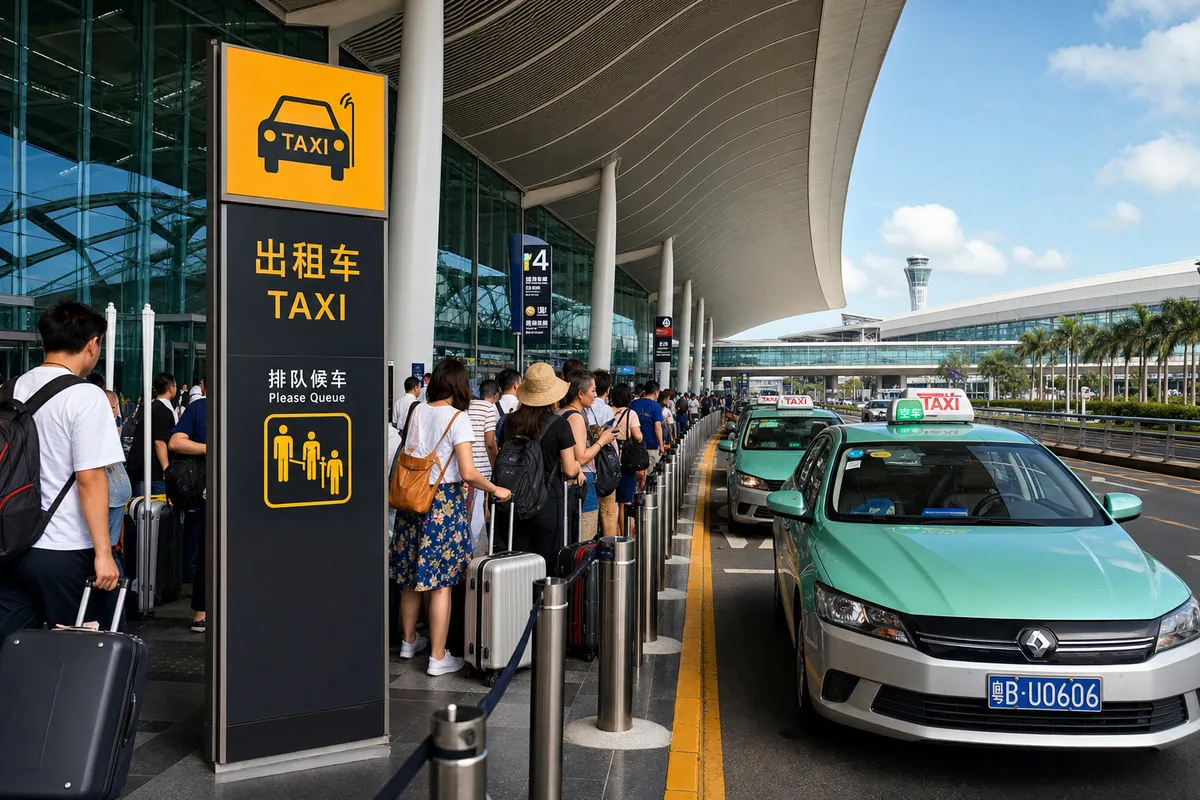
To flag one down, stand somewhere it is safe and legal to stop, raise your hand, and look for a cab with its roof light lit (an unlit light usually means occupied or off-duty). At airports, train stations, and major hotels, head to the official taxi rank rather than accepting offers from people approaching you. Once inside:
- Have your destination written in Chinese characters, or show it on a map. Most drivers speak little or no English.
- Check that the driver starts the meter. By law they must use it and charge the displayed amount.
- Ask for the printed receipt (发票, fāpiào) at the end. It lists the company, complaint number, distance, and times, which is exactly what you need if anything goes wrong.
What taxis cost
Fares are set by each city government, so the starting fare and per-kilometer rate vary from place to place. The meter always rules; there is no negotiating and no legitimate reason for a flat "special price."
In Beijing, the starting fare is 13 RMB (covering the first 3 km), then 2.3 RMB per km during the day. Between 23:00 and 05:00 the rate rises to 2.76 RMB per km, a roughly 20% night surcharge, and trips over 15 km add an empty-return fee. In Shanghai, the standard starting fare is 14 RMB (first 3 km), then 2.70 RMB per km from 4 to 15 km and 4.05 RMB beyond that; at night the flagfall jumps to 18 RMB. Electric taxis in Shanghai start at 16 RMB.
| City | Approx. starting fare |
|---|---|
| Beijing | 13 RMB |
| Shanghai | 14–16 RMB |
| Guangzhou | ~12 RMB |
| Hangzhou | ~13 RMB |
| Chengdu | ~9 RMB |
| Shenzhen | ~10 RMB |
| Xi'an | ~8.5 RMB |
Treat every figure except Beijing and Shanghai as a rough community estimate rather than an official tariff. Rates change, and cities periodically adjust fuel surcharges and night rules, so check the rate card posted inside the cab, which is always current for that city.
Ride-hailing: DiDi is the one to use
DiDi (滴滴出行, Dīdī Chūxíng) is China's largest ride-hailing platform and covers nearly every major city, including Beijing, Shanghai, Guangzhou, and Chengdu. As of late 2025 it was still the most-used ride-hailing app in the country by a wide margin. For foreign visitors it is the obvious pick because it offers a full English interface, lets you register with an overseas phone number, and translates in-app messages between you and the driver in both directions. It also runs 24/7 customer support in English and Chinese.
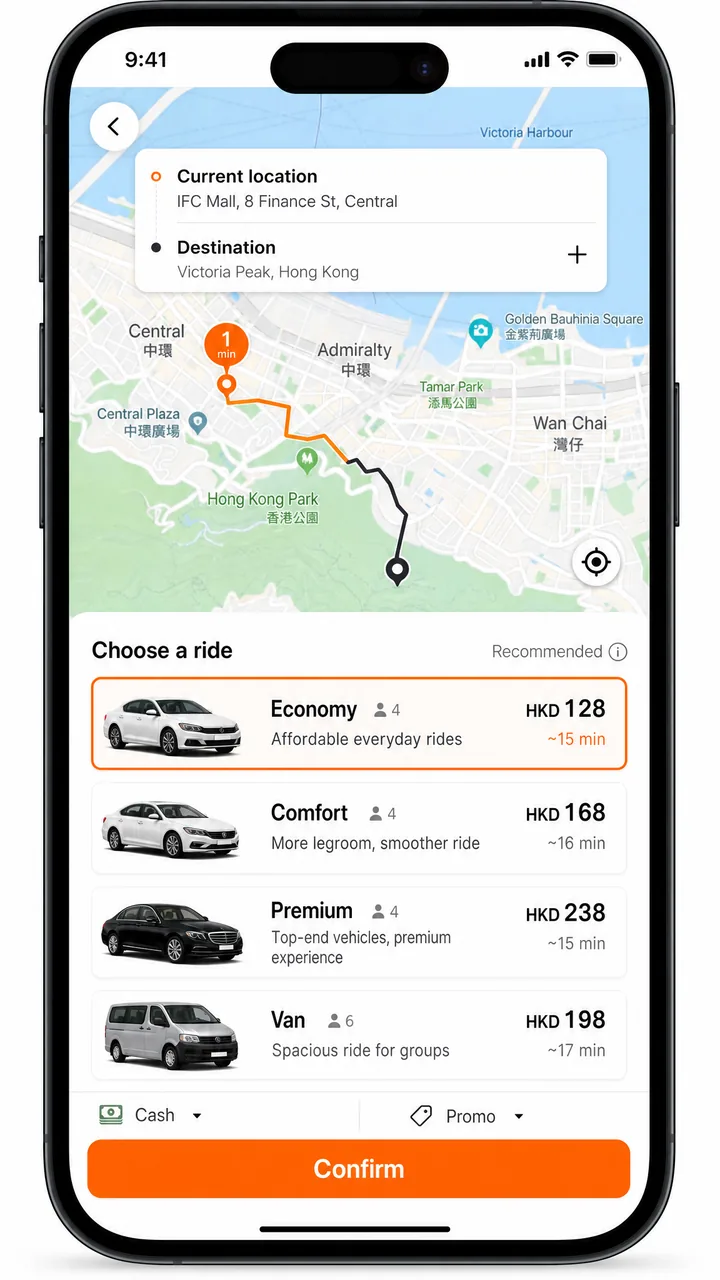
A few practical notes when you set it up:
- In the app store, choose the official "Didi China" app (listed as "DiDi: Ride Hailing in China"). Do not confuse it with "Didi Rider," which operates only outside mainland China.
- To switch to English inside the app, go to Me → Settings → General → Language 语言 → English → Confirm.
- If you would rather not install another app, you can run DiDi inside Alipay or WeChat as a mini-program. The Alipay version works without a Chinese phone number and pays from your Alipay balance or linked card. In WeChat you'll need to search the Chinese name "滴滴出行" (searching "didi" in English usually fails), and it only takes WeChat Pay, which does not accept foreign cards.
Because all of this depends on having mobile data the moment you land, sort out connectivity before you arrive. A travel eSIM such as Airalo lets you book your first ride straight off the plane without hunting for a SIM counter. For the full breakdown of options, see our China SIM Card & eSIM Guide.
Paying for a DiDi
DiDi accepts international credit and debit cards (Visa, Mastercard, JCB, Diners Club), plus WeChat Pay, Alipay, and Apple Pay. Most car types are pay-online-only; only traditional taxis booked through the app take cash. Whether international cards and Apple Pay work can vary by city, so add a backup payment method like Alipay before you travel. We could not confirm whether foreign-card payments carry extra processing fees, so check your card's foreign-transaction terms.
Other apps, and why they're harder
DiDi is not the only option, but it is the only one built for foreigners. Amap (高德), the mapping app, aggregates several ride providers and compares prices, and you can log in with Apple ID, Facebook, or WeChat. Meituan's ride service is often cheaper with more drivers but is Chinese-first and unfriendly to newcomers. The catch with most non-DiDi apps is that they expect a Chinese phone number and a local bank-linked wallet, which most short-term visitors won't have. For app-by-app setup steps, see our Didi Guide and Map Apps Guide.
Safety features and what's behind them
Ride-hailing in China is more tightly regulated than many visitors expect. Under national rules, both the car and the driver must hold ride-hailing licenses, the online and offline driver must match, and platforms are barred from detouring, dumping passengers mid-trip, or charging improper fees. Platforms must also carry carrier liability insurance for passengers; Shanghai goes further and makes the platform pay passengers first if a safety incident happens during a trip.
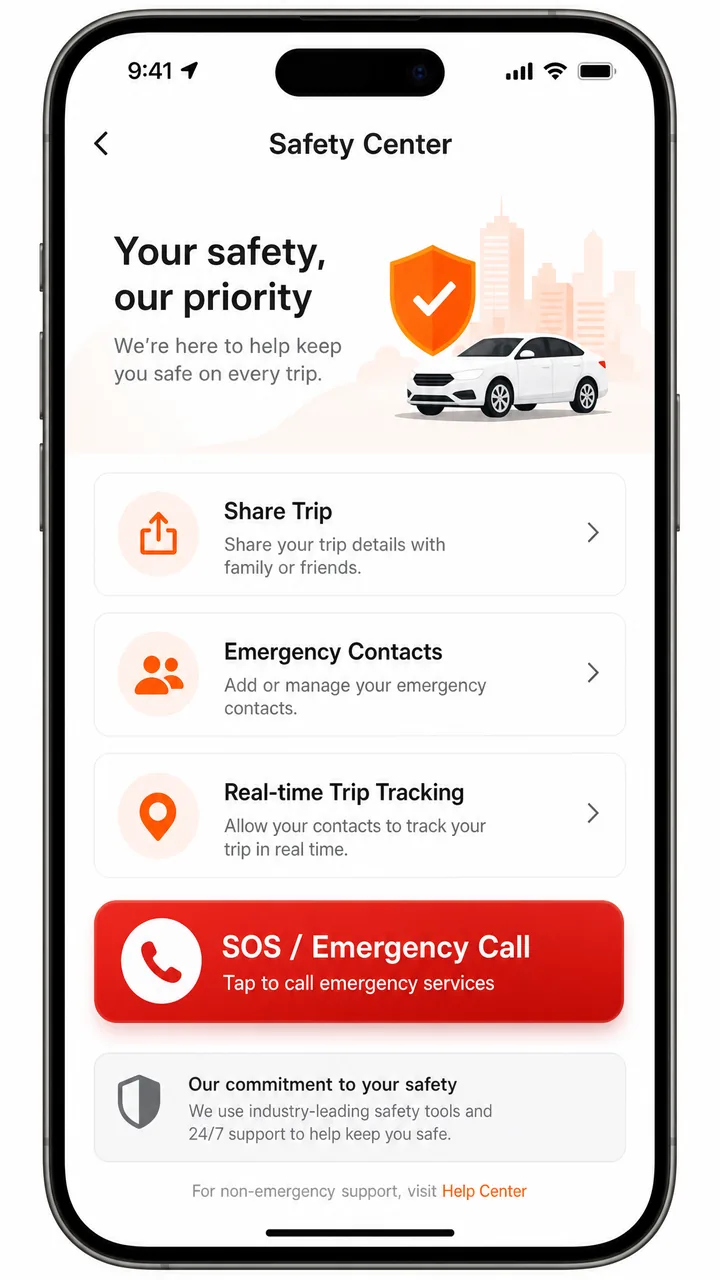
Inside the DiDi app you get real-time trip tracking, the option to share your trip with an emergency contact, number protection that masks both phones, and an SOS button. Since DiDi's 2018 safety overhaul, that SOS button calls the police directly (110) rather than just alerting your contacts, and a consolidated Safety Center handles reporting and trip sharing. You can also raise trip or fare disputes with support directly in the app.
Scams to watch for
Serious problems are uncommon, but a few tricks still target tourists, mostly around airports, train stations, and tourist sites. None of them survive the basic habits below.
Other things to keep an eye on:
- Rigged or "broken" meters. A meter that climbs unnaturally fast, or a driver who claims the meter is broken and quotes a flat price, are both red flags. Insist on the meter; if the driver refuses, get out.
- The currency switch. A driver palms your real note, shows you a fake, and says you handed over counterfeit. Pay with small notes or, better, by mobile payment, and keep track of what you hand over.
- The "your hotel is closed" routine. A driver claims your hotel has shut down and offers to take you somewhere that pays them a kickback. Call your hotel or just insist on your original destination.
- Airport "helpers." Anyone calling themselves an airport staffer or driver who approaches you before you reach the rank is best ignored. Airport taxis may add a small legitimate surcharge (around 10–20 RMB), but everything else is metered.
For the wider picture on travel scams in China, see our Tourist Scams in China guide.
Airports: where to actually get a cab
At every major airport, follow signs to the official taxi rank (sometimes labeled "taxi queue") in the arrivals area and join the line. At Shanghai Pudong, for example, the Terminal 1 taxi pickup is outside Gate 12 on the arrivals level and the Terminal 2 pickup is outside Gate 25, both open 24 hours. As a price reference, a Beijing taxi from Capital Airport to Tiananmen runs roughly 100–140 RMB, while Daxing Airport to Tiananmen is closer to 180–250 RMB and takes 45–70 minutes depending on traffic. For airport-specific layouts and transfer options, see our Shanghai Airport Guide and Beijing Airport Guide.
If something goes wrong
For an in-trip emergency, call the police on 110. China's other emergency numbers are 119 (fire), 120 (ambulance), and 122 (traffic accidents), and you can dial them from any phone, even one that is locked or has no SIM. Operators generally speak Chinese with limited English, so have your location ready in Chinese if you can.
For complaints that aren't emergencies, such as an overcharge, a refused fare, or a deliberate detour, China has a national transport service hotline, 12328, that handles taxi and ride-hailing complaints. Add the city's area code if you're calling from another city. Many cities also take complaints through the 12345 municipal hotline or local transport WeChat accounts. Whatever route you use, keep evidence: the license plate, the driver's name or phone number, and the printed receipt, which carries the company and complaint details. According to the Ministry of Transport's official ride-hailing regulations, platforms and drivers are legally required to charge correctly and provide receipts, which gives complaints real weight.
For the full text of the rules, see the Ministry of Transport's Interim Measures for Online Ride-Hailing Services and Regulations on Cruising Taxi Services.
Frequently asked questions
Do I need to tip taxi or DiDi drivers?
No. Tipping is not expected in Chinese taxis or ride-hailing, and drivers generally won't anticipate it. See our Tipping Culture in China guide for the wider picture.
Can I pay a street taxi with a foreign card?
Usually not directly. Street taxis take cash and almost always accept Alipay or WeChat QR codes, but they rarely take foreign cards at the terminal. Carry some cash as a fallback, or set up a mobile wallet before you arrive.
Is DiDi cheaper than a taxi?
Often, yes, especially off-peak, because DiDi's base fare is lower. But DiDi uses dynamic pricing and surges during rush hour, rain, or high demand, while metered taxis never do. When it's pouring and everyone wants a ride, a street taxi can be the better deal.
What if no driver speaks English?
That's the normal case in a street taxi, which is why a destination written in Chinese is essential. In DiDi the in-app chat translates both directions, so language is much less of an issue.
Does DiDi work in small towns?
It covers the vast majority of cities well, but coverage thins out in rural and remote areas. In smaller places you may wait longer or fall back on street taxis.
The bottom line
For most visitors, DiDi is the default: English interface, in-app translation, transparent fares, and no language barrier at pickup. Keep a street taxi in your back pocket for when your phone is dead, there's no signal, or prices surge in the rain. Whichever you use, the safety basics are the same everywhere: get in only at official ranks or through the app, make sure the meter runs, keep your receipt, and pay by phone where you can. Set up mobile data and a payment method before you land so your very first ride is the easy one. If anything goes sideways, 110 handles emergencies and 12328 handles complaints. For getting around without a car at all, our Metro Systems Guide and City Transportation overview cover the rest.
Last updated: June 2026
Read in other languages
Last train times for 10 Chinese metro systems
Every line and station, checked by hand — the same data behind our offline route planner.
Get the WaysChina App
Offline guides, currency converter, essential phrases, and more — all in your pocket.

Related Articles
City Transportation in China: How to Get Around
Metros, taxis, buses, and ride-hailing in Chinese cities — what works for foreign visitors, how to pay, and how to...

China Metro Guide: How to Use the Subway in Any City
A practical guide to using China's metro systems as a foreign traveler — payment with foreign cards, fares, tickets,...
Public Buses Guide
How to ride city buses in China as a foreign visitor: payment options, boarding rules, fares, English support, and...