
This article contains affiliate links. If you make a purchase through these links, we may earn a small commission at no extra cost to you. This helps support our work in creating free travel guides.
Two days is enough for Huangshan (黄山, Huángshān, the Yellow Mountain) if you sleep on the summit. On Day 1, take a morning high-speed train to Huangshan North, go by road to Tangkou, the town at the foot of the mountain, ride the Yungu cable car up, and walk across the top past Beginning-to-Believe Peak and the North Sea area to Bright Summit Peak, then spend the night in a summit hotel. On Day 2, watch the sunrise, walk the West Sea Grand Canyon if it is open, pass Flying-Over Rock and the Welcoming Guest Pine, ride the Yuping cable car down and take an evening train out. You never walk the same path twice. Before you go, book three things: your train, your mountain ticket in your own name on the scenic area's official mini program, which the scenic area asks you to do at least three days ahead, and your summit hotel.
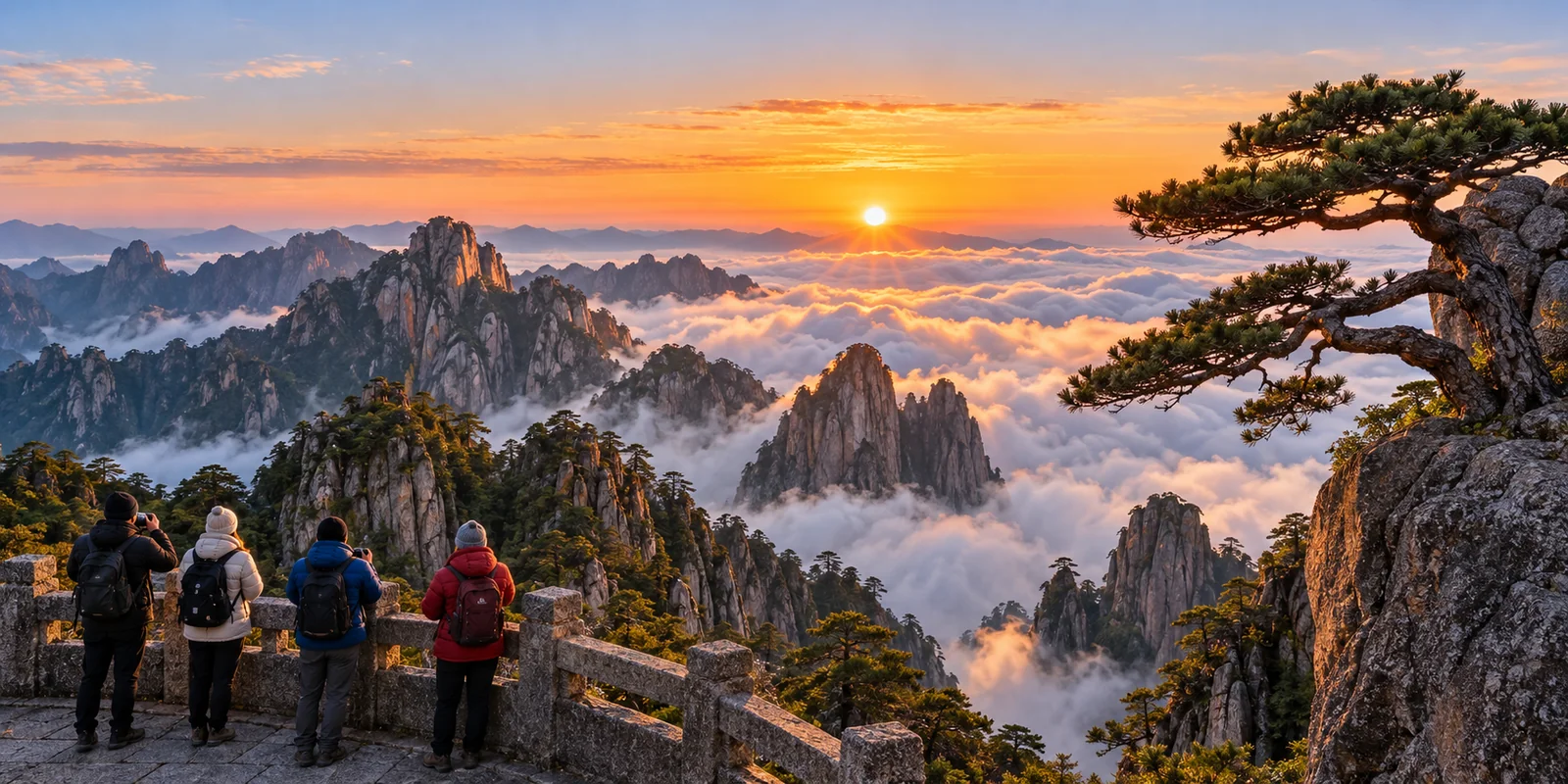
How the two days work, and what to book before you go
This plan follows four simple rules.
- Go up on the gentle side and come down on the dramatic side. The Yungu cable car starts on the east side of the mountain and drops you near Beginning-to-Believe Peak and the North Sea area. The Yuping cable car on the south side brings you down past the Welcoming Guest Pine. Going up one and down the other means you cross the whole summit once, from east to south, without turning back.
- Sleep on the mountain. The best light on Huangshan is at sunset and sunrise, and the only way to see both is to stay on top. You also get the summit paths in the early evening and early morning, before the day visitors come up from Tangkou.
- Keep Day 2 morning as your reserve. If fog hides everything on Day 1, you still have a second look the next morning. Your mountain ticket helps here too: it is valid for three days in a row, counting the first day, and you can go in and out during that time, as long as you scan it at the gate on the first day; for each extra day you re-enter, book a "multi-entry" (多次进山门票) slot in the official mini program, because places are limited and the ticket windows do not handle it.
- Leave Day 2 afternoon open for the trip down. Book an evening train, not an afternoon one. The descent, the shuttle bus and the road back to the station all take longer than people expect.
The plan suits most first-time visitors who are reasonably fit and can manage a few hours of stone stairs each day. If you cannot sleep on the summit, or you do not want to, use the version without an overnight stay, described further down. If anyone in your group has bad knees, read the section on seniors and kids before you book anything, because it changes which parts of Day 2 you do.
Your booking timeline
Book in this order, as soon as you know your dates.
- Train tickets, both ways. China's railway sells tickets up to 15 days ahead, counting the day of travel, and each station sets its own time for releasing them, so there is no single national opening time. The official railway site, 12306 in English, accepts foreign passports, but your account can only buy tickets after your identity check shows "passed"; you can upload a photo of your passport or have it checked at a station ticket window. Book the return train at the same time as the outbound one. Weekend and holiday trains to and from Huangshan fill up, and you do not want to be stuck on the mountain looking for a seat home. Our guide on how to book China train tickets with a foreign passport walks through 12306 step by step.
- Your Huangshan mountain ticket. Entry works by real-name booking, for a set time slot and a set direction (which gate you enter by), on the Huangshan Tourism Official Platform (黄山旅游官方平台), a mini program inside WeChat and Alipay; the name on the booking must match the person who enters. Foreign visitors can book there too: in the ID field, choose "other ID type" (其他证件类型) and upload your passport details. If that does not work, you can book in person at the booking desk at the scenic area, and staff check passports by hand at the gate. When a day sells out, the platform opens a waitlist; if no ticket comes free, you get your money back the way you paid. The scenic area warns against booking through unofficial sellers or paying extra to "grab" tickets. For Day 1, book entry at the Yungu side, since that is where this plan goes up.
- Your summit hotel. You must book your mountain ticket before you can stay at a hotel inside the scenic area. Book both on the same day so the dates match. Summit rooms sell out early for weekends, public holidays and the autumn season, so do not leave this to the last week.
- Optional: Tiandu Peak. This plan does not climb Tiandu Peak (天都峰, Tiāndū Fēng), the steep, exposed peak on the front of the mountain. If you want to add it, it needs its own real-name booking in the same mini program, and without one you will not be let on.
The card below has the current ticket and cable car prices, the booking rules and the hiking cut-off time in one place.
Your mountain ticket does not include the cable cars or the shuttle buses inside the scenic area. For this plan as written, an adult in the regular season pays 360 yuan before the shuttle buses — 190 for the mountain ticket, 80 for the Yungu cable car up and 90 for the Yuping cable car down. The West Sea Grand Canyon sightseeing car is extra, at 100 yuan one way in the regular season. Those regular-season prices run from 21 January to 19 December 2026; in the last winter period, from 20 December 2025 to 20 January 2026, the mountain ticket was 150 yuan. The shuttle bus fare is not in the official price notice (in Chinese), so check it at the Tangkou transfer center when you buy it.
💡 Tip: Children and teenagers may get in free in November 2026, so check this when you book: 15 paid scenic areas around the city, including Huangshan, Hongcun and Xidi, waive the entry ticket for everyone under 18 for the whole month, though study-tour groups are excluded. The notice does not say whether foreign children qualify, so check at the gate or in the booking mini program before you rely on it. As in past offers, cable cars and shuttle buses are still paid; check at the gate.
If you are flying in, Huangshan Tunxi International Airport is one of Anhui's two entry points for China's 240-hour visa-free transit. Check whether your passport and onward ticket qualify in our 240-hour visa-free transit guide. Everything about getting to Huangshan, the full train table and where else to stay is in our Huangshan guide; this article stays with the two-day plan.
Day 1: train to Tangkou, Yungu cable car up, North Sea and Bright Summit
Day 1 has a long travel morning and a short, easy afternoon on top. The goal is to be on the Yungu cable car by early afternoon, with time to check in, walk a few viewpoints and be in place for sunset.
Morning: the high-speed train to Huangshan North
Take the earliest train you can face to Huangshan North (黄山北, Huángshān Běi), the main high-speed station for the area. From Shanghai Hongqiao, the fastest train on a sample day took 2 hours 16 minutes and most took about two and a half to three hours. From Hangzhou, most trains leave from Hangzhou West: the fastest took 1 hour 13 minutes and most about 1 hour 20 minutes. From Beijing South, the fastest train took about 5 hours 17 minutes and the rest six and a half hours or more, so from Beijing it is better to arrive the evening before and sleep in Tangkou. Times and the number of trains change with each timetable, so check 12306 for your own date.
Be careful with station names. A few trains stop at Huangshan West instead, which takes about four hours from Shanghai and is the wrong station for this plan; make sure your ticket says Huangshan North. If you are starting from Shanghai or Hangzhou, our Shanghai travel guide and Hangzhou travel guide cover getting to the stations.
At the station, use the staffed gate. Foreign passports are checked by hand at entry and exit, because the automatic gates cannot read them. Allow extra time for that line, especially at Hongqiao. Our guide to finding your way through a Chinese train station shows what to expect.
Late morning: Huangshan North to Tangkou
The station is in the city, a long way from the mountain gates, so you still have a road trip to Tangkou (汤口, Tāngkǒu), the small town at the southern foot of the mountain where the scenic area's transfer center is. You have two options:
- Tourist bus. Buses to Tangkou leave from the bus area at the station. Ask at the station's bus counter for the next departure and the fare, and expect to wait a while for the bus to leave.
- Taxi or ride-hailing. Faster, door to door, and easier with luggage. It is the better choice for two or more people, or if your train arrives late.
Either way, plan the road leg as most of a morning, including the change at Tangkou, so do not plan to be on the cable car within minutes of stepping off the train. If you have a large suitcase, deal with it now: see the section on luggage below.
Midday: the shuttle bus and the Yungu cable car
Visitors normally switch to the scenic area's own shuttle at Tangkou rather than driving up. At the Tangkou transfer center (换乘中心, huànchéng zhōngxīn) you buy a ticket for the scenic area's shuttle bus (换乘车, huànchéng chē) and ride it up the mountain road to Yungu Temple (云谷寺, Yúngǔ Sì), where the Yungu cable car starts. The shuttle is paid separately from the mountain ticket. Make sure you board the bus for Yungu Temple, not the one for Ciguang Pavilion, which goes to the Yuping cable car you will take down tomorrow.
At the gate, staff check your passport by hand against your booking. This first scan also activates the three-day validity of your ticket, so make sure it really is scanned.
The Yungu cable car (云谷索道, Yúngǔ Suǒdào) costs 80 yuan one way in the regular season. It climbs through forest and over granite ridges to the eastern edge of the summit, a short walk from Beginning-to-Believe Peak. Cable car hours change with the season and the scenic area's notices. During Golden Week 2026, the busiest week of the year, the scenic area and all four cable cars ran from 6:00 or 6:30 until 17:40; ordinary days can start later, so check the scenic area's current notice for your date. You will not be close to the closing time on Day 1 if you follow this plan, but on a late train in winter you could be.
Thunderstorms, strong wind and heavy rain stop the cable cars, and in serious weather the whole scenic area closes, with every entrance and cable car shut at the same time. If the cable car is stopped when you arrive, wait at the station and follow the staff's instructions; do not try to walk up in a thunderstorm.
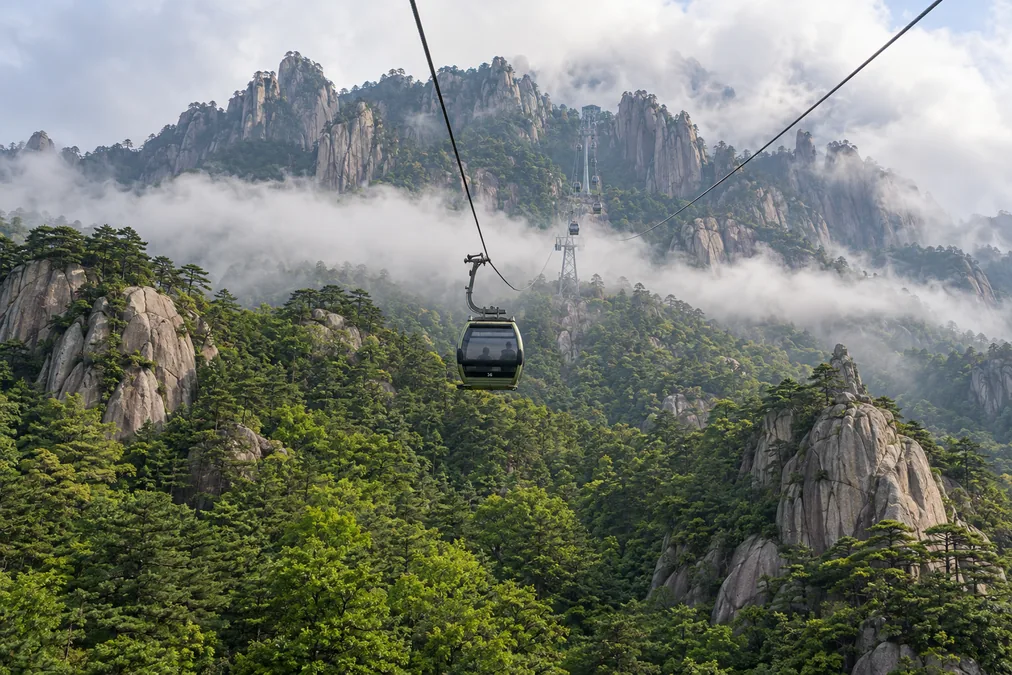
⚠️ Warning: If you plan to walk up the stairs instead of riding, start in the morning. On public holidays and in the winter season, the ticket gates at the start of the hiking trails close at 15:00; after that you can walk out but cannot enter on foot, so a late arrival can only ride up. On ordinary days, confirm the cut-off time with the gate staff.
Walking up the back mountain stairs from Yungu Temple is a real option for fit hikers. It is the less steep side and mostly in forest, but it is still several hours of continuous stone steps with a pack on, and you arrive tired for the evening. For most people on a two-day plan, the cable car up is the better use of the day.
Afternoon: Beginning-to-Believe Peak and the North Sea area
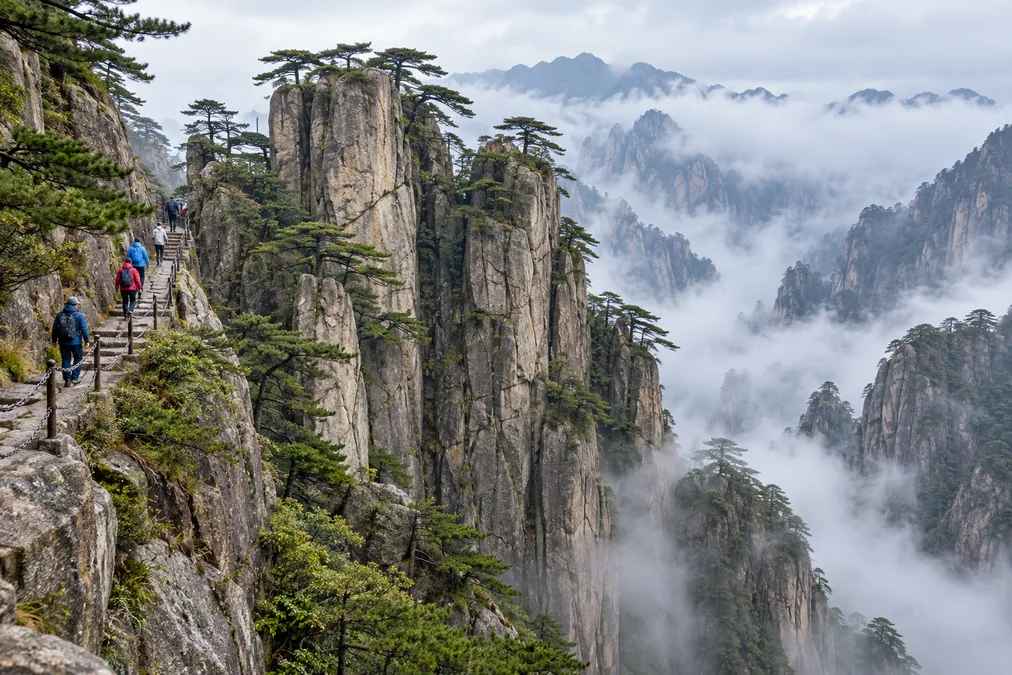
From the top of the Yungu cable car, the paths lead toward the North Sea area. Your first stop is Beginning-to-Believe Peak (始信峰, Shǐxìn Fēng), a short side loop off the main path. The name comes from the old saying that you only start to believe Huangshan is real once you see it. It is small, crowded at the top, and worth it: pines growing straight out of sheer rock, and deep drops on both sides. The stone steps are narrow in places, so take your time.
Then continue into the North Sea area (北海, Běihǎi). "Sea" here means the sea of clouds, not water: on the right day, cloud fills the valleys below the peaks, and the North Sea viewpoints look out over it. Cooling Terrace (清凉台, Qīngliáng Tái) is one of the classic terraces here. The North Sea area is also where several summit hotels are, so this is a good moment to check in, drop your daypack and take off a layer.
Where to sleep on the summit
The main summit hotels are run by Huangshan Tourism Development, the listed company that also operates the cable cars. Its annual report lists them as the Yunlu Beihai Hotel (雲麓北海宾馆), the Shilin Hotel (狮林大酒店), the Xihai Hotel (西海饭店), the Baiyun Hotel (白云宾馆), the Yupinglou Hotel (玉屏楼宾馆), and the newer Yunye Paiyun and Yunji properties. For this plan, the best area is around the North Sea and the West Sea, which means the Beihai, Shilin or Xihai hotels. They are close to Bright Summit and the sunrise viewpoints, and the Xihai Hotel is on the West Sea side, where Day 2 starts.
Expect to pay a lot for a fairly plain room. Supplies reach the summit by cable car or on porters' shoulders, so a summit night costs much more than a similar room down in Tangkou, and meals and bottled drinks are priced the same way. What you are buying is the location: sunset and sunrise a short walk from your bed. Prices change by season and day of the week, so compare current rates before you choose; you can see the summit hotels and Tangkou options side by side on Booking.com. Book the hotel only after you have booked your mountain ticket for the same date.
Late afternoon and evening: Bright Summit Peak and sunset
From the North Sea area, walk on to Bright Summit Peak (光明顶, Guāngmíng Dǐng). At 1,860 meters it is the second-highest peak on Huangshan; the top is broad and flat, there is a weather station on it, and from there you can look out over the peaks to the east and west. It is an easy walk on wide paths compared with the rest of the mountain, and it is a good place to get your bearings for tomorrow: you can see the direction of the West Sea and the front peaks you will walk past.
For sunset, most people head to the West Sea side, around Paiyun Pavilion (排云亭, Páiyún Tíng), which looks west over the canyon. Ask at your hotel for today's sunset time and whether the sky is expected to clear. Leave yourself enough daylight to walk back to the hotel, and carry a headlamp or use your phone light in case you stay out late. The paths are well built, but they are steep stone steps with no street lights.
Dinner is in your hotel or at one of the other summit hotels' restaurants. Choice is limited and it costs more than in town. Go to bed early. Sunrise means getting up in the dark, and you have a full day of walking tomorrow.
Day 2: sunrise, West Sea Grand Canyon, Welcoming Guest Pine, Yuping cable car down
Day 2 is the big day. You walk across the rest of the summit from the north and west to the south, with the West Sea Grand Canyon as the main event of the morning, then ride down to Tangkou and take an evening train.
Sunrise
Your hotel will post the next morning's sunrise time and the weather outlook in the lobby, or you can ask at the front desk the evening before. The most popular sunrise spots are Bright Summit Peak, the terraces in the North Sea area such as Cooling Terrace, and Beginning-to-Believe Peak. Pick the one closest to your hotel; walking far in the dark is not worth it.
Dress for cold. Put on all your layers, take gloves in autumn and winter, and carry a headlamp for the walk in the dark. The summit is windy before dawn even in July, and you will be standing still for a while. Expect a crowd at the main viewpoints. If the cloud is thick and you see nothing, wait a while before giving up; the cloud on Huangshan often moves quickly, and the light just after sunrise can be better than the moment itself.
Then go back for breakfast, check out, and set off with only your daypack.
Morning: West Sea Grand Canyon
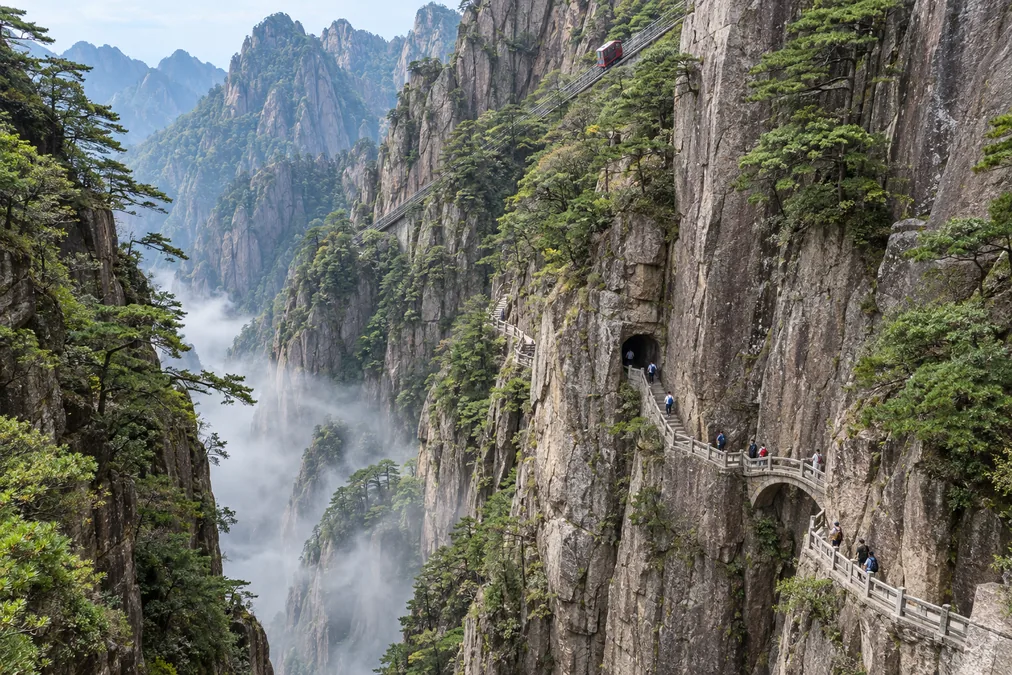
The West Sea Grand Canyon (西海大峡谷, Xīhǎi Dà Xiágǔ) is a deep gorge on the west side of the summit, with paths cut into the cliff faces, bridges, tunnels and steep stone stairs. It is the most dramatic walk you can do on Huangshan without special booking, and also the most tiring part of this plan.
There is a sightseeing rail car in the canyon (西海大峡谷观光缆车), often called the "little train" or the monorail. It runs along the canyon slope on a track, not up the mountain from below, and it saves you the steepest climb. It costs 100 yuan one way in the regular season. Many visitors walk down into the canyon from the rim near Paiyun Pavilion, follow the paths through the lower canyon, and then ride the car back up, so they skip the hardest climb. Fit walkers can do the whole loop on foot. Either way it takes up most of the morning, so start right after breakfast.
If you are tired after yesterday, or the canyon is in cloud, you can skip the lower loop and just walk the rim paths near the Xihai Hotel and Paiyun Pavilion for the views down into it. That still gives you a good look at the canyon and saves your legs for the rest of the day.
⚠️ Warning: The canyon closes in winter. In the 2024–25 winter the scenic area closed the West Sea Grand Canyon and Tiandu Peak for maintenance from 1 December, together with the West Gate area, while Lotus Peak stayed closed for its rest period; the canyon and its sightseeing car reopened on 14 March 2026. If you travel between December and early spring, check the scenic area's current notice and plan Day 2 without the canyon.
Midday: Flying-Over Rock and Bright Summit
From the canyon, walk back toward Bright Summit and stop at Flying-Over Rock (飞来石, Fēilái Shí), a tall boulder standing on a ledge as if it had landed there from somewhere else. It is a short side path from the main route between the West Sea and Bright Summit. If you did not reach Bright Summit yesterday, cross it now.
From Bright Summit the path heads south toward the front of the mountain and the Jade Screen area. This stretch has long sections of stairs, both up and down. You pass close to Lotus Peak (莲花峰, Liánhuā Fēng), which at 1,864 meters is the highest peak on Huangshan. Its summit paths are regularly shut for "rotation rest", a break that lets the vegetation and trails recover, so check whether it is open before you plan to climb it. On a two-day plan, most people walk past and keep their energy for the descent.
Eat something here. Summit food stalls and hotel restaurants along the way sell noodles, snacks and drinks at summit prices, and you still have a long way to go.
Afternoon: the Welcoming Guest Pine and the Yuping cable car down
The path ends at the Jade Screen area, near the Yupinglou Hotel. This is where the Welcoming Guest Pine (迎客松, Yíngkè Sōng) grows: an old pine on the rock face with one long branch reaching out like an arm, the best-known tree on the mountain. There is a viewing area in front of it, usually busy with people taking turns for photos. Tiandu Peak is close by. If you booked it, this is where you would add it; the climb is steep and exposed, it closes in thunder and strong wind, and during Golden Week 2026 its gates closed to new climbers at 15:00.
The Yuping cable car (玉屏索道, Yùpíng Suǒdào) starts just below, near the pine. It costs 90 yuan one way in the regular season, and it takes you down to Ciguang Pavilion (慈光阁, Cíguāng Gé) on the front of the mountain. Check the last cable car time when you get on the mountain on Day 1 and plan around it. In the 2024–25 winter, for example, the cable cars ran until 16:40. Aim to reach the Yuping station in the early afternoon, so a queue or a short weather stop does not put you under pressure.
If your legs are strong, the front-mountain stairs from Jade Screen down to Ciguang Pavilion are the alternative. The steps are narrow and cut straight into the rock, with long drops beside them, and the granite views on the way are excellent. Going down this many steps punishes the knees far more than climbing them. Only do it if your legs are still fresh after the canyon.
Late afternoon: back to Tangkou and the train out
At Ciguang Pavilion, take the shuttle bus back down to the Tangkou transfer center. During Golden Week 2026 the downhill shuttle ran until 18:10; in the 2024–25 winter it ran until 17:10. From Tangkou, pick up any bags you left and take a bus or a taxi back to Huangshan North.
For the train home, choose an evening departure that leaves a few hours of buffer after your planned time at the bottom of the cable car. On the sample day, the fastest train from Huangshan North back to Hangzhou West took 1 hour 13 minutes, and the fastest back to Shanghai Hongqiao took 2 hours 22 minutes. If the last convenient train leaves too early for a relaxed descent, sleep one more night in Tangkou or Tunxi and leave the next morning; it is a much calmer end to the trip than running for a train with sore legs. If you have not booked the trip home yet, or would rather not deal with a 12306 account, you can book trains from Huangshan North in English with your passport on Trip.com.
The version without a night on the summit
Some people cannot or do not want to sleep on top: the summit hotels are full, the price is too high, or someone in the group needs a proper hotel. You can still see the main summit sights in one long day, but you lose sunset and sunrise, and the day is tighter.
Day 1: arrive, and see Hongcun or Tunxi instead
Take a train that arrives around midday and use the afternoon for something on the ground. You have two options:
- Hongcun (宏村, Hóngcūn). A Huizhou-style village of white walls and black tile roofs built around a pond and water channels. Together with Xidi, it was listed as a UNESCO World Cultural Heritage site in 2000. It is in Yi County, a road trip from both the station and Tangkou, so go straight there from the station, see it in the afternoon, and then take a taxi on to Tangkou for the night. If you would rather sleep in Hongcun, add the road trip to Tangkou to the start of your mountain day. Tickets are sold at the village entrance and on the official channels; check the current price there. Hongcun is very popular, with millions of visitors a year, so late afternoon is calmer than midday.
- Tunxi Old Street (屯溪老街, Túnxī Lǎojiē). A long street of old shopfronts in Tunxi, the city's main district. It is an easy, relaxed evening: tea, ink stones, snacks and dinner. It was the first area in Anhui set up to serve foreign visitors' payments, which makes it a comfortable first stop if you are still getting used to paying in China.
Then sleep in Tangkou, at the foot of the mountain, so you are close to the transfer center early the next morning. Tunxi has more hotels and restaurants, but it adds a road trip before your big day.
Day 2: a full day on the mountain
Be at the Tangkou transfer center for one of the first shuttle buses. During Golden Week 2026 the first uphill shuttle left at 5:40 on the busiest days; on ordinary days and in winter it starts later, so check the times in the scenic area's current notice. Then follow the same route as the two-day plan, in one go:
- Yungu cable car up.
- Beginning-to-Believe Peak and the North Sea area.
- Bright Summit Peak and Flying-Over Rock.
- The West Sea Grand Canyon rim, but probably not the full lower loop, which takes too much of a one-day visit.
- The front-mountain path to the Welcoming Guest Pine.
- Yuping cable car down.
The time limit that matters is the last cable car down. Ask the staff when you go up and set an alarm on your phone for when you must start walking toward Yuping. In winter the cable cars stop earlier, at 16:40 in the 2024–25 season, so drop the canyon rim and go straight from Bright Summit to Jade Screen.
Do not plan an evening train for the same day unless it is late and you are fit. A day trip plus an evening train makes for a very long day; a third night in Tangkou or Tunxi is the calmer choice. If fog hides everything, remember that your ticket is valid for three days: you can book a second entry on the official mini program and try again the next morning, as long as places are still available; second entries cannot be booked at the ticket windows.
If you can sleep on the summit, do. The overnight plan gives you two chances at good light, a slower pace and quieter paths. The day-trip version suits people who want a real hotel, are traveling with someone who should not spend two days on stairs, or are visiting in winter, when the canyon is closed anyway and the extra day on top adds less.
Changes for rain and fog, winter, seniors and kids, or a third day
Rain and fog
Huangshan is cloudy a lot of the time, and that is part of the point: the sea of clouds and the peaks coming in and out of the mist are what the mountain is known for. Light rain and fog are not a reason to cancel. The paths are paved, the views come and go, and photos in thin mist can be better than in clear sun. Bring a rain jacket rather than an umbrella, because the wind on the ridges is strong.
Heavy weather is different. Thunderstorms, strong wind and heavy rain stop the cable cars, and in serious weather, such as typhoons, the whole scenic area closes. That happened twice in summer 2026, on 11–12 July and from 9 August; people with bookings for the closed days could cancel or change them through the channel they booked on. If you travel between July and September, the typhoon season, keep a spare day in your trip and buy train tickets you can change. The scenic area's visitor hotline is 0559-2590999 and its emergency rescue line is 0559-5563333; assume both are Chinese-only, and ask your hotel or a Chinese speaker to call for you if you can.
On a foggy Day 1, keep to the plan but skip the long viewpoints and save energy. On a foggy Day 2, wait at your hotel for an hour after breakfast before setting off; fog often lifts during the morning. If both days are fogged in, use the three-day ticket for a third morning, as described above.
Winter
Winter on Huangshan can be very beautiful, with rime ice on the pines and snow on the granite, and the paths are much quieter. It also changes the plan:
- Closures. In the 2024–25 winter the West Sea Grand Canyon and Tiandu Peak closed for maintenance from 1 December. Without the canyon, Day 2 becomes sunrise, Bright Summit, Flying-Over Rock, the West Sea rim, the Welcoming Guest Pine and the Yuping cable car, which is an easier day.
- Shorter hours. In the 2024–25 winter, the scenic area and the cable cars ran from 7:30 to 16:40 in December and from 8:00 to 16:40 from January to the start of March, and the shuttle buses started later and stopped earlier. The hiking gates close at 15:00 in the winter season.
- Lower prices. The winter price window is shorter than the winter hours: the last one ran from 20 December 2025 to 20 January 2026, while the 2024–25 winter hours ran from 1 December to 1 March. In that price window the mountain ticket was 150 yuan, the Yungu cable car 65 yuan and the Yuping cable car 75 yuan. Winter dates and prices are set each year, so check the scenic area's notice for this winter before you go.
- Ice. The stone steps get icy. Wear boots with a good grip, bring gloves and a hat, and take the cable car both ways rather than walking up or down.
Seniors, kids and bad knees
Huangshan is a mountain of stairs. Even with cable cars both ways, the summit walk from the Yungu side to the Yuping side is hours of stone steps, up and down. For older travelers, young children or anyone with knee trouble:
- Ride both cable cars, as the plan already does, and do not walk any part of the front or back mountain stairs.
- Skip the lower West Sea Grand Canyon loop and look into the canyon from the rim paths near Paiyun Pavilion instead. The sightseeing car saves one climb, but the loop still has long flights of stairs inside the canyon, so it is not a way to avoid walking.
- Sleep on the summit at a hotel close to the top of the Yungu cable car, so Day 1 has very little walking, and choose sunrise at the viewpoint nearest your hotel. This leaves the whole summit crossing to the Yuping side for Day 2, so start that day early and allow plenty of rests.
- Take Day 2 slowly and go straight from Bright Summit toward the Welcoming Guest Pine.
The mountain ticket has a half-price fare of 95 yuan in the regular season, but the price notice does not list who qualifies, so check on the booking mini program whether your children or older travelers can use it. On the train, children aged 6 to 13 travel on a child ticket, and each adult can bring one child under 6 free if the child does not take a seat; you must declare the free child when you book.
Add a third day: Hongcun and Xidi
If you have a third day, spend it in Hongcun and Xidi (西递, Xīdì), the two villages listed together as a UNESCO World Heritage site in 2000. After coming down the mountain on Day 2, go to Hongcun by road and sleep there, so you can walk the village early the next morning before the crowds. Xidi is nearby, and you can see both in one day before heading back to Huangshan North for an evening train. Tickets for both villages are sold at the entrances; check the current price there. If you would rather not arrange the transport yourself, you can book a Hongcun and Xidi day tour on GetYourGuide; check that it starts from where you are staying. Our Huangshan guide has more on the villages and on Tunxi Old Street.
Luggage and what to carry
Do not take a big suitcase up the mountain. Leave big bags at your Tangkou or Tunxi hotel: book one of your nights there and ask the hotel to hold your bag while you are on the mountain; confirm this when you book. Your train ticket also has luggage limits: each adult can carry up to 20 kg free, and on high-speed trains each piece must not be more than 130 cm when you add its length, width and height.
In your daypack: a headlamp for sunrise, a rain jacket, a warm layer and gloves, water and snacks (everything costs more on the summit), any medicine you need, a phone charger or power bank, and your passport, which you need at the gate and at your hotel. Set up Alipay or WeChat Pay with your foreign card before you go; our guide to using Alipay with a foreign card covers it. Carry some cash too. In early 2025 Huangshan city had 60 currency exchange points and 302 ATMs that take foreign cards, mostly around the main sights and in town, but don't count on finding one on the summit.
FAQ
Is two days enough for Huangshan?
Yes, for the mountain itself. Two days with a night on the summit covers the Yungu and Yuping cable cars, Beginning-to-Believe Peak, the North Sea area, Bright Summit, sunset and sunrise, the West Sea Grand Canyon, Flying-Over Rock and the Welcoming Guest Pine. You need a third day if you want to see Hongcun and Xidi, add Tiandu Peak, walk up or down the stairs, or have a spare day in case of bad weather. The ticket stays valid for three days in a row, so a third day on the mountain is possible too.
Can you see the sunrise without staying on the summit?
Not really. Sunrise happens before the first shuttle buses and cable cars bring day visitors up, so the only realistic way to see it from a summit viewpoint is to sleep in one of the hotels on top. Even on the busiest days of Golden Week 2026, the first uphill shuttle left at 5:40 and the cable cars opened at 6:00, and you still have the ride and the walk to a viewpoint after that. If sunrise matters to you, book a summit hotel.
What do I do with big luggage?
Leave it at a hotel in Tangkou or Tunxi before you go up. Book one of your nights there, or ask a hotel you are staying at later whether it will hold your bag, and confirm when you book. Then go up with a small daypack only. The stairs on Huangshan are long and steep, and dragging a suitcase across the summit is not realistic.
Should I still go up Huangshan if it is raining?
In light rain or fog, yes. The views come and go, and the sea of clouds and misty peaks are what Huangshan is famous for. Bring a rain jacket and shoes with good grip. In thunderstorms, strong wind or heavy rain, the cable cars stop, and in serious weather such as typhoons the whole scenic area closes; if that happens on your booked date, you can cancel or change the booking through the channel you used. Check the forecast the day before and the scenic area's notices on the morning you go up; its Golden Week 2026 notice (in Chinese) shows the kind of hours, booking and weather rules it publishes.
Last updated: October 2026
Fact-checked sources
- Official m.gmw.cn 7 pages
- Official China Railway 12306 10 pages
- Official static.cninfo.com.cn
- Official m.thepaper.cn 2 pages
- Official National Immigration Administration 2 pages
- Official Chinese embassies and consulates
- chinanews.com
- cn.chinadaily.com.cn
Show 2 more sources
Last verified: 2026-10-14
Read in other languages
Last train times for 10 Chinese metro systems
Every line and station, checked by hand — the same data behind our offline route planner.
Get the WaysChina App
Offline guides, currency converter, essential phrases, and more — all in your pocket.

Related Articles
Shanghai Food Guide: What to Eat, Where to Eat It, and How to Order
Beyond soup dumplings: how to eat xiaolongbao without scalding yourself, where locals actually eat, halal and...
3 Days in Shanghai: An Itinerary You Can Follow As Written
A day-by-day Shanghai route built on metro logic: museum and Bund on day one, towers and old town on day two, a flex...
Day Trips from Shanghai: Water Towns, Suzhou and Hangzhou, Honestly Compared
Which Shanghai day trip fits you: metro-reach Zhujiajiao, Suzhou's real-name garden tickets, free West Lake, or an...

Huangshan Travel Guide: Getting There, Tickets, Cable Cars and the Summit
How to reach Huangshan by high-speed train, book the 3-day mountain ticket with a passport, pick a cable car route,...