

This article contains affiliate links. If you make a purchase through these links, we may earn a small commission at no extra cost to you. This helps support our work in creating free travel guides.
Landing at any of China's big airports, you have the same three choices: a train (the metro, or a dedicated airport express), a taxi or DiDi, or an airport bus. The train is almost always the cheapest and the most predictable, the taxi is the easiest with luggage or late at night, and the bus is worth it only where it stops right by your hotel. The table below gives the rail option for the ten busiest hubs, the fare for the airport-express lines, and the last train out of the airport — find your row, then jump to your airport's section. Journey times aren't in the table: the metro app's route planner, or the station's platform screens, give the time for your exact stop.
| Airport | Rail from the terminal | Fare | Last train from the airport |
|---|---|---|---|
| Shanghai Pudong (PVG) | Maglev to Longyang Road; Metro Line 2 from T1 and T2; Airport Link Line to Hongqiao T2 | Maglev ¥50 one way; metro and Link Line fares shown at the machine | Maglev 21:42; Link Line 22:15; Line 2 on our Shanghai page |
| Shanghai Hongqiao (SHA) | Line 10 from T1 and T2; Line 2 from T2; Airport Link Line from T2 (to Pudong) | Metro fare shown at the machine | Airport Link Line to Pudong 22:00; metro on our Shanghai page |
| Beijing Capital (PEK) | Airport Express to Sanyuanqiao, Dongzhimen and Beixinqiao | ¥25 flat | T3 22:52, T2 23:10 |
| Beijing Daxing (PKX) | Daxing Airport Express to Caoqiao | ¥35 to Caoqiao | 23:00 |
| Chengdu Shuangliu (CTU) | Line 10 from T1 and T2; Lines 19 and 30 from T2 | Metro fare shown at the machine | Line 10 toward Wuhouci 23:15 from T1, 23:12 from T2 |
| Chongqing Jiangbei (CKG) | Line 10 from T2 and T3; Line 3 from T2 | Metro fare shown at the machine | Line 10 from T3: 23:23 toward Lanhua Road, 23:49 toward Wangjiazhuang |
| Hangzhou Xiaoshan (HGH) | Lines 1, 7 and 19 | Metro fare shown at the machine | Line 1 toward Xianghu 22:30; Line 7 toward Wushan Square 22:49; Line 19 toward Hangzhou West Railway Station 23:14 |
| Chengdu Tianfu (TFU) | Metro — line and hours on our Chengdu page | Metro fare shown at the machine | See the Chengdu page |
| Guangzhou Baiyun (CAN) | Metro — line and hours on our Guangzhou page | Metro fare shown at the machine | See the Guangzhou page |
| Shenzhen Bao'an (SZX) | Metro — line and hours on our Shenzhen page | Metro fare shown at the machine | See the Shenzhen page |
How to read it: the last-train times are the last departure from the airport station in the direction named, and the gates close a little before that — Daxing's airport line, for example, stops selling and checking tickets five minutes before its last train. Add the time it takes to clear immigration and collect bags, which on an international arrival is rarely under an hour. If your flight lands within an hour of the last train, plan on a taxi from the start rather than running for it. For a red-eye that lands early, the first trains are in the sections below.
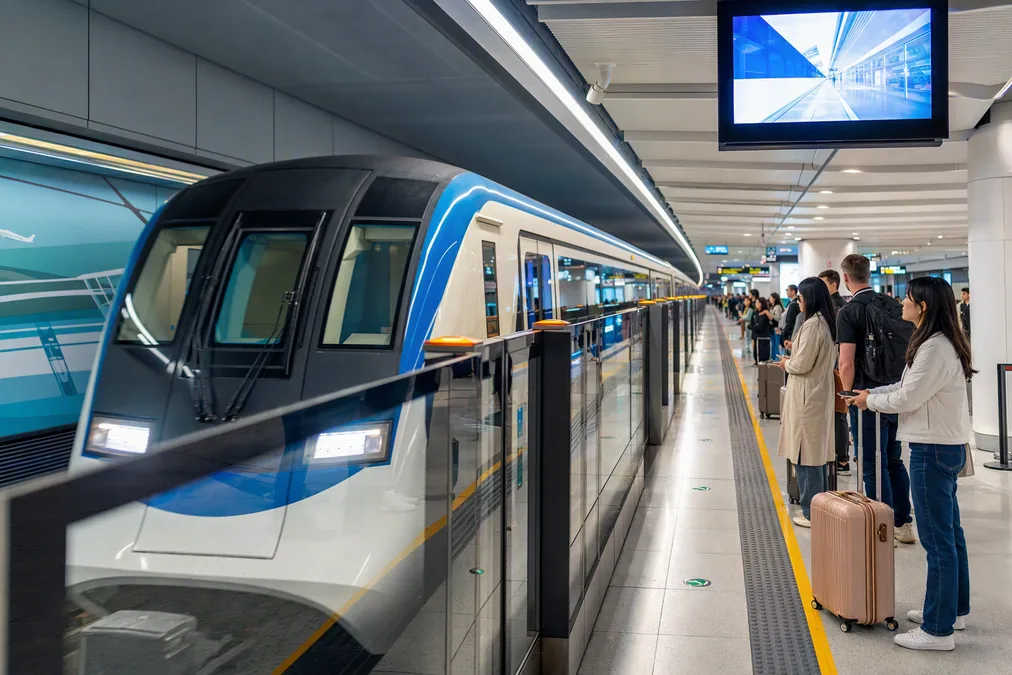
Airport by airport: taking the train in
Shanghai Pudong (PVG) and Hongqiao (SHA)
Pudong has three rail options. The maglev runs from the terminal to Longyang Road metro station for ¥50 one way, ¥80 return, from 07:02 to 21:42; Metro Line 2 serves both terminals and runs right through the city to Hongqiao; and the Airport Link Line goes straight to Hongqiao Terminal 2 every 15 minutes from 06:00 to 22:15. Hongqiao is simpler: Line 10 serves both terminals and Line 2 serves Terminal 2. Which to pick, plus the maglev discounts, the buses and the taxis, are all in the Shanghai airport guide.
Beijing Capital (PEK) and Daxing (PKX)
Capital Airport's Airport Express is a flat ¥25 whichever station you use; you board at Terminal 2 parking building B2 or Terminal 3 parking building level 2, and it stops at Sanyuanqiao (change to Lines 10 and 12) and Dongzhimen (Lines 2 and 13) and ends at Beixinqiao (Line 5); the first trains toward the city leave Terminal 3 at 06:22 and Terminal 2 at 06:36. Daxing's own express leaves from level B1 of the terminal for Caoqiao, where you change to Lines 10 and 19; the full run is ¥35, and trains leave the airport from 06:00 to 23:00. Both airports, the buses, and how to get between them are in the Beijing airport guide.
Chengdu Shuangliu (CTU)
Shuangliu is Chengdu's older airport, the one nearer the city, and it's well connected. Line 10 has entrances at Terminal 1 (outside exit 04 on the arrivals level and in the T1 car park) and at Terminal 2 (level B2, through the L2, L3 and L4 corridors); Lines 19 and 30 both leave from the same B2 level at Terminal 2, through the L3 corridor. For the city center, take Line 10 toward Wuhouci (Wuhou Shrine): the first trains are 06:03 from Terminal 1 and 06:00 from Terminal 2, the last 23:15 and 23:12. Line 19 is the one to know if you're connecting: it runs from Shuangliu to Tianfu Airport North, with the last train at 23:30. The airport's ground transport page keeps the current times.
Chengdu Tianfu (TFU)
Tianfu is Chengdu's newer airport, well outside the city to the southeast; the airport code on your ticket (TFU or CTU) tells you which one you're using. The metro line from the terminal and its last train are on our Chengdu last-trains page; the fare is shown at the machine. If you're switching airports, Line 19 links Tianfu Airport North station with Shuangliu Terminal 2 — how that station connects to the Tianfu terminal is on the Chengdu page too.
Chongqing Jiangbei (CKG)
Terminal 2 has both Line 10 and Line 3; Terminal 3 has Line 10 only. Line 10 from Terminal 3 starts at 06:38 toward Lanhua Road and 06:30 toward Wangjiazhuang and runs until 23:23 and 23:49 respectively; from Terminal 2 the last trains are 23:20 and 23:53, and Line 3 from Terminal 2 runs 06:30–22:30. Platform signs name the terminus, not "downtown", so check the line map on the platform for which side your stop is on — the late 23:49 train toward Wangjiazhuang only has a few stops left. The airport's transport guide has the full timetable, and so does our Chongqing page.
Hangzhou Xiaoshan (HGH)
Three lines meet under the airport: Line 1, Line 7 and Line 19; the station opens at 05:50 and closes at 00:27, and the first trains leave between 06:00 and 06:20 depending on the line, and the last are 22:30 on Line 1 toward Xianghu, 22:49 on Line 7 toward Wushan Square (the old town), 23:14 on Line 19 toward Hangzhou West Railway Station, and 00:09 on Line 19 toward Yongsheng Road, which is away from the city, all published on the airport's metro page. Our Hangzhou page has the full timetable.
Guangzhou Baiyun (CAN) and Shenzhen Bao'an (SZX)
In both cities the metro is the sensible choice unless you land late. Our pages show the airport's metro line, its hours and the last train: Guangzhou and Shenzhen pages. The same timetables work offline in the WaysChina app, which also plans the route from the airport to your hotel's nearest station.
Taxis at Chinese airports
The rule is the same everywhere: use the official taxi rank, ignore anyone who approaches you in the arrivals hall, and expect a meter. The ranks are signed from arrivals and staffed. At Beijing Capital the stand is outside doors 5–9 on the ground floor of Terminal 2 and in the B1 taxi area of Terminal 3; at Pudong it's outside arrivals door 12 for Terminal 1 and door 26 for Terminal 2, both running 24 hours; at Hongqiao, outside arrivals door 1 for Terminal 1 and door 4 for Terminal 2; at Hangzhou, outside arrivals door 14 of Terminal 3 and on the ground-floor walkway between Terminal 4 and the transport center. The people offering "taxi, taxi" inside the terminal are not taxis.
Meters are set by each city. In Beijing the flag fall is ¥13 for the first 3 km, then ¥2.3 per kilometer plus a ¥1 fuel surcharge per trip, with the per-kilometer rate rising 50% for any part of a trip beyond 15 km and 20% between 23:00 and 05:00. In Shanghai it's ¥14 for the first 3 km (¥16 in certain models), then ¥2.7 per kilometer, again with 50% more per kilometer beyond 15 km and 30% more on both the flag fall and the kilometer rate between 23:00 and 05:00. Those long-distance and night surcharges are why an airport run costs more per kilometer than a ride across town — they're official, and they'll be on the meter and the printed receipt. For any other city, and for a figure before you ride, open the DiDi app and price the same trip: its estimate is a fair guide to what the meter will show.
DiDi works at every airport, with a designated pickup point that the app names once you book — usually a marked bay in the car park, not the taxi rank. It needs mobile data from the moment you land, so have a SIM or eSIM working before you're through immigration; a travel eSIM from Airalo installed before the flight is the simplest way. Set-up and payment are in our DiDi guide, and the taxi side — paying, receipts, the few scams — in taxis and ride-hailing in China.
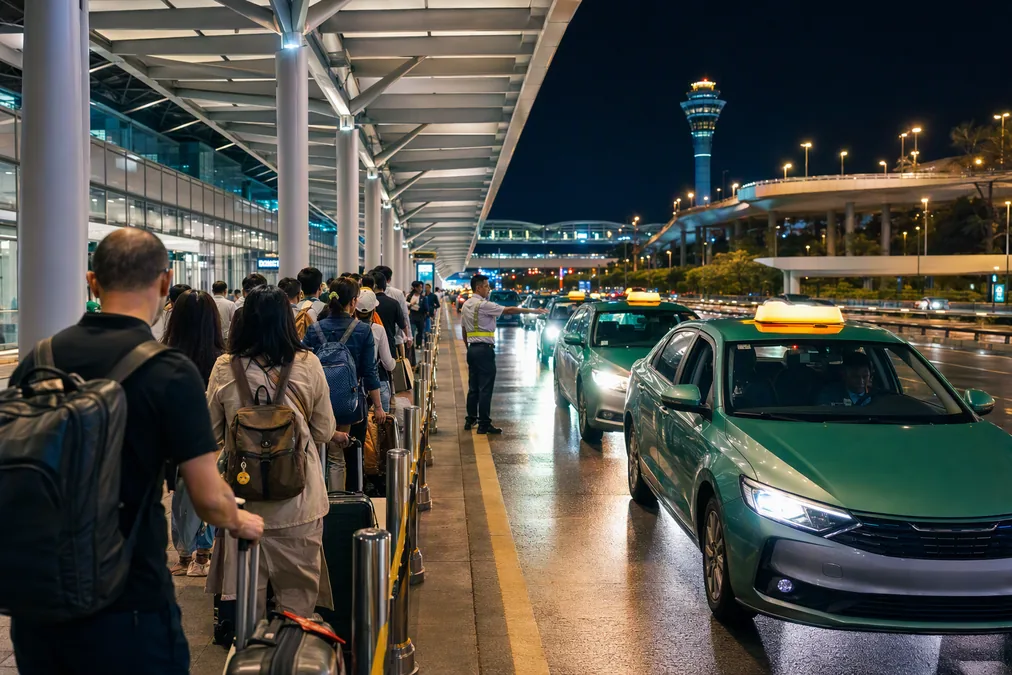
Landing late at night
Trains stop, taxis don't. The last departures from the airport stations are in the table above — Pudong's maglev at 21:42, Capital's express at 22:52 from Terminal 3 and 23:10 from Terminal 2, Daxing's at 23:00 — and past those, three options remain.
Night buses. Pudong runs an overnight bus to the Hongqiao transport hub from 23:00 to 05:30 (from 23:03 at Terminal 2), leaving when full and at most every 30 minutes, for ¥18–34 depending on where you get off. Daxing has night bus lines east to Sanyuanqiao and west to Yonghegong from the city-bus waiting area inside door 20 on the ground floor, with departure times posted at the desk. Capital Airport's city buses sell tickets outside door 11 of Terminal 2 and inside door 1 of Terminal 3; whether a late departure is running that night is on the board at the ticket desk.
Taxis. The ranks at Pudong are 24-hour, and every major airport keeps its rank open for late arrivals; expect a queue after a bank of late flights, and expect the night surcharge — 30% in Shanghai, 20% per kilometer in Beijing, both between 23:00 and 05:00. It's still the answer for most late arrivals.
Staying at the airport. If you land after 1 am and fly on in the morning, an airport hotel beats a taxi into town and back. Every hub has hotels inside or next to the terminal, bookable on Booking.com — filter by distance to the airport, and read the reviews for whether the shuttle actually runs at night.
Which to choose
With big luggage: the airport express trains (Beijing's two, Shanghai's maglev and Link Line) have luggage space and no steps, and a full-size checked suitcase is fine on them. An ordinary metro line with a change at a busy station is where stairs and crowds slow you down; with two big cases, take a taxi, or book a private transfer via Klook: you're met in arrivals and the price is agreed in advance. If you flew in with checked bags right up to the allowance — Air China's domestic economy limit is 20 kg, for example — that's the point where the taxi starts to make sense. In a hurry: the express train or metro, then a taxi from the station nearest your hotel, usually beats a taxi all the way in daytime traffic. On a budget: the metro, every time.
Frequently Asked Questions
When does the metro from Chinese airports stop at night, and what if I miss it?
It varies by airport, and the table above has the last departures, or a link to the page that does — from 21:42 (Pudong's maglev) to 23:14 toward the city at Hangzhou (Line 19 toward Hangzhou West). Ticket gates close a few minutes before the last train — five minutes at Daxing, and Hangzhou warns the same — so don't leave it tight. If you miss it, go to the official taxi rank; at Pudong there's also the night bus to Hongqiao, and at Daxing night buses to Sanyuanqiao and Yonghegong. For your city's full line-by-line timetable, use the last-trains pages linked in the table.
I don't have DiDi or Alipay — can I still get a taxi at the airport?
Yes. The official taxi rank needs no app: queue, get in, the meter runs, and you pay at the end — taxis take cash, so carry some small notes for the first ride; if you have a QR-code wallet, that works too. Know the pickup location before you land (Beijing Capital: Terminal 2 doors 5–9, Terminal 3 level B1; Pudong: door 12 or door 26), and show the driver your hotel's name and address in Chinese on your phone. The only thing to refuse is a car offered inside the terminal.
Do the airport express trains cost the same as the metro?
No — they're priced separately. Beijing's Airport Express is a flat ¥25 to any of its stations, the Daxing line is ¥10, ¥25 or ¥35 by distance, and Shanghai's maglev is ¥50 one way, all well above an ordinary metro fare. Where you change onto the regular metro — Sanyuanqiao or Dongzhimen in Beijing, Caoqiao from Daxing, Longyang Road in Shanghai — budget for the onward metro fare as well; the ticket machine shows it.
Should I change money first or get on the train? Do the trains take foreign cards?
Get on the train. The airport express lines and metro ticket machines take cash for a single ticket, so a small amount of yuan from an airport ATM covers the first ride; if the machine won't take a large note, the staffed window sells the same ticket. Shanghai's maglev goes further: you can tap a Visa, Mastercard, American Express or JCB card with contactless enabled straight at the gate for the ¥50 fare. For the regular metro in each city, foreign-card acceptance at the gate varies, so check the signage at the gates or use a ticket machine; the reliable long-term answer is Alipay with your foreign card linked, which is worth setting up before you fly — see how to use Alipay with foreign cards.
The three-minute decision
Off the plane, check the time against your airport's last train in the table. Before the last train and traveling light: the express or metro. After it, or with heavy bags: the official taxi rank, or a pre-booked car. Landing after 1 am with a morning flight: an airport hotel. Then open the last-trains page for your city — Beijing, Shanghai, Guangzhou, Shenzhen, Chengdu, Chongqing, Hangzhou, Nanjing, Wuhan, Xi'an — for the line you'll be riding. What happens before you reach any of this, at immigration and customs, is in arriving in China.
Last updated: August 2026
Fact-checked sources
- Official Shanghai Airport Authority 8 pages
- Official Shanghai Maglev Transportation
- Official Beijing Capital International Airport 3 pages
- Official Beijing Municipal Government 3 pages
- Official Chengdu Shuangliu International Airport
- Official Chongqing Airport Group
- Official Hangzhou Xiaoshan International Airport 2 pages
- Official Air China 2 pages
Last verified: 2026-08-30
Read in other languages
Last train times for 10 Chinese metro systems
Every line and station, checked by hand — the same data behind our offline route planner.
Get the WaysChina App
Offline guides, currency converter, essential phrases, and more — all in your pocket.

Related Articles

Beijing Airports Guide: Capital (PEK) and Daxing (PKX) to the City
Capital or Daxing, and how to get into Beijing from each: the two Airport Express lines with fares and last trains,...

Domestic Flights in China: Booking, Baggage, Security Rules and Delays
Flying inside China with a foreign passport: how to book, the weight-based baggage rules, why liquids and unmarked...

Shanghai Airports Guide: Pudong (PVG) and Hongqiao (SHA) to the City
Pudong or Hongqiao, and how to get into Shanghai from each: the maglev and its discounts, Metro Line 2, the Airport...