
This article contains affiliate links. If you make a purchase through these links, we may earn a small commission at no extra cost to you. This helps support our work in creating free travel guides.
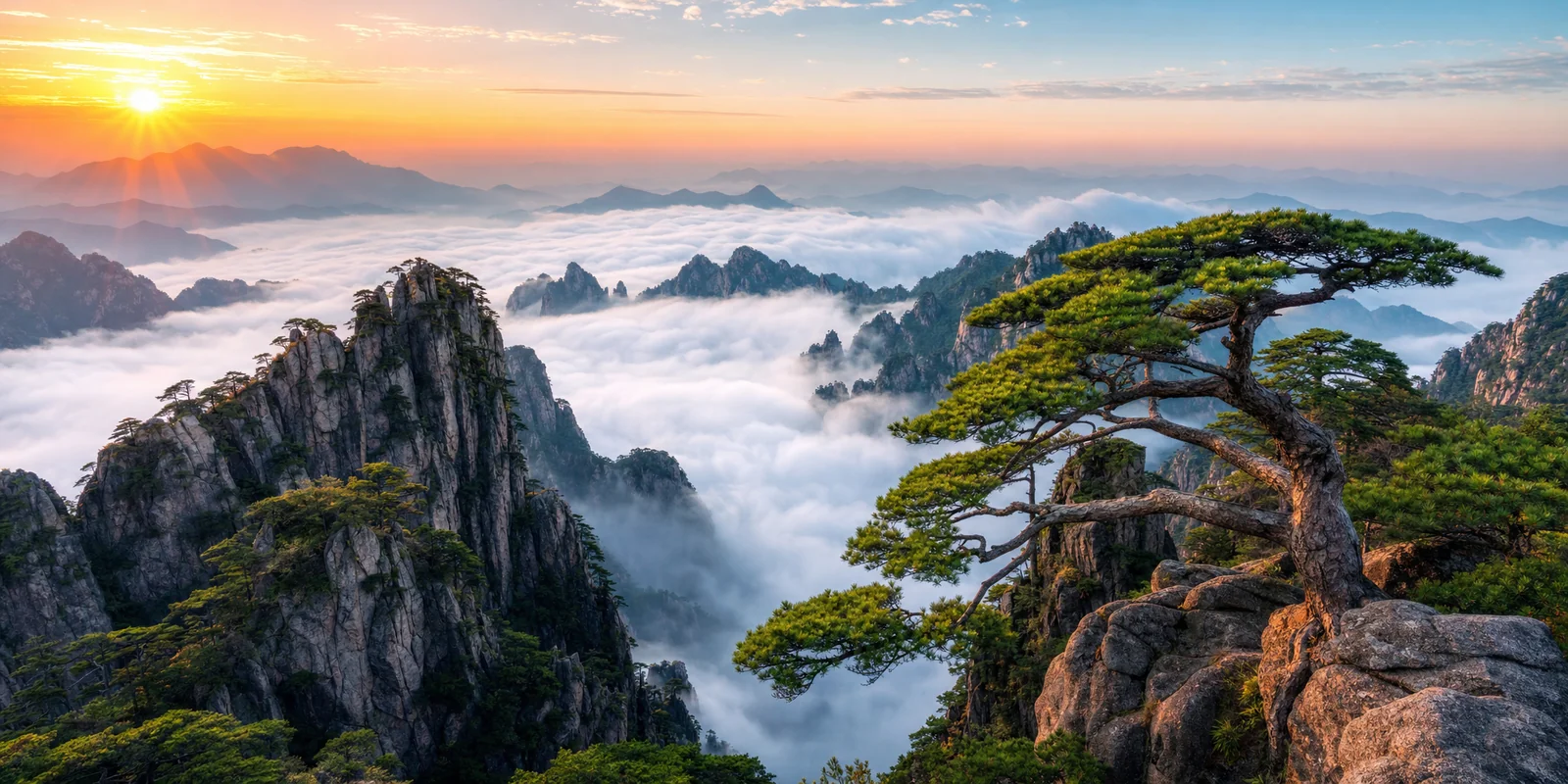
Mount Huangshan (黄山, Huángshān) — the Yellow Mountains — is the granite range in southern Anhui that shaped centuries of Chinese landscape painting. Twisted pines growing straight out of rock, oddly shaped boulders, and a sea of clouds that rolls over the peaks at dawn: this is the scenery you've seen in ink paintings without knowing where it came from. It's a UNESCO World Heritage site and arguably China's most famous mountain, which means it's also busy. This guide covers the part most first-time visitors get wrong: how you get up the mountain, where you sleep, and how you come back down — plus the canal-side villages and old street nearby that turn a peak climb into a proper two- or three-day trip.
Orientation: what "Huangshan" actually refers to
This trips people up. "Huangshan" means three different things depending on context:
- Huangshan City (黄山市) — the administrative city. Its downtown is the district of Tunxi (屯溪), where the main train station and airport are. This is where you arrive.
- Huangshan Scenic Area (黄山风景区) — the actual mountain, about 60–70 km north of Tunxi. This is what you climb.
- Tangkou (汤口) — the small town at the mountain's southern foot where buses, hotels, and the cable car bases cluster. Your real staging point.
So when you book a "Huangshan" hotel online, check carefully whether it's in Tunxi (city, far from the mountain) or Tangkou (mountain base). They're over an hour apart.
Getting to Huangshan
By high-speed train (the usual way)
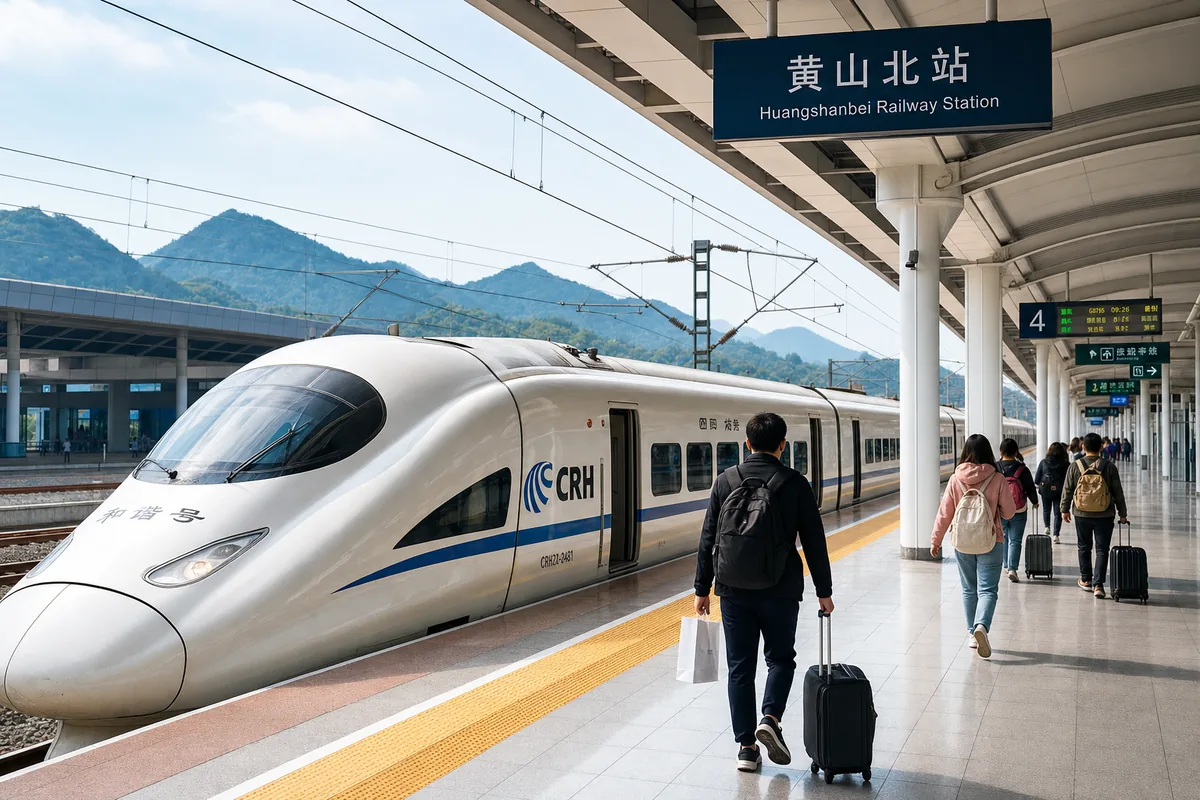
The fast option is the high-speed train (高铁, gāotiě) to Huangshanbei Station (黄山北站, Huangshan North). Don't confuse it with the older, slower "Huangshan Station" downtown — you want Huangshan North.
- From Shanghai: about 2.5–3 hours from Shanghai Hongqiao. This is the most common approach and makes Huangshan an easy add-on to a Shanghai trip.
- From Hangzhou: about 1.5 hours. The closest major city and a natural pairing.
- From Nanjing: around 2.5–3 hours.
- From Beijing: roughly 5.5–6.5 hours direct.
You can book through the official 12306 system, or use an English-friendly platform like Trip Com Train if you'd rather avoid the Chinese-only interface. Bring your passport — it's your ticket ID.
From Huangshan North Station to the mountain
Huangshan North sits north of Tunxi. From there to Tangkou (mountain base) takes about 1 hour by tourist bus or taxi/ride-hail. Direct buses run from the station to Tangkou throughout the day; ask at the station bus terminal. If you're staying in Tunxi first (for the old street), the station is about 15–20 minutes from downtown.
By air
Huangshan Tunxi International Airport (TXN) has domestic flights from Beijing, Shanghai, Guangzhou, Chengdu and others, plus some seasonal regional international routes. It's small but convenient if rail timing is awkward. The airport is right by Tunxi, about 10 minutes from downtown.
The mountain: routes up and down
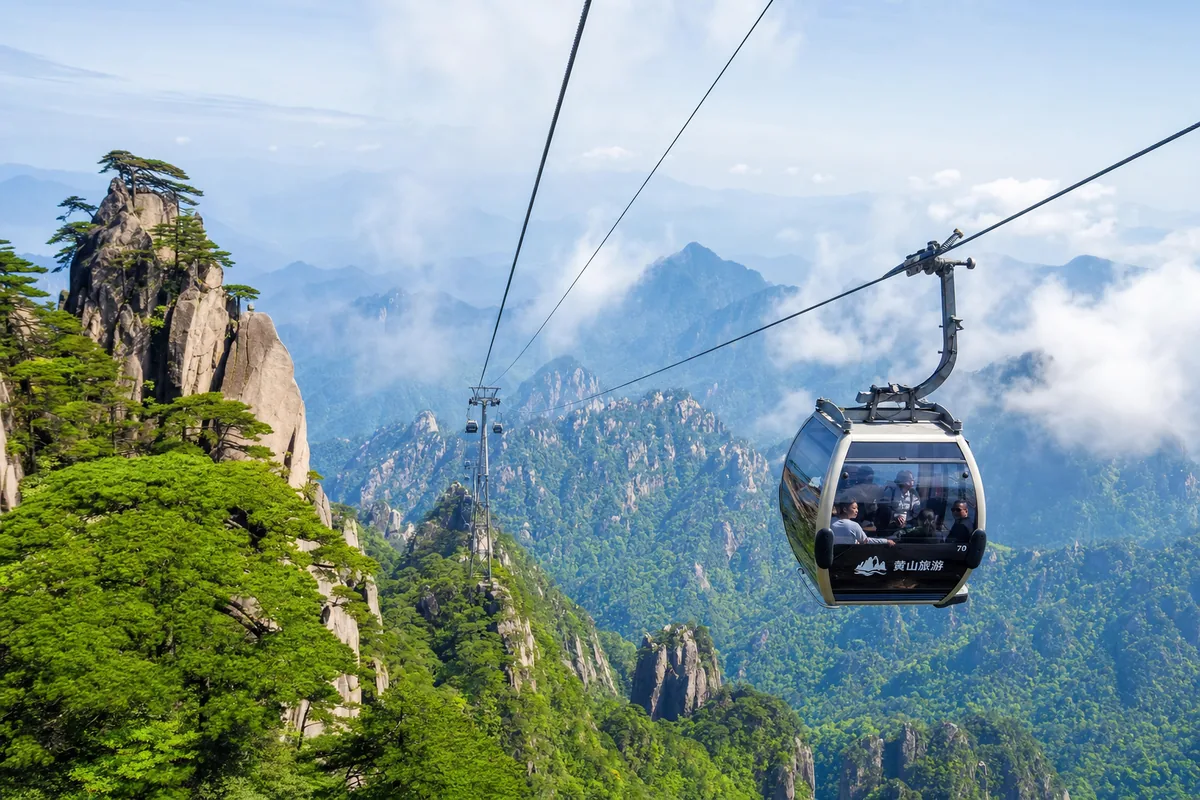
This is the decision that shapes your whole trip, so it's worth understanding before you go. The Scenic Area has two main entrances and two main cable cars, and most visitors mix walking and cable car rather than doing everything on foot.
The two sides
- Front Mountain (前山) — Yungu (云谷) side / south: Reached from Tangkou via the eco-shuttle to the Yungu cable car. This is the standard, gentler way up toward the central scenic zone (Beihai / White Goose Ridge area).
- Rear/West routes — Mercy Light (慈光阁) and Taiping (太平) cable cars: The Yuping (玉屏) cable car from Mercy Light takes you up toward Jade Screen Peak and the famous Greeting Pine; the Taiping cable car serves the north side near Songgu.
How most people do it
A practical and popular plan: ride the Yungu cable car up (front side), spend the day walking the connected ridge trails through the central scenic zone, sleep at a summit hotel, catch sunrise, then descend the Yuping cable car from Jade Screen down to Mercy Light — seeing the Greeting Pine on the way. This gives you both major sections without backtracking.
If you want to actually hike a long stretch, the classic on-foot route from Mercy Light up past Jade Screen to the summit zone is a serious stair climb — thousands of stone steps, several hours, steep in places. It's rewarding but hard on the knees. Most visitors take a cable car at least one direction.
Cable cars: practical notes
- Lines: In peak season and good weather, cable car queues can run 1–2 hours. Going up early or down late helps.
- Tickets: You'll pay separately for the Scenic Area entry ticket, the eco-shuttle, and each cable car ride. Carry your passport for ticketing.
- Closures: Cable cars stop in high wind, storms, or ice. Always have a backup in mind.
For a smoother entry, some visitors prebook the Scenic Area admission and cable car as a combo through platforms like Klook, which can save queuing at the ticket window — worth it on busy weekends, optional otherwise.
What you actually see up top
Huangshan's scenery is built around three things locals call the "three wonders": the pines, the rocks, and the sea of clouds — plus hot springs at the base as a fourth.
The pines and peaks
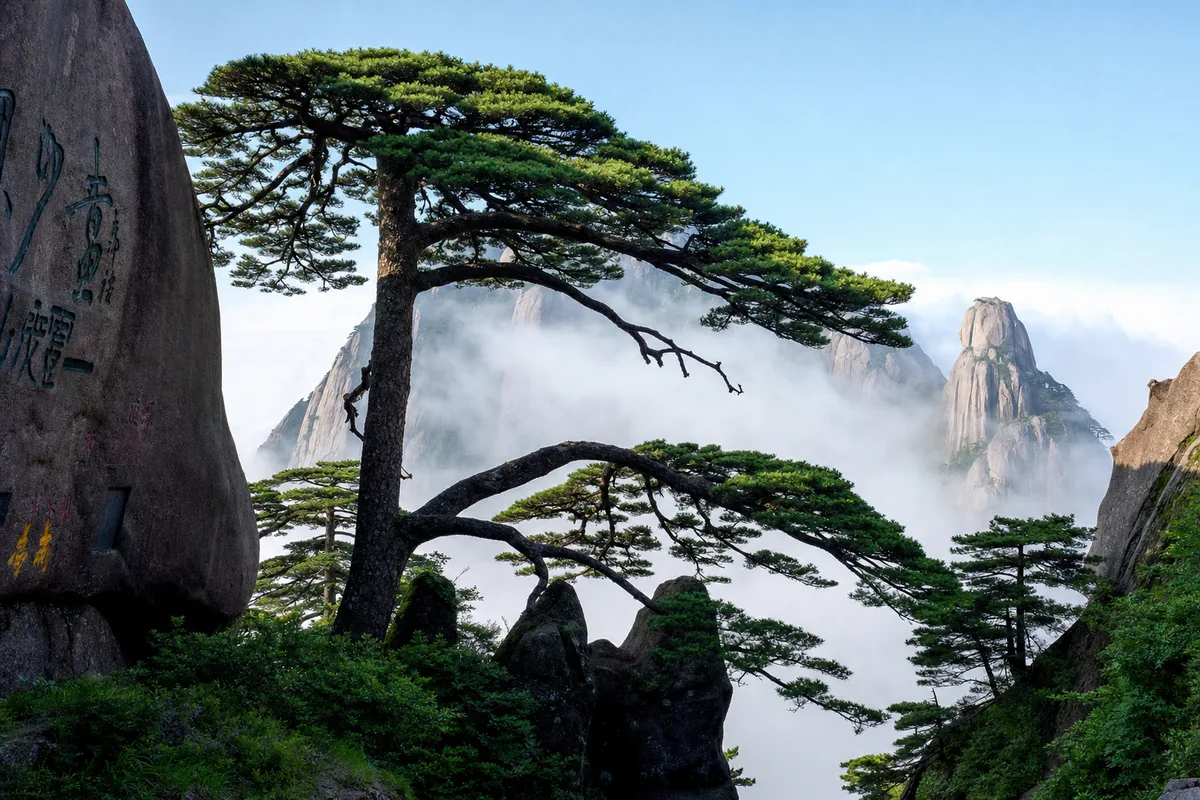
The Greeting Pine (迎客松, Yíngkèsōng) near Jade Screen Peak is the single most photographed tree in China — a gnarled pine with one branch extended like an arm, growing out of bare rock. Around it, named peaks rise in clusters: Lotus Peak (莲花峰) and Bright Summit (光明顶) are the highest accessible points, and Celestial Capital Peak (天都峰) has a knife-edge stair section that periodically closes for rest rotation.
Sunrise and the cloud sea
The reason people sleep on the mountain is sunrise. On a clear morning after rain or in shifting humidity, a sea of clouds (云海) fills the valleys below the peaks and the sun comes up over the top of it. Common sunrise spots include Cloud-Dispelling Pavilion (排云亭), Bright Summit, and the Beihai area. Ask your hotel the night before — staff post the expected sunrise time and the best nearby viewpoint, and people set out in the dark with headlamps.
Where to sleep
On the mountain (recommended for sunrise)
There are several hotels in the summit scenic zone — around Beihai, White Goose Ridge, and near Bright Summit. They are basic-to-comfortable, not luxury, and they are expensive for what you get, because everything is carried up by porters. Expect simple rooms, sometimes dorm options, and inflated prices for food and water. Book well ahead in peak season — summit rooms sell out and prices climb on weekends and holidays.
Despite the cost, sleeping up top is the single best thing you can do for the experience: you avoid the cable car crush, you're already in position for sunrise, and the mountain empties out beautifully in the early evening once day-trippers leave. You can compare summit and base-town options on Booking Com Hotel and book the one that fits your sunrise plan.
At the base (Tangkou) or in Tunxi
If summit prices put you off, stay in Tangkou the night before, start early, and do a long day on the mountain. Tunxi is better if you also want the old street and the villages, but it's too far to be a sunrise base.
The villages and old street (the other half of the trip)
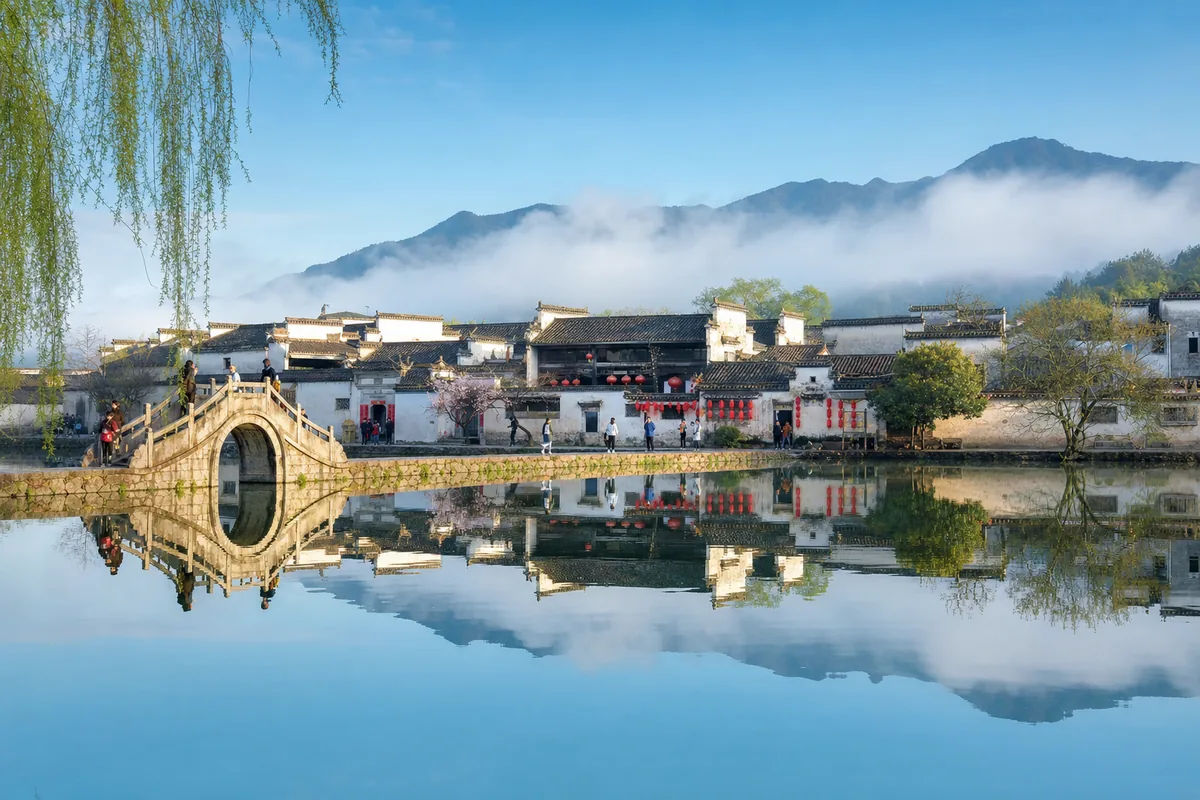
The lowland area around Huangshan, historically called Huizhou (徽州), has some of China's best-preserved old architecture: whitewashed walls, black tile roofs, carved wooden lintels, and family ancestral halls. Two villages and one old street are the highlights, and they're a complete change of pace from the peaks.
Xidi Village (西递)
A UNESCO-listed Huizhou village dating back roughly 900 years, Xidi is known for its intact lanes of Ming and Qing merchant houses, decorative memorial archways (牌坊), and stone-carved gateways. It's quieter and more lived-in than Hongcun, with residents still occupying many of the old courtyard homes. Wander the narrow alleys and look up at the carved beams and "sky wells" (天井) — open courtyards that let light and rain into the center of each house.
Hongcun Village (宏村)
Also UNESCO-listed and about 10 km from Xidi, Hongcun is the famous one — laid out in the shape of an ox, with an artificial canal system threading water through every lane to a central moon-shaped pond (月沼) and a larger lake (南湖) at the entrance. The reflections of white walls in still water are why this village appears in countless paintings and films; the opening scenes of Crouching Tiger, Hidden Dragon were shot here. Go early or late to dodge the tour groups and catch the reflections at their stillest.
Tunxi Old Street (屯溪老街)
Back in Huangshan City's downtown, Tunxi Old Street is a pedestrian street of Song- and Ming-style shopfronts running about a kilometer along the Xin'an River. It's the place to eat, buy local tea (this is prime green tea country — Huangshan Maofeng is the regional name), browse ink stones and brushes (Huizhou was a center of the "four treasures of the study"), and try Anhui snacks. It's touristy but genuinely old and a relaxed way to spend an evening at the start or end of your trip.
Local food worth trying
- Stinky mandarin fish (臭鳜鱼, chòu guìyú): the signature Huizhou dish — fermented river fish that smells strong but tastes savory and tender. Don't let the name stop you.
- Maodofu (毛豆腐): "hairy tofu," fermented until covered in a fine white mold, then pan-fried. A regional specialty.
- Huangshan Maofeng tea: the local green tea, sold fresh in spring.
- Bamboo shoots and wild herbs: mountain ingredients show up across the menu, especially in spring.
Getting between the mountain and the villages
The villages (Xidi, Hongcun) are in Yi County (黟县), west of Tangkou and Tunxi. From Tunxi there are tourist buses to Hongcun/Xidi taking roughly 1–1.5 hours. From Tangkou (mountain base) there are also connections, but they're less frequent — many travelers base in Tunxi for the village days and Tangkou or the summit for the mountain. A ride-hail or chartered car makes the village hop much smoother if you're short on time.
For planning multi-day itineraries and city metro routes once you continue on to Shanghai or Hangzhou, the WaysChina app has offline metro maps and a built-in trip planner.
Suggested itineraries
2 days (mountain focus)
- Day 1: Train to Huangshan North → shuttle to Tangkou → eco-bus to Yungu → cable car up → walk the central scenic zone → overnight at a summit hotel.
- Day 2: Sunrise → more walking toward Jade Screen → Yuping cable car down → bus back → afternoon train out (or evening in Tunxi).
3 days (mountain + villages)
- Day 1: Arrive Tunxi, settle in, evening on Tunxi Old Street.
- Day 2: Up the mountain, central zone, overnight on the summit for sunrise.
- Day 3: Descend in the morning → Hongcun and/or Xidi in the afternoon → return to Tunxi or onward train.
Combining with nearby cities
Huangshan slots neatly into an eastern China route. Hangzhou (1.5 hrs by train) pairs best for time; Shanghai (about 3 hrs) is the most common gateway; Nanjing (around 2.5–3 hrs) works if you're coming through Jiangsu. Many travelers fold Huangshan into a wider eastern loop — see our Jiangnan Water Towns Route for how the canal towns, Hangzhou, and Suzhou connect, and add Huangshan as the mountain leg.
The bottom line
The key decisions for Huangshan are simple once you know them: arrive at Huangshan North (not the old downtown station), use the eco-shuttle from Tangkou to reach the cable cars, ride a cable car at least one direction unless you genuinely want a multi-thousand-step climb, and — if you possibly can — sleep on the summit to catch sunrise and the cloud sea. Add a day for Hongcun, Xidi, and Tunxi Old Street and you've seen both halves of the region: the painted peaks and the old Huizhou world below them. Book summit hotels and peak-season trains early, pack warm layers for the top, and check the weather forecast before you commit to a sunrise climb.
Related reading
- Hangzhou Complete Guide — the closest major city and easiest pairing.
- Shanghai Complete Guide — the most common gateway to Huangshan.
- High-Speed Train Complete Guide — how to ride and what to expect.
- Best Time to Visit China — timing your trip around the seasons.
- Autumn Travel in China — why fall is prime time for the cloud sea.
Prices, cable car schedules, and entry fees change seasonally — check the latest information before you travel.
Last updated: June 2026
Read in other languages
Last train times for 10 Chinese metro systems
Every line and station, checked by hand — the same data behind our offline route planner.
Get the WaysChina App
Offline guides, currency converter, essential phrases, and more — all in your pocket.

Related Articles
3 Days in Shanghai: An Itinerary You Can Follow As Written
A day-by-day Shanghai route built on metro logic: museum and Bund on day one, towers and old town on day two, a flex...
Day Trips from Shanghai: Water Towns, Suzhou and Hangzhou, Honestly Compared
Which Shanghai day trip fits you: metro-reach Zhujiajiao, Suzhou's real-name garden tickets, free West Lake, or an...
Shanghai Food Guide: What to Eat, Where to Eat It, and How to Order
Beyond soup dumplings: how to eat xiaolongbao without scalding yourself, where locals actually eat, halal and...
Hangzhou Travel Guide: How Many Days, What's Free at West Lake, and How to Book Lingyin
Two days in Hangzhou: which of the three railway stations to book, how to get around a lake district that limits...