
This article contains affiliate links. If you make a purchase through these links, we may earn a small commission at no extra cost to you. This helps support our work in creating free travel guides.
You can order and pay in a Chinese restaurant without a word of Chinese. You'll meet four situations: a menu with photos, where you point; a QR code on the table, where you order on your own phone; a menu with only Chinese characters, where a camera translator does the reading; and a counter or street stall, where the food is in front of you. The one that trips people up is QR-code ordering, because you need WeChat or Alipay with a foreign card already linked, plus mobile data. If it doesn't work, wave a server over and ask for a paper menu. In Shanghai, a 2023 guideline says restaurants that use QR ordering should keep one. This guide covers each situation, how to translate a menu, how to get "not spicy" or an allergy across, how much to order, and how to pay.
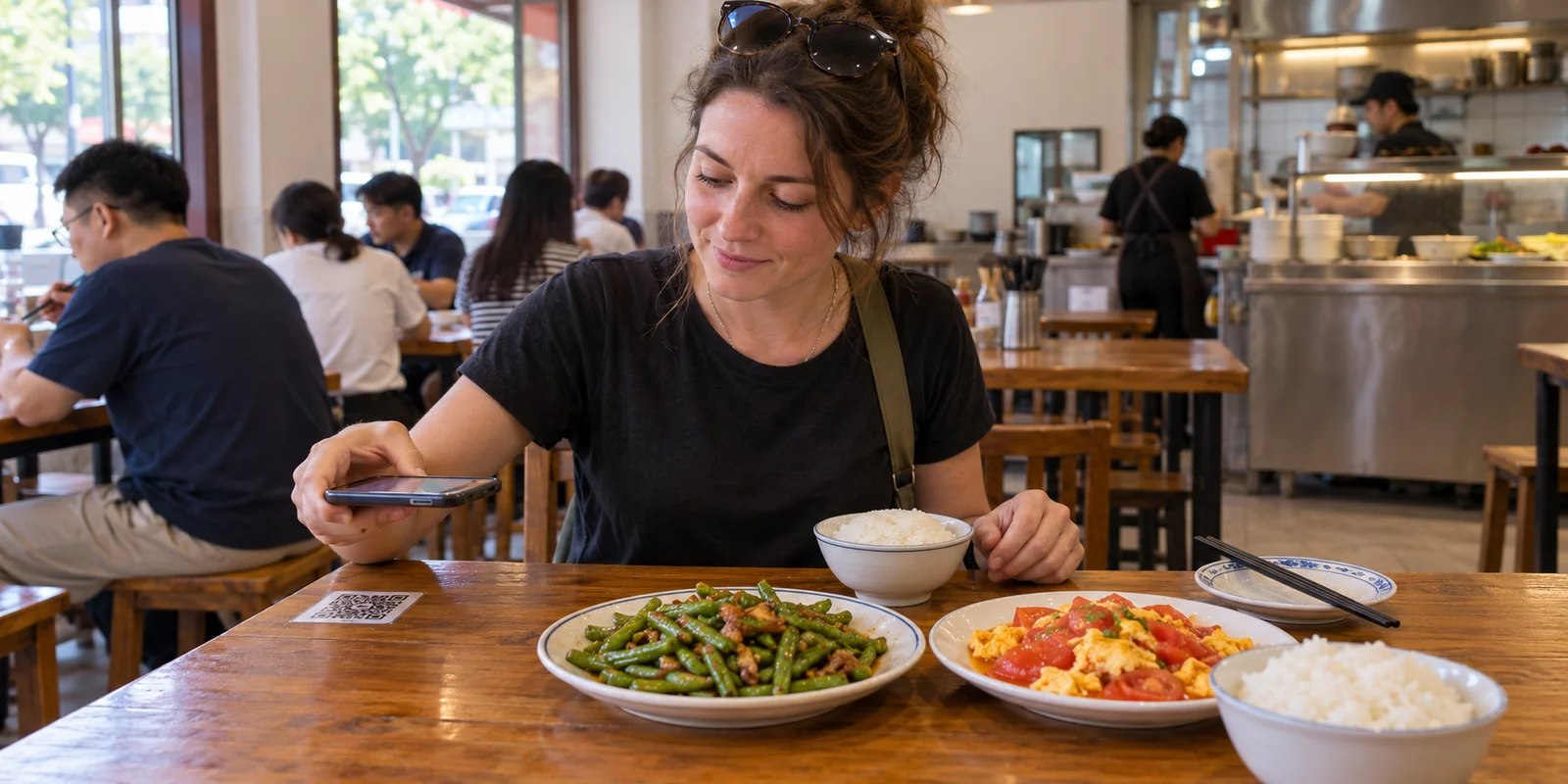
The four ways you'll order, and what makes each one hard
Almost every meal in China falls into one of these four setups. Work out which one you're in and you know what to do next.
| Situation | Where you'll see it | What you need | How hard |
|---|---|---|---|
| Picture menu | Chain restaurants, mid-range places, tourist areas | A finger to point with | Easy |
| QR code on the table | Most city restaurants, hotpot, tea and coffee chains | WeChat or Alipay with a card linked, mobile data, a translator | The hardest |
| Text-only menu | Older family restaurants, noodle shops, regional places | A camera translator | Medium |
| Counter or stall | Street food, fast food, canteens, bakeries | A way to pay (phone or cash) | Easy |
1. The picture menu
This is the easy one. Many restaurants print a photo next to every dish, and some chains use a big laminated sheet or a tablet with pictures. Point at what you want and hold up fingers for how many. The price is usually printed right under the photo.
Two things the photos don't tell you. First, rice is often not on the menu at all. Ask for it separately: 米饭 (mǐfàn, plain rice), or just point at a bowl on the next table. Second, dishes are made for sharing, and the plate is often bigger than the photo suggests. More on portions below.
2. QR-code ordering
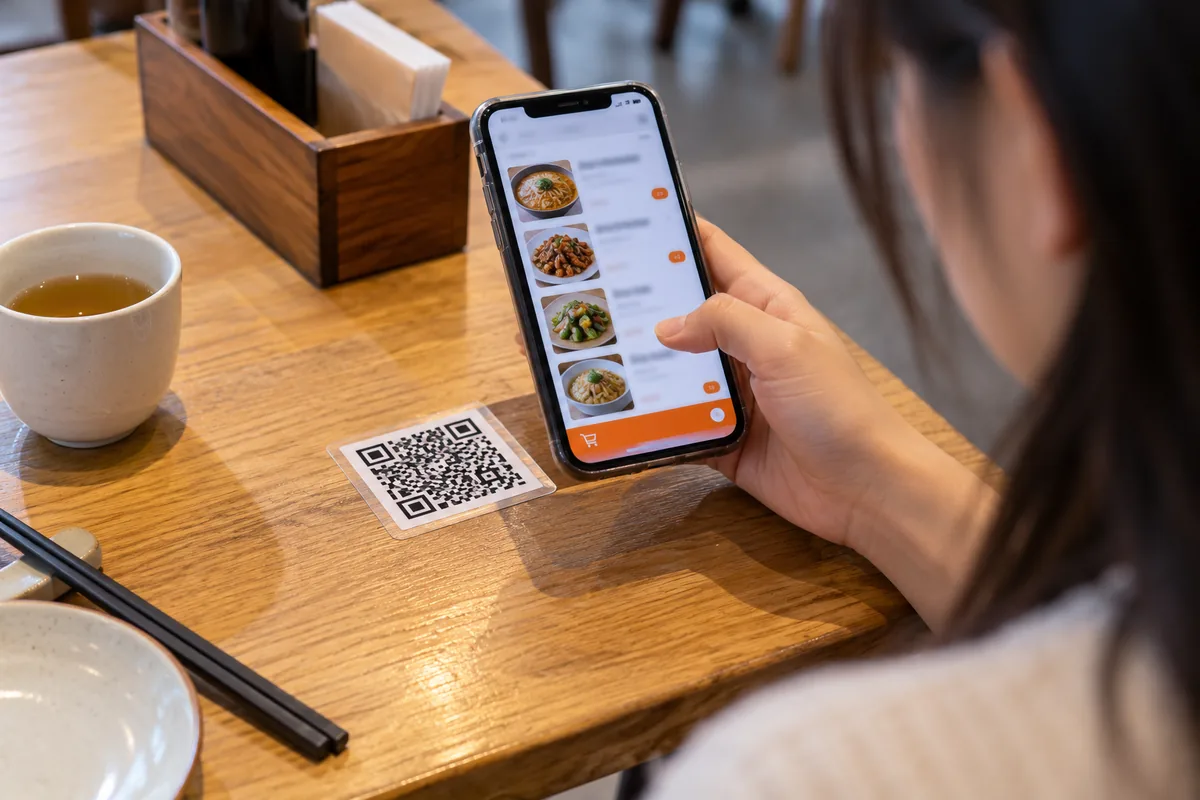
You sit down and there's no menu, only a QR code stuck to the table. You scan it, a menu opens inside WeChat or Alipay, you add dishes to a cart and send the order to the kitchen from your phone. It's called 扫码点餐 (sǎomǎ diǎncān, scan-code ordering), and in cities it's now the default at many restaurants. The menu is usually in Chinese only. It gets its own section below because it's where most visitors get stuck.
3. The text-only menu
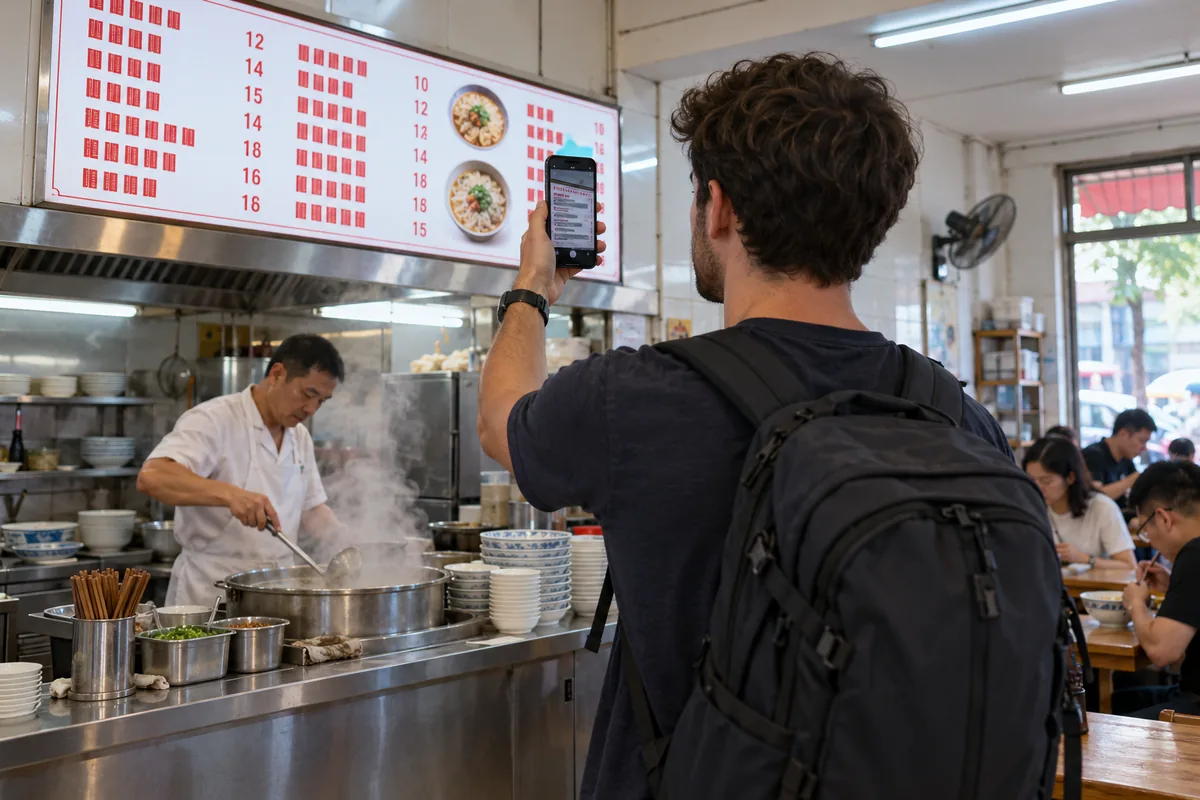
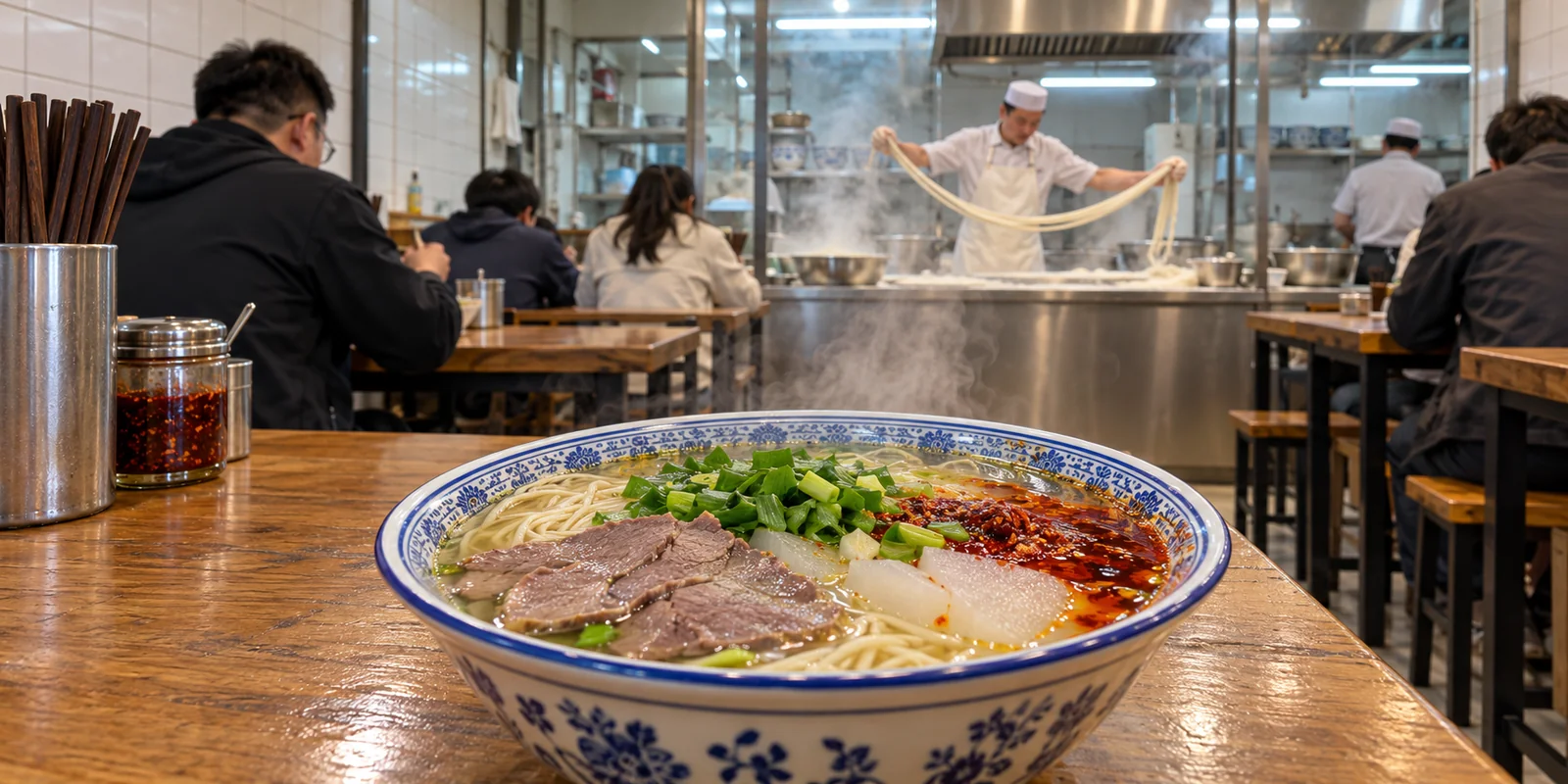
Some of the best meals in China come from small places with a menu board of Chinese characters and nothing else. Don't walk past them. A camera translator turns the board into English well enough to order (see the translation section). When the translation makes no sense, look at what other tables are eating and point at a dish you like the look of. Staff are used to this.
4. The counter or stall
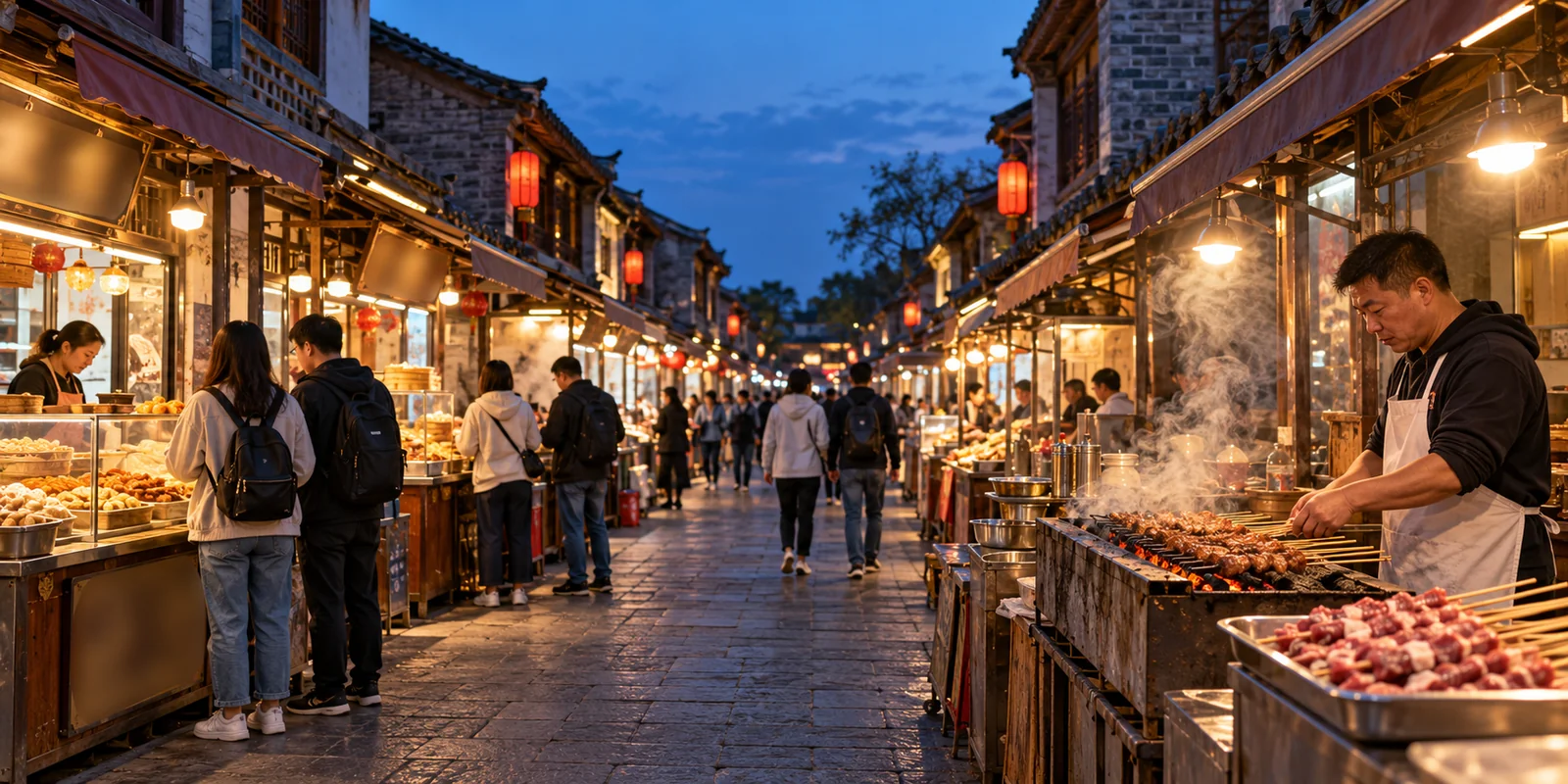
Street food, noodle counters, dumpling shops, bakeries and fast-food chains are the most foreigner-friendly places to eat, because you can see the food. Point, hold up fingers, and pay. At a stall you usually pay first, by scanning the seller's QR code or handing over cash. Big fast-food chains have touchscreen kiosks, and many of them have an English button in a corner of the screen.
💡 Tip: Keep a phone album of dishes you already like, such as 小笼包 (xiǎolóngbāo, soup dumplings) or 宫保鸡丁 (gōngbǎo jīdīng, kung pao chicken). Showing a photo works at any counter. For what the dishes are and where they come from, see our guide to Chinese cuisine by region.
QR-code ordering: the one that catches people out
The QR code on the table opens a mini program (小程序, xiǎochéngxù), a small app that runs inside WeChat or Alipay. Weixin mini programs are opened by scanning a code or searching inside the app, and they are used for shopping, dining, travel and many other services. Each restaurant's mini program is different. Few have an English version.
What you need before you sit down
- WeChat or Alipay, with a card linked. Set this up before your trip, not at the table. WeChat Pay accepts foreign cards on UnionPay, Visa, Mastercard, American Express, JCB, Diners Club and Discover. Alipay accepts UnionPay, Visa, Mastercard, JCB, Diners Club and Discover, and the central bank's guide does not list American Express for Alipay. Step-by-step setup is in our guides to Alipay with foreign cards and WeChat Pay with foreign cards.
- Use the scanner inside the app. Your phone's normal camera often won't open the mini program. Open WeChat or Alipay and use its own Scan button.
- Mobile data and some battery. The menu, the order and the payment all happen online.
- A WeChat account that has opted in. If a pop-up asks you to agree to "Weixin Services", tap agree. If you signed up for WeChat with a non-Chinese phone number, you're usually a WeChat (not Weixin) user, and some features hosted in mainland China ask you to opt in once before they work; you can turn them off later under Settings > General. Our WeChat setup guide covers sign-up and verification.
Ordering step by step
- Scan the code on your table. The table number is usually filled in for you. If the menu asks for it, it's printed on the sticker or the table edge.
- Deal with the pop-ups. The mini program may ask for your phone number, your location or to "follow" the restaurant's official account. You can usually close these and keep ordering. In Shanghai, the 2023 guideline says restaurants should not force or push you to follow their account or hand over unrelated personal information, and should not refuse service if you decline to share your phone number or location.
- Translate the menu. Take screenshots as you scroll, then translate the screenshots (how to do this is in the next section). Pointing a camera at another phone's screen works badly.
- Add dishes to the cart. Tap the "+" next to each dish. Some dishes open a small options box first: size, spice level, or a side. Pick one, or the order button stays grey.
- Submit and pay. The cart is usually at the bottom of the screen. Some restaurants take payment right away; others send the order to the kitchen and you pay at the end, either in the mini program or at the counter. If you're not sure, show the screen to a server.
What the rules say about QR menus
There is no national rule on QR ordering. The rules that exist are local and mostly not binding:
- Shanghai, 2023: a compliance guideline from the Shanghai Consumer Council and the city's restaurant association, in force since 18 July 2023, says QR-ordering restaurants should also keep a paper menu that matches the online one, and must not force customers to follow an account or share unrelated personal data; it is guidance, not law.
- Shanghai's Xuhui district, 2022: a district guideline says restaurants should collect only the minimum personal information needed and must not force you to register or authorise your phone number or WeChat ID; it is a trial guideline without legal force.
- Shenzhen, 2024: a joint initiative by the city's consumer council, cooking association and catering chamber asks restaurants to offer both QR and staff ordering, show the menu in several forms including paper, and not force customers to register or follow an account; it is voluntary.
Outside these cities, there's no written right to a paper menu. In practice, most places will still take your order another way when you ask, because nobody wants to lose a table.
When it doesn't work: your fallbacks
- Ask for a paper menu. Say 菜单 (càidān, menu) and make a book shape with your hands. Many restaurants keep a few behind the counter.
- Ask a server to order for you. Point at the QR code, shake your head, then point at the dishes in your screenshots or at other tables. Staff often enter the order on their own phone or tablet, and you pay at the counter.
- Pay at the counter if the payment step fails. Cards from abroad occasionally get declined inside mini programs. The counter can take the same app by its own QR code, or cash.
- Pick a different kind of place. If you're tired and hungry, a counter-service noodle shop or a picture-menu chain is easier than fighting a mini program.
Everything above depends on mobile data, so set that up before you land. If your home plan's roaming is expensive in China, a travel eSIM you install at home and switch on at arrival is the simplest fix; Airalo sells China data plans. Our China SIM card and eSIM guide compares the options.
Ordering delivery to your hotel
The same apps deliver food. On Meituan (美团, Měituán) you sign up with a phone number and an SMS code, then pay with Alipay, WeChat Pay or the digital yuan (e-CNY). Whether it accepts your foreign number varies, so try it before you're hungry; the Shanghai government guide to food delivery apps walks through the steps.
Translating the menu with your phone camera
A camera translator is the single most useful tool for eating in China. Set up two before you travel: one that works offline, and WeChat's built-in one as a backup. Our translation apps comparison tests them side by side; here is what matters for menus.
- WeChat Scan → Translate. In WeChat, tap "+" in the top right, choose Scan, switch to Translate, and photograph the text. It works on Chinese networks without anything extra, and you'll have WeChat anyway.
- WeChat image translation for QR-menu screenshots. When a chat contains an image with Chinese text, open the image, tap the icon in the top right and choose Translate. Send your menu screenshots to yourself in a chat (WeChat's File Transfer works) and translate them there.
- Apple Translate (iPhone). The camera mode translates text around you live, with restaurant menus as Apple's own example, and it can also translate text in photos you've already taken, including screenshots. Download Chinese before you fly under Settings > Apps > Translate > Languages, and it then works with no connection.
- Google Translate. China's official tourism website, Travel China, says Google services can't be reached directly in China without a VPN, so download the Chinese language pack at home: downloaded languages translate with no internet, and some of them also work with the instant camera. Test the camera offline before you leave to see whether it works for your pair.
- Microsoft Translator. On Android, its offline language packs also cover camera translation of photos of signs and menus. On iPhone, test the camera offline before your trip.
- Chinese-made translators. Youdao Translate (有道翻译官) has photo translation and offline packs for English and several other languages, with an English interface. Tencent's TranSmart (腾讯翻译君) is free and offers photo translation of menus and signs.
How to read what the translator gives you
- Some dish names are poetic. 夫妻肺片 (fūqī fèipiàn) comes out as "husband and wife lung slices" but is cold sliced beef in chili oil. 蚂蚁上树 (mǎyǐ shàng shù), "ants climbing a tree", is glass noodles with minced pork. If a name sounds strange, it's probably a name, not a list of ingredients.
- Other translations are just ingredients. "Pork, green pepper, shredded" is usually a normal stir-fry. Look for the cooking word: 炒 (chǎo, stir-fried), 煮 (zhǔ, boiled), 蒸 (zhēng, steamed), 烤 (kǎo, roasted or grilled), 炸 (zhá, deep-fried), 凉拌 (liángbàn, cold dressed).
- Prices are easy. China's price-marking rules require prices in Arabic numerals in yuan; English labels are allowed but not required. So even a menu you can't read tells you what each dish costs. If a dish is priced by weight (common for fish and seafood), the unit is usually 斤 (jīn, half a kilo) or 两 (liǎng, 50 grams). Ask for the total before they cook it.
Are English menus common?
You'll find English or bilingual menus in hotel restaurants, international chains, places in the main tourist areas of Beijing, Shanghai, Xi'an and Chengdu, and some bigger chains' apps. In ordinary neighbourhood restaurants and in smaller cities, expect Chinese only. Asking costs nothing: 有英文菜单吗? (yǒu Yīngwén càidān ma? Do you have an English menu?) Even if the answer is no, someone often comes over to help.
Getting "not spicy", allergies and diets across
Don't rely on gestures for anything that matters. Write it down in Chinese, save it as a photo or a note on your phone, and show it when you order, before the food is cooked. A written card is clearer than a translation app read out loud, and a server can show it to the kitchen.
Spice
Spice level is the request you'll make most. The words you need:
- 不辣 (bú là): not spicy
- 微辣 (wēi là): a little spicy
- 中辣 (zhōng là): medium
- 特辣 (tè là): very spicy
- 不要香菜 (bú yào xiāngcài): no coriander
QR menus often ask the spice question for you in the options box: look for 辣度 (là dù, spice level). In Sichuan, Chongqing and Hunan, "a little spicy" is still spicy by most Western standards, and some dishes can't be made without chili at all. If you don't eat spicy food, choose dishes that aren't red with chili in the photo instead of asking the kitchen to tone down a famously hot one. For a fuller list of ordering words, see our survival Chinese phrases.
Allergies
Write the allergy and how serious it is. For example:
我对花生过敏,很严重。请不要放花生和花生油。
(I have a serious peanut allergy. Please do not use peanuts or peanut oil.)
Change 花生 (peanut) to your allergen. Hidden ingredients such as peanut oil, sesame, shrimp paste and wheat in soy sauce are common, and small kitchens may not be able to guarantee anything. Our guide to food safety and dietary restrictions has a full allergy card and the ingredients to watch for.
Halal and vegetarian
For halal food, look for the word 清真 (qīngzhēn, halal) on the sign above the door; there is more on finding halal restaurants and what to eat in our halal food guide. For vegetarian food, 我吃素 (wǒ chī sù, I'm vegetarian) is the phrase, but vegetable dishes are often cooked in lard or chicken stock, or come with small pieces of meat for flavour. Write out exactly what you don't eat, and read our vegetarian and vegan guide for which dishes are safest.
How much to order: portions and food waste
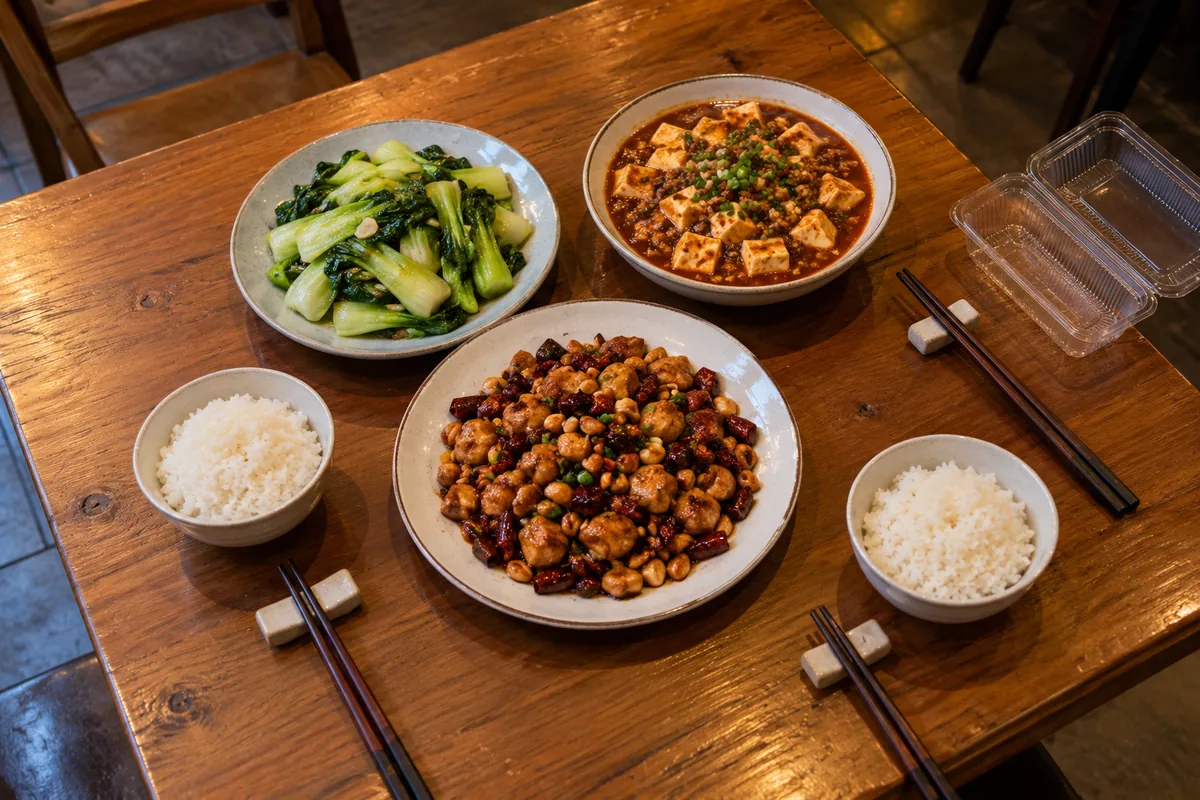
In most sit-down restaurants, dishes come to the middle of the table and everyone shares. Nobody orders "a main each". A workable starting point: one dish per person, plus rice, and maybe a soup for a group. Order a little less than you think, then add more. Adding a dish halfway through a meal is completely normal.
A few more habits that help:
- Ask for a smaller portion. 小份 (xiǎo fèn, small portion) or 半份 (bàn fèn, half portion) are on some menus, especially at chains.
- Mix the plate types. One meat, one vegetable, one tofu or egg dish, and rice is a balanced order for two.
- Watch for weight pricing. Fish and seafood priced per 斤 can add up quickly. Ask the server to confirm the total.
What the Anti-Food Waste Law means for you
China's Anti-Food Waste Law has been in force since 29 April 2021. It requires restaurants to remind diners not to waste food, with anti-waste signs or a word from staff, to guide you to order what you need, and to offer different portion sizes such as small plates. Restaurants may not push or mislead you into ordering too much. They can mark portion sizes and the suggested number of diners on the menu, and they should provide serving spoons and chopsticks and takeaway packing when you ask.
So if a server says "that's enough" when you try to add a fourth dish for two people, they're following the law, not being rude. The law also lets a restaurant charge a fee for disposing of food when a diner leaves an obvious amount of waste, but only if the fee and its rate are clearly shown in advance. The penalties in the law fall on restaurants: a warning for not reminding diners, and for pushing diners to over-order, a warning and then a fine of 1,000 to 10,000 yuan if they don't correct it.
Takeaway boxes and serving chopsticks
Taking leftovers home is normal, and nobody will think it odd. Say 打包 (dǎbāo, pack it up) and staff will bring a box or pack it for you. The national catering measures in force since 15 June 2025 say restaurants should provide serving spoons and chopsticks (公筷, gōngkuài) when customers need them, remind diners to pack up leftovers and provide packing on request. Some places charge a little for the box; it should be listed on the menu or shown before you order. The rules for restaurants are summarised here:
Paying the bill
Pay first or pay after?
- Pay first: street stalls, counters, fast food, canteens, bakeries, and many QR-ordering restaurants.
- Pay after: most sit-down restaurants. Say 买单 (mǎidān, the bill, please) or make a writing gesture in the air. Some places bring the bill to the table; in many smaller ones you pay at the counter on the way out. If you ordered by QR code, the mini program may show a "pay" button at the end.
How to pay
- Alipay or WeChat Pay is accepted almost everywhere. You either scan the restaurant's QR code and type in the amount, or show your payment code for the cashier to scan. Check the amount on screen before you confirm.
- Bank cards. The central bank's payment guide says cards with UnionPay, Visa or Mastercard logos work at merchants showing the same logo, and where there's no logo you can ask the cashier whether your card is accepted. Hotels, airports and big malls are the most likely to take foreign cards; small restaurants mostly don't. A 2023 survey of the main business districts in Beijing, Shanghai, Guangzhou and Shenzhen found fewer than four in ten shops and restaurants accepted foreign cards, though the central bank reported in 2024 that coverage at key merchants had risen sharply. More in our guide to using international cards in China.
- Cash. Renminbi cash is legal tender and businesses may not refuse it; refusing cash is subject to penalties. The complaint hotline for refused cash is 12363. Small stalls may struggle to give change for a large note, so carry some small bills.
Tips, extra charges and receipts
- No tip. Restaurants in mainland China don't expect one, and the price on the bill is what you pay. Details, and the few exceptions, are in our guide to tipping in China.
- No unlisted charges. Businesses may not add a price on top of the marked price or charge any fee they haven't listed. Restaurants have also been banned from setting a minimum spend since 15 June 2025. Common add-ons such as a charge for tea, wet towels or tableware are fine only if they were shown before you ordered. If something on the bill looks wrong, ask what it is and where it was listed. The national rules on charges are in the 2025 catering measures published by the State Council Gazette (in Chinese).
- Receipts. If you ask for a receipt or an official invoice, the business must give you one. The official invoice is called a 发票 (fāpiào); you only need one for expense claims. Since 1 December 2024, fully digital e-invoices have been rolled out nationwide, and they can be delivered by email or QR code. At the counter, say 要发票 (yào fāpiào) and you may be handed a QR code to scan and fill in.
FAQ
The restaurant only has QR-code ordering and I can't use it. What do I do?
Ask for a paper menu by saying 菜单 (càidān), or ask a server to take your order. In Shanghai, a 2023 guideline says restaurants with QR ordering should also keep a paper menu matching the online one, and should not refuse service if you won't share your phone number. Shenzhen has a voluntary initiative asking restaurants to offer staff ordering alongside QR codes. Elsewhere there's no rule, but most restaurants will still take your order at the counter or on a staff phone and let you pay at the till. If the payment step in the mini program fails, pay at the counter by QR code or cash.
Can I eat at small local restaurants if I don't speak Chinese?
Yes. A camera translator, pointing at other tables, and a payment app get you through almost any neighbourhood restaurant, and staff at small places are used to helping. The food there is often the best you'll have. Go at slightly off-peak times (before noon, or after 1:30 pm) when staff have time to help you. If you'd like someone to take you the first time and explain what you're eating, a guided food tour is an easy start; Klook lists food tours in the main cities.
Do restaurants in China have English menus?
Some do, mostly hotel restaurants, international chains and places in the main tourist areas of big cities. Most neighbourhood restaurants don't. There's no requirement for one: prices must be shown in Arabic numerals, but English labels are optional. Ask anyway (有英文菜单吗? yǒu Yīngwén càidān ma?), and keep a camera translator ready for when the answer is no.
The short version
Before you fly, link a card to Alipay or WeChat Pay, download Chinese for offline translation in Apple Translate, Google Translate or Microsoft Translator, and sort out mobile data. In the restaurant, work out which of the four situations you're in: point at a picture menu, scan a QR code with the scanner inside WeChat or Alipay and translate screenshots, use the camera on a text-only menu, or point at the counter. If QR ordering fails, ask for a paper menu or have a server take your order. Show a written card for spice, allergies or diet. Order about one dish per person plus rice, and take leftovers home with 打包. Pay by app, card where accepted, or cash, and don't tip.
Last updated: October 2026
Fact-checked sources
- The Paper (thepaper.cn)
- Official Shanghai Municipal Government 7 pages
- Official Tencent
- Official People's Bank of China 2 pages
- Official help.wechat.com
- sznews.com
- Official support.apple.com 3 pages
- Official Travel China (Ministry of Culture and Tourism)
Show 8 more sources
- Official support.google.com 2 pages
- Official microsoft.com
- Official apps.apple.com 2 pages
- Official Chinese central government (gov.cn) 3 pages
- Official Gansu Provincial Government Services portal
- Wise
- Official whwx.gov.cn
- Official fgk.chinatax.gov.cn
Last verified: 2026-10-26
Read in other languages
Last train times for 10 Chinese metro systems
Every line and station, checked by hand — the same data behind our offline route planner.
Get the WaysChina App
Offline guides, currency converter, essential phrases, and more — all in your pocket.

Related Articles

Chinese Cuisine by Region: The Eight Great Cuisines, Regional Dishes and How to Order
The Eight Great Cuisines of China and what to order in each, regional food beyond them, north vs south, how Chinese...

Vegetarian and Vegan in China: Hidden Ingredients, Safe Dishes and Buddhist Restaurants
Vegetarian is easy in China, vegan takes more care: the hidden stock, lard and oyster sauce, dishes you can order...
Halal Food in China: How to Find It, What to Eat and the Easiest Cities
How to find halal food in China: what the 清真 sign means and who issues it, what to order, the easiest cities,...
Best Cities for Street Food in China: Where to Go and What to Eat
The best Chinese cities for street food, ranked: which streets to head for in Xi'an, Chengdu, Changsha and more,...