
This article contains affiliate links. If you make a purchase through these links, we may earn a small commission at no extra cost to you. This helps support our work in creating free travel guides.
Street food is some of the best eating you'll do in China, and it's cheap — most snacks run between 5 and 30 yuan (roughly $0.70 to $4). The hard part isn't finding it; it's knowing which cities are genuinely worth seeking out, what's actually good versus what's a tourist trap, and how to order when nobody at the stall speaks English. This guide covers the cities where street food is a reason to visit, what to eat in each, and a few practical notes on payment, hygiene, and timing.
One thing to set up before you go: nearly every stall and night market in China runs on QR code payments (Alipay or WeChat Pay). A handful of vendors still take cash, but you'll be the odd one out. Link a foreign card to Alipay before your trip — it takes about ten minutes and saves a lot of fumbling.
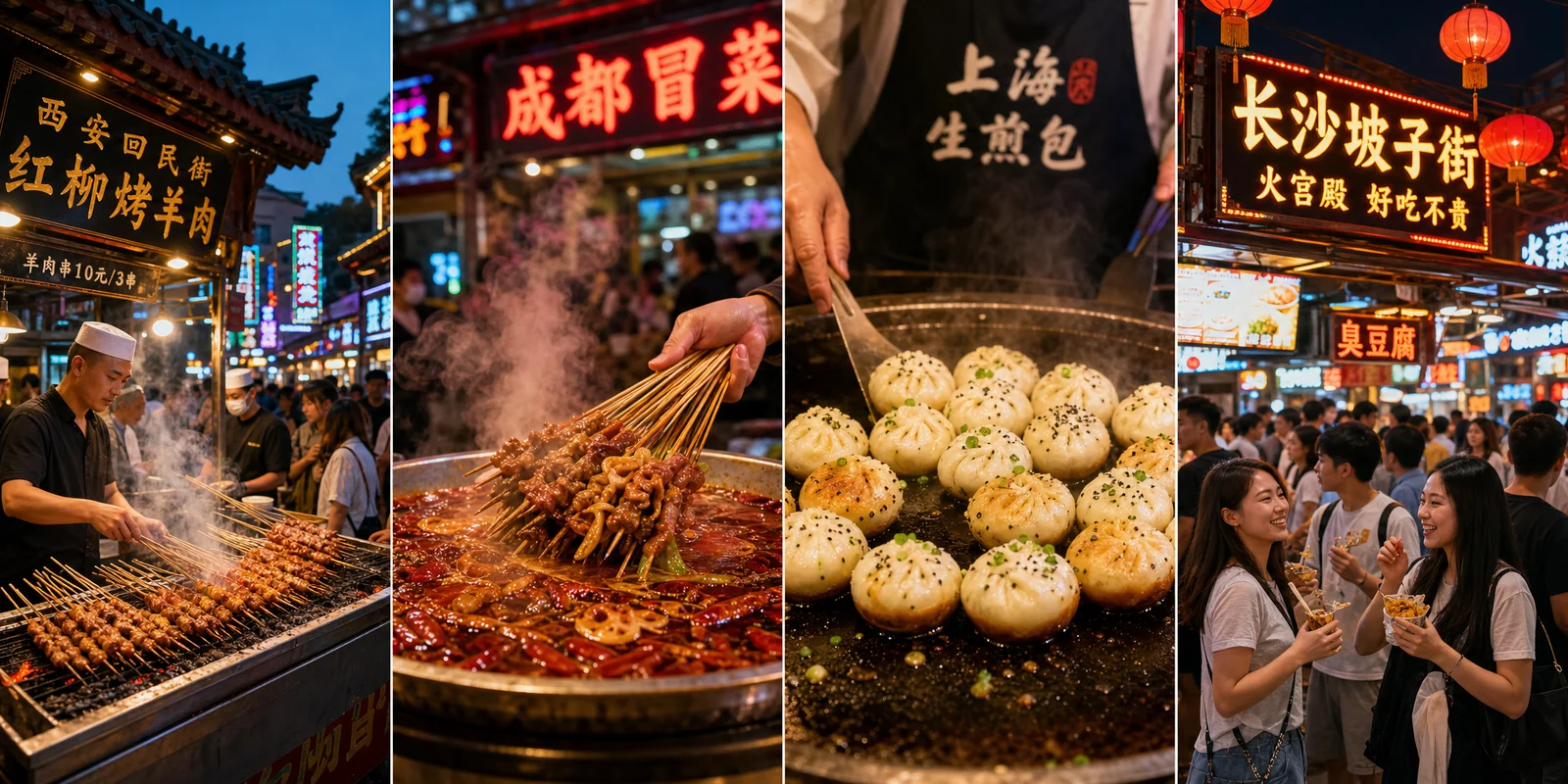
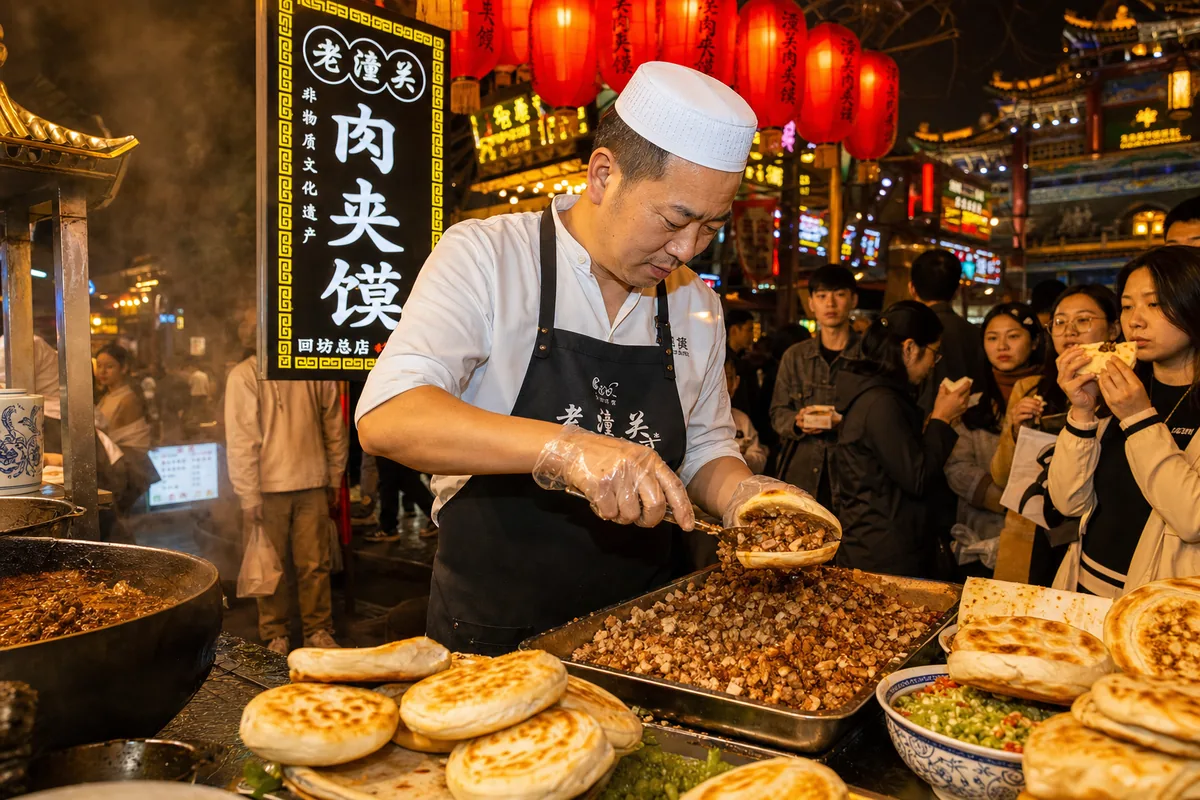
Xi'an — The Street Food Capital
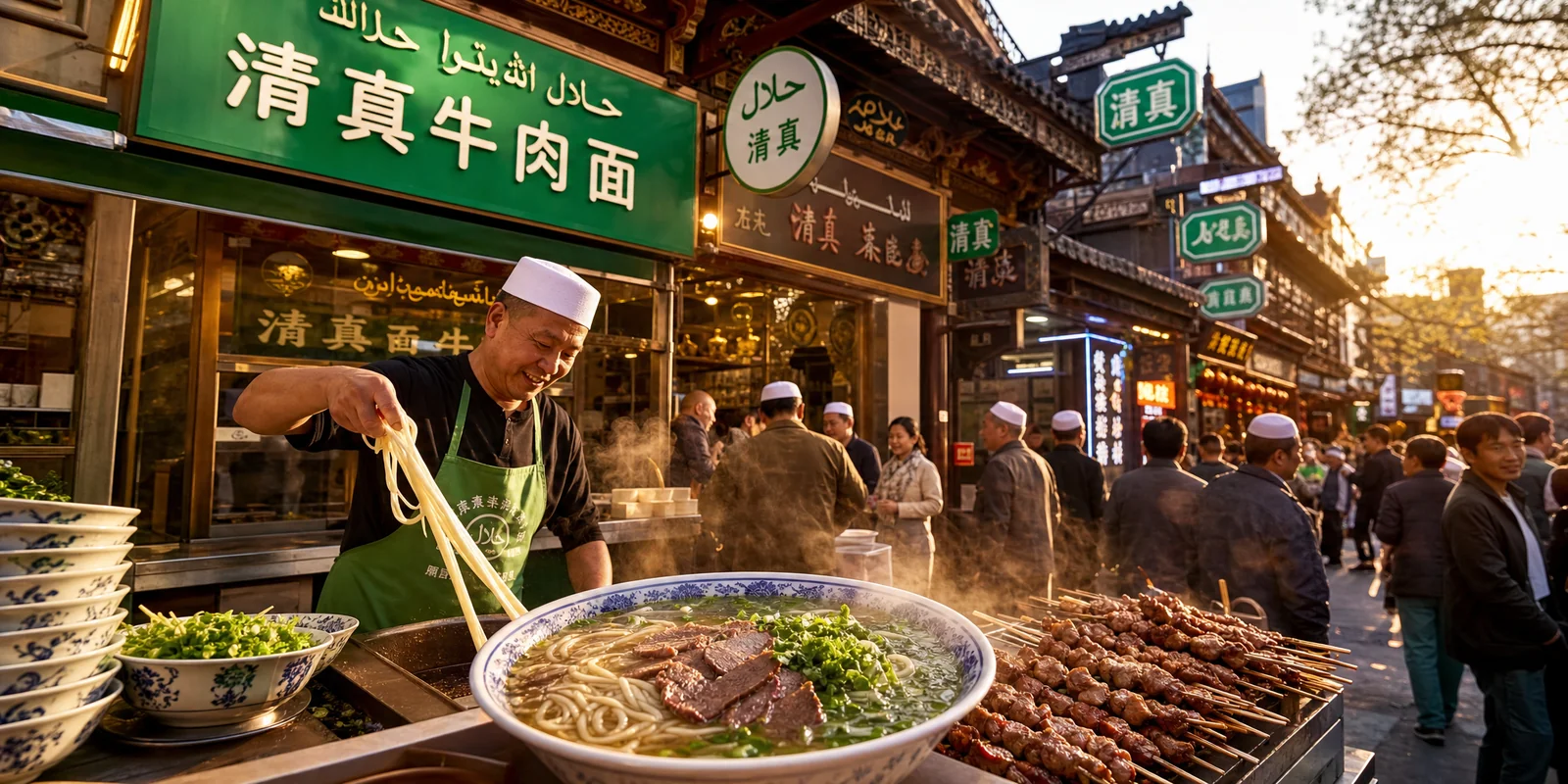
If you only have time for one street food city, make it Xi'an. As the eastern end of the old Silk Road, it absorbed centuries of flavors, and the Muslim Quarter (回民街, Huímín Jiē) is the densest concentration of snacks you'll find anywhere in the country. The neighborhood around the Drum Tower is packed with stalls from late morning until past midnight.
What to order:
- Roujiamo (肉夹馍, ròujiāmó) — Often called the "Chinese hamburger." Slow-cooked, spiced meat (usually pork, or beef/lamb in the Muslim Quarter) chopped and stuffed into a crisp griddled bun. 8–15 yuan.
- Biangbiang noodles (biángbiáng面) — Wide, hand-pulled belt noodles topped with chili, garlic, and a sizzle of hot oil. The character for "biang" is one of the most complex in Chinese and isn't in standard dictionaries.
- Yangrou paomo (羊肉泡馍, yángròu pàomó) — A lamb soup you assemble yourself by tearing flatbread into a bowl. More of a sit-down dish, but a Xi'an essential.
- Persimmon cakes (黄桂柿子饼, huángguì shìzi bǐng) — Sweet, pan-fried, made from local persimmons. A good palate cleanser.
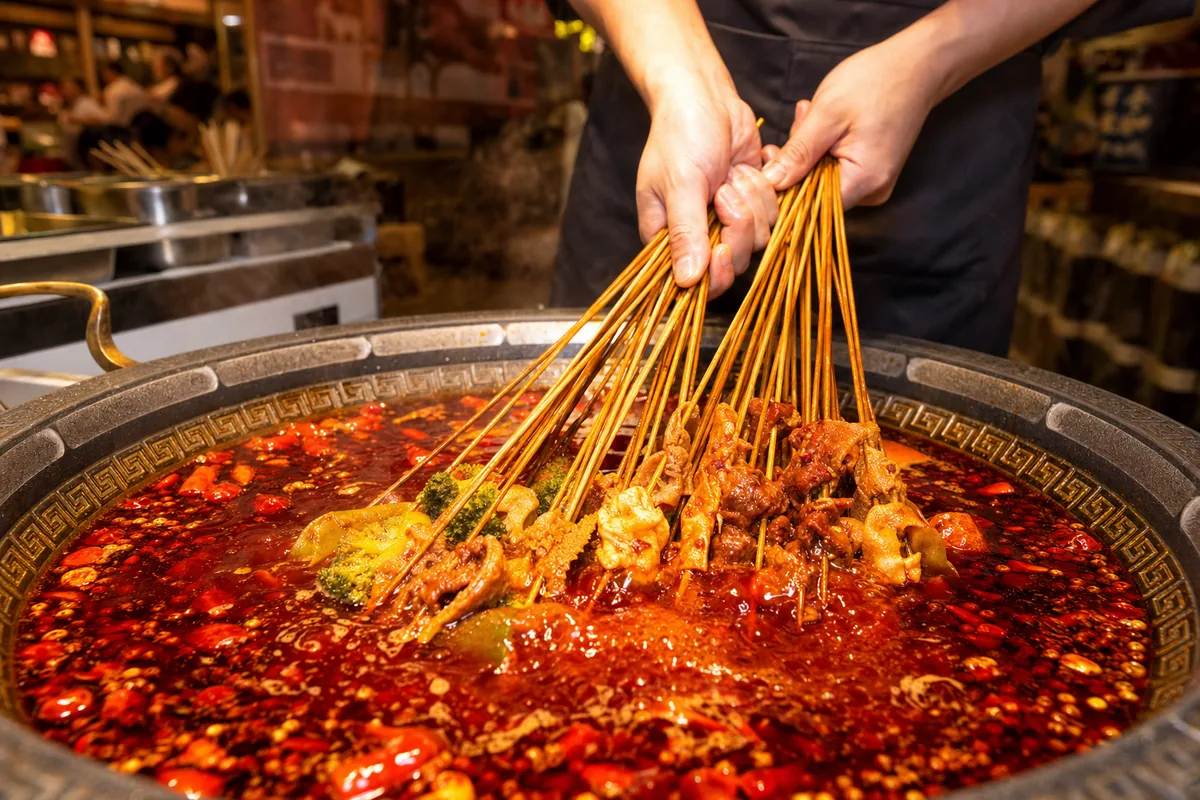
Chengdu — Sichuan Heat on the Sidewalk
Chengdu's street food is built around málà (麻辣) — the combination of numbing Sichuan peppercorn and chili heat that defines the region. Even snacks that aren't spicy tend to carry that tingle. The city is relaxed about street eating, and you'll find vendors near Jinli Ancient Street, Kuanzhai Alley, and any neighborhood market.
What to order:
- Chuan'r / skewers (串串, chuànchuàn) — Skewered meat and vegetables cooked in spiced broth, priced per stick. You grab what you want and pay by counting skewers at the end.
- Dan dan noodles (担担面, dàndàn miàn) — Noodles with a savory, nutty, chili-oil sauce and minced pork. Smaller portions than you'd expect, by design — meant as a snack.
- Long chao shou (龙抄手, lóng chāoshǒu) — Sichuan wontons in chili oil.
- Rabbit head (兔头, tùtóu) — Not for everyone, but a genuine local obsession. Spiced, braised, and eaten with your hands.
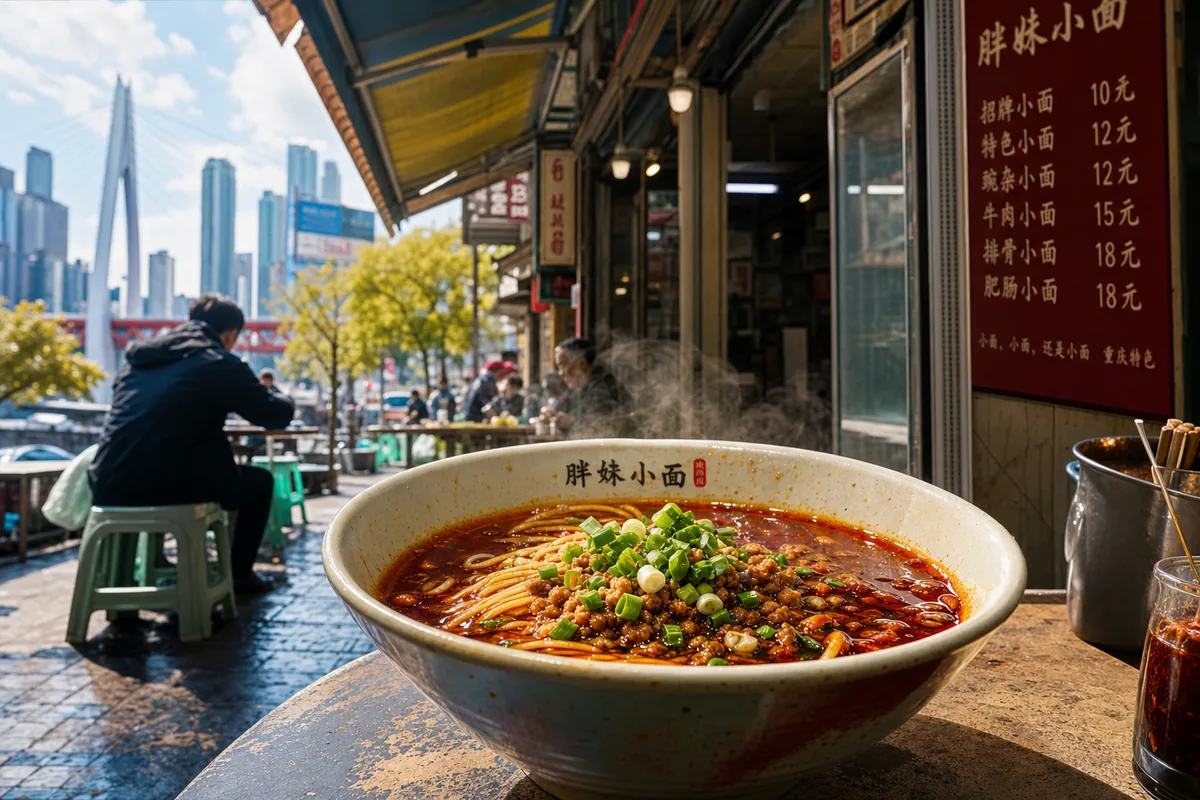
Chongqing — Hotpot Country and Noodle Mornings
An hour from Chengdu by high-speed rail but with its own identity, Chongqing is hillier, hotter, and arguably even more intense with chili. The city's signature isn't technically street food, but you can't talk about eating here without it.
What to order:
- Xiaomian (小面, xiǎomiàn) — Chongqing's breakfast noodle, served in a spicy, numbing broth. Locals eat it standing at tiny street-side stools before work. Around 8–12 yuan.
- Suan la fen (酸辣粉, suānlàfěn) — Hot-and-sour sweet potato noodles, sour and fiery and slippery.
- Hotpot (火锅, huǒguō) — The mala broth originated here. Some open-front shops feel like street eating even though you sit down.
Beijing — Imperial Snacks and Hutong Bites
Beijing's street food leans toward old-school northern snacks, many tied to the city's imperial and Hui Muslim history. Skip the infamous scorpion skewers at Wangfujing — that strip is a tourist setup and locals don't eat there. Head to the hutong neighborhoods and morning markets instead.
What to order:
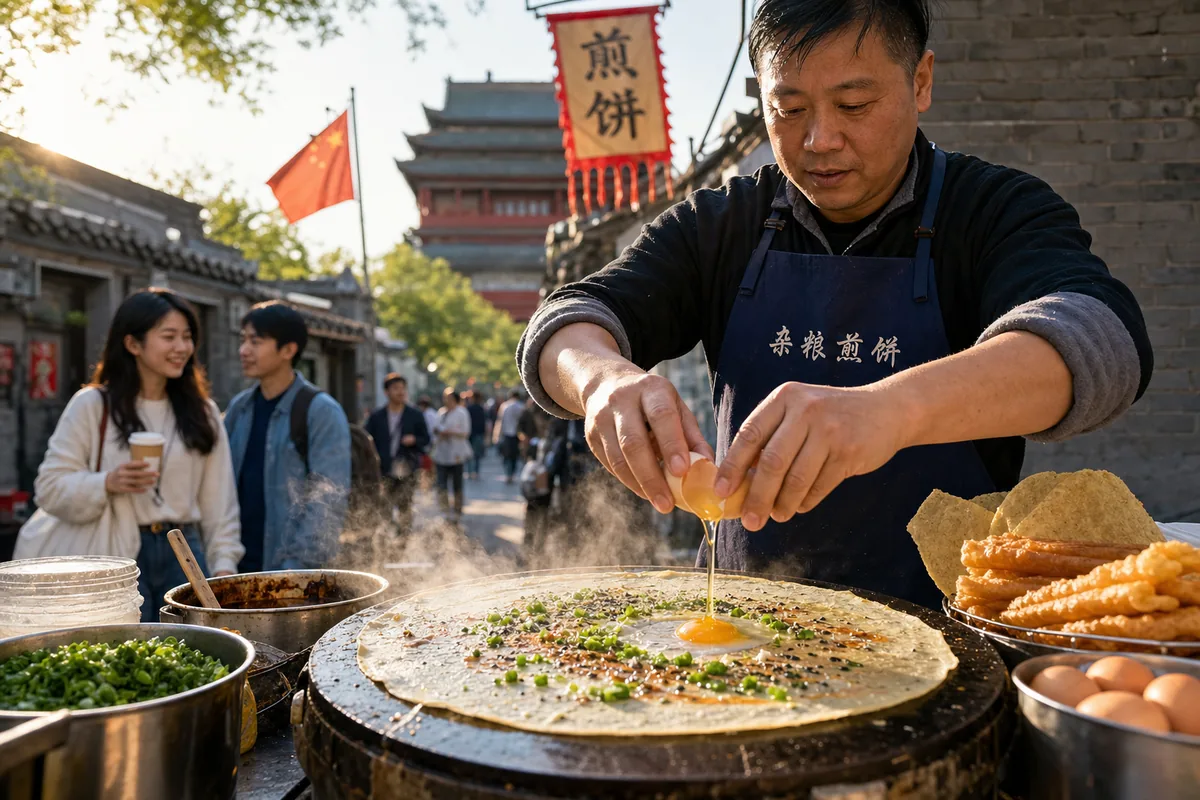
- Jianbing (煎饼, jiānbing) — A savory crepe griddled with egg, scallions, crispy cracker, and sauce, folded into a hand-held package. The classic Chinese breakfast on the go. 6–12 yuan.
- Lamb skewers (羊肉串, yángròu chuàn) — Cumin-heavy grilled lamb, a northern staple, best from charcoal grills in the evening.
- Tanghulu (糖葫芦, tánghúlu) — Hawthorn fruits on a stick coated in hard sugar glaze. Tart and sweet.
- Douzhi (豆汁, dòuzhī) — Fermented mung bean drink. An acquired Beijing taste that many visitors actively dislike — try a small cup before committing.
For a deeper dive into the city's sit-down classics like Peking duck, see our Beijing Food Guide.
Shanghai — Breakfast Streets and Soup Dumplings
Shanghai's street food is more refined and breakfast-focused than the spicy interior cities. The local culture revolves around the "four warriors" of breakfast and the city's famous dumplings. Old neighborhoods like the area around Yuyuan Garden and the lanes of the former French Concession are good hunting grounds, though the best stalls are often in unglamorous residential streets.
What to order:
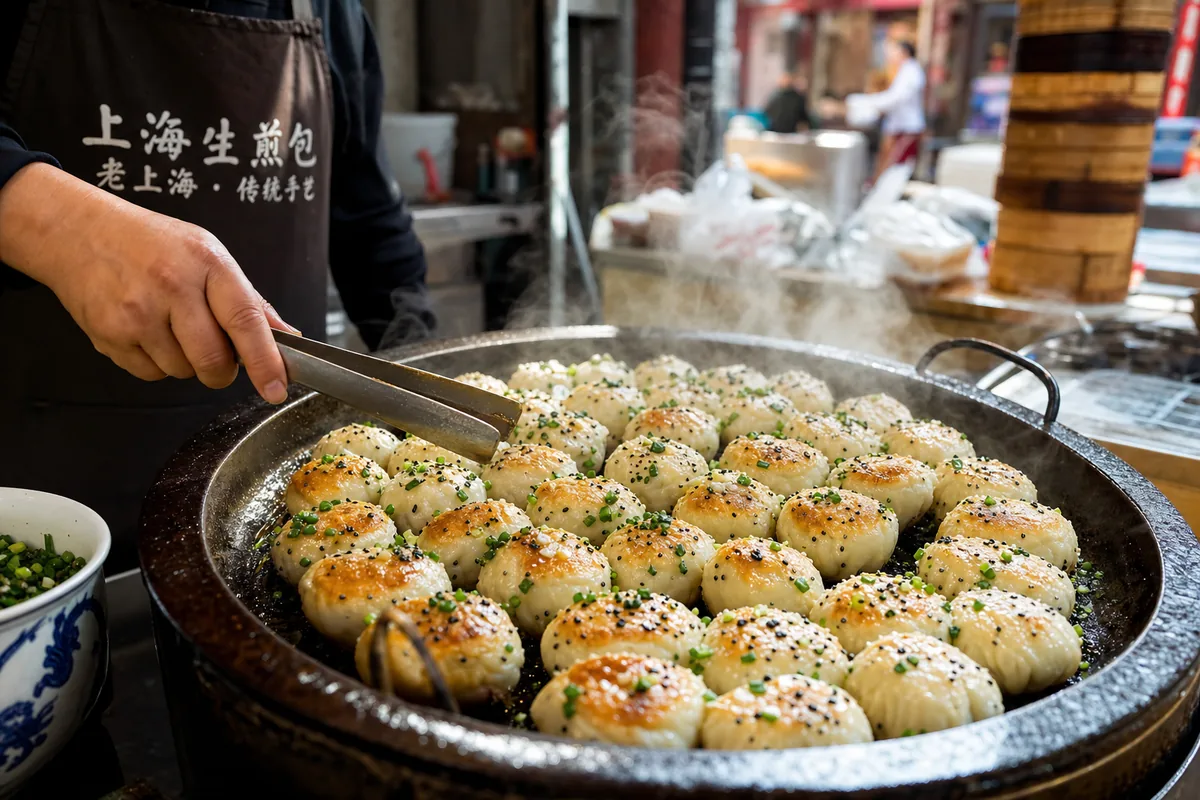
- Shengjianbao (生煎包, shēngjiānbāo) — Pan-fried pork buns with crispy bottoms and a burst of hot soup inside. Bite carefully. 6–10 yuan for four.
- Xiaolongbao (小笼包, xiǎolóngbāo) — Delicate steamed soup dumplings. Technically more of a teahouse dish, but widely available.
- Cong you bing (葱油饼, cōngyóu bǐng) — Flaky, crispy scallion pancakes fried to order.
- Ci fan tuan (粢饭团, cīfàn tuán) — Sticky rice rolls stuffed with fried dough, pickles, and pork floss. A filling breakfast for a few yuan.
If you're comparing the two big cities, our notes on Shanghai's food scene go further into sit-down restaurants and regional specialties.
Guangzhou — Cantonese Snacks and Dim Sum Culture
Cantonese cuisine prizes freshness and subtlety over heat, and Guangzhou's street eating reflects that. The food here is less about fiery skewers and more about delicate snacks, congee, and the dim sum tradition that spills out from teahouses onto the street.
What to order:
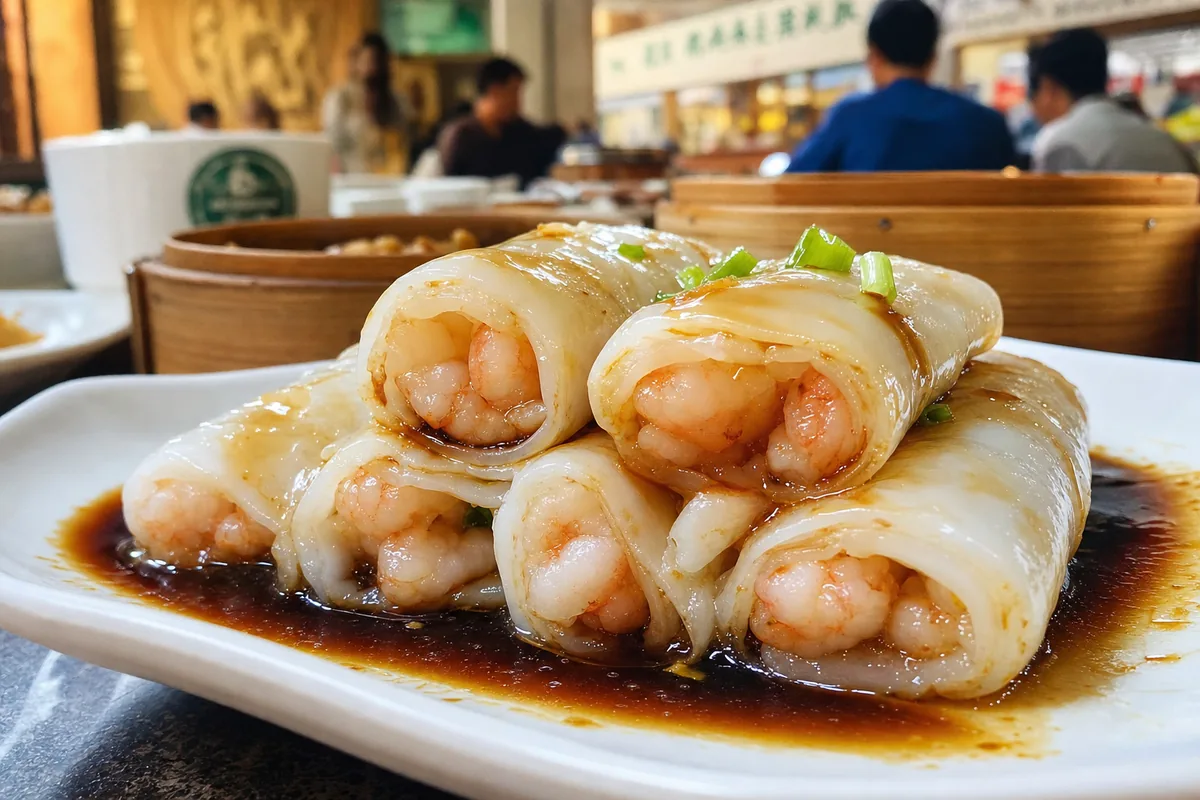
- Cheung fun (肠粉, chángfěn) — Silky steamed rice noodle rolls filled with shrimp, beef, or egg, drizzled with sweet soy. A morning staple.
- Wonton noodles (云吞面, yúntūn miàn) — Springy egg noodles with shrimp-and-pork wontons in clear broth.
- Egg waffles (鸡蛋仔, jīdànzǎi) — Sweet, eggy, bubble-shaped waffles. A Hong Kong and Guangdong street classic.
- Beef offal (牛杂, niúzá) — Slow-braised beef tripe and innards in broth, sold from carts. Better than it sounds.
Changsha — The Boldest Flavors and the Best Night Markets
Hunan's capital has become one of China's most talked-about food cities, partly thanks to homegrown brands and a young, energetic night-market scene. Hunan spice is different from Sichuan's — drier, sharper heat without the numbing peppercorn. Pozi Street (坡子街) and the night markets here run late and loud.
What to order:
- Stinky tofu (臭豆腐, chòudòufu) — Changsha's black-fried version is famous nationwide. The smell is confronting; the taste, once you get past it, is savory and addictive.
- Sister Tang's clay-oven flatbread and various grilled snacks — Look for the crowds.
- Crayfish (小龙虾, xiǎolóngxiā) — In summer, spicy crayfish is everywhere, eaten by hand late into the night.
- Tang you ba ba (糖油粑粑, tángyóu bābā) — Sticky rice balls fried in sugar syrup. Sweet and chewy.
How Much to Budget and What to Expect
| City | Signature snack | Spice level | Best time to eat |
|---|---|---|---|
| Xi'an | Roujiamo | Mild–medium | All day / late night |
| Chengdu | Skewers (chuan'r) | High (numbing) | Evening |
| Chongqing | Xiaomian noodles | Very high | Morning |
| Beijing | Jianbing | Mild | Morning |
| Shanghai | Shengjianbao | Mild | Morning |
| Guangzhou | Cheung fun | Mild | Morning / dim sum hours |
| Changsha | Stinky tofu | High | Night |
A satisfying street food meal across two or three stalls rarely costs more than 40–60 yuan ($6–8) per person. Night markets generally come alive after 6 or 7 pm and run until late; breakfast stalls in the southern cities are best between 7 and 10 am.
Ordering Without Chinese
Most stall vendors speak no English, but ordering street food is easier than ordering in a restaurant because you can point. A few practical tactics:
- Point at what someone else is eating, or at the ingredients on display.
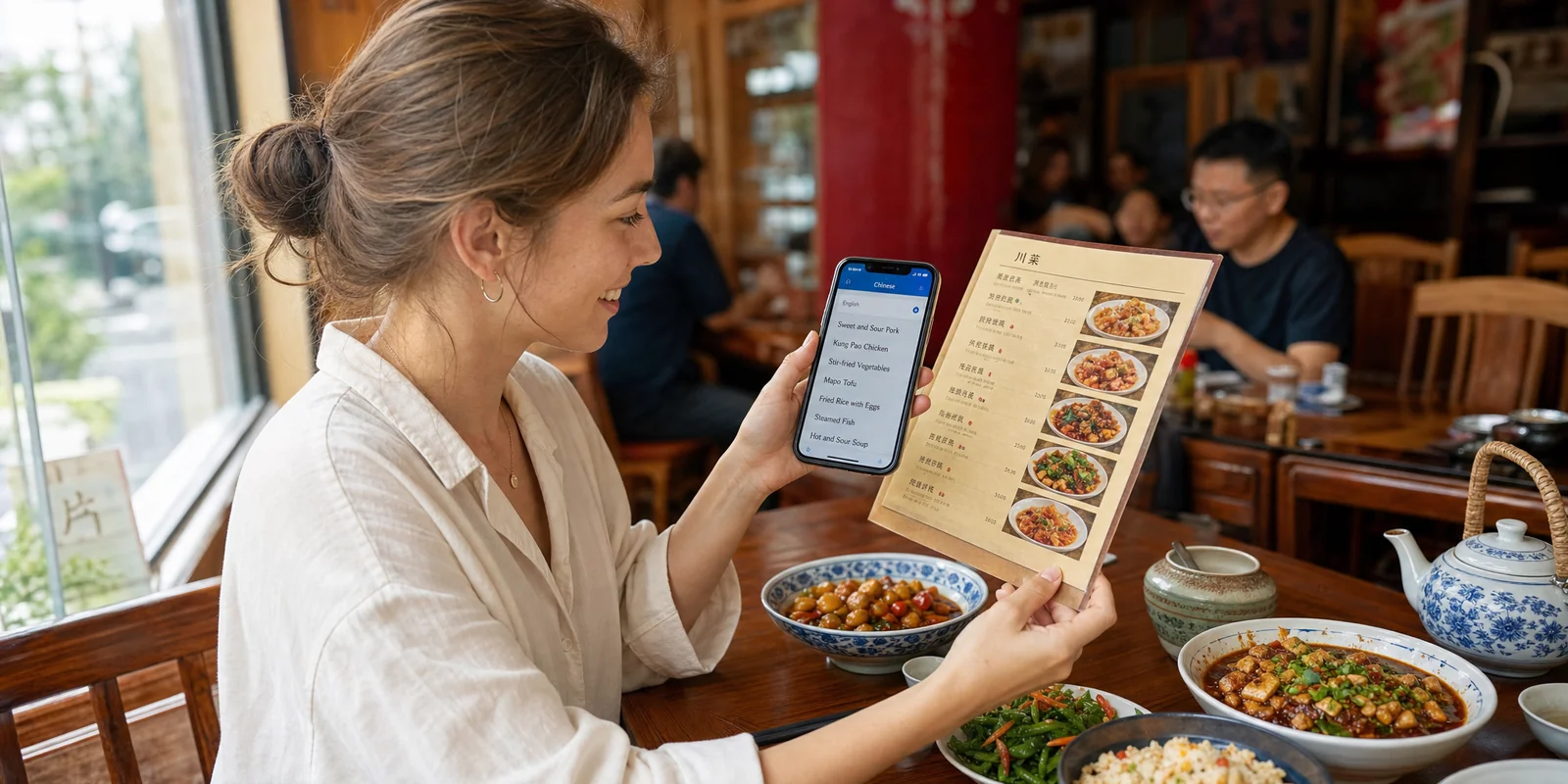
- Have a translation app ready — typing or showing the Chinese name of a dish works well. Our guide to ordering food with zero Chinese covers this in detail.
- Learn the numbers 1–10 in finger gestures, or just show the price screen on Alipay after they enter it.
- For skewer stalls, you usually grab raw skewers yourself and they count them at the end.
Is Street Food Safe?
Generally, yes — with common sense. Busy stalls with high turnover are your friend: food doesn't sit around, and locals vote with their feet. Look for vendors cooking to order over high heat. Be more cautious with pre-cut fruit, raw or cold items, and anything that's been sitting out. If your stomach isn't used to heavy chili and oil, ease in rather than going all-in on the first night. For a fuller rundown, see our food safety guide.
If you'd rather have a local walk you through a neighborhood's best stalls and explain what you're eating, a guided street food tour can be worth it in a city like Xi'an or Chengdu — you'll cover more ground and skip the tourist traps. You can browse options on Klook.
The Bottom Line
If you want one city that delivers the full street food experience, Xi'an is the pick — variety, history, and density in one walkable quarter. For heat and atmosphere, Chengdu and Chongqing are unbeatable. Beijing and Shanghai reward early risers with morning snacks, and Guangzhou and Changsha sit at opposite ends of the flavor spectrum, one subtle, one bold. Whichever you visit, eat where the lines are longest, carry a charged phone with Alipay set up, and don't over-order at the first stall — the whole point is to graze.
Next steps: set up mobile payments, pin a few markets on your map app, and read up on the regional cuisine of wherever you're headed in our guide to Chinese cuisine by region.
Last updated: June 2026
Read in other languages
Last train times for 10 Chinese metro systems
Every line and station, checked by hand — the same data behind our offline route planner.
Get the WaysChina App
Offline guides, currency converter, essential phrases, and more — all in your pocket.

Related Articles
Guide to Chinese Cuisine by Region
Chinese food isn't one thing — it's dozens of distinct regional cuisines. Here's a practical guide to the Eight...
Halal Food in China
Finding halal food in China is easier than most travelers expect. Here's how to spot certified restaurants, what...
How to Order Food with Zero Chinese
Ordering food in China without speaking Chinese is easier than most travelers expect. Here are the apps, photo-menu...
Vegetarian & Vegan Travel in China: A Practical Guide
Eating vegetarian or vegan in China is easier than most travelers expect, but it takes a bit of know-how. Here are...