
This article contains affiliate links. If you make a purchase through these links, we may earn a small commission at no extra cost to you. This helps support our work in creating free travel guides.
Beijing food is northern food: wheat more than rice, lamb as much as pork, salty soybean paste and sesame instead of chili. If you eat only four things here, make them a proper Peking duck dinner, a bowl of zhajiangmian (fried-sauce noodles), a copper-pot lamb hotpot if it's cold, and a jianbing egg crepe from a breakfast window. Then try one old-Beijing snack out of curiosity.
What to eat, and how to eat it
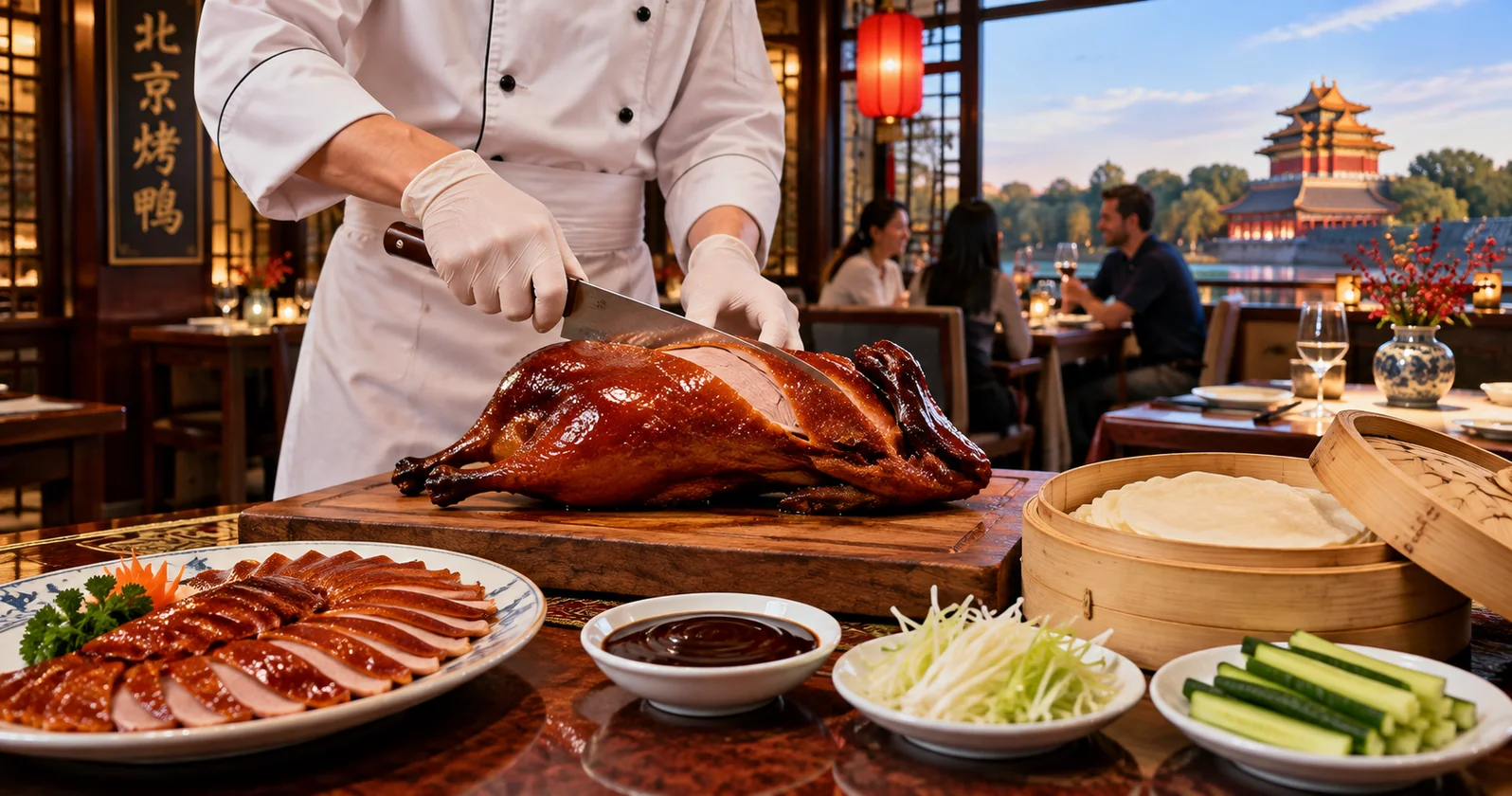
Peking duck (北京烤鸭, Běijīng kǎoyā)
Two schools, both the real thing. Hung-oven duck (挂炉, guàlú) roasts over an open fruitwood fire, so the skin is crisp and a little smoky; that's the style Quanjude built its name on. Closed-oven duck (焖炉, mènlú) cooks on the stored heat of a sealed brick oven after the fire is put out, giving thinner skin and juicier meat; Bianyifang is the historic house of that school.
A whole duck (整只, zhěng zhī) feeds three or four; most places also sell a half (半只, bàn zhī), right for two. It's carved beside your table, and at a good house the first plate is crisp skin on its own — dip a piece in the small dish of sugar. The rest goes into thin pancakes (荷叶饼, héyèbǐng): pancake on your palm, a smear of sweet bean sauce (甜面酱, tiánmiànjiàng), two or three slices of duck, scallion and cucumber sticks, fold the bottom up, roll the sides in. A duck plus one or two vegetable dishes is a full meal; say yes if they offer to make a soup from the carcass.
Zhajiangmian (炸酱面, zhájiàngmiàn)
The city's everyday lunch: thick wheat noodles, a small bowl of dark sauce made from fried fermented soybean paste and diced pork belly, and a ring of little dishes — cucumber, bean sprouts, radish, soybeans. It arrives unmixed on purpose. Pour the sauce over the noodles, tip in all the vegetables and mix hard until every strand is coated; the sauce is salty by design and the raw vegetables balance it. In summer ask for the noodles rinsed cold (过水, guò shuǐ), in winter straight from the pot (锅挑, guō tiāo).
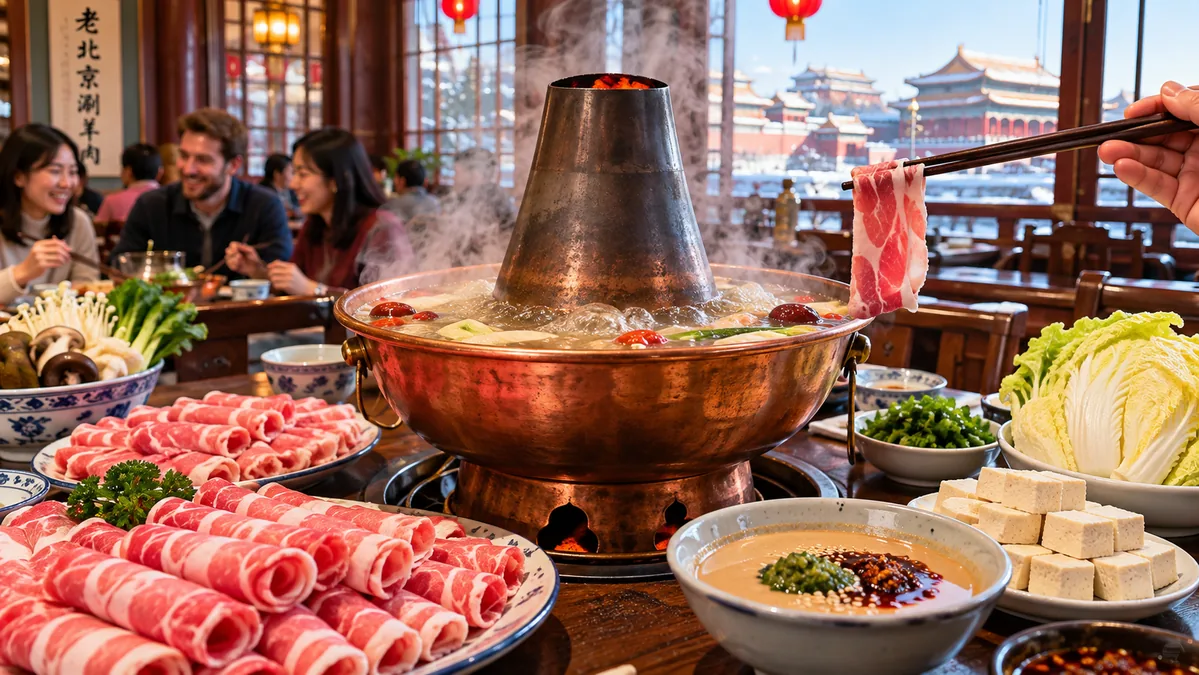
Copper-pot lamb hotpot (涮羊肉, shuàn yángròu)
Not the red-oil Sichuan kind. A copper pot with a charcoal chimney holds a clear broth with little in it but ginger, scallion and a few dried shrimp; the point is the lamb, paper-thin and ordered by the plate. Swish a slice in the boiling broth for a few seconds until it turns grey, then dip it in sesame-paste sauce (麻酱, májiàng), which comes mixed with fermented tofu (腐乳, fǔrǔ), chive-flower paste (韭菜花, jiǔcàihuā) and chili oil — ask for it pre-mixed if unsure. After the lamb: frozen tofu, napa cabbage, glass noodles, and a sesame flatbread (烧饼, shāobing) to finish. Best in the cold months, fine in any.
Old-Beijing snacks: which to try
The traditional snacks (小吃, xiǎochī) split into the ones everyone likes and the ones you try once.
- Jianbing (煎饼, jiānbing) — a thin egg crepe off a griddle, painted with sauce and folded around a crisp cracker and scallions. Everyone likes it; best breakfast in the city.
- Lüdagun (驴打滚, lǘdǎgǔn, "rolling donkey") — sticky rice rolled around red-bean paste in toasted soybean flour. Sweet and safe, like tanghulu (糖葫芦, tánghúlu), candied hawthorn on a stick.
- Douzhi (豆汁, dòuzhī) — fermented mung-bean liquid, grey-green, with a sour smell like something that has turned, drunk hot with a fried dough ring (焦圈, jiāoquān) and pickles. Most first-timers manage two sips; nobody minds if you leave the rest.
- Luzhu (卤煮, lǔzhǔ) — pork intestine, lung and tofu stewed with pieces of flatbread in a dark, garlicky broth. If you happily eat tripe at home you'll like it; if not, you won't.
- Chaogan (炒肝, chǎogān) — a thick, starchy, garlic-heavy stew of liver and intestine, eaten at breakfast with steamed buns. Same rule.
Imperial cuisine (宫廷菜, gōngtíngcài), palace-kitchen dishes served in courtyard restaurants with costumes and a bit of theatre, is a special-occasion dinner that costs a lot and is more about the setting than the cooking; you've missed nothing if you skip it.
Where to eat: pick a district, not a restaurant
Qianmen and Dashilar (前门 / 大栅栏). The old shopping streets south of Tiananmen Square hold the century-old "time-honored brands" (老字号, lǎozìhào): flagship duck houses, pastry shops, pickle sellers. The setting is real and the food is fine, but the flagships here have the longest queues and the highest prices in the city for the same dish a quieter branch of the same brand serves. Qianmen Street is a free, open pedestrian street — walk it, buy a pastry, and have your duck dinner somewhere less crowded.
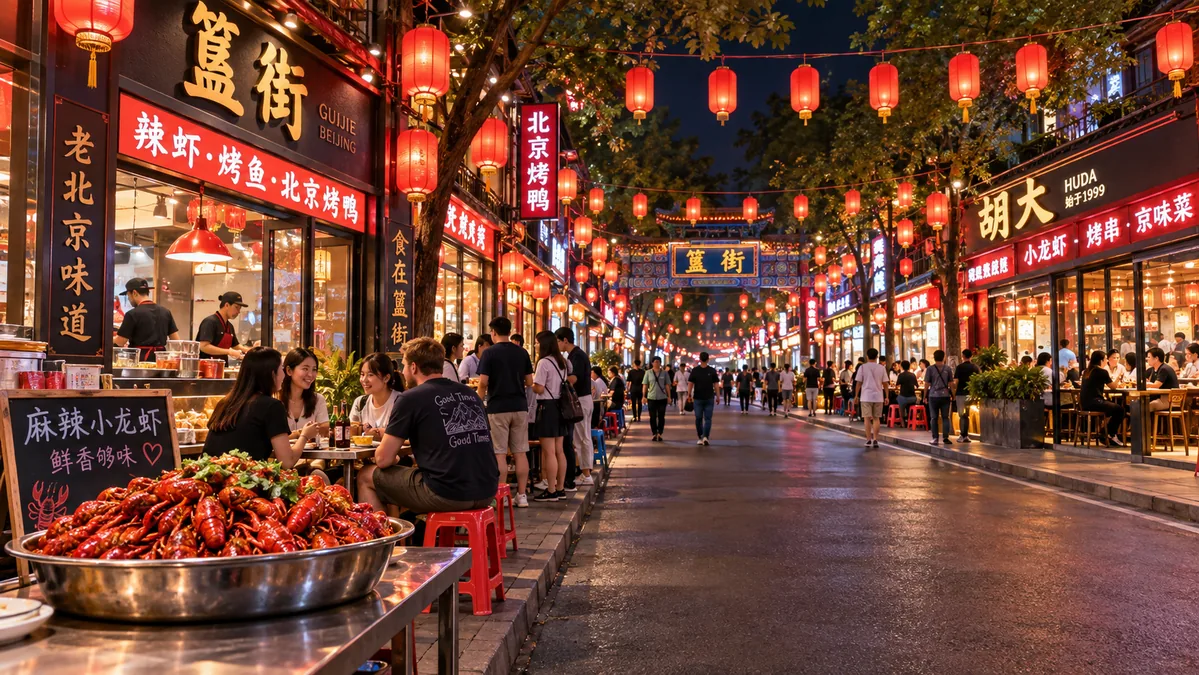
Guijie (簋街, Guǐjiē, "Ghost Street"). A stretch of Dongzhimen Inner Street lined with red lanterns and restaurants open into the small hours. This is where Beijing eats late, and the specialties aren't local: spicy crayfish (麻辣小龙虾, málà xiǎolóngxiā) by the basin in summer, Sichuan hotpot, grilled fish, skewers. Go after nine, when it fills up, and expect a wait on weekends. Plan the trip home first: Beijing's metro lines mostly stop running around eleven at night and every line is different, so check the last train times for Beijing. After that it's a taxi or a DiDi (the ride-hailing app); Beijing's taxi regulations require the driver to run the meter and forbid bargaining a fare, so if someone at the curb quotes a price, walk past and flag a metered cab.
Niujie (牛街, Niújiē, "Ox Street"). The historic Muslim quarter in the southwest of the old city, around the Niujie Mosque, and the best halal eating in Beijing: hand-cut lamb, beef pies, sesame flatbreads, snack shops with the widest range of traditional pastries. Go hungry, around lunch.
The hutong around Gulou, Dongsi and the Lama Temple. The hutong (胡同, hútòng) are the old lanes, and those around the Drum Tower (鼓楼, Gǔlóu), Dongsi (东四) and the Lama Temple hold the small family restaurants, courtyard restaurants, dumpling shops and everyday zhajiangmian places. Nanluoguxiang (南锣鼓巷), the famous lane, is free to walk and open all day, but it's a snack-and-souvenir strip, so eat in the quieter lanes on either side; the bars around Houhai (后海) are the same story. If you'd rather have someone lead you through the lanes and explain what's on the plate on your first evening, a small-group hutong food walk booked through Klook does that job.
Mall food floors. Every big shopping center — Wangfujing, Xidan, Sanlitun, Guomao — has a basement or top-floor food hall with regional chains, picture menus, QR ordering and air-conditioning. Not exciting, but reliable, and the right answer when it's raining or the kids are hungry now.
Breakfast windows. On any residential street in the morning: jianbing, fried dough sticks (油条, yóutiáo), hot soy milk (豆浆, dòujiāng), steamed buns (包子, bāozi), savory tofu pudding (豆腐脑, dòufunǎo). The cheapest genuinely local meal you'll have, and mostly gone by mid-morning. Eat it on the pavement — eating inside metro carriages is against the passenger rules.
Ordering and paying without Chinese
Outside hotels and big chains, assume no English menu and no English-speaking staff; the city's official English-language help is built around transport, not restaurants, so bring your own. Three things cover almost every meal: picture menus (point), QR-code ordering (scan the code on the table; the menu usually has photos even without English), and a translation app with camera mode for text-only menus. The full toolkit, including how to say "not spicy" and what to do when the QR menu wants a Chinese app, is in our zero-Chinese ordering guide.
Paying is simpler. Nearly every restaurant, stall and window takes Alipay (支付宝, Zhīfùbǎo) or WeChat Pay (微信支付, Wēixìn Zhīfù) by QR code, and both work with a foreign card once set up — see our Alipay setup guide. Officially you can also pay by bank card, cash or digital yuan, but small restaurants run on QR codes. Keep some cash anyway: renminbi (yuan) cash is legal tender and a business may not refuse it, and small notes matter because a breakfast window won't have change for a hundred. If a note you get back looks worn, tilt it: on genuine current-series notes the big numeral on the front shifts color. How much to carry is in do you need cash in China; nobody expects a tip, at a duck house or a noodle window — see the tipping guide if unsure.
Halal, vegetarian and allergies
Halal. Beijing is one of the easier Chinese cities for halal eating, thanks to Niujie and the Hui Muslim (回族, Huízú) tradition of lamb, beef, flatbreads and hand-pulled noodle shops all over town. Under Beijing's own halal-food regulation, a business selling halal (清真, qīngzhēn) food must register with the district ethnic-affairs office and hang the uniform halal sign issued by the city, so look for that plaque rather than trusting Arabic lettering on a menu. Chains, apps and stricter observance are in our halal food guide.
Vegetarian and vegan. Doable, with effort. Buddhist vegetarian restaurants (素菜馆, sùcàiguǎn), often near temples, cook full meat-free menus; ordinary restaurants will stir-fry greens, tofu and mushrooms if you ask. Say wǒ chī sù (我吃素, "I eat vegetarian") and add bú yào ròu tāng, bú yào zhū yóu (不要肉汤,不要猪油, "no meat broth, no lard"), because those two hide in dishes that look vegetarian. Beijing traps: zhajiangmian's sauce is fried with pork, the hotpot broth may be made on bones even when it looks clear, and "vegetable" dumplings often contain egg. More phrases and a dish list are in our vegetarian and vegan guide.
Allergies. Show a card in Chinese naming the allergen — peanut 花生, tree nuts 坚果, shellfish 虾蟹贝类, wheat and gluten 小麦/麸质, egg 鸡蛋, soy 大豆, milk 牛奶, sesame 芝麻 — rather than explaining it in words. From March 2027 a new national labeling standard makes allergen warnings mandatory on packaged food, but it does not cover restaurant dishes or food made and sold on the spot, so nothing on the table will warn you. Sesame paste and peanuts are in many of Beijing's sauces and cold dishes, and wheat is in nearly everything, so show the card before you order, every time. Card wording and what to do if you react are in our food safety guide.
Eating safely: the face at the door, the tap water and the street stall
Licensed restaurants display a hygiene grade at the door or in the dining room. Under the national scheme, each inspection produces a dynamic grade shown as a cartoon face — a big laugh for excellent, a smile for good, a flat face for average — plus a yearly letter grade of A, B or C; the exact design of the sign varies by city. Eat where the face is laughing or smiling and the turnover is fast; a flat face is still legal, but it's a hint.
Tap water: Beijing's water authority publishes quarterly test results, and the latest report shows every routine indicator of the water leaving the treatment plants within the national drinking-water standard. Even so, the official advice from the China CDC is to boil tap water before drinking, because pipes can recontaminate treated water and a boil of one to three minutes kills germs and drives off the chlorine. A chlorine smell from the tap is normal here, since Beijing's supply is chlorine-disinfected. In practice: hotel kettle, bottled water outside, and the hot water and tea restaurants pour by default, which is boiled.
Street stalls carry no grade sign, so choose by eye: a queue of residents, food cooked hot in front of you, oil that isn't black, a vendor who handles money with one hand and food with tongs. Skip anything sitting lukewarm in the sun. If you do get sick, the pharmacy and hospital steps are in the food safety guide.
What it costs, roughly
Everyday eating in Beijing is cheap. A bowl of zhajiangmian, a jianbing or a plate of dumplings at a neighborhood shop is pocket change; a copper-pot hotpot for two at an ordinary restaurant is a modest dinner by Western standards; mall food halls sit in between. The money goes in predictable places: a whole duck at a famous-name house, an imperial-cuisine dinner, and any flagship branch on a tourist street, which charges the most for the same dish its quieter branch serves. Menus change, so the number to trust is the one printed on the menu or posted at the door. For the rest of the trip, start with our Beijing complete guide and the 3-day Beijing itinerary.
Frequently asked questions
What is Beijing's most famous food?
Peking duck, by far: roasted until the skin is crisp, carved at the table and rolled into pancakes with sweet bean sauce and scallion. Behind it come zhajiangmian, the fried-sauce noodles that are the city's everyday lunch, and copper-pot lamb hotpot in winter. Among snacks, jianbing (Tianjin's invention, sold on every Beijing corner) is the one everyone loves and douzhi is the one everyone has heard about.
Is Quanjude worth it?
Quanjude is the most famous duck name in China and the standard-bearer of the hung-oven school; the duck is competent and the branches usually have English menus. The catch is the flagship branches on Qianmen and Wangfujing: long queues, the highest prices, and dining rooms built for tour groups. Many people who live in Beijing prefer the smaller duck specialists or the closed-oven rival. If you want the famous name, go to an ordinary branch at an off-peak hour; if you want the best duck for the money, pick a duck house with a queue of residents outside and book a day ahead. Either way, don't cross town to stand in a long line for it.
What is douzhi, and should I try it?
Douzhi is the liquid left over from making mung-bean starch, fermented until it turns sour, then heated and served with a crisp fried dough ring and pickles. It smells like something that has gone off, and to most newcomers it tastes that way too; Beijingers who grew up on it love it. Try it once at a snack shop, where it's cheap, take two sips, and you'll know. Nobody expects you to finish.
Is street food in Beijing safe?
Generally yes, if you choose by the same signs residents use: busy stalls, food cooked hot in front of you, nothing that has been sitting out. For sit-down places, use the posted hygiene grade — a laughing or smiling face marks the top two tiers under the national scheme. Boil tap water before drinking it, which is the official advice, or buy bottled.
Last updated: September 2026
Read in other languages
Getting to the sights by metro
Forbidden City
World's largest imperial palace, home to 24 Ming and Qing emperors.
- Tian'anmen East
- Tian'anmen West
- Beihai North
Tiananmen Square
World's largest public square. Arrive before sunrise for flag ceremony.
- Tian'anmen East
- Tian'anmen West
- Qianmen
Temple of Heaven
Ming-era imperial complex where emperors prayed for good harvests.
- East Gate of Temple of Heaven
- Tianqiao
- Qiaowan
Summer Palace
Imperial garden with Kunming Lake, Long Corridor, and Marble Boat.
- Beigongmen
- Xiyuan
Lama Temple (Yonghe Temple)
Tibetan Buddhist monastery with an 18m Maitreya statue.
- Yonghegong Lama Temple
- Beixinqiao
Bird's Nest (National Stadium)
2008 Olympic main stadium, lit up at night.
- Olympic Park
- Olympic Sports Center
Water Cube (National Aquatics Center)
2008 Olympic swimming venue, blue bubble facade.
- Olympic Park
- Olympic Sports Center
Olympic Forest Park
Largest urban park in Beijing; great for jogging.
- South Gate of Forest Park
- Olympic Park
798 Art Zone
Contemporary art district in converted Bauhaus factories.
- Gaojiayuan
- Jiangtai
Wangfujing
Beijing's most famous shopping street and night market.
- Wangfujing
- Dengshikou
- Dongdan
Nanluoguxiang
Historic hutong lanes lined with boutique shops and cafes.
- South Luogu Alley
- Shichahai
Houhai (Shichahai)
Lake-side hutong district with bars, rickshaws, and Prince Gong's Mansion.
- Shichahai
- Beihai North
Beihai Park
1000-year-old imperial garden with a lake and White Pagoda.
- Beihai North
- Shichahai
- Tian'anmen West
Jingshan Park
Hilltop park directly north of the Forbidden City — best panoramic view.
- Beihai North
- Shichahai
- South Luogu Alley
Qianmen Street
Restored imperial-era pedestrian street with traditional shops.
- Qianmen
- Zhushikou
- Qiaowan
Sanlitun
Trendy nightlife and shopping district; embassies nearby.
- Tuanjiehu
- Agricultural Exhibition Center
- Dongsi Shitiao
Temple of Confucius & Imperial College
Imperial Confucian temple and academy; quiet alternative to Lama Temple.
- Yonghegong Lama Temple
- Andingmen
Beijing Capital International Airport
Beijing's main international airport (PEK), Terminal 3 designed by Norman Foster.
- Capital Airport Terminal 3
- Capital Airport Terminal 2
Beijing Daxing International Airport
Beijing's second international airport (PKX), Zaha Hadid's six-pier starfish terminal.
- Daxing Airport
Beijing South Railway Station
Major high-speed rail terminus for Beijing–Shanghai and Beijing–Tianjin lines.
- Beijing South Railway
Beijing West Railway Station
Major terminus for Beijing–Guangzhou and Beijing–Kunming high-speed lines.
- Beijing West Railway
Beijing metro: last train times by station
Every line and station, checked by hand — the same data behind our offline route planner.
Get the WaysChina App
Offline guides, currency converter, essential phrases, and more — all in your pocket.

Related Articles
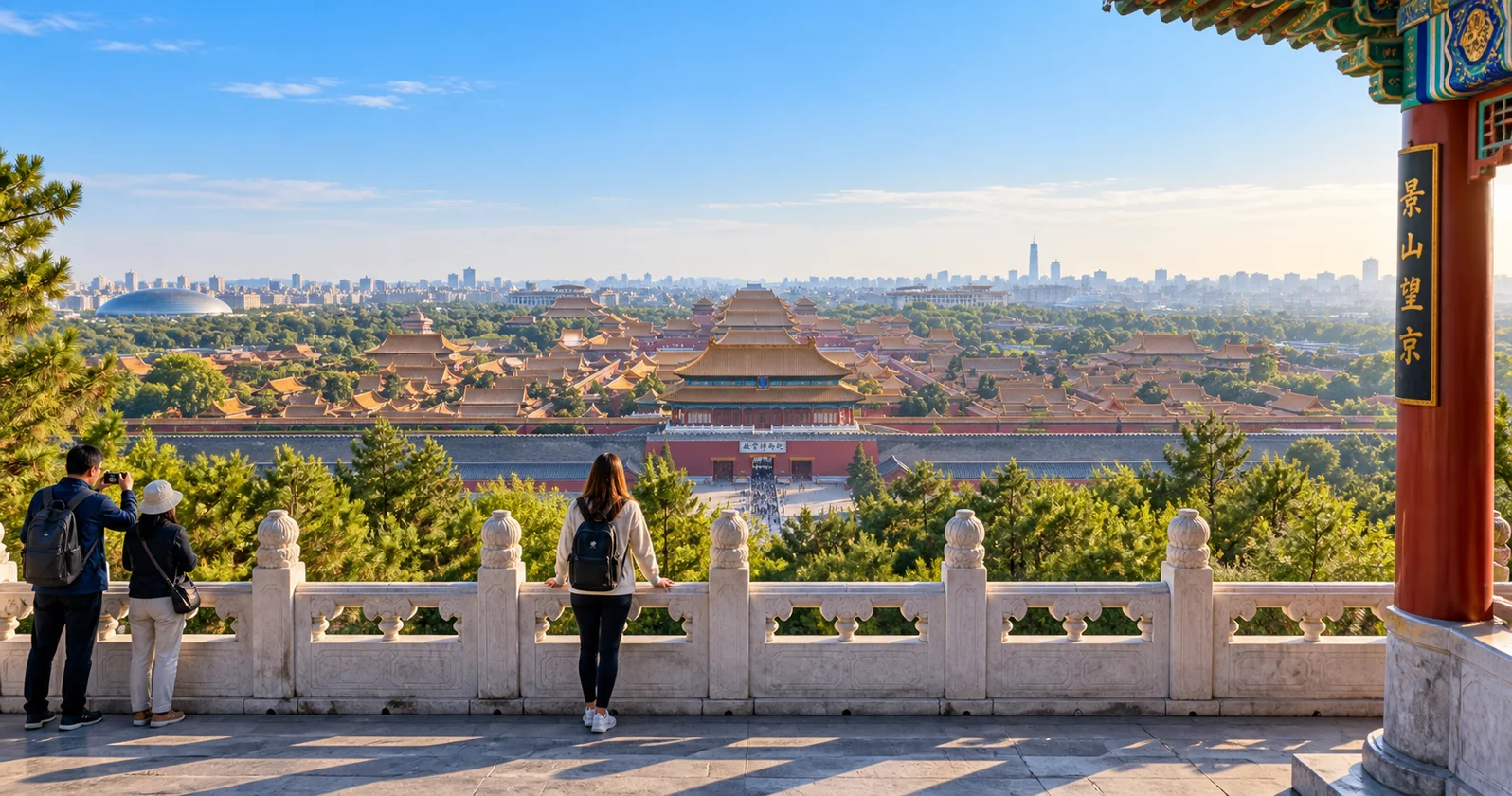
3 Days in Beijing: A Day-by-Day Itinerary Built Around the Bookings
A three-day Beijing route in metro order — imperial axis, Great Wall, Temple of Heaven and hutongs — with the...

Day Trips from Beijing: Which Great Wall Section, Plus the Ming Tombs, Tianjin and Chengde
Which Great Wall section fits you — Mutianyu, Badaling, Jinshanling or Simatai with Gubei — plus the Ming Tombs,...
Datong Complete Guide
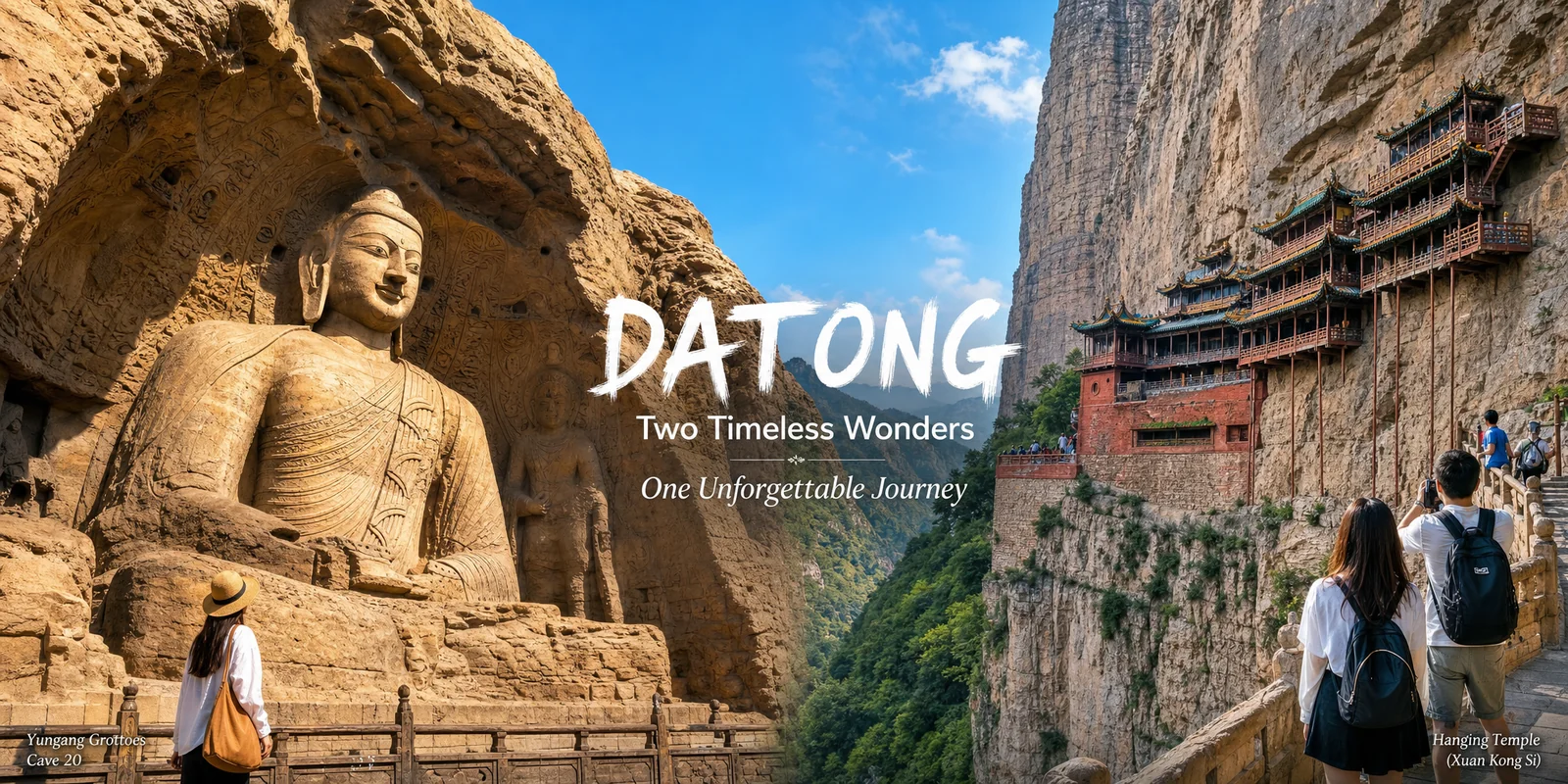
Datong was the first capital of the Northern Wei dynasty and home to the UNESCO-listed Yungang Grottoes. Here's how...
Tianjin Complete Guide
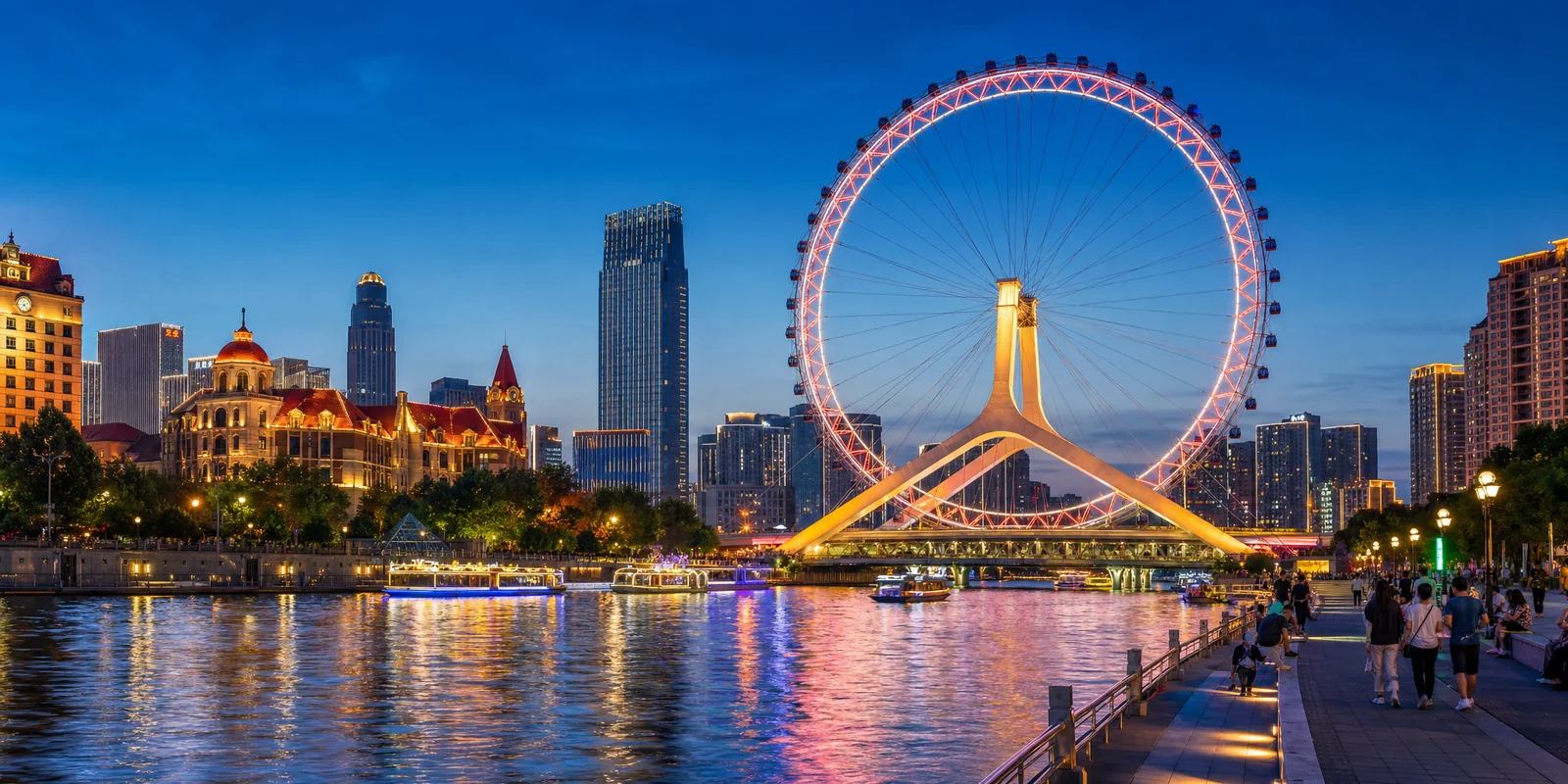
Tianjin sits 30 minutes from Beijing by high-speed rail, with European architecture, a giant Ferris wheel over the...