
This article contains affiliate links. If you make a purchase through these links, we may earn a small commission at no extra cost to you. This helps support our work in creating free travel guides.
China has thousands of active temples, monasteries, mosques, and Daoist halls, and most of the famous ones are open to visitors regardless of faith. They range from working Buddhist monasteries in remote mountains to grand imperial temple complexes in the middle of major cities. Many are also UNESCO World Heritage Sites. This guide covers the religious sites most worth your time, the basic etiquette that keeps you from accidentally offending anyone, and enough cultural background to understand what you're actually looking at — because a temple makes a lot more sense once you know which tradition built it and why.
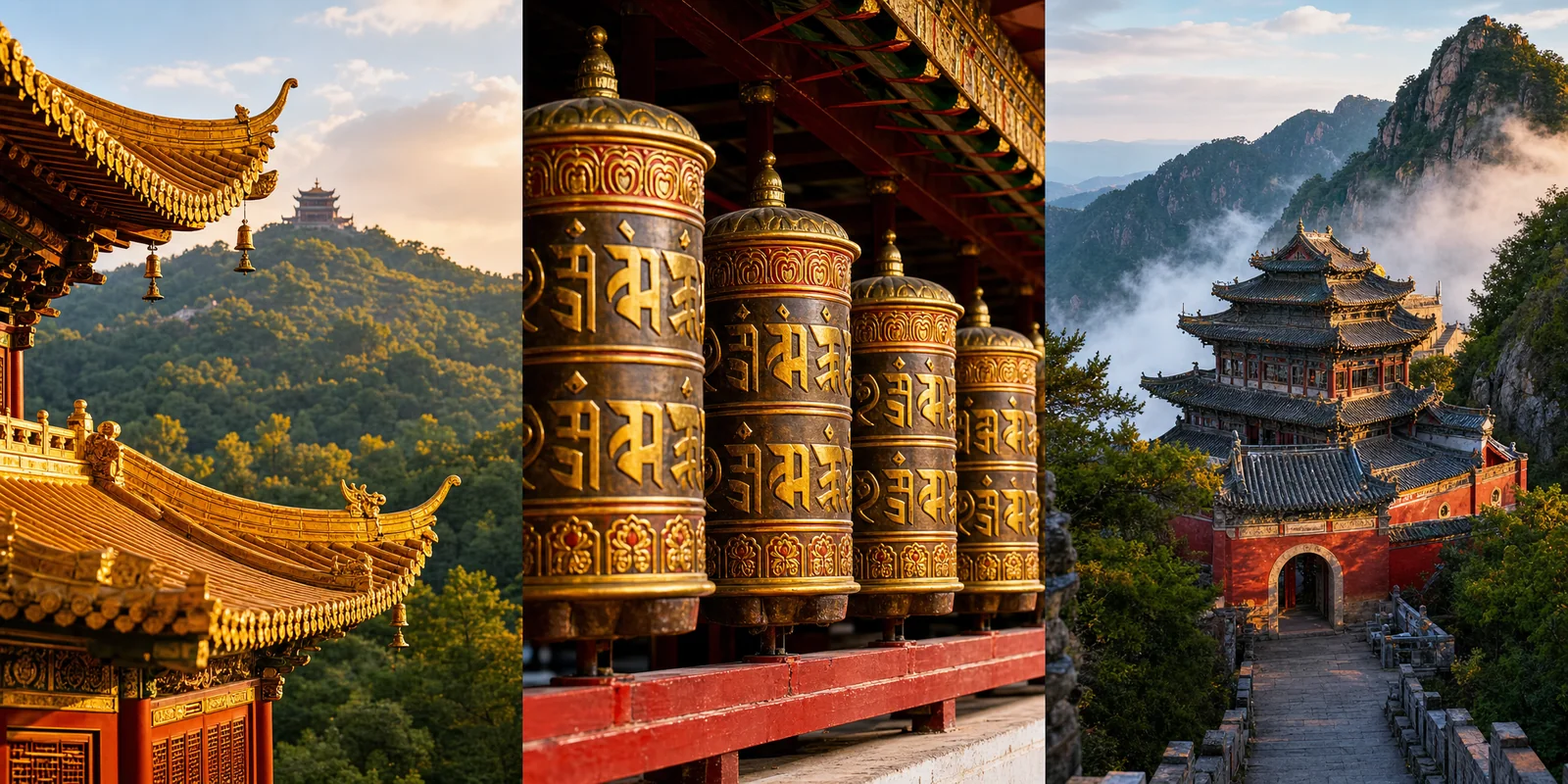
Understanding China's Religious Landscape
Before listing specific sites, it helps to know the main traditions you'll encounter. China is officially secular, but several religions are practiced openly and have shaped its architecture for over two thousand years.
- Buddhism (佛教, Fójiào) — by far the most visible. Arrived from India around 2,000 years ago and split into several schools. Most temples you'll visit are Buddhist.
- Tibetan Buddhism (藏传佛教, Zàngchuán Fójiào) — a distinct branch found in Tibet, Qinghai, parts of Sichuan, Yunnan, and Inner Mongolia, with very different art, prayer flags, and rituals.
- Daoism (道教, Dàojiào) — China's only native organized religion, focused on harmony with nature and the Dao. Daoist temples often sit on sacred mountains.
- Islam (伊斯兰教, Yīsīlán Jiào) — practiced mainly by the Hui and Uyghur communities, with historic mosques in Xi'an, Ningxia, Yunnan, and the northwest.
- Confucianism — more a philosophy than a religion, but its temples (especially in Qufu) function as major cultural sites.
One thing surprises a lot of visitors: many Chinese temples mix traditions freely. You'll find Buddhist, Daoist, and folk deities under one roof, and worshippers who don't strictly identify with any single faith. Don't try to force it into Western categories.
Buddhist Temples
These are the temples most travelers come to see, and the easiest to access. Here are the ones that reward the trip.
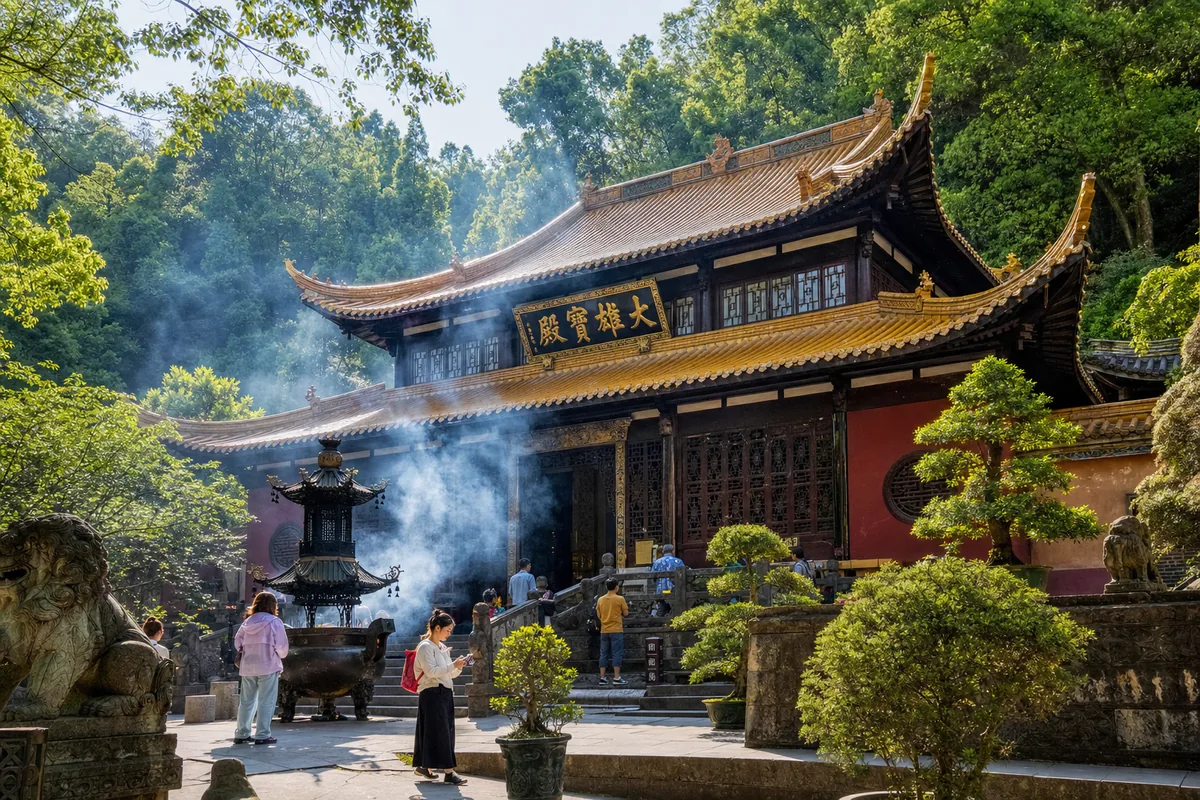
Lingyin Temple, Hangzhou
One of China's oldest and wealthiest Buddhist monasteries, founded over 1,600 years ago, tucked into forested hills west of West Lake. The approach passes a cliff face carved with around 300 Buddhist figures dating back to the 10th century. The main halls house enormous gilded statues, and the place is genuinely active — you'll see monks and worshippers, not just tourists. Entry is split into two tickets: one for the surrounding Feilai Feng scenic area and one for the temple itself.
Shaolin Temple, Henan
The birthplace of Chan (Zen) Buddhism and the source of Shaolin kung fu, on Mount Song near Luoyang. Yes, it's commercialized and crowded, but the martial arts demonstrations are real and the Pagoda Forest — a field of nearly 250 brick stupas marking the graves of eminent monks — is quietly impressive. If kung fu is what draws you, you can also arrange longer training experiences nearby; see our Kung Fu Experiences guide.
Big Wild Goose Pagoda, Xi'an
Built in the 7th century to house Buddhist scriptures brought back from India by the monk Xuanzang, this is one of Xi'an's signature landmarks. You can climb the seven-story brick pagoda for views over the city. The surrounding temple grounds and the large musical fountain square out front make it an easy half-day.
Famen Temple, Shaanxi
About two hours from Xi'an, Famen Temple famously holds what is said to be a finger bone relic of the Buddha, discovered in 1987 in a sealed underground crypt along with thousands of Tang dynasty treasures. The modern hall built to enshrine it is dramatic, and the on-site museum of unearthed gold and silver is excellent.
Jokhang Temple, Lhasa
The spiritual heart of Tibetan Buddhism and the holiest temple in Tibet. Pilgrims prostrate themselves on the flagstones out front, and the daily flow of worshippers walking the Barkhor circuit around it is something you won't see elsewhere. Visiting Tibet requires a special permit arranged in advance through a registered tour — read our Lhasa & Tibet Guide before planning anything.
Tibetan Buddhist Monasteries
If you want the full Tibetan Buddhist experience without a Tibet permit, several major monasteries sit in provinces you can visit freely.
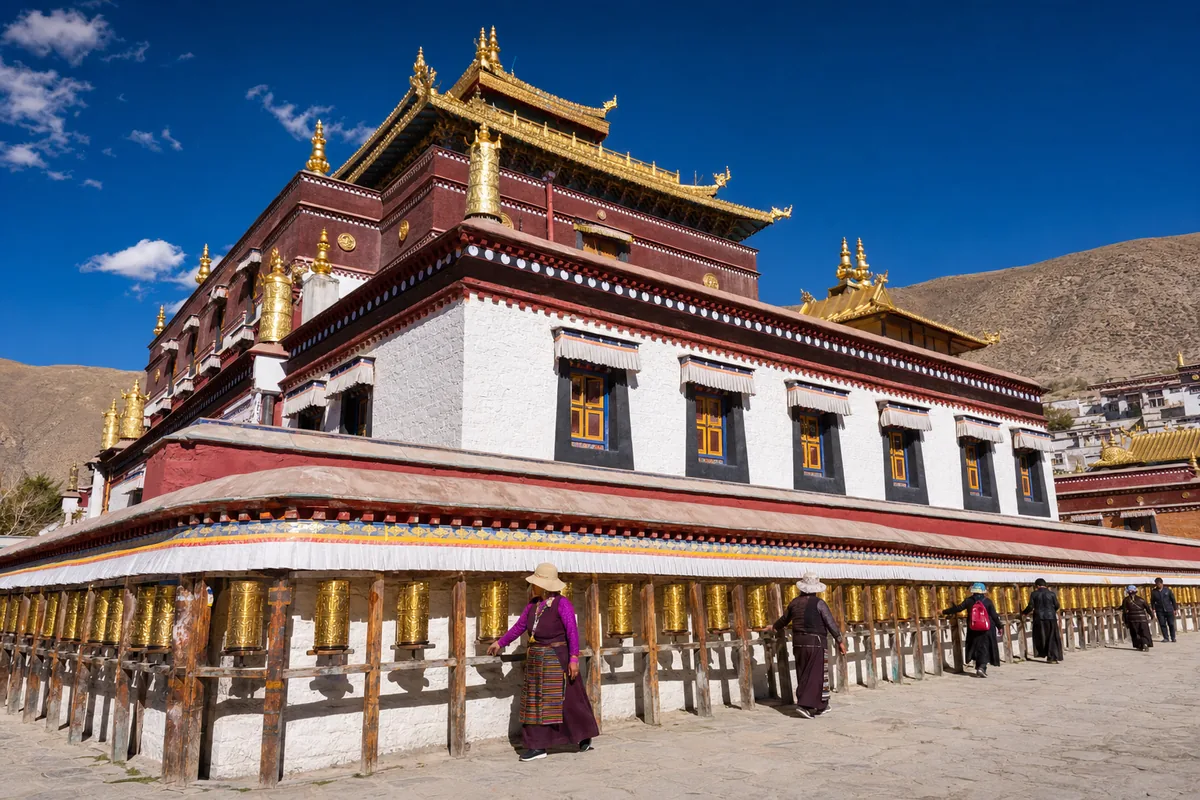
Labrang Monastery, Gansu
In the town of Xiahe, Labrang is one of the six great monasteries of the Gelug school and home to hundreds of monks. It holds the longest prayer-wheel corridor in the world — walking the full circuit takes over an hour. The atmosphere here is far more authentic and less touristy than most sites, and you can join the morning kora (clockwise circumambulation) alongside local pilgrims.
Ta'er (Kumbum) Monastery, Qinghai
Near Xining, this is one of Tibetan Buddhism's most important monasteries, marking the birthplace of Tsongkhapa, founder of the Gelug school. It's famous for its "three arts": butter sculptures, murals, and barbola appliqué. Easy to reach as a day trip — see our Xining & Qinghai Lake Guide.
Songzanlin Monastery, Shangri-La
The largest Tibetan Buddhist monastery in Yunnan, often called the "Little Potala Palace" for its tiered, golden-roofed silhouette against the hills. It's a good introduction to Tibetan architecture for travelers doing the Yunnan circuit.
Daoist Temples and Sacred Mountains
Daoism is woven into China's landscape through its sacred mountains, where temples cling to cliffs and ridgelines.
Wudang Mountains, Hubei
A UNESCO World Heritage Site and the legendary home of Tai Chi and internal martial arts. The complex of Ming dynasty temples and palaces scattered across the peaks is stunning, and you can still see Daoist priests practicing here. If you're curious about the martial side, our Tai Chi Experiences guide covers where to try it.
White Cloud Temple, Beijing
The most important Daoist temple in Beijing and headquarters of the Quanzhen school. It's an active center of worship, especially atmospheric during the lunar new year temple fair. A good option if you want to see living Daoism without leaving the capital.
Mount Qingcheng, Sichuan
One of Daoism's birthplaces, near Chengdu and easily paired with the Dujiangyan irrigation system. The mountain is green, misty, and forested, with quiet temples along the trail — a calmer alternative to the bigger Buddhist sites. See our Chengdu Day Trips guide.
Historic Mosques
China's Islamic heritage is centuries old, and its historic mosques blend Middle Eastern function with Chinese architectural style in a way you won't see anywhere else.
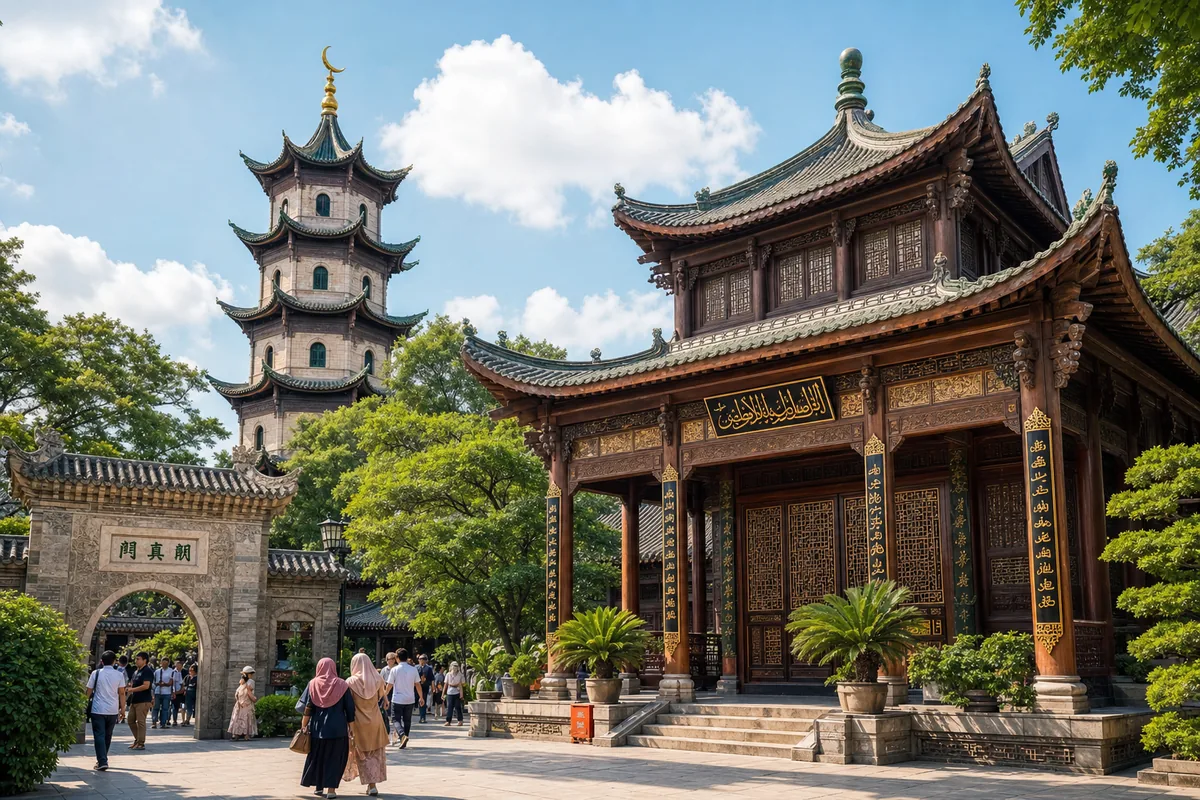
Great Mosque of Xi'an
Founded in the 8th century and one of the oldest and largest mosques in China. From the outside it looks like a classical Chinese temple — courtyards, pavilions, a minaret shaped like a pagoda — with Arabic calligraphy woven throughout. It sits in the Muslim Quarter, so you can combine it with the famous food street. Non-Muslims can visit the grounds but not the main prayer hall.
Id Kah Mosque, Kashgar
The largest mosque in China, in the heart of old Kashgar in Xinjiang, with a distinctly Central Asian character. It remains a working mosque central to the local Uyghur community.
Temple Etiquette: The Essentials
You don't need to be religious to visit, and nobody expects foreigners to know every custom. But a few basics show respect and keep you out of trouble.
- Dress modestly. Cover shoulders and knees. This matters most at active religious sites and mosques.
- Remove your hat and sunglasses when entering main halls.
- Step over the raised threshold, never on it. The wooden beam at the base of temple doorways is symbolically important — stepping on it is bad form.
- Don't point at statues with your finger or feet, and don't touch them.
- Keep your voice down. These are places of worship, even when crowded.
- Ask before photographing people praying, and never use flash near murals or statues — many halls ban photography of Buddha images entirely. Look for signs.
- Walk clockwise through Buddhist and Tibetan sites when there's a circuit to follow.
- Don't enter prayer halls during services unless invited, and stay to the side if you do enter.
Cultural Background Worth Knowing
A few points that help the experience click:
- Temples aren't museums. Even the touristy ones are functioning places of worship with real monks and real devotees. Treat them accordingly.
- The big-bellied laughing figure you'll see near many temple entrances is Maitreya, the future Buddha. The fierce armored guardians flanking the gate are the Four Heavenly Kings, protecting the temple.
- Donation, not entry fees, traditionally funded temples. Most major sites now charge admission, but you'll still see donation boxes. Giving is optional.
- Watch for scams at a handful of commercialized temples, where people in robes may pressure you into buying expensive incense or 「blessings.」 Genuine monks don't aggressively sell anything. When in doubt, walk away. Our Tourist Scams in China guide covers this.
Guided Visits and Practicalities
Most temples are easy to visit independently with a metro or taxi ride and a ticket bought on arrival or through a mini-program. But the cultural and historical layers are easy to miss without context — a knowledgeable guide turns a pretty building into a story you'll remember. For major sites like Shaolin, Lingyin, or the Tibetan monasteries, a half-day guided tour is often worth it; you can browse and book options through platforms like Viator offer guided temple tours.
For getting between cities to reach these sites, China's rail network handles almost everything — see our High-Speed Train Complete Guide. And before you go, our Cultural Etiquette & Taboos guide covers broader do's and don'ts beyond temple grounds.
Final Recommendations
If you only have time for one or two religious sites, match them to where you're already going. In Xi'an, the Big Wild Goose Pagoda and the Great Mosque are both easy and impressive. Near Hangzhou, Lingyin Temple is the standout. Heading to the northwest, Labrang Monastery delivers the most authentic Tibetan Buddhist atmosphere you can reach without a permit. Wherever you go, dress modestly, keep your voice down, step over the threshold, and walk clockwise — those four habits cover most situations. Buy tickets on-site or check the latest entry policies and hours before visiting, since these change with seasons and festivals. Approach these places as living traditions rather than backdrops, and they'll reward you far more.
Related Reading
- Historical Sites — pair temple visits with China's great historical landmarks.
- Cultural Etiquette & Taboos — the broader rules of respectful behavior in China.
- Lhasa & Tibet Guide — permits and planning for Tibetan Buddhist sites.
- Xi'an Complete Guide — base for the pagodas, Famen Temple, and the Great Mosque.
- Tai Chi Experiences — the Daoist martial tradition you can try yourself.
Last updated: June 2026
Read in other languages
Last train times for 10 Chinese metro systems
Every line and station, checked by hand — the same data behind our offline route planner.
Get the WaysChina App
Offline guides, currency converter, essential phrases, and more — all in your pocket.

Related Articles
China's Historical Sites: 12 Ancient Landmarks Worth Your Time
From the Great Wall to the Terracotta Army, here are the historical sites in China that actually live up to their...

Modern Landmarks: China's Skyscrapers, Skylines & Observation Decks
From the Shanghai skyline to the world's second-tallest tower, here are China's best modern landmarks — what to see,...
Best Museums in China: A Visitor's Guide
China's top museums hold thousands of years of art, history, and discovery — and most are free. Here's where to go,...
Natural Wonders: China's Most Spectacular Landscapes
From the sandstone pillars of Zhangjiajie to the rainbow-striped hills of Zhangye, here are China's most striking...