

This article contains affiliate links. If you make a purchase through these links, we may earn a small commission at no extra cost to you. This helps support our work in creating free travel guides.
For a first visit to the Great Wall (长城, Chángchéng) from Beijing, go to Mutianyu: the wall is restored, it is less crowded than Badaling, and you can ride up by cable car and come down on a toboggan. Pick Badaling instead if you want the simplest trip, because it is the one section with a high-speed train to its door. Entry tickets are a few dozen yuan: Mutianyu is 45 yuan for adults, and Badaling is 40 yuan from April to October and 35 yuan from November to March. Both sell tickets to foreign visitors on a passport. Mutianyu wants a real-name booking made online, up to 30 days ahead, while Badaling needs no reservation and has ticket windows that take cash and foreign cards. From central Beijing, plan on one to two hours each way.
Which section to choose for a first visit
Choose by the kind of day you want, not by the name you have heard most often.
- Mutianyu (慕田峪, Mùtiányù): the best all-round first visit. Restored wall in wooded hills, a cable car and a toboggan, and enough length to walk for two or three hours without seeing the same view twice. It is the section most foreign visitors choose: the scenic area says it welcomed more than a million inbound visitors in 2026, checks passports directly at the gate and accepts foreign cards. The one catch is that there is no train, so you go by tourist bus, public bus with a change, or car.
- Badaling (八达岭, Bādálǐng): the easiest to reach. About 60 km northwest of the city, with a high-speed train station and a direct bus. It is the most heavily restored and the most crowded section, especially on weekends and holidays. Good if you are short on time, travelling with older relatives, or do not want to arrange a bus or a car.
- Simatai (司马台, Sīmǎtái) with Gubei Water Town (古北水镇, Gǔběi Shuǐzhèn): the Wall at night. Steep, partly original wall above a rebuilt canal town, with a regular evening tour on the wall. It is far from the city, so it works best as an overnight trip. (Mutianyu also has a night session.)
- Juyongguan (居庸关, Jūyōngguān): the closest pass. A big fortified gate in a valley on the road to Badaling, with wall climbing steeply up both sides. Short and very steep; a half day is enough.
- Huanghuacheng (黄花城, Huánghuāchéng): wall beside a lake. Sections of wall run down into a reservoir. Quieter than the big names, and easiest by car.
- Jinshanling (金山岭, Jīnshānlǐng): for a real hike. Across the border in Hebei province, partly restored and partly crumbling, and good for a long walk along the ridge. The hardest to reach on your own.
If you only have one day for the Wall, our advice is Mutianyu on a weekday morning. If you have only half a day, or the morning is already taken, Badaling by train is the safer bet. Hikers who are happy with a long day should look at Jinshanling. Families with small children and anyone with bad knees should stay at Mutianyu or Badaling and use the cable car: every section is steeper than it looks in photos, and the steps are uneven.
The sections compared: crowds, restoration, cable cars and hiking
The table below gives the official ticket prices, booking rules and opening hours for six sections near Beijing. Read it together with the notes under it, which say what each section is actually like on the ground.
| Section | Ticket | Booking | Hours |
|---|---|---|---|
| Badaling | adult ¥40 (Apr–Oct) / ¥35 (Nov–Mar) · concession ¥20 / ¥17.5 · free with ID: under 18, 60+, visitors with disabilities | Not required. Real-name tickets at the gate (cash, mobile payment, foreign-card POS; Chinese–English service window) or with a passport on the official “长城内外” WeChat platform; enter with your passport, a paper ticket or the QR code | 06:30–16:30 (Apr–Oct) / 07:30–16:00 (Nov–Mar) · no fixed closing day |
| Shuiguan (Water Pass) | adult ¥35 · students 18+ ¥17.5 · free with ID: under 18, 60+, visitors with disabilities | Not required: buy at the gate | 09:00–16:30 (Apr–Oct) / 09:00–16:00 (Nov–Mar) |
| Mutianyu | adult ¥45 · concession ¥25 (incl. foreign visitors aged 6–18, students, seniors 60+ from outside Beijing) · same price all year · shuttle bus, cable car, chairlift and toboggan extra; cable car and chairlift/toboggan tickets are not interchangeable | Required, real-name: up to 30 days ahead on the official website; passport accepted, no ticket swap — show the same passport at the gate · one ticket per ID per day · unused tickets can be refunded or changed until 24:00 on the visit day | 07:30–18:00 weekdays / 07:30–18:30 weekends (Mar 16–Nov 15); 08:00–17:30 (Nov 16–Mar 15) · ticket sales stop 1 h and entry 30 min before closing · cable car runs the same hours · day ticket: towers 1–20; night session: towers 10–15 |
| Simatai | Simatai day ticket ¥40 (concession ¥20) · cable car ¥130 one way / ¥200 return · with Gubei Water Town: day combo ¥150, night tour incl. return cable car ¥260 · official online prices for May 1–Dec 31, 2026 | Not required: Gubei Water Town official website, WeChat mini-program or hotline +86 10 8100 9999; water town and Simatai are sold separately or as a combo | Day: 09:00–17:00, last entry 15:00 (gate outside the water town) / 16:10 (inside), cleared by 16:30; cable car up 09:00–16:10, down 09:00–17:00 · Night tour: 18:00–21:40 (May–Oct); 17:30–20:10 Sun–Thu / 17:30–20:40 Fri–Sat (Nov–Apr) |
| Juyongguan | adult ¥40 peak / ¥35 off-peak · half price ¥20 / ¥17.5 for full-time students aged 19–25 (undergraduate and below) · free with ID: under 18, 60+, visitors with disabilities | Not required: buy at the gate | 08:30–17:30 peak / 08:30–16:30 off-peak (switch dates not published) |
| Huanghuacheng (lakeside wall) | adult ¥60 · concession for students, children over 6 up to 18, seniors 60+ from outside Beijing and others (amount not published) | — | Summer: 08:30–17:00 weekdays, 08:00–18:00 Saturdays and Golden Week, 08:00–17:00 Sundays and last day of holidays · winter: 08:30–16:30 (switch dates not published) |
Mutianyu: restored, green and well run
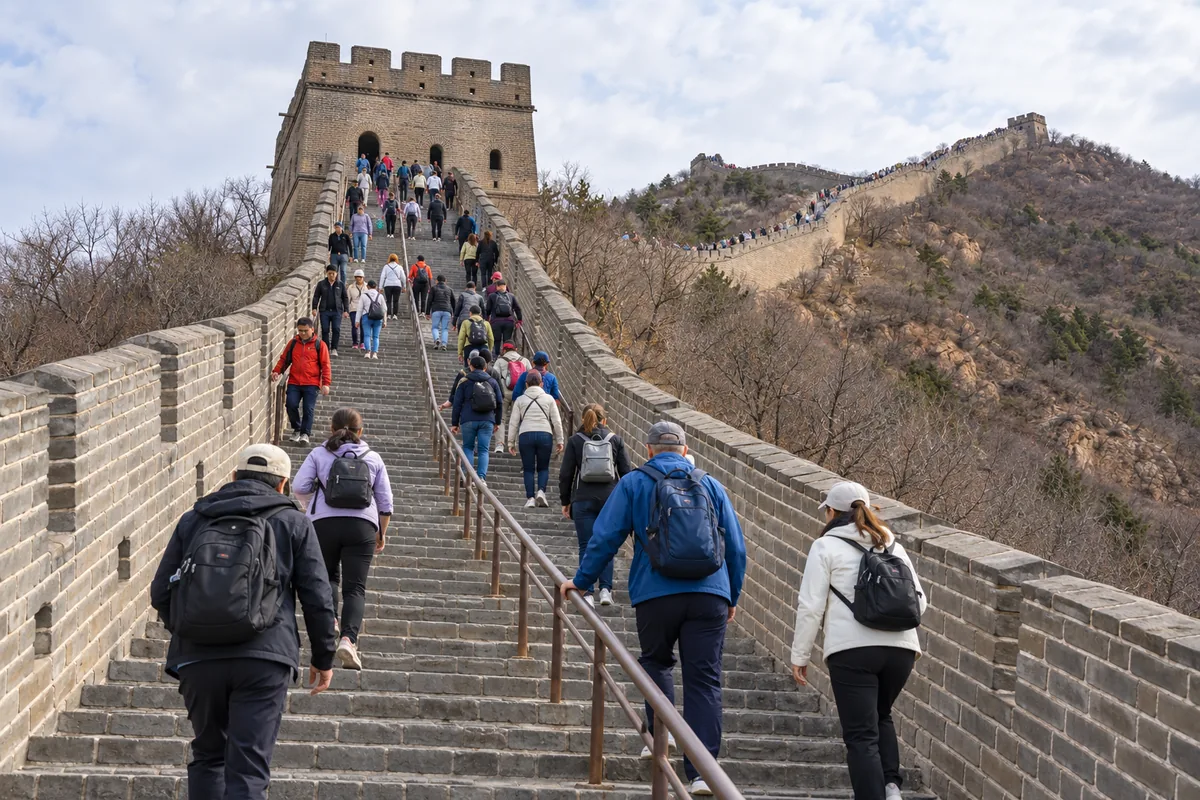
Mutianyu is in Huairou district, about 73 km from the city centre. The wall here is fully rebuilt and has watchtowers close together, so even a short walk feels like the Wall in pictures. On a day ticket you can walk between watchtowers 1 and 20; the night session opens towers 10 to 15.
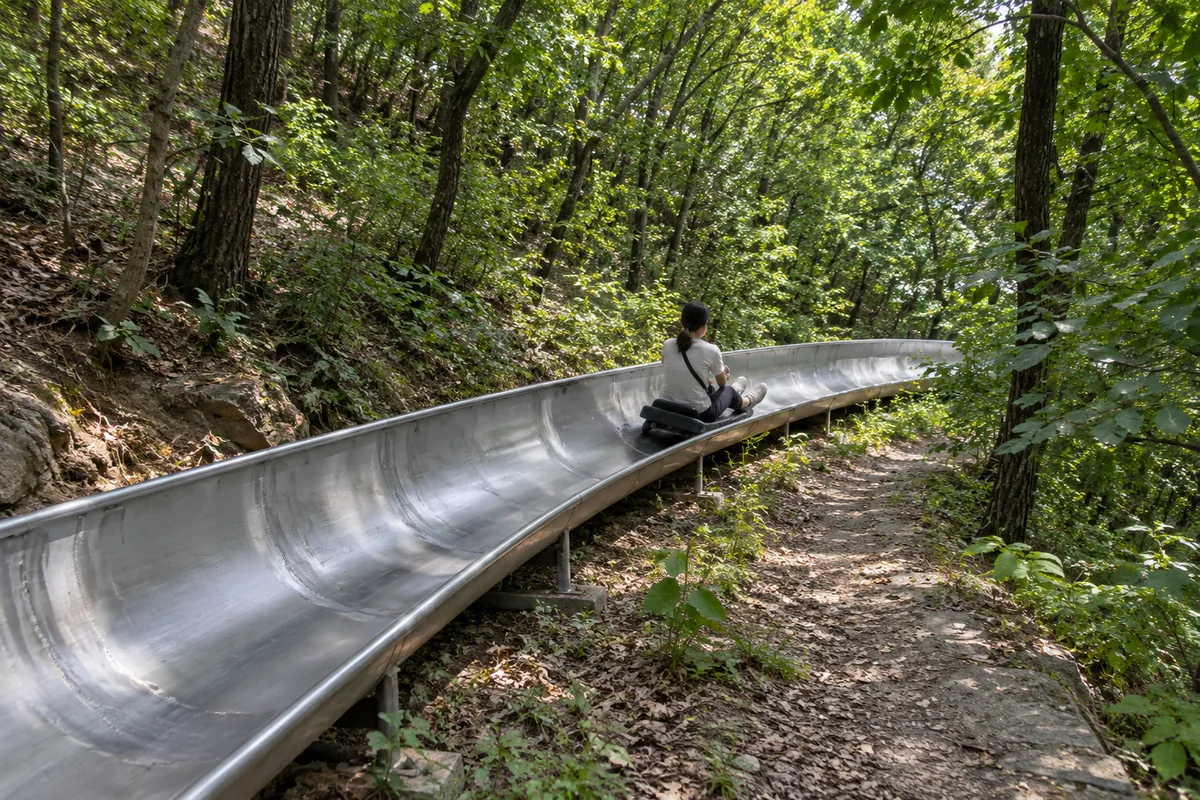
Getting up the hill is the part to plan. A shuttle bus runs from the shuttle station, about 3 km from the ticket gate, up toward the wall, and the shuttle, the cable car, the chairlift and the toboggan are all charged on top of the entry ticket. The cable car belongs to one company and the chairlift and toboggan to another, so their tickets are not interchangeable. Decide before you buy. The cable car is the easy option for children and older visitors. The chairlift and toboggan are the fun option: you ride the chairlift up and steer a small sled down a metal track. You can also walk up the steps from the bottom, which is hard work on a hot day.
Badaling and Shuiguan: easy access, big crowds
Badaling is the showpiece section: wide, smooth, fully rebuilt wall with handrails on the steepest parts. That makes it the easiest walk of all the sections, and the most crowded. Cable cars run here too and are charged separately; the price is shown at the ticket office and on the booking platform. Badaling is also growing: Yanqing district is building a 16.5 km route linking Shuiguan, Badaling and two older stretches, and has planned to open a continuous section from Badaling to Huajiayao in 2026. Check what is open when you go.
Shuiguan (水关, Shuǐguān) is a smaller section inside the Badaling area with its own gate and its own ticket. It is steep and short, and it gets far fewer people than the main Badaling gate.
Simatai and Gubei Water Town: steep wall and a night visit
Simatai and Gubei Water Town are two separate scenic areas run by the same company, each with its own ticket; you can buy them together as a combined ticket. The wall at Simatai is narrow and steep and climbs a sharp ridge, which is why people go. A cable car takes most of the climb out: 130 yuan one way or 200 yuan return for adults. The night tour runs in the evening and comes with the cable car both ways in the Water Town package. Staying at a hotel inside the resort does not include entry tickets.
Juyongguan: the pass, not the ridge
Juyongguan is a rebuilt fortified pass. The gate, the walls and the towers sit in a narrow valley, and the wall climbs very steeply up the hills on both sides in a loop. You can see a lot in two hours, and it is easy to combine with other sights on the same road. It needs no reservation; you buy at the gate.
Huanghuacheng: the lakeside wall
At Huanghuacheng the wall runs down into a reservoir, so you see it from the water's edge as well as from the top. It is a good choice for photographers and for people who have already seen Mutianyu. The adult ticket is 60 yuan. Public transport here is awkward, so most visitors come by car.
Jinshanling: the hikers' section
Jinshanling is in Luanping county, Hebei, on the border with Beijing's Miyun district, about 130 km from central Beijing, and it joins Simatai to the east. It is partly restored and partly crumbling, with broken steps and towers in different states, which is what hikers come for. Beijing's tourism site lists 65 yuan from 16 March to 15 November and 55 yuan from 16 November to 15 March, and the cableway may not be running, so call the scenic area's Beijing office on +86 10 8402 4628 to confirm prices and the cableway before you go. The easiest way to get there is a private car or a tour.
Tickets, booking with a passport, and opening hours
Each section has its own ticket rules. The short version: book Mutianyu online in advance, and buy Badaling, Juyongguan and Shuiguan on the day if you like.
Badaling: no booking needed, passport accepted
Tickets are real-name. The official sales platform is called 长城内外 (Chángchéng Nèiwài, "Inside and Outside the Great Wall"), a WeChat account with the ID changchengnw, and it accepts foreign passports; at the gate you can show your passport, a paper ticket or the QR code. You do not have to book ahead. The ticket windows take cash, mobile payment and foreign cards, and there is a Chinese-English service window for buying, exchanging and checking tickets. If you have WeChat set up, buying in advance on the platform saves time in the queue; if not, the window is fine.
Badaling and the Wall's other sections often give free entry to people under 18 and over 60. At Badaling the official list is under-18s, over-60s and people with disabilities, with valid ID. China has no national rule on whether foreigners get these concessions, and many sights limit them to Chinese citizens, so show your passport at the window and ask before you pay for a child or a grandparent.
Mutianyu: book online, one ticket per passport
Mutianyu tickets are real-name and booked in advance. You can book up to 30 days ahead, each ID (including a passport) can buy one ticket per day, and every person needs their own ticket. If you booked with a foreign passport you do not need to exchange it for a paper ticket: go straight to the check-in gate with the passport you booked with. Unused tickets can be refunded or changed on the booking platform until midnight on the day of the visit; after that, the ticket is lost.
Book on the official Mutianyu website. The adult entry ticket is 45 yuan and the reduced ticket 25 yuan; the reduced ticket covers foreign children aged 6 to 18, students, and over-60s from outside Beijing, among others. Children up to 1.2 metres ride the shuttle bus and cable car free, and everyone taller pays full price; there are no child, senior or disability discounts on the rides. The ride prices are on the booking page when you reserve, so check them there and decide on cable car or toboggan at the same time.
Simatai and Gubei Water Town: online or at the gate
Gubei Water Town sells tickets on its official website, its WeChat mini program and the hotline +86 10 8100 9999. Buying online asks for a Chinese ID number, so if the form will not take your passport, buy at the gate, where entry is by QR code and no ID is needed. On the official ticket system, the Simatai day ticket is 40 yuan, the Water Town ticket 120 yuan, and a combined Water Town and Simatai day ticket 150 yuan; Water Town plus the Simatai night tour with the return cable car is 260 yuan. The Simatai day ticket is the same 40 yuan at the gate, but the Water Town and combined tickets cost more at the gate than online.
Juyongguan, Shuiguan and Huanghuacheng
Juyongguan and Shuiguan both sell tickets at the gate with no reservation. Huanghuacheng's reduced ticket covers students, children over 6 and up to 18, and over-60s who are not registered Beijing residents, among others; show your passport at the window and ask for the reduced price if one of these applies to you.
Opening hours, and the November switch
Badaling and Mutianyu change to winter hours in November, but not on the same day: Badaling switches on 1 November and Mutianyu on 16 November.
- Badaling: 06:30–16:30 from 1 April to 31 October, and 07:30–16:00 from 1 November to 31 March.
- Mutianyu: from 16 March to 15 November, 07:30–18:00 on weekdays and 07:30–18:30 at weekends; from 16 November to 15 March, 08:00–17:30. Ticket sales stop one hour before closing and entry checks half an hour before; the cable car runs the same hours as the park.
- Simatai: the day visit runs 09:00–17:00, with the last entry at 15:00 at the booking point outside the Water Town and 16:10 inside it. The night tour runs 18:00–21:40 from May to October; from November to April it is 17:30–20:10 Sunday to Thursday and 17:30–20:40 on Friday and Saturday.
- Juyongguan: 08:30–17:30 in the high season and 08:30–16:30 in the low season.
- Huanghuacheng: 08:30–16:30 in winter; summer hours are longer and vary by day of the week.
At every section, arrive well before closing time rather than close to it. Any section can close for a day in heavy rain or storms, so check the scenic area's notice that morning if the weather looks bad.
Getting there from central Beijing
All of these sections are outside the city, and none of them is on the metro. Here is how to reach each one on your own, then when a car makes more sense.
To Badaling: high-speed train or the 877 bus
By high-speed train. Trains on the Beijing–Zhangjiakou line's Yanqing branch leave from Beijing North station (北京北站, at Xizhimen) and reach Badaling Great Wall station (八达岭长城站) in a little over half an hour. Trains also run from Qinghe station. The station is built deep underground, and you need a real-name ticket bought through 12306, China Railway's official booking system. Foreign passports are accepted on the 12306 website and app, but your account has to pass identity verification before you can buy online; you can do it by uploading a photo of your passport, or at any station ticket window. Our guide to booking train tickets in China walks through it. Check train times on 12306 a day or two before, book the return train too, and allow time for the long escalators up from the platform.
By bus 877. Bus 877 leaves from Deshengmen (德胜门), at the depot on the north side of the arrow tower, and runs non-stop on the G6 expressway to Badaling. The trip usually takes about 70 minutes and costs 12 yuan, less if you pay with a transport card or a QR code. In summer the first bus leaves at 06:00 and buses come every couple of minutes at peak times; Mondays, when the Forbidden City is closed, are especially busy.
Not the S2 train any more. Older guides tell you to take suburban line S2 from Huangtudian. Since 25 October 2025 Huangtudian station is closed, and S2 now runs only between Nankou and Yanqing (Shacheng), so you can no longer ride it from the city to Badaling.
To Mutianyu: tourist bus or public bus with a change
Dongzhimen tourist line. It leaves from the bus stops outside Dongzhimen (东直门) at 08:30 every day and returns at 16:00. You buy the ticket on the bus, sales start half an hour before departure, and it leaves when it is full. Arrive early.
Qianmen tourist line. Buses leave Qianmen (前门) at 07:30, 08:30, 09:30 and 10:30 and come back at 14:30, 15:30 and 16:30; you buy at the Qianmen tourist centre or on the Beijing Tourist Distribution Center website. This one gives you the most choice of times.
Public bus. From the Dongzhimen transport hub, take bus 916 Express to Huairou Beidajie (怀柔北大街), then change to bus H23, H3 or H71 to the Mutianyu Scenic Area stop. It works, but with the change it is the slowest option, and finding the second bus without Chinese takes some patience.
Several private companies also run direct shuttle buses to Mutianyu from metro stations in the city. They are commercial services, not official lines, so compare times and reviews before booking.
To Simatai and Gubei Water Town: the Wangjing West bus
A direct bus leaves Wangjing West transport hub (望京西) at 09:00 and 13:00 and returns from Gubei Water Town at 12:00 and 17:00. The 134 km trip takes about 120 minutes and costs 48 yuan. Board at door 5 on the bus mezzanine level. Payment is the tricky part: the bus takes a Beijing transport card, the Beijing Bus or Yitongxing apps, phone NFC, or exact cash, but not Alipay or WeChat Pay. Bring small notes if you have no transport card. The same fare applies on a tourist line from the CYTS building at Dongzhimen, and you can also take the Huaimi suburban train from Beijing North or Qinghe to Gubeikou and change to a shuttle bus there.
The timetable puts you at the Water Town around 11:00 and gives you a 17:00 bus back, which rules out the night tour on a day trip. If you want the Simatai night tour, stay over.
To Juyongguan, Huanghuacheng and Jinshanling
These three are easiest by car. Juyongguan is on the same expressway as Badaling, so it is easy to stop there on a car day to Badaling. For Huanghuacheng and Jinshanling, public options are limited and change by season (Jinshanling has had weekend-only direct buses in the warmer months, so check before relying on one), and a taxi or private car is far simpler.
Car, DiDi or a tour
A car door to door is the most comfortable way to see the Wall, and it is the only easy way to reach Huanghuacheng and Jinshanling or to combine two sections. DiDi, China's main ride-hailing app, has an English version that takes international cards, and our DiDi guide shows how to set it up. Getting a ride to the Wall is easy; getting one back from a remote section in the late afternoon is not, because few drivers are waiting there. If you go by DiDi, either agree a return trip with the same driver or book a car for the whole day.
If you would rather not deal with buses, transfers and tickets at all, a small-group or private-car tour handles all of it, and most include the entry ticket and pick you up at your hotel. You can compare Great Wall tours from Beijing on GetYourGuide. Check what is included before you book: the cable car, toboggan and lunch are often extra.
Coming back in the evening, you will usually return to a metro station. If you are cutting it close, check the last trains on our Beijing metro last-train times page, and see our metro guide for how to pay at the gates.
the WaysChina appWhen to go: seasons, time of day and holidays
Season. Spring (April and May) and autumn (September to early November) are the best times. The air is clear, it is comfortable to walk, and in late October the hills around Mutianyu and Huanghuacheng turn red and gold. Summer is hot and wet: July is Beijing's warmest month, with an average temperature of 27.2°C, and June to August bring about two thirds of the year's rain. Winter is cold and dry, with January averaging below freezing in the city and mountain areas colder still, but the crowds are small and the Wall after snow is beautiful. Dress for wind on the ridge whatever the season; our what to wear by season guide has more detail, and the best time to visit China covers the rest of the year.
Time of day. Arrive at opening time. Tour buses reach Badaling and Mutianyu from mid-morning, and the first hour is the quietest. Late afternoon is quieter too, but watch the last entry times above.
Days to avoid. Weekends are busier than weekdays everywhere. Chinese public holidays are much busier still, above all the National Day week, which starts on 1 October and normally runs for seven days. The May Day holiday (five days from 1 May) is busy too. In 2019 Badaling set its maximum at 65,000 visitors a day, which gives you a sense of the holiday crowds. If your dates fall on one of these weeks, go to a quieter section such as Huanghuacheng or Jinshanling, or do the Wall another day. Our Golden Week survival guide explains how to work around the holidays.
Can you hike the "wild" Great Wall?
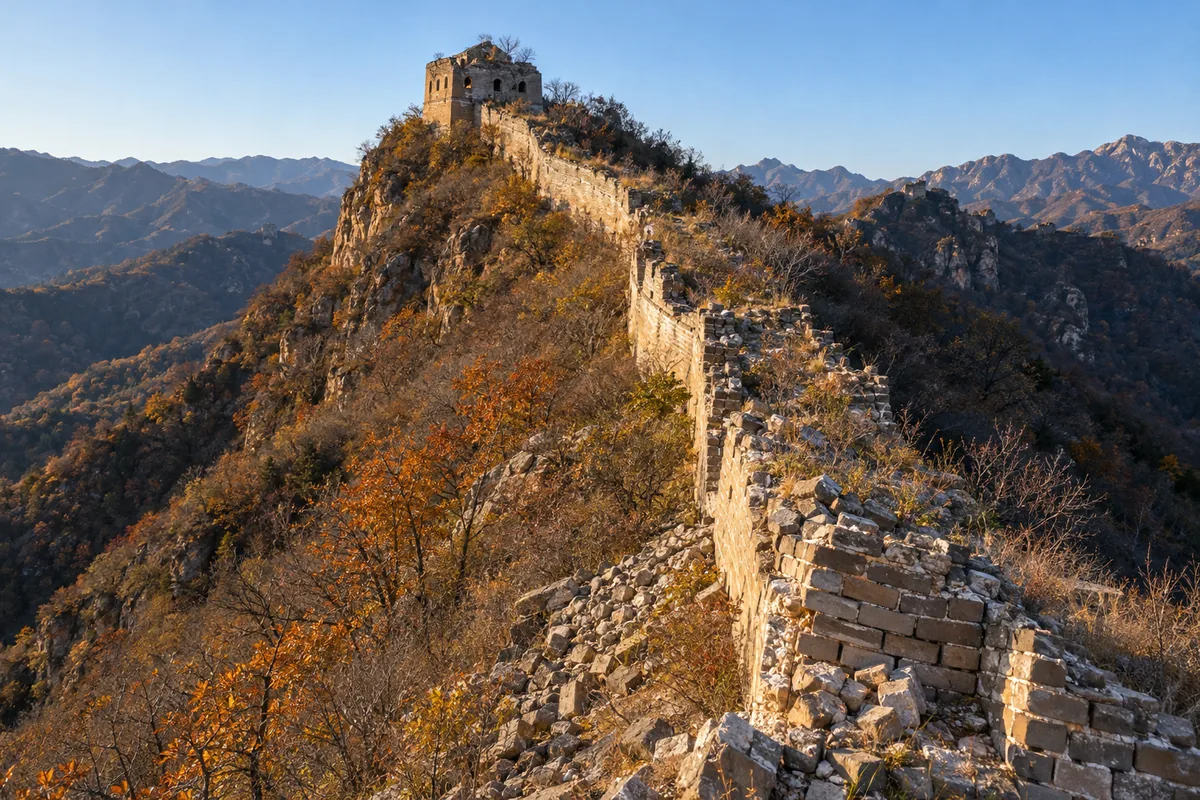
"Wild wall" (野长城, yě chángchéng) means sections that are not open to visitors: unrestored, often crumbling stretches such as Jiankou (箭扣) that hikers photograph. The law on them is more specific than most travel forums say.
China's national Great Wall Protection Regulations, in force since 1 December 2006, forbid taking earth or bricks from the Wall, carving or painting on it, and organising activities on sections that are not open to visitors. Taking bricks or organising activities on unopened sections can, in serious cases, bring fines of 1,000–5,000 yuan for individuals and 10,000–50,000 yuan for organisations. The national rules do not explicitly ban a single person from walking on an unopened section, but Beijing's earlier rules did explicitly ban climbing sections not approved for opening, and our advice is still not to do it (reasons below). In Beijing, new Great Wall regulations took effect on 1 March 2026 and allow district authorities to use electronic fencing and similar systems to warn hikers of the risk and discourage them from climbing wild wall. You can read the national regulations on the Chinese government website.
There are two reasons not to do it. First, the risk is real. Wild sections have loose bricks, steep drops and no rescue access, accidents do happen, and you will be far from help without Chinese. Second, a guided "wild wall hike" is exactly the kind of organised activity the rules target, and the walking itself damages the wall. If you want unrestored wall, go to Jinshanling or the quieter parts of Simatai, where you get the same look on sections that are open, ticketed and patrolled.
The Great Wall beyond Beijing
Two famous ends of the Ming wall are worth knowing about. In the east, Shanhaiguan (山海关) in Qinhuangdao, Hebei, is where the wall meets the sea at Old Dragon Head (老龙头, Lǎolóngtóu), with the fortified gate called the First Pass Under Heaven (天下第一关) in the old town. Under the city's 2024 price document, Old Dragon Head costs up to 60 yuan, the First Pass Under Heaven up to 50 yuan and a combined ticket up to 130 yuan; the price at the gate can be lower, so check it and the opening hours before you go. In the far west, Jiayuguan Pass (嘉峪关) in Gansu costs 110 yuan, including the Overhanging Great Wall and the First Beacon Tower, and buses run from Jiayuguan South high-speed station via the city to the pass. Jiayuguan fits best into a Silk Road trip from Xi'an to Dunhuang.
A short background
The Great Wall is not one wall but many, built by different dynasties over many centuries, and it is listed as a UNESCO World Heritage Site. According to China's National Cultural Heritage Administration, walls and trenches from all periods add up to 21,196.18 km across 15 provinces, and the main Ming dynasty line, from Hushan in Liaoning to Jiayuguan in Gansu, is 8,851.8 km long. The sections near Beijing are all Ming-dynasty wall, built to guard the capital.
Frequently asked questions
Should I visit Badaling or Mutianyu on my first trip to the Great Wall?
Mutianyu, for most people. It is restored and well kept but less crowded than Badaling, and the cable car and toboggan make it easy for every age. Choose Badaling if you want to go by high-speed train or bus without a transfer, or if you have only half a day. Badaling is about 60 km from the city and Mutianyu about 73 km.
How do foreigners buy Great Wall tickets, and do I need to book ahead?
It depends on the section. At Mutianyu, book online with your passport, up to 30 days ahead; each passport can buy one ticket per day, and you enter by showing the passport you booked with. At Badaling you do not need to book: you can buy at the window with cash or a foreign card, or in advance with your passport on the 长城内外 WeChat platform. Juyongguan and Shuiguan sell at the gate too.
What is the easiest way to get from central Beijing to the Great Wall?
The high-speed train from Beijing North station to Badaling Great Wall station, which takes a little over half an hour. For Mutianyu, the Dongzhimen and Qianmen tourist buses go straight to the scenic area. A tour or a car hired for the day is the easiest of all if you do not want to handle transport yourself.
Can I climb the wild Great Wall?
Unopened sections are not open to visitors. National rules ban organised activities on them and allow fines in serious cases, and since 1 March 2026 Beijing's regulations let district authorities use electronic fencing to discourage people from climbing wild wall. They are also dangerous. For unrestored-looking wall that is open and safe, go to Jinshanling or Simatai.
Planning the rest of your Beijing days
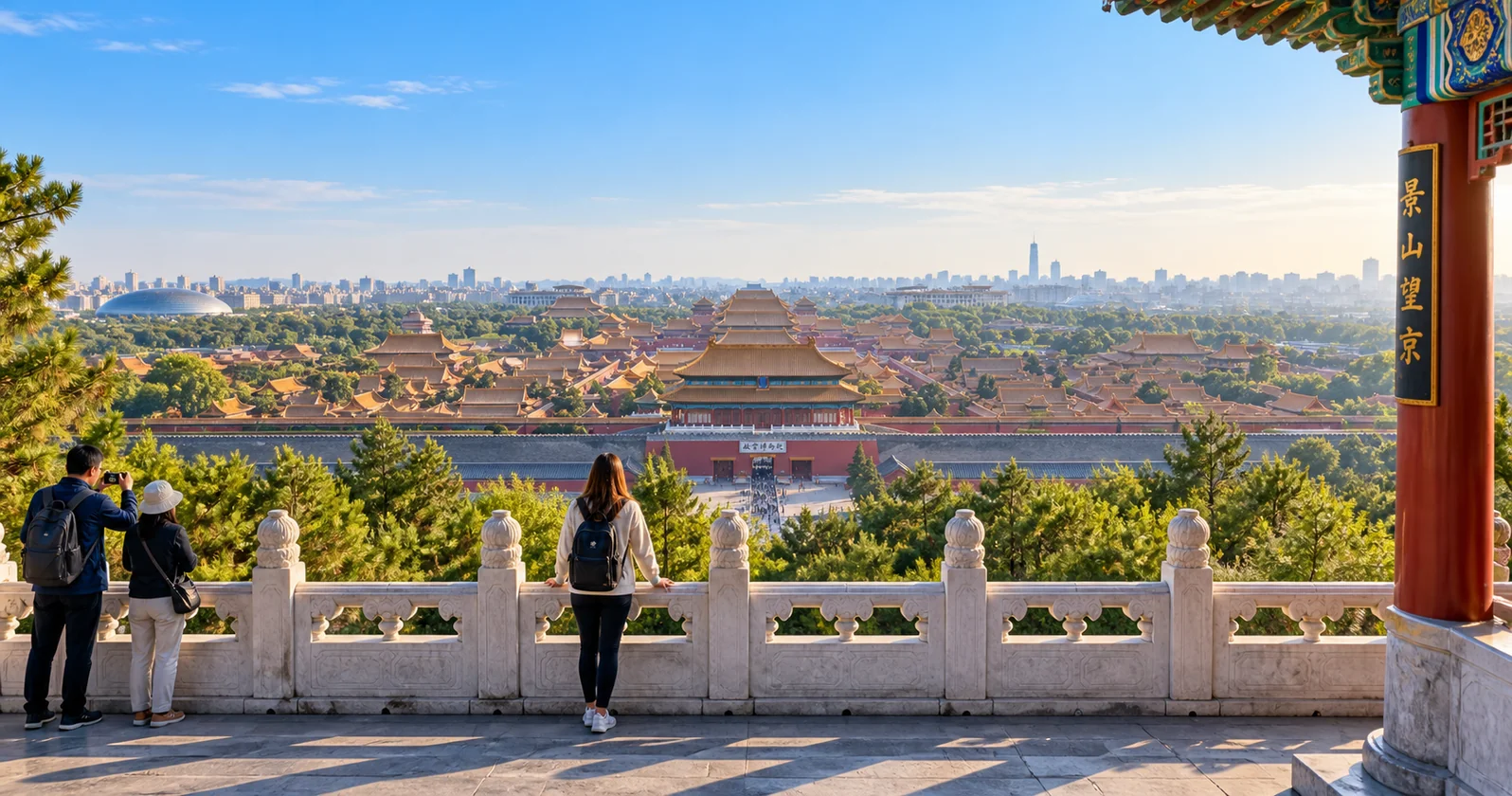
Give the Wall a full day: Mutianyu booked online with your passport, or Badaling by train, on a weekday, arriving at opening. For the rest of the trip, our Beijing travel guide covers the city, the 3-day Beijing itinerary shows where the Wall fits, and the Forbidden City guide explains how to book the palace, which you should do a week ahead. For the Ming Tombs, Tianjin and Chengde, see day trips from Beijing, and for other historic sights around the country, our guide to China's historical sites.
Last updated: October 2026
Fact-checked sources
- Official Beijing Municipal Government 15 pages
- Official mutianyugreatwall.com 3 pages
- Bendibao (local listings site)
- Official mp.weixin.qq.com
- Official visitbeijing.com.cn 3 pages
- Official wtown.com 3 pages
- Official s.visitbeijing.com.cn
- Official bmy.com.cn
Show 11 more sources
- Official wuhouci.net.cn
- Official tangparadise.cn
- Official drc.xizang.gov.cn
- Official hqpalaceglobal.com
- Official China Railway 12306
- Official data.jma.go.jp 2 pages
- Official Chinese central government (gov.cn) 2 pages
- bjnews.com.cn
- Official info.shanhaiguan.gov.cn
- Official jyg.gov.cn 2 pages
- Official National Cultural Heritage Administration
Last verified: 2026-10-29
Read in other languages
Getting to the sights by metro
Forbidden City
World's largest imperial palace, home to 24 Ming and Qing emperors.
- Tian'anmen East
- Tian'anmen West
- Beihai North
Tiananmen Square
World's largest public square. Arrive before sunrise for flag ceremony.
- Tian'anmen East
- Tian'anmen West
- Qianmen
Temple of Heaven
Ming-era imperial complex where emperors prayed for good harvests.
- East Gate of Temple of Heaven
- Tianqiao
- Qiaowan
Summer Palace
Imperial garden with Kunming Lake, Long Corridor, and Marble Boat.
- Beigongmen
- Xiyuan
Lama Temple (Yonghe Temple)
Tibetan Buddhist monastery with an 18m Maitreya statue.
- Yonghegong Lama Temple
- Beixinqiao
Bird's Nest (National Stadium)
2008 Olympic main stadium, lit up at night.
- Olympic Park
- Olympic Sports Center
Water Cube (National Aquatics Center)
2008 Olympic swimming venue, blue bubble facade.
- Olympic Park
- Olympic Sports Center
Olympic Forest Park
Largest urban park in Beijing; great for jogging.
- South Gate of Forest Park
- Olympic Park
798 Art Zone
Contemporary art district in converted Bauhaus factories.
- Gaojiayuan
- Jiangtai
Wangfujing
Beijing's most famous shopping street and night market.
- Wangfujing
- Dengshikou
- Dongdan
Nanluoguxiang
Historic hutong lanes lined with boutique shops and cafes.
- South Luogu Alley
- Shichahai
Houhai (Shichahai)
Lake-side hutong district with bars, rickshaws, and Prince Gong's Mansion.
- Shichahai
- Beihai North
Beihai Park
1000-year-old imperial garden with a lake and White Pagoda.
- Beihai North
- Shichahai
- Tian'anmen West
Jingshan Park
Hilltop park directly north of the Forbidden City — best panoramic view.
- Beihai North
- Shichahai
- South Luogu Alley
Qianmen Street
Restored imperial-era pedestrian street with traditional shops.
- Qianmen
- Zhushikou
- Qiaowan
Sanlitun
Trendy nightlife and shopping district; embassies nearby.
- Tuanjiehu
- Agricultural Exhibition Center
- Dongsi Shitiao
Temple of Confucius & Imperial College
Imperial Confucian temple and academy; quiet alternative to Lama Temple.
- Yonghegong Lama Temple
- Andingmen
Beijing Capital International Airport
Beijing's main international airport (PEK), Terminal 3 designed by Norman Foster.
- Capital Airport Terminal 3
- Capital Airport Terminal 2
Beijing Daxing International Airport
Beijing's second international airport (PKX), Zaha Hadid's six-pier starfish terminal.
- Daxing Airport
Beijing South Railway Station
Major high-speed rail terminus for Beijing–Shanghai and Beijing–Tianjin lines.
- Beijing South Railway
Beijing West Railway Station
Major terminus for Beijing–Guangzhou and Beijing–Kunming high-speed lines.
- Beijing West Railway
Beijing metro: last train times by station
Every line and station, checked by hand — the same data behind our offline route planner.
Get the WaysChina App
Offline guides, currency converter, essential phrases, and more — all in your pocket.

Related Articles

Summer Palace Beijing: Tickets, Buying with a Passport, Gates and Route
Summer Palace tickets vs the through ticket, buying at the gate with a passport, which gate and metro station to...

Temple of Heaven: Tickets, Buying with a Passport, Opening Hours and Route
Which Temple of Heaven ticket to buy, how foreigners buy at the gate with a passport, the park and hall hours, which...

Forbidden City: Tickets, Passport Booking, Opening Hours and Route
No same-day tickets: how to book the Forbidden City with a passport, prices by season, Monday closure and last...
3 Days in Beijing: A Day-by-Day Itinerary Built Around the Bookings
A three-day Beijing route in metro order — imperial axis, Great Wall, Temple of Heaven and hutongs — with the...