
China's central bank digital currency, the digital yuan (数字人民币, shùzì rénmínbì), is now open to foreign visitors. You can open an e-CNY wallet with just an overseas phone number, no Chinese bank account or local SIM required, and top it up with a Visa or Mastercard. The People's Bank of China (PBOC) released a bilingual user guide in March 2024 specifically to make this easier for travelers.
That said, here's the honest version up front: for most tourists, Alipay and WeChat Pay are still the more practical choice because far more merchants accept them. The digital yuan is a real, working option, and in some situations it's genuinely useful, but it's a backup rather than your main payment method. This guide explains what e-CNY is, how to set it up, where it works, and whether it's worth your time.

What is the digital yuan (e-CNY)?
The e-CNY is China's official central bank digital currency (CBDC). It's not a cryptocurrency, there's no blockchain speculation, no price swings. One digital yuan equals one physical yuan. It's issued directly by the PBOC and functions as legal tender, the same money in your pocket, just in digital form.
For travelers, the appeal is straightforward. Unlike Alipay (支付宝, Zhīfùbǎo) and WeChat Pay (微信支付, Wēixìn Zhīfù), which are private platforms built around a Chinese super-app ecosystem, e-CNY is a standalone payment tool issued by the state. You don't need a Chinese bank account to use the basic version, and the app exists in English.
China has been piloting e-CNY for years. Foreign visitors first used it at scale during the Beijing 2022 Winter Olympics, mostly through physical payment cards at venues. Since then, access has gradually opened up to ordinary tourists.
Do you actually need it?
Probably not as your primary payment method, and we'd rather be straight with you than oversell it.
Merchant acceptance is the issue. Alipay and WeChat Pay are accepted almost everywhere in China, from street vendors to taxis to vending machines. The e-CNY is accepted at a narrower set of merchants, those displaying the e-CNY logo, plus several major online platforms. It works, but you'll find places that take Alipay and WeChat but not e-CNY far more often than the reverse.
So who is e-CNY actually good for?
- Privacy-minded travelers. The phone-number-only wallet is anonymous and isn't tied to your bank, your passport, or a social platform.
- People who want a state-backed backup. If your Alipay or WeChat card linking runs into trouble, e-CNY gives you a second independent rail.
- Anyone curious about CBDCs. If you're interested in how digital currencies work in practice, China is the largest live experiment in the world.
The two types of e-CNY wallet
There are two ways to hold digital yuan as a visitor, and they suit different people.
1. The app wallet (soft wallet)
This is the e-CNY mobile app on your phone. You register with an overseas phone number, fund it with an international card, and pay by QR code. This is the most flexible option and what most travelers will use.
2. The hardware wallet (card)
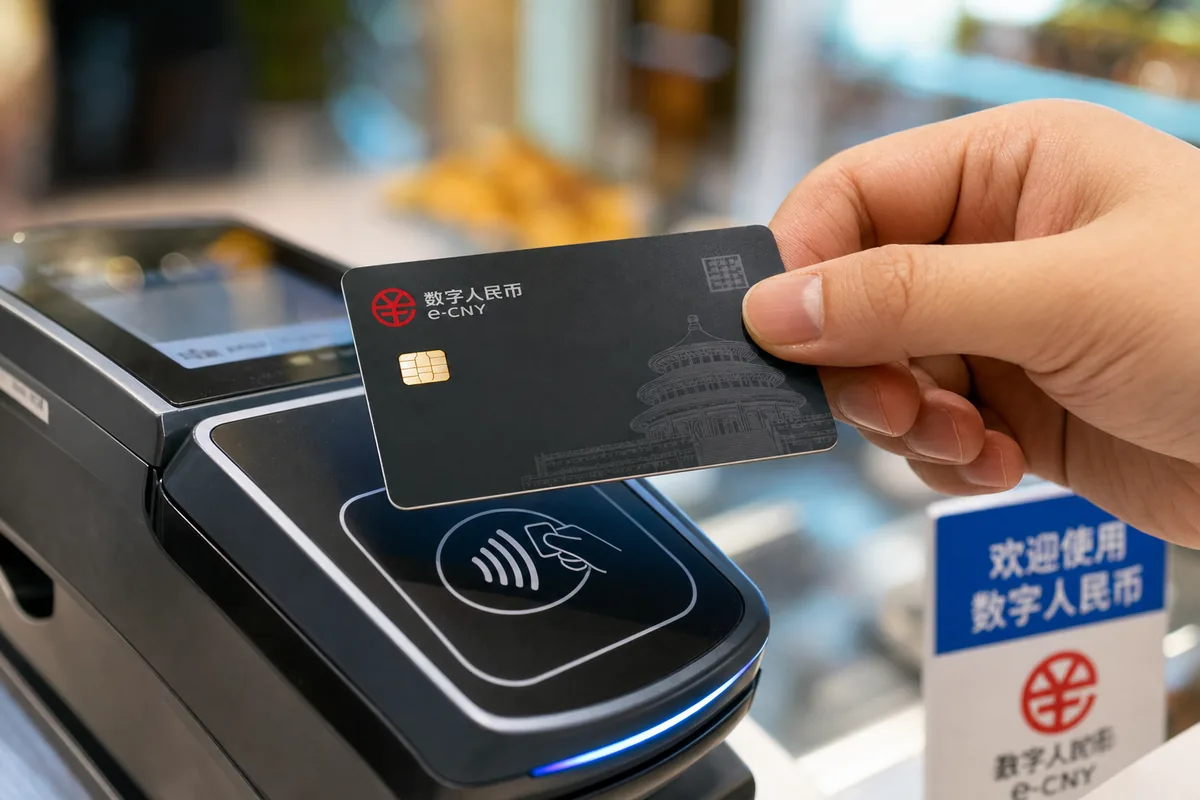
This is a physical card with NFC. According to Bank of China, foreign visitors can exchange foreign cash for a digital yuan hardware wallet at BOC self-service currency machines, then pay by tapping the card on a supported point-of-sale terminal. Some hardware wallets also support offline payment, meaning they work even when your phone has no signal or is out of power, though the loadable amount tends to be smaller.
The hardware wallet is handy if you'd rather not deal with an app at all, or if you're paying with cash and want a tap-to-pay card instead of carrying notes.
How to set up the e-CNY app wallet
The PBOC's official guide lays out the process. Registration is open to mobile numbers from over 210 countries and regions, so your home phone number should work.
- Download the app. Search for "e-CNY" in the App Store or Google Play and install the official app.
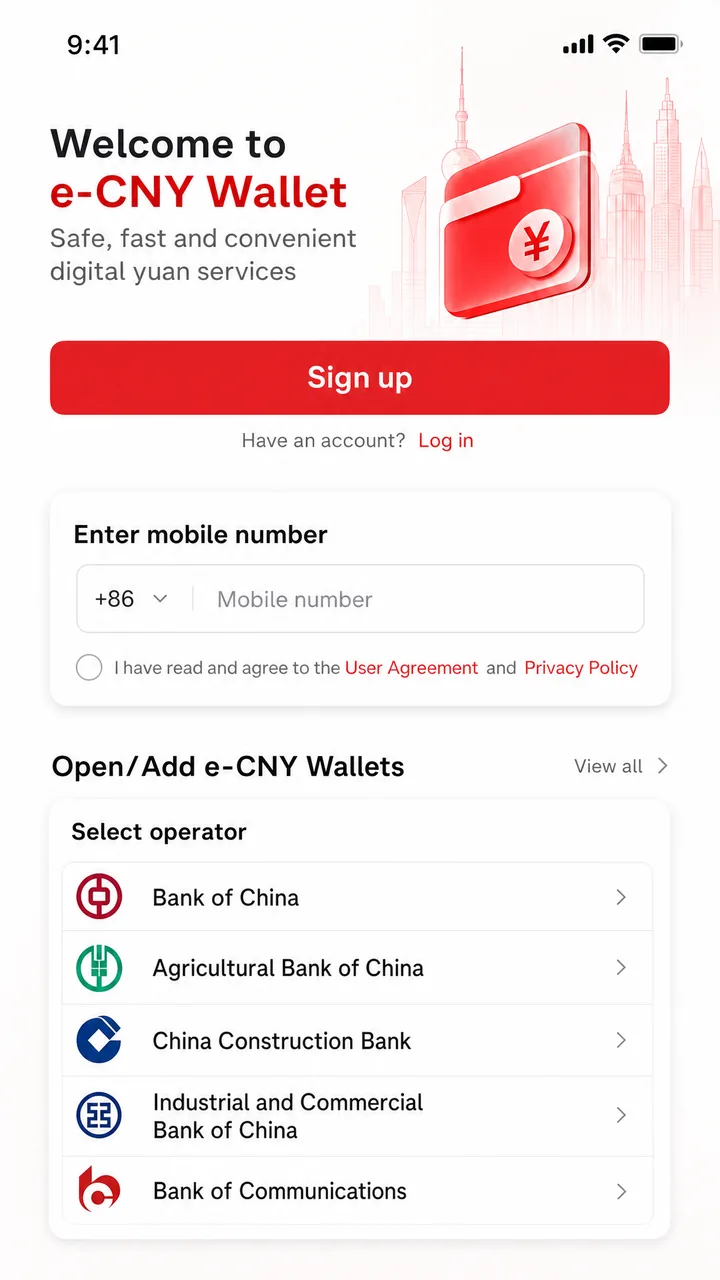
- Sign up. Open the app and tap Sign up, then register using your overseas mobile number and verify it with the code you receive.
- Open a wallet. Tap Open/Add e-CNY Wallets and choose an authorized operating institution that supports international services. These operators are the banks and platforms that run the wallets behind the scenes.
- Link your card and top up. Add an overseas Visa or Mastercard and use the "top-up before use" feature to load money into the wallet.
If you register with your phone number only and don't submit a passport or other ID, you get what's called a Category 4 (Type 4) wallet, the anonymous, basic tier. This is enough for everyday spending and is what most short-term visitors will use.
Topping up your wallet
You have a few ways to load money in:
- Overseas Visa or Mastercard. The "top-up before use" feature (先充后用, xiān chōng hòu yòng) launched for foreign cards in September 2023. You recharge the wallet from your card, then spend the balance. Earlier the system worked on a "top-up as you pay" basis; both approaches let you fund the wallet from a foreign card.
- Cash at a bank branch. You can also walk into a bank service point and top up your wallet with cash.
- Foreign cash at a self-service machine. For the hardware wallet, Bank of China lets you load it with foreign banknotes at its currency-exchange machines.
One genuinely useful detail: any remaining balance can be returned to the same overseas bank card or account you used to top up. So you're not stuck spending down every last yuan before you fly home.
Wallet limits you should know about
The anonymous Category 4 wallet has caps. These are confirmed by the Hong Kong Monetary Authority and CCB (Asia):
| Limit type | Category 4 (anonymous) wallet |
|---|---|
| Per transaction | RMB 2,000 |
| Daily total | RMB 5,000 |
| Annual total | RMB 50,000 |
| Maximum balance | RMB 10,000 |
For typical tourist spending, meals, transport, shopping, attraction tickets, these limits are comfortable. If you upgrade the wallet with more identity verification, the caps rise, but most visitors won't need to.
One more rule worth noting: the e-CNY wallet is for retail payments only. Under the current cross-boundary pilot rules, you can't use it for person-to-person transfers, so don't expect to send money to a friend's wallet.
Paying with e-CNY
In practice, paying is similar to Alipay and WeChat: you scan or show a QR code. For smaller amounts the process is quicker, payments under RMB 500 can go through in one step without entering a PIN, while anything over RMB 500 asks for your payment password.
You can use e-CNY at offline merchants displaying the acceptance logo, and on several major online platforms including Didi (滴滴, ride-hailing), Meituan (美团, food delivery and local services), Ctrip and Qunar (travel booking), and JD (京东, online shopping). That covers a decent slice of what travelers actually pay for.
Where the digital yuan works
The e-CNY is still a pilot program rather than a nationwide rollout. As of recent reporting it covered 26 cities across 17 provinces, later expanding to around 29 pilot areas, though figures vary by source and date.
Bank of China lists the available regions as: Beijing, Tianjin, Dalian, Shanghai, Jiangsu, Zhejiang (Hangzhou, Ningbo, Wenzhou, Huzhou, Shaoxing, Jinhua), Fujian (Fuzhou, Xiamen), Shandong (Jinan, Qingdao), Changsha, Guangdong, Guangxi (Nanning, Fangchenggang), Hainan, Chongqing, Sichuan, Yunnan (Kunming, Xishuangbanna), and Xi'an.
If your itinerary covers major destinations like Beijing, Shanghai, Xi'an, Chengdu, or Guangzhou, you're within the pilot zone. The catch isn't the city, it's whether the specific shop or restaurant in front of you displays the e-CNY logo. Acceptance on the ground is patchier than the city list suggests, and there's no authoritative figure for what share of ordinary merchants actually take it.
Digital yuan vs Alipay and WeChat Pay
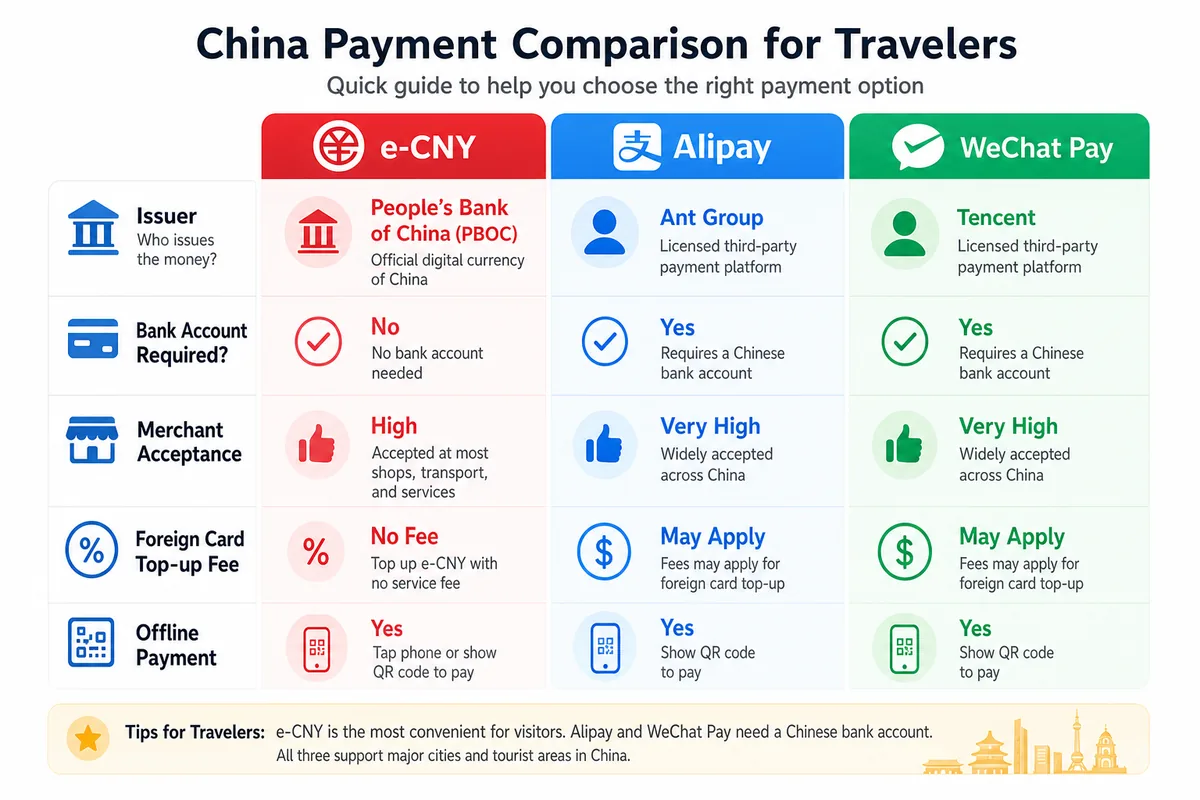
Here's how the three stack up for a foreign visitor. For the full picture on the two private platforms, see our dedicated guides linked at the end.
| e-CNY | Alipay | WeChat Pay | |
|---|---|---|---|
| Issued by | PBOC (state) | Ant Group (private) | Tencent (private) |
| Chinese bank account needed? | No | No | No |
| Funded by | Visa/Mastercard, or cash | International card | International card |
| Merchant acceptance | Narrower (logo merchants + major apps) | Very wide | Very wide |
| Foreign-card fee | Set by issuer/bank | Free under RMB 200, 3% above | Free under RMB 200, 3% above |
| Offline payment | Yes (some hardware wallets) | No | No |
Both Alipay and WeChat Pay opened international card linking to foreign users in March 2024, and Alipay expanded its in-app service to 16 languages. On fees, WeChat Pay and Alipay both waive the 3% charge on transactions under RMB 200 and apply 3% above that. WeChat Pay has also run a campaign waiving the 3% fee on daily transactions under RMB 1,000 for the first 60 days after a new user links an international card, capped at RMB 30 saved per transaction, worth checking whether it's still running when you travel.
Common questions
Is the e-CNY app in English?
The PBOC published a bilingual (Chinese and English) user guide, and the app is designed to support international users. That said, some reports about the exact interface come from secondary sources, so set expectations accordingly and explore the app once it's installed.
Can I get my money back when I leave?
Yes. The remaining balance can be returned to the overseas bank card or account you used to top up. Do this before you leave China while you still have access to the app and a connection.
What if something goes wrong?
There's a 24-hour e-CNY customer service hotline at +86-10-956196. Save it in your phone before you travel.
Will most shops accept it?
Not as reliably as Alipay or WeChat. Look for the e-CNY acceptance logo, and always have a backup payment method ready.
Is it the same as cryptocurrency?
No. The e-CNY is official state-issued money pegged one-to-one to the physical yuan. It doesn't fluctuate in value and has nothing to do with Bitcoin or other crypto.
The bottom line
The digital yuan is a legitimate, working payment option for foreign visitors, and the barrier to entry is genuinely low: an overseas phone number, a Visa or Mastercard, and about ten minutes to set up the app. It's anonymous at the basic tier, refundable when you leave, and backed by the central bank.
But be realistic about its role. Alipay and WeChat Pay accept foreign cards now and are taken almost everywhere, so they should be your main setup. Add e-CNY if you want a state-backed backup, value privacy, or are simply curious about how a CBDC works in daily life. Set everything up before you fly, keep a little cash on hand, and you'll have no trouble paying for anything in China.
For the wider context on how all of this fits together, start with our overview of Chinese payment systems, then set up your main wallets using the guides below.
Last updated: June 2026
Read in other languages
Last train times for 10 Chinese metro systems
Every line and station, checked by hand — the same data behind our offline route planner.
Get the WaysChina App
Offline guides, currency converter, essential phrases, and more — all in your pocket.

Related Articles

Do You Need Cash in China? How Much to Bring and Where to Get It
Yes, bring some cash to China — just not much. A practical guide to how much to carry, where to withdraw yuan at a...

How to Use Alipay with Foreign Cards: Setup, Fees and Fixes
Bind your Visa or Mastercard to Alipay in about 10 minutes: which cards work, real fees and limits, what to do when...

How to Use WeChat Pay with Foreign Cards: Setup, Fees, and Fixes
Bind Visa, Mastercard or Amex to WeChat Pay in minutes: the seven supported networks, the wallet-region trap, real...

Understanding Chinese Payment Systems: Mobile, Cards, Cash and e-CNY
How payments in China actually fit together — mobile apps, bank cards, cash and the digital yuan — with real-world...