
This article contains affiliate links. If you make a purchase through these links, we may earn a small commission at no extra cost to you. This helps support our work in creating free travel guides.
Here's the honest version: a foreign Visa or Mastercard works in fewer places in China than you'd expect, but the country has changed a lot since 2024. Big hotels, major airports, and upscale stores take international cards. Most small restaurants, street vendors, taxis, and corner shops do not. The real fix for day-to-day spending isn't a physical card at all — it's linking that card to Alipay or WeChat Pay, which now accept foreign cards directly. This guide covers where your card actually swipes, how to pull cash from ATMs, and the practical limits and fees you'll run into.
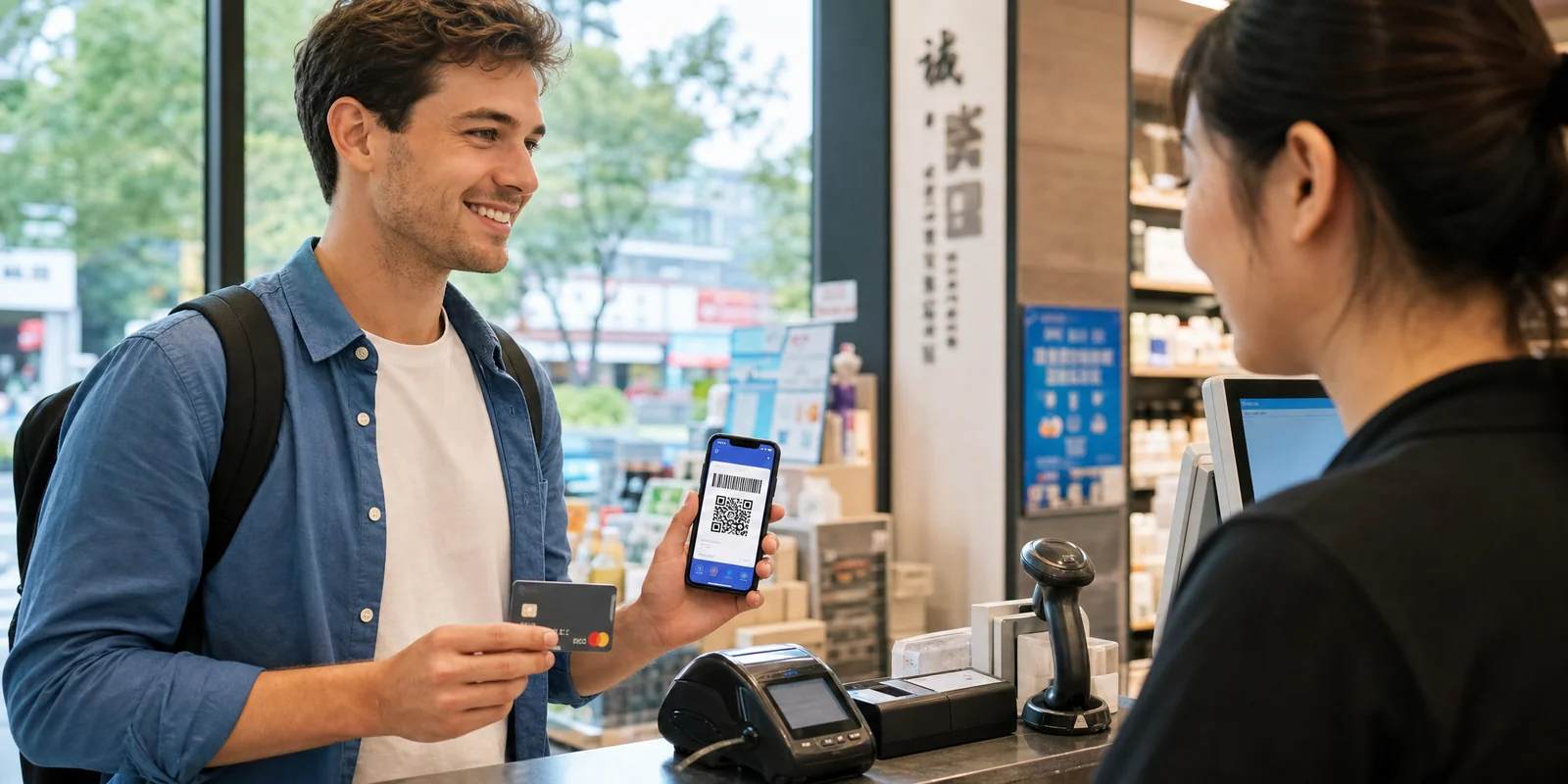
Where international cards actually work
The blunt truth is that China runs on mobile payments and the domestic UnionPay (银联, Yínlián) network. A foreign Visa or Mastercard is the exception, not the norm. According to a 2023 Mastercard survey of prime commercial districts in Beijing, Shanghai, Guangzhou, and Shenzhen, fewer than 40% of retail and dining merchants accepted foreign cards. Outside those big cities, expect even less.
That said, there are clear places where your card is reliable:
- International hotel chains (Marriott, Hilton, Hyatt, IHG and similar) — front desks routinely process Visa and Mastercard.
- Major international airports in big cities — duty-free shops, airline counters, and some restaurants.
- High-end department stores and upscale restaurants, especially international chains.
- Three-star-and-above hotels and top-rated tourist attractions, which are now required to accept foreign bank cards.
This last point reflects a real policy shift. In March 2024 China's State Council issued guidance to improve payment services for foreigners, summed up in the slogan "large amounts by card, small amounts by QR scan, cash as a fallback." Key merchants — malls, scenic spots, hotels, transport hubs, and hospitals — were directed to enable foreign bank card acceptance. You can read the original guidance (in Chinese) on the official government portal.
The takeaway: carry your card and use it at hotels, airports, and major attractions, but don't assume you can swipe it for noodles, a metro ticket, or a cab. For that, you need mobile pay.
The real solution: link your card to a payment app
This is the single most useful thing you can do before traveling. Since around August 2023, both Alipay (支付宝, Zhīfùbǎo) and WeChat Pay (微信支付, Wēixìn Zhīfù) let foreign visitors link an international credit card directly — no Chinese bank account, no prepaid setup required. Once linked, you scan QR codes like everyone else, and the app handles the currency conversion behind the scenes.
Supported networks differ slightly. Per the Shanghai municipal government's English portal, WeChat Pay accepts Visa, Mastercard, JCB, Diners Club, and Discover; Alipay accepts Visa, Mastercard, Diners Club, and Discover. American Express acceptance is inconsistent — check inside the app when you add a card.
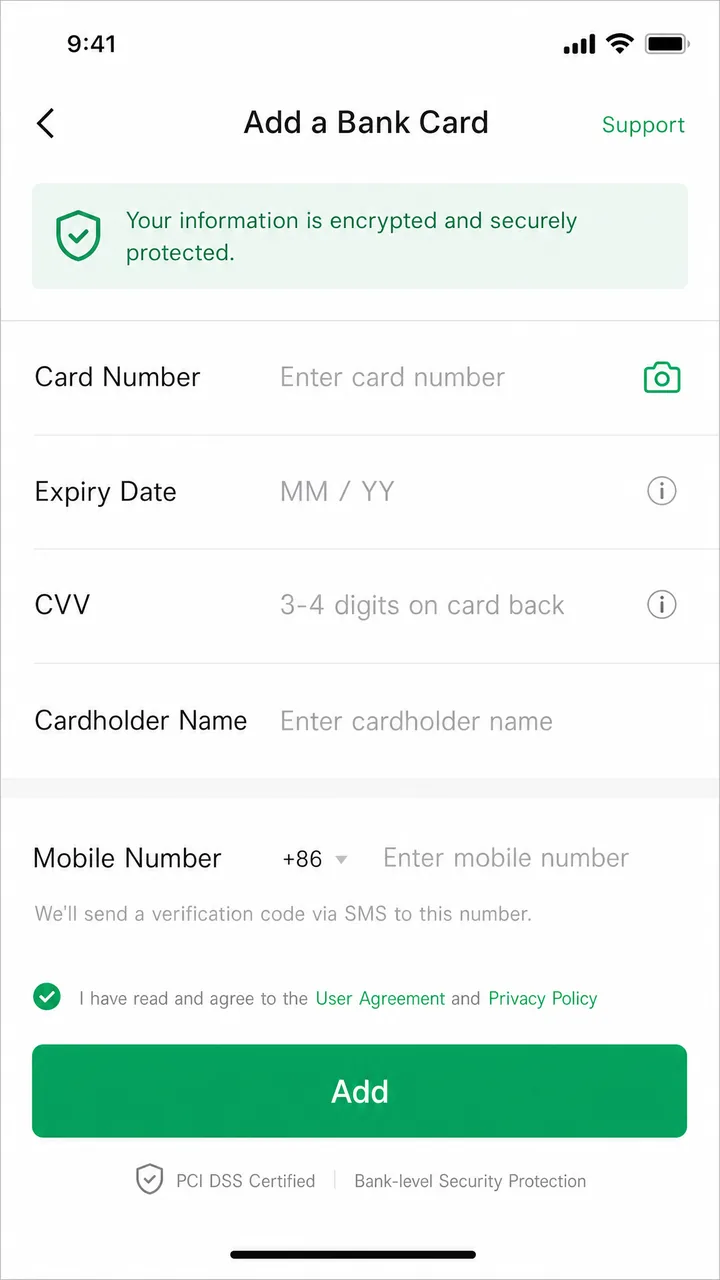
Setting up WeChat Pay (3 steps)
According to the official WeChat Pay Help Center, the process is short:
- Download or update WeChat and register an account.
- Go to Me → Pay and Services → Wallet.
- In Wallet, tap Bank Cards → Add a Bank Card, fill in your identity details, and add the card.
You do not need a Chinese (+86) phone number — an international number that can receive SMS codes works fine. Accepted ID includes a passport, a PRC Foreign Permanent Resident ID Card, or a Mainland Travel Permit for residents of Hong Kong, Macau, or Taiwan.
Fees and limits to know
This is where people get caught off guard, so the numbers matter. For WeChat Pay's international card feature, the official help page lists:
- No fee on single transactions under RMB 200.
- 3% fee on single transactions above RMB 200 (refunds reimburse the fee proportionally).
- Transaction limits of RMB 6,500 per single payment, RMB 50,000 per month, and RMB 65,000 per year.
Alipay works similarly: fees are waived on single transactions up to RMB 200 and run 3% above that. On limits, Alipay raised its ID-free annual spending cap to USD 2,000 in March 2024 (up from USD 500); registering your ID lifts the single-transaction ceiling. Separately, the People's Bank of China raised the per-transaction limit for foreign visitors in mobile pay apps to USD 5,000 and the annual cap to USD 50,000. Limits and fees do change, so confirm the current figures inside the app before relying on them.
One important limitation: foreign cards linked to Alipay or WeChat Pay are for merchant purchases only. You cannot send red packets (红包, hóngbāo), do peer-to-peer transfers, or move money between users. That's fine for tourists — you're buying things, not paying friends back.
For the full walkthrough, see our dedicated guides on using Alipay with foreign cards and using WeChat Pay with foreign cards.
Alipay TourCard: a prepaid alternative
If linking your card directly doesn't work or you'd rather keep your main card off the app, Alipay offers a prepaid "Tour Pass" / TourCard. It's a prepaid card issued by Bank of Shanghai, accessed through an Alipay mini-program and topped up with an international card (Visa, Mastercard, Diners Club, JCB).
Per the official agreement, the minimum top-up is RMB 100. Newer third-party guides describe a roughly 5% top-up service fee and a higher total cap, but these details have shifted over time and sources disagree — so treat the TourCard's exact fees, validity, and limits as something to verify on the actual top-up screen before you load money. For most travelers, direct card linking is simpler and cheaper; the TourCard is a backup if that fails.
Withdrawing cash from ATMs
Cash is no longer king in China, but it's still a useful fallback — for the occasional vendor who takes nothing else, for small towns, and for peace of mind. Your foreign card can pull RMB from ATMs, with some rules worth knowing.
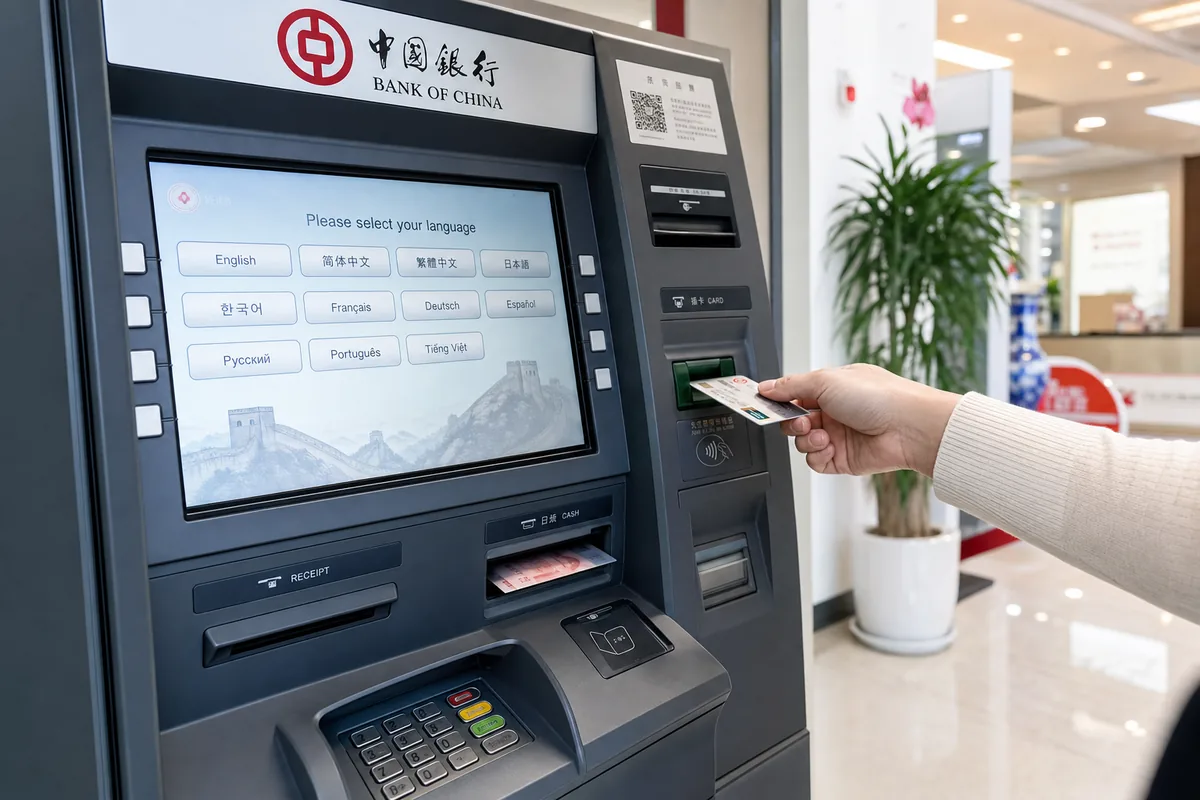
Bank of China ATMs are a reliable choice. Per the bank's official English ATM page, they support around-the-clock cash withdrawal and balance inquiries with major international cards — UnionPay, Visa, Mastercard, JCB, and American Express. Withdrawal fees are set by your home (issuing) bank, not the Chinese ATM.
The key numbers and gotchas:
- Per-withdrawal limit: RMB 3,000 per ATM transaction on a foreign card. Daily and annual totals are set by your issuing bank.
- Surcharges: Some ATM operators add a surcharge that appears on screen during the transaction. Read the prompt before confirming.
- Conversion: Amounts are converted to RMB and debited by your issuing bank, so check your bank's foreign-ATM and currency-conversion fees before you travel.
- Decline DCC: If the ATM offers to charge you in your home currency (dynamic currency conversion), decline it and choose RMB — DCC usually means a worse exchange rate.
The 2024 government guidance also directed banks to keep upgrading ATMs so foreigners can withdraw RMB with overseas cards, and to add more currency-exchange points at airports, ports, and hotels with many foreign guests. In practice, ATMs at Bank of China, ICBC, and other major banks in cities work well; UnionPay's customer hotline is 95516 if a card is rejected.
A note on UnionPay
UnionPay is China's dominant network — it accounted for roughly 93% of card spending in the country in 2019, and its cards are accepted at virtually every ATM and merchant. If you happen to hold a UnionPay card issued in your own country (some banks in Asia and elsewhere offer them), it'll be far more widely accepted than Visa or Mastercard. Most Western travelers won't have one, but it's worth knowing why the network is everywhere.
What to bring: a practical card strategy
You don't need to overthink this. A workable setup for most visitors:
- Alipay or WeChat Pay linked to your card — your main tool for everyday spending.
- One physical Visa or Mastercard for hotels, airports, and big purchases.
- A travel-friendly debit card for ATM withdrawals, ideally one with low or no foreign-transaction and ATM fees.
- Some cash as a backup — a few hundred RMB pulled from an ATM on arrival covers you where nothing digital works.
If you don't already have a low-fee card for travel, multi-currency travel cards like Wise are popular for keeping foreign-transaction and ATM costs down and showing you the real exchange rate. Compare what your existing bank charges first — if your card already has no foreign-transaction fee, you may not need anything new.
For more on getting RMB and comparing exchange options, see our guide on where to exchange money in China, and for the big-picture overview of how everything fits together, understanding Chinese payment systems.
Frequently asked questions
Can I use my Visa in China?
Yes, but with limits. Visa works at international hotels, major airports, upscale stores, and three-star-plus hotels and top attractions. It does not work at most small merchants. For everyday spending, link your Visa to Alipay or WeChat Pay.
Is Mastercard accepted in China?
Same as Visa — accepted at higher-end and tourist-facing businesses, and linkable to both major payment apps, but not widely accepted at small shops.
Will my foreign debit card work at ATMs?
Yes, at major bank ATMs (Bank of China is reliable). Expect a RMB 3,000 per-transaction cap, possible on-screen surcharges, and fees set by your home bank. Always choose to be billed in RMB.
Do I need a Chinese phone number?
No. Alipay and WeChat Pay both work with an international number that can receive SMS verification codes.
What if my card gets declined?
Try a different ATM or merchant, make sure your bank knows you're traveling (some block foreign transactions), and for UnionPay-related issues call 95516. Keep some cash as a fallback.
The bottom line
Your physical Visa or Mastercard will get you through hotels, airports, and major attractions, but it won't cover daily life in China. The fix is simple and free to set up: link your card to Alipay or WeChat Pay before you travel, and you'll pay by QR code like everyone else, with no fee on small purchases. Carry one card for big payments, a low-fee debit card for ATM cash, and a few hundred RMB as backup. Confirm current fees and limits inside the apps before you go, since these have been changing fast — and once you land, you'll find paying is far easier than it was a couple of years ago.
Last updated: June 2026
Read in other languages
Last train times for 10 Chinese metro systems
Every line and station, checked by hand — the same data behind our offline route planner.
Get the WaysChina App
Offline guides, currency converter, essential phrases, and more — all in your pocket.

Related Articles

Do You Need Cash in China? How Much to Bring and Where to Get It
Yes, bring some cash to China — just not much. A practical guide to how much to carry, where to withdraw yuan at a...

Digital Yuan for Tourists: How to Use e-CNY in China
China's digital yuan (e-CNY) is open to foreign visitors, no Chinese bank account needed. Here's how to set up a...

How to Use Alipay with Foreign Cards: Setup, Fees and Fixes
Bind your Visa or Mastercard to Alipay in about 10 minutes: which cards work, real fees and limits, what to do when...

How to Use WeChat Pay with Foreign Cards: Setup, Fees, and Fixes
Bind Visa, Mastercard or Amex to WeChat Pay in minutes: the seven supported networks, the wallet-region trap, real...