

This article contains affiliate links. If you make a purchase through these links, we may earn a small commission at no extra cost to you. This helps support our work in creating free travel guides.
China mostly skipped the credit-card era. It went from cash straight to phones. Today the noodle shop points you at a QR code. So does the taxi. So does the temple ticket counter. From the outside this looks chaotic. Underneath, it is deliberately layered. The government's own rule for major shopping districts, tourist sites, entertainment venues and hotels is "large purchases by card, small ones by QR scan, cash as the backstop" — and those venues are required to support all three. The central bank's payment guide for foreign visitors lists five ways to pay: mobile payments, bank cards, cash, the digital yuan, and a domestic bank account. The bank account only matters if you are staying long-term. So your real job as a visitor is picking a mix of the other four. Here is what each layer is good at, where it fails, and what to set up before you fly.
Mobile payments: the layer you'll live in
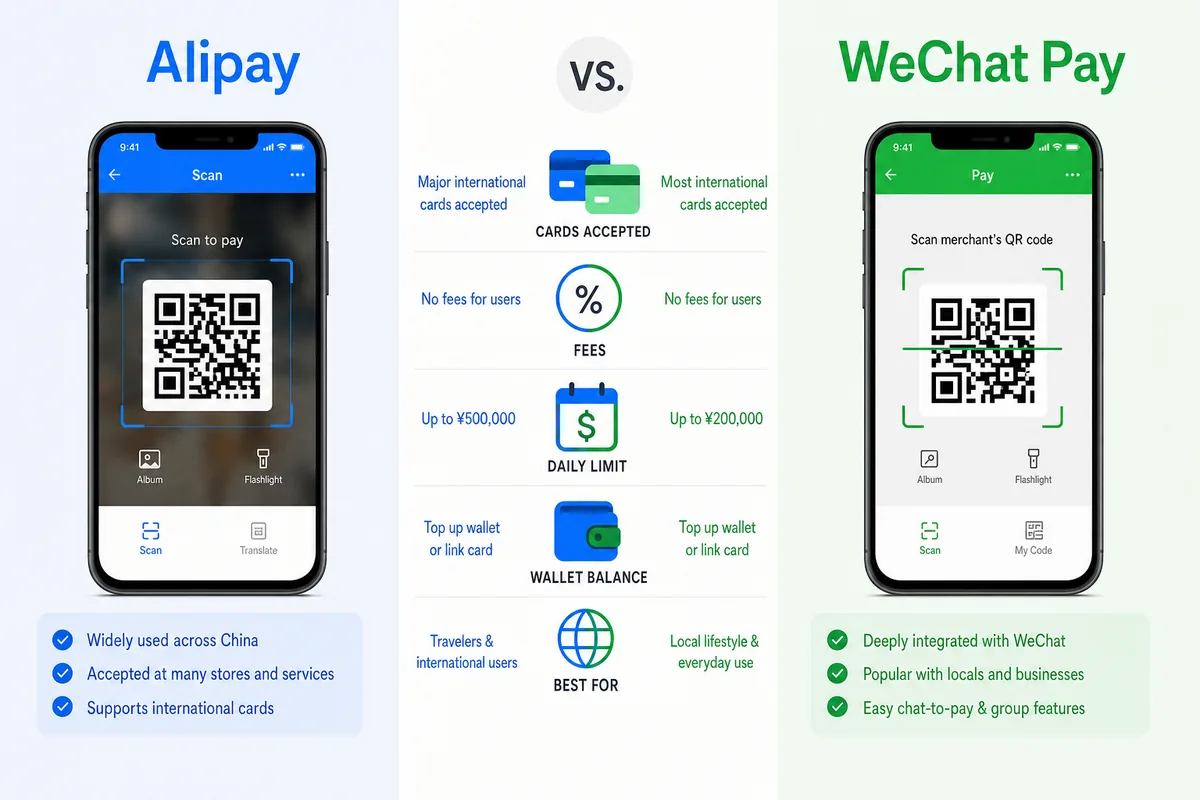
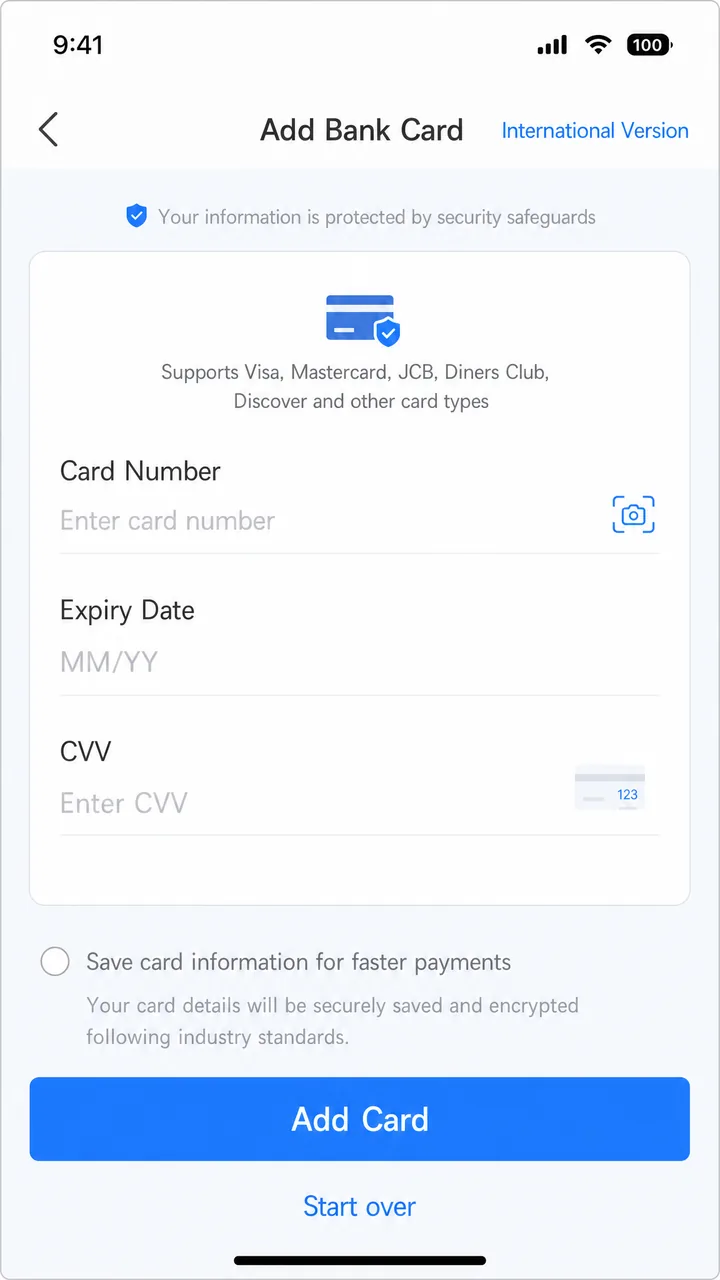
Alipay (支付宝, Zhīfùbǎo) and WeChat Pay (微信支付, Wēixìn Zhīfù) sit behind almost every QR code in China. Both take foreign cards. Alipay's official list is Visa, Mastercard, JCB, Diners Club and Discover — though the Add Card screen in the app shows the latest lineup, and that screen outranks any guide. WeChat Pay's published list has those five plus American Express and UnionPay International, and again the Add Card screen carries the latest version. Signing up is less work than it sounds. Your home phone number registers the account, and your passport handles identity verification before the first payment.
At the register, the two apps feel identical. Before you confirm any payment, its fee appears on the confirmation screen — the number there is the one to trust. WeChat Pay's latest published structure is the reference point: free under 200 RMB per transaction, 3% above that — meaning 3 RMB on every 100 RMB. Alipay works out about the same in practice. What does that line cover? A bowl of noodles, a metro ride, a bottle of water — everyday buys sit well under that line, so most of your payments carry no app fee at all. When a big payment does cross the line, the math stays small: 3% of a 1,000 RMB hotel bill is 30 RMB, roughly one coffee back home — and the confirmation screen shows the exact figure before you approve. The spending limits are just as forgiving. Once verified, foreign visitors can spend up to $5,000 per transaction and $50,000 per year under the central bank's rules. No ordinary trip gets anywhere near that. One more fee lives outside China entirely: your own bank may add a foreign-transaction fee of roughly 1-3%. If yours does, a multi-currency travel card like Wise or Revolut was built for exactly this job.
Our advice is simple: install both apps at home, before the flight. Lead with Alipay for payments — the step-by-step is in our Alipay foreign-card guide. Then get WeChat Pay working too, because half of daily life in China happens inside WeChat; the WeChat Pay setup guide covers its extra quirks. Each app takes about ten minutes on your sofa. The same job jet-lagged in an arrivals hall takes far longer, so do it early.
What paying actually looks like
Two moves cover every counter in the country. Move one is for small places — the noodle shop, the fruit stall. You scan their printed code. You type the amount they quote. You turn the confirmation screen toward them. Done. Move two is for anywhere with a register — supermarkets, chain stores, metro gates. You open your payment code. They point the scanner at your phone. Beep. Done. Not sure which move a place wants? Watch the person ahead of you in line — one payment shows you the whole protocol. Restaurants add one twist. The code taped to your table often opens an ordering menu, not a payment page. You pick dishes on your phone, and the bill settles in the same flow. None of this needs a word of Chinese; the vendor will point you at the right move before you finish looking confused.
Bank cards: real, but narrower than at home
You might be hoping to just swipe your card like at home. Sometimes you can. Hotels will take it. Airports will. Department stores and upscale restaurants will too. Step outside those places, though, and the odds drop fast. A survey of the prime shopping districts of Beijing, Shanghai, Guangzhou and Shenzhen found fewer than four in ten retail and dining merchants took foreign cards. The noodle place where you'll actually eat lunch? Assume no. Same for the market stall, and the taxi. So treat the physical card as the tool for big-ticket moments, not the daily driver. Our guide to using international cards in China maps where it actually works.
ATMs are a different story. Bank of China machines take UnionPay, Visa, Mastercard, JCB and American Express around the clock, at up to 3,000 RMB per withdrawal under the bank's latest published rules — enough for days of meals, metro rides and tickets. Agricultural Bank of China ATMs allow credit-card cash too — up to five times and 5,000 RMB per day. An airport ATM withdrawal right after landing is the fastest honest way to get walking-around money.
Cash: the backstop with legal teeth
RMB cash is legal tender, refusing it is against the law, and enforcement is real — businesses have been penalized in a national campaign running since late 2023. If a merchant waves your notes away, the complaint hotline is 12363. How much should you carry? Less than the horror stories suggest. A few hundred RMB covers the places phones fail: the tiny stall, the small-town bus, and your own phone on a dead battery.
Getting cash is straightforward. Bank branches exchange major currencies with just your passport — Bank of China counters handle 38 currencies. Hotels and airports can help too: more than 1,300 authorized hotel desks and airport counters exchange money, capped at 10,000 RMB per day. But their rates run roughly 5-10% worse than banks, plus fixed fees. On a few hundred dollars, that gap is roughly a dinner's worth of money. Use them for emergencies; use banks for everything else. One habit to start on day one: keep every exchange slip. With the original vouchers, valid 24 months, you can convert leftover RMB back at up to $500 per day in town or $1,000 at airside departure counters. On the way in, two customs rules apply: foreign cash over $5,000 must be declared, and RMB itself is capped at 20,000 per entry. The full playbook is in where to exchange money.
The digital yuan: interesting, strictly optional
e-CNY (数字人民币, shùzì rénmínbì) is digital cash issued by the central bank, with its own app. Tourists can genuinely use it: registration works with foreign phone numbers from 210+ countries and regions, no Chinese bank account needed, with top-ups from Visa or Mastercard. The anonymous starter wallet has limits — 2,000 RMB per transaction and 5,000 RMB per day. That is plenty for meals and tickets, tight for serious shopping. It spends at merchants displaying the e-CNY sign and inside apps like Didi, Meituan and Ctrip, while person-to-person transfers are not available. Our honest read: for most travelers it is a curiosity and a decent backup, not a necessity. Alipay and WeChat already cover everything it does. If the technology itself is the draw, the digital yuan for tourists goes deeper.
Two upgrades worth knowing about
First, the wallet already on your phone might work here. Through the Alipay+ network, users of 10+ e-wallets from Malaysia, South Korea, Singapore and elsewhere can scan mainland payment codes directly with the app they already carry — check whether yours is on that list before installing anything new. Second, tax refunds got easier. Since April 2025, eligible foreign tourists can claim VAT refunds on the spot in the store rather than queueing at the airport, paid out to cards, cash, or straight into Alipay or WeChat.
What to actually pack
| Your trip | Set up before flying | Backup | Cash |
|---|---|---|---|
| Weekend city break | Alipay + one mainstream credit card | Hotel and airport take cards | A little, for stalls and taxis |
| Two weeks, several cities | Alipay and WeChat Pay, verified on day one | ATM-capable card for top-ups | A few hundred RMB, refilled from bank ATMs |
| Amex is your main card | WeChat Pay first — its published list includes Amex, check the add-card screen for the latest | Bank of China ATMs take Amex | A bit more than average |
| Prefer plastic and paper | Book card-friendly hotels; exchange at bank branches | Hotline 12363 if cash is refused | Enough for each day out |
The bottom line
Set up Alipay and WeChat Pay on your sofa, before you fly. Land with one good credit card and a little cash. That is most of the job — no destination we cover rewards ten minutes of preparation like China does. And if the phone ever lets you down, the law itself guarantees that cash bails you out anywhere. Skip the e-CNY unless the technology amuses you. Check whether your home wallet rides the Alipay+ network. Keep your exchange slips for the flight home. The deep dives are one click away: Alipay setup, WeChat Pay setup, card acceptance, and exchanging money.
Official references: the People's Bank of China Payment Guide for Foreigners in China and the State Council's instant tax refund announcement.
Last updated: August 2026
Fact-checked sources
- Official Chinese central government (gov.cn) 5 pages
- Official People's Bank of China
- Official Beijing Municipal Government 3 pages
- Official Alipay+
- Official Alipay
- Official WeChat Pay Help Center
- Official Tencent
- Trip.com 2 pages
Show 8 more sources
- Wise
- Official Bank of China 4 pages
- Official Agricultural Bank of China
- Official Shanghai Municipal Government
- Remitly
- Official China Customs
- Official Hong Kong Monetary Authority
- Official China Construction Bank (Asia)
Last verified: 2026-07-19
Read in other languages
Last train times for 10 Chinese metro systems
Every line and station, checked by hand — the same data behind our offline route planner.
Get the WaysChina App
Offline guides, currency converter, essential phrases, and more — all in your pocket.

Related Articles

Do You Need Cash in China? How Much to Bring and Where to Get It
Yes, bring some cash to China — just not much. A practical guide to how much to carry, where to withdraw yuan at a...

Digital Yuan for Tourists: How to Use e-CNY in China
China's digital yuan (e-CNY) is open to foreign visitors, no Chinese bank account needed. Here's how to set up a...

How to Use Alipay with Foreign Cards: Setup, Fees and Fixes
Bind your Visa or Mastercard to Alipay in about 10 minutes: which cards work, real fees and limits, what to do when...

How to Use WeChat Pay with Foreign Cards: Setup, Fees, and Fixes
Bind Visa, Mastercard or Amex to WeChat Pay in minutes: the seven supported networks, the wallet-region trap, real...