
This article contains affiliate links. If you make a purchase through these links, we may earn a small commission at no extra cost to you. This helps support our work in creating free travel guides.
You have fewer reasons to carry large amounts of cash in China than almost anywhere else, because Alipay and WeChat Pay now handle most everyday spending. But you'll still want some yuan (人民币, rénmínbì, often shortened to RMB) for small vendors, rural areas, temples, and the occasional machine that won't take a foreign card. This guide compares the main ways to get RMB — banks, airport and hotel counters, ATMs, and mobile payments — so you can pick the right mix and avoid losing money on bad rates. We'll also cover what customs lets you bring in and out, and how to convert leftover cash back when you leave.
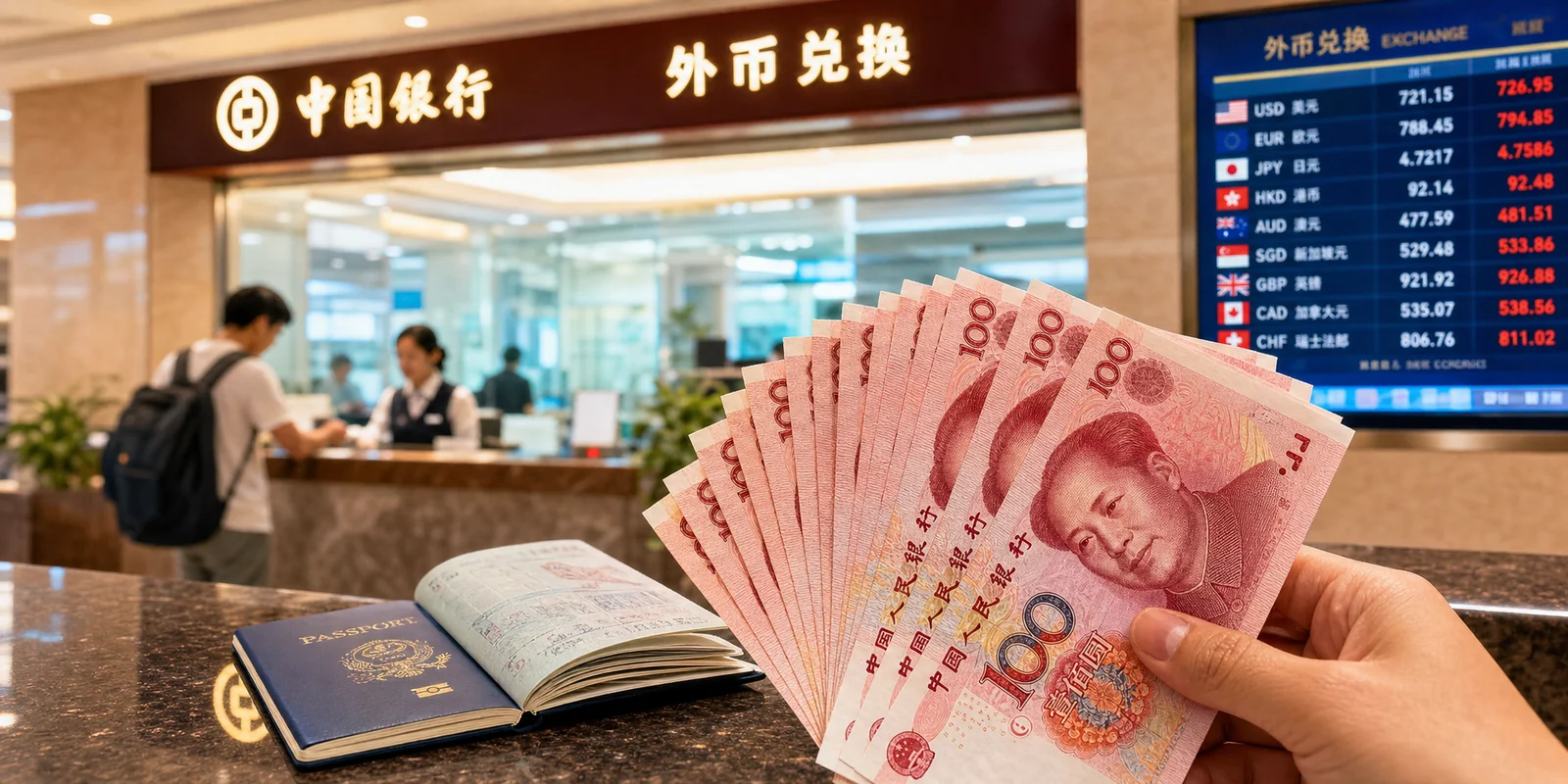
How much cash should you actually bring?
There's no official answer, and the honest one is: less than you'd expect. Most travelers can run almost an entire trip on mobile payments once Alipay or WeChat Pay is linked to a foreign card. We suggest treating cash as a backup rather than your main method — enough to cover a taxi, a few street meals, and small purchases for the first day or two, then top up from an ATM if you find you need more.
Whatever you decide, mind the customs thresholds. According to China Customs, you must file a written declaration on entry if you carry foreign currency cash worth more than the equivalent of US$5,000. There's no limit on how much foreign currency, traveler's checks, or letters of credit you can bring in overall — only the declaration threshold. For RMB cash specifically, the limit is ¥20,000 per person per crossing, in either direction.
Option 1: Banks — the best rates for cash
If you want to exchange physical foreign cash for RMB, a bank branch gives you the most reliable rate. Bank of China (中国银行, Zhōngguó Yínháng) is the one most set up for foreign visitors, and its branches handle currency exchange across 38 currencies, including US dollars, euros, pounds, yen, Hong Kong dollars, Australian and Canadian dollars, Swiss francs, Singapore dollars, Korean won, and Thai baht.
The process is straightforward. Per the Bank of China foreign exchange service, you present your valid passport, fill out the form the teller gives you, hand over your cash, and collect your yuan. Small exchanges don't require opening an account. Keep the receipt (water slip) you get — you'll need it if you want to convert leftover RMB back later.
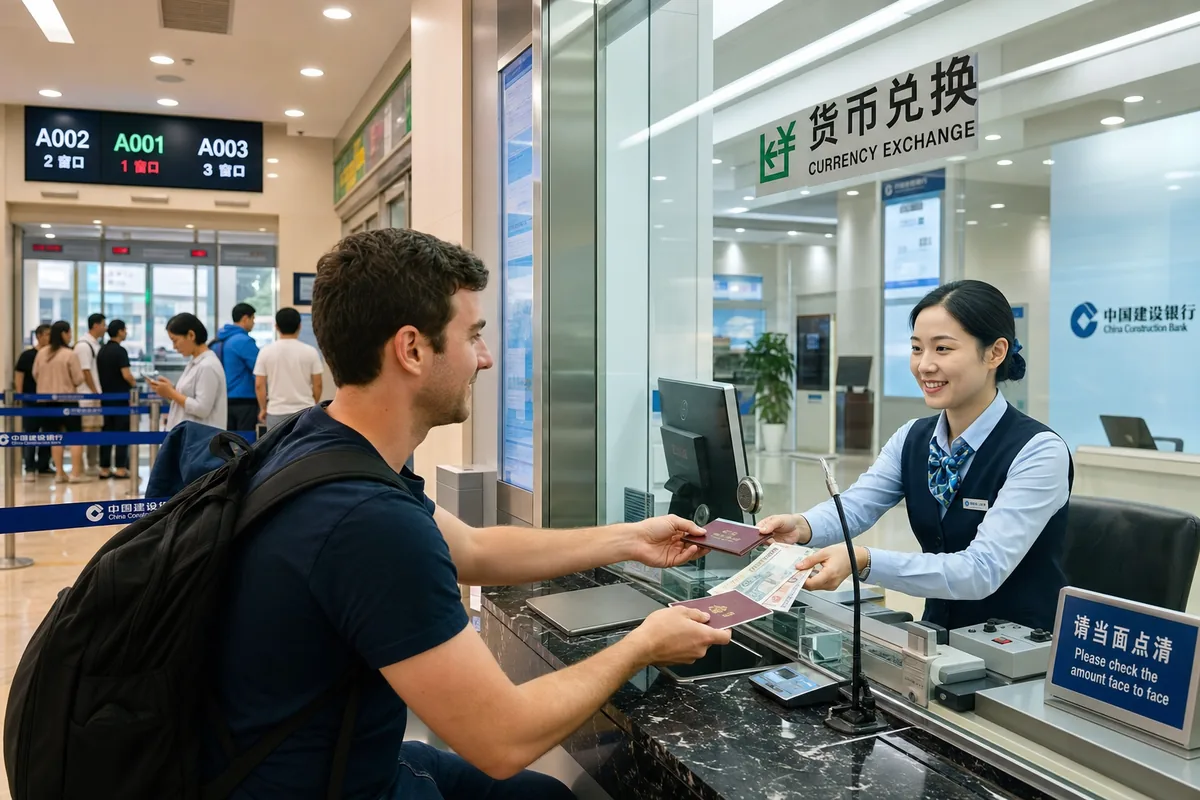
A few practical notes:
- Bring your physical passport. A photo or copy won't do.
- Hours are limited. The big state banks (Bank of China, ICBC, China Construction Bank, Agricultural Bank) generally run Monday to Friday, roughly 9:00–17:00, with some flagship branches in major cities open on weekends. Verify your nearest branch's hours before you go.
- Large exchanges need a declaration. If you exchange more than the equivalent of US$5,000 in a single day, you'll fill out an additional declaration form.
- You don't need to be a resident. Foreign visitors exchange on a passport alone, and as a non-resident this typically doesn't draw down the annual conversion quota that applies to residents.
For context, China runs an annual individual conversion quota equivalent to US$50,000, as HSBC China notes. For a typical tourist exchanging a few hundred or thousand dollars, this isn't something you'll bump into.
Option 2: ATMs — usually the easiest
For most visitors, pulling cash directly from an ATM with a foreign debit or credit card is the simplest route. Bank of China ATMs accept overseas-issued UnionPay, Visa, Mastercard, JCB, and American Express cards for 24/7 withdrawals and balance inquiries, according to Bank of China.
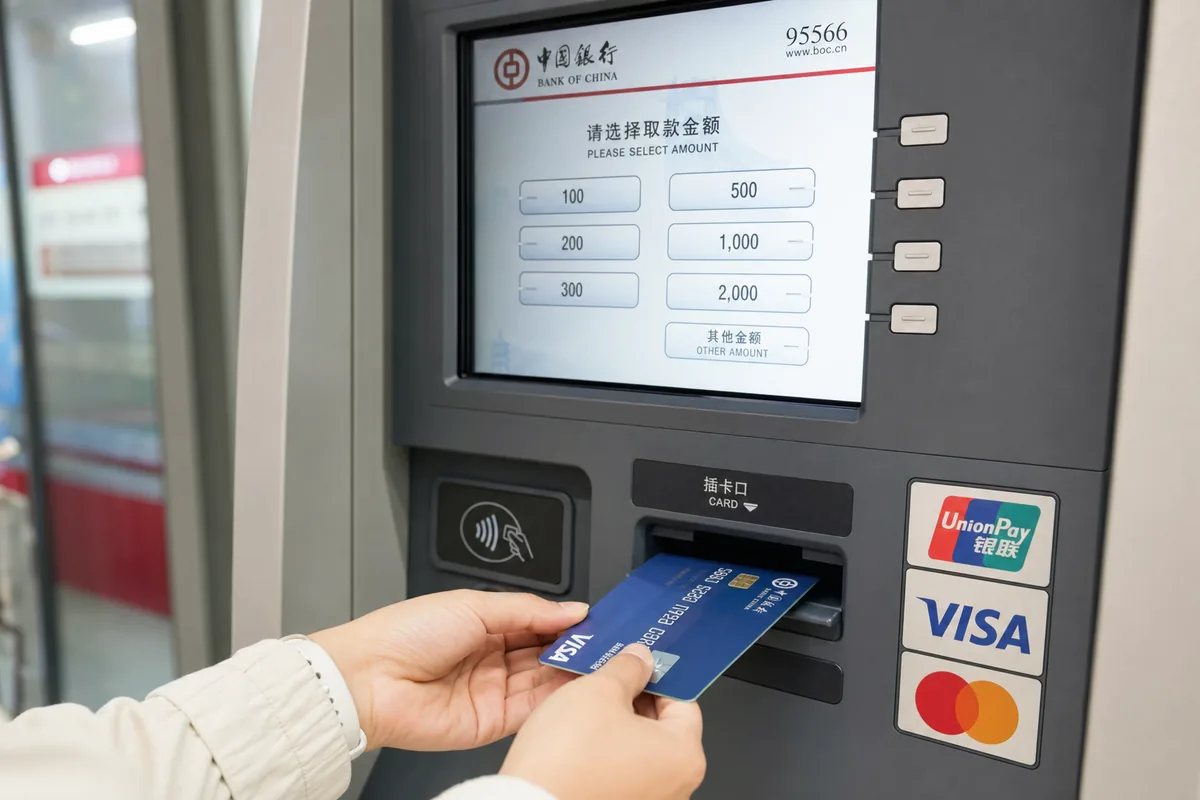
The key number to know: foreign cards are capped at ¥3,000 per withdrawal at Chinese ATMs. Daily and annual limits are set by your home bank, not the Chinese ATM. If you need more than ¥3,000, you can sometimes run a second transaction, but each one may carry a fee.
Speaking of fees, this is where ATMs get murky. Two charges can stack up:
- Your home bank's fees — a foreign transaction fee and/or a flat ATM-abroad charge. These vary widely by bank, so check with yours before you travel. A card with no foreign-transaction fees makes a real difference.
- The Chinese bank's fee — determined by the card network and your issuer, per Bank of China.
Other banks' ATMs may also accept foreign cards, but acceptance isn't guaranteed and limits differ. Agricultural Bank, for example, allows credit-card cash withdrawals of up to 5 times per day and a maximum of ¥5,000 per card per day at its domestic ATMs. When in doubt, look for a Bank of China machine — it's the most consistently foreign-card friendly.
Option 3: Airport and hotel counters — emergencies only
You'll see currency exchange desks the moment you clear customs, and many hotels offer exchange at the front desk. They're convenient, and that convenience is exactly what you pay for. Airport and hotel rates are noticeably worse than banks and ATMs, with higher fees on top, so they're best kept for a genuine pinch — say, you've landed with no yuan and need cash for the taxi.
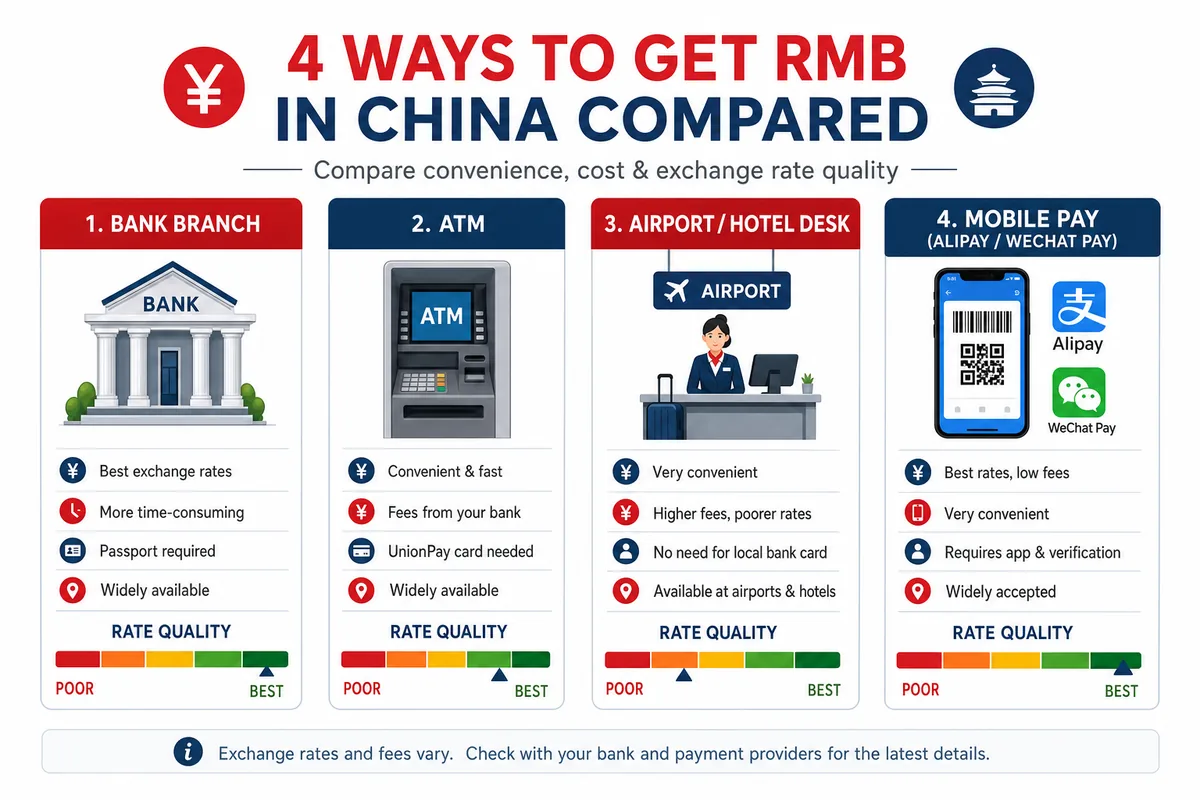
To put numbers on it: airport exchange rates typically run about 5–10% worse than a bank's, plus a per-transaction fee of roughly US$5–15, according to Remitly. On a US$500 exchange that can mean losing US$25–65 versus a better channel. If you must use one, change only what you need to get into the city, then switch to an ATM or bank.
Many of these front-desk and airport desks operate as authorized agents of Bank of China. Bank of China authorizes more than 1,300 hotel and airport exchange points, where you exchange with your passport and foreign cash up to ¥10,000 per person per day and ¥50,000 cumulative per year. Useful to know, but the rate is still the rate.
Option 4: Skip cash — go mobile
For day-to-day spending, the smoothest "exchange" is no exchange at all: link a foreign card to Alipay (支付宝, Zhīfùbǎo) or WeChat Pay (微信支付, Wēixìn Zhīfù) and let the app handle conversion at the point of sale. This covers the overwhelming majority of shops, restaurants, taxis, metros, and vending machines.
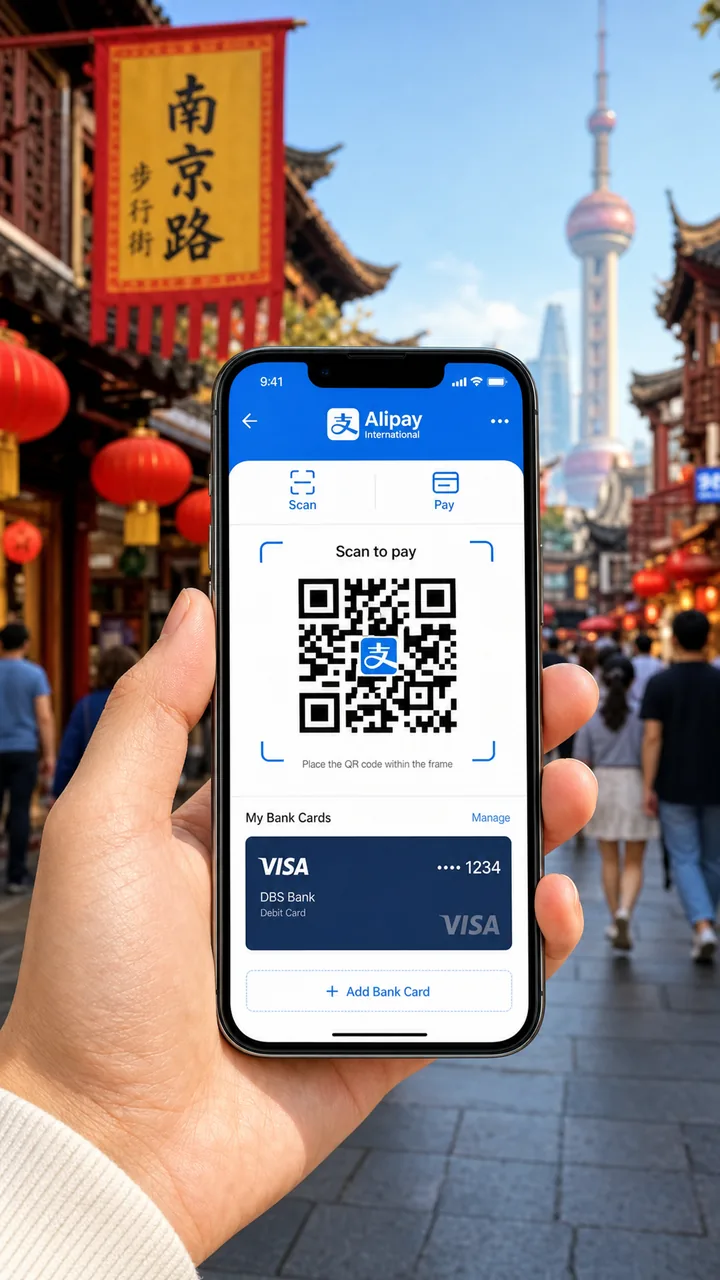
Both now accept major foreign cards. WeChat Pay has supported seven international networks — Visa, Mastercard, American Express, Discover Global Network, JCB, Diners Club, and UnionPay — since July 2023, per the Beijing Municipal Government. Alipay's International Version lets you register with your phone number and add an overseas card directly, as described on the Alipay+ official page.
Fees and limits worth knowing:
- WeChat Pay: no surcharge on single transactions of ¥200 or under; a 3% fee applies above ¥200. New users get a 60-day window where single-day transactions under ¥1,000 skip the 3% fee (saving up to ¥30 per transaction). Caps run to ¥6,000 per transaction, ¥50,000 per month, and ¥60,000 per year.
- Alipay: the rate comes from your card network and issuer, with no markup added by Alipay — so check your card statement for the actual rate. Fee structures and caps are similar in spirit; verify current details in the app.
One important limit on both: foreign cards are for spending at merchants only. You can't use them for person-to-person transfers, sending or receiving red packets (红包, hóngbāo), or financial products. For full setup walkthroughs, see our guides to using Alipay with foreign cards and using WeChat Pay with foreign cards.
Comparing your options at a glance
| Channel | Rate | Best for | Watch out for |
|---|---|---|---|
| Bank branch | Best for cash | Exchanging physical foreign cash | Limited weekday hours; bring passport |
| ATM (Bank of China) | Good (interbank-based) | Quick cash, anytime | ¥3,000 per withdrawal; home-bank fees |
| Airport / hotel desk | Poor (5–10% worse) | Emergencies only | High fees + weak rate |
| Alipay / WeChat Pay | Card network rate | Everyday spending | 3% fee over ¥200 (WeChat); no transfers |
A smart combination for most travelers
In our experience, the lowest-hassle, lowest-cost setup looks like this: link a foreign card to Alipay and WeChat Pay before you arrive for everyday payments, withdraw a modest amount of cash from a Bank of China ATM after you land, and only use a bank branch if you're carrying foreign cash you want to change. Airport and hotel counters stay in reserve for emergencies.
If you'd rather avoid stacked foreign-transaction fees entirely, a multi-currency travel card can help. Services like Wise let you hold and convert yuan at the mid-market rate and withdraw from ATMs with predictable, often lower, fees — handy if your home bank charges heavily for overseas use. Confirm China support and current fees on the provider's site before relying on it.
Converting leftover yuan back when you leave
Ending your trip with extra cash? You can convert unused RMB back to foreign currency, but the rules reward keeping your paperwork. Bank of China lets non-resident individuals reconvert with a valid passport and the original exchange receipt (water slip), which stays valid for 24 months from the date of exchange.
Without that receipt, there are still allowances: you can reconvert up to the equivalent of US$500 per day on your passport alone, or up to US$1,000 per day at an exit point inside the customs zone before departure. To carry RMB cash out, remember the ¥20,000 per-person limit. For taking foreign cash out, if it exceeds your most recent entry declaration, amounts up to US$5,000 pass freely, US$5,000–10,000 require a carrying permit from the bank, and above US$10,000 needs a permit from the foreign exchange authority, per China Customs.
Frequently asked questions
Where do I get the best exchange rate?
For physical cash, a bank branch (Bank of China is the most foreign-friendly). For convenience, a Bank of China ATM gives a rate close to the interbank rate. For everyday spending, Alipay or WeChat Pay at the card network rate. Avoid airport and hotel counters except in a pinch.
Do I need to open an account to exchange money?
No. Small cash exchanges at Bank of China are done on your passport without opening an account.
Will my foreign card work at Chinese ATMs?
At Bank of China ATMs, yes — UnionPay, Visa, Mastercard, JCB, and Amex are accepted 24/7, capped at ¥3,000 per withdrawal. Other banks' machines may or may not accept foreign cards.
Is exchanging money in my home country before the trip a good idea?
A small starter amount for arrival is sensible if your home bank's rate is fair. Beyond that, ATMs in China usually beat home-country exchange shops.
What if something goes wrong with an exchange or my card?
Bank of China's customer service line is 95566 within China, or +86 (area code) 95566 from abroad. Keep receipts for any exchange you make.
The bottom line
Getting yuan in China is genuinely easy once you know the channels. Lean on Alipay and WeChat Pay for daily spending, use a Bank of China ATM for cash, and visit a bank branch if you're changing physical foreign currency — always with your passport in hand. Treat airport and hotel desks as a last resort, mind the ¥20,000 RMB and US$5,000 declaration thresholds, and hold onto your exchange receipts so you can convert leftovers back. Rates and fees shift, so check your bank's posted rate and a reference like a major currency converter before you commit. For the wider picture on tap-to-pay culture, see our overview of Chinese payment systems.
Last updated: June 2026
Read in other languages
Last train times for 10 Chinese metro systems
Every line and station, checked by hand — the same data behind our offline route planner.
Get the WaysChina App
Offline guides, currency converter, essential phrases, and more — all in your pocket.

Related Articles

Do You Need Cash in China? How Much to Bring and Where to Get It
Yes, bring some cash to China — just not much. A practical guide to how much to carry, where to withdraw yuan at a...

Digital Yuan for Tourists: How to Use e-CNY in China
China's digital yuan (e-CNY) is open to foreign visitors, no Chinese bank account needed. Here's how to set up a...

How to Use Alipay with Foreign Cards: Setup, Fees and Fixes
Bind your Visa or Mastercard to Alipay in about 10 minutes: which cards work, real fees and limits, what to do when...

How to Use WeChat Pay with Foreign Cards: Setup, Fees, and Fixes
Bind Visa, Mastercard or Amex to WeChat Pay in minutes: the seven supported networks, the wallet-region trap, real...