

This article contains affiliate links. If you make a purchase through these links, we may earn a small commission at no extra cost to you. This helps support our work in creating free travel guides.
Flying inside China is straightforward and, by the numbers, reliable: in 2025 the country's airlines ran more than five million flights with an on-time rate of about 91% and an average delay of seven minutes. What catches foreign visitors is a handful of rules that differ from home. Power banks need a Chinese safety mark or they don't fly. Liquids can't go in your carry-on at all. Baggage is counted by weight, not by piece. Check-in closes before you'd expect, even if you checked in online. Below: booking with a passport, what you can bring, the airport routine, and what you're owed when things go wrong — starting with whether you should fly at all.
Plane or train?
For a lot of the trips visitors make — Beijing to Xi'an, Shanghai to Hangzhou or Nanjing, Guangzhou to Guilin — the high-speed train wins door to door. Stations are in or near the city center, there's no baggage drop, security takes minutes, and the train leaves on time. Airports are the opposite: far out, so add an hour and a metro or taxi fare at each end. From Beijing Daxing, for example, the Airport Express into town is ¥10–35 depending on distance, ¥35 for the full run to Caoqiao — a separate leg on top of the flight, in time and money. Our rule of thumb: if the fastest train takes up to about five hours, take the train; beyond that, or anywhere the train would take most of a day — Yunnan's far corners, Xinjiang, Hainan's beaches, Tibet — fly. The train side of that decision is in the complete guide to China's high-speed trains.
Booking: channels, passport and payment
You can book a Chinese domestic flight three ways. Trip.com shows every domestic route in English with English support, and for a first trip it's the least friction. Airline websites and apps — Air China, China Eastern, China Southern, Hainan Airlines and the budget carrier Spring Airlines all have English versions — are where you'll find the airline's own fare bundles and where changes are simplest. Global booking sites also list Chinese domestic flights. Whichever you use, book under the name and passport number exactly as printed in the passport, because that document is what you'll show at every step. There's no paper ticket: at the counter you show the passport and the agent finds the booking.
For a foreign traveler the valid document for a domestic flight is your passport (a diplomatic ID or a Chinese permanent residence card also qualify), and the rules require the same document, with the same details, for booking, check-in and security. Don't book on a passport you're about to renew. Payment: most airline sites list international cards at checkout; confirm on the payment page before you get attached to a fare, and Alipay with a linked foreign card is the usual fallback (see how to use Alipay with foreign cards).
Two family notes. Airlines treat a baby as an infant from 14 days old until the second birthday, and newborns under 14 days (or premature babies under 90 days) are generally not carried at all. A child aged 5 to 12 flying alone needs the airline's unaccompanied-minor service, which you must ask about before buying and apply for when you book.
Baggage: weight, not pieces
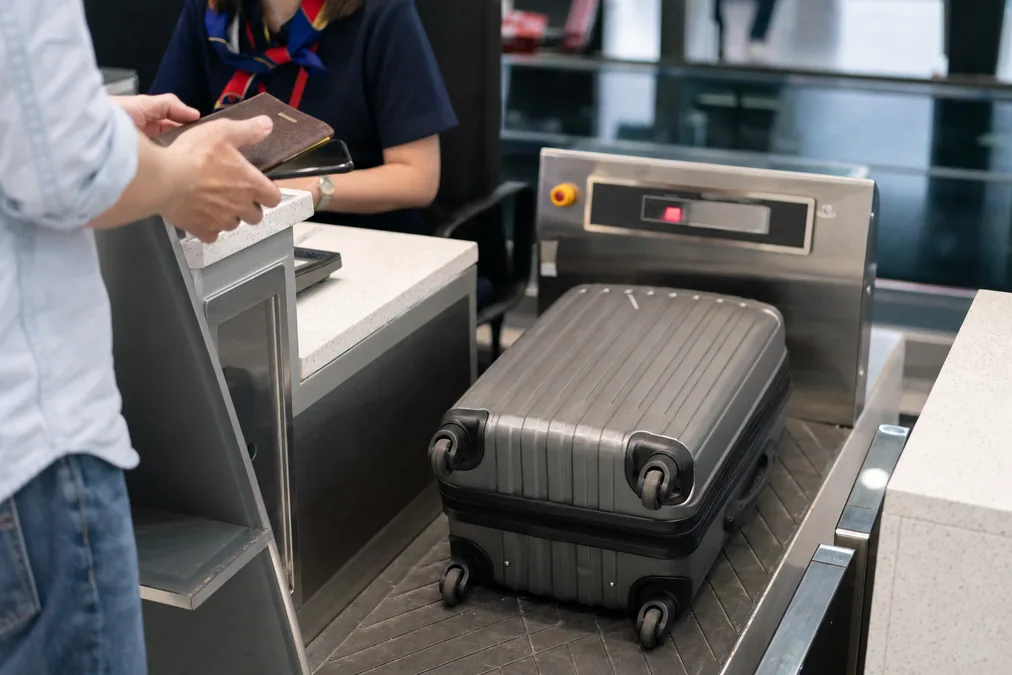
Chinese airlines count checked baggage by total weight, not by number of bags, and the allowance depends on the cabin. Air China's domestic allowance is the pattern the big carriers follow: 20 kg in economy, 30 kg in business and 40 kg in first, plus 10 kg and a folding stroller for an infant; a single piece can't exceed 100×60×40 cm or 45 kg. China Eastern, China Southern and Hainan publish their own allowances — the number printed on your ticket or booking page is the one that applies to you. In the cabin, Air China allows economy passengers one bag of up to 5 kg measuring no more than 55×40×20 cm, plus a small personal item that fits under the seat; first and business get two bags of up to 8 kg each. Five kilograms is less than most Western carriers allow, and it does get weighed at busy check-in counters, so keep the heavy things — camera, laptop, books — in the personal item.
Going over costs real money. Air China charges excess baggage at 1.5% of the full economy fare per extra kilogram — on a route with a ¥1,000 full fare that's ¥15 a kilo, and note it's the full published fare, not the discounted price you paid, so a heavy bag on a cheap ticket hurts most. Look in the airline's app for prepaid extra weight before you get to the airport — it shows the price, and the counter rate is the one to avoid.
Budget airlines are different. Spring Airlines sells three fare brands, and only the top one includes a checked bag: the cheapest fare has no checked allowance at all, the middle fare gets 20 kg only if you buy the baggage bundle, and the top fare includes 20 kg; cabin bags are one piece of 7 kg on the two lower fares, with a smaller size limit as well, and 10 kg on the top fare. If a Spring fare looks half the price of Air China's, add the bag before you compare.
One more reason to keep valuables with you: if a checked bag is lost or damaged on a domestic flight, the airline's liability is capped at ¥100 per kilogram unless you declared a higher value and paid for it. Packing to these limits is covered in luggage rules in China.
Security: what you can and can't bring
Chinese domestic security has a few rules that differ from what most visitors are used to, and they're enforced at the X-ray without much discussion:
| Item | Carry-on | Checked | Rule |
|---|---|---|---|
| Liquids | No | Yes | Exceptions for personal use only: cosmetics (1 of each kind, container ≤100 mL, opened for inspection), toothpaste and shaving cream (1 each, ≤100 g/mL) |
| Alcohol | No | Yes | Sealed retail packaging, container ≤5 L: ≤24% ABV unlimited; 24–70% up to 5 L per passenger; over 70% not allowed at all |
| Power banks / lithium batteries | Yes | No | ≤100 Wh allowed; 100–160 Wh only with airline approval (max 2); over 160 Wh not allowed; cannot be used in flight |
| Power banks – CCC mark | Yes | No | Since 2025-06-28: domestic flights only accept power banks with a clear CCC (3C) mark; recalled models and batches are banned |
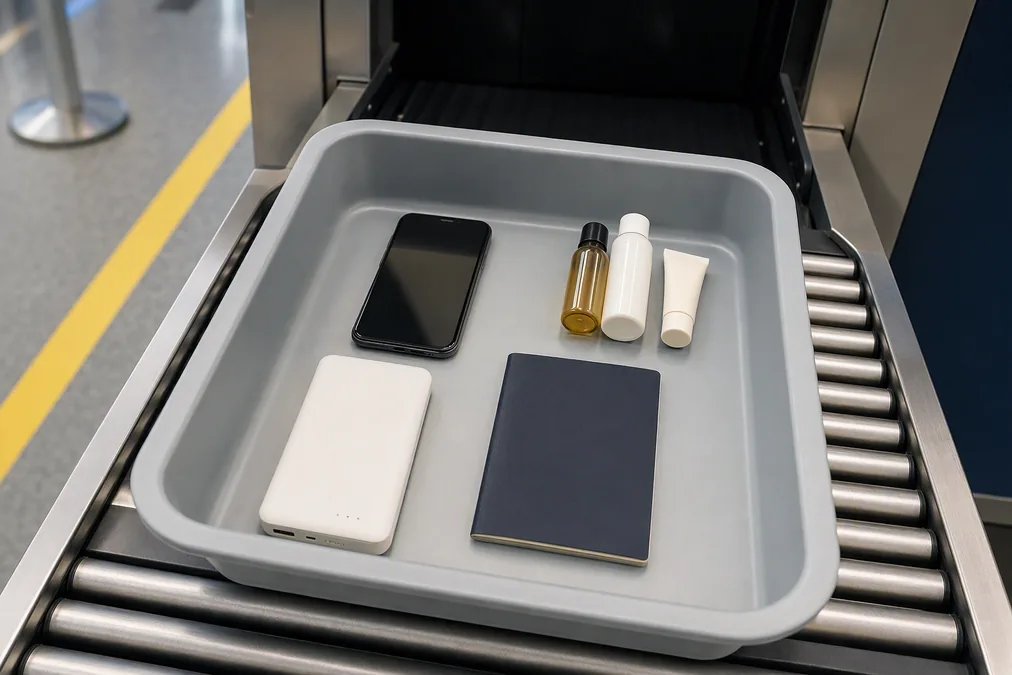
Liquids. On a domestic flight you can't carry liquids through security at all, with narrow exceptions for personal-use cosmetics (one of each kind, in containers of 100 mL or less, opened for inspection) and one tube each of toothpaste and shaving cream up to 100 g. Water, coffee, sunscreen, contact-lens solution — into the checked bag, or buy them after security. International flights leaving China use the familiar rule instead: containers of 100 mL or less in one resealable one-liter bag. Don't carry that habit onto a domestic flight.
Alcohol. It can't go through security in your hand luggage. It can be checked in sealed retail packaging in containers of up to 5 liters: no limit on quantity at 24% ABV or below, up to 5 liters per person from 24% to 70%, and nothing above 70% either way. Pack it well in the suitcase, or buy it at your destination.
Power banks and spare batteries. The rule most likely to catch you. Power banks can never be checked — carry-on only — and they can't be used during the flight; up to 100 Wh needs no approval, 100–160 Wh needs the airline's approval and is limited to two, and anything over 160 Wh doesn't fly. On top of that, since 28 June 2025 a power bank can only board a domestic flight if it carries a clear CCC (3C) certification mark; no mark, a worn-off mark, or a recalled model means it's refused at security. Most power banks bought outside China don't have the mark. The 3C requirement is for power banks; spare camera and laptop batteries follow only the Wh limits above. Either buy one in China (any electronics shop or convenience store, and the mark is printed on the case) or leave yours at the hotel. Trains are looser — the railway's limit is simply 100 Wh per unit — so the same bank that rode the train from Beijing may be taken off you at Xi'an airport.
Lighters and matches. Assume no; if you're a smoker, check the airport's prohibited-items notice and plan to buy a lighter after you land. Knives and tools go in checked baggage.
Airport day: how early, the check-in cutoff, the gate
The number to respect is the check-in cutoff, and it applies even if you have no bag to drop. Each airport sets its own, generally between 20 and 45 minutes before departure for domestic flights; in Hainan Airlines' published list, Beijing Capital, Shanghai Pudong, Chengdu Tianfu and Chongqing close at 40 minutes, and Shanghai Hongqiao and Chengdu Shuangliu at 30, while international flights typically close at 60. After the cutoff you can't drop a bag or get a boarding pass, and checking in online doesn't exempt you: an online check-in still has to be turned into a boarding pass before that same cutoff. If the airline app shows an e-boarding pass for your airport, that counts; if it only shows a check-in confirmation, get the pass at a counter or kiosk before the cutoff. Your airline's app or ticket shows the exact time for your flight.
Our timing: be at the terminal 90 minutes before a domestic flight with a bag to check, 60 minutes with cabin baggage only, and add 30 at Beijing, Shanghai and Guangzhou at peak hours. Allow 20–30 minutes for security at the big hubs; the ID check there uses the same passport you booked with. The boarding pass shows the gate and a boarding time — treat that time as your deadline at the gate, and remember that gates at the largest terminals can be a long walk. Getting to the airport itself — Beijing's two airports and Shanghai's two each have their own quirks — is in our guides to Beijing's airports and Shanghai's airports, and for the other big hubs, airport-to-city transfers.
Delays and cancellations: what you're owed
Weather is the usual culprit — it caused 56% of all irregular flights in 2025, with the airlines' own causes at 17% — and that matters because your rights depend on the cause. The regulator's rules work like this: if a delay or cancellation at the departure airport is the airline's fault (maintenance, crew, scheduling), the airline must provide meals or a hotel; if it's weather, air traffic control, security or another cause outside the airline, the airline only helps you arrange them and you pay. At a stopover, or after a diversion, the airline provides meals or a hotel regardless of cause. Cash compensation is not set by the regulator — each airline decides whether and how much to pay in its own conditions of carriage, so look for "delay compensation" on your airline's website before you accept a voucher.
What you can always insist on is information and a written certificate. The airline must publish the delay or cancellation and its cause within 30 minutes of knowing, and you can ask for a written delay certificate for insurance or your employer; if you dispute the stated cause, the regulator's service platform at 12326.cn can confirm it, and a wrong certificate has to be reissued within 7 days. Stuck on the plane, the crew must update you every 30 minutes; after two hours on the ground you must be given water and food, and after three hours with no departure time in sight you must be allowed off the aircraft, safety permitting.
If an airline doesn't follow these rules, the complaint route is the Civil Aviation Administration's consumer center: hotline 12326, or the website and app at 12326.cn (if you don't speak Chinese, use the website form rather than the hotline); you'll need your real name and document details, a specific request, and to file within six months, and the center tells you within 7 working days whether it's taking the case. For the money a long delay actually costs — a missed connection, a hotel night — travel insurance is the practical backstop; check what yours covers before you fly, and if you don't have any, Safetywing is a common choice among long-term travelers. More in travel insurance for China.
Frequently Asked Questions
My power bank has no 3C mark — can I take it on a domestic flight in China?
No. Since 28 June 2025, domestic flights only accept power banks that carry a clear, legible CCC (3C) mark; unmarked, worn or recalled units are refused at security, and there's no option to check it instead, because power banks are carry-on only. Buy a marked one in China if you need one on the plane. On trains the same bank is fine as long as it's within 100 Wh.
How much checked baggage is free in economy on a Chinese domestic flight?
On the full-service airlines, a weight allowance in the region of 20 kg — that's Air China's economy figure, with 30 kg in business and 40 kg in first — and the figure on your own booking is the one that counts. Budget carrier Spring Airlines includes no checked bag on its cheapest fare and 20 kg only on its top fare or with a paid bundle. Cabin bags are limited to 5 kg on Air China economy, which is the number most visitors trip over.
How long does a delay have to be before the airline owes me a hotel or money?
It isn't measured in hours — it's decided by cause. If the delay or cancellation is the airline's own fault, you get meals or a hotel from the first announcement; if it's weather or air traffic control, the airline helps arrange them but you pay. The only hour-based rules are on board: water and food after two hours stuck on the ground, and the right to get off after three hours with no departure time. Cash compensation is whatever your airline's conditions of carriage say — check them before you accept a voucher, ask for the delay certificate and claim on your insurance.
Can I book Chinese domestic flights without Trip.com?
Yes. The airlines' own English websites and apps sell every seat, and they're the better place if you might change the flight later. You need a passport that will still be valid on the day, entered exactly as printed, because the same document is checked at booking, check-in and security; whether the checkout takes your card is something to confirm on the payment page rather than assume. That said, for a first booking Trip.com removes the guesswork, and its English support is useful if a flight gets cancelled.
The night before: five checks
- Power bank: does it have a 3C mark? If not, it stays behind.
- Liquids: everything into the checked bag, except one small toothpaste and a few 100 mL cosmetics. Not checking a bag? Then no liquids at all — buy water after security.
- Bag weight: under your allowance, and cabin bag under 5 kg (Air China's limit — check yours).
- Passport: the one you booked with, valid on the day.
- Cutoff: look up your airport's check-in cutoff in the airline app; be at the terminal 90 minutes before a domestic departure with a bag to check, 60 without.
Last updated: August 2026
Read in other languages
Last train times for 10 Chinese metro systems
Every line and station, checked by hand — the same data behind our offline route planner.
Get the WaysChina App
Offline guides, currency converter, essential phrases, and more — all in your pocket.

Related Articles

Airport to City in China: Trains, Taxis and Last Departures at 10 Major Airports
How to get from China's ten busiest airports into the city: the rail link from each terminal, published fares, the...

Beijing Airports Guide: Capital (PEK) and Daxing (PKX) to the City
Capital or Daxing, and how to get into Beijing from each: the two Airport Express lines with fares and last trains,...

Shanghai Airports Guide: Pudong (PVG) and Hongqiao (SHA) to the City
Pudong or Hongqiao, and how to get into Shanghai from each: the maglev and its discounts, Metro Line 2, the Airport...