
This article contains affiliate links. If you make a purchase through these links, we may earn a small commission at no extra cost to you. This helps support our work in creating free travel guides.
Getting around China is easier than most first-time visitors expect, and the network is genuinely world-class. The country runs the longest high-speed rail system on the planet, around 48,000 kilometers as of the end of 2024, with trains that cruise at 350 km/h. Cities have clean, cheap, English-signed metros, and you can hail a car or unlock a shared bike from your phone in seconds. The real learning curve isn't the transport itself, it's the setup: tickets are tied to your passport, and almost everything is paid by QR code. This guide walks through every option, when to use each one, and the few things you need to sort out before you travel.

The big picture: how China moves
China carried over 4 billion rail passengers in 2024 and another 730 million by air, and the numbers keep climbing. For you as a traveler, that scale translates into frequent departures, plenty of route choices, and infrastructure that mostly just works. The decision tree is simpler than it looks:
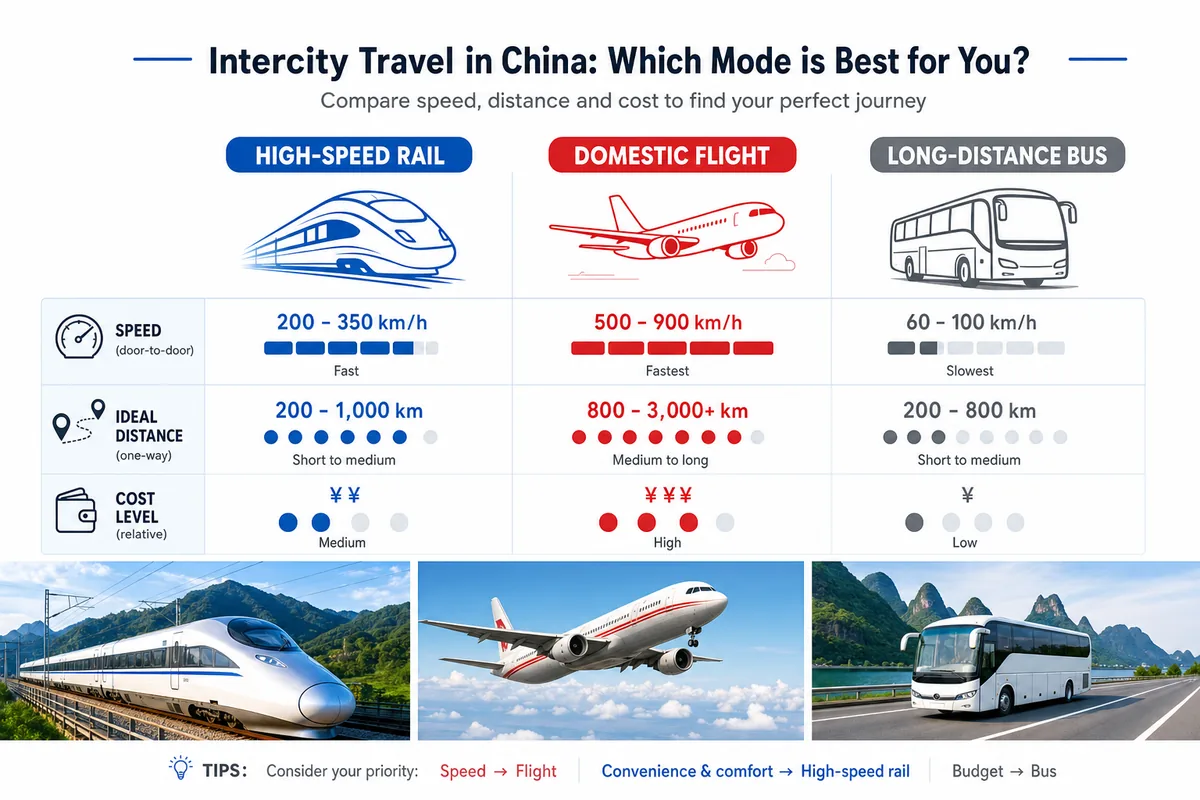
- Between cities, you'll choose between high-speed rail (高铁, gāotiě), domestic flights, and long-distance buses. For most trips under about 1,000 km, the train wins.
- Within cities, you'll use the metro (地铁, dìtiě), ride-hailing, taxis, buses, and shared bikes. The metro covers most of what tourists want to reach.
The one thing that ties it all together is mobile payment. Sort that out first and everything else falls into place, so we'll cover it before the transport modes.
Set up payment before anything else
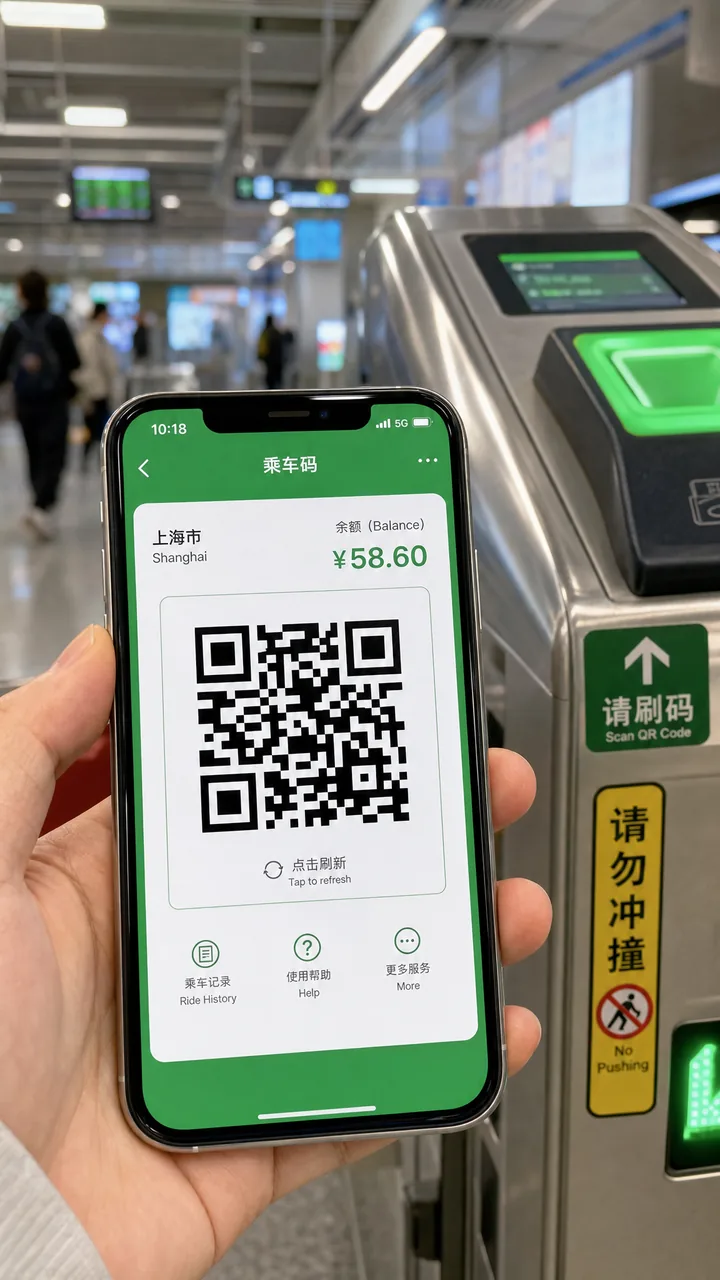
Almost all transport in China is paid through Alipay (支付宝, Zhīfùbǎo) or WeChat Pay (微信支付, Wēixìn Zhīfù). Both now let foreign visitors link an overseas card, and this is the single most important thing to do before your trip. It powers metro ride codes, ride-hailing, shared bikes, and bus fares.
Both apps accept major international cards including Visa, Mastercard, JCB, Diners Club and Discover. According to China's official cross-border payment guidance, transactions of 200 yuan or less carry no surcharge, while anything above 200 yuan adds a 3% fee. There are also caps: a single transaction can't exceed roughly US$5,000, and the annual total is capped around US$50,000, which is far more than any traveler needs for getting around. With Alipay, once your cumulative spending passes about US$500 you'll be asked to upload ID to verify your identity before you can keep going, so register with your passport details from the start.
For the full walkthrough, see our guides on using Alipay with foreign cards and how Chinese payment systems work.
High-speed rail: the default for most routes
If there's one mode that defines travel in China, it's high-speed rail. Stations are in or near city centers, there's no airport-style hassle, and the ride is smooth and punctual. Trains are graded by a letter prefix on the train number:
- G trains are the fastest, running up to 350 km/h. The newest Fuxing (复兴号, Fùxīng) sets operate at 350 km/h in regular service.
- D trains top out around 250 km/h.
- C trains are intercity services, around 200 km/h, for shorter hops like Beijing to Tianjin.
To put the speed in context: Beijing to Shanghai, roughly 1,300 km, takes about 4.5 hours on a fast G train. For anything up to around 1,000 km, the train usually beats flying once you count airport transfers, check-in and security.

Booking train tickets as a foreigner
Train tickets in China are sold under a real-name system, so each ticket is tied to a passport. You have two main routes to buy:
- The official 12306 platform. China Railway's official 12306 English site and app let foreign passport holders register and buy directly. Note that the English platform only accepts valid foreign passports; other document types have to use the Chinese-language platform. Ticketing runs daily from 5:00 to 1:00 the next morning, while inquiries and refunds are available around the clock.
- Third-party platforms like Trip.com, which many travelers find easier for a first trip. You book with your passport number, receive a QR code or e-ticket, and use it to enter the station.
One thing to know: tickets go on sale 15 days ahead, full stop. If a third-party site claims you can book 30 or 90 days out, that's a marketing reservation, not a confirmed ticket; everyone is bound by the same 15-day presale window. So plan your route early, but don't panic about buying the instant you land.
If you'd rather book in English with international card and PayPal support, you can book China train tickets through Trip.com and get your e-ticket QR code on your passport, then just show your passport at the gate. For the deep details, see our train booking tutorial and the complete high-speed rail guide.
Flights: for the long hauls
When distances stretch past 1,500 km or so, flying makes sense again. Think Beijing to the far southwest, or any trip to Tibet, Xinjiang, or Hainan. China's aviation network is huge: 263 commercial airports as of the end of 2024, and the busiest hubs, Shanghai Pudong, Guangzhou Baiyun and Beijing Capital, each handled well over 65 million passengers in 2024.
Domestic flights are frequent and competitively priced, but build in buffer time. Chinese airports are large, security can be slow, and weather delays are common at major hubs. Book through a platform that handles foreign passports cleanly, and have your passport ready for ID checks at the gate. For the practical details on domestic flying, see our domestic flights guide.
Long-distance buses: the gap-filler
Buses (长途汽车, chángtú qìchē) cover the routes trains and planes skip, smaller towns, remote scenic areas, and mountainous regions without rail links. They're cheap and flexible, but slower and less comfortable, and ticketing is rarely in English. For most tourists they're a backup option rather than a first choice, useful mainly for reaching specific destinations off the rail network. Fares, schedules and booking vary widely by region, so check locally or ask your accommodation to help.
Getting around within cities
Once you're in a city, you have several good options. China's urban rail network spans 58 cities and over 12,000 kilometers of track as of the end of 2024, and it carried more than 32 billion passengers that year.
Metro
The metro is the backbone of city travel for visitors: cheap, fast, and signed in English at stations and on maps. Shanghai (around 1,032 km) and Beijing (around 952 km) have the largest networks in the country, with Chengdu, Guangzhou and Shenzhen not far behind. Once you've verified your identity and linked a card in Alipay or WeChat, you can pull up a ride code (乘车码, chéngchē mǎ) and scan in and out of the gates. Note that each city's ride code is activated separately, so you'll set it up again in each new city. You can also buy single-journey tickets at machines or staffed windows, and children under 1.3 meters tall generally ride free.
For planning metro routes and day-by-day itineraries across major cities, the WaysChina app has offline metro maps and a built-in trip planner, which is handy when your mobile data is patchy underground. See our metro systems guide and the broader city transportation overview for more.
Ride-hailing and taxis
DiDi (滴滴) is China's dominant ride-hailing app and works well for foreigners. You can register with your passport and an international phone number, the app has an English interface and two-way driver-passenger translation, and there's 24/7 English customer support. It accepts international cards, Alipay, WeChat and cash. You can also use DiDi as a mini-program inside Alipay or WeChat without a separate download, and going through the Alipay mini-program doesn't even require a Chinese phone number.
Street taxis are still everywhere and reliable, but drivers rarely speak English and fares vary by city. Have your destination written in Chinese or shown on a map. Our taxis and ride-hailing guide and dedicated DiDi guide cover the setup in detail.
Shared bikes
For short hops, shared bikes are everywhere and cost almost nothing. The three main operators are Hellobike (blue), Meituan (yellow) and DiDi's Qingju (cyan). As China Daily explains, you verify your identity with your passport, link a payment method, then scan the QR code on the bike to unlock it. You can use them through the Alipay or WeChat mini-programs without downloading separate apps. Park them in the marked zones to avoid extra fees.
Side-by-side comparison
Here's how the main options stack up for a typical traveler:
| Mode | Best for | Speed | Booking | Notes |
|---|---|---|---|---|
| High-speed rail | City pairs under ~1,000 km | 250–350 km/h | 12306 or Trip.com, passport-based, 15-day presale | Central stations, very punctual |
| Flights | Long hauls 1,500 km+, remote regions | Fastest over distance | Booking platforms | Add airport buffer time |
| Long-distance bus | Towns off the rail network | Slow | Local stations, little English | Cheap, backup option |
| Metro | City sightseeing | Fast in-city | Ride code or single ticket | English signage, very cheap |
| DiDi / taxi | Door-to-door, late nights | Traffic-dependent | App or street hail | DiDi has English support |
| Shared bike | Last mile, short hops | Slow but flexible | Scan QR via app | Park in marked zones |
One visa note that affects your transport plans
If you're transiting through China, the visa-free transit policy can shape how you route your trip. As of late 2024, eligible citizens of 55 countries can enter visa-free for up to 240 hours (10 days) through designated ports, provided they hold a valid travel document and an onward ticket to a third country. The number of qualifying ports has expanded to 65 as of November 2025, including major rail and air gateways. The key condition: you must be heading onward to a third country or region, and the stay covers tourism and visits but not work or study. Always confirm the current terms with the National Immigration Administration before you travel, since ports and eligible countries change. Our visa-free and transit policies guide breaks down who qualifies.
Our recommendation
For a typical first trip hitting a few major cities, here's what works for most travelers: set up Alipay before you fly, book high-speed rail for intercity travel, and rely on the metro plus DiDi once you're on the ground. Fall back on flights only for the genuinely long distances or hard-to-reach regions. That combination covers the vast majority of itineraries and keeps things cheap and predictable.
The setup work is front-loaded: link your payment app, register on a booking platform with your passport, and you're set for the rest of the trip. None of it is hard, it just pays to do it before you arrive rather than scrambling at a station.
Quick recap
China's transport network is fast, dense, and increasingly foreigner-friendly. High-speed rail is your default for travel between cities, flights handle the long hauls, and within cities the metro and DiDi cover almost everything. The one prerequisite that unlocks it all is mobile payment, so set up Alipay or WeChat Pay with your card before you go. Tickets are passport-based and trains go on sale 15 days ahead, so plan routes early but don't stress over buying too soon. Sort the basics first, and getting around becomes one of the easiest parts of your trip.
Related reading:
- High-Speed Train Complete Guide
- How to Book Train Tickets
- City Transportation
- Understanding Chinese Payment Systems
- Visa-Free & Transit Policies
Last updated: June 2026
Read in other languages
Last train times for 10 Chinese metro systems
Every line and station, checked by hand — the same data behind our offline route planner.
Get the WaysChina App
Offline guides, currency converter, essential phrases, and more — all in your pocket.