

This article contains affiliate links. If you make a purchase through these links, we may earn a small commission at no extra cost to you. This helps support our work in creating free travel guides.
Shanghai has two airports on opposite sides of the city. Pudong (PVG) is the big international airport, out to the east; Hongqiao (SHA) is west of the center, in the same complex as Hongqiao railway station, and handles mostly domestic flights. The airport code on your ticket tells you which one you're using, and it matters, because they're a long way apart. The table gives the decision; the sections below cover each way into the city, transferring between the airports, and how early to leave for a departure.
| Your situation | From Pudong (PVG) | From Hongqiao (SHA) |
|---|---|---|
| Fastest into the center | Maglev to Longyang Road (¥50; ¥40 with a transport card), then metro or taxi | Taxi, or the metro straight from the terminal |
| Cheapest | Metro Line 2 all the way | Metro Line 2 or Line 10 |
| Heavy luggage or a family | Taxi from the official rank | Taxi from the official rank |
| Landing after 22:15 | Taxi; or the overnight airport bus to the Hongqiao hub (Terminal 2 and the railway station), 23:00–05:30, ¥18–34 | Taxi, or the metro if it's still running — see the Shanghai last-trains page |
| Heading to Hongqiao railway station or the other airport | Airport Link Line to Hongqiao Terminal 2, every 15 minutes until 22:15 | Line 10 to the railway station; Airport Link Line from Terminal 2 to Pudong until 22:00 |
If you're still at the "which airport is mine" stage: long-haul international flights almost all use Pudong; Hongqiao is almost entirely domestic, but Pudong has plenty of domestic flights too, so go by the code, not the flight type. A connection between an international and a domestic flight can easily mean changing airports — the section on that is below. If your onward travel is by train, note that Hongqiao airport and Hongqiao railway station are next to each other, which makes Hongqiao the better arrival point when you have the choice.
Pudong (PVG): every way into the city
| Option | Fare | Hours | Notes |
|---|---|---|---|
| Maglev (to Longyang Road) | ¥50 one way / ¥80 return · VIP ¥100 / ¥160 | From PVG 07:02–21:42; from Longyang Road 06:45–21:40 | Return ticket valid 7 days |
| Airport Link Line (to Hongqiao T2) | — | From PVG 06:00–22:15, every 15 min | |
| Metro Line 2 | — | — | Serves T1 and T2; runs through to Hongqiao Airport T2 |
| Airport buses | Bus Line 4 (Shanghai Railway Station) ¥2–28 Bus Line 7 (Shanghai South Station) ¥4–20 Night bus (Hongqiao hub) ¥18–34 | Bus Line 4 (Shanghai Railway Station) T1 07:00-23:00 / T2 07:03-23:03 Bus Line 7 (Shanghai South Station) T1 07:30-23:00 / T2 07:35-23:05 Night bus (Hongqiao hub) T1 23:00-+1d 05:30 / T2 23:03-+1d 05:33 |
The maglev (磁浮, cífú) is Pudong's famous option: it runs from the terminal to Longyang Road station on the edge of the city for ¥50 one way or ¥80 return, with a VIP class at ¥100 and ¥160, from 07:02 to 21:42 out of the airport. It's far faster than the metro over that stretch, but Longyang Road is not the center — it's a metro interchange, and from there you continue on the metro or take a taxi. A return ticket is valid for 7 days, so if you're flying back out of Pudong within a week, buy the return.
Three ways to pay less: show a same-day air ticket for 20% off a single (one ticket per air ticket), tap a Shanghai public transport card at the gate for the same 20% off (¥40), or buy a maglev-plus-metro combo — ¥55 for a single, ¥85 for two maglev rides — which includes 24 hours of unlimited metro from your first tap. The combo is the one we'd buy on arrival: it covers the onward metro ride from Longyang Road and the rest of your first day.
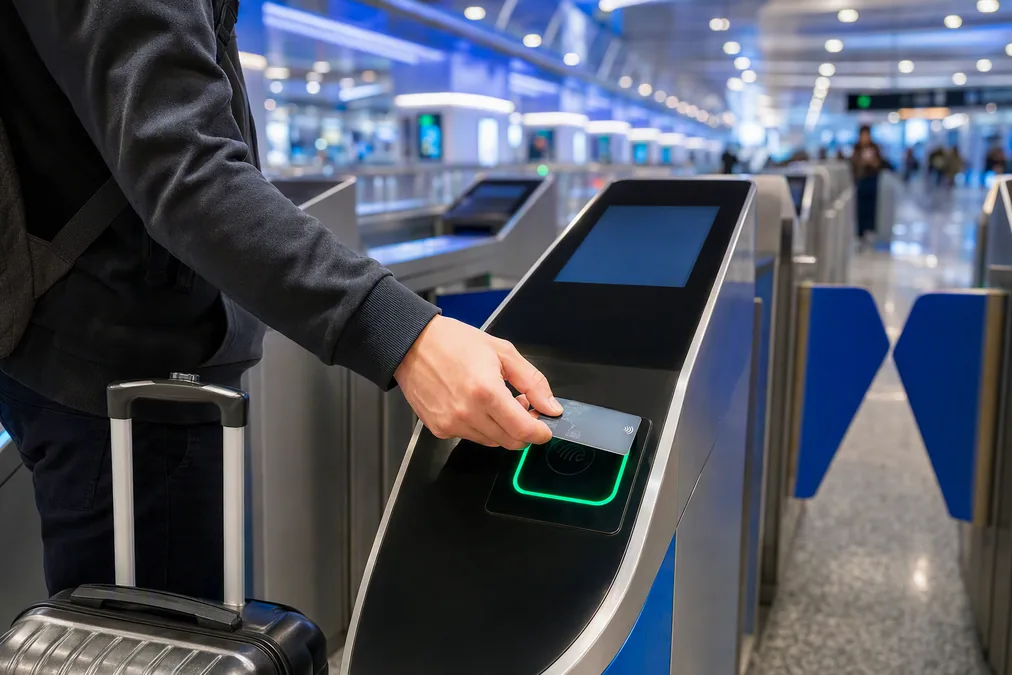
You can also skip the ticket office entirely and tap in at the gate: a Visa, Mastercard, American Express or JCB card with contactless payment enabled is accepted at the full ¥50 fare, as are Chinese-issued UnionPay contactless cards, the Shanghai metro apps' ride codes and a digital-yuan hard wallet. The airport's maglev page has the current timetable.
Metro Line 2 serves both Pudong terminals and is the only metro line at the airport; it runs right through the center and on to Hongqiao Airport Terminal 2. It's the cheapest way in and the slowest — a long ride with many stops, so it suits a light bag and no hurry. The fare shows on the ticket machine, and the first and last trains are on our Shanghai last-trains page. Check the Line 2 map against your hotel — it passes the Lujiazui and Nanjing Road stops.
The Airport Link Line (市域机场线, Shìyù Jīchǎngxiàn) is a fast rail line from the Pudong terminals to Hongqiao Terminal 2, every 15 minutes from 06:00 to 22:15. It doesn't serve the city center, so it's the choice when you're heading to the Hongqiao side of town, to Hongqiao railway station for a train, or to the other airport. The fare is on the ticket machine.
Airport buses run from both terminals (these are airport bus lines, not the metro lines with the same numbers): Airport Bus Line 4 (机场四线) to Shanghai railway station's north square for ¥2–28, Airport Bus Line 7 (机场七线) to Shanghai South railway station for ¥4–20, and the overnight line to the Hongqiao hub for ¥18–34. Bus Line 4 runs 07:00–23:00 from Terminal 1 (07:03–23:03 from Terminal 2) every 20–70 minutes; bus Line 7 runs 07:30–23:00 (07:35–23:05 from Terminal 2) every 25–45 minutes. Take a bus only if it ends near your hotel; otherwise the train is more predictable.
Taxis leave from official stands outside arrivals door 12 at Terminal 1 (from door 4 or 8, walk south) and outside arrivals door 26 at Terminal 2, both staffed 24 hours. Ignore anyone offering a car inside the terminal. The meter starts at ¥14 for the first 3 km (¥16 in certain models — Touran MPVs and Roewe Ei5 electrics) and runs at ¥2.7 per kilometer, with the per-kilometer rate rising 50% for the part of any trip beyond 15 km and everything up 30% between 23:00 and 05:00; an airport run into the center is long enough that the beyond-15-km rate applies to a good part of it. For a figure before you get in, price the same trip in the DiDi app — see our DiDi guide — and show the driver your hotel's name in Chinese.
Hongqiao (SHA): terminals, metro and the railway station
Hongqiao's two terminals are on opposite sides of the runways and have different metro service: Terminal 1 has Line 10 only, Terminal 2 has both Line 2 and Line 10. Line 10 links the two terminals with each other and with Hongqiao railway station; Line 2 runs from Terminal 2 through the center of the city and on to Pudong Airport. For most hotels, Line 2 from Terminal 2 is the ride; from Terminal 1, take Line 10 across to Terminal 2 and change to Line 2, or take a taxi. The airport's rail transit page maps the lines.
Terminal 2 and Hongqiao railway station are part of the same hub, so if you're catching a train, follow the signs for 虹桥火车站 — it's an indoor walk, no need for the metro. From Terminal 1, Line 10 takes you across. Taxis leave from outside arrivals door 1 at Terminal 1 and door 4 at Terminal 2, at the same city meter rates as above.
Between the two airports
Three ways, in order of preference. The Airport Link Line is built for exactly this: from the Pudong terminals it runs every 15 minutes from 06:00 to 22:15, and from Hongqiao Terminal 2 from 05:45 to 22:00; the fare is on the ticket machine, and the platform screens show the journey time. Metro Line 2 does the same trip for a standard metro fare, all the way from the Pudong terminals to Hongqiao Terminal 2, but with every stop in between, so it's for a long layover and a light bag. A taxi is the fallback outside those hours: the ride is well beyond the 15 km mark where the per-kilometer rate rises 50%, and 30% more again at night, so price it in DiDi first. Between 23:00 and 05:30 the overnight airport bus from Pudong runs to the Hongqiao hub for ¥18–34; in daytime there's no bus worth choosing over the Airport Link Line. Whichever you take, treat a cross-airport connection as a half-day job: your bags have to be collected and re-checked, and check-in at the second airport closes well before departure. Our advice: allow at least three hours between the flights, book both on one ticket if you can so the airline is responsible for the connection, and on separate tickets allow even more time.
Landing late
The maglev's last train from the airport is at 21:42 and the Airport Link Line's at 22:15; Line 2's last train is on our Shanghai last-trains page. After that, two things keep running. The overnight bus to the Hongqiao transport hub leaves Terminal 1 between 23:00 and 05:30 (Terminal 2 from 23:03), departing when full and at most every 30 minutes, for ¥18–34 depending on where you get off — it makes stops on the way, so tell the driver yours. And the taxi stands at both terminals are 24-hour, with the 30% night surcharge on the meter between 23:00 and 05:00. If you land after 1 am and fly on in the morning, an airport hotel is the practical choice — Booking Com lets you filter by distance to Pudong and pick one you can walk to.
Leaving: how early, and moving between terminals
Leaving early in the morning: the first maglev toward the airport leaves Longyang Road at 06:45; the first Airport Link Line train leaves Hongqiao Terminal 2 at 05:45; airport bus Line 4 starts from the city at 05:00 and bus Line 7 at 06:30. For a dawn departure from Pudong, a taxi or a night at an airport hotel is more reliable than any of them.
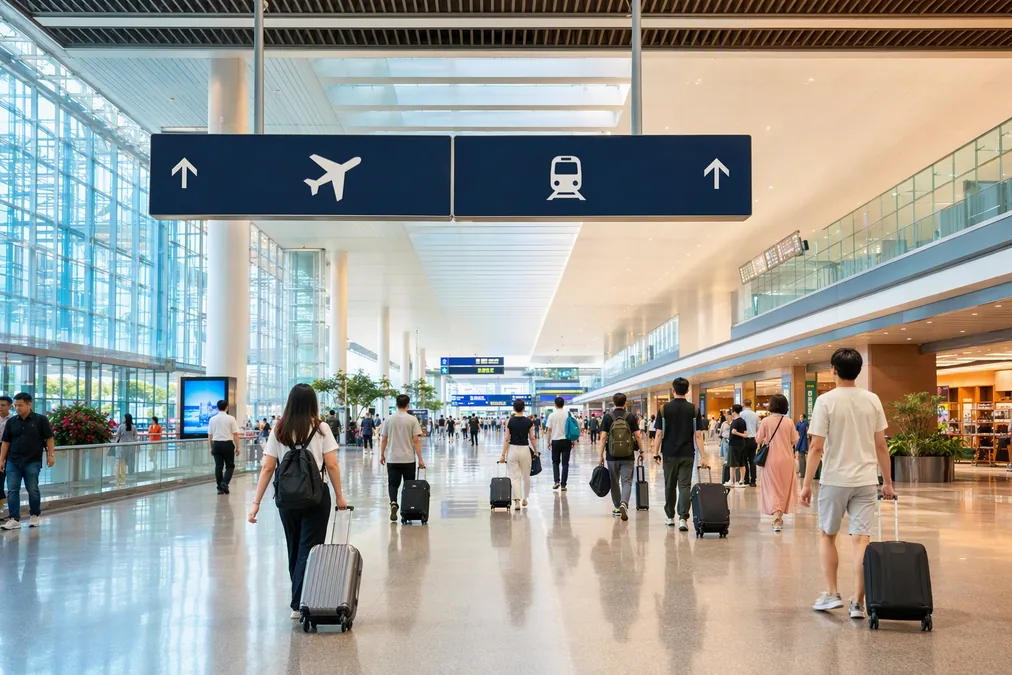
Check-in closes earlier than many visitors expect. Airports set the cutoff themselves; one airline's published list gives 40 minutes before departure for domestic flights at Pudong, 30 at Hongqiao, and typically 60 for international — your own airline's app shows the exact time for your flight. Our timing: be inside the terminal three hours before an international departure from Pudong, and 90 minutes before a domestic flight at either airport with a bag to check. Pudong's two terminals are connected — follow the signs, and give yourself 20 minutes if you're in the wrong one. At Hongqiao, Terminals 1 and 2 are on opposite sides of the airport; Line 10 links them, so check the terminal on your ticket before you set off. What happens once you're inside — baggage rules, the liquids and power bank checks — is in domestic flights in China.
Frequently Asked Questions
PVG and SHA — which airport is which, and where do international flights land?
PVG is Pudong International Airport, east of the city; SHA is Hongqiao International Airport, west of the center next to Hongqiao railway station. Long-haul international flights use Pudong almost without exception; Hongqiao is mainly domestic, with a small number of short international routes. The code is printed on your ticket and boarding pass — read it before you leave the hotel.
Is the maglev worth it, and how much time does it save over Line 2?
Worth it once, for the ride itself and for the speed over the stretch it covers. It runs to Longyang Road only, so compare the whole trip: maglev at ¥50 (¥40 with a transport card; or the ¥55 combo, which adds 24 hours of metro) plus a metro or taxi from Longyang Road, against Line 2 all the way at a standard fare. The maglev wins on time by a wide margin for anywhere on the east side of the city and for Lujiazui; for the far west it's closer to even once you add the change. It's daytime only — 07:02 to 21:42 from the airport — so a late arrival makes the decision for you.
Can I pay for the maglev and the metro with Alipay or WeChat, or a foreign card?
At the maglev gates, a foreign Visa, Mastercard, American Express or JCB card with contactless enabled taps straight in at ¥50, and the Shanghai metro apps' ride codes are accepted too. For the metro itself, the ticket machines list what they accept, and whether your particular foreign card, ride code or Alipay setup works at a given gate is shown on the signage at the gate — check there on the day. The dependable answer for the whole trip is Alipay with your foreign card linked, set up before you fly — see how to use Alipay with foreign cards.
How much is a taxi from Pudong to the Bund?
The meter is the price, and its parts are public: ¥14 for the first 3 km, ¥2.7 per kilometer after that, 50% more per kilometer for the part beyond 15 km, and 30% on top between 23:00 and 05:00. The ride to the Bund is a long one, so the beyond-15-km rate applies to much of it. For a number before you commit, price the trip in the DiDi app from the arrivals hall — its estimate tracks the meter closely — and use the official stand outside door 12 at Terminal 1 or door 26 at Terminal 2, never a car offered inside.
The short version
On a budget: Line 2 from either airport; at Pudong, the maglev-plus-metro combo if you want the ride. Short on time: maglev then taxi from Pudong; taxi from Hongqiao. Lots of luggage: the official taxi stand at either airport, priced in DiDi first. For the city itself once you're in, see the Shanghai complete guide, and for the other big hubs, airport-to-city transfers across China.
Last updated: August 2026
Read in other languages
Last train times for 10 Chinese metro systems
Every line and station, checked by hand — the same data behind our offline route planner.
Get the WaysChina App
Offline guides, currency converter, essential phrases, and more — all in your pocket.

Related Articles

Airport to City in China: Trains, Taxis and Last Departures at 10 Major Airports
How to get from China's ten busiest airports into the city: the rail link from each terminal, published fares, the...

Beijing Airports Guide: Capital (PEK) and Daxing (PKX) to the City
Capital or Daxing, and how to get into Beijing from each: the two Airport Express lines with fares and last trains,...

Domestic Flights in China: Booking, Baggage, Security Rules and Delays
Flying inside China with a foreign passport: how to book, the weight-based baggage rules, why liquids and unmarked...