
This article contains affiliate links. If you make a purchase through these links, we may earn a small commission at no extra cost to you. This helps support our work in creating free travel guides.
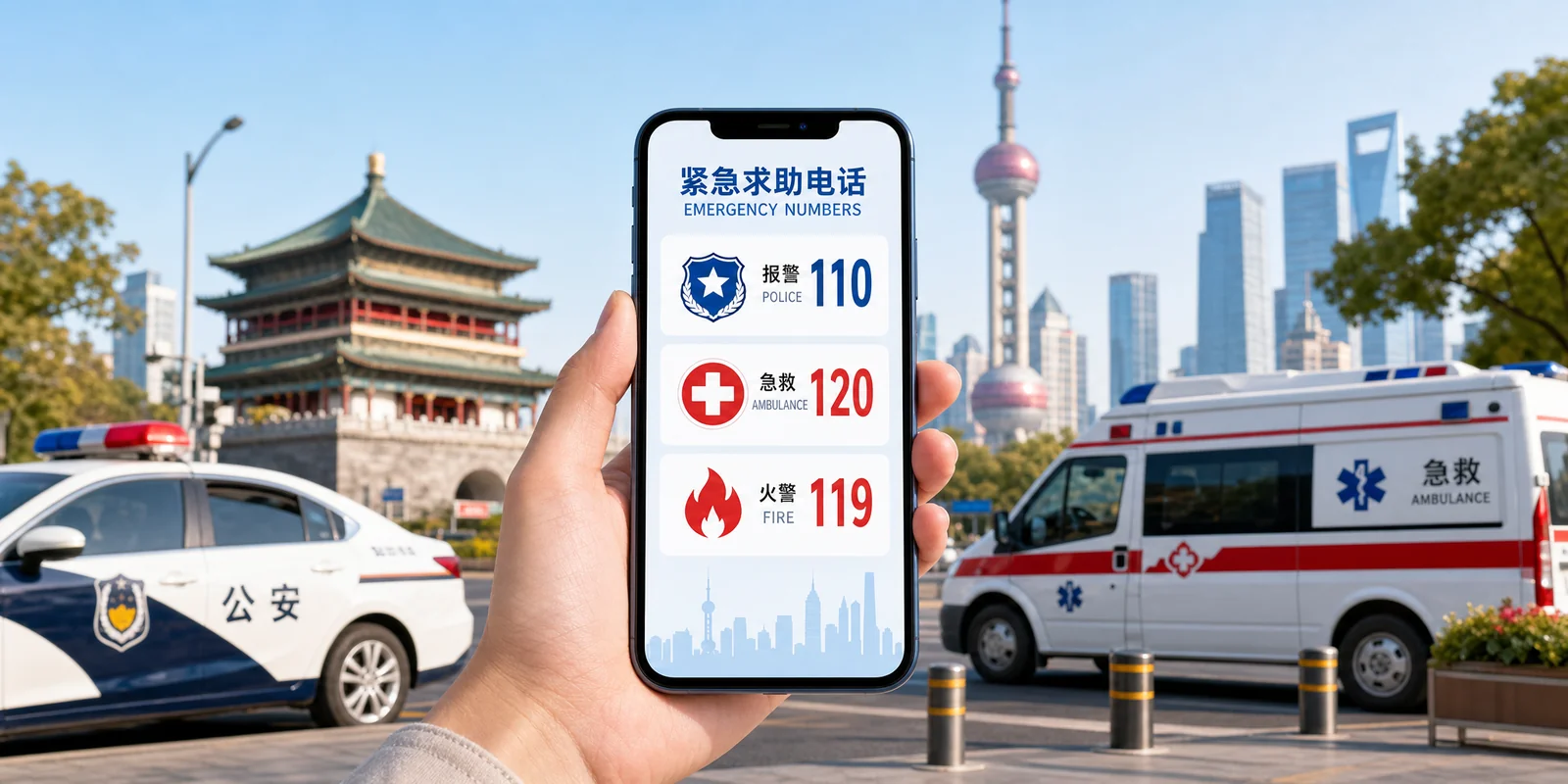
China does not have a single all-purpose emergency number like 911 or 112. Instead, you dial a different three-digit number depending on what's happening: 110 for police, 119 for fire, 120 for medical emergencies, and 122 for traffic accidents. All of these are free to call, work 24 hours a day, and connect across the whole country. The catch for foreign visitors is that English support is patchy outside a few big cities, and the healthcare system isn't free. This page is your starting point for emergencies in China — it explains which number does what, what information to have ready, and where to turn for medical, police, immigration, and lost-document problems. For deeper detail on any single topic, we link to dedicated guides throughout.

The four emergency numbers you actually need
Memorize these four. They are the backbone of emergency help in China, and you can reach all of them from any phone — including a locked phone, a payphone without coins, or a foreign SIM. The phone company waives the call charge for emergency lines.
| Number | Service | Use it for |
|---|---|---|
| 110 | Police (公安, gōng'ān) | Crime, theft, assault, lost property, general emergencies, and as the default number if you're unsure who to call |
| 119 | Fire (消防, xiāofáng) | Fire, explosions, chemical leaks, people trapped, building collapse, major disasters |
| 120 | Medical (急救, jíjiù) | Serious illness or injury, chest pain, difficulty breathing, suspected stroke, heavy bleeding — anything needing an ambulance |
| 122 | Traffic accidents (交通, jiāotōng) | Road traffic accidents; also call 120 if anyone is injured |
According to the Shanghai Municipal Government's emergency guidance, 110 is the first-choice number for any emergency you can't otherwise categorize — the operator can route you. If you remember only one number, make it 110.
What to say when you call
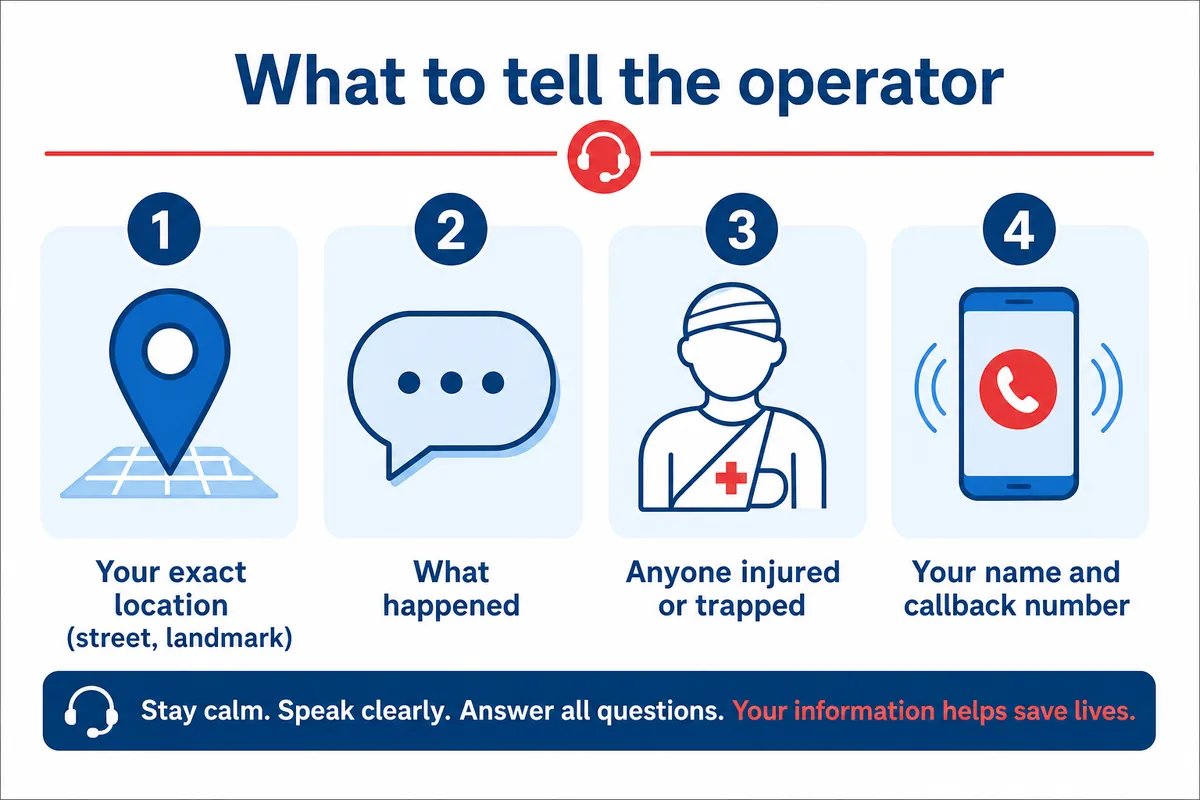
Operators need specific information fast. Whether you're calling in English or through a translation app, have these ready before you dial:
- Your exact location — street name, building number, or a clear nearby landmark (a metro station exit, a well-known store, a hotel name). This is the single most important thing.
- What's happening — the nature of the emergency in a sentence or two.
- Whether anyone is hurt or trapped, and roughly how many people are involved.
- Your name and a phone number they can call back on.
Stay on the line until the operator tells you to hang up. If you don't speak Chinese and you're not in a city with multilingual support, the fastest fix is often to ask a nearby Chinese speaker — a hotel front desk, a shop staffer, a passerby — to talk to the operator for you while you point to the problem.
Is there any English-language emergency support?
Some cities do offer it, but coverage is uneven and you shouldn't count on it nationwide.
- Shanghai's 110 hotline offers service in eight foreign languages — English, Japanese, Russian, German, French, Spanish, Arabic, and Korean — per the city government's official emergency page.
- The National Immigration Administration runs 12367, a 24/7 line with Chinese-English (and other languages) live service for visa, entry-exit, and residence questions. It's not an emergency line, but it's genuinely useful for immigration problems. The National Immigration Administration publishes the contact details; dial it with the local area code (for example, 010-12367 in Beijing).
- City government hotlines (12345) in Beijing and Shanghai offer multilingual service — Beijing in 10 languages, Shanghai in 18 — but these are non-emergency citizen-service lines. Use them for complaints, tourism questions, and general help, not for a crisis in progress.
For everything else, plan as if you'll need a Chinese speaker to relay information. A good translation app and the willingness to grab a stranger for help go a long way.
Medical emergencies and ambulances
For any serious medical situation — chest pain, suspected stroke, severe injury, trouble breathing, heavy bleeding — call 120. This is the nationwide ambulance number. In Beijing, note that the 120 line is now the unified emergency medical number; the older 999 line has shifted to non-emergency transport and Red Cross services, so 120 is what you want for an actual emergency.
Ambulances are not free
This surprises a lot of visitors. In China, ambulance service is billed, typically somewhere in the range of a few hundred to over a thousand yuan depending on the city and distance — this figure comes from a secondary source, so treat it as a rough guide rather than a fixed price. More importantly, the ambulance will usually take the patient to the nearest hospital with emergency capacity, not necessarily one you choose. You can suggest a hospital, but the paramedics make the final call based on the patient's condition.
Hospitals run on prepayment
Chinese public hospitals generally require payment up front, and medical bills can be substantial. Public hospitals widely accept Alipay (支付宝, Zhīfùbǎo) and WeChat Pay (微信支付, Wēixìn zhīfù); some windows take UnionPay cards, but foreign bank cards are hit-or-miss. Since 2024, policy allows linking international Visa/Mastercard credit cards to Alipay and WeChat Pay, so set that up before you arrive. Always carry your passport (or a copy) or residence permit — you'll need it to register, and emergency departments are typically open 24 hours, so you can walk in directly.
Good travel insurance with medical and evacuation coverage is the single most important thing you can arrange before a trip to China. Providers like SafetyWing offer plans aimed at travelers and long-stay visitors that include emergency medical and evacuation — worth comparing against your existing coverage before you go. For more on choosing a plan, see our dedicated guide.
If you need to find a hospital with English-speaking staff or an international clinic, our guide to finding English-speaking hospitals covers what to look for and how international departments work.
Police, theft, and crime
Call 110 for any crime — theft, scams, assault, or a lost item you think was stolen. China is, on the whole, a very safe country for travelers, and violent crime against tourists is rare. The more common issues are petty theft in crowded areas and scams aimed at foreigners.
If you're a victim of a crime, the police report (报案回执, bào'àn huízhí) you get from the local police station (派出所, pàichūsuǒ) is important — you'll need it for insurance claims and, in the case of a lost passport, for replacing your documents. There's also a nationwide SMS police-reporting number, 12110, though official English guidance on how to use it is limited, so don't rely on texting in English.
For how to recognize and avoid the common setups targeting visitors — the tea ceremony scam, fake taxis, art-student approaches — read our guide to tourist scams in China.

Lost or stolen passport
Losing your passport is stressful but the process is well-defined. Here's the sequence, drawn from the official guidance published by the Shanghai and Beijing municipal governments:
- Report it at the nearest police station (派出所) and get a Loss Report Receipt (报案回执). In Beijing this step is free and handled on the spot.
- Take that receipt to the local Exit-Entry Administration Bureau (公安局出入境管理部门) of the Public Security Bureau and apply for a Confirmation of Passport Loss. This is also free. You'll typically need around three passport-size color photos, some form of ID (a passport copy, your national ID, driver's license, or student card), and the police receipt.
- Go to your country's embassy or consulate in China to apply for a new passport or an emergency travel document. This is your government's job, not China's — each embassy has its own process and fees.
- Return to the Exit-Entry Administration with your new passport to get a replacement visa or residence permit, as required under Article 35 of China's Exit and Entry Administration Law.
This is exactly the kind of situation where keeping a photo of your passport's photo page on your phone, plus a printed copy stored separately from the original, pays off. For the full step-by-step, including what to bring and how long each stage takes, see our dedicated guide to handling a lost passport in China, and our embassy contacts list for reaching your own consulate.
Immigration and accommodation registration
One rule that catches travelers off guard: every foreigner in China must register their accommodation with the local police within 24 hours of arrival. If you stay in a hotel, the hotel handles this for you automatically at check-in. If you stay anywhere else — a guesthouse, a rented apartment, a friend's home — you (or your host) are responsible for registering at the local police station within 24 hours, under Article 39 of the Exit and Entry Administration Law.
This isn't an emergency, but it becomes one if you're caught without it: failure to register can bring a warning and a fine of up to 2,000 yuan under Article 76. The good news is that the National Immigration Administration now allows online registration for non-hotel stays through its government services platform, with the same legal effect as registering in person. If you're not sure of the current platform or app, ask your host or check the NIA site.
Other numbers worth knowing
| Number | What it's for |
|---|---|
| 12367 | National Immigration Administration — 24/7 bilingual help for visa, entry-exit, and residence questions |
| 12345 | City government citizen-service hotline (non-emergency); multilingual in Beijing and Shanghai; also handles tourism complaints and questions since the old 12301 tourism line was merged into it |
| 12395 | Maritime search and rescue — water emergencies and distress at sea |
| 12110 | SMS police reporting (limited English guidance) |
One number you'll see mentioned for foreigners is 12308, China's consular protection hotline. Be clear about what it is: it's run by China's Ministry of Foreign Affairs and serves Chinese citizens abroad, not foreign tourists inside China. As a non-Chinese visitor, your equivalent is your own country's embassy or consulate. If anyone calls claiming to be "12308" asking you to "cooperate with an investigation" or pay a fee, it's a scam — that line doesn't make outgoing calls.
Quick decision guide
| Situation | What to do |
|---|---|
| Someone collapses / serious injury | Call 120. Carry the patient's passport. Expect to prepay at the hospital. |
| Theft, scam, assault, lost item | Call 110 and get a police report receipt. |
| Fire, gas leak, people trapped | Call 119. |
| Car accident | Call 122; add 120 if anyone is hurt. |
| Lost passport | Police station → Exit-Entry Bureau → your embassy → new visa. |
| Visa / registration / entry-exit question | Call 12367 or check the NIA site. |
| Not sure who to call | Call 110. They can route you. |
Before you go: a short checklist
- Save 110, 119, 120, and 122 in your phone, and write them somewhere offline too.
- Buy travel insurance that covers medical treatment and medical evacuation.
- Link an international card to Alipay or WeChat Pay so you can pay at hospitals.
- Photograph your passport photo page and store a printed copy separately.
- Look up your embassy's address and 24-hour emergency line for the cities you'll visit.
- Install a translation app and know how to use it offline.
The bottom line
Emergencies in China are manageable once you know the system. There's no single number — it's 110 for police, 119 for fire, 120 for medical, and 122 for traffic, all free and available around the clock. English support exists in a few major cities but isn't guaranteed, so plan to have a Chinese speaker relay critical details if needed. Carry your passport, sort out insurance and mobile payments before you travel, and keep copies of your documents. Most trips never need any of this — but the five minutes it takes to prepare is the difference between a frightening situation and a manageable one. For specific contact numbers in one place, see our emergency contacts list.
Policies, prices, and phone services change. Confirm the latest details — especially foreign-language support in your destination city and current document requirements — before you travel.
Last updated: June 2026
Read in other languages
Get the WaysChina App
Offline guides, currency converter, essential phrases, and more — all in your pocket.

Related Articles

Embassy Contacts in China: Phone Numbers & Addresses
A practical directory of major embassies and consulates in China — addresses, phone numbers, and 24-hour emergency...
China Emergency Contacts: Numbers, Hotlines & Embassies
China's emergency numbers are split by service: 110 for police, 120 for ambulance, 119 for fire. Here's the full...

Finding English-Speaking Hospitals in China
A practical guide to finding English-speaking doctors and international hospitals in China — emergency numbers, who...
Lost Passport in China: What to Do Step by Step
Lost or had your passport stolen in China? Here's the exact order of steps — police report, loss confirmation,...