
This article contains affiliate links. If you make a purchase through these links, we may earn a small commission at no extra cost to you. This helps support our work in creating free travel guides.
Xi'an's big draw is inside the city — the Terracotta Army, the city wall, the Muslim Quarter. But once you've covered those, the area around Xi'an holds some of the most interesting half- and full-day trips in northwest China: one of the country's five sacred mountains, an imperial tomb you can walk straight into, and a temple that turned out to be hiding a relic of the Buddha for over a thousand years.
This guide covers four trips that work well from a Xi'an base: Mount Huashan, Famen Temple, Qianling Mausoleum, and Hanyangling Museum. For each one you get how to get there, how hard it is, and how much time to set aside, so you can match the trip to the kind of day you want.

Quick comparison
If you only have time for one or two of these, this table sorts out what each trip actually involves.
| Destination | Distance from Xi'an | Travel time (one way) | Physical difficulty | Time needed |
|---|---|---|---|---|
| Mount Huashan (华山) | ~120 km east | 30–40 min by train | High (cable car options reduce it) | Full day |
| Famen Temple (法门寺) | ~120 km west | 1.5–2 hrs | Low | Full day |
| Qianling Mausoleum (乾陵) | ~80 km northwest | 1.5–2 hrs | Low–moderate (some walking and stairs) | Half to full day |
| Hanyangling Museum (汉阳陵) | ~20 km north | 40–60 min | Low | Half day |
Mount Huashan: the sacred mountain
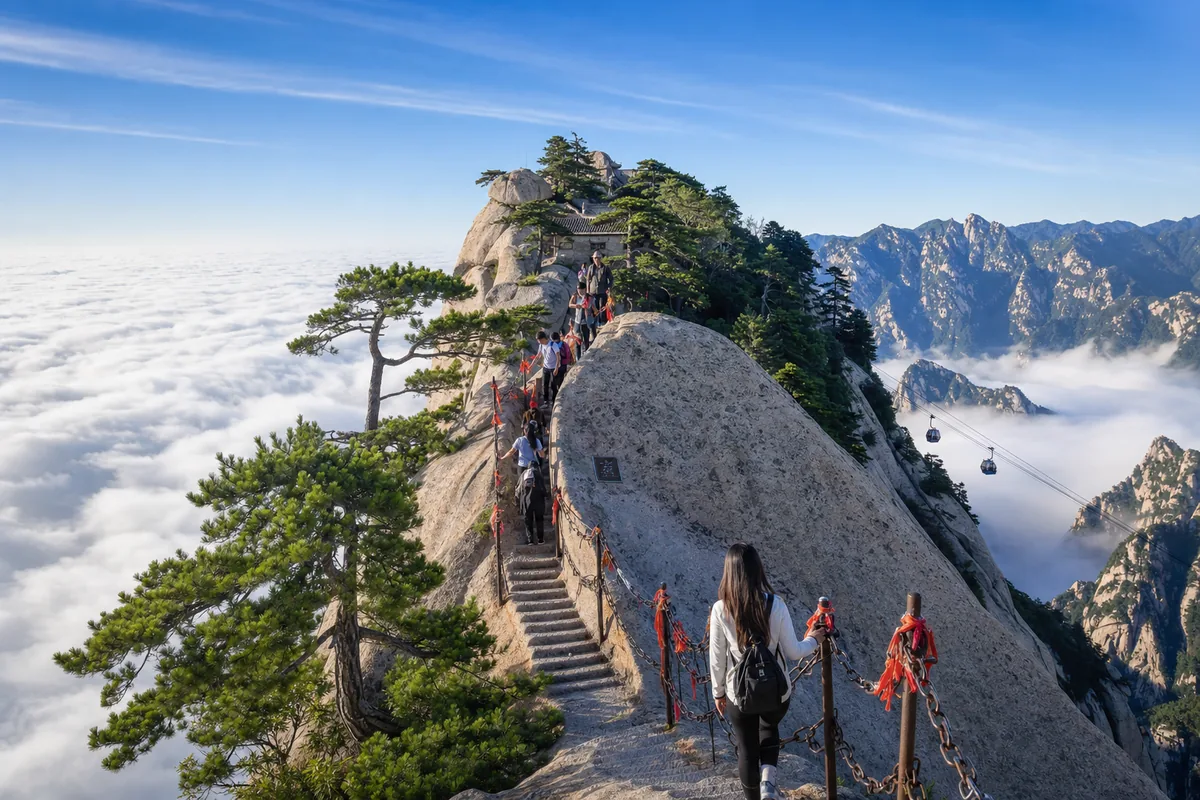
Mount Huashan (华山, Huàshān) is the western peak of China's Five Great Mountains and easily the most dramatic day trip from Xi'an. It's famous for granite cliffs, narrow ridge trails, and a reputation as one of the more demanding climbs in the country. It's also genuinely accessible — there are two cable cars, so you don't have to be a serious hiker to reach the top.
Getting there
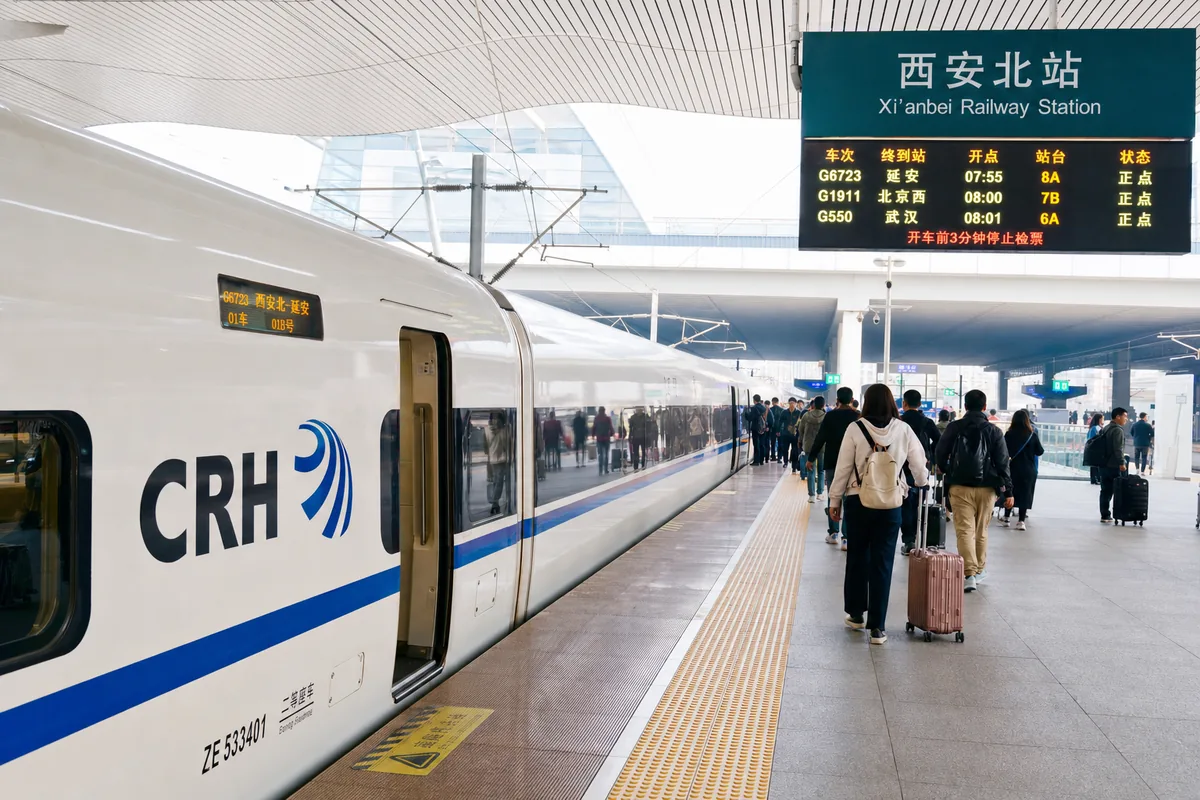
The easiest way is the high-speed train (高铁, gāotiě) from Xi'an North Station (西安北站) to Huashan North Station (华山北站). The ride takes 30–40 minutes, and trains run frequently throughout the day. From Huashan North Station, a free or low-cost shuttle bus connects to the mountain's tourist center, where you buy your entrance ticket and cable car tickets.
You can book high-speed rail tickets through the official 12306 platform or through Trip.com, which has an English interface and accepts foreign cards — useful if you'd rather not deal with the Chinese-only booking flow. Either way, book a day or two ahead in peak season.
The climb and the two routes
There are two main ways up. The North Peak cable car is the classic option: it drops you partway up, and from there a network of stone paths and stairs connects the North, East, South, and West peaks. The West Peak cable car is longer and goes higher, so it's the choice if you want to minimize climbing.
If you take a cable car up and walk between the peaks, expect a moderate day of stairs and ridge paths — steep in places, with chains and railings, but manageable for anyone reasonably fit. If you climb the whole thing on foot from the base, that's a serious multi-hour effort and not really a relaxed day trip.
The famous "plank walk" (长空栈道) — wooden boards bolted to a sheer cliff face — is an optional add-on near the South Peak. You clip into a safety harness. It's a paid extra and there's often a long queue. Skip it if you're short on time or uneasy with heights; the regular trails already deliver the views.
Timing
Treat Huashan as a full day. A realistic plan: early train out of Xi'an, on the mountain by mid-morning, several hours exploring the peaks, and an afternoon or early-evening train back. If you want to catch sunrise from the East Peak, some visitors stay overnight on the mountain — but that turns it into a two-day trip.
Famen Temple: the Buddha's finger relic
Famen Temple (法门寺, Fǎmén Sì) sits about 120 km west of Xi'an. Its claim to fame is extraordinary: in 1987, archaeologists opened a sealed crypt beneath the temple's collapsed pagoda and found a finger bone relic of the Buddha, along with thousands of Tang dynasty (618–907) treasures — gold, silver, glass, and silk — that had been sealed away for over 1,100 years.
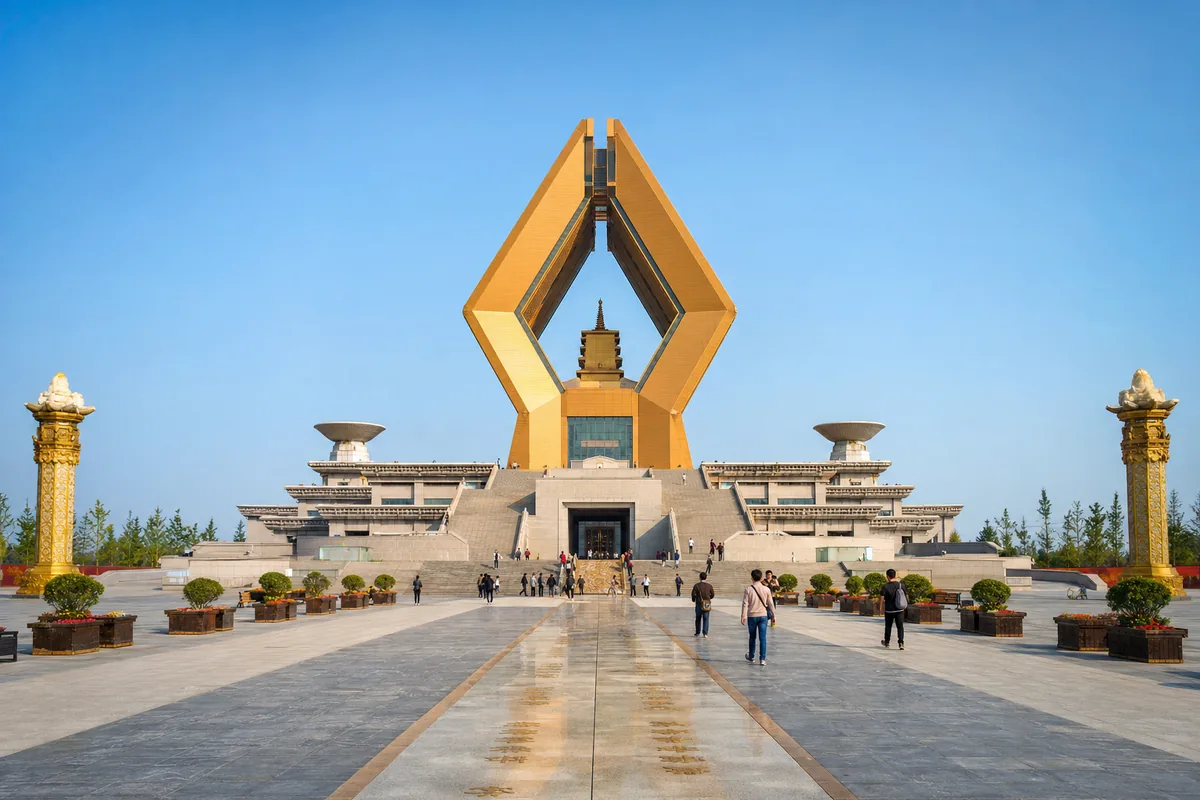
The site today has two parts. The old temple and museum hold the original crypt and the Tang treasures, which are genuinely world-class artifacts. The newer Namaste Dagoba area is a huge modern complex built in the 2000s, with a long ceremonial avenue leading to a towering golden hall where the relic is displayed on special occasions. Reactions to the modern section are mixed — some find it impressive, others find it overbuilt. The historic crypt and museum are the real reason to come.
Getting there
Famen Temple is the trickiest of these four to reach by public transport. Options:
- Tourist bus: Seasonal direct buses run from near Xi'an Railway Station (火车站) — convenient when operating, but schedules vary by season, so confirm before relying on it.
- Train + local bus: Take a train or bus to Fufeng (扶风) county, then a local bus or taxi to the temple. Doable but involves connections.
- Organized day tour: Many travelers combine Famen Temple with Qianling Mausoleum in a single guided day trip, which removes the transport headache. You'll find these on Klook and similar platforms.
Difficulty and timing
Physically this is an easy trip — flat walking, with a lot of ground to cover in the modern complex. The challenge is purely logistical. Set aside a full day given the distance and the size of the site. Allow at least two hours on-site to do the museum and crypt justice.
Qianling Mausoleum: a tomb you walk up to
Qianling Mausoleum (乾陵, Qiánlíng) is the joint tomb of Emperor Gaozong of Tang and Empress Wu Zetian — China's only female emperor in her own right. It's built into a natural mountain about 80 km northwest of Xi'an, and unlike many imperial tombs, the main burial chamber has never been excavated.
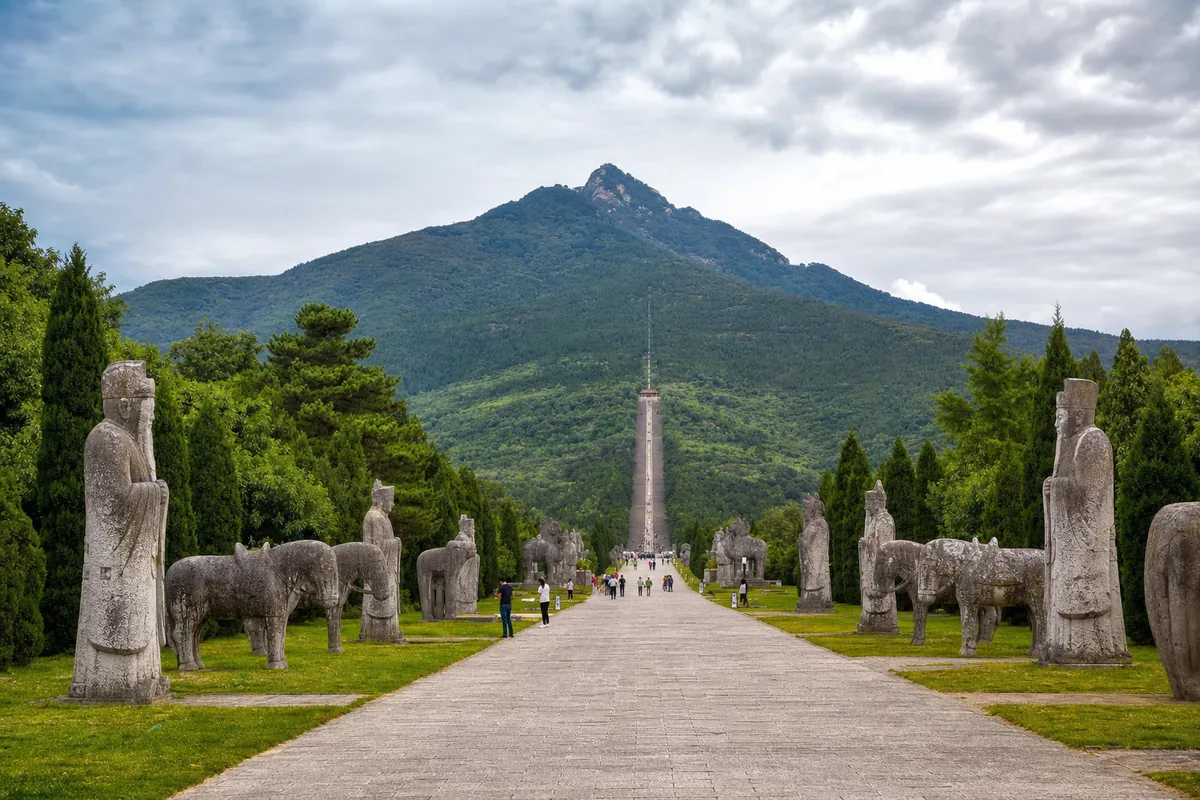
What you actually see is the approach: a long ceremonial pathway, the Sacred Way (神道), lined with large stone statues of animals, officials, and foreign envoys. Two famous features stand out — the pairs of stone guardians, and the "wordless stele" (无字碑), a blank memorial tablet left without inscription, which has fueled centuries of speculation about why Wu Zetian's monument carries no text.
The broader Qianling area also includes several satellite tombs of princes and princesses, some with vivid Tang dynasty wall murals. The Princess Yongtai tomb is a common stop — you can descend into the burial passage and see the paintings.
Getting there
Qianling is in Qian County (乾县). The most reliable independent route is a bus from one of Xi'an's bus stations toward Qian County, then a local taxi to the site. As with Famen Temple, many visitors find it simpler to take a combined day tour, since the two sites are in the same general direction northwest of the city.
Difficulty and timing
Mostly easy walking, with some gentle uphill stretches and stairs along the Sacred Way and into the satellite tombs. Comfortable shoes are enough. The mausoleum itself can be seen in a couple of hours; combined with satellite tombs or with Famen Temple, it fills a day.
Hanyangling Museum: the easy half-day
If the others sound like a commitment, Hanyangling (汉阳陵, Hànyánglíng) is the relaxed choice. It's the tomb of Emperor Jingdi of the Han dynasty (206 BCE–220 CE) and his empress, only about 20 km north of central Xi'an — close to the airport, which makes it a smart stop on an arrival or departure day.
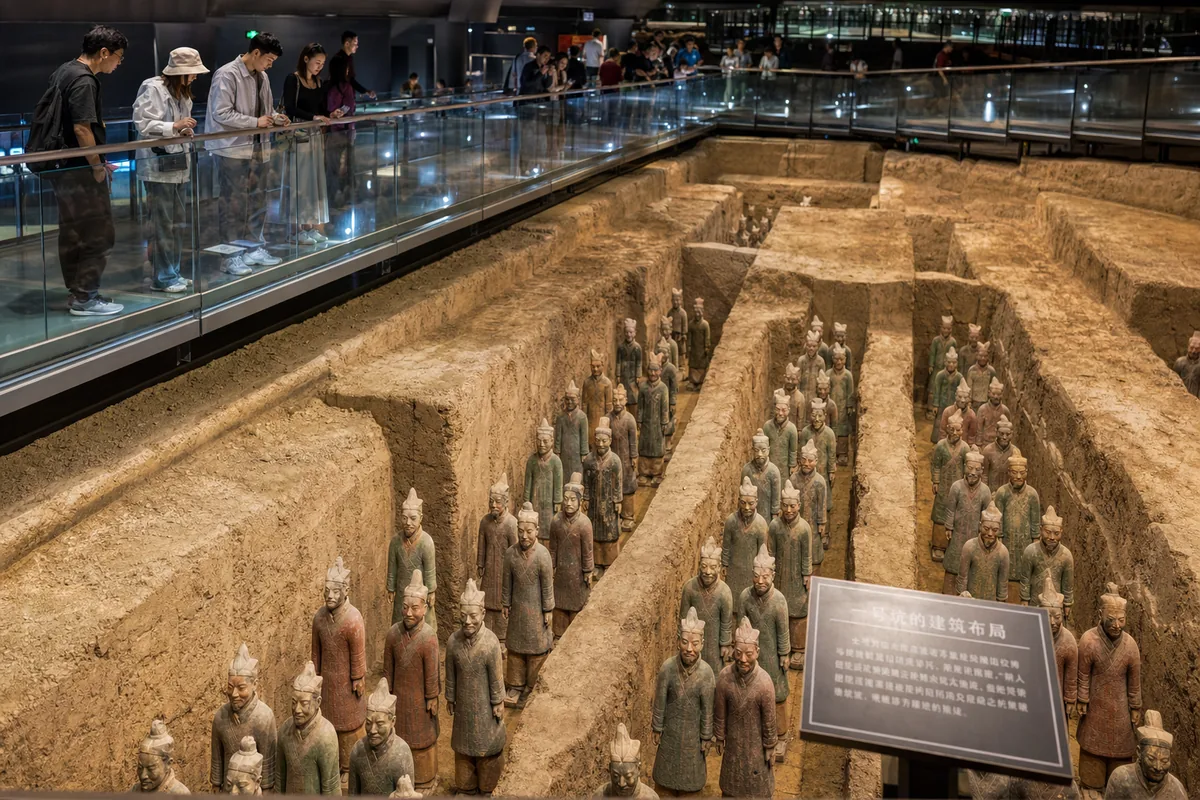
The highlight is the underground museum. Glass walkways let you stand directly above the excavated burial pits, looking down at thousands of miniature terracotta figures — about a third life-size, originally clothed and with wooden arms that have long since decayed. They're smaller and gentler than the famous Terracotta Army, and the museum's lighting and design make it one of the better-presented archaeological sites near Xi'an. There are also figures of animals and everyday objects, which paint a picture of Han court life rather than war.
Getting there
Because it's close to the city and the airport, Hanyangling is reachable by taxi or ride-hailing in 40–60 minutes from central Xi'an. There are also tourist and local buses heading toward the airport area that stop nearby. A ride-hailing app makes this the most straightforward of the four trips to organize on your own.
Difficulty and timing
This is an easy, flat, indoor-heavy visit — comfortable in any weather, and good for travelers who don't want a physically demanding day. Two to three hours on-site is plenty, which is why it works so well as a half-day or an add-on to airport timing.
Planning your trips
A few practical notes that apply across all four:
- Best seasons: Spring (March–May) and autumn (September–November) are ideal — mild, clear, and comfortable for Huashan especially. Summer is hot and crowded; winter brings ice risk on the mountain and shorter daylight.
- Avoid national holidays: During Golden Week and other public holidays, Huashan in particular sees enormous crowds and long cable car queues. If your dates overlap a holiday, go early or pick one of the quieter sites.
- Tickets and times: Entrance fees, cable car prices, and opening hours change. Check the latest before you go, and book high-speed train seats ahead in busy periods.
- Combine wisely: Famen Temple and Qianling sit in the same direction (west/northwest) and pair naturally. Hanyangling pairs with airport days. Huashan is a standalone full day to the east.
For mapping out which sites fit into your remaining days in Xi'an, the WaysChina app has offline metro maps for the city and a trip planner where you can lay out a day-by-day itinerary before you leave.
Which trip should you choose?
If you want one classic experience and you're reasonably fit, take Huashan — it's the most memorable and the easiest to reach by train. If history is your thing, Qianling and Famen Temple together make a rich day, though you'll want a tour or car to smooth the logistics. And if you're short on time, low on energy, or working around a flight, Hanyangling delivers a lot for half a day with minimal effort.
All four are doable from a Xi'an base without overnight stays, except Huashan if you choose to chase sunrise. Match the trip to your energy and your schedule, check current ticket and transport details before you set out, and you'll get far more out of the region than the Terracotta Army alone.
For deeper city context, see our Xi'an Complete Guide and the 2-Day Xi'an Itinerary to slot these day trips into your plans.
Last updated: June 2026
Read in other languages
Getting to the sights by metro
Terracotta Army Museum
UNESCO site with 8,000 life-size warriors guarding Emperor Qin Shi Huang's tomb.
- Huaqing Pool
Xi'an City Wall
14km Ming-era city wall, fully circumnavigable on foot or rented bicycle.
- Yongningmen
- North Avenue
- Bell Tower
Bell Tower & Drum Tower
Ming-era twin towers at the city's heart, bracketing the Muslim Quarter.
- Bell Tower
Muslim Quarter (Hui Min Jie)
Halal food street with lamb skewers, biang-biang noodles and roujiamo since the Tang dynasty.
- Bell Tower
- North Avenue
Big Wild Goose Pagoda
Tang-era 7-story pagoda built by Xuanzang to house Buddhist sutras from India.
- Great Wild Goose Pagoda
Shaanxi History Museum
Top museum for Tang-era treasures and Silk Road artifacts; book ahead online.
- Great Wild Goose Pagoda
- Xiaozhai
Small Wild Goose Pagoda
Tang-era 13-story pagoda paired with the Xi'an Museum (free entry).
- Nanshaomen
- Wenyi Road
Tang Paradise (Datang Furong Park)
Tang-themed cultural park with nightly water-screen movie and palace re-creations.
- TangParadise
Tang Eternal City (Datang Everbright City)
Tang-themed pedestrian street with viral 'Living Statue Lady' street performance.
- Datang Everbright City
- Great Wild Goose Pagoda
Forest of Stelae Museum (Beilin)
World's largest collection of stone tablets — 11,000+ inscriptions, calligraphy treasury.
- Yongningmen
- Bell Tower
Huaqing Palace Hot Springs
Tang-era imperial hot springs and site of Yang Guifei's bathing chamber.
- Huaqing Pool
Datang West Market Museum
Reconstructed Tang-dynasty Silk Road market, with archaeology museum below.
- Datangxishi
Xi'an North Railway Hub
Massive high-speed rail hub linking Xi'an to all of central China.
- Xi'an North Railway
Xi'an Xianyang International Airport
Northwest China's main international airport (XIY); located 30 km northwest of central Xi'an.
- Airport
- Airport West
Xi'an metro: last train times by station
Every line and station, checked by hand — the same data behind our offline route planner.
Get the WaysChina App
Offline guides, currency converter, essential phrases, and more — all in your pocket.

Related Articles
2-Day Xi'an Itinerary: Terracotta Warriors, City Wall & More
A practical 2-day Xi'an itinerary with real timings and transport: the Terracotta Warriors and Huaqing Palace on Day...
Lanzhou Complete Guide
Everything you need for visiting Lanzhou: the famous beef noodles, the Yellow River waterfront, the Gansu Provincial...
Xi'an Food Guide
What to eat in Xi'an and where to find it — from biangbiang noodles and roujiamo to lamb soup in the Muslim Quarter,...

Xining & Qinghai Lake Guide
Xining is the gateway to Qinghai Lake, Chaka Salt Lake, and the Ta'er Monastery. Here's how to plan 2-3 days at...