
This article contains affiliate links. If you make a purchase through these links, we may earn a small commission at no extra cost to you. This helps support our work in creating free travel guides.
Xi'an is a wheat city, not a rice city. That single fact explains most of what you'll eat here: hand-pulled noodles, flatbread stuffed with braised meat, dumplings, and bread torn into bowls of soup. The food carries a strong Central Asian and Hui Muslim influence, the result of more than a thousand years as the eastern end of the Silk Road. This guide covers the dishes worth seeking out, the neighborhoods where you'll find them, and a few honest notes on which famous spots live up to their reputation and which are mostly there for the photos.
The Dishes You Came For
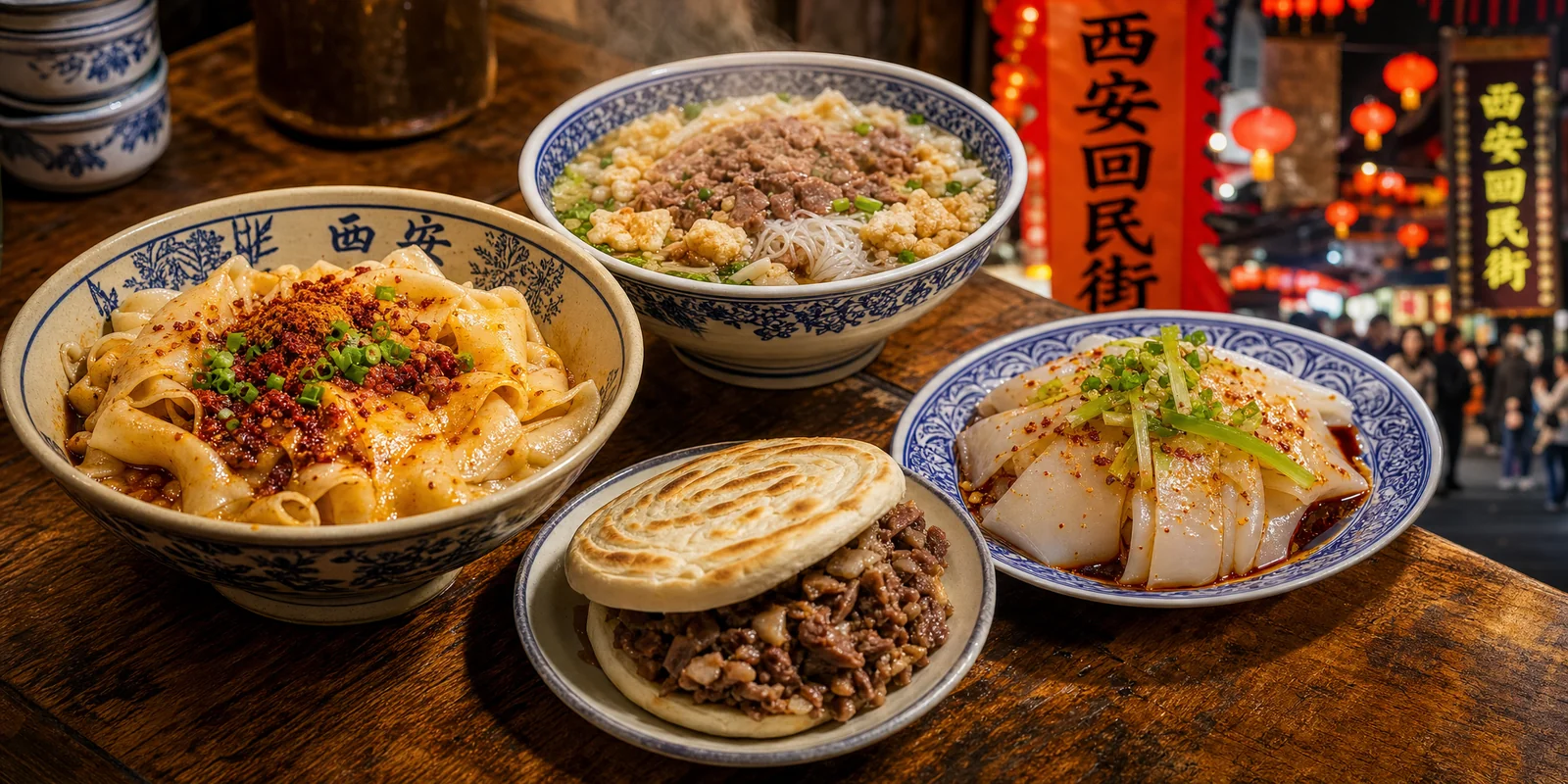
Before you start wandering, it helps to know what you're looking at. These are the staples that define Xi'an eating. Most cost between 10 and 30 RMB, and you'll find versions of all of them across the city.
Roujiamo (肉夹馍, ròujiāmó)
Often called "China's hamburger," though it predates the hamburger by a few centuries. A crisp-edged griddled flatbread (called mo) is split and packed with slow-braised pork that's been simmering in a spiced stock, sometimes for days. The good versions chop the meat with a bit of fat and a little of the gelatinous skin, then moisten it with a spoonful of the braising liquid. There's also a beef or lamb version in the Muslim Quarter, made halal. Expect to pay 8–15 RMB.
Roujiamo's partner: liangpi (凉皮, liángpí)
Cold wheat or rice noodles, springy and a little chewy, dressed with chili oil, vinegar, garlic water, and chunks of wheat gluten (mianjin). It's tangy, garlicky, and refreshing — locals often eat roujiamo and liangpi together as a set. Around 8–12 RMB.
Yangrou paomo (羊肉泡馍, yángròu pàomó)
This is the dish people travel for. You're given one or two rounds of dense, unleavened flatbread and a bowl, and you tear the bread into small pieces yourself — the smaller the better. Tradition holds that you should make them roughly the size of soybeans. The kitchen then takes your bowl, adds lamb, vermicelli, and a long-simmered mutton broth, and brings it back. Tearing the bread is part of the experience and can take 15–20 minutes; this is not fast food. A bowl runs 30–45 RMB. Pickled garlic and chili paste on the side cut the richness.
The Noodle Lineup
Shaanxi noodles deserve their own section. Northerners take wheat seriously, and the variety here goes well beyond what most visitors expect.
Biangbiang noodles (biángbiáng面)
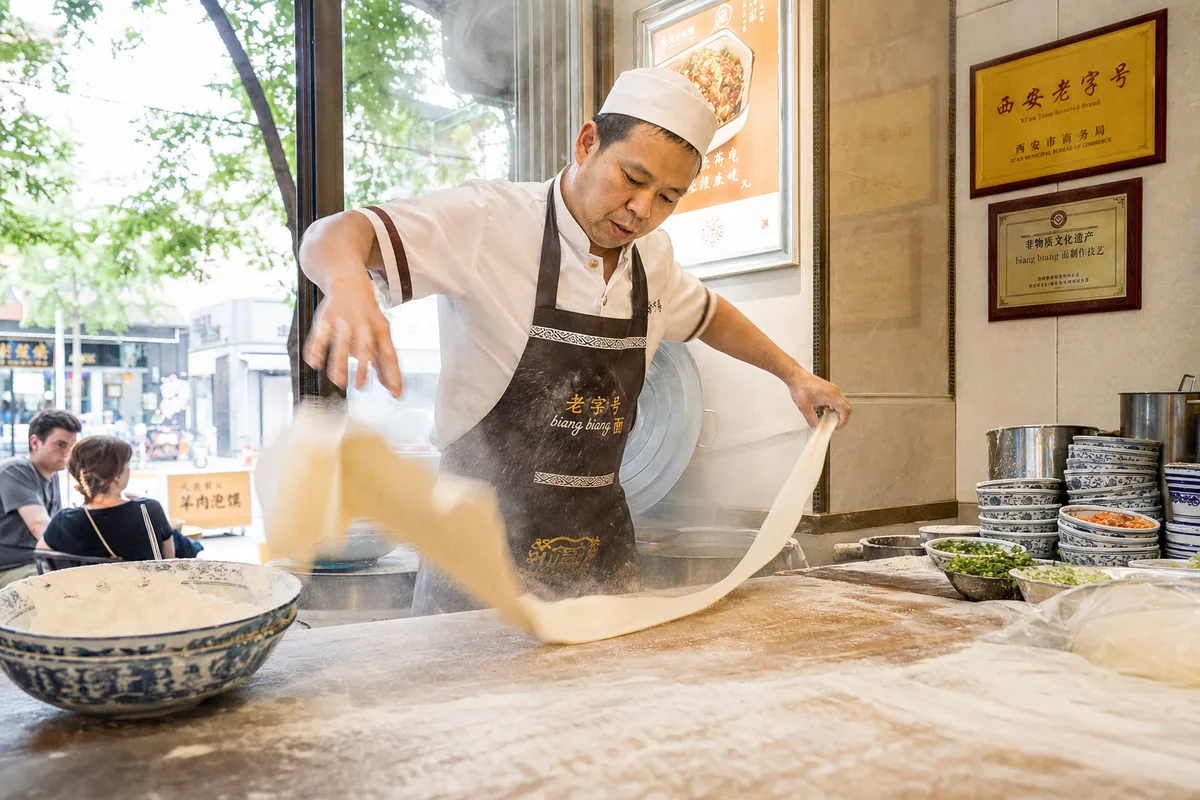
The famous one — partly because of the noodle itself, partly because its written character is one of the most complex in Chinese, with over 50 strokes, and can't be typed on a standard keyboard. The noodle is wide, thick, and as long as a belt, hand-slapped against the counter (that's the "biang biang" sound). The classic preparation is youpo (oil-splashed): a mound of chili flakes, garlic, and scallion piled on the noodles, then doused with smoking-hot oil at the table so it crackles. Toss it all together. Around 15–20 RMB.
Youpo che mian / oil-splashed noodles (油泼面, yóupō miàn)
The technique that defines Xi'an noodles. Whether on biangbiang or thinner noodles, the oil-splash finish — chili, garlic, sometimes a touch of vinegar and soy — is the local signature. Simple, but when the oil is hot enough and the chili is fresh, it's one of the best cheap meals in China.
Saozi noodles (臊子面, sàozi miàn)
A Qishan-style dish: thin noodles in a sour-and-spicy broth topped with a finely diced mix of pork, tofu, egg, and vegetables. The broth is the point — bright with vinegar, layered with chili. Traditionally eaten in small bowls, a few noodles at a time, so don't be surprised if portions look modest.
Other noodles worth trying
- Hulutou (葫芦头): not a noodle, but a related broth dish with pig intestine and bread — an acquired taste worth a mention.
- Majiang liangpi: the sesame-paste version of cold noodles, richer and nuttier than the standard vinegar dressing.
- Suan tang shuijiao (酸汤水饺): dumplings in a sour, chili-spiked soup — common in the Muslim Quarter.
The Muslim Quarter (回民街, Huímín Jiē)
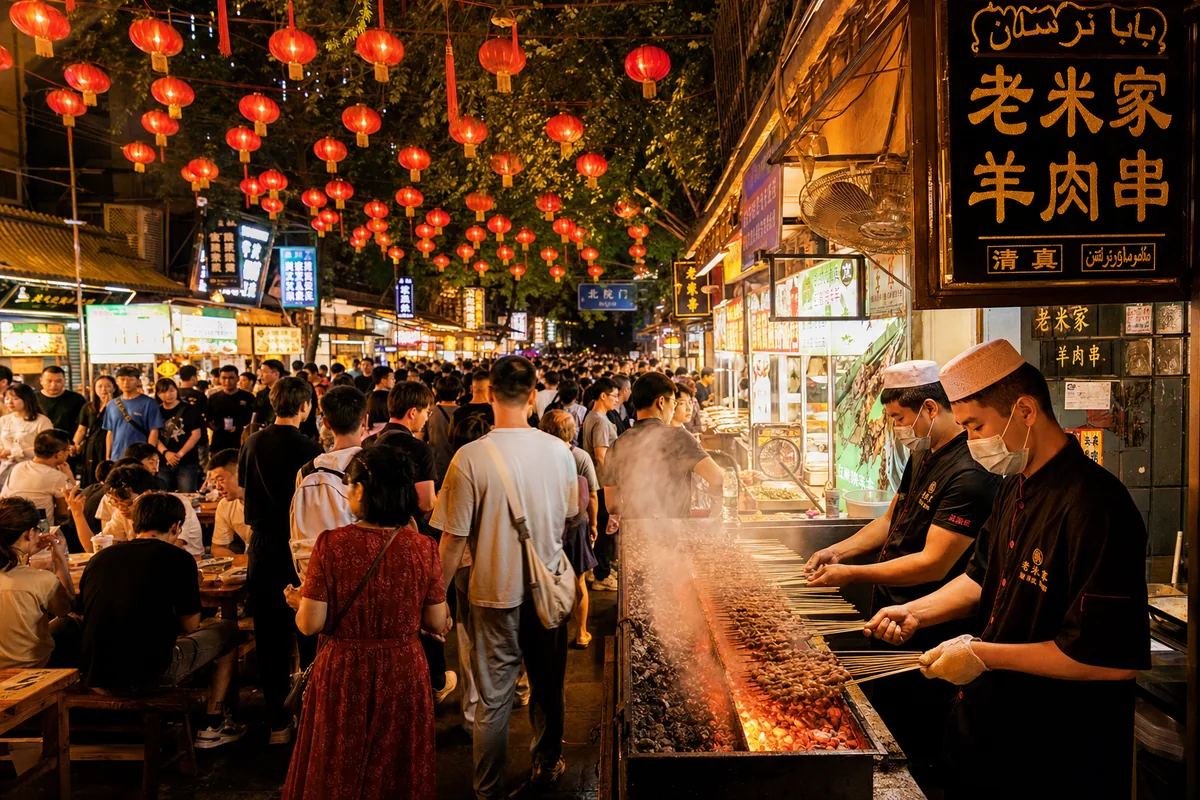
This is the neighborhood every visitor hears about, and it earns its reputation — with caveats. The Muslim Quarter is a cluster of streets behind the Drum Tower, home to Xi'an's Hui community, where halal food has been made for centuries. The main drag, Beiyuanmen, is the touristy spine: loud, packed, and lined with vendors performing for the crowd (the rhythmic pounding of peanut candy is mostly theater). It's worth seeing once, but the better food is usually a street or two off the main road.
What to eat here
- Lamb/beef roujiamo: the halal version, often better-spiced than you'd expect.
- Yangrou paomo: several long-running restaurants here; this is the traditional home of the dish.
- Grilled lamb skewers (羊肉串, yángròuchuàn): cumin-heavy, charred over charcoal, sold everywhere.
- Rose persimmon cakes (黄桂柿子饼): sweet, sticky fried cakes made from local persimmons — a genuine Xi'an specialty, not a tourist invention.
- Guantang baozi (灌汤包子): soup-filled steamed buns, often lamb or beef.
- Bingfeng (冰峰): the local orange soda. The classic combo locals order is "three treasures" — roujiamo, liangpi, and a bottle of Bingfeng.
To go deeper than wandering on your own, a guided food walk is a reasonable option — a local guide takes you to the smaller side-street stalls, explains the Hui food culture, and handles ordering. You can book a Muslim Quarter food tour on Klook if you'd rather not navigate the crowds blind on your first night.
Yongxingfang (永兴坊, Yǒngxīngfāng)
If the Muslim Quarter is the famous one, Yongxingfang is the one locals will quietly tell you to visit instead. It's a recreated Tang-dynasty-style food street near the eastern city wall (close to Zhongshan Gate), organized as a collection of stalls representing food from across Shaanxi province — not just Xi'an. The setting is built for tourists, but the food is genuinely good and covers regional dishes you won't easily find elsewhere.
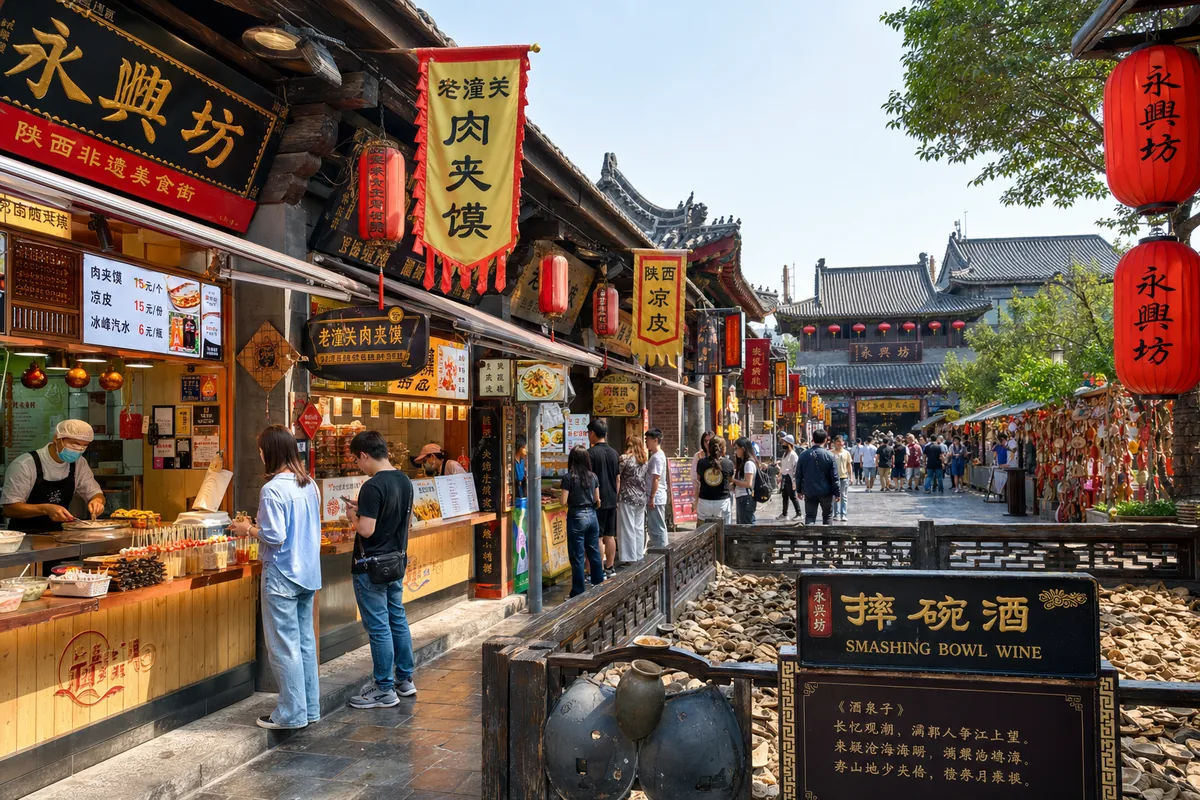
It's also where the "smashing bowl wine" (摔碗酒, shuāiwǎn jiǔ) trend took off — you down a small bowl of rice wine and throw the bowl into a pit to shatter it. Touristy, yes, but fun, and the pile of broken pottery is a sight. Beyond the gimmick, look for:
- Zha jiang mian and regional noodle styles from different Shaanxi counties.
- Hancheng and Weinan specialties rarely seen in central Xi'an.
- Stuffed steamed buns, cold dishes, and local sweets at fixed, clearly marked prices.
Prices are posted, payment is by QR code at each stall, and it's far less chaotic than Beiyuanmen. Many travelers find it the more comfortable place to actually sit and eat.
Local Noodle Shops and Where Locals Actually Eat
The best Xi'an food often comes from small, unglamorous shops with a single specialty, plastic stools, and a line of office workers at lunch. You don't need addresses so much as a willingness to walk into a busy place that does one thing.
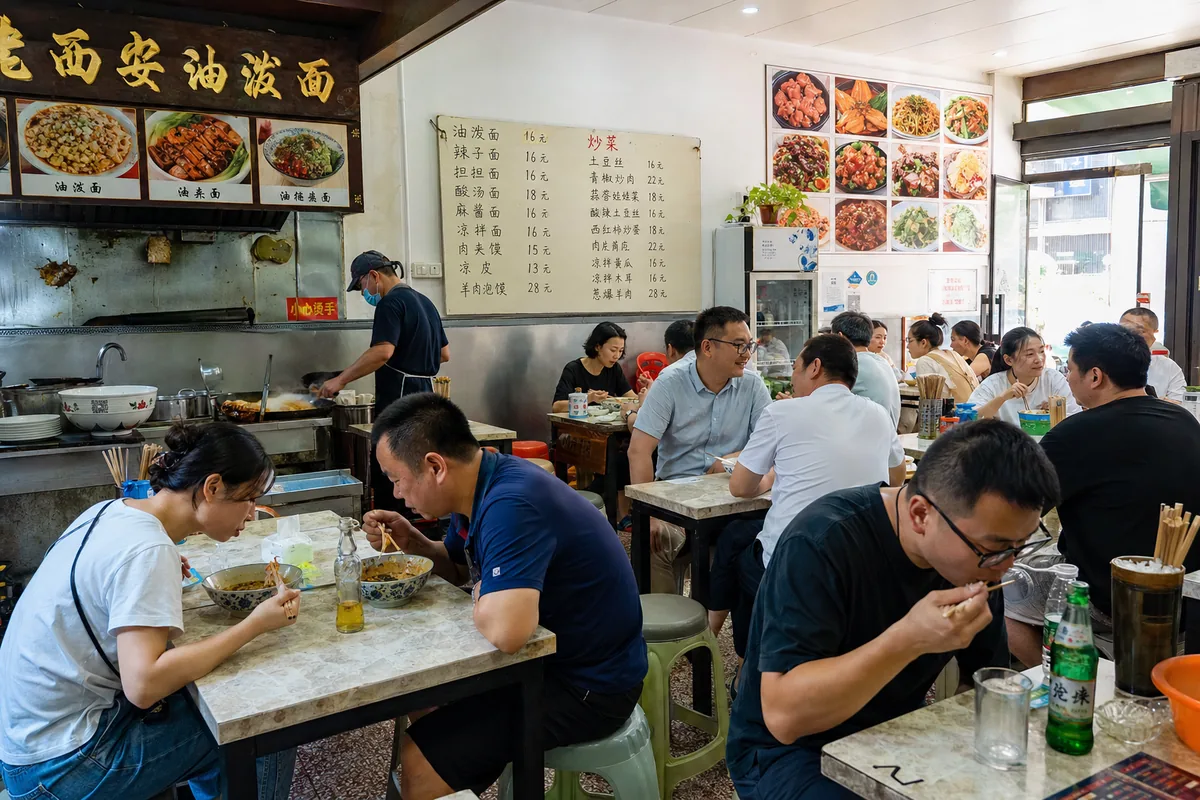
A few principles that serve you well:
- Follow the crowds at lunch. A packed shop at 12:30 is packed for a reason. Empty ones near major sights are usually coasting on foot traffic.
- One-dish specialists beat menus with 80 items. A shop with "油泼面" painted on the window and nothing else is a good sign.
- Neighborhoods like Sajinqiao and the areas around the universities have dense clusters of cheap, excellent noodle and roujiamo shops aimed at locals, not tourists.
- Breakfast matters here. Many people start the day with a bowl of hu lu tou or a simple bowl of paomo. Shops open early and the morning versions are often the freshest.
Night Markets and Late-Night Eating
Xi'an eats late. Beyond the Muslim Quarter (which stays busy into the night), a few areas come alive after dark with street food, grilled skewers, and beer.
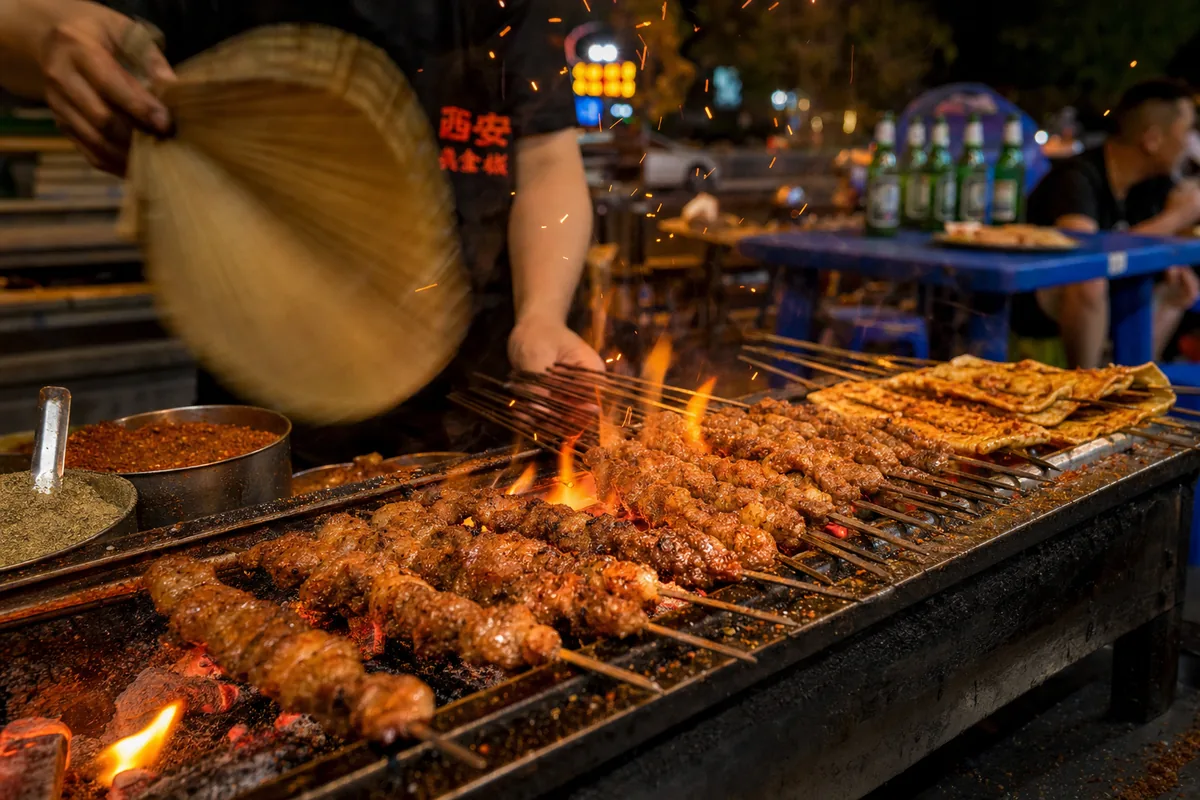
- Muslim Quarter at night: the most atmospheric, with the lanterns lit and the grills going. Busiest around 7–10 PM.
- Sajinqiao (洒金桥): a more local alternative to Beiyuanmen, with a strong reputation for paomo, grilled meat, and breakfast spots that also run late. This is where many Xi'an residents send friends.
- Yongxingfang: generally winds down earlier than the Muslim Quarter, so go for dinner rather than midnight snacks.
Late-night staples include lamb skewers, grilled gluten (kao mianjin), grilled fish and squid, and cold beer. Skewers are typically 2–5 RMB each, so a satisfying late meal rarely costs more than 40–60 RMB.
Practical Tips for Eating in Xi'an
Paying
Nearly every stall and shop takes mobile payment by QR code. Set up Alipay (支付宝, Zhīfùbǎo) or WeChat Pay (微信支付, Wēixìn Zhīfù) before you arrive — both now let foreign cards link in. A small amount of cash is still handy for the rare older vendor.
Halal and dietary needs
The Muslim Quarter is entirely halal, which makes Xi'an one of the easier major Chinese cities for halal travelers. Vegetarians have a harder time — many noodle and bread dishes are meat-light but cooked with meat stock or lard. Liangpi, plain biangbiang with oil-splash (ask for no meat), and vegetable buns are reliable. For more, see our guide to halal food in China and the vegetarian and vegan guide.
Spice and stomach
Xi'an food is chili-heavy but more fragrant than mouth-numbing (it's not Sichuan). If you're sensitive, ask for shao la (少辣, less spicy). The bigger risk for visitors is simply overdoing the rich, oily food on day one — pace yourself.
When to come
Spring (March–May) and autumn (September–November) are the most comfortable seasons for walking the food streets — summer evenings are hot and crowded, and winter nights get cold fast, though a steaming bowl of paomo hits differently when it's freezing out.
A Suggested Eating Plan
If you have two days, this rough rhythm covers the essentials without burning out:
- Day 1 lunch: roujiamo + liangpi + Bingfeng at a local shop.
- Day 1 dinner: yangrou paomo in or near the Muslim Quarter, then skewers and a wander.
- Day 2 lunch: oil-splashed or biangbiang noodles at a one-dish specialist.
- Day 2 dinner: Yongxingfang for regional Shaanxi dishes and the broken-bowl wine.
This pairs naturally with sightseeing — see our 2-day Xi'an itinerary to slot the meals around the Terracotta Army, the city wall, and the Bell and Drum Towers.
The Bottom Line
Xi'an rewards eating widely and cheaply. The headline dishes — roujiamo, biangbiang noodles, yangrou paomo — are genuinely worth the hype, and you'll eat well for under 50 RMB a meal almost anywhere. Skip the over-weighed dried fruit on the main tourist drag, follow the lunch crowds into one-dish shops, and try Yongxingfang and Sajinqiao for the food locals actually rate. Set up mobile payment, pace yourself with the oil and chili, and come hungry. For the full picture of the city beyond its food, start with the Xi'an complete guide.
Last updated: June 2026
Read in other languages
Getting to the sights by metro
Terracotta Army Museum
UNESCO site with 8,000 life-size warriors guarding Emperor Qin Shi Huang's tomb.
- Huaqing Pool
Xi'an City Wall
14km Ming-era city wall, fully circumnavigable on foot or rented bicycle.
- Yongningmen
- North Avenue
- Bell Tower
Bell Tower & Drum Tower
Ming-era twin towers at the city's heart, bracketing the Muslim Quarter.
- Bell Tower
Muslim Quarter (Hui Min Jie)
Halal food street with lamb skewers, biang-biang noodles and roujiamo since the Tang dynasty.
- Bell Tower
- North Avenue
Big Wild Goose Pagoda
Tang-era 7-story pagoda built by Xuanzang to house Buddhist sutras from India.
- Great Wild Goose Pagoda
Shaanxi History Museum
Top museum for Tang-era treasures and Silk Road artifacts; book ahead online.
- Great Wild Goose Pagoda
- Xiaozhai
Small Wild Goose Pagoda
Tang-era 13-story pagoda paired with the Xi'an Museum (free entry).
- Nanshaomen
- Wenyi Road
Tang Paradise (Datang Furong Park)
Tang-themed cultural park with nightly water-screen movie and palace re-creations.
- TangParadise
Tang Eternal City (Datang Everbright City)
Tang-themed pedestrian street with viral 'Living Statue Lady' street performance.
- Datang Everbright City
- Great Wild Goose Pagoda
Forest of Stelae Museum (Beilin)
World's largest collection of stone tablets — 11,000+ inscriptions, calligraphy treasury.
- Yongningmen
- Bell Tower
Huaqing Palace Hot Springs
Tang-era imperial hot springs and site of Yang Guifei's bathing chamber.
- Huaqing Pool
Datang West Market Museum
Reconstructed Tang-dynasty Silk Road market, with archaeology museum below.
- Datangxishi
Xi'an North Railway Hub
Massive high-speed rail hub linking Xi'an to all of central China.
- Xi'an North Railway
Xi'an Xianyang International Airport
Northwest China's main international airport (XIY); located 30 km northwest of central Xi'an.
- Airport
- Airport West
Xi'an metro: last train times by station
Every line and station, checked by hand — the same data behind our offline route planner.
Get the WaysChina App
Offline guides, currency converter, essential phrases, and more — all in your pocket.

Related Articles
2-Day Xi'an Itinerary: Terracotta Warriors, City Wall & More
A practical 2-day Xi'an itinerary with real timings and transport: the Terracotta Warriors and Huaqing Palace on Day...
Lanzhou Complete Guide
Everything you need for visiting Lanzhou: the famous beef noodles, the Yellow River waterfront, the Gansu Provincial...

Xi'an Day Trips
Four of the best day trips from Xi'an — Mount Huashan, Famen Temple, Qianling Mausoleum, and Hanyangling Museum —...

Xining & Qinghai Lake Guide
Xining is the gateway to Qinghai Lake, Chaka Salt Lake, and the Ta'er Monastery. Here's how to plan 2-3 days at...