
This article contains affiliate links. If you make a purchase through these links, we may earn a small commission at no extra cost to you. This helps support our work in creating free travel guides.
Xi'an was the eastern end of the Silk Road and the capital of thirteen Chinese dynasties, including the Tang — the period most people picture when they imagine imperial China. That history is still visible: a fully intact city wall around the old town, an army of life-size clay soldiers buried for over 2,000 years, and a Muslim Quarter that has been feeding traders and travelers for more than a millennium. For most visitors, three to four days is enough to see the highlights without rushing.
This guide covers the core sights, the food (which is reason enough to come), how to get here and get around, where to base yourself, and a sample itinerary. Spring (March–May) and autumn (September–November) are the most comfortable times to visit. Summer is hot and crowded; winter is cold but quiet, with thinner lines at the Terracotta Warriors.
A Quick Overview of Xi'an
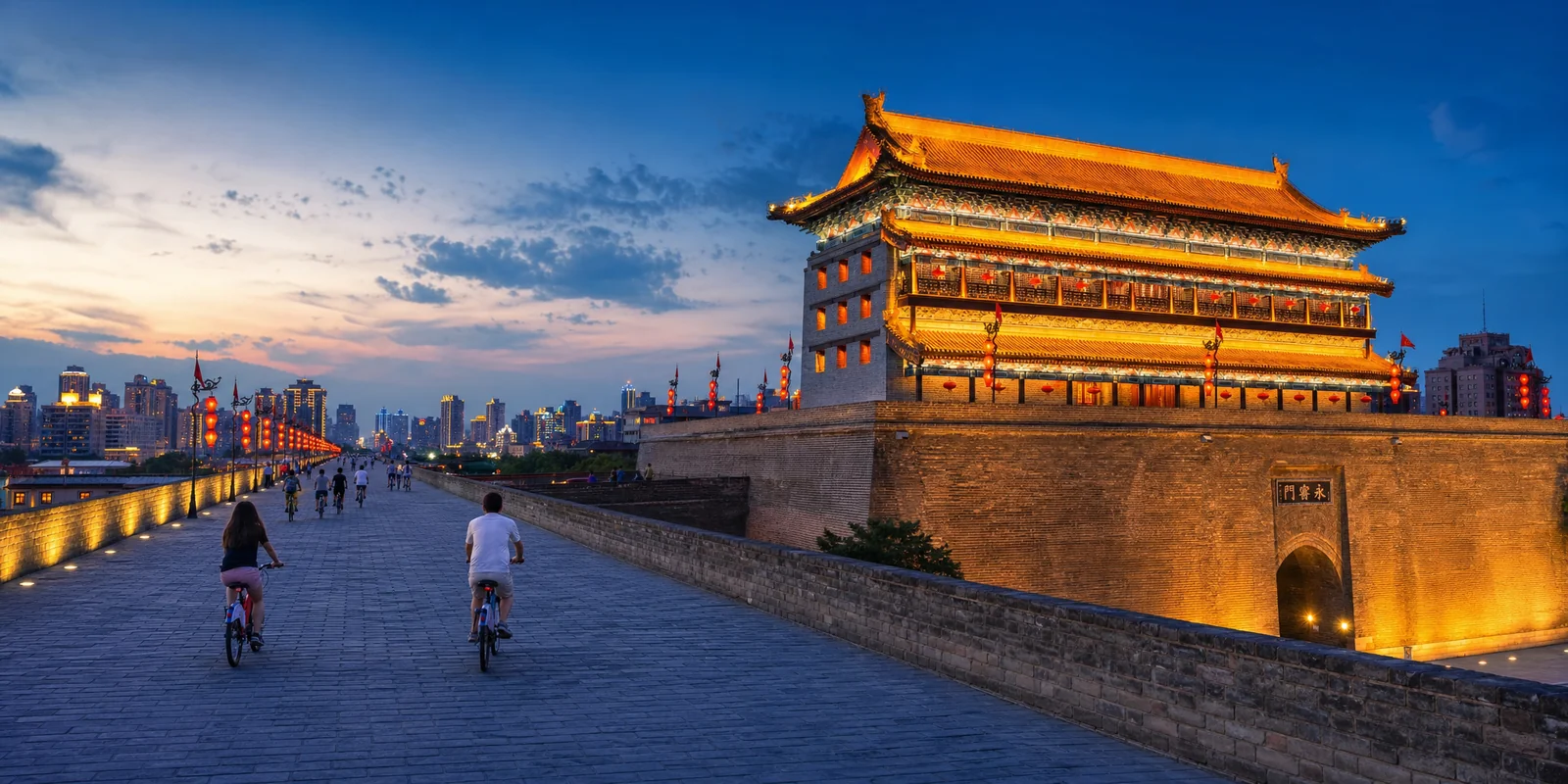
Xi'an (西安, Xī'ān) is the capital of Shaanxi Province in northwest China, with a metro population of around 13 million. The layout is easy to grasp: a square old city ringed by the ancient wall, with the Bell Tower (钟楼, Zhōnglóu) marking the center. Most historical sights sit inside or just outside the wall, while the Terracotta Warriors are about 40km northeast, near Lintong.
The city is well connected. Xi'an Xianyang International Airport (XIY) handles domestic and a growing number of international flights, and the high-speed rail network links it to Beijing, Shanghai, Chengdu, Luoyang, and beyond. Getting around the center is straightforward with a clean, modern metro system.
The Terracotta Warriors
This is why most people come, and it lives up to it. Discovered in 1974 by farmers digging a well, the Terracotta Army is a collection of thousands of life-size clay soldiers, horses, and chariots built to guard the tomb of Qin Shi Huang, China's first emperor, who died in 210 BCE. Every face is different. The site is a UNESCO World Heritage location and one of the most significant archaeological finds of the 20th century.
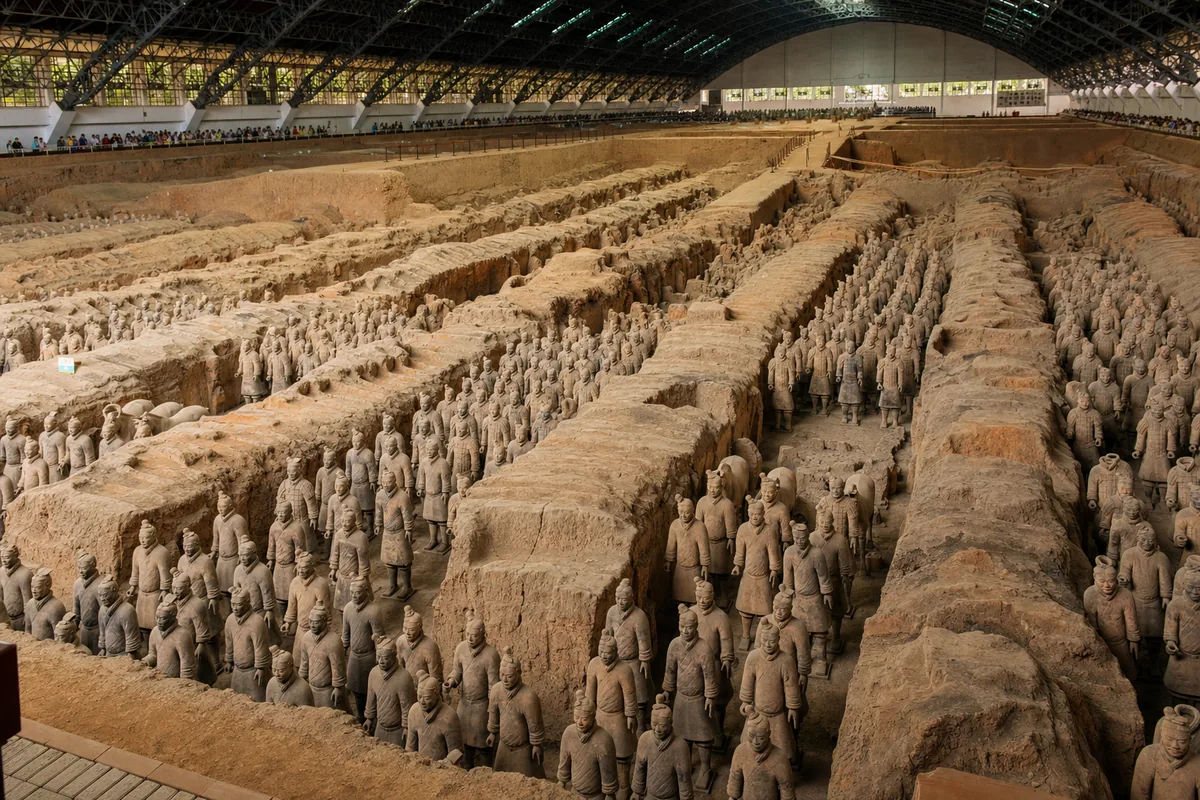
The site is organized into three excavation pits inside large hangar-like buildings, plus an exhibition hall:
- Pit 1 — the largest and most impressive, with rows of infantry stretching the length of a football field. See this one first while you have energy and patience for the crowds.
- Pit 2 — partially excavated, showing the army in different stages of recovery, plus close-up display cases of individual figures.
- Pit 3 — the smallest, believed to be the command post.
Plan for three to four hours. The site is genuinely worth a guide — much of what makes it remarkable (the original paint, the manufacturing techniques, the kneeling archer's intact sole) is invisible without context. You can hire an English-speaking guide at the entrance, rent an audio guide, or book a guided day tour that includes transport from the city.
Getting there: The cheapest option is tourist bus 游5 (You 5, also numbered 306) from Xi'an Railway Station's east square, which takes about an hour and costs a few yuan. A Didi (the Chinese ride-hailing app) costs more but saves time and hassle, especially in a group. Many travelers find a guided tour the easiest route, since it bundles transport, tickets, and explanation — booking ahead is sensible in peak season.
The City Wall
Xi'an's city wall is the most complete ancient city wall in China — roughly 14km around, 12 meters high, and wide enough on top to drive a car (though you can't). Built in the Ming dynasty on Tang-era foundations, it completely encircles the old town. Walking or cycling the full loop is one of the best things you can do here.
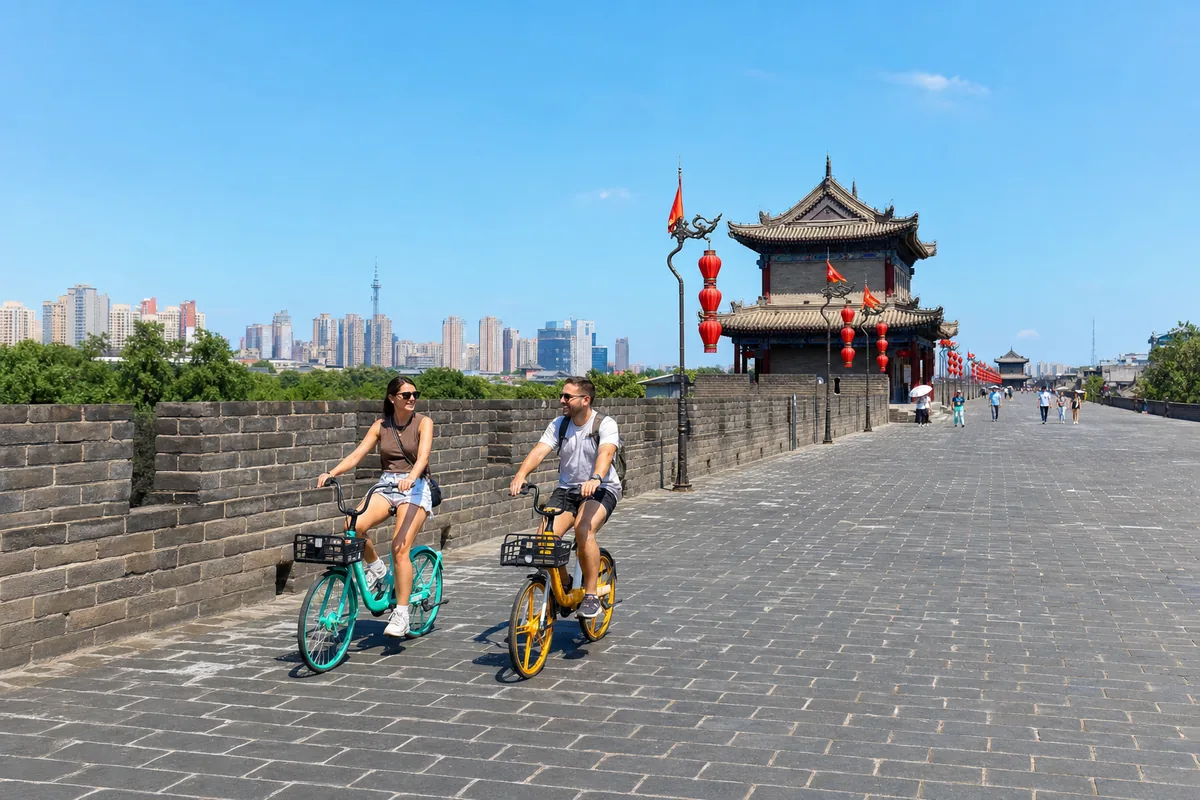
Renting a bike on top of the wall is the classic experience. A full circuit takes about 90 minutes to two hours at a relaxed pace, with views down into old neighborhoods on one side and the modern city on the other. There are several access gates; the South Gate (永宁门, Yǒngníng Mén) is the grandest and most popular, but it's also the busiest — entering at a quieter gate like the East or West can mean fewer crowds.
Bike rental is available on top near the main gates, with a refundable deposit. If cycling isn't your thing, you can walk a section or take an electric cart. Evening visits are worth it when the wall and gate towers are lit up.
The Muslim Quarter
The Muslim Quarter (回民街, Huímín Jiē) is the heart of Xi'an's Hui Muslim community, who have lived here for over a thousand years since the Silk Road trading days. It's a warren of lanes packed with food stalls, butchers, spice sellers, and souvenir shops, centered on a network of streets behind the Drum Tower.
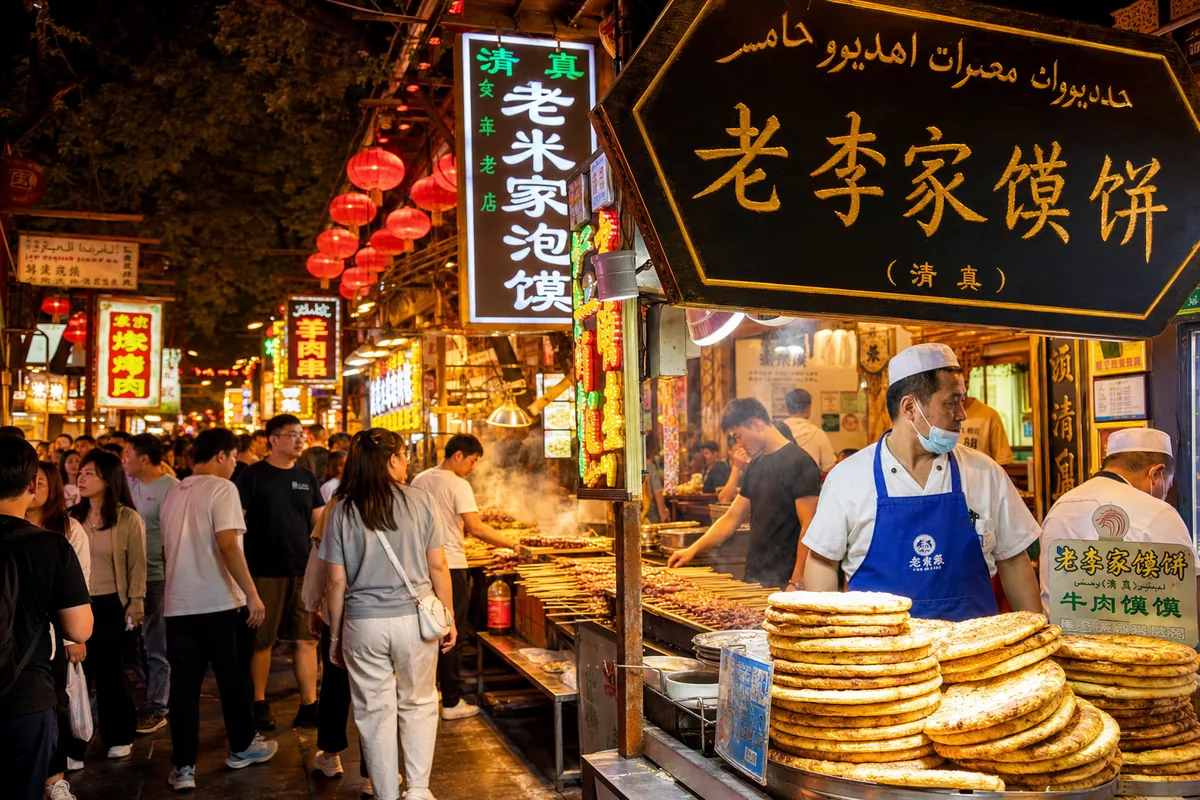
This is the place to eat (more on that below), but it's also worth visiting for the atmosphere and for the Great Mosque of Xi'an (西安大清真寺), tucked away down a side lane. Built in Tang and Ming styles rather than the domes and minarets you might expect, it looks more like a Chinese temple complex with Arabic calligraphy. It's a quiet, walled garden retreat from the chaos of the food streets — a small entrance fee applies, and modest dress is expected.
The main streets get extremely crowded in the evening and on weekends. Come in the late morning or early afternoon if you want to actually move and take photos. The deeper back lanes (away from the most touristed strip) often have better, cheaper food where locals actually eat.
Big Wild Goose Pagoda
The Big Wild Goose Pagoda (大雁塔, Dàyàn Tǎ) is a seven-story Tang dynasty Buddhist pagoda built in 652 CE to house scriptures the monk Xuanzang brought back from his 17-year journey to India — the same pilgrimage that inspired the classic novel Journey to the West. It sits within the active Da Ci'en Temple complex in the south of the city.
You can admire the pagoda from the surrounding gardens, or pay extra to climb it for views over the city. The large square to the north has one of Asia's biggest musical fountain shows, which runs at set times (usually midday and evening) and draws big crowds — check the schedule locally as times shift seasonally. The whole area is pleasant for an evening stroll and connects to the Tang Dynasty cultural park district.
What to Eat in Xi'an
Xi'an food is hearty, wheat-based, and heavy on lamb, cumin, and chili — a legacy of its position where Chinese and Central Asian trade routes met. It's distinct from anything you'll eat in eastern China. Here are the dishes worth seeking out:
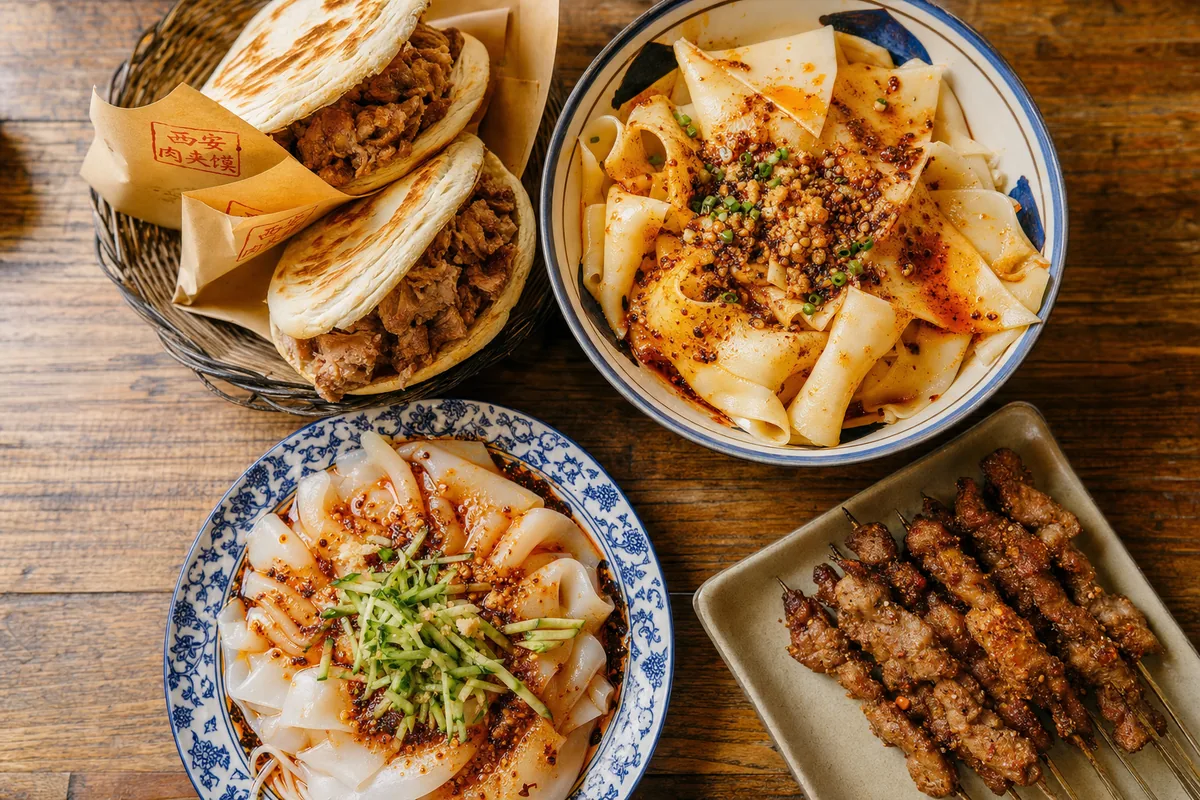
- Roujiamo (肉夹馍) — often called a "Chinese hamburger": chopped, slow-braised pork (or beef/lamb in halal versions) stuffed into a crisp flatbread. The classic Xi'an street snack.
- Biangbiang noodles (biángbiáng面) — wide, hand-pulled belt noodles topped with chili, garlic, and a sizzle of hot oil. The character for "biang" is one of the most complex in Chinese and isn't in standard dictionaries.
- Yangrou paomo (羊肉泡馍) — Xi'an's signature dish: you tear a dense flatbread into small pieces by hand into a bowl, then it's returned to you filled with rich lamb soup. A slow, filling meal.
- Liangpi (凉皮) — cold wheat or rice noodles dressed with chili oil, vinegar, and garlic. Refreshing in summer.
- Persimmon cakes (柿子饼) and various lamb skewers, sweet rice, and pomegranate juice round out the Muslim Quarter offerings.
For a deeper dive into specific stalls and where locals eat versus the tourist strip, see our dedicated Xi'an Food Guide.
Getting to Xi'an
Xi'an is a major transport hub, so reaching it is easy from anywhere in China.
| From | By High-Speed Rail | By Air |
|---|---|---|
| Beijing | ~4.5–6 hours | ~2 hours |
| Shanghai | ~6–7 hours | ~2.5 hours |
| Chengdu | ~3–4 hours | ~1.5 hours |
| Luoyang | ~1.5 hours | — |
| Lanzhou | ~3 hours | ~1.5 hours |
The high-speed train (高铁, gāotiě) is usually the best choice for trips under about 1,000km — it's reliable, comfortable, and drops you in the city rather than a far-flung airport. Trains arrive at Xi'an North Station (西安北站), which connects to the city center via metro Line 2 in about 30 minutes. You can book train tickets through Trip.com in English, or directly on the official 12306 platform if you've set up an account. For how the rail system works, see our High-Speed Train Complete Guide.
From the airport (XIY), the Airport Metro (Chengji Line / Line 14) and dedicated airport buses both connect to the city in under an hour.
Getting Around the City
Xi'an's metro is modern, cheap, and signed in English. Line 2 runs north–south through the center past the Bell Tower; Line 1 runs east–west. You can pay by scanning a QR code in your metro app or with Alipay/WeChat, so there's no need to fumble with tokens. Buses are extensive but harder to navigate without Chinese.
For shorter hops, Didi (滴滴) is the standard ride-hailing app and works well — you can set it up in English. Taxis exist but Didi is usually easier since you don't need to explain your destination verbally. Within the old city, walking is often the best option since sights cluster together.
Where to Stay
For a first visit, staying inside or near the city wall puts you within walking distance of the Bell Tower, Drum Tower, and Muslim Quarter, and a short metro ride from everything else. This is the most convenient base for sightseeing.
- Inside the wall (Bell Tower / Muslim Quarter area) — most central, walkable to old-town sights, good range of hotels and hostels. Can be noisy near the food streets.
- Near Xi'an North Station — practical if you're arriving late or leaving early by train, but far from the sights.
- South city (Big Wild Goose Pagoda / Qujiang) — quieter, more modern, with parks and the pagoda nearby; a metro ride from the old town.
Xi'an has accommodation at every level, from social hostels in the old town to international business hotels. Booking platforms like Booking.com list a wide range, and booking ahead is wise during spring, autumn, and Chinese public holidays when the city fills up.
Suggested 3-Day Itinerary
This balances the big sights with time to actually enjoy the food and atmosphere.
- Day 1 — Old city. Climb or cycle the City Wall in the morning, see the Bell and Drum Towers, then spend the afternoon and evening eating your way through the Muslim Quarter and visiting the Great Mosque.
- Day 2 — Terracotta Warriors. Head out early (it's about an hour away) to beat the worst crowds. Spend the morning and early afternoon at the site with a guide. Back in the city, relax in the evening.
- Day 3 — South city and culture. Visit the Big Wild Goose Pagoda and Da Ci'en Temple, catch the fountain show, and consider the Shaanxi History Museum (book free tickets in advance — they go fast) for context on everything you've seen.
With a fourth day, add a Tang Dynasty Show with dumpling banquet, a half-day at the Han Yang Ling tomb (quieter than the Terracotta Warriors), or a day trip to Mount Hua (华山, Huàshān), one of China's five sacred mountains, about 90 minutes away by train. For a tighter plan, our 2-Day Xi'an Itinerary hits the essentials.
Combining Xi'an with Other Cities
Xi'an sits at a natural crossroads, which makes it easy to fold into a longer trip:
- Luoyang — just ~1.5 hours by high-speed rail, home to the Longmen Grottoes. An easy add-on for more ancient-capital history. See the Luoyang Ancient Capital Guide.
- Chengdu — ~3–4 hours by rail, for pandas and Sichuan food.
- Lanzhou — ~3 hours by rail, the gateway west toward the Silk Road and famous for hand-pulled beef noodles.
Two popular routes run through Xi'an: the classic Beijing–Xi'an–Shanghai route for first-timers wanting the headline cities, and the Silk Road route from Xi'an to Dunhuang heading northwest into the desert.
Final Tips
Three to four days in Xi'an gives you the Terracotta Warriors, a walk on the city wall, the best wheat-and-lamb food in China, and a real feel for the Tang dynasty capital. Visit in spring or autumn if you can, set up mobile payments before you arrive, and book a guide for the Warriors so the experience makes sense. Book accommodation and train tickets ahead during peak seasons and holidays, and reserve Shaanxi History Museum tickets early since they're free and disappear quickly. Always check the latest opening hours, prices, and fountain-show times locally, as these change with the seasons.
Related Reading
- Xi'an Food Guide — where to eat beyond the tourist strip
- Xi'an Day Trips — Mount Hua and beyond
- Chengdu Complete Guide — a popular next stop
- Dunhuang & Silk Road Guide — heading west from Xi'an
- High-Speed Train Complete Guide — how to get around China by rail
Last updated: June 2026
Read in other languages
Getting to the sights by metro
Terracotta Army Museum
UNESCO site with 8,000 life-size warriors guarding Emperor Qin Shi Huang's tomb.
- Huaqing Pool
Xi'an City Wall
14km Ming-era city wall, fully circumnavigable on foot or rented bicycle.
- Yongningmen
- North Avenue
- Bell Tower
Bell Tower & Drum Tower
Ming-era twin towers at the city's heart, bracketing the Muslim Quarter.
- Bell Tower
Muslim Quarter (Hui Min Jie)
Halal food street with lamb skewers, biang-biang noodles and roujiamo since the Tang dynasty.
- Bell Tower
- North Avenue
Big Wild Goose Pagoda
Tang-era 7-story pagoda built by Xuanzang to house Buddhist sutras from India.
- Great Wild Goose Pagoda
Shaanxi History Museum
Top museum for Tang-era treasures and Silk Road artifacts; book ahead online.
- Great Wild Goose Pagoda
- Xiaozhai
Small Wild Goose Pagoda
Tang-era 13-story pagoda paired with the Xi'an Museum (free entry).
- Nanshaomen
- Wenyi Road
Tang Paradise (Datang Furong Park)
Tang-themed cultural park with nightly water-screen movie and palace re-creations.
- TangParadise
Tang Eternal City (Datang Everbright City)
Tang-themed pedestrian street with viral 'Living Statue Lady' street performance.
- Datang Everbright City
- Great Wild Goose Pagoda
Forest of Stelae Museum (Beilin)
World's largest collection of stone tablets — 11,000+ inscriptions, calligraphy treasury.
- Yongningmen
- Bell Tower
Huaqing Palace Hot Springs
Tang-era imperial hot springs and site of Yang Guifei's bathing chamber.
- Huaqing Pool
Datang West Market Museum
Reconstructed Tang-dynasty Silk Road market, with archaeology museum below.
- Datangxishi
Xi'an North Railway Hub
Massive high-speed rail hub linking Xi'an to all of central China.
- Xi'an North Railway
Xi'an Xianyang International Airport
Northwest China's main international airport (XIY); located 30 km northwest of central Xi'an.
- Airport
- Airport West
Xi'an metro: last train times by station
Every line and station, checked by hand — the same data behind our offline route planner.
Get the WaysChina App
Offline guides, currency converter, essential phrases, and more — all in your pocket.

Related Articles
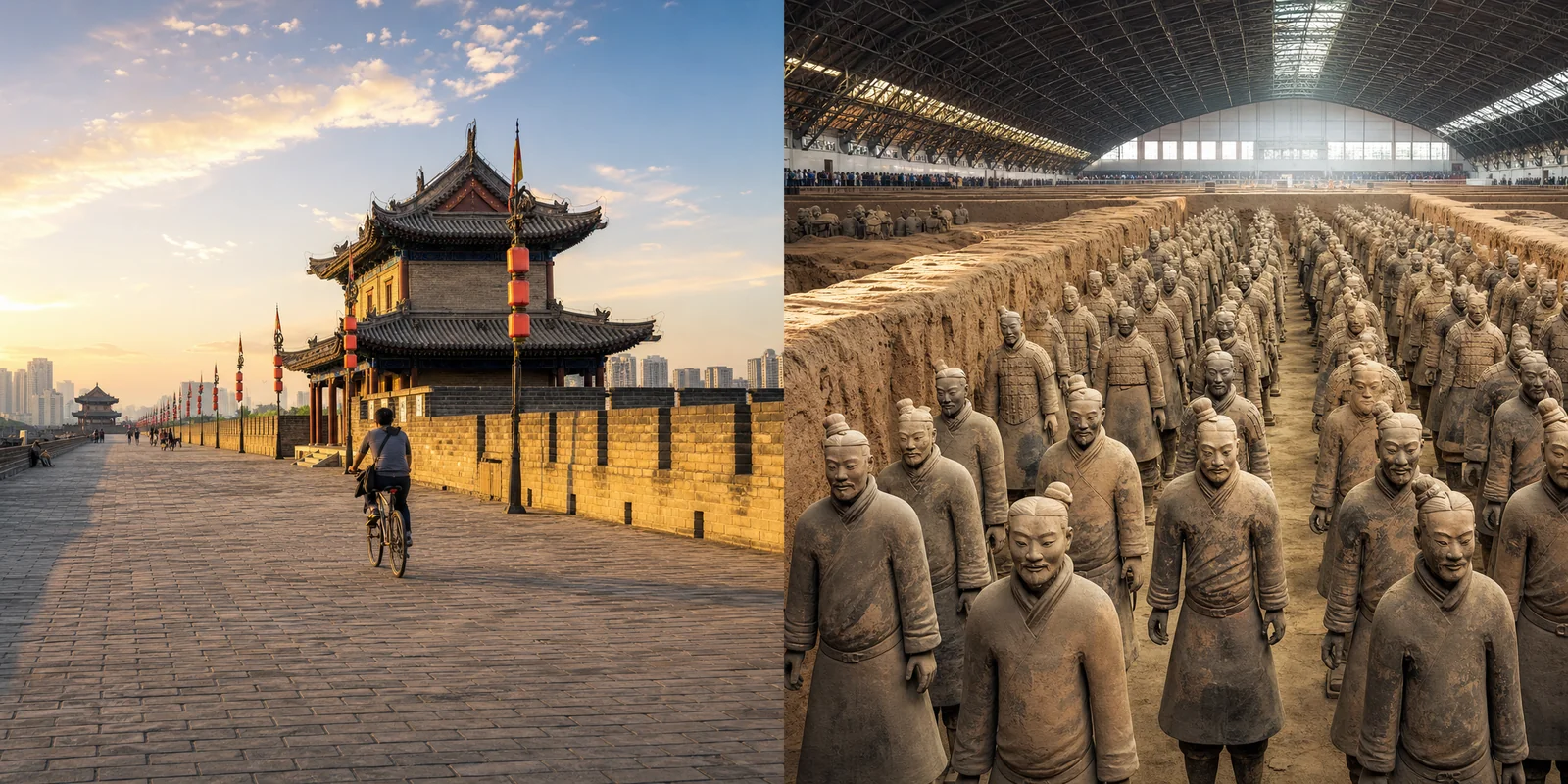
2-Day Xi'an Itinerary: Terracotta Warriors, City Wall & More
A practical 2-day Xi'an itinerary with real timings and transport: the Terracotta Warriors and Huaqing Palace on Day...
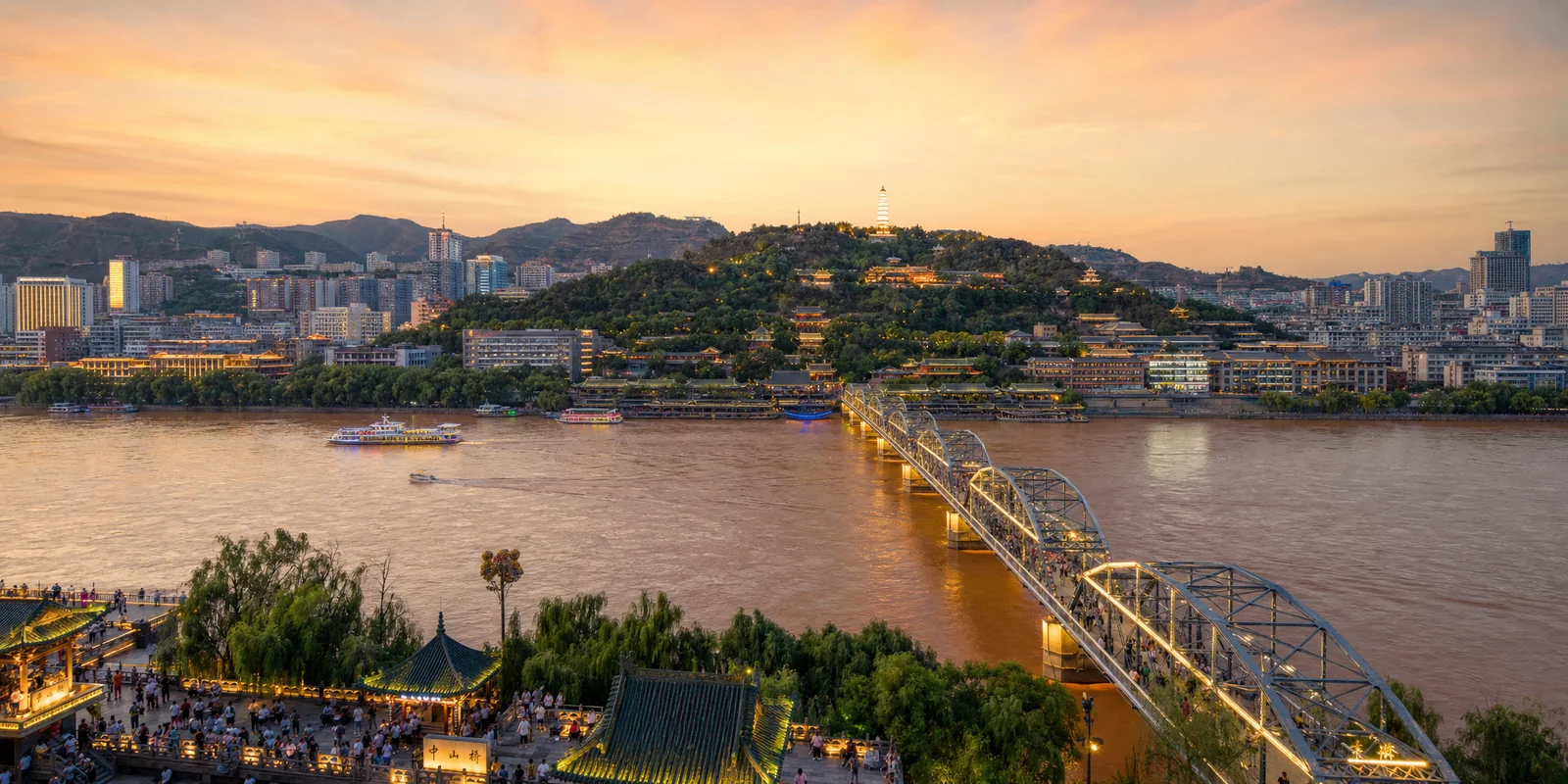
Lanzhou Complete Guide
Everything you need for visiting Lanzhou: the famous beef noodles, the Yellow River waterfront, the Gansu Provincial...

Xi'an Day Trips
Four of the best day trips from Xi'an — Mount Huashan, Famen Temple, Qianling Mausoleum, and Hanyangling Museum —...
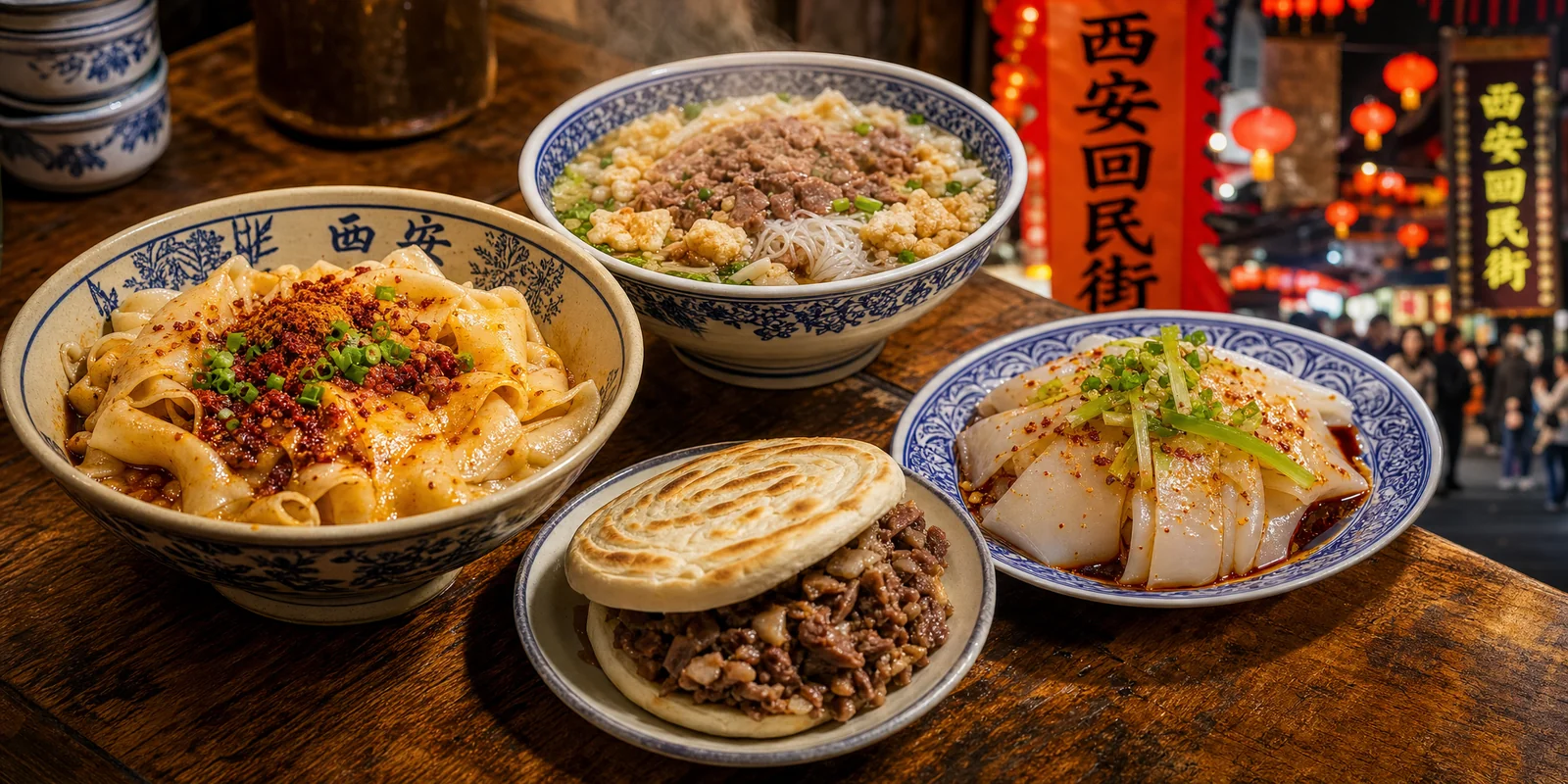
Xi'an Food Guide
What to eat in Xi'an and where to find it — from biangbiang noodles and roujiamo to lamb soup in the Muslim Quarter,...