
This article contains affiliate links. If you make a purchase through these links, we may earn a small commission at no extra cost to you. This helps support our work in creating free travel guides.
Two days is enough to see the highlights of Xi'an (西安, Xī'ān) without rushing, as long as you split them smartly. The trick is grouping the far-out sights together: the Terracotta Warriors and Huaqing Palace sit about an hour east of the city, so they take up a full day on their own. That leaves Day 2 for everything inside and around the old walls, which you can cover on foot, by bike, and on the metro.
This itinerary assumes you're based somewhere central, near the Bell Tower or inside the City Wall. It includes specific timings, the transport between each stop, and rough costs so you can see where the day goes. Adjust the pace to taste, but the order below keeps backtracking to a minimum.
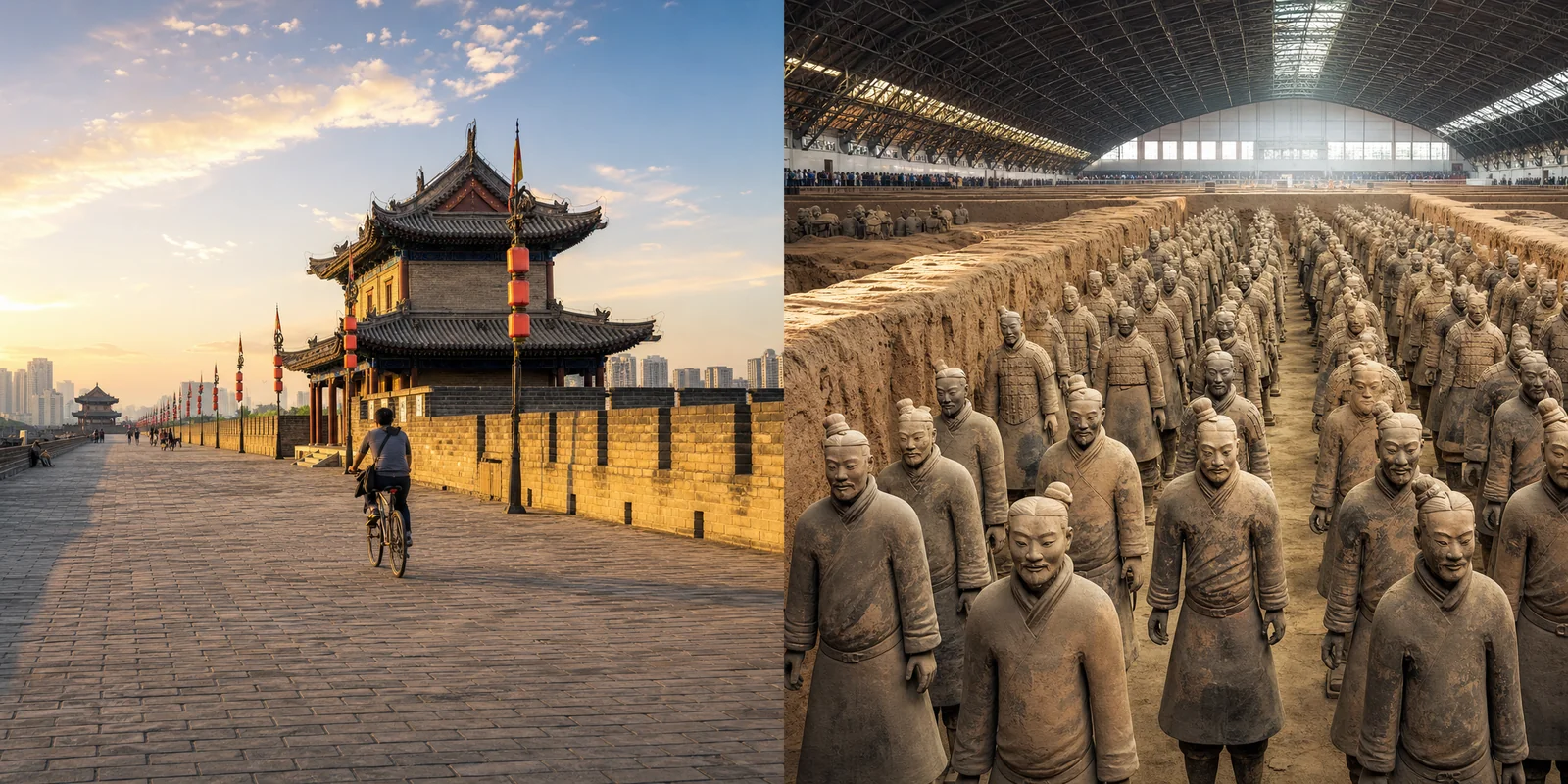
Quick Overview: What Fits in 2 Days
Here's the shape of the trip before we get into the detail.
| Day | Morning | Afternoon | Evening |
|---|---|---|---|
| Day 1 | Terracotta Warriors | Huaqing Palace | Return to city, dinner near Bell Tower |
| Day 2 | City Wall cycling | Muslim Quarter lunch, Big Wild Goose Pagoda | Datang Everbright City light show |
If you only have time for one thing, make it the Terracotta Warriors. Everything else on this list is excellent, but the Warriors are the reason most people fly to Xi'an in the first place.
Day 1: Terracotta Warriors and Huaqing Palace
Both of today's sights are in Lintong District, roughly 40-60 minutes east of central Xi'an. Going early matters here, both to beat tour-bus crowds at the Warriors and to leave enough time for Huaqing Palace afterward.
Morning: Terracotta Warriors (8:30 AM - 12:30 PM)
The Terracotta Army (兵马俑, Bīngmǎyǒng) is a collection of thousands of life-sized clay soldiers, horses, and chariots buried to guard the tomb of China's first emperor over 2,200 years ago. It's a UNESCO World Heritage site and genuinely lives up to the hype: the scale of Pit 1, with rows of warriors stretching back under a hangar-sized roof, is hard to grasp from photos. You can read more on the UNESCO World Heritage listing.
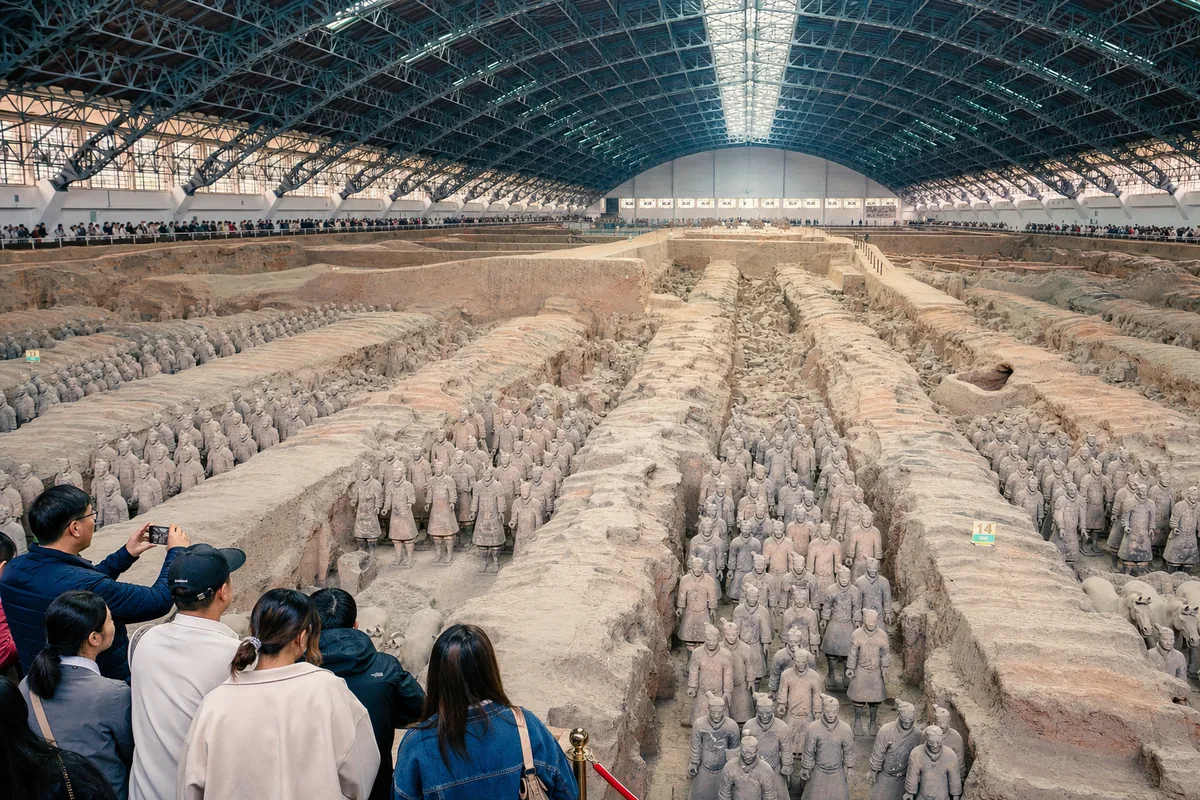
Getting there: The cheapest option is public bus 游5 (Tourist Bus 5, also numbered 306) from the east square of Xi'an Railway Station. It runs frequently, costs around ¥8, and takes about an hour. A taxi or Didi (滴滴, China's main ride-hailing app) from the city center runs ¥80-120 one way depending on traffic. If you'd rather skip the logistics entirely, a guided day tour bundles transport, tickets, and an English-speaking guide.
Tickets and timing: Entry is around ¥120. The site opens at 8:30 AM. Give yourself at least three hours: see the three pits in order (Pit 1 last, since it's the showstopper), then the bronze chariots exhibition hall. A guide or an audio guide makes a big difference here, because there's almost no signage explaining what you're looking at.
If you want a hassle-free version of this morning with hotel pickup and a guide who can explain the history, you can book a Terracotta Warriors day tour on Klook. Independent travel works fine too, especially if you're comfortable with buses and don't mind reading up beforehand.
Lunch (12:30 PM - 1:30 PM)
There are restaurants near the Warriors' exit, though they're priced for captive tourists. A decent middle option is to grab a quick bowl of noodles near the site, then save your appetite for the Muslim Quarter on Day 2. If you're with a tour, lunch is often included.
Afternoon: Huaqing Palace (1:30 PM - 4:30 PM)
Huaqing Palace (华清宫, Huáqīng Gōng) is only about 15 minutes by car from the Warriors, which is why they pair so well. It's a complex of hot-spring pools and gardens at the foot of Mount Li, used by Tang dynasty emperors as a winter retreat. The most famous association is the romance between Emperor Xuanzong and his consort Yang Guifei.
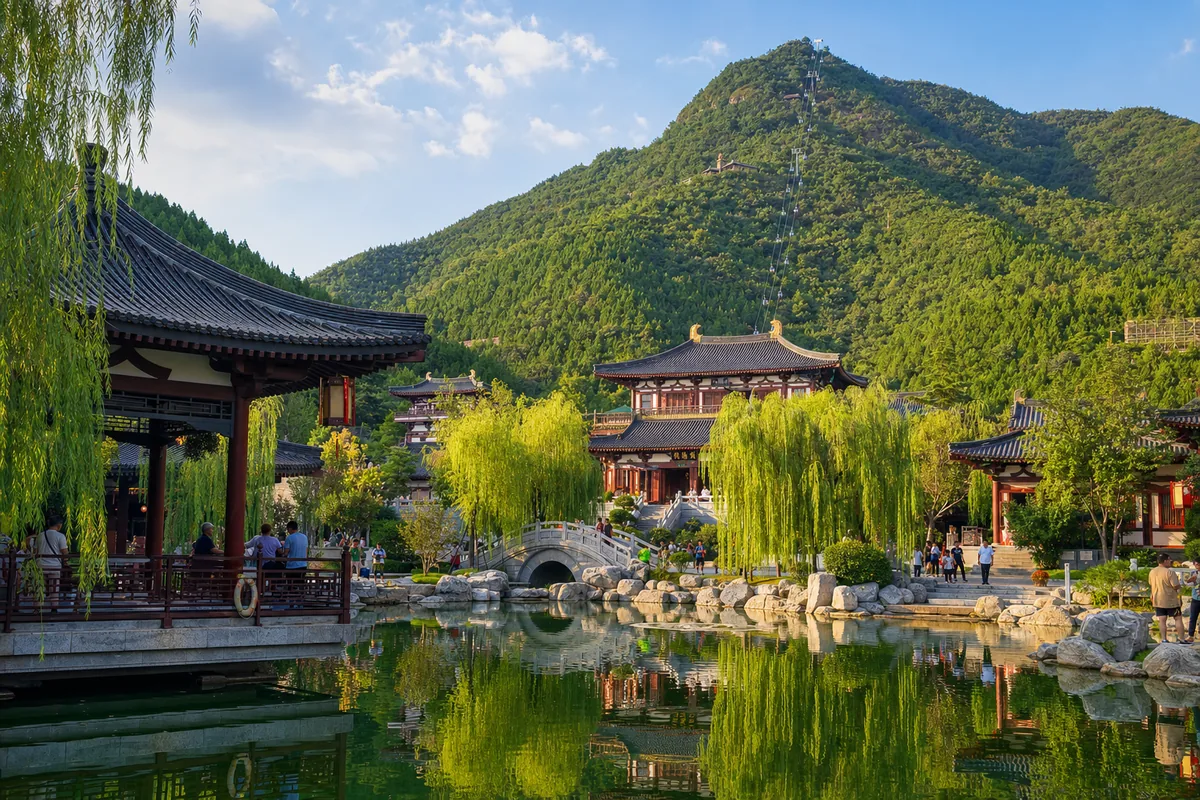
The grounds are pleasant for a wander: ornamental pools, the preserved imperial bathing pools, and trails up the hillside. The same Tourist Bus 5 stops here on its way back to the city, so you don't need separate transport. Entry is around ¥120.
Evening: Back to the City (5:00 PM onward)
Take Tourist Bus 5 back to Xi'an Railway Station, then a short taxi or metro ride to your hotel. Have a relaxed dinner near the Bell Tower (钟楼, Zhōnglóu) to recover; you've covered a lot of ground. Day 2 is busier on the feet but lighter on travel time.
Day 2: City Wall, Muslim Quarter, and the Pagoda
Today stays close to the center. Everything is reachable on foot or by a couple of metro stops, so there's no early bus to catch.
Morning: Cycling the City Wall (9:00 AM - 11:00 AM)
Xi'an's City Wall (城墙, Chéngqiáng) is the best-preserved ancient city wall in China, a complete 13.7 km rectangle built in the Ming dynasty on Tang foundations. Renting a bike and riding the full loop on top of the wall is the single most enjoyable thing to do in the city.
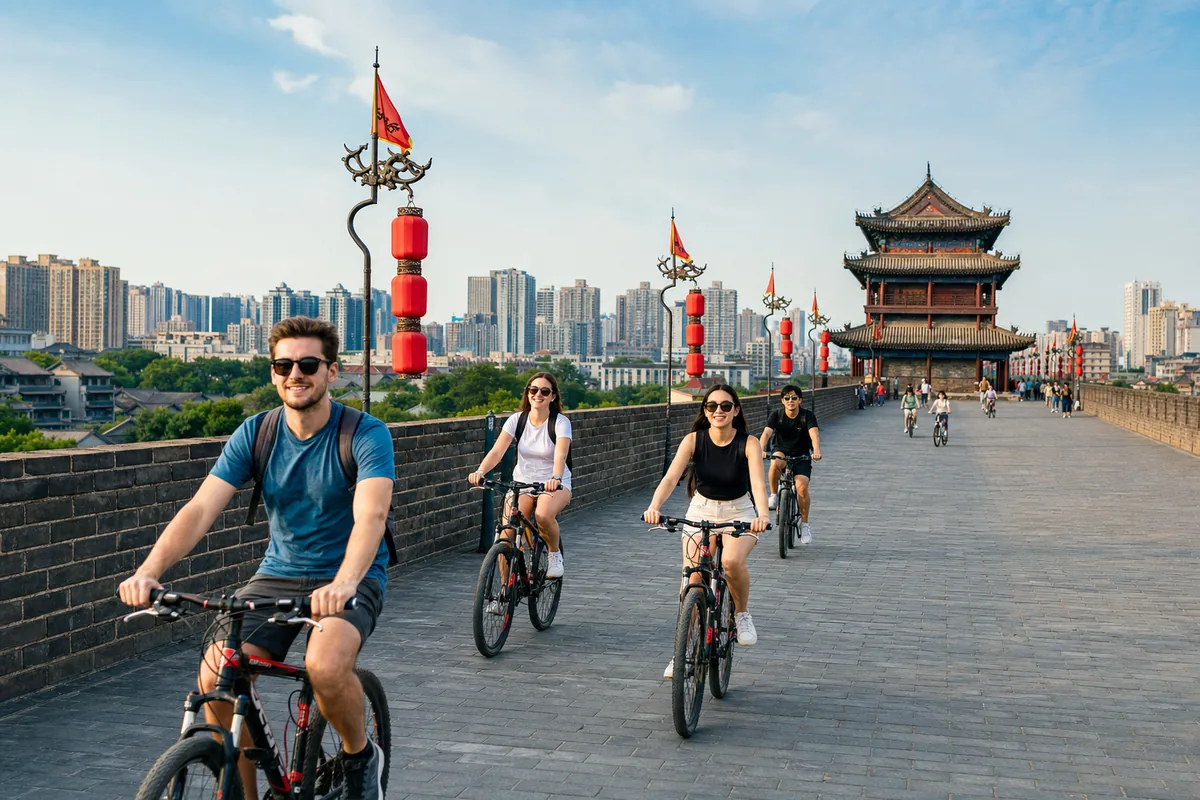
How it works: Climb up at the South Gate (南门, Nánmén), the grandest and most central access point. Entry to the wall is around ¥54. Bike rental is roughly ¥45 for a single bike for a fixed time window (usually around two hours, plus a refundable deposit), which is plenty to ride the full circuit at an easy pace with stops for photos.
From up top you look down on the old city on one side and the modern traffic on the other, passing watchtowers and the four main gates as you go. The surface is brick and slightly uneven in places, so it's not a smooth road ride, but it's an easy, flat loop. Tandem bikes are available if you're traveling as a pair.
Lunch: Muslim Quarter (11:30 AM - 1:30 PM)
From the South Gate it's a short walk or quick taxi to the Muslim Quarter (回民街, Huímín Jiē), the historic neighborhood around the Great Mosque where Xi'an's Hui community has lived for centuries. The main streets are packed with food stalls, and this is where you eat your way through the city's signature dishes.
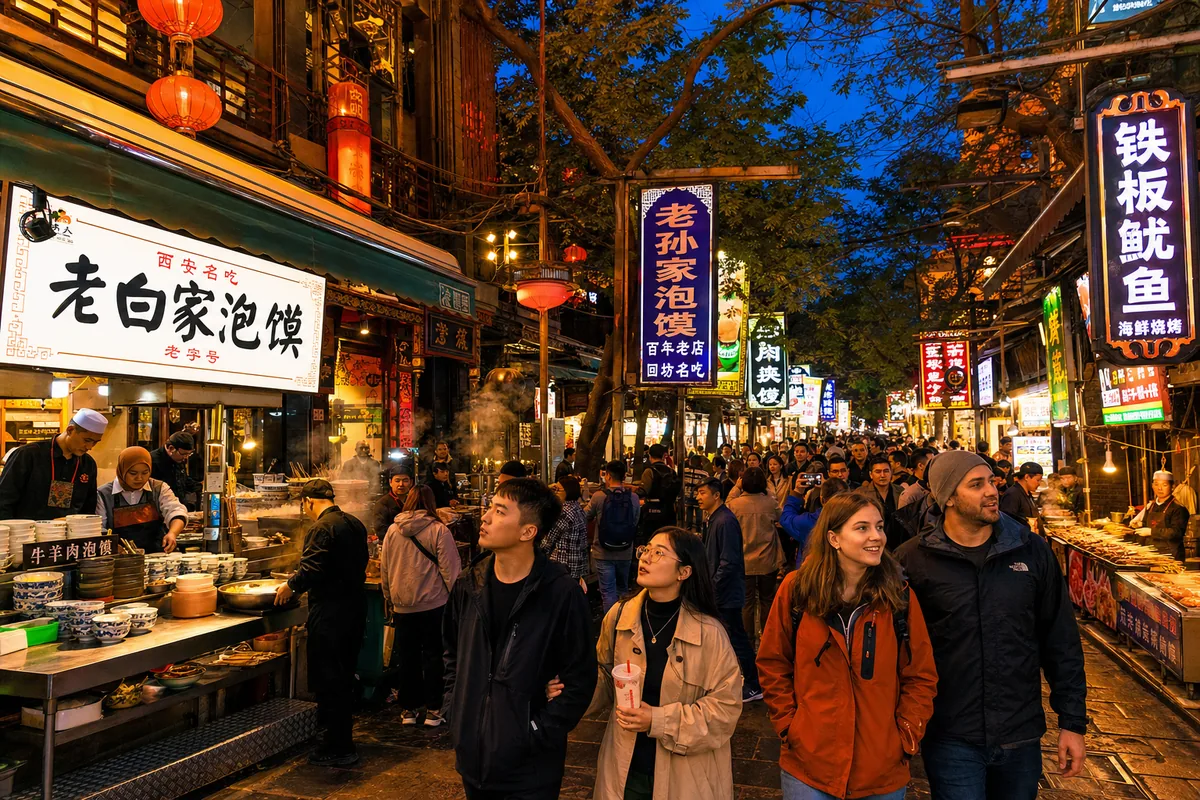
What to try:
- Roujiamo (肉夹馍) — often called a "Chinese hamburger," slow-cooked meat stuffed into a flatbread
- Yangrou paomo (羊肉泡馍) — mutton soup with torn bread, the dish most associated with Xi'an
- Liangpi (凉皮) — cold wheat or rice noodles in a tangy, spicy sauce
- Persimmon cakes (柿子饼) — sweet fried cakes you'll smell before you see
The quarter is busy and aimed squarely at visitors, so prices on the main drag are higher than elsewhere in the city. Step one street back from the main lane for cheaper, less crowded stalls. If you have dietary needs, note that most food here is halal given the neighborhood's history.
Afternoon: Big Wild Goose Pagoda (2:30 PM - 4:30 PM)
Take the metro Line 2 south, then Line 3 or a short taxi to the Big Wild Goose Pagoda (大雁塔, Dàyàn Tǎ). This seven-story brick pagoda was built in the 7th century to house Buddhist scriptures the monk Xuanzang brought back from India, the same journey that inspired the novel Journey to the West.
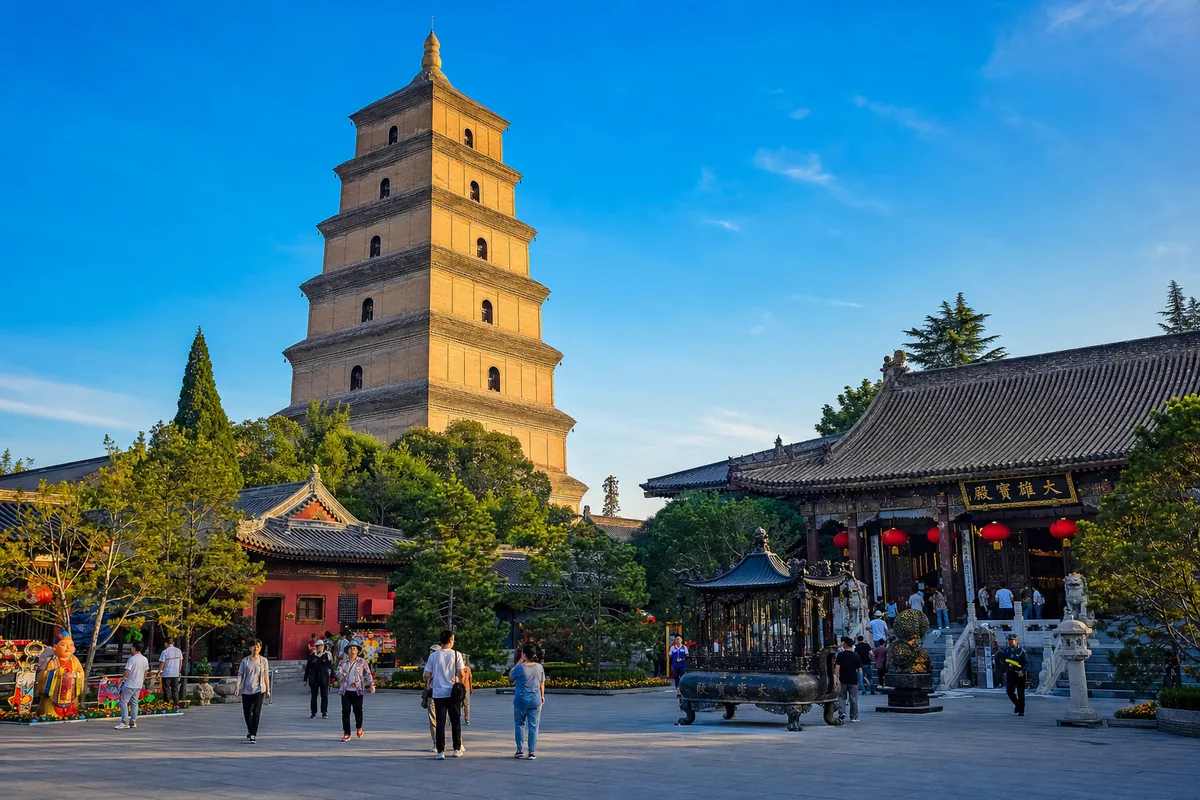
You can admire the pagoda and wander the surrounding Da Ci'en Temple grounds for a modest fee, with an extra charge if you want to climb the pagoda itself. The plaza in front is large and free to walk through, with fountains that run on a schedule. It's an easy, low-energy stop after a morning of cycling and a heavy lunch.
Evening: Datang Everbright City (6:00 PM onward)
Just south of the pagoda is Datang Everbright City (大唐不夜城, Dàtáng Bùyèchéng), a pedestrian boulevard built in Tang-dynasty style that comes alive after dark. The buildings light up, street performers fill the avenue, and the whole strip glows for over a kilometer.
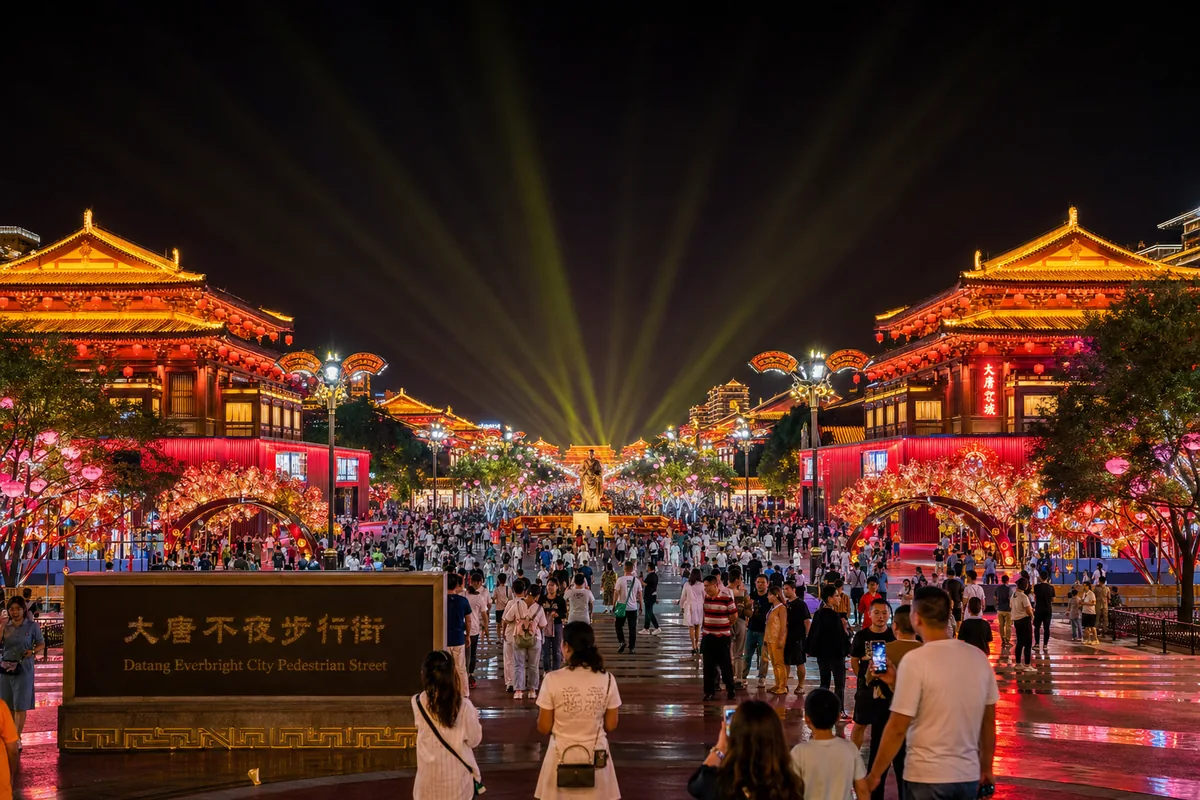
It's free to walk and one of the best evening atmospheres in any Chinese city. Grab dinner at one of the surrounding restaurants, watch a few of the costumed performances, and finish the trip here. From Datang Everbright City, a taxi or metro gets you back to the center in 15-25 minutes.
Getting Around: Practical Notes
Xi'an is straightforward to navigate, but a few things help.
- Metro: Clean, cheap, and signed in English. Buy single tickets at machines or use Alipay's transit QR code. Lines 2 and 3 cover most of this itinerary.
- Ride-hailing: Didi is reliable and far cheaper than flagging taxis, especially for the airport and the Lintong sights. Link a foreign card in advance.
- Walking: The area inside the City Wall is compact. The Bell Tower, Drum Tower, and Muslim Quarter are all within a short walk of each other.
For mapping metro routes and laying out your stops day by day, the WaysChina app has offline metro maps and a built-in trip planner, which is handy when your data connection drops underground.
Where to Stay
For a 2-day trip this tight, location beats everything. Stay inside or just outside the City Wall, near the Bell Tower or South Gate. That puts you walking distance from the Muslim Quarter and one metro ride from almost everything else, and it shortens your morning trip to the Warriors bus.
The area around the Bell Tower has the widest range, from international chains to boutique courtyard hotels. You can compare central Xi'an hotels on Booking.com or check rates on Agoda, which often has competitive prices for properties in China. Wherever you book, remember that hotels handle your police registration (住宿登记, zhùsù dēngjì) at check-in automatically.
Best Time to Visit
Spring (March-May) and autumn (September-November) are the most comfortable, with mild temperatures and lower rainfall. Summer in Xi'an is hot and the outdoor sights, especially the exposed City Wall and the Warriors' parking-lot walk, get draining. Winter is cold but quiet, and a dusting of snow on the wall is worth seeing. Avoid the first week of October if you can; the Golden Week holiday brings domestic crowds that make the Warriors genuinely unpleasant. Always check current ticket prices and opening hours before you go, since they change seasonally.
Final Thoughts
Two days in Xi'an works because the sights divide so cleanly: one day east for the Terracotta Warriors and Huaqing Palace, one day in the center for the City Wall, Muslim Quarter, pagoda, and the Tang-style night strip. Start Day 1 early to beat the tour buses, keep Day 2 on foot and metro, and you'll see the city's headline attractions without feeling rushed. If you have a third day, Xi'an makes an easy base for nearby day trips, or the launch point for the Silk Road heading west.
Book your Terracotta Warriors visit and central accommodation a few days ahead in peak season, sort out Alipay or WeChat Pay before you arrive, and the rest of the trip falls into place.
Last updated: June 2026
Read in other languages
Getting to the sights by metro
Terracotta Army Museum
UNESCO site with 8,000 life-size warriors guarding Emperor Qin Shi Huang's tomb.
- Huaqing Pool
Xi'an City Wall
14km Ming-era city wall, fully circumnavigable on foot or rented bicycle.
- Yongningmen
- North Avenue
- Bell Tower
Bell Tower & Drum Tower
Ming-era twin towers at the city's heart, bracketing the Muslim Quarter.
- Bell Tower
Muslim Quarter (Hui Min Jie)
Halal food street with lamb skewers, biang-biang noodles and roujiamo since the Tang dynasty.
- Bell Tower
- North Avenue
Big Wild Goose Pagoda
Tang-era 7-story pagoda built by Xuanzang to house Buddhist sutras from India.
- Great Wild Goose Pagoda
Shaanxi History Museum
Top museum for Tang-era treasures and Silk Road artifacts; book ahead online.
- Great Wild Goose Pagoda
- Xiaozhai
Small Wild Goose Pagoda
Tang-era 13-story pagoda paired with the Xi'an Museum (free entry).
- Nanshaomen
- Wenyi Road
Tang Paradise (Datang Furong Park)
Tang-themed cultural park with nightly water-screen movie and palace re-creations.
- TangParadise
Tang Eternal City (Datang Everbright City)
Tang-themed pedestrian street with viral 'Living Statue Lady' street performance.
- Datang Everbright City
- Great Wild Goose Pagoda
Forest of Stelae Museum (Beilin)
World's largest collection of stone tablets — 11,000+ inscriptions, calligraphy treasury.
- Yongningmen
- Bell Tower
Huaqing Palace Hot Springs
Tang-era imperial hot springs and site of Yang Guifei's bathing chamber.
- Huaqing Pool
Datang West Market Museum
Reconstructed Tang-dynasty Silk Road market, with archaeology museum below.
- Datangxishi
Xi'an North Railway Hub
Massive high-speed rail hub linking Xi'an to all of central China.
- Xi'an North Railway
Xi'an Xianyang International Airport
Northwest China's main international airport (XIY); located 30 km northwest of central Xi'an.
- Airport
- Airport West
Xi'an metro: last train times by station
Every line and station, checked by hand — the same data behind our offline route planner.
Get the WaysChina App
Offline guides, currency converter, essential phrases, and more — all in your pocket.

Related Articles
Lanzhou Complete Guide
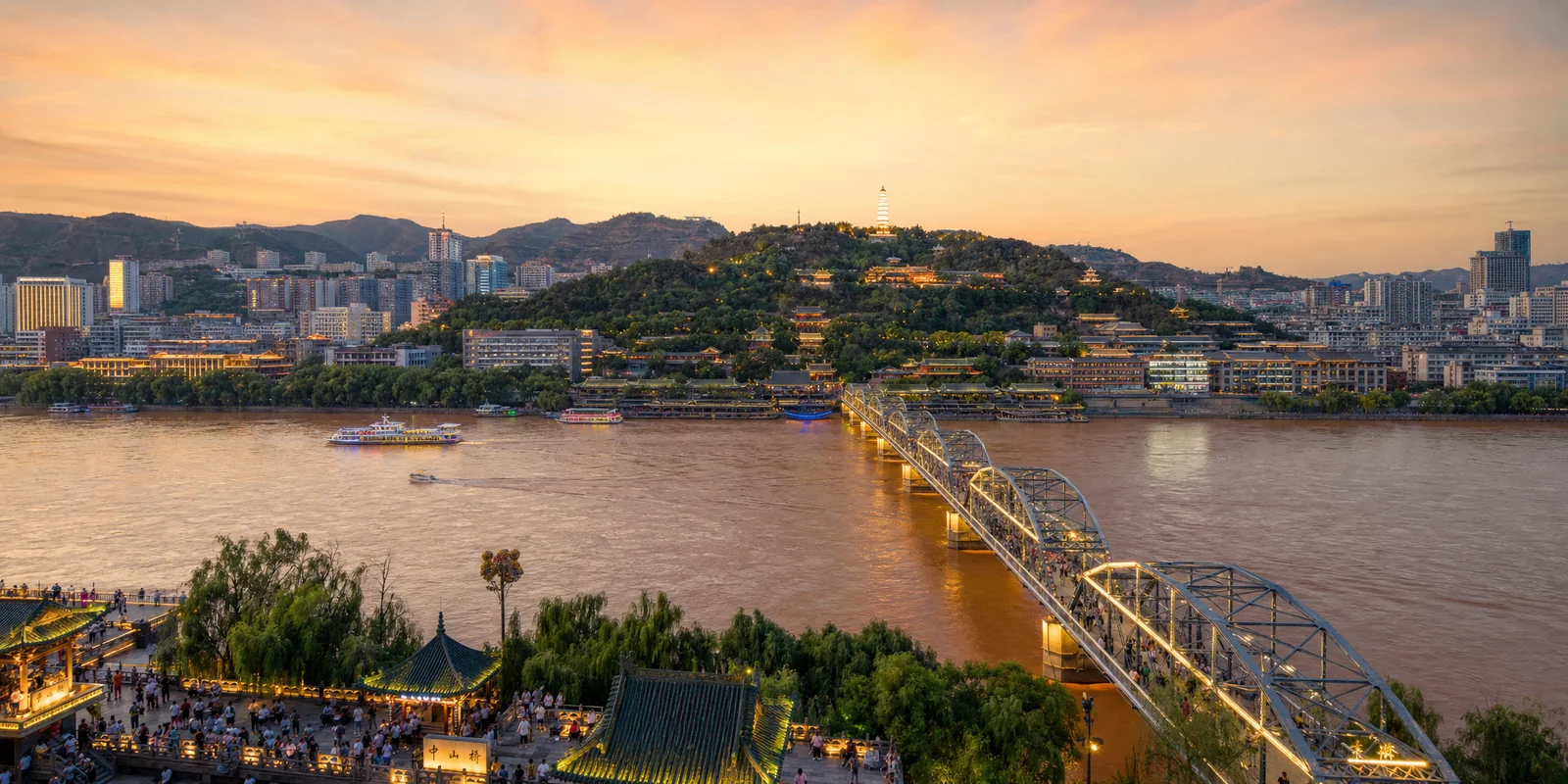
Everything you need for visiting Lanzhou: the famous beef noodles, the Yellow River waterfront, the Gansu Provincial...
Xi'an Day Trips
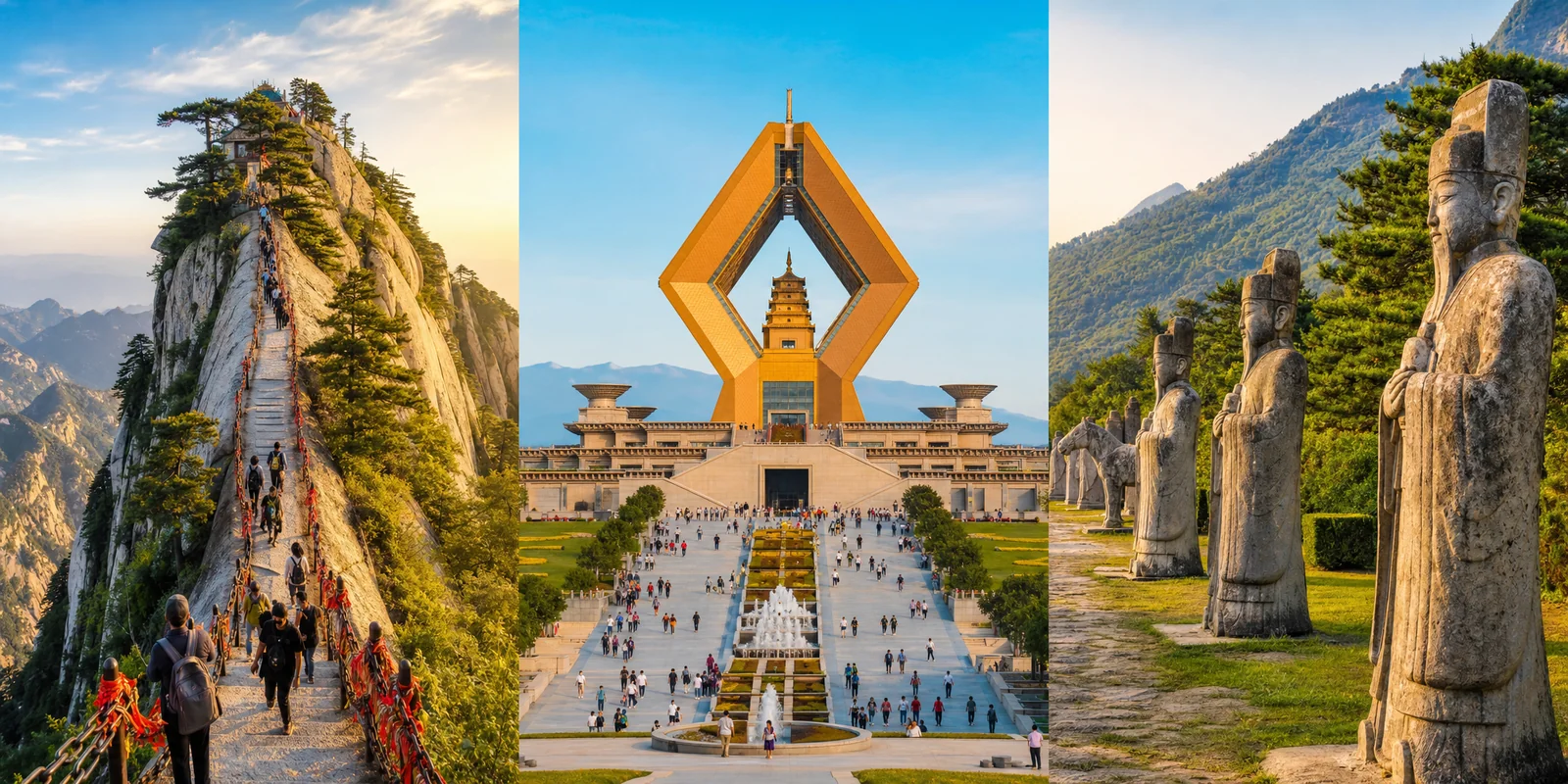
Four of the best day trips from Xi'an — Mount Huashan, Famen Temple, Qianling Mausoleum, and Hanyangling Museum —...
Xi'an Food Guide
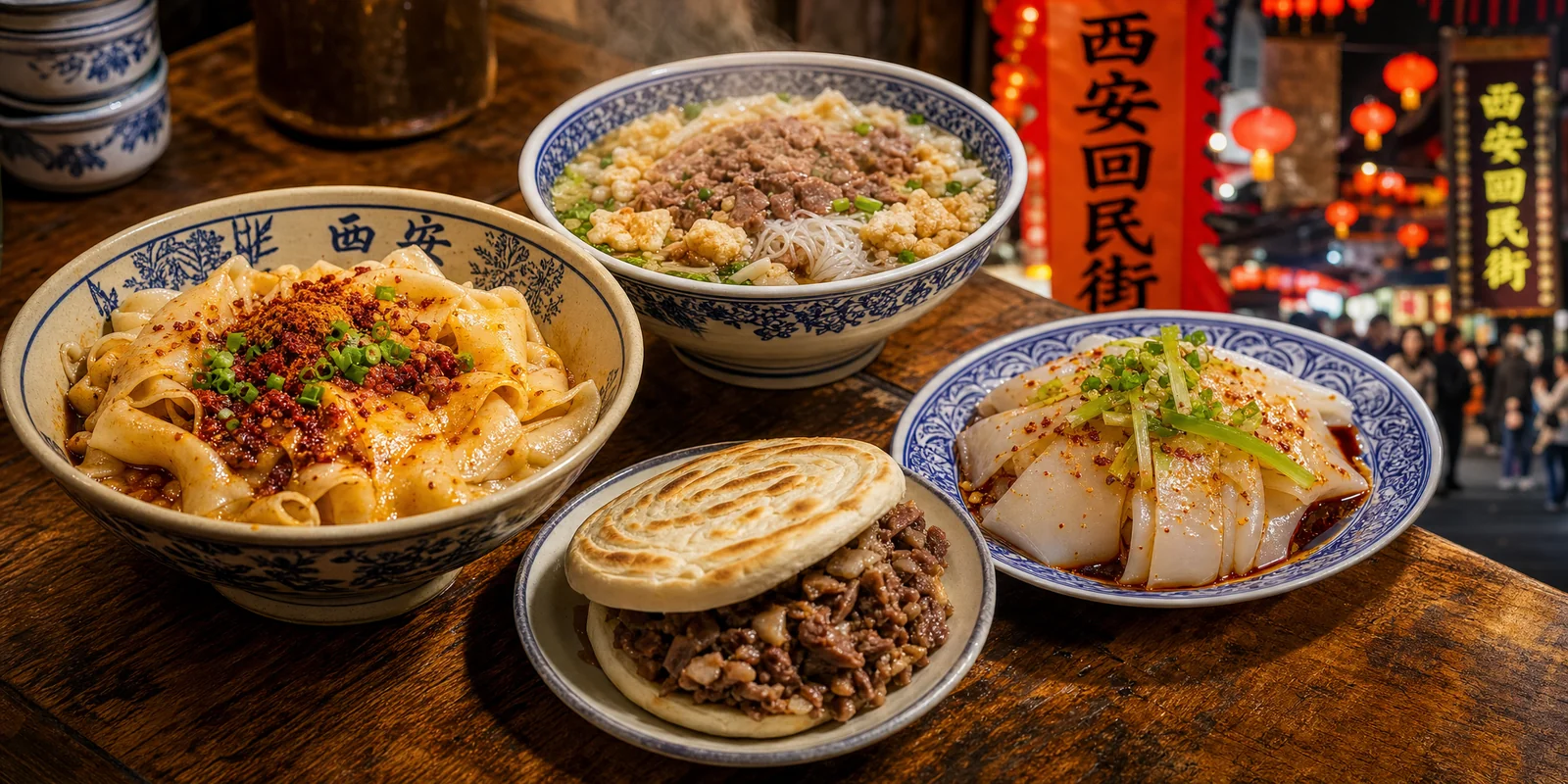
What to eat in Xi'an and where to find it — from biangbiang noodles and roujiamo to lamb soup in the Muslim Quarter,...
Xining & Qinghai Lake Guide
Xining is the gateway to Qinghai Lake, Chaka Salt Lake, and the Ta'er Monastery. Here's how to plan 2-3 days at...