
This article contains affiliate links. If you make a purchase through these links, we may earn a small commission at no extra cost to you. This helps support our work in creating free travel guides.
Accessible travel in China has improved a lot over the past decade, but it's uneven. New infrastructure — high-speed rail stations, airports, big-city metros, modern hotels — is often very good, with elevators, ramps, and accessible toilets that meet international standards. Older neighborhoods, smaller cities, and many tourist sites are a different story: broken curb cuts, steps without ramps, and "accessible" toilets used as storage closets. This guide tells you what to actually expect as a wheelchair user or traveler with reduced mobility, how to use the air and rail systems, which cities are easiest, and how to plan around the rough patches. It's doable — it just takes more planning than in most Western countries.
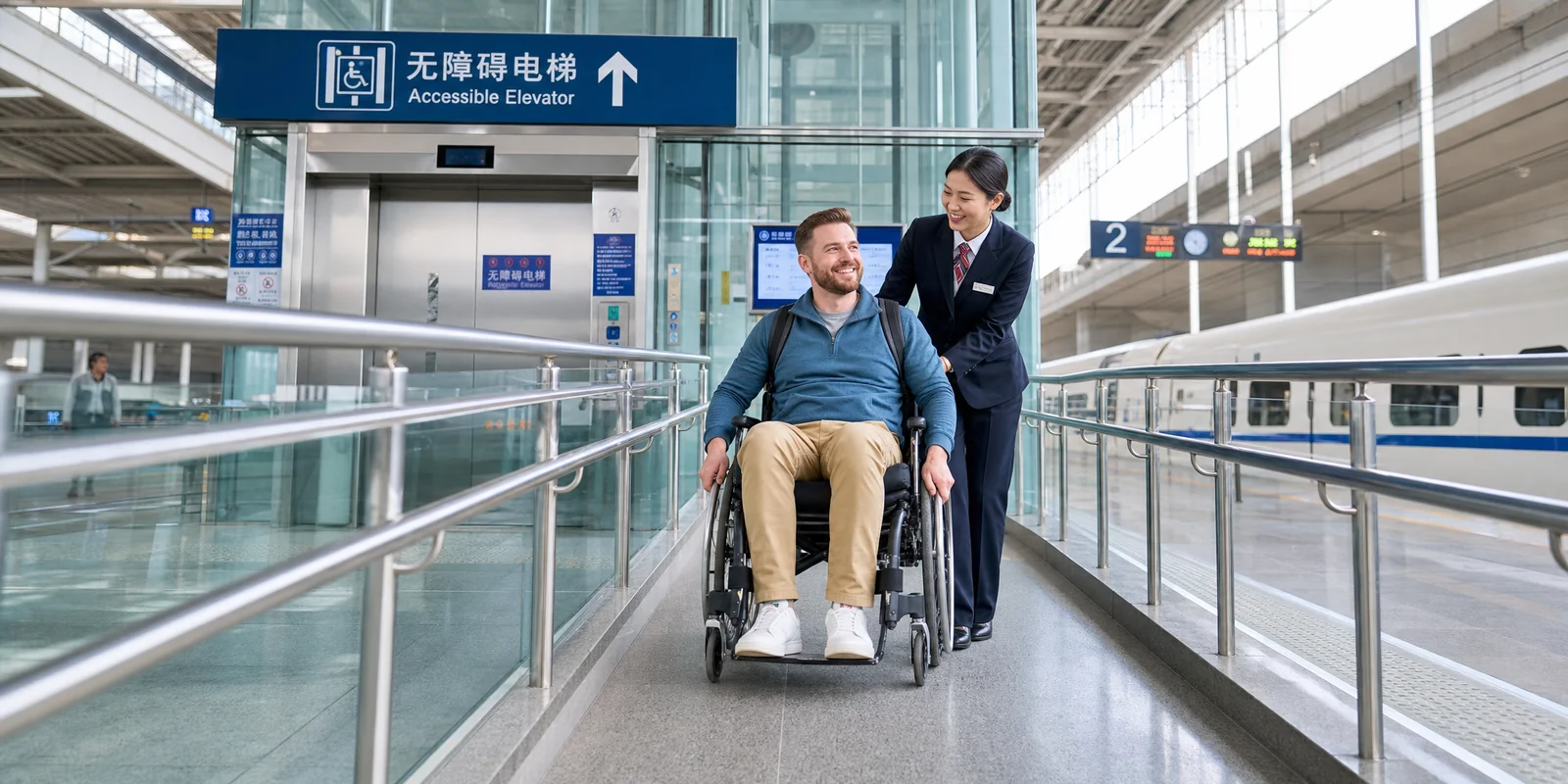
The Honest Overview: What to Expect
The single most useful thing to understand is the split between new and old infrastructure. China built most of its high-speed rail, airports, and big-city metro lines in the last 15-20 years, and accessibility was designed in. These spaces tend to work well. The challenge is everything connecting them: sidewalks blocked by parked scooters, dropped curbs that end in a 10cm lip, ancient temple complexes with hundreds of stone steps, and hutong alleys too narrow and bumpy for a wheelchair.
A few things that surprise first-time visitors:
- Staff assistance is often excellent and free. Train stations and airports have dedicated assistance services, and staff will physically help you. Culturally, helping someone with a disability is seen as normal and expected — you'll rarely be ignored.
- Tactile paving is everywhere for visually impaired travelers, though it's often poorly maintained or blocked.
- English signage for accessible routes is hit-or-miss. Translation apps and a few key phrases go a long way.
- Power wheelchair users face extra hurdles. Battery rules on flights, weight for staff-assisted lifting, and charging logistics all need advance planning.
Air Travel: Airports and Flights
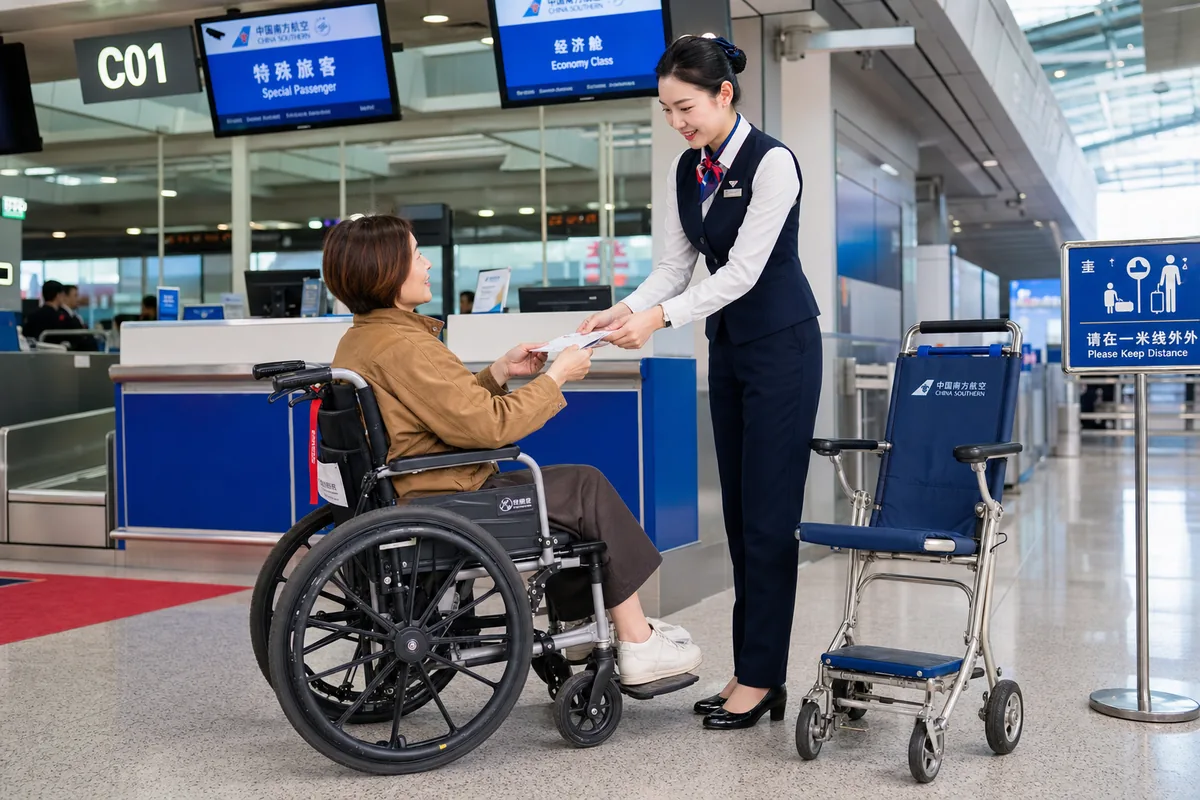
China's major international airports — Beijing (PEK and PKX), Shanghai (PVG and SHA), Guangzhou, Chengdu, Shenzhen — are large, modern, and genuinely accessible. Step-free routes, elevators, accessible toilets, and wheelchair-height check-in counters are standard. Aisle chairs for boarding are available.
Booking and Requesting Assistance
Request wheelchair assistance when you book your ticket, and again at least 48 hours before departure. Both Chinese carriers (Air China, China Eastern, China Southern) and international airlines flying into China handle this routinely. You'll typically be met at check-in, helped through security and immigration, and either pushed to the gate or boarded via aisle chair.
Bringing Your Own Wheelchair
Manual wheelchairs travel free and are usually gate-checked. Power wheelchairs are where it gets technical. Lithium battery rules are strict and enforced. Confirm with your airline well in advance:
- Whether your battery type is accepted (dry/gel cell vs. lithium-ion)
- Watt-hour limits and whether the battery must be removed and carried in the cabin
- The exact procedure for disconnecting and protecting terminals
Bring documentation of your wheelchair's specifications. Get the battery details in writing from the manufacturer if you can.
High-Speed Rail: Often the Best Option
For getting between cities, China's high-speed train (高铁, gāotiě) network is frequently the most accessible choice — more so than flying for many routes. Major stations are huge, modern, and step-free, with elevators and accessible toilets. Trains have designated wheelchair spaces and accessible toilets in specific carriages.
Booking an Accessible Seat
Each high-speed train has a small number of wheelchair-accessible spaces, usually in a specific carriage. These can be hard to book through standard channels, so plan ahead. The official booking platform is China Railway 12306, which also runs the bookings for accessibility services. For step-by-step help with the system, see our guide on how to book train tickets.
Station Assistance
Large stations have a dedicated assistance service (sometimes signed as "重点旅客服务", priority passenger service). Look for it near the main entrance or accessible ticket gates. Staff will guide you through security, help you to the platform via elevator, and assist with boarding using a portable ramp to bridge the platform gap. Arrive earlier than usual — 60-90 minutes before departure — so there's time to arrange this. Our train station navigation guide explains the general layout and security flow.
Why Trains Often Beat Flights
| Factor | High-Speed Rail | Domestic Flight |
|---|---|---|
| Wheelchair handling | You stay in your own chair the whole time | Chair is gate-checked; transfer to aisle chair |
| Battery restrictions | None for power chairs | Strict lithium battery rules |
| Station/airport access | City-center, step-free | Often far from city, but accessible |
| Boarding | Portable ramp, staff assist | Aisle chair, more handling |
| Toilets en route | Accessible toilet on board | Limited on short domestic flights |
City Transport: Metros, Taxis, and Streets
Metro Systems
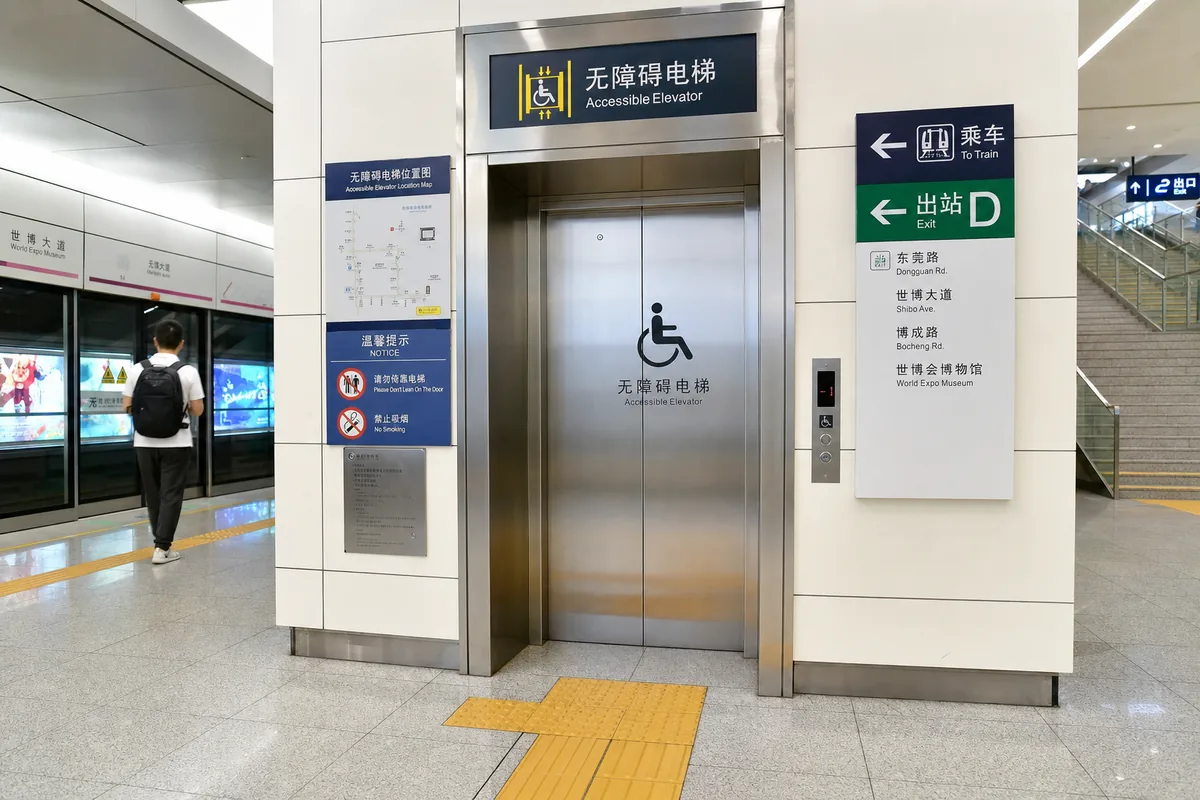
Big-city metros are generally good. Beijing, Shanghai, Guangzhou, Shenzhen, and Chengdu all have elevators at most stations, tactile paving, and station staff who can deploy ramps for the platform-to-train gap. Newer lines are almost always fully accessible; some older lines (parts of Beijing Line 1, for example) have stations where the only step-free route is roundabout or occasionally out of service.
Practical realities:
- Elevators exist but can be hard to find — they're sometimes at a single specific exit, not every entrance. Look for the wheelchair symbol on station maps or ask staff.
- Some elevators require staff to operate or unlock them. Flag down an attendant.
- Rush hour crowds (roughly 7:30-9:30am and 5:30-7:30pm) make maneuvering hard. Travel outside these windows if you can.
Our metro systems guide covers ticketing and navigation in more detail.
Taxis and Ride-Hailing
Standard taxis can carry a folding manual wheelchair in the trunk, and drivers will usually help. Wheelchair-accessible vehicles (WAVs) with ramps are rare and mostly limited to a few cities and pre-booking services. Power wheelchair users who can't transfer to a car seat will find day-to-day taxi travel difficult.
The dominant ride-hailing app is Didi (滴滴), which is far easier than hailing on the street because the app handles the address and payment without any spoken Chinese. See our Didi guide and taxis and ride-hailing guide for setup. A few cities offer accessible vehicle options through Didi or local services, but availability is limited — don't count on a WAV being available on demand.
Sidewalks and Street-Level Reality
This is often the hardest part. Even in modern districts, you'll hit:
- Curb cuts that exist but are blocked by parked e-bikes and shared bicycles
- Sudden steps, uneven paving, and missing dropped curbs in older areas
- Pedestrian overpasses and underpasses (common at big intersections) with stairs and no elevator
For longer distances, the metro or a Didi often beats trying to roll along the street. For getting around major cities, the WaysChina app has offline metro maps and a trip planner that's useful for mapping out step-free routes between stations and attractions in advance.
Accessible Hotels
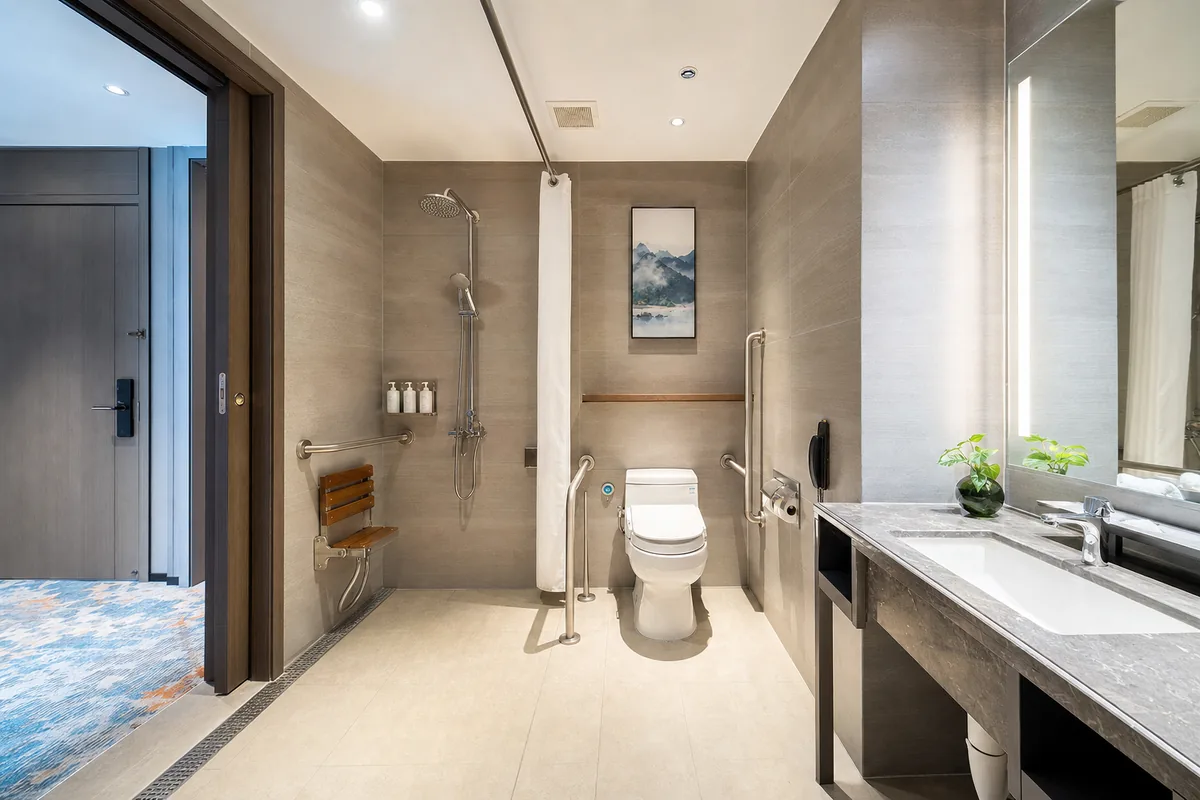
International chains (Marriott, Hilton, Hyatt, InterContinental, Shangri-La) in major cities are your safest bet for genuine accessible rooms — roll-in showers, grab bars, wider doorways, and lower fixtures. Many newer Chinese-brand business hotels also have accessible rooms, but quality varies and "accessible" sometimes just means "ground floor."
How to Book Without Surprises
Don't rely on a checkbox. Booking platforms list accessible rooms, but the definition isn't standardized. Book a room described as accessible, then email or call the hotel directly to confirm the specifics that matter to you:
- Roll-in shower vs. bathtub (bathtubs are common even in "accessible" rooms)
- Door widths and whether the bathroom door is wide enough
- Grab bars by toilet and shower
- Bed height and space to transfer
- Step-free route from entrance to room (and elevator size)
You can compare accessible-room listings across many properties on Booking.com, then confirm the details with the hotel before paying — the platform's filters are a starting point, not a guarantee. Note that all foreign guests must complete police registration (住宿登记, zhùsù dēngjì) at check-in, which hotels licensed to take foreigners handle automatically.
City-by-City: Where It's Easiest
Accessibility correlates strongly with how new and how big a city's infrastructure is. Here's a realistic ranking for wheelchair users.
| City | Accessibility | Notes |
|---|---|---|
| Shanghai | Best overall | Modern metro, flat terrain, many accessible hotels, good airports. The Bund and newer districts are manageable. |
| Shenzhen | Excellent | One of China's newest cities — built recently, so accessibility is strong. |
| Guangzhou | Very good | Good metro and modern areas; some older districts are tougher. |
| Beijing | Good but mixed | Great metro and stations, but the Forbidden City, Great Wall, and hutongs range from partially to barely accessible. |
| Chengdu | Good | Flat, modern metro, relaxed pace. Panda base has accessible paths. |
| Hangzhou / Suzhou | Moderate | West Lake has flat lakeside paths; classical gardens have steps and narrow passages. |
| Hilly/old cities (Chongqing, Pingyao, Fenghuang) | Challenging | Steep terrain or ancient stone streets. Possible with help, but expect significant barriers. |
Attractions: The Real Bottleneck
Many of China's most famous sites are historic, which means steps. Some specifics:
- Great Wall: Mutianyu has a cable car that gets you to the wall, but the wall itself is steep with steps and uneven surfaces. Badaling is similar. You can reach a viewing area but won't traverse much.
- Forbidden City (Beijing): Has ramps on the main central axis and is partially navigable, but side areas have steps and thresholds. Borrow a wheelchair at the entrance if needed.
- Terracotta Warriors (Xi'an): The main pits have ramps and viewing platforms; reasonably accessible.
- Modern attractions (Shanghai Tower, museums, the Bund, panda bases) are generally well designed for step-free access.
Most major attractions lend wheelchairs for free at the entrance (you'll leave a deposit or ID). This is handy if your own chair can't handle the terrain or you only need one for a long site.
Planning a Trip That Actually Works
Given the unevenness, a bit of structure makes a huge difference:
- Anchor your trip in accessible cities. A Shanghai-based trip with day trips, or a Beijing-Xi'an-Shanghai high-speed rail route, hits modern infrastructure most of the time.
- Pre-book everything that can be pre-booked: accessible train seats, station assistance, hotel rooms (confirmed by email), and airport assistance.
- Build in buffer time. Elevators out of service, longer routes, and assistance arrangements all eat time.
- Consider a specialist operator. For a complex itinerary, a tour company that arranges accessible vehicles, vetted hotels, and guides who know the step-free routes can be worth the cost. Operators like China Highlights can build custom accessible itineraries with private accessible transport, which removes the biggest daily headaches.
Other Disabilities
Visual Impairment
Tactile paving is widespread, and metro announcements are in Chinese and usually English. Major stations have staff assistance. Guide dogs are legally permitted in public spaces and transport, but enforcement and awareness vary, so carry documentation and expect occasional pushback at smaller venues.
Hearing Impairment
China is highly visual and text-based, which helps. Translation apps, written notes, and the prevalence of QR codes and screens make many transactions doable without speech. See our translation apps comparison for tools that handle both text and speech-to-text.
Essential Apps and Phrases
- Didi — ride-hailing without spoken Chinese
- A translation app — for explaining needs and reading signs
- A map app — for planning routes (see our map apps guide)
- Alipay or WeChat Pay — set up before arrival, since cash is increasingly rare
A few phrases worth having ready in Chinese (your translation app can speak them): "Where is the elevator?", "I need wheelchair assistance," "Is there an accessible toilet?", "Is this route step-free?" Our survival phrases guide has more.
Frequently Asked Questions
Can I travel China independently as a wheelchair user?
Yes, in major eastern cities, especially Shanghai and Shenzhen, with good planning. For historic sites, smaller cities, or a packed multi-region itinerary, having a companion or a specialist operator makes it much smoother.
Are accessible toilets common?
In new airports, train stations, malls, and metro stations, yes. On the street and in older buildings, much less so. Plan around the reliable ones (stations and malls).
Will I be able to rent a wheelchair or scooter?
Most major attractions lend manual wheelchairs free with a deposit. Renting a power chair or mobility scooter for a whole trip is hard to arrange — bring your own if you rely on one, and sort out the flight battery rules early.
Is medical care accessible if I need it?
Major cities have international hospitals and clinics. See our guide to English-speaking hospitals and consider travel insurance that covers your equipment and any pre-existing conditions.
The Bottom Line
China is more accessible than many travelers assume — but only in the right places, and only with planning. The modern backbone (high-speed rail, big-city metros, major airports, international hotels) works well, and staff assistance is reliable and free. The gaps are at street level, in historic sites, and in smaller cities. Build your trip around accessible cities, pre-book assistance and rooms, confirm hotel details in writing, and lean on trains over flights when you can. With those pieces in place, most travelers with mobility needs have a genuinely good experience. Start by choosing one or two accessible base cities, then plan outward from there.
Policies on flight batteries, accessible-seat booking, and station services change — always confirm the latest requirements with your airline, the railway, and your hotel before you travel.
Last updated: June 2026
Read in other languages
Last train times for 10 Chinese metro systems
Every line and station, checked by hand — the same data behind our offline route planner.
Get the WaysChina App
Offline guides, currency converter, essential phrases, and more — all in your pocket.

Related Articles

Business Travel in China
A practical guide to business travel in China: visas, etiquette for meetings and dinners, business card customs,...

Couples & Honeymoon Travel in China
A practical guide to romantic travel in China — where to go for couples and honeymoons, how to plan the route, and...

Digital Nomad Guide to China
Working remotely from China is very doable once you sort out three things: your visa, your internet setup, and your...

Female Solo Travel in China
China is one of the safer destinations for women traveling alone. Here's an honest, practical guide to safety,...