

This article contains affiliate links. If you make a purchase through these links, we may earn a small commission at no extra cost to you. This helps support our work in creating free travel guides.
The Leshan Giant Buddha is an easy day trip from Chengdu, and you do not need a tour to do it. Take a high-speed train from Chengdu East Station to Leshan Station, which usually takes 46 to 60 minutes. From Leshan Station, city buses K1 and 3 start right at the station and run to the scenic area. The daytime ticket costs 80 yuan, and the river boat that shows you the whole statue costs 70 yuan more. Plan on leaving Chengdu in the morning and being back in the evening.
The one real decision is how you see the Buddha. You can walk the cliff path down to its feet, or you can see the whole figure at once from a boat on the river. Most people who have a full day do both. This guide covers the trains and buses, the ticket and opening hours, how to buy as a foreigner, the climb and the boat, the rest of the scenic area, the evening options, and whether to add Mount Emei.
The short answer: how to get there, what it costs, how long it takes
Here is the whole day in one list. The times are for the winter season, which runs from 8 October 2026 to 31 March 2027; summer hours start again on 1 April.
- Train: Chengdu East to Leshan, 46 to 60 minutes on most trains, with a second-class seat between 26 and 63 yuan depending on the train.
- Bus from Leshan Station: K1 or 3, both starting at the station. Check the fare and the journey time at the stop.
- Ticket: 80 yuan for the daytime visit, which includes the route to the Buddha itself; children under 1.2 m or under 6 go free.
- Opening hours: 08:00–17:30 in winter and 07:30–18:30 in summer, with no fixed closing day.
- Daytime boat: 70 yuan, boarding between 08:30 and 17:30 in winter.
- Last train back: around 23:07 from Leshan, most of them to Chengdu East.
Inside the scenic area, the climb plus the boat takes about half a day. Add the trains and buses from Chengdu and back, and it becomes a full day: an early train out, the climb in the morning, lunch, the boat in the afternoon, and a train back in the evening. If you have less time than that, choose one of the two; the section on the climb and the boat below will help you pick.
For how Leshan compares with the other trips out of Chengdu, see our Chengdu day trips guide.
From Chengdu by high-speed train, then a city bus
Which Chengdu station
Go from Chengdu East Station (成都东站, Chéngdū Dōng Zhàn). It is the main departure station for Leshan, and Chengdu South is a smaller back-up. A few trains also start from Xipu, but for most visitors staying in the center, Chengdu East is the simplest choice.
Chengdu East is on metro Line 2 and Line 7. On Line 2, it is 6 stops from Chunxi Road and 7 stops from Tianfu Square, the center of the city. Check your route on our Chengdu metro map, and leave time to get through the station's ticket check and security before your train.
The train
Trains run all day. A sample timetable from late September 2026 lists about 78 direct trains a day from Chengdu to Leshan, with the first leaving at about 05:55 and the last at about 22:51. Most trains take between 46 and 60 minutes. Second-class fares range from about 26 to 63 yuan because China Railway prices each train differently, so check the fare for the exact train on 12306 when you book.
Buy your ticket with your passport on the official China Railway 12306 site or app. If the 12306 sign-up or payment gives you trouble, Trip.com sells the same train tickets in English and takes foreign cards. Our guide to booking China train tickets with a foreign passport walks through both, and the high-speed train guide explains seat classes, boarding and what happens at the gate.
Book both directions at the start. A morning train out and a train back in the early evening is the most relaxed plan. On weekends and Chinese public holidays the popular times sell out, so book as early as you can.
From Leshan Station to the Buddha
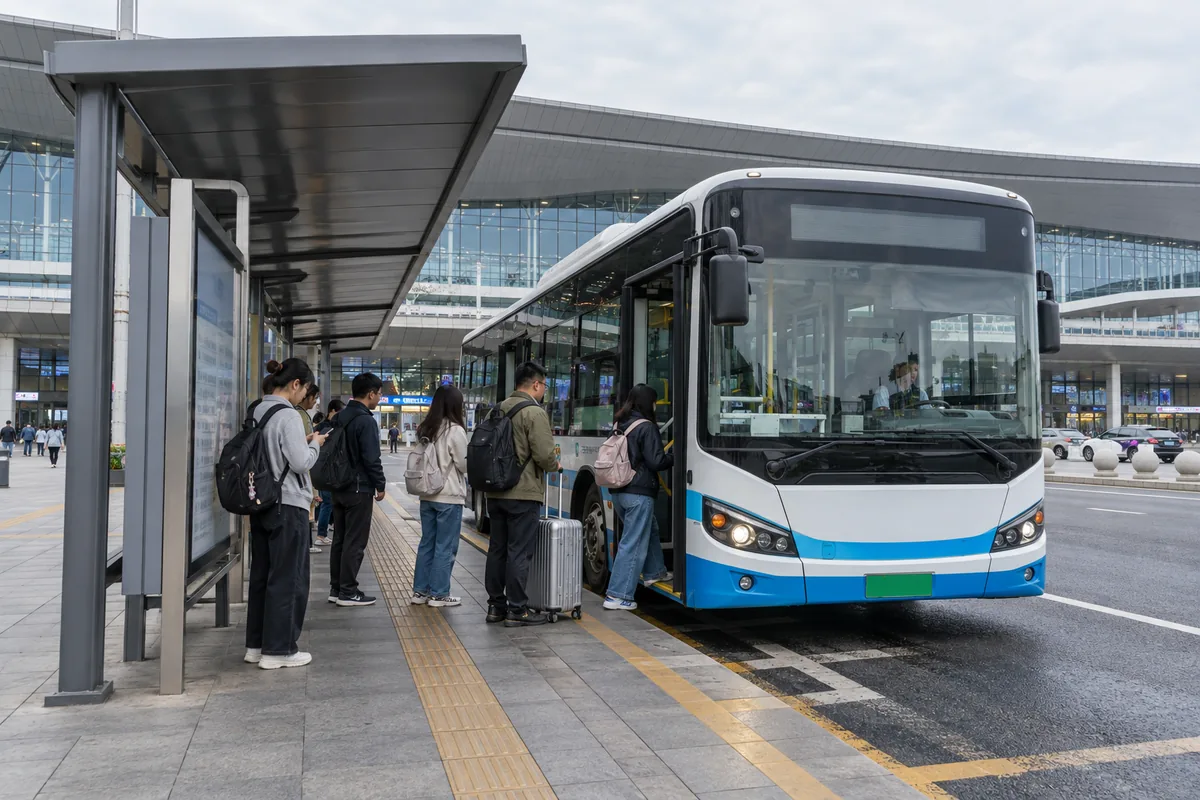
Leshan Station (乐山站, Lèshān Zhàn) is the high-speed station on the edge of the city, not next to the Buddha. Two city bus lines, K1 and 3, both start at Leshan Station and go to the Giant Buddha scenic area, and K1 is usually described as the fastest. Lines 13 and 601 also reach the scenic area from other parts of town. Leshan buses change routes from time to time, so check the route board at the stop and confirm the fare there before you board; keep some coins or small notes, or Alipay, ready.
The scenic area is long, with the North Gate and North Visitor Centre at one end and the South Visitor Centre at the other. If you are climbing, aim for the North Gate side. If you only want the boat, either visitor centre works, because both sell boat tickets. Tell the driver or show the name 乐山大佛 (Lèshān Dàfó, "Leshan Giant Buddha") if you are not sure where to get off.
With two or three people, a taxi or a DiDi (滴滴, Dīdī, China's main ride-hailing app) from the station is faster than the bus and not much more per person; the app shows the price before you confirm. Our DiDi guide explains how to set it up with a foreign card.
Coming back to Chengdu
You will not get stuck in Leshan. The sample timetable lists about 75 trains a day from Leshan back to Chengdu, and the last one leaves at around 23:07, most of them ending at Chengdu East. The catch is the metro at the other end: the last Line 2 train from Chengdu East toward the city center (the Xipu direction) leaves at 23:29. Trains that leave Leshan after about 22:15 arrive too close to that time to count on it, so after that you will need a taxi from the station. Check the late-evening times on our Chengdu last-train page. the WaysChina app works offline as a metro and day-plan helper for Chengdu, so you can check the route home on the train without data.
Tickets, opening hours and how to buy
The basic ticket is the daytime "mountain" ticket (白天游山, báitiān yóushān). It costs 80 yuan and includes the walking route to the Buddha. Children under 1.2 m or under 6 years old enter free. The boat, the night walk on Lingyun Mountain and the sightseeing cart are separate tickets, and so is the night river cruise. Student and other discounts depend on your documents, so ask at the ticket window; foreign student cards are not always accepted at Chinese sights.
The site has two seasons. From 1 April to 7 October it opens 07:30–18:30, and from 8 October to 31 March it opens 08:00–17:30. There is no weekly closing day. No separate last-entry time is listed, so in winter it is best to be through the gate by early afternoon if you want to do the climb at an easy pace.
You can buy tickets in three ways:
- Online in the "大佛旅游" (Dàfó Lǚyóu, "Giant Buddha Tourism") mini-program inside WeChat or Alipay, or by searching "乐山大佛景区" in Douyin, China's version of TikTok.
- At the ticket halls in the North Visitor Centre and South Visitor Centre.
- At the ticket windows at the North, South and West Gates.
For foreign visitors, the ticket halls at the two visitor centres are the easiest place to buy. The windows there have see-through translation screens that work in 14 languages, staff carry translation devices, and you can rent a self-guided audio player in 7 languages. Card machines that take foreign bank cards are installed across the scenic area. There are also two service points for foreign visitors that help with translation and urgent problems.
Buying online with a passport is less certain. The operator lists the mini-program as a sales channel but does not say whether it accepts a passport as ID, so check at the ID step whether a passport option appears. If it does not, buy at a visitor centre window on the day. Tickets are sold on the same day at the windows, so a walk-up visit works. Keep your passport with you all day, because ticket checks are by real name.
The table below has the ticket and opening details in one place.
For the operator's own words, the 2026–27 winter notice is published on Leshan News (in Chinese). Your browser's translate button handles it well enough.
Climb down to the feet, or see it all from the boat
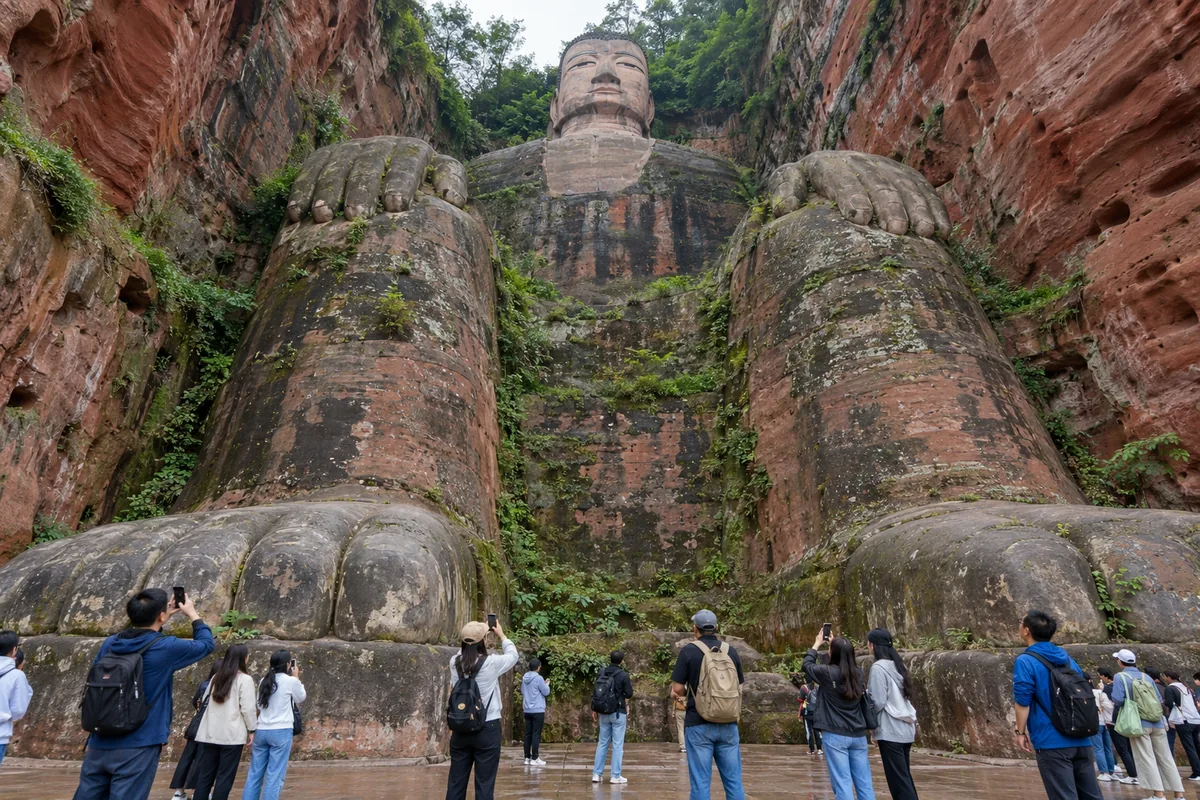
The Buddha is 71 m tall and carved into the cliff, facing the river. That size is the reason for the choice. From the cliff top you stand next to its head and look down; from the stairs you see it in pieces, an ear, a shoulder, a knee; at the bottom you stand at its feet and look straight up. Only from the river do you see the whole seated figure from head to feet in one view.
The climb: Lingyun Plank Road
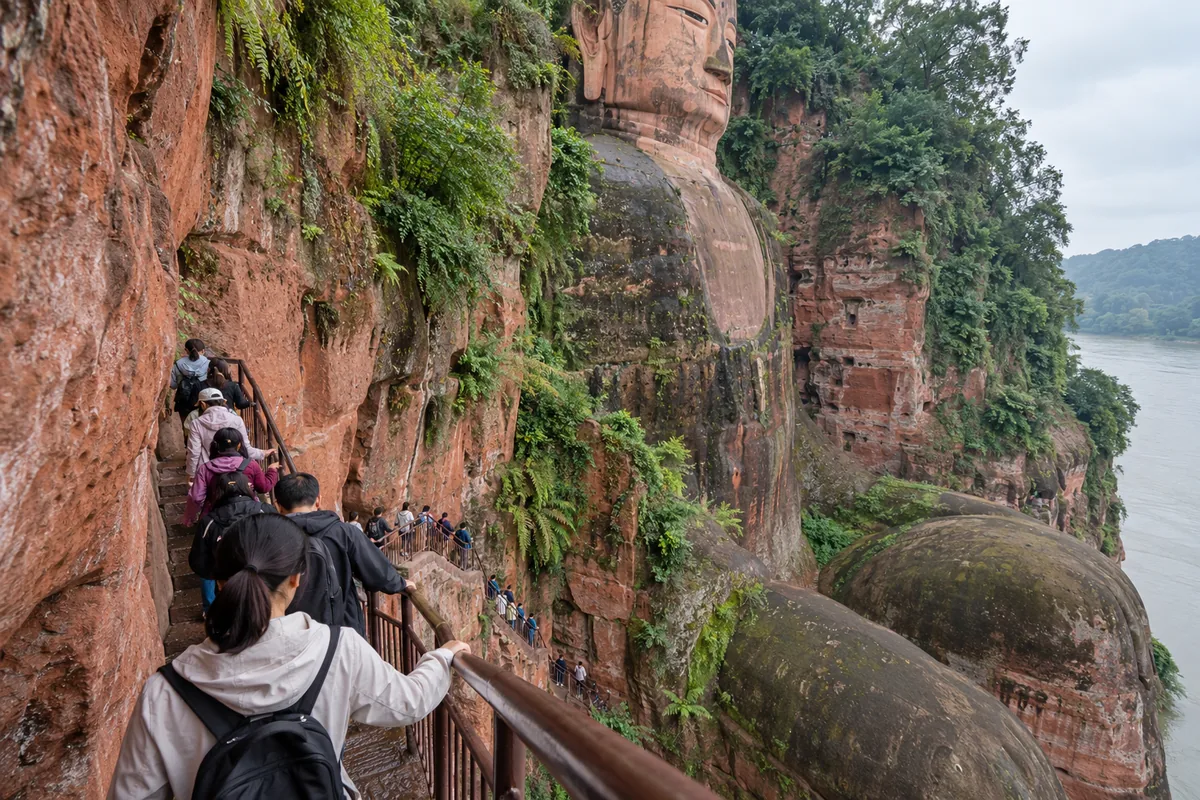
The way down to the feet is the Lingyun Plank Road (凌云栈道, Língyún Zhàndào), a narrow stairway cut into the cliff beside the statue. The other path you may read about in older guides, the Nine-Turn Plank Road (九曲栈道, Jiǔqū Zhàndào), is closed for maintenance; the operator's 2026–27 winter notice still says so and gives no reopening date, and it sends everyone down by the Lingyun Plank Road instead.
The usual walk goes like this. You enter on the North Gate side, walk up through the trees to Lingyun Temple, come out on the cliff top beside the Buddha's head, and then join the line for the plank road. The stairs are narrow and the flow of people usually runs one way, downhill, so the line moves at the speed of the slowest walker; follow staff directions on the stairs. At the bottom there is a platform at the Buddha's feet by the water, where you get the classic photo looking up. From there, signs lead you on and out of the cliff area.
The line for the plank road is the slowest part of the day. It is shortest on weekdays and right after opening, and clearly longer on weekends, during school holidays and above all on national holidays such as the October Golden Week. If you have any choice, go on a weekday and be at the gate when it opens.
The stairs are steep in places and wet after rain. Wear shoes with grip, keep one hand free for the rail, and leave large bags at your hotel in Chengdu. If you have bad knees or a fear of heights, the boat is the better choice.
The boat: the full view from the river
The daytime boat (白天游船, báitiān yóuchuán) costs 70 yuan. In winter, boarding runs continuously from 08:30 to 17:30, and the ticket windows sell boat tickets from 08:00 to 17:00. Children under 1.2 m ride free, but they still need a free ticket. You can buy in the same "大佛旅游" mini-program or on Douyin, where daytime boat tickets for the next day go on sale at 18:00 the evening before, or at the North and South Visitor Centre ticket halls.
The boat does not land at the Buddha. It goes out on the river and slows down in front of the statue, so you can photograph the whole figure, then returns. The ride itself is short. The operator changes sailings with the river level and the weather, so ask at the ticket hall which pier is sailing that day and how to get there from where you are standing.
Bring a zoom lens or use your phone's telephoto setting. People on the feet platform look tiny next to the statue, and that sense of scale makes the best boat photo. If you can, stand or sit on the side of the boat that faces the cliff as it approaches.
Doing both, and in which order
If you have the day, do both. We suggest the climb first and the boat second, for three reasons. The plank road line grows through the morning, so it pays to be early. The boat runs until late afternoon, so it fits after lunch. And after you have stood at the feet, the view from the river makes more sense, because you can pick out the platform where you were standing.
The reverse order also works if you arrive late or the line looks long when you get there: take the boat first, then decide whether the climb is worth the wait.
The two ends of the scenic area are linked by a sightseeing cart (观光车, guānguāngchē). In winter it runs from 08:00 to 20:30, costs 10 yuan for a single ride or 15 yuan for a day pass, and runs between the South Visitor Centre and the North Visitor Centre, with stops including the South Gate, Oriental Buddha Park (东方佛都, Dōngfāng Fódū), Huahuwan, the East Gate, the North Gate and Baxiandong. With a climb and a boat in one day, the day pass is the sensible buy. In the daytime there is also a small new ferry across the river between Leshan Port in town and Baxiandong, once an hour from 09:30 to 17:30, on a trial basis at 2 yuan.
Here are the winter boat, ferry and cart times in one table.
| Service | Times | Fare | Tickets and notes |
|---|---|---|---|
| Daytime river boat | boarding 08:30–17:30, continuous departures; ticket windows sell 08:00–17:00 | ¥70; children under 1.2 m free, but still need a free ticket | 大佛旅游 mini-program (WeChat or Alipay) or Douyin, where next-day tickets go on sale at 18:00 the evening before; North and South Visitor Centre ticket halls. Sailings depend on river level and weather |
| Three Rivers night cruise | 20:00 daily, from Wuyou Temple pier past the Buddha and back | ¥138; children under 1.2 m ¥69; babies under 1 free; no other concessions | Visitor centre windows sell that day’s cruise from 18:00; online as for the daytime boat. Be at the North or South Visitor Centre cart stop 30 min before sailing for the free cart to the pier. May not sail at some river levels; check on +86 833 235 5557 |
| Lingyun Mountain night walk | Closed for maintenance all season; any holiday openings announced separately | — | — |
| Ferry: Leshan Port – Baxiandong | Oct 9, 2026 – Mar 31, 2027: 09:30–17:30, every 60 min; sails only if the water level allows; extra departures on holidays | ¥2 (trial-run price, may change); free with a night-cruise or Lingyun night-walk order and for children under 1.2 m | Online, or scan the QR code on site |
| Sightseeing cart | 08:00–20:30, continuous departures | ¥10 per ride · ¥15 day pass, unlimited rides | 大佛旅游 mini-program or Douyin, or on site (staffed counter or QR self-service). Stops: South Visitor Centre → South Gate → Oriental Buddha Park → Huahuwan → East Gate → North Gate drop-off → Baxiandong → North Visitor Centre |
What else is inside the scenic area
The Buddha is the main event, but the hills around it hold a few more places worth a look if you have time.
- Lingyun Temple (凌云寺, Língyún Sì) sits on the hill just behind the Buddha's head. You walk past it on the usual route to the top of the plank road, so it costs you nothing extra in time.
- Wuyou Temple (乌尤寺, Wūyóu Sì) stands on a smaller hill at the south end, near the Wuyou Temple pier used by the night cruise. It is quieter than the main route and a good stop if you are already at the south end for the boat.
- Oriental Buddha Park (东方佛都, Dōngfāng Fódū) is a park of Buddhist carvings and statues between the two ends of the scenic area, with its own stop on the sightseeing cart.
- Mahao Cliff Tombs (麻浩崖墓, Máhào Yámù) are ancient tombs cut into the rock, in the same area.
The operator's notices do not say whether Wuyou Temple, Oriental Buddha Park or the Mahao Cliff Tombs are covered by the 80-yuan mountain ticket, so ask at the ticket window before you head to any of them. Temples in China often sell incense at the door; buying it is your choice, not a requirement.
For a first visit, a good route for the half day you will spend inside the scenic area is: North Gate, Lingyun Temple, the cliff top at the head, the plank road down to the feet, then the cart to the South Visitor Centre for the boat. Add Wuyou Temple or Oriental Buddha Park only if you still have energy and an hour or two before your train. If you enjoy temples, our guide to temples and other religious sites in China covers etiquette and how tickets usually work.
Seeing it at night
In winter the only evening option is the Three Rivers night cruise (夜游三江, yèyóu sānjiāng). It sails once a day at 20:00 from Wuyou Temple pier, passes the Buddha and returns, and costs 138 yuan; children under 1.2 m pay 69 yuan and babies under one ride free. Ticket windows at the visitor centres start selling that day's cruise at 18:00, and you need to be at the cart stop at the North or South Visitor Centre 30 minutes before sailing for the free cart ride to the pier. The cruise can be cancelled when the river is high or low, so call +86 833 235 5557 to check that day.
The night walk on Lingyun Mountain (夜游凌云山) is closed for maintenance for the whole winter season, with any holiday openings announced separately. A night cruise also means staying in Leshan, or catching one of the last trains back with a taxi at the Chengdu end, so it suits people who are already spending the night. These are winter arrangements; for evenings from April on, check the summer operating notice that the scenic area publishes in spring.
Should you add Mount Emei?
Mount Emei (峨眉山, Éméi Shān) is close to Leshan, and the two are listed together as one World Heritage site. Trains between Leshan Station and Emeishan Station take about 15 minutes, a little over 30 trains a day run toward Emei (some to the older Emei station), and second-class seats cost about 6 to 11 yuan. That makes a two-day trip easy: the Buddha on day one, a night in Leshan or near the mountain, and Emei on day two.
Do not try to fit both into one day from Chengdu. Emei is a big mountain with several hours of bus rides, cable cars and walking between the bottom and the Golden Summit, and it needs a full day of its own. Here is what to know before you add it.
- Ticket: 160 yuan in peak season and 110 yuan in the low season from 15 December to 15 January; this does not include temples, cable cars, the bus or insurance.
- Mountain bus: a full round-trip bus ticket is 90 yuan. Since 10 March 2026, buses to Leidongping (the stop below the Golden Summit) need a real-name booking for a time slot, made through the official Mount Emei WeChat account, mini-program or partner sites such as Trip.com, and a passport is accepted.
- Golden Summit cable car: 65 yuan up and 55 yuan down in peak season.
- Building work: the Leidongping area and the Golden Summit cable car are being rebuilt, with work expected to finish in 2027. The mountain stays open, but from 23 May 2026 Golden Summit tickets are capped at 8,000 a day and the high-mountain buses are limited too. Book early and expect lines.
- Monkeys: do not feed, touch, chase or stare at the monkeys; the scenic area bans it, and in 2026 it banned a visitor for three years for pushing one.
If you add Emei, a night in Leshan near the river makes the next morning simpler, and you can book a room on Booking.com. For the Emei day itself and how it compares with Dujiangyan and the panda bases, see our Chengdu day trips guide, and for more of China's mountains and landscapes, our natural wonders guide.
Rules and practical tips
- Follow the flow. The plank road is narrow and people usually move one way, downhill. Follow staff directions, and do not try to walk back up against the crowd.
- Rain. The cliff stairs get slippery. Shoes with grip matter more than a rain jacket.
- Photos. Take your photos on the cliff top and on the platform at the feet, where there is room to stop; do not stop on the narrow stairs.
- Drones. The operator's notices do not cover drones, so do not fly one unless staff at the gate confirm it is allowed.
- Passport. Keep it on you for ticket checks, and for the train home.
A short history
Work on the Buddha began in 713, during the Tang dynasty, and took about 90 years to finish. The project was started by a monk named Haitong, who hoped the statue would calm the dangerous water below. The Buddha stands where three rivers meet, the Min, the Dadu and the Qingyi, and at 71 m it is the largest and tallest ancient stone carving of a seated Buddha in the world. In 1996, UNESCO added it, together with Mount Emei, to the World Heritage List as "Mount Emei Scenic Area, including Leshan Giant Buddha Scenic Area".
Frequently asked questions
Can I visit the Leshan Giant Buddha as a day trip from Chengdu?
Yes. Trains from Chengdu East take about 46 to 60 minutes, and the last train back from Leshan leaves at around 23:07. Take a morning train out, do the climb and the boat, and aim for a train back that reaches Chengdu East before the last Line 2 metro at 23:29. For a three-day plan that includes Leshan, see our 3-day Chengdu itinerary, and for the city itself, our Chengdu travel guide.
Is it better to see the Buddha by boat or by climbing?
They show you different things. The climb takes you down the Lingyun Plank Road to stand at the feet; it is the closer experience, but it involves steep stairs and the longest line of the day. The boat costs 70 yuan and is the only way to see the whole figure at once. Doing both takes about half a day inside the scenic area, which with the trains from Chengdu makes a full day; do both if you have that day, climb first. If you have less time, or bad knees, choose the boat.
Can foreigners buy Leshan Giant Buddha tickets online?
Tickets are sold online in the "大佛旅游" mini-program in WeChat or Alipay and on Douyin, so check at the ID step whether a passport is accepted when you try. The reliable route is the ticket hall at the North or South Visitor Centre, where the windows have translation screens and you can pay with a foreign card. Same-day tickets are sold at the windows, so you do not need to buy in advance.
How long is the queue at the Leshan Giant Buddha?
There is no official waiting time. The line forms at the top of the Lingyun Plank Road, the only open path down to the feet. It is shortest on weekdays and right after opening, and clearly longer on weekends, in school holidays and above all during national holidays. Arrive at opening time, 08:00 in winter and 07:30 in summer, and do the climb first.
Before you go
Take a high-speed train from Chengdu East to Leshan, then bus K1 or 3 or a taxi to the scenic area. Buy the 80-yuan mountain ticket at a visitor centre window with your passport. Climb down the Lingyun Plank Road in the morning, before the line grows, and take the 70-yuan boat in the afternoon for the full view. Remember that the winter times in this guide change on 1 April. Before you go, book your train tickets in both directions and check the last metro from Chengdu East for your return.
Last updated: October 2026
Fact-checked sources
- Trip.com 7 pages
- Bendibao (local listings site) 2 pages
- Official wlt.sc.gov.cn 2 pages
- Official leshan.cn
- Official chengdurail.com
- Official sc.gov.cn
- chinanews.com.cn
- Xinhua News
Show 1 more sources
- Official leshan.gov.cn 4 pages
Last verified: 2026-10-30
Read in other languages
Getting to the sights by metro
Chengdu Panda Base
World-renowned panda research base with daily morning feeding shows.
- Panda Avenue
Wuhou Shrine & Jinli
Memorial temple to Three Kingdoms hero Zhuge Liang, beside the Jinli folk street.
- Wohou Shrine
Kuanzhai Alleys
Three parallel Qing-era alleyways with teahouses, snacks and traditional shops.
- Kuanzhaixiangzi Alleys
Du Fu Thatched Cottage
Restored thatched cottage where the Tang poet Du Fu lived for 4 years.
- Du Fu Thatched Cottage
Chunxi Road & Taikoo Li
Premier shopping district pairing pedestrian street with Taikoo Li's modern complex.
- Chunxi Road
Tianfu Square
Central plaza with Mao statue and the Sichuan Science & Technology Museum.
- Tianfu Square
Jinsha Site Museum
3,000-year-old Shu kingdom archaeological site with the iconic Sun & Immortal Birds gold disc.
- Jinsha Site Museum
Wenshu Monastery
Active Tang-era Buddhist monastery with vegetarian dining and a teahouse courtyard.
- Wenshu Monastery
Qingyang Palace
Southwest China's largest Taoist temple, named for the bronze goats in its courtyard.
- Qingyang Taoist Temple
People's Park
Beloved local park with Heming Teahouse — best place to experience Chengdu lifestyle.
- People's Park
Yongling Mausoleum (Wang Jian Tomb)
Tomb of 10th-century Former Shu emperor Wang Jian, with rare stone tomb chamber.
- Wenshu Monastery
Dujiangyan Irrigation System
2,300-year-old UNESCO irrigation system still in use; reach via 30-min intercity rail.
- Chengdu West Railway
Chengdu East Railway Hub
Major high-speed rail hub linking Chengdu to all of southwestern China.
- Chengdu East Railway
Chengdu Tianfu International Airport
Chengdu's main international airport (TFU), opened 2021; western China's largest aviation hub.
- Terminal 1 & 2 of Tianfu International Airport
- Tianfu International Airport North
Chengdu Shuangliu International Airport
Chengdu's secondary airport (CTU), 16 km from city center; mostly domestic and short-haul international after Tianfu opened.
- Terminal 2 of Shuangliu International Airport
- Terminal 1 of Shuangliu International Airport
Chengdu metro: last train times by station
Every line and station, checked by hand — the same data behind our offline route planner.
Get the WaysChina App
Offline guides, currency converter, essential phrases, and more — all in your pocket.

Related Articles

Chengdu Day Trips: Leshan, Mount Emei, Dujiangyan and Pandas
Leshan Buddha, Dujiangyan with Qingcheng, Panda Valley or Mount Emei: which trip from Chengdu to pick, which station...
Chengdu Travel Guide: How Many Days, Panda Base Booking and Getting Around
How many days Chengdu needs, how to book the Panda Base with a passport and when to go, where to stay, which sights...
Luxury Travel in Chengdu: Can You Still Pay to Be a Panda Keeper for a Day?
Planning a high-end Chengdu trip around pandas? No official base sells a one-day keeper experience. What the...
Chengdu Food Guide: What to Eat, How Spicy It Is, and Where to Go
Hotpot vs chuanchuan vs maocai vs bobo chicken, the noodles and snacks worth trying, how to ask for less spice in...