

This article contains affiliate links. If you make a purchase through these links, we may earn a small commission at no extra cost to you. This helps support our work in creating free travel guides.
You cannot buy a Potala Palace (布达拉宫, Bùdálāgōng) ticket at the gate on the day. Every visitor needs a real-name booking made in advance through the palace's own WeChat booking system, and there are no same-day tickets. The palace has been closed every Monday since 21 September 2026, except on Chinese public holidays. During the "Winter in Tibet" season, from 15 October 2026 to 15 March 2027, entry is free, but you still have to book ahead and you still cannot walk in. Outside that window the main palace ticket is ¥200 for route 1 (¥100 for route 2) from May to October and ¥100 from November to April.
Most foreign visitors get their slot through the travel agency that runs their Tibet tour, and the palace's booking system has a separate entrance for agencies. This page covers what the ticket costs and when, how booking works, opening hours, what happens at the gate and inside, the rules on clothes, bags and photos, and how to fit the Jokhang Temple into the same day.
Potala Palace in short: booking, price and hours
The key points for getting in:
- Booking. Tickets are sold only through the official mini program 布达拉宫票务预订系统 (Potala Palace Ticket Booking System) inside WeChat, the palace's official WeChat account, and an agency entrance. The palace says it has not authorised any third-party seller, and it names Taobao, Trip.com, Qunar, Fliggy, Amap, JD and Douyin.
- Book early. The official ticket page says ten days ahead in the mini program, and the Tibet tourism department's 2026 summer guide says bookings open up to 15 days ahead. Book on the first day the system lets you.
- Price. Free from 15 October 2026 to 15 March 2027. Otherwise ¥100 from November to April and ¥200 for the main route from May to October.
- Hours. November to April: opens 09:30, last entry 15:20; May to October: opens 09:00, last entry 15:40.
- Closed Mondays, except public holidays.
- Arrive early. The winter 2026–27 notice asks visitors to be at the south gate an hour before their slot for the security check.
One thing comes before all of this. Foreign visitors cannot reach Lhasa without a Tibet permit applied for in advance through the Tibet tourism authority. In practice that means booking a tour with an authorised agency, and our Tibet travel permit guide explains what official sources say about it. Your Potala date then becomes one fixed day in that tour.
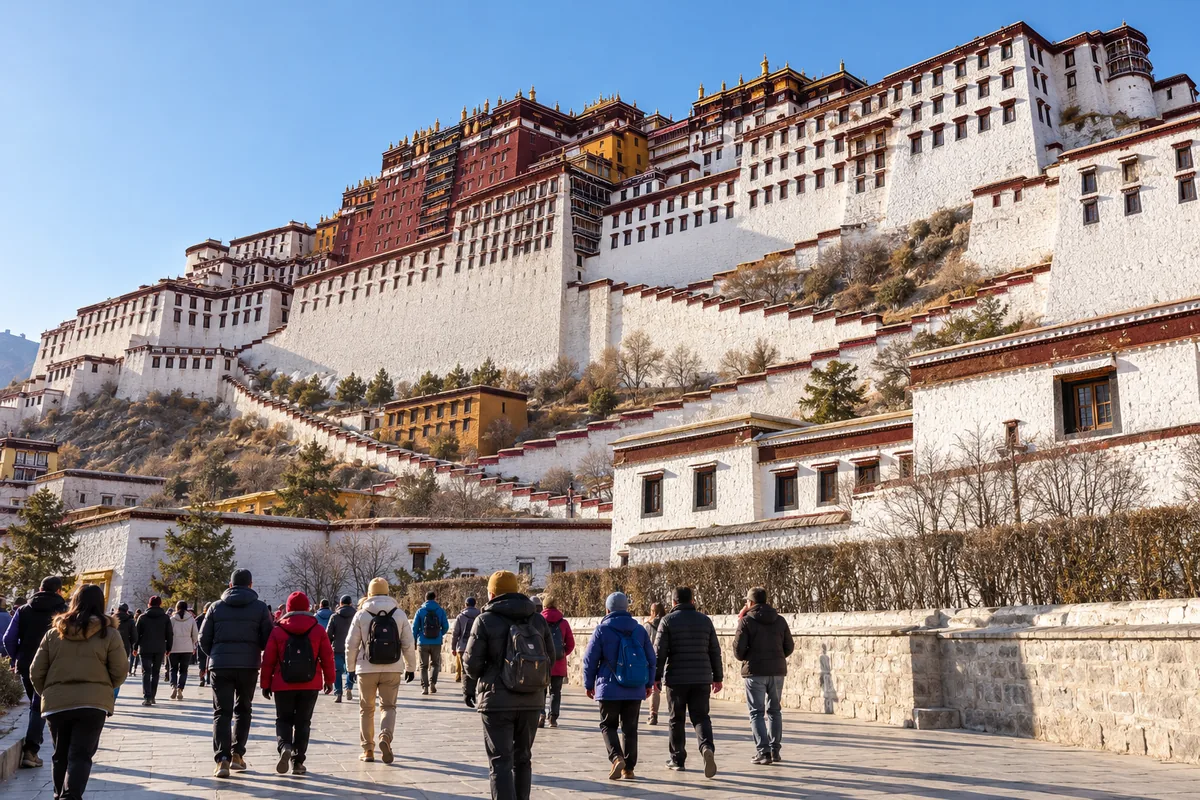
Tickets and prices
The table below has every price and season in one place: the main palace in peak and off season, the separate Snow City route, the public-holiday discount and the winter free-entry season. Read it with the notes under it, because which line applies to you depends on your date and, for discounts, on whether you count as a "domestic" visitor.
| Ticket | What it covers | Peak season (May 1–Oct 31) | Off-season (Nov 1–Apr 30) |
|---|---|---|---|
| Main palace, route 1 | The main palace building | Full 200 yuan · Concession 100 yuan | Full 100 yuan · Concession 50 yuan |
| Main palace, route 2 | The main palace building; official notices don't describe how it differs from route 1 | Full 100 yuan · Concession 50 yuan | Full 100 yuan · Concession 50 yuan |
| Snow City (Zhol) route | The Treasure Hall, the old Snow prison, the old mint and other Snow City buildings, not the main palace. Sold separately since Sep 20, 2026; book in the same mini program, enter by the east or south gate, leave by the Snow City west gate | Full 25 yuan · Concession 12.5 yuan | Full 10 yuan · Concession 5 yuan |
| Public holidays (2024 notice) | Half price for all visitors, Chinese and foreign, during New Year's Day, Spring Festival, Qingming, Labour Day, the Dragon Boat Festival, Mid-Autumn Festival and National Day; booking still required | Route 1 100 yuan · route 2 50 yuan | 50 yuan |
| Winter in Tibet (Oct 15, 2026–Mar 15, 2027) | Main palace free, Snow City route free too. Real-name booking in the mini program is still required and there are no same-day tickets; be at the south gate 60 minutes before your slot for the security check | Free | |
| Opening hours | Tuesday to Sunday; closed every Monday except national public holidays (since Sep 21, 2026). The Snow City route keeps the same hours | Opens 09:00, last entry 15:40 | Opens 09:30, last entry 15:20 |
Which price applies to your visit
If your trip falls between 15 October 2026 and 15 March 2027, you are in the Winter in Tibet season. Tibet's tourism department made all A-grade scenic areas in the region free from 15 October 2026 to 15 March 2027, except temples. The Lhasa government's winter notice confirms the Potala is free in this period but still requires a real-name booking in the mini program, with no same-day tickets. "Free" here means you pay nothing. It does not mean you can walk in, and it does not make slots easier to get.
From 16 March to 30 April the off-season price applies again, and from 1 May the peak price starts. In peak season there are two routes with different prices: route 1 is the full-price ¥200 ticket and route 2 is ¥100. In winter 2026 the Lhasa tourism bureau said both routes could be booked but the actual visit followed route 1. If your agency books route 2 in summer, ask them what it covers, because the official notices do not describe the difference in detail.
Public-holiday half price
A 2024 palace notice says that during China's national public holidays (New Year's Day, Spring Festival, Qingming, Labour Day, the Dragon Boat Festival, Mid-Autumn Festival and National Day) all visitors, Chinese and foreign, pay half price, and still have to book ahead. The palace has not repeated this notice since, so check the price the booking system shows for your date. Holidays are also the busiest days of the year in Lhasa, so a cheaper ticket comes with a harder booking.
Concession tickets and foreign visitors
The concession ticket is half the current season's price. The official list of who qualifies, from 2015, names only domestic groups: Chinese students, people with disabilities, active military, teachers and seniors, with free entry for Chinese children under 1.2 m. No current official text says whether foreign students, seniors or children qualify. Plan on a full-price ticket, and if you are travelling with a child or an older parent, ask your agency to confirm on the booking system before you assume a discount.
The Snow City route and the Treasure Hall
Since 20 September 2026 the Snow City (雪城, Xuěchéng, also called Zhol) at the foot of the palace has had its own ticket. It covers the Treasure Hall, the old Snow prison, the old mint and other buildings in the Snow City, but not the main palace building. You book it in the same mini program, enter by the east or south gate and leave by the Snow City west gate. It costs ¥25 in peak season and ¥10 in off season, and it is free during Winter in Tibet.
Older guides (and an older version of the palace's own tips page) say a palace ticket lets you see the Snow City and Treasure Hall for free. That changed when the separate Snow City ticket started. The notice does not say whether a main palace ticket includes the Snow City route, so if you want the Treasure Hall, book the Snow City route as its own ticket.
How to book a Potala slot
It helps to know how booking works even if your agency does it for you. The booking rules are in the table below, followed by what they mean in practice.
Who books: you or your agency
The official channels are the WeChat mini program, the palace's WeChat official account, and a booking entrance for travel agencies. The palace has not published separate instructions for foreign visitors, and the official pages do not say how a foreign passport is handled in the system. Booking is real-name and uses face verification. The official pages do not say how face verification works with a foreign passport.
Because foreign visitors come to Tibet on an organised tour, the agency running the tour usually books the Potala as part of the package. That is the simplest route and the one we recommend. Ask your agency three things when you book the tour: which date they have planned for the Potala, whether they will book the slot through their agency entrance, and what happens if that day's tickets sell out. If you would rather try the mini program yourself, set up WeChat before you travel (our WeChat setup guide covers sign-up and verification), and tell your agency first so you do not end up with two bookings.
Do not buy from any website, ticket app or seller outside the official system. The palace states that tickets bought through unofficial channels may not get you in and may cost you money.
When tickets open
The sources disagree on how far ahead you can book. The palace's own ticket page says ten days ahead in the mini program (and one day ahead for on-site booking), while the Tibet tourism department's 2026 summer guide says up to 15 days ahead. The same 2026 guide says tickets are released at 00:00 each day with a second release at 08:30. A 2025 palace notice says returned tickets are released in random batches after 00:00 and 08:00 once a day has sold out.
What this means for you: check the booking window on the mini program, or ask your agency, about two weeks before your Potala date, and book the moment the date appears. If your date is sold out, try again just after midnight and in the early morning, when returned tickets come back. In peak summer and on holidays the first release is the one that matters.
One ticket per WeChat account
Each WeChat account can buy one ticket, and that ticket can carry up to two companions who are under 18 or over 60. In other words, two adults aged 18 to 60 cannot book on one phone; each needs their own WeChat account and their own booking. This is easy to miss when one person is doing the planning for a group.
Refunds, changes and the seven-day ban
Online bookings can be refunded but not changed: to move to another day you refund and book again. If you refund twice in one week, or you book and then do not show up without refunding, the system blocks you from booking for seven days. For a short trip that ban can mean missing the Potala altogether, so if your plans change, refund properly instead of just not going. Visits are also tied to the time slot you booked.
Daily limits
The palace runs a "limited numbers, booking, staggered times" system. Its 2024 peak-season notice set the daily limit at 5,000 visitors for route 1 and 2,000 for route 2. Those caps are the reason slots sell out in summer, and why your Potala date should be the fixed point you build the rest of your Lhasa days around.
Opening hours and closed days
The palace keeps two sets of hours. From 1 November to 30 April it opens at 09:30 and the last entry is 15:20; from 1 May to 31 October it opens at 09:00 and the last entry is 15:40. "Last entry" is the latest time you can go in, not closing time, and since the winter 2026–27 notice asks you to arrive an hour before your slot, a late afternoon slot leaves little room for delays.
Since Monday 21 September 2026 the palace is closed every Monday all year, and open Tuesday to Sunday. The exception is China's national public holidays: if a holiday falls on a Monday, the palace opens. The Monday closure resumed on 21 September 2026 after a break, so older posts may say the palace opens seven days a week. Plan your Lhasa days so the Potala lands on a Tuesday to Sunday.
Special days follow their own notices. Tibetan New Year (Losar) is the clearest example. In 2026 the palace closed on Losar eve (17 February) and on the second day (19 February), and opened at 06:00 on Losar day itself (18 February) through the south main gate, with entry stopping at 11:00. The Losar date moves every year and the palace publishes a new notice each time, so if your trip falls near Tibetan New Year, check the official WeChat account for that year's arrangement.
The official places to check hours and closures are the palace's ticket page on potalapalace.cn and the Tibet tourism department's notice on the Monday closure and opening hours.
Inside: route, entrances and how long it takes
Which gate
Group visitors enter by the east gate and individual visitors who booked in the mini program use the south gate, and every entrance has a security check. If you are on an agency tour, your guide will tell you which gate your booking uses; follow them on the day. In winter the Lhasa government asks visitors to arrive at the south gate an hour before their slot.
The climb and the route
The Potala stands on Red Hill (红山, Hóngshān, Marpo Ri in Tibetan) above the city. After security you walk up a long series of stone ramps and staircases on the outside of the palace before you reach the first halls. Inside, the usual route takes you through halls of the White Palace and the Red Palace and then back down another way. Staff are posted along the way and keep the line moving, and the exact route can change by season, so follow the signs and staff on the day. The palace notes that there are many steps, steep stairways and slippery floors made of aga (阿嘎土, a traditional polished earth floor). Wear shoes with grip and use the handrails.
How long it takes
The palace has not published a time limit for the visit or for individual halls. You will read that "you only get an hour inside"; that is not in any official notice, but in busy periods the staff do keep people moving and you will not be able to linger in the halls. Plan about two to three hours from arriving at the gate to walking out at the bottom: time for arrival and the security check (the winter 2026–27 notice asks you to be at the south gate an hour before your slot), around 30 to 45 minutes for the climb if you take it slowly, and an hour or more inside. Add time if you also booked the Snow City route.
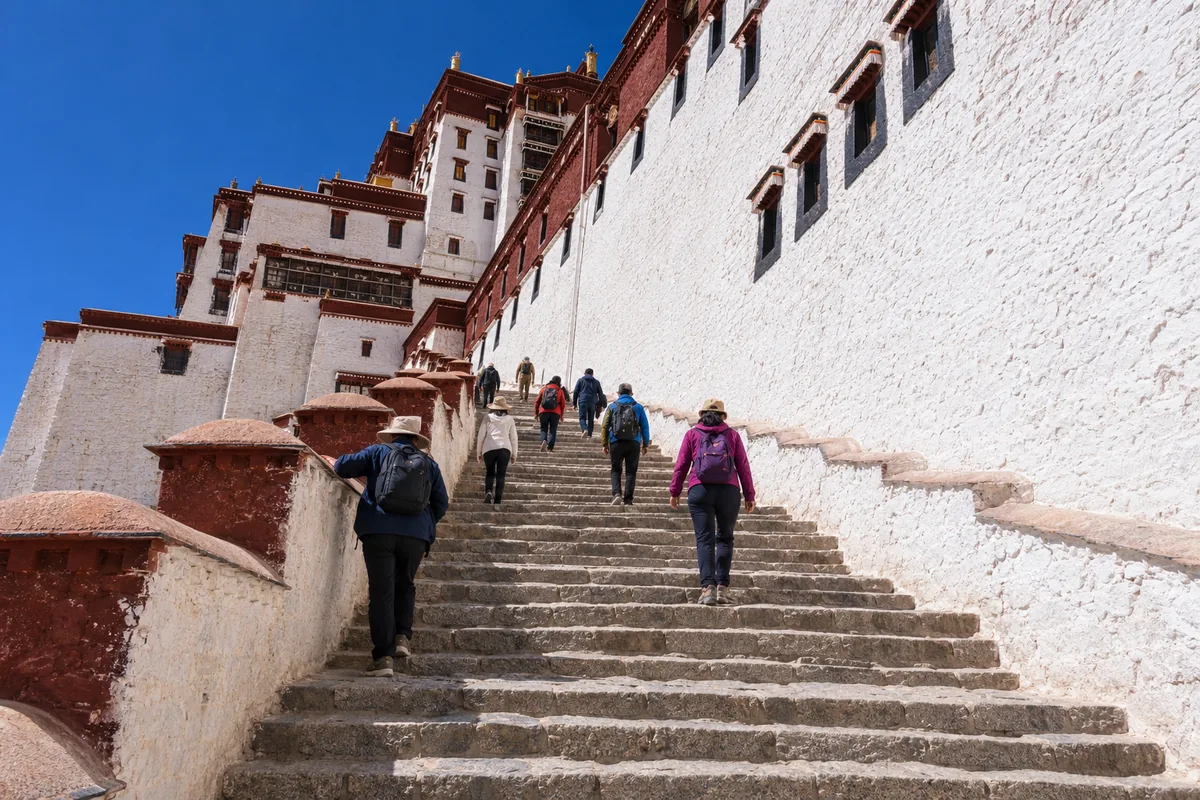
The climb at altitude
Lhasa sits at about 3,658 m, and the Potala visit starts with the steepest climb most people do in the city. Doctors at Lhasa People's Hospital tell visitors not to rush into climbing and sightseeing after arrival, to limit exertion and to adapt step by step. Our advice: do not put the Potala on your arrival day or the day after. Day three or later is better, after a couple of easy days in the old town. On the climb, walk slowly, stop on the landings, and breathe evenly instead of pushing to keep up with your group.
If you get a severe headache, keep vomiting, or start to stagger and lose your balance, stop climbing and get medical help. Lhasa People's Hospital has a 24-hour altitude sickness treatment centre, and the medical emergency number anywhere in China is 120 (see our emergency numbers guide). The altitude section of our Lhasa and Tibet guide covers who should talk to a doctor before going and how to pace your first days.
Rules: dress, bags and photos
What to wear
Short skirts, shorts, low-cut or revealing tops, and open-toe slippers are not allowed. Long trousers or a long skirt, a top that covers your shoulders, and closed shoes are the safe choice. In winter you will want layers anyway: mornings in Lhasa are cold, but the climb in strong sun warms you up quickly.
Inside the halls
- No photos or video inside the halls. You can photograph the outside of the palace and the views from the terraces, but put your phone away when you go through a hall door.
- Take off hats and sunglasses inside the halls. Keep them somewhere easy to reach, because you will move between bright sun and dark halls many times.
- Do not step on the door thresholds; step over them.
- Walk in the direction staff show you, keep your voice down, and do not touch statues or murals. Our guide to religious sites in China covers general temple etiquette.
What you can bring
Everyone goes through a security check. You cannot bring flammable or explosive items, poisons, knives or other sharp objects, or printed material, slogans, banners or flags for political, religious or commercial purposes. Drinks are not allowed inside the palace, and large bags must be checked in. Keep valuables with you; if you do not collect checked items in time, you have to pick them up in person at the Snow City west gate.
Bring a small bag with your passport (the booking is real-name), your phone, and an empty cup or bottle. The palace's tips page says there is a drinking-water dispenser at the Deyangshar (德央厦, the large courtyard on the way up) where you can fill your own cup with hot water for free. That is useful at altitude, where you will be thirsty after the climb.
Guides inside the palace
The palace has a guide booking window inside where you can book a guide on the spot. Official staff wear uniforms and work ID, and the palace warns visitors not to trust unofficial "guides" who approach them at the gate. The palace has not published guide prices or the languages offered, so ask at the window.
On an agency tour, your Tibet guide usually comes into the palace with you and explains as you go, and for most English speakers that is the easier option. If the explanations matter to you, ask your agency before the trip how much their guide covers inside the Potala.
Potala Square, the Chakpori view and the Jokhang on the same day
Potala Square and the evening view
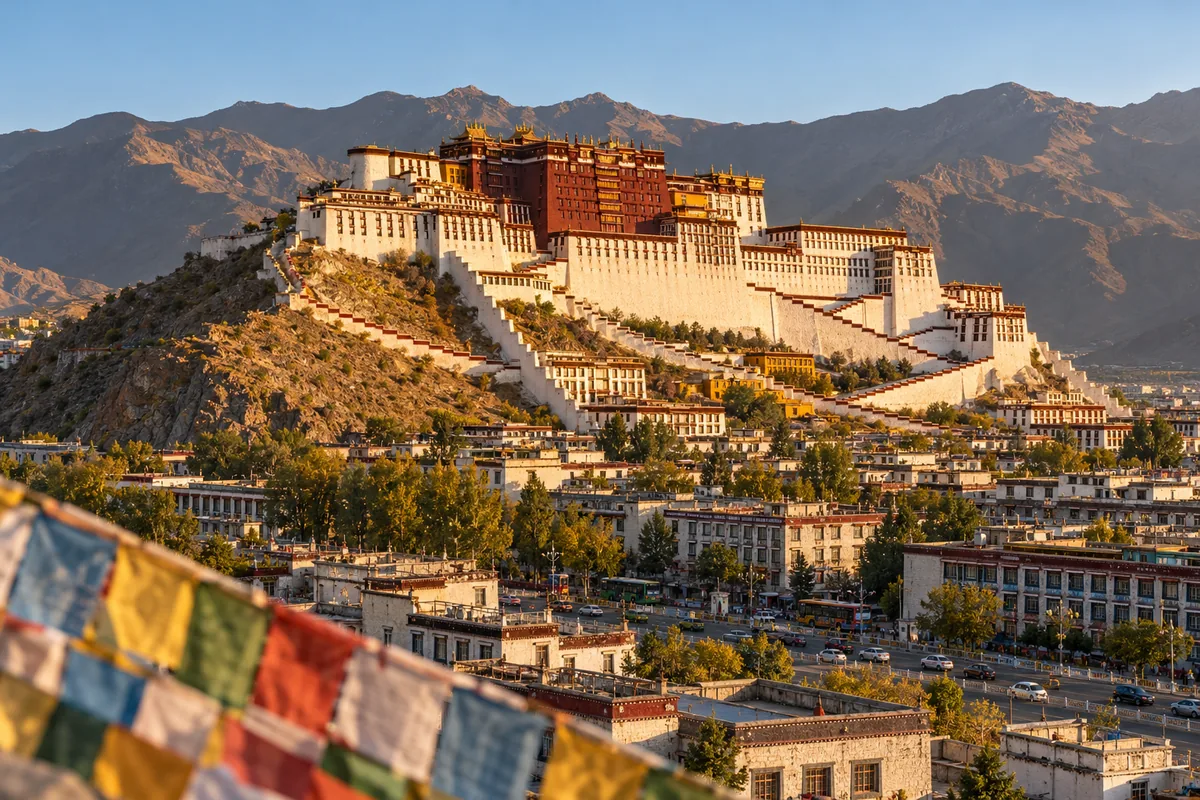
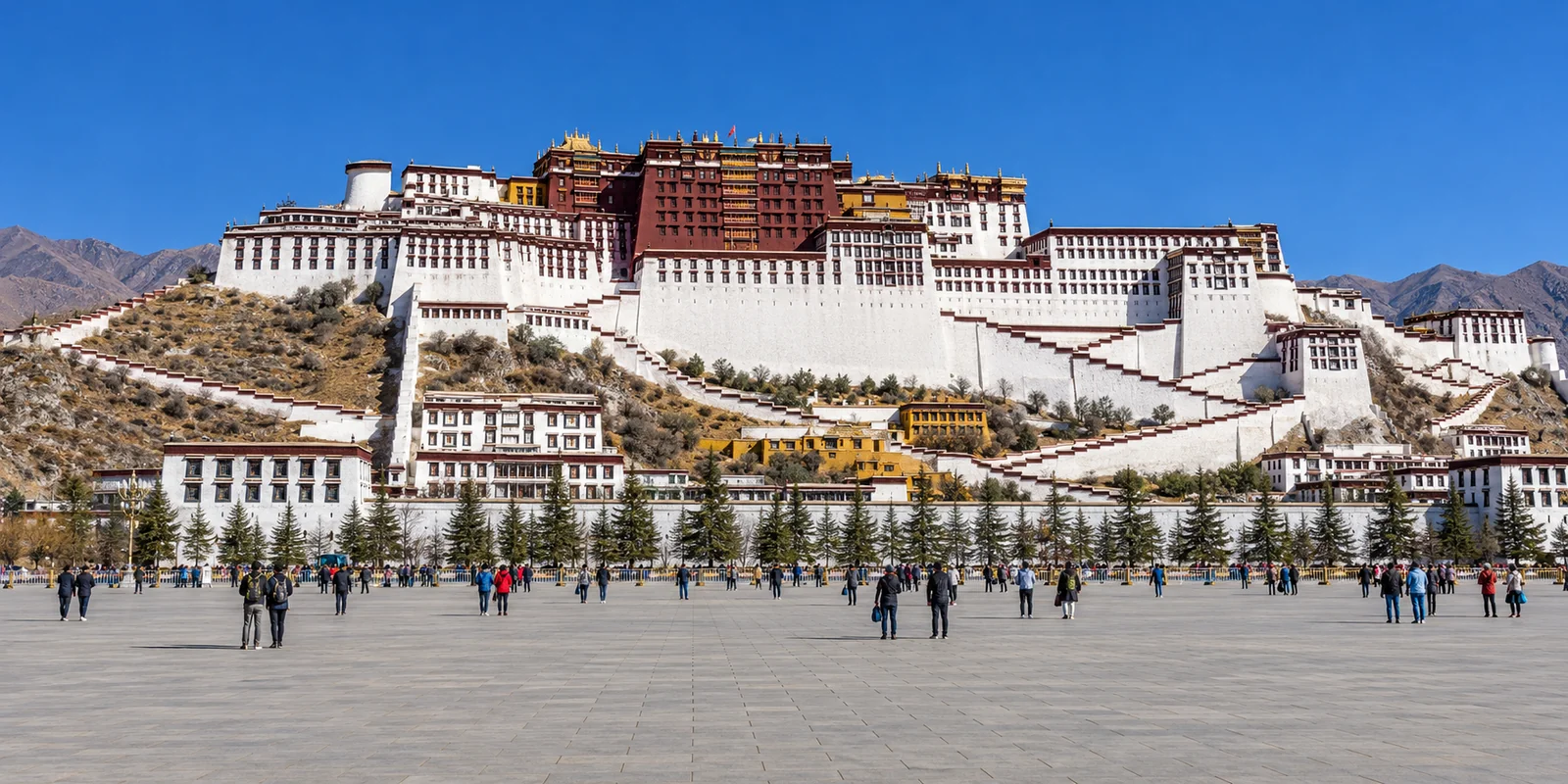
The large square on the south side of the palace is the place for the classic straight-on photo, and it is a short walk from most central hotels. The palace is lit up in the evening, and many visitors come back after dinner to see it. No official source gives the lighting times, so look at it as a bonus on any evening you feel well enough to be out; doctors in Lhasa advise against long nights out in your first days.
Chakpori: the view from the opposite hill
Chakpori (药王山, Yàowángshān, "Medicine King Hill") is the hill just southwest of the palace. A viewing area there looks straight back across at the Potala's south face, the angle most postcards use. Chakpori's viewpoint has no published opening hours or price, so ask your guide or hotel on the day. It involves another set of stairs, so it fits better on a different day from your Potala visit if you are still adjusting to the altitude.
Pairing the Potala with the Jokhang
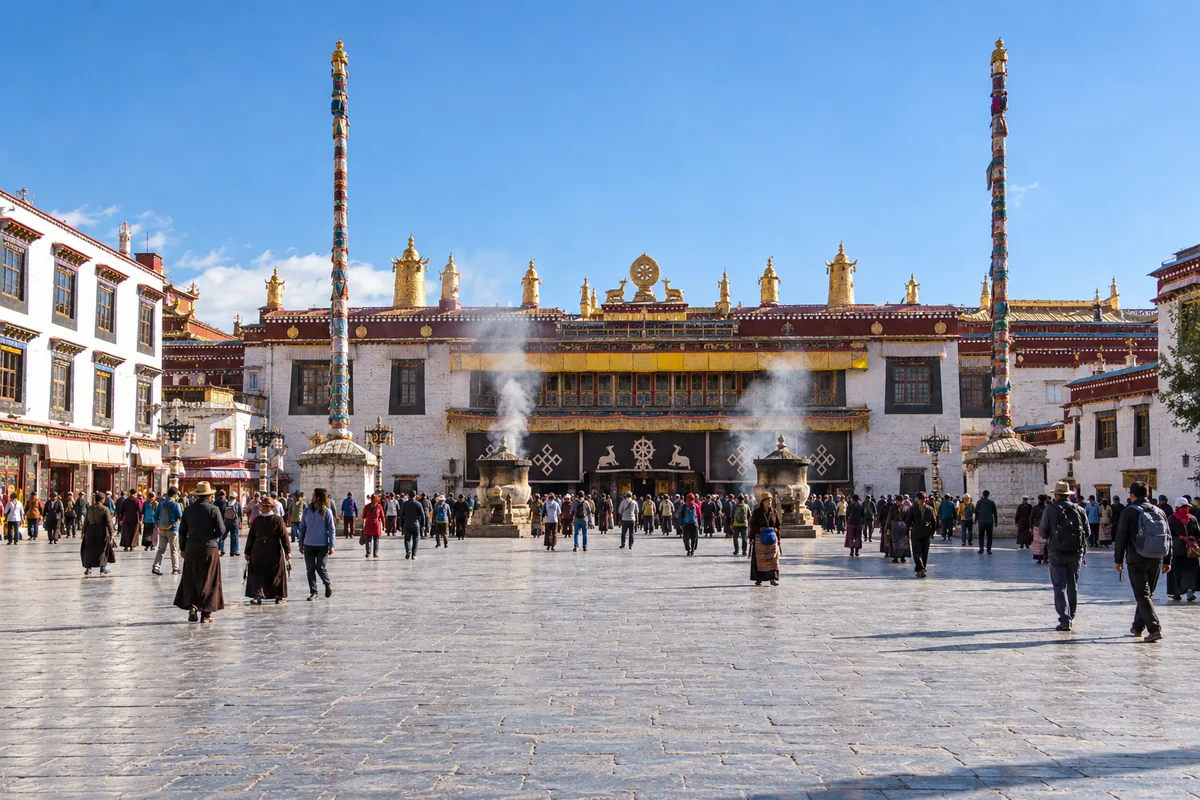
The Jokhang Temple (大昭寺, Dàzhāosì) is the other big visit in Lhasa, and the two fit well into one day: Potala in the morning, Jokhang and the Barkhor (八廓街, Bākuòjiē, the old-town circuit around it) in the afternoon. The Jokhang works differently from the Potala:
- You book the Jokhang one day ahead, real-name, through its own "大昭寺" (Jokhang) mini program or WeChat account, then pay and collect your ticket on site on the day.
- Entry from 08:30 to 13:30 follows your booked time slot, and afternoon entry has no slot restriction. That makes the afternoon the easy half of the day for the Jokhang.
- The Jokhang is a temple, so it is not part of the Winter in Tibet free entry and still charges in winter. An official price list from 2015 gives ¥85; confirm the current price when you pay.
- Its dress rules are similar: no shorts or revealing clothes, hats off, no photos in the main hall.
- Walk the Barkhor clockwise, with the flow of pilgrims.
A Potala morning plus a Jokhang afternoon is a full day at about 3,658 m, with a lot of stairs and standing. If you are still feeling the altitude, split them across two days. Our Lhasa and Tibet guide has full-day plans for the rest of the city.
Staying close by
A hotel within walking distance of both the Potala and the Barkhor makes an early arrival at the south gate easy and saves you taxi rides at altitude. You can compare hotels in central Lhasa on Booking.com; before you book, check with the hotel that it can register foreign guests, and let your agency know where you are staying.
If you are still deciding how to get to Lhasa, our Qinghai–Tibet Railway guide covers the train, which boarding city to choose and how the oxygen supply on board works.
A short history
The Potala was first built in the 7th century, rebuilt in the 17th century, and reached its present form by the 1930s. According to the palace's official description, the complex covers about 400,000 square metres of ground, with a floor area of about 130,000 square metres; the main building is 115.703 m tall and has 1,267 rooms. It was listed as a UNESCO World Heritage Site in 1994. For background before you go, UNESCO's page on the Historic Ensemble of the Potala Palace is a good start.
Frequently asked questions
Can foreigners book Potala Palace tickets themselves?
The official booking channels are the WeChat mini program, the palace's WeChat account and an entrance for travel agencies. The palace has not published instructions for foreign passport holders, and booking needs real-name and face verification. Foreign visitors travel to Tibet on an agency tour, and in practice the agency books the Potala slot. If you want to book yourself, confirm with your agency first so you do not end up with two bookings.
How many days in advance should I book the Potala Palace?
The palace's ticket page says ten days, and the Tibet tourism department's 2026 guide says up to 15 days. Check the window in the mini program about two weeks before your date and book as soon as your day opens. There are no same-day tickets.
Can you take photos inside the Potala Palace?
No. Photos and video are not allowed inside the halls. You can photograph the outside of the palace, the view over Lhasa from the terraces, and the palace from Potala Square and Chakpori.
How long does a Potala Palace visit take?
The palace has not published an official time limit. Plan about two to three hours in total: arrival and the security check (in winter 2026–27 you are asked to come an hour before your slot), then the climb and the halls at a slow pace. Staff keep the line moving on busy days, so you will not be able to stay long in any one hall.
To sum up: get your Tibet tour and permit sorted first, then fix your Potala date on a Tuesday to Sunday, ideally your third day in Lhasa or later. Make sure the booking happens through the official system, on the first day it opens, with a separate WeChat account for each adult aged 18 to 60 (under-18s and over-60s can be added as companions). From 15 October to 15 March entry is free but still needs a booking; the rest of the year the ticket is ¥100 or ¥200 depending on the month. On the day, wear covered clothes and grippy shoes, leave drinks and lighters behind, arrive early for security (an hour before your slot under the winter 2026–27 notice), and climb slowly.
Last updated: October 2026
Fact-checked sources
- Official potalapalace.cn 9 pages
- Official wlt.xizang.gov.cn 9 pages
- Official lasa.gov.cn 5 pages
- Official Ministry of Foreign Affairs
- Official Chinese embassies and consulates
- Official lasa.xzdw.gov.cn
- Official wsjkw.sc.gov.cn
- Official Qingpu District Government (Shanghai)
Show 3 more sources
- Official Shanghai Municipal Government
- Official Embassy of Japan in China
- Official xzmt.gov.cn
Last verified: 2026-10-22
Read in other languages
Last train times for 10 Chinese metro systems
Every line and station, checked by hand — the same data behind our offline route planner.
Get the WaysChina App
Offline guides, currency converter, essential phrases, and more — all in your pocket.

Related Articles
Lhasa & Tibet Travel Guide: How Many Days, Permits, Altitude, Trains and Everest
How many days to plan for Lhasa, the lakes and Everest, which Tibet permits foreigners need, how to handle the...

Jiuzhaigou Travel Guide: Getting There from Chengdu, Passport Booking, Tickets and Huanglong
How to reach Jiuzhaigou from Chengdu by train, book with a passport, what tickets and the park bus cost by season,...

Leshan Giant Buddha: Day Trip from Chengdu, Tickets, Climb or Boat
How to reach the Leshan Giant Buddha from Chengdu by train and bus, the ticket and hours, buying with a passport,...
Chongqing Travel Guide: How Many Days, Getting Around the 8D City, and the Best Night Views
How many days Chongqing needs, how to ride the metro when foreign cards can't tap the gates, which sights to pick,...