

This article contains affiliate links. If you make a purchase through these links, we may earn a small commission at no extra cost to you. This helps support our work in creating free travel guides.
West Lake (西湖, Xīhú) in Hangzhou costs nothing to visit: the lake has been free since 2002, and the shore is an open park with no walls and no entrance gate. Broken Bridge, Autumn Moon over the Calm Lake, Lotus in the Breeze at Quyuan Garden, Viewing Fish at Flower Pond and Orioles Singing in the Willows are all open around the clock. You pay only for a few extras: the boat to the Three Pools Mirroring the Moon island is 55 or 70 yuan depending on the boat, island entry included, and Leifeng Pagoda is 40 yuan for an adult. To get there, take metro Line 1 to Longxiangqiao (龙翔桥) on the east shore, six stops from Hangzhou East Railway Station. Then walk the north side and one causeway, take a boat or the lakeside cart for the rest, and book Lingyin Temple at least a day ahead if you want to add it.
The short answer: is it free, how to get there, how to see it
- Entry. Free. You can walk onto the shore, the causeways and the bridges at any hour.
- What costs money. Boats, the Three Pools island, Leifeng Pagoda, and a short list of walled parks and temples on the shore. The card below separates the free sights from the paid ones.
- Getting there. Metro Line 1 to Longxiangqiao puts you a short walk from the east shore; from Hangzhou Railway Station (the old city-centre station) it is only two stops.
- How to get around. On foot for the north shore and Su Causeway, then the lakeside sightseeing cart or a boat for the long stretches. Bikes are banned on both causeways.
- How long. Half a day covers Broken Bridge, Bai Causeway and Gushan Island. A full day lets you add Su Causeway, the island boat and Leifeng Pagoda.
- Lingyin Temple. Free, but you must reserve a time slot with your passport, at least one day in advance.
The lake is the centre of most visits to Hangzhou, but not the whole city. For how many days to give Hangzhou, where to stay and what to eat, see our Hangzhou travel guide. This page is only about the lake and the sights you can link to it in one day.
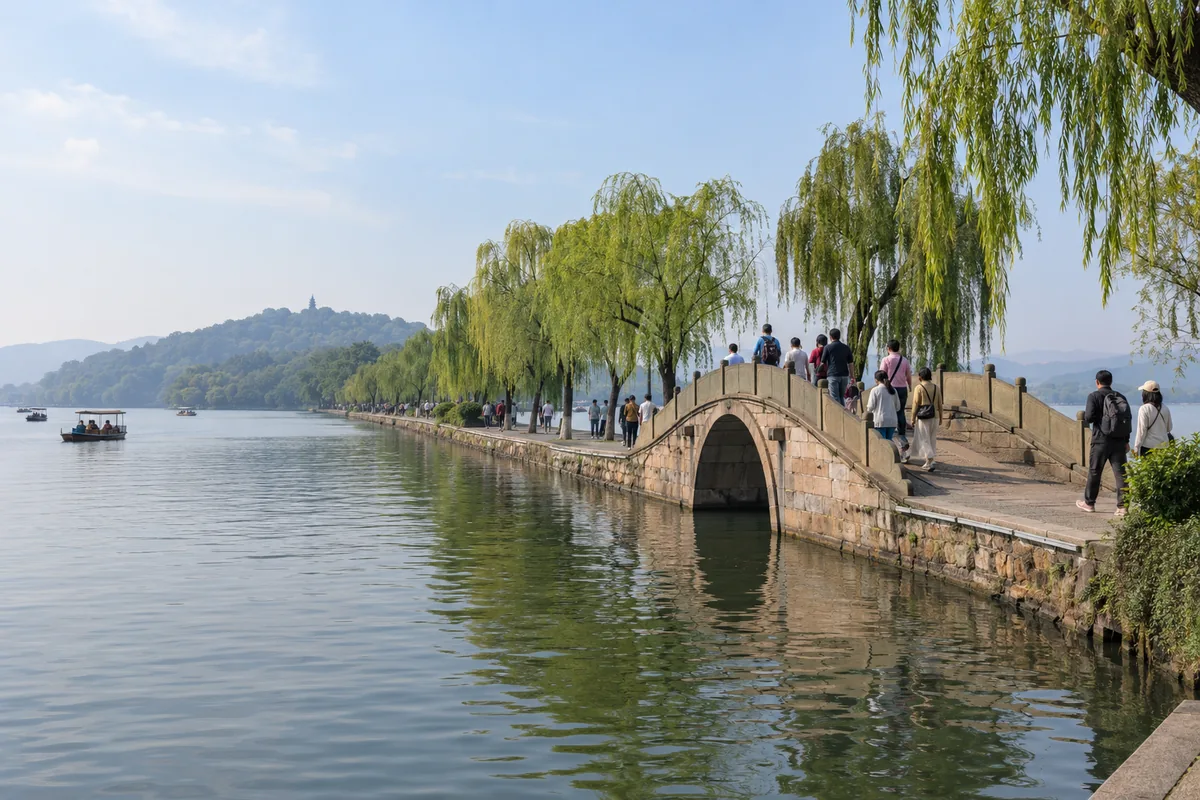
Getting to the lake by metro
The downtown side of the lake is the east shore, called Hubin (湖滨, "by the lake"). It has the shopping streets, the hotels and the metro. Most people start here, because it is where the metro drops you and where the walk to Broken Bridge begins.
The stations that serve the lake. Hangzhou's transport authority points visitors to these metro stations for the scenic area, with shuttle bus lines running from them: Longxiangqiao on Line 1, Wulin Square (武林广场) on Lines 1 and 3, Fengqi Road (凤起路) on Lines 1 and 2, Huanglongdong (黄龙洞) on Line 3, and Wushan Square (吴山广场) on Line 7. In practice:
- Longxiangqiao is the default. It is the closest stop to the Hubin waterfront, and from there you can walk north along the shore to Broken Bridge.
- Fengqi Road is one stop further north on Line 1. It also works for the north end of the waterfront, and it is a transfer station for Line 2.
- Wushan Square is the stop for the south-east corner and for Hefang Street, the old shopping street under Wushan Hill.
- Huanglongdong on Line 3 sits behind the hills on the north side, useful only if you are coming from that direction.
Follow the 西湖 (West Lake) signs on the platform, or check the exit in your map app.
From the railway stations. Hangzhou has three main railway stations, and the name on your ticket matters:
- Hangzhou East (杭州东站) is the big high-speed hub where most trains from Shanghai, Suzhou and Nanjing arrive. Take Line 1 toward Xianghu (湘湖) for six stops to Longxiangqiao.
- Hangzhou Railway Station (杭州站), locally called Chengzhan, is the old station in the city centre and the closest of the three to the lake: two stops on Line 1 to Longxiangqiao.
- Hangzhou West (杭州西站) is far out to the west. Take Line 19 to West Lake Cultural Square (西湖文化广场) and change to Line 1 for Longxiangqiao.
Coming from Shanghai, trains from Shanghai Hongqiao to Hangzhou East run all day; on one sample travel day (12 November 2026), 109 trains are scheduled on that route and the fastest takes 45 minutes. Book the train with our guide to booking China train tickets with a passport.
From Xiaoshan Airport. The airport station is on Lines 1, 7 and 19. Line 1 toward Xianghu (湘湖) runs through the city centre and stops at Longxiangqiao, so you can ride to the lake without changing trains; it is a long ride, and you should check the direction on the platform signs before boarding. From the airport, Line 1 in that direction runs from 06:00 to 22:30. Line 7 runs toward Wushan Square, one of the lake stops listed above; on that direction the first train leaves the airport at 06:16 and the last at 22:49. If you land late, a taxi is the simple answer; the taxi ranks are outside Door 14 on the arrivals level of Terminal 3, and at the walkway between Terminal 4 and the transport centre on floor 1.
Paying for the metro. Fares start at 2 yuan for the first 4 km, so a ride across town to the lake is cheap. The easiest way to pay is the Alipay ride code: register Alipay with your phone number, link a Visa, Mastercard, JCB, Diners Club or Discover card, and open the Hangzhou transport code under "Transport" on the home screen. The official ticket rules do not list foreign Visa or Mastercard cards for tapping at the gates, so do not count on that; the ticket machines in every station sell single tickets as a backup. If you will ride a lot, a one-day metro pass costs 15 yuan and a three-day pass 40 yuan, bought at the station service centre. Children under 1.3 metres ride free with an adult. Our China metro guide covers paying and last trains in more detail.
To plan the ride, our Hangzhou metro map and route planner shows every line and transfer. On your phone without data, the WaysChina app is our offline metro and trip-planning helper, with Hangzhou's metro and its lakeside sights built in.
A one-day route around the lake
The shoreline is about 15 km long. Walking all of it, with stops, fills a long day, and most visitors do not need to. Two causeways cross the water: Bai Causeway (白堤, Báidī) on the north side and Su Causeway (苏堤, Sūdī) on the west side, and together they split the lake into five parts. The route below follows them in a loop, starting from the metro on the east shore and ending near Leifeng Pagoda in the south.
Along the way you will pass most of the Ten Scenes of West Lake (西湖十景), a list of named views from the Southern Song dynasty: Spring Dawn at Su Causeway, Lotus in the Breeze at Quyuan Garden, Autumn Moon over the Calm Lake, Lingering Snow on the Broken Bridge, Orioles Singing in the Willows, Viewing Fish at Flower Pond, Leifeng Pagoda in the Evening Glow, Twin Peaks Piercing the Clouds, Evening Bell at Nanping Hill, and Three Pools Mirroring the Moon. You will see the names on signs and on tickets. Several are a spot on the shore with a view and a stone tablet, not a separate attraction.
1. Hubin to Broken Bridge
From Longxiangqiao, walk to the water and turn right (north). The path runs along the shore past the Hubin parks to Broken Bridge (断桥, Duànqiáo), a small stone bridge at the east end of Bai Causeway. It is short, so it is not the bridge itself people come for; it is the view back over the lake and the start of the causeway. It is also the most crowded point on the lake by mid-morning. Get here early if you want photos without a wall of people.
2. Bai Causeway and Gushan Island
Bai Causeway runs west from Broken Bridge to Gushan (孤山, "Solitary Hill"), one of the four islands in the lake. The causeway is flat, lined with willows and peach trees, and closed to bikes, so it is an easy walk. At the island end is Autumn Moon over the Calm Lake, a lakeside pavilion and terrace that is open all day.
Gushan holds three places worth a stop if you like art and history. The Zhejiang Provincial Museum has a branch here, open Tuesday to Sunday 09:00–17:00 with last entry at 16:30 and closed on Mondays. The Xiling Seal Art Society (西泠印社), a famous club of seal carvers, has its old grounds on the west slope of the hill, open 09:00–17:00; its terraced garden with small pavilions climbs the hill and has views back over the lake. Next door, the China Seal Museum opens Tuesday to Sunday 08:30–16:30. If none of that interests you, walk across the island path and keep going.
3. Yue Fei Temple and the north end of Su Causeway
Leave Gushan by Xiling Bridge on the west side and follow Beishan Road a little further west to Yue Fei Temple (岳王庙, Yuèwáng Miào), the shrine and tomb of a Song dynasty general who is a national hero in China. It sits on the north shore near the northern entrance to Su Causeway, and it is one of the paid stops (details in the paid-sights section). Just to the south is Lotus in the Breeze at Quyuan Garden, which is free and open all day; in summer its ponds fill with lotus.
4. Su Causeway, north to south
Su Causeway runs almost three kilometres across the west side of the lake, from below Qixia Hill in the north to the foot of Nanping Hill in the south. It was built in the Northern Song dynasty from mud dredged out of the lake when the poet Su Dongpo was governor of Hangzhou, and "Spring Dawn at Su Causeway" comes first in the Ten Scenes list. It has a string of arched stone bridges along the way, open water on both sides, and trees all along it. If you only walk one part of the lake end to end, make it this one. It is quieter than Bai Causeway, and early in the morning you share it mostly with joggers and people doing tai chi.
West of Su Causeway, a second, parallel causeway called Yanggong Causeway (杨公堤) carries a road. It is where bikes and the sightseeing cart go, not a walking route you need to plan around.
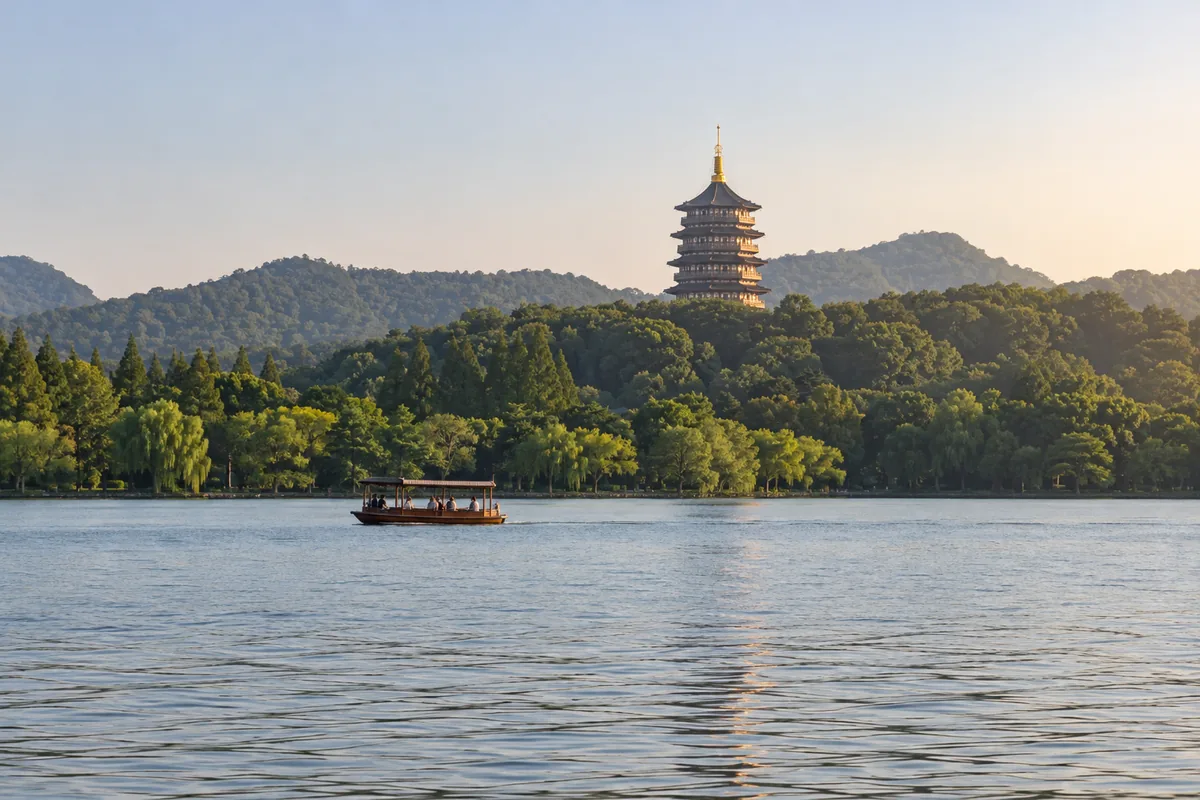
5. Flower Pond, Leifeng Pagoda and Jingci Temple
At the south end of Su Causeway is Viewing Fish at Flower Pond (花港观鱼), a park with ponds full of large orange and red carp. It is free and open all day. Flower Pond also has a boat pier, which makes it the easiest place to catch a boat to the Three Pools island or back across the lake to Hubin.
From Flower Pond, walk east along the south shore to Leifeng Pagoda (雷峰塔), on a low hill overlooking the lake at 15 Nanshan Road. Across the road is Jingci Temple (净慈寺), the temple of the Evening Bell at Nanping Hill, founded in 954 and one of the two great Buddhist temples on the lake, with Lingyin. Its bell is 3 metres high and weighs over 10 tonnes. Doing both takes about an hour and a half. From here, the cart or a taxi takes you back to Hubin, or you can walk north along Nanshan Road past Orioles Singing in the Willows, a willow-lined park on the east shore that is open all day.
How to cut it down
- Half a day, or a first evening: stages 1 and 2, then back to Hubin. This is the classic walk and needs no tickets at all.
- Full day, mostly walking: stages 1 to 4, then a boat from Flower Pond to the Three Pools island and on to Hubin. Leave Leifeng Pagoda for another day or skip it.
- Full day, less walking: stages 1 and 2 on foot, the cart from Yue Fei Temple round the west and south side to Leifeng Pagoda, then a boat back across the lake.
- Two days in Hangzhou: give the lake one day and use the second for Lingyin Temple in the morning and Longjing Village and the Nine Creeks in the afternoon (see further down).
If you have also seen the gardens in Suzhou, the lake feels different: it is open and public rather than walled and private. Our Suzhou travel guide explains which gardens to pick there if you are doing both cities.
Walk, cart, boat or bike
The lake is too big to walk all the way round comfortably in one go, but too small to need a taxi between sights. Mix the four ways to get around based on how far you want to walk. The card below has the fares and rules for the cart and the metro, and the weekend traffic limits around the lake.
On foot. The best way to see the causeways, the bridges and Gushan, and the only way to get along the causeways themselves. Wear shoes you can walk 10 km or more in if you are doing the full-day route.
The lakeside sightseeing cart. Open-sided electric carts drive a loop of about 13.5 km around the lake in 60–70 minutes, in four sections: Children's Palace (少年宫) to Yongjinmen, Yongjinmen to Leifeng Pagoda, Leifeng Pagoda to Yue Fei Temple, and Yue Fei Temple back to Children's Palace. There is no ticket office: you wave the cart down at the roadside, get on, and scan a code to pay. Have a phone payment app ready; the Alipay you set up for the metro is the one to use. A ticket is good for one continuous ride, and it ends if you get off, so pay for one section at a time if you plan to stop. A regular cart costs 40 yuan for the full loop or 10 yuan per section; the old-style carts cost 80 yuan for the loop or 20 yuan per section. They run 08:30–17:00, later in summer (to 20:30, depending on weather). The cart is most useful for the west and south side, from Yue Fei Temple to Leifeng Pagoda, where the road runs away from the water.
The boat to Three Pools Mirroring the Moon. Three Pools Mirroring the Moon (三潭印月, Sāntán Yìnyuè) is a small island in the south of the lake, also called Xiaoyingzhou (小瀛洲), with ponds inside it and three small stone pagodas standing in the water just off its south side. You can only reach it by boat. The ticket is priced by boat: 55 yuan on a standard boat, 70 yuan on a luxury, painted or electric boat, and both include the 20-yuan island ticket and the return trip, with no time limit on the island. Children 1.2–1.5 m pay half, and under 1.2 m ride free with an adult. You can board and buy by scanning the code at nine piers: Park 1, Park 2, Park 5, Children's Palace, Zhongshan Park, Yuehu, Yue Fei Temple, Flower Pond and Qianwang Temple. On the way back you can get off at a different pier, such as Flower Pond, Hangzhou Hotel, Zhongshan Park or Hubin, which makes the boat a one-way shortcut across the lake as well as a trip to the island. Ticket sales close in the late afternoon, earlier in winter than in summer, so check the closing time at the pier before you plan a late crossing.
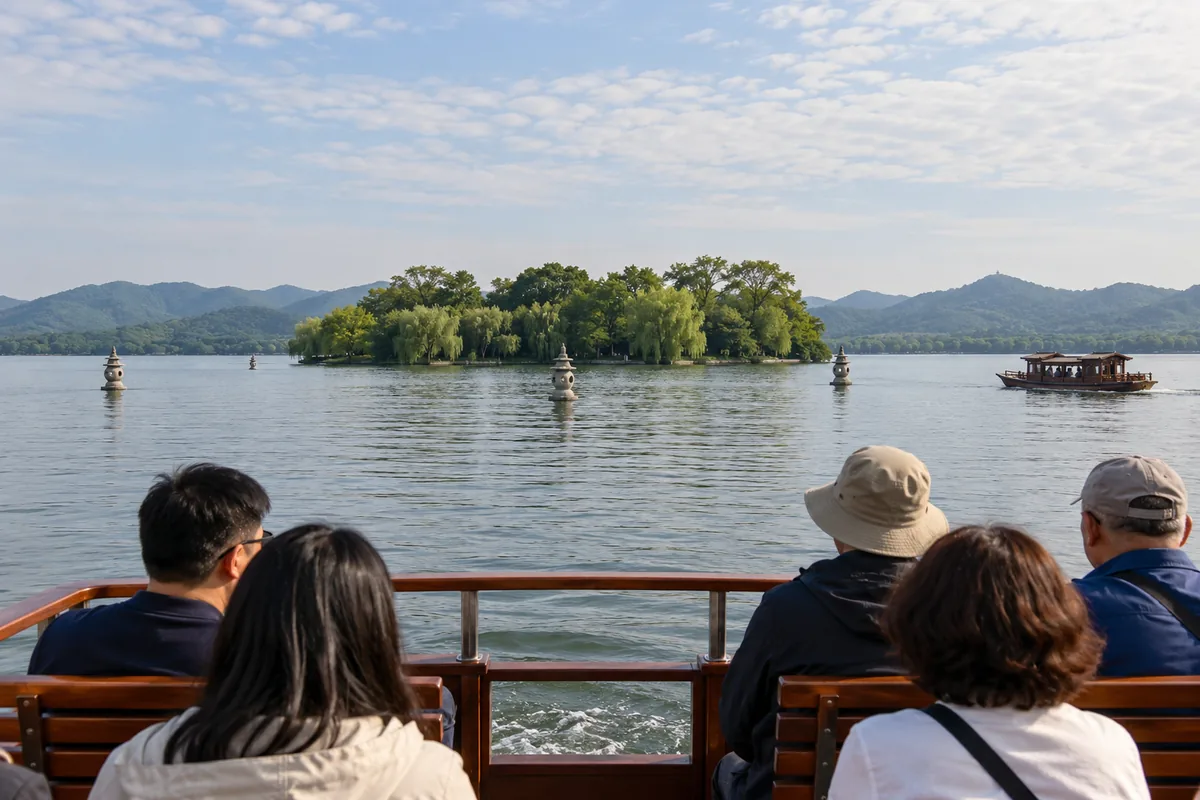
Other boats. If you just want to be on the water:
- A hop-on lake-loop boat stops at piers around the shore, at 6 or 8 yuan per section or 70 yuan for the full loop.
- A large Song-style painted boat does one loop of the lake from the Park 5 pier for 90 yuan per person.
- Self-drive electric boats (4 or 6 seats) from the Broken Bridge pier cost 30 yuan per half hour per boat, and self-row boats (5 seats) from Hubin Park 6 (湖滨六公园) cost 30 yuan per hour per boat.
- Traditional hand-rowed boats with a boatman seat six and cost 150 yuan for the first hour per boat, then 75 yuan per extra half hour. If you want one to take you to the Three Pools island, you buy the island ticket separately, and waiting time counts as rental time.
For most first-time visitors the standard island boat is the one to take: it gets you onto the island and across the lake for one fare. A hand-rowed boat is slower and quieter, and it works out reasonable if you fill all six seats.
Bikes. All non-motorised vehicles, including bikes, shared bikes, e-bikes, scooters and skateboards, have been banned on Su Causeway and Bai Causeway (Broken Bridge included) all day since 1 May 2018. There are bike parking areas at the causeway entrances. If you are riding, go round by Beishan Road, Yanggong Causeway and Nanshan Road; from the north end of Su Causeway to the south end that detour is about 4.3 km, about 22 minutes by bike. The roads around the rest of the lake are fine for cycling. Do not rent a shared e-bike inside the scenic area: the West Lake management says rental e-bikes are banned there, and any you see are parked illegally.
Bad weather. In typhoon season the lake area can close at short notice. During a typhoon in July 2026, parks and hill areas closed first, Bai Causeway was sealed off at both ends at the highest alert level, and parks and museums stayed shut for a while after the causeways reopened. Boats stop in bad weather too. If a storm is forecast, keep the lake day flexible.
Paid sights around the lake, and booking Lingyin Temple
Most of the lake is free, but a handful of walled parks, temples and museums along the shore charge for entry. The card below lists prices and hours for the main ones.
| Sight | Ticket | Hours |
|---|---|---|
| Leifeng Pagoda | adult ¥40; over 6 to 18, students and 60–69 ¥20; 6 and under, and 70+, free | 08:00–17:30 (Nov 1–Mar 15) / 08:00–19:00 (Mar 16–Apr 30) / 08:00–20:00 (May–Oct) · last entry 30 min before closing · no closing day |
| Yue Fei Temple | Paid; price shown at the ticket window | 08:00–17:00 · summer (Jul 15–Sep 30, 2025) 08:00–18:00, last sale 17:45 — check the year’s notice · no closing day |
| Zhejiang Provincial Museum (Gushan) | — | Tue–Sun 09:00–17:00 · last entry 16:30 · closed Mon (open on public holidays) |
| Xiling Seal Art Society | — | 09:00–17:00 |
| China Seal Museum | — | Tue–Sun 08:30–16:30 · closed Mon (open on public holidays) |
| West Lake Museum | — | Tue–Sun 09:00–17:00 · closed Mon (open on public holidays) |
| Jingci Temple (Evening Bell at Nanping Hill) | — | 07:00–16:45 |
Leifeng Pagoda. Adults pay 40 yuan; ages 6–18, full-time students and people aged 60–69 pay 20 yuan with ID; children up to 6 years old or up to 1.2 m tall, people aged 70 or over and visitors with disabilities enter free with ID. Opening hours change three times a year: 08:00–17:30 from 1 November to 15 March (last entry 17:00), 08:00–19:00 from 16 March to 30 April (last entry 18:30), and 08:00–20:00 from 1 May to 31 October (last entry 19:30). In the long summer season you can be at the top for sunset over the lake; in winter, go in the afternoon and be in by 17:00. Hours can change at short notice for events or bad weather, and the Leifeng Pagoda official site posts the current notice. The pagoda you climb is a modern rebuild over the ruins of the old one, so it is more about the view than an old building. It is worth it if you have a clear day and want to see the whole lake and both causeways from above; skip it if it is hazy.
Yue Fei Temple. Open 08:00–17:00, sometimes later in summer; in 2025 summer hours ran to 18:00. It charges an entry fee; the price is shown at the ticket window. The tomb and the iron statues of the men who betrayed Yue Fei, kneeling in front of it, are the part most visitors remember.
Jingci Temple. The temple area at the Evening Bell at Nanping Hill is open 07:00–16:45. Check the entry price at the gate. Like the other Buddhist temples around the lake, it gives you three sticks of incense free and does not allow you to bring your own.
Museums. The Zhejiang Provincial Museum on Gushan and the West Lake Museum on Nanshan Road both close on Mondays, apart from public holidays. If you plan a museum, do not put it on a Monday.
The other paid parks. The parks around the lake that charge entry include Yue Fei Temple, Guo's Villa (郭庄, a small classical garden on the west shore), Liuhe Pagoda, Hupao Park, Qianwang Temple, Yuhuang Hill and Wansong Academy, plus the zoo and the botanical garden. Hangzhou residents can use a yearly park card for these, but the card is for people who live in Hangzhou, so as a visitor you pay at each gate. None of these are essential on a first visit. Guo's Villa is the one we would add if you like gardens and are passing the west shore anyway.
Lingyin Temple: free, but book a slot
Lingyin Temple (灵隐寺, Língyǐn Sì) sits in the hills west of the lake, with Feilai Peak (飞来峰), a hill covered in old Buddhist rock carvings, in front of it. Since 1 December 2025 the whole Lingyin–Feilai Peak area, including Yongfu and Taoguang temples, has been free, but you must book a real-name time slot. How it works:
- Book in the official "杭州灵隐飞来峰" (Hangzhou Lingyin Feilaifeng) mini-program inside Alipay or WeChat. Search the Chinese name in the app's search bar.
- Book at least one day before your visit, and up to seven days ahead; same-day booking is not possible.
- Pick the morning slot (07:30–12:00) or the afternoon slot (12:00–17:00).
- Foreign visitors can book with a passport. One phone can book up to five people at a time, and new slots are released at 08:00 each day.
- The area is open 07:30–17:30, with last entry at 17:00.
Daily limits are 35,000 visitors on weekdays, 50,000 at weekends and 65,000 on holidays. Weekday slots are rarely the problem; book as soon as your dates are fixed if you are going on a weekend or a holiday. Go in the morning slot: it is cooler, and you can be at Longjing Village for lunch.
Getting to Lingyin on a weekend is the tricky part. On weekends and holidays from 08:00 to 17:00, taxis and ride-hailing cars are not allowed into the Lingyin area; you are dropped at a transfer point (the car park at 608 Xixi Road or the Xiaoyawu bus stop) and take a shuttle bus in. The official advice is to come by metro and the shuttle bus lines from the lake stations instead. For the rest of the Lingyin visit and how it fits into a stay, see the Hangzhou guide.
West Lake in the evening
The lake does not close, so the evening walk is free. The main things to time are the musical fountain on the east shore and, if you want a bigger show, the light show on the Qiantang River.
The musical fountain. The West Lake fountain is on the Hubin waterfront, around Park 3, near Longxiangqiao station. In the autumn–winter season (12 October 2026 to 14 April 2027) it plays one show a day, at 19:30. Arrive 20–30 minutes early to get a spot near the railing; the front rows along the shore fill first. The timetable changes with the season, so after mid-April check the new times. If you miss it, the fountain at Wulin Square, a few stops north, plays at 18:30, 19:30 and 20:30 in the same season.
The Qiantang River light show. This is not at the lake but on the Qiantang River, south-east of the lake, with the buildings on both banks lit up as one show. In the same season it runs at 18:30 and 19:30 on Fridays and Saturdays, and at 19:30 only from Sunday to Thursday. From Sunday to Thursday the lake fountain and the river show both start at 19:30, so on those evenings pick one; the fountain is the easy choice if you are staying near the lake. On Fridays and Saturdays the river also has an 18:30 show, an hour before the fountain. If you want both, watch the 18:30 river show and take the metro back toward Longxiangqiao; check the route on the metro map before you set off.
Lights around the lake. In this season the lights at Hubin, the walkway around West Lake, Hefang Street and the other main areas are on every evening from 18:00 to 22:30. That is the window for an evening walk out to Broken Bridge. In the summer season Leifeng Pagoda stays open until 20:00, so you can watch the sun go down from it, but from November to mid-March it closes at 17:30.
Avoiding the crowds
West Lake is free and right next to the city, so weekends are busy and Chinese public holidays are very busy. The biggest crowds are around Broken Bridge, Bai Causeway and the Hubin waterfront. Some ways to deal with that:
- Go early. Before 08:00 the causeways are quiet and the light is soft. Start at Broken Bridge at sunrise and you will be on Su Causeway before the tour groups arrive.
- Do it the other way round. Most people start at Hubin and walk to Broken Bridge. On a busy day, take a taxi or the cart to Leifeng Pagoda first and walk the route backwards, south to north.
- Visit on a weekday. Weekends add day-trippers from Shanghai and the rest of the province.
- Avoid Golden Week. The first week of October and the May Day holiday are the hardest times to visit the lake. If you have to come then, see our Golden Week guide for the dates and how to plan around them.
Traffic rules on weekends and holidays. From 08:00 to 17:00 on weekends and on public holidays of three days or less, private cars inside the lake area can only drive on dates that match the last digit of the plate: odd numbers on odd dates, even on even dates. Tour buses are banned from the area at those times. Taxis and DiDi cars are exempt from the odd-even rule, but the police can still limit traffic on busy days, and the Lingyin ban described above applies. For you as a visitor this means one thing: on a weekend, use the metro to reach the lake and expect a taxi to drop you short of where you wanted to go.
Stay close. The simplest way to beat the crowds is to sleep near the lake and be out early. The Hubin area on the east shore has the most hotels close to the metro and walking distance from Broken Bridge; you can compare them on Booking.com or Trip.com. Our Hangzhou guide covers where to stay in more detail.
Longjing Village and the Nine Creeks
The tea hills start just south-west of the lake, and they make a good half day after Lingyin or after the south shore. You will need a taxi or a bus for this part, because there is no metro in the valleys.
Longjing Village (龙井村). The village at the centre of West Lake Longjing tea (龙井, "Dragon Well") production is open all day and free to walk around. You can see the "Eighteen Imperial Tea Bushes" at Old Longjing and the Dragon Well spring itself. Family tea houses in the village will sit you down and brew a pot; prices are set by each house, so ask before you order. The picking season in spring is the busiest time; in 2026 picking on the protected gardens at Wengjiashan started on 18 March. Our guide to the Chinese tea ceremony explains Longjing and how tea is served.
China National Tea Museum. Two sites sit on the roads up to the village, at 88 Longjing Road and at 268 Wengjiashan; both open Tuesday to Sunday 09:00–16:30 and close on Mondays except public holidays. Hangzhou's state-run museums let individual visitors in on weekdays with ID and no booking, but need a booking on weekends and holidays; the Tea Museum is not named in that rule and passport entry isn't spelled out, so check its official account before a weekend visit.
Nine Creeks (九溪烟树, Jiǔxī). South of the village a valley of small streams and stepping stones, the Nine Creeks and Eighteen Gullies, runs down to the Qiantang River. The park at the end is free and open all day, and a hill path of about 2.5 km links Longjing Village to it. Walking down from the village is the easy direction. It is greener and quieter than anywhere on the lake, and it is the best part of this side trip if you like walking.
Liuhe Pagoda (六和塔). The Nine Creeks path ends near the river, and Liuhe Pagoda stands on a hill above the river on the same road (16 Zhijiang Road). It opens at 07:00 and closes at 17:30 in summer or 16:55 in winter. It is one of the paid parks. From there, take a taxi back to the lake or the city.
Hefang Street (河坊街). Back near the lake, Hefang Street and the Southern Song Imperial Street are a free pedestrian area of old-style shops and snack stalls under Wushan Hill, open all day. It is a short walk from the south-east corner of the lake and from Wushan Square station, and a natural end to a lake day if you want dinner.
A day that joins these up: Lingyin in the morning slot, taxi to Longjing Village for tea and lunch, walk down through the Nine Creeks to the river, then Liuhe Pagoda before it closes. For other green escapes in China, from mountains to karst rivers, see our guide to China's natural wonders.
A little history
People have shaped the lake for centuries. Su Causeway was built from mud dredged out of the lake when the poet Su Dongpo was governor of Hangzhou in the Northern Song dynasty. The Ten Scenes were named in the Southern Song dynasty. On 24 June 2011 the "West Lake Cultural Landscape of Hangzhou" was added to the UNESCO World Heritage List. The West Lake management's own Ten Scenes of West Lake pages (in Chinese) have the story behind each name.
Frequently asked questions
Do I need a ticket for West Lake?
No. The lake and its shore are a free public park, open all day, with no entrance gate. You only pay for extras such as the boat to the Three Pools island (55 or 70 yuan, island entry included), Leifeng Pagoda (40 yuan for adults), and a few walled parks and temples on the shore. Lingyin Temple is free but needs a booking a day ahead.
How long does it take to walk around West Lake?
The shoreline is about 15 km, so a full loop on foot with stops takes most of a day, and few people do the whole thing. A better plan is to walk Broken Bridge, Bai Causeway, Gushan and Su Causeway, which is almost three kilometres on its own, and use the sightseeing cart or a boat for the rest. The cart does the whole loop in 60–70 minutes if you stay on.
Can I cycle around West Lake?
Yes, on the roads around the lake, but not on the causeways. All bikes, e-bikes and scooters have been banned on Su Causeway and Bai Causeway all day since May 2018. Ride round by Beishan Road, Yanggong Causeway and Nanshan Road instead; that detour is about 4.3 km from one end of Su Causeway to the other. Shared e-bikes are not allowed in the scenic area.
Which metro station is closest to West Lake?
Longxiangqiao on Line 1, on the east shore. It is six stops from Hangzhou East Railway Station and two from Hangzhou Railway Station. Fengqi Road (Lines 1 and 2) is the next stop north and also serves the lake, and Wushan Square (Line 7) is the stop for the south-east corner and Hefang Street.
Summing up
West Lake is free and open all day, so the only planning is how to move around it and what to pay for. Take Line 1 to Longxiangqiao, walk to Broken Bridge and along Bai Causeway to Gushan early in the morning, then walk Su Causeway north to south. Use the boat to Three Pools Mirroring the Moon (it doubles as a ride across the lake) and the sightseeing cart for the long road on the west and south sides. Bikes stay off the causeways. Add Leifeng Pagoda on a clear day, book Lingyin Temple at least one day ahead in the official mini-program, and finish at the 19:30 fountain on the Hubin waterfront. If you have a second day, give it to Lingyin, Longjing Village and the Nine Creeks.
Last updated: October 2026
Fact-checked sources
- Official Zhejiang Provincial Government portal (zj.gov.cn)
- Official Hangzhou Culture, Radio, TV and Tourism Bureau 24 pages
- Official hzzx.gov.cn
- Bendibao (local listings site) 2 pages
- Official jing.leifengta.com 2 pages
- Hangzhou.com.cn (Hangzhou Daily) 5 pages
- Xinhua News
- Zhejiang Online (Chao News) 2 pages
Show 8 more sources
- Official Hangzhou Transport Bureau
- Official China Railway 12306
- Official Hangzhou Xiaoshan International Airport 2 pages
- Official hzmetro.com 2 pages
- Official Hangzhou Municipal Government 10 pages
- ori.hangzhou.com.cn
- Official lingyinsi.org
- ctma.com.cn
Last verified: 2026-11-02
Read in other languages
Getting to the sights by metro
West Lake
Iconic freshwater lake immortalized by poets, with causeways, pagodas and pavilions.
- Longxiangqiao
- Fengqi Road
- Ding'an Road
Lingyin Temple
1700-year-old Chan Buddhist temple at the foot of Lingyin Mountain, famed for grottoes.
- Huanglong Sports Center
- Longxiangqiao
Leifeng Pagoda
Five-story pagoda with sunset lake views; setting of the Madame White Snake legend.
- Ding'an Road
- Longxiangqiao
Hefang Street
Restored Song-dynasty pedestrian street with snacks, traditional crafts and tea houses.
- Ding'an Road
- WuShanGuangChang
Song Dynasty Town
Theme park recreating Song dynasty life, famed for its evening 'Romance of the Song' show.
- Ding'an Road
Xixi National Wetland Park
Vast urban wetland with boat tours, persimmon orchards and waterside boardwalks.
- XiXiShiDiBei
- XiXiShiDiNan
Huanglongdong Park
Tranquil garden park with bamboo groves, traditional pavilions and waterfalls.
- Huanglongdong
Grand Canal & Gongchen Bridge
Hangzhou's terminus of the UNESCO Grand Canal, marked by the 380-year-old Gongchen Bridge.
- East Gongchen Bridge
Qianjiang New City Skyline
Riverside CBD with the iconic 'Sun & Moon' towers and nightly light shows.
- Citizen Center
- Qianjiang Road
Wulin Square
Downtown shopping plaza with Hangzhou Tower and luxury brand flagship stores.
- Wulin Square
- Wulinmen
Hupao Spring
Famed spring whose waters are paired with Longjing tea by tea connoisseurs.
- Ding'an Road
Liuhe Pagoda
Northern Song-era octagonal pagoda overlooking the Qiantang River tidal bore.
- Ding'an Road
Hangzhou East Railway Station
One of Asia's largest high-speed rail hubs, an architectural sight in itself.
- East Railway
Hangzhou Xiaoshan International Airport
Hangzhou's main airport (HGH); 27 km from city center; major eastern China hub for Sino-Asian services.
- Xiaoshan International Airport
Hangzhou metro: last train times by station
Every line and station, checked by hand — the same data behind our offline route planner.
Get the WaysChina App
Offline guides, currency converter, essential phrases, and more — all in your pocket.

Related Articles
Hangzhou Travel Guide: How Many Days, What's Free at West Lake, and How to Book Lingyin
Two days in Hangzhou: which of the three railway stations to book, how to get around a lake district that limits...

Yangzhou Travel Guide: Slender West Lake, Morning Tea and a Day Trip from Nanjing
How many days Yangzhou needs, Yangzhou East or Yangzhou Station, Slender West Lake and garden tickets by season, the...
Shanghai Skyline: Free Viewpoints, Which Observation Deck, Light Times and the Ferry
Where to see the Shanghai skyline for free, which of the four Lujiazui decks to go up, when the Bund lights go off,...
Nanjing Travel Guide: How Many Days, What to Book, and What Closes on Mondays
Two or three days in Nanjing: Nanjing South or Nanjing Station, booking the Sun Yat-sen Mausoleum, Nanjing Museum...