
This article contains affiliate links. If you make a purchase through these links, we may earn a small commission at no extra cost to you. This helps support our work in creating free travel guides.
Nanjing (南京, Nánjīng, literally "Southern Capital") has been the seat of power for ten regimes across more than 1,800 years, including six dynasties and the early Ming. The result is a city where you can walk along a 600-year-old wall in the morning, stand in the office where Sun Yat-sen ran the early Republic in the afternoon, and eat salted duck the same night. Most travelers spend two or three days here, often as a stop between Shanghai and inland China. This guide covers the four sites worth your time, what to eat, how to get around, where to stay, and how to fit it all together.
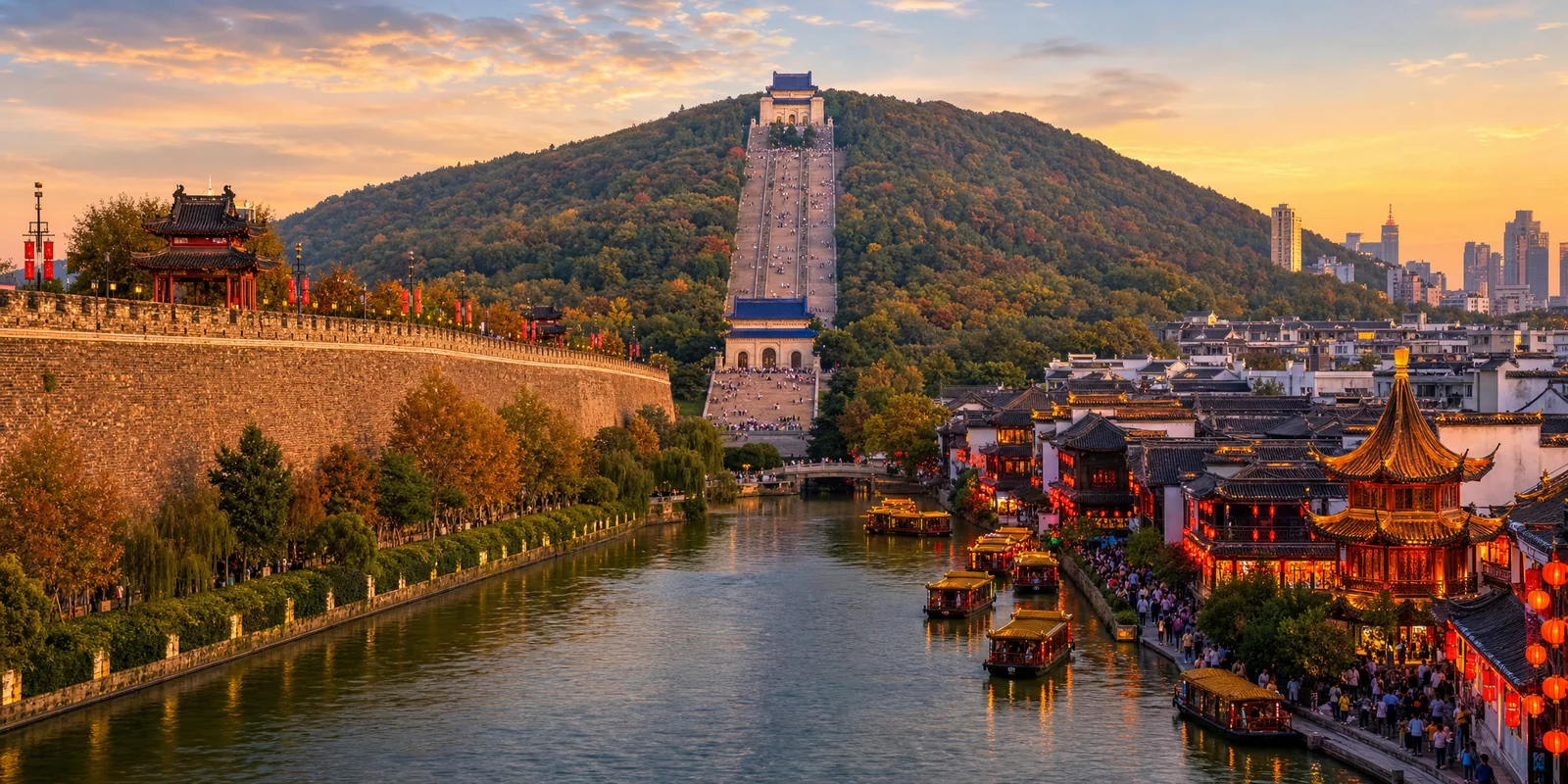
Why Visit Nanjing
Nanjing sits on the Yangtze River in Jiangsu Province, about 300km west of Shanghai. It's a provincial capital of over 9 million people, but it doesn't feel as relentless as Shanghai or Beijing. Tree-lined avenues, the green slopes of Purple Mountain, and one of the best-preserved city walls in the world give it a calmer, more layered character.
What sets Nanjing apart is the depth of its history and the seriousness of how it remembers it. This is a city that was the capital when the Ming dynasty was founded, that became the capital of the Republic of China, and that endured one of the worst atrocities of the 20th century. You feel all three layers as you move around. It rewards travelers who want substance over postcard views.
Best Time to Visit
Spring (March-May) and autumn (September-November) are clearly the best windows. Spring brings cherry and plum blossoms around the Ming Xiaoling and Jiming Temple; autumn brings cool, clear days and red leaves on Purple Mountain. Summers are genuinely hot and humid — Nanjing is one of China's traditional "three furnaces" along the Yangtze, with July-August temperatures regularly above 35°C. Winters are cold and damp but rarely snowy. If you can choose, aim for April or October. For more on timing, see our guide to the best time to visit China.
Top Attractions in Nanjing
You can see the four headline sites in two full days. They cluster in two areas: Purple Mountain (east) and the city center / Qinhuai (south and central). Group them by location and you'll save a lot of transit time.
Sun Yat-sen Mausoleum (中山陵, Zhōngshānlíng)
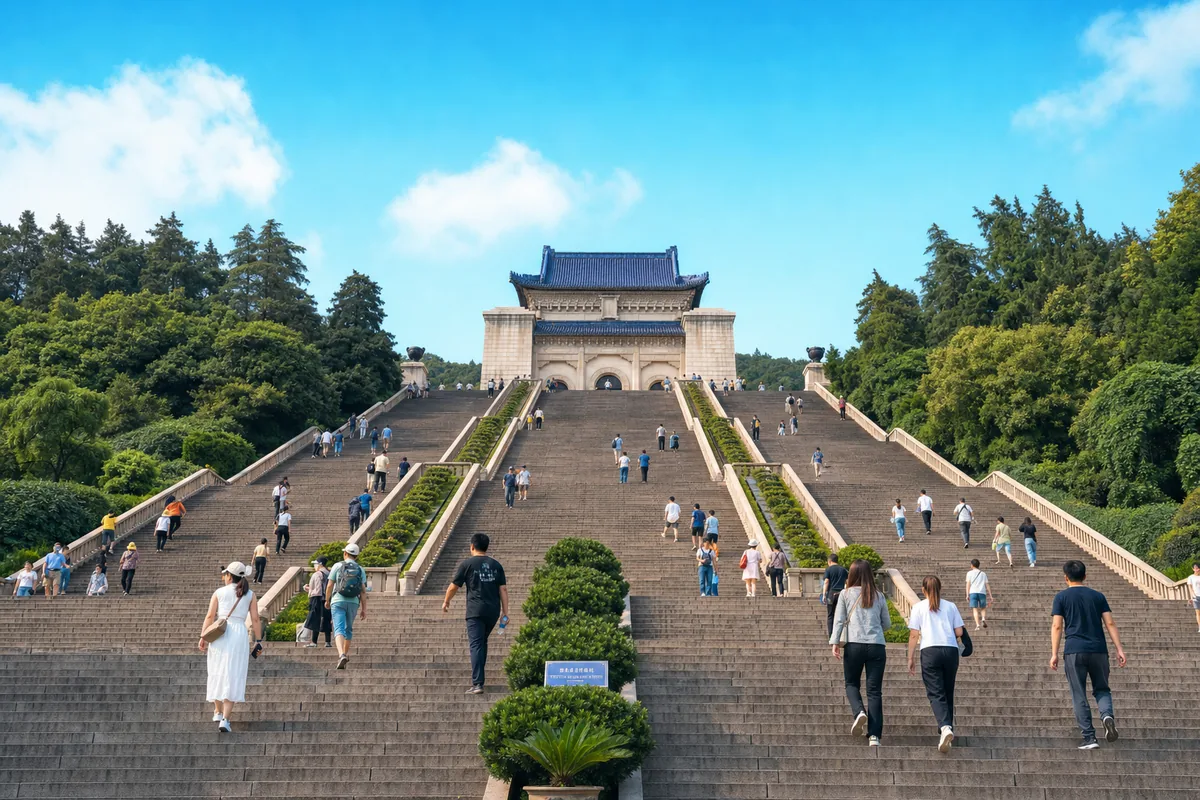
This is the tomb of Sun Yat-sen, the founding father of modern China who is respected on both sides of the Taiwan Strait. Built into the southern slope of Purple Mountain, it's a monumental stairway of 392 granite steps rising to a memorial hall and burial chamber. The climb is the point: each landing reveals the scale of the structure above, and from the top you look back down over the forested mountainside toward the city.
Entry to the mausoleum itself is free, but you need to reserve a time slot in advance through the official WeChat account, and you'll want your passport. It gets crowded on weekends and holidays. Budget two to three hours, more if you combine it with nearby sites. The whole Purple Mountain (Zijinshan) scenic area also contains the Ming Xiaoling Mausoleum and Linggu Temple, so plan a half to full day here.
Ming Xiaoling Mausoleum (明孝陵, Míng Xiàolíng)
A short ride from Sun Yat-sen's tomb is the burial site of the Hongwu Emperor, founder of the Ming dynasty, who made Nanjing his capital. It's a UNESCO World Heritage Site and the prototype for the later Ming tombs near Beijing. The highlight is the Sacred Way (神道, Shéndào), a curving path lined with large stone statues of elephants, camels, lions, and mythical creatures. In late autumn the avenue turns gold and red — it's one of the most photographed spots in the city. You can read more about Ming-era sites in our historical sites roundup.
Nanjing City Wall (南京城墙, Nánjīng Chéngqiáng)
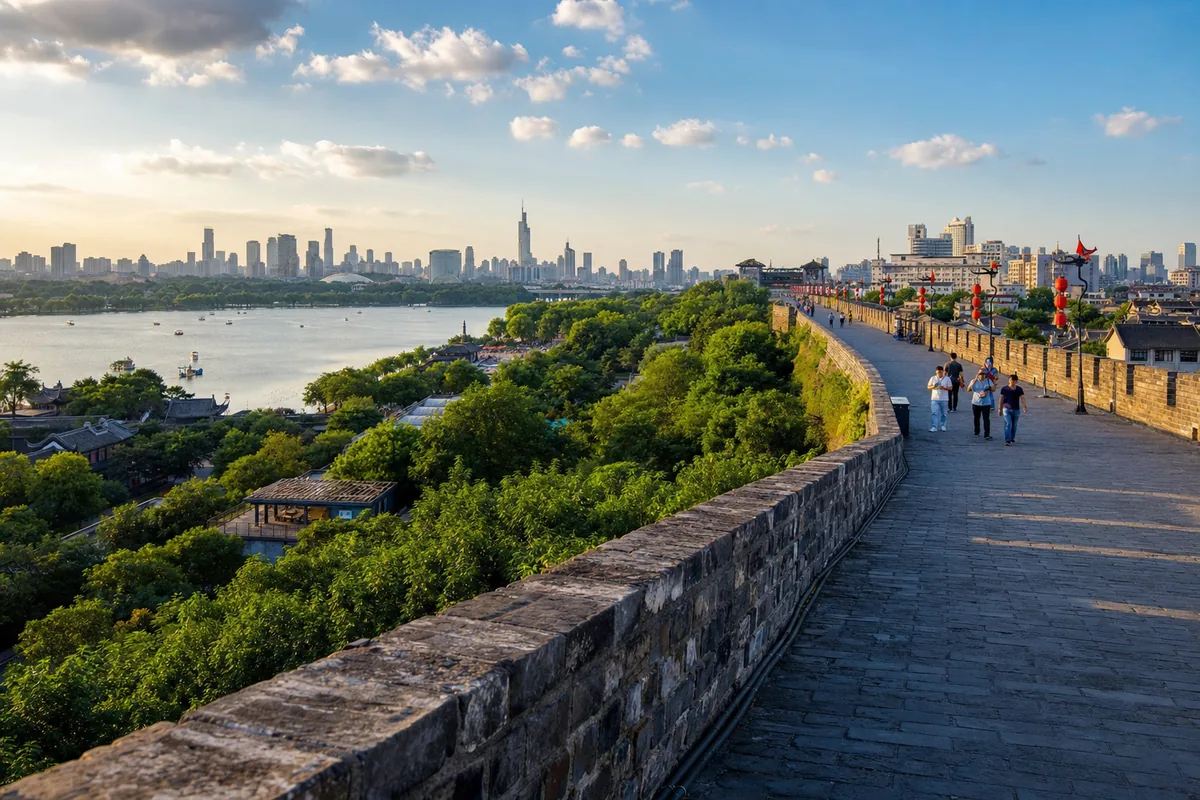
The Hongwu Emperor built this wall in the late 14th century, and roughly 25km of the original 35km still stands — making it the longest surviving city wall in the world. The bricks are stamped with the names of the workshops and officials responsible for them, an early form of quality control you can still read up close.
The best stretch to walk is between Zhonghua Gate and the section near Xuanwu Lake, or the Taicheng segment beside Jiming Temple, where you get a clear view over the lake and the temple's yellow walls. Zhonghua Gate (中华门, Zhōnghuámén) itself is worth a dedicated stop — it's a massive fortified gate complex with internal courtyards (urn cities) designed to trap attackers. Tickets for the wall sections run around 30-50 RMB depending on the gate.
Presidential Palace (总统府, Zǒngtǒngfǔ)
This sprawling complex in the city center is where modern Chinese political history played out. It was a Ming princely residence, a Qing governor's office, the seat of the Taiping Heavenly Kingdom rebellion, and then the office of the Republic of China government — including Sun Yat-sen's provisional presidential office. Today it's a well-organized museum mixing classical Chinese gardens with early-20th-century Western-style government buildings.
Give yourself two to three hours. The contrast is the interesting part: you walk from a traditional garden with rockeries and ponds straight into a wood-paneled cabinet room. Tickets are around 35-40 RMB. It's centrally located and easy to reach by metro.
Confucius Temple & Qinhuai River (夫子庙, Fūzǐmiào)
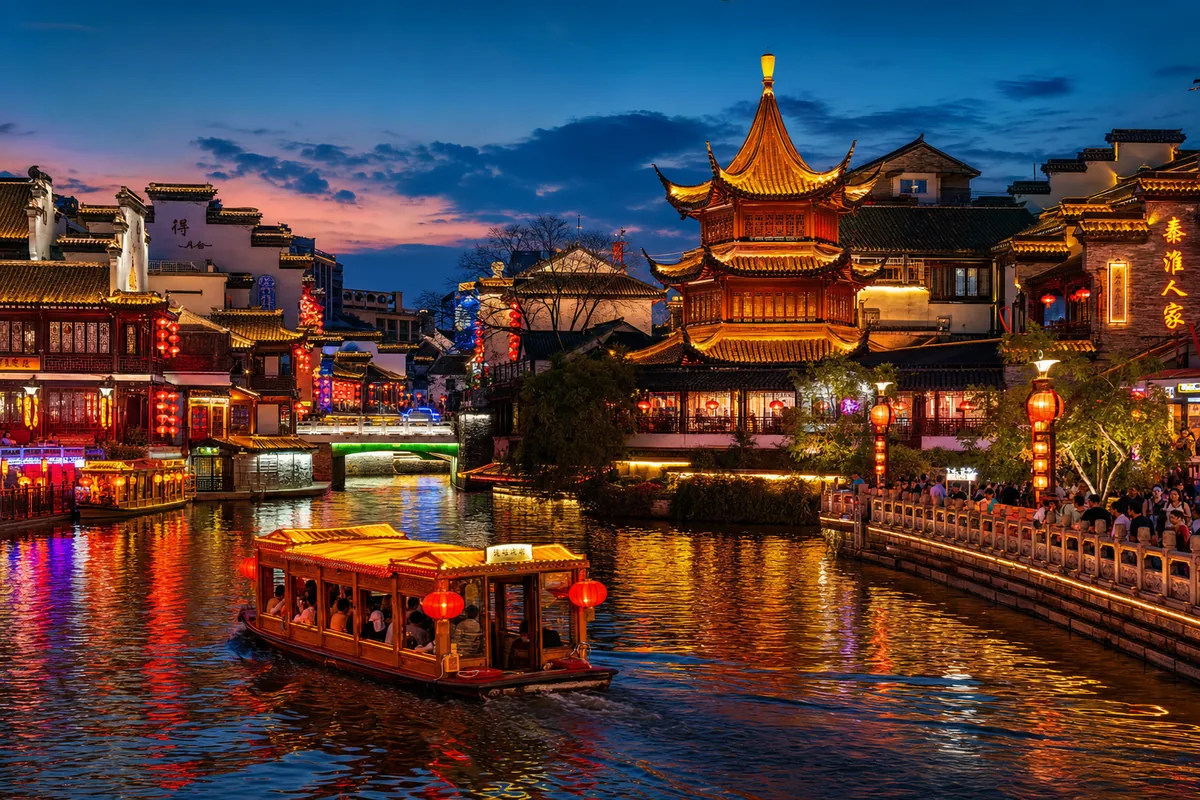
The Confucius Temple area, known as Fuzimiao, is Nanjing's most famous old quarter, set along the Qinhuai River (秦淮河, Qínhuái Hé). Historically this was the heart of the city's scholarly and entertainment life, home to the imperial examination halls. Today it's a restored pedestrian zone of shops, snack stalls, and traditional architecture that lights up dramatically after dark, with reflections in the river and small wooden boats gliding past.
Be honest with yourself about what it is now: a busy, commercial, touristy area. It's still worth visiting, especially in the evening for the lanterns and the atmosphere, and for the street food. Inside the precinct, the Jiangnan Imperial Examination Museum (江南贡院) is genuinely interesting if you want to understand how China's civil service exams shaped society for centuries. A night boat ride on the Qinhuai costs around 80 RMB.
The Nanjing Massacre Memorial Hall
The Memorial Hall of the Victims in the Nanjing Massacre (侵华日军南京大屠杀遇难同胞纪念馆) commemorates the tens of thousands of civilians and disarmed soldiers killed by the invading Japanese army in late 1937 and early 1938. It is a place of mourning and historical record, built on a former mass burial site, and it is treated by the city with great solemnity.
Visiting is a heavy but worthwhile experience if you want to understand modern Nanjing. The exhibitions are detailed and include survivor testimony, archival photographs, and excavated remains. Admission is free; you reserve a slot in advance and bring your passport. Please treat it as the somber memorial it is: dress respectfully, keep your voice down, and be thoughtful about photography — many areas ask visitors not to photograph at all. It is not a casual sightseeing stop, and travelers should approach it with that understanding.
What to Eat in Nanjing
Nanjing cuisine (sometimes grouped under Jinling or Huaiyang-influenced cooking) is known for duck above all else. The flavors are generally lighter and slightly sweet compared to spicier inland cooking.
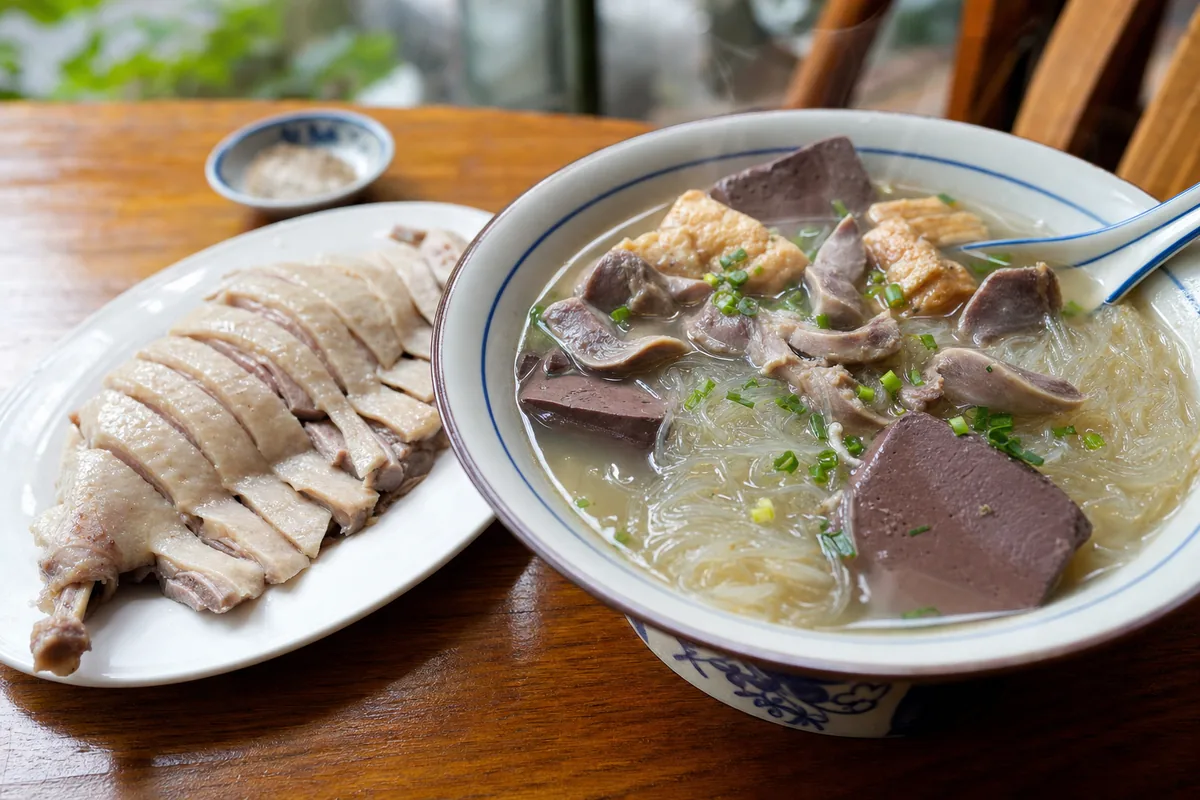
- Salted duck (盐水鸭, yánshuǐyā) — Nanjing's signature dish. Poached and brined, served cold in slices, tender and savory rather than greasy. Locals buy it by weight from specialty shops.
- Duck blood and vermicelli soup (鸭血粉丝汤, yāxuě fěnsī tāng) — a warming bowl of glass noodles, duck blood curd, gizzard, and tofu in a clear broth. Cheaper and more comforting than it sounds; a great quick lunch.
- Soup dumplings (汤包, tāngbāo) — Nanjing's version is larger than Shanghai's xiaolongbao; some come with a straw to sip the broth.
- Beef pot stickers and sesame cakes — classic street snacks around Fuzimiao.
- Osmanthus-flavored sweets — Nanjing loves the autumn osmanthus flower; you'll find it in cakes, drinks, and sticky rice.
For sit-down salted duck and Huaiyang dishes, look at established local chains and the restaurants around Fuzimiao and Xinjiekou. If you have dietary restrictions, our guide to ordering food with zero Chinese and the halal food guide are worth a look before you go.
Getting to and Around Nanjing
Getting There
Nanjing is a major high-speed rail hub on the Beijing-Shanghai line, which makes it easy to reach from most big cities.
| From | Mode | Time | Notes |
|---|---|---|---|
| Shanghai | High-speed rail | 1h 10m – 1h 40m | Frequent trains; the most popular link |
| Hangzhou | High-speed rail | 1h 10m – 1h 40m | Direct trains via the Hangzhou-Nanjing line |
| Beijing | High-speed rail | 3h 30m – 4h | Direct on the Beijing-Shanghai HSR |
| Suzhou | High-speed rail | about 1h | Easy add-on to a Jiangnan trip |
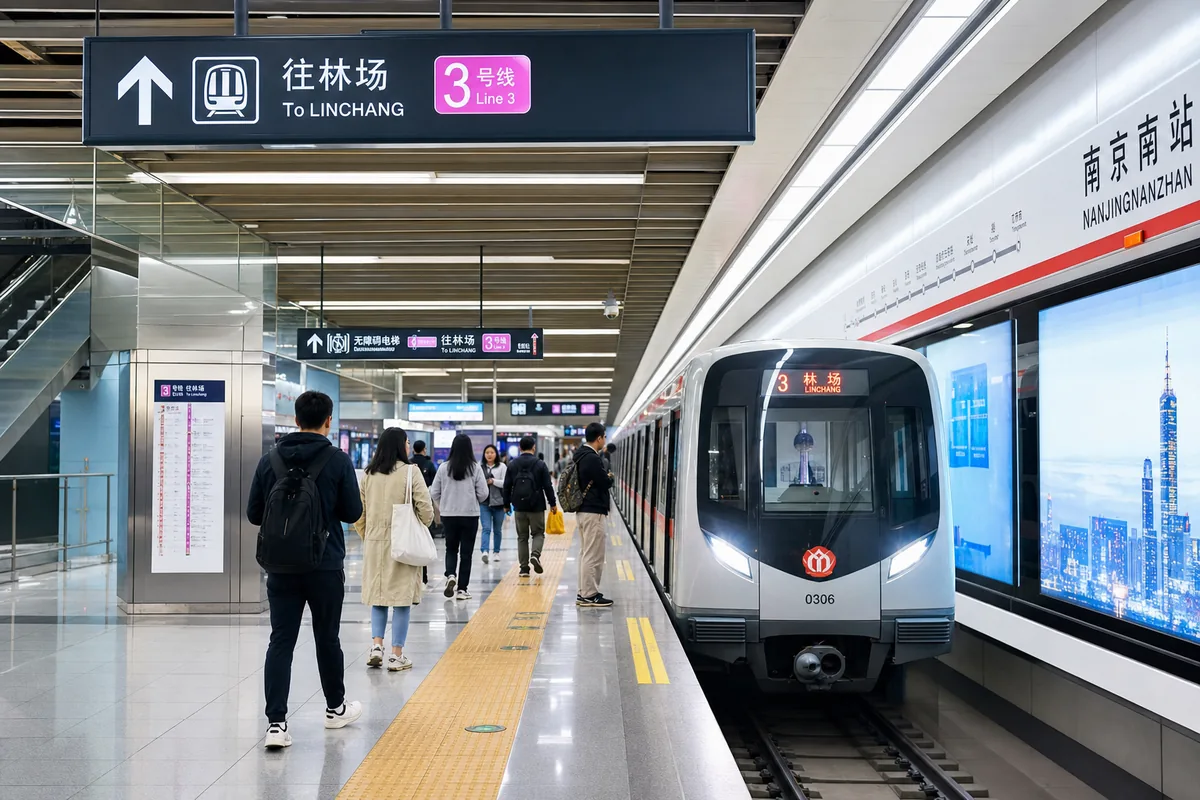
Nanjing has two main high-speed stations: Nanjing South (南京南站), the larger hub, and Nanjing Station (南京站), closer to Xuanwu Lake. Both connect to the metro. You can book tickets through the official 12306 system or an English-language platform like Trip Com Train, which handles foreign passports and cards more smoothly. For the full process, see our guide to booking train tickets.
Nanjing Lukou International Airport (NKG) handles domestic and some regional international flights, connected to the city by metro Line S1 (about 35-45 minutes to the center).
Getting Around the City
Nanjing's metro is extensive, clean, and cheap, with English on signage and ticket machines. It reaches almost everything you'll want: Presidential Palace, Fuzimiao, the South Station, the airport, and the Purple Mountain area (via Line 2 to Muxuyuan or the dedicated sightseeing connections). Single rides cost 2-7 RMB depending on distance.
You pay for the metro, taxis, and almost everything else with mobile payments. Set up Alipay (支付宝, Zhīfùbǎo) or WeChat Pay before you arrive — see our guides on using Alipay with foreign cards and taxis and ride-hailing. For navigating routes and planning which sites to group by day, the WaysChina app has offline metro maps and a built-in trip planner that work well for a city like Nanjing where the attractions split between the mountain and the center.
Where to Stay
Three areas make the most sense for visitors:
- Xinjiekou (新街口) — the central business and shopping district, with the densest metro connections and the widest range of hotels from budget to luxury. Best for first-timers who want to be central.
- Fuzimiao / Confucius Temple — atmospheric and walkable in the evenings, near the Qinhuai River and street food. More boutique guesthouses and mid-range options here.
- Near Nanjing South Station — practical if you're passing through quickly or have an early train, though it's away from the main sights.
Nanjing has good value compared to Shanghai. Comfortable mid-range hotels often run 300-600 RMB a night, with budget options well below that. You can compare properties and read recent reviews on Booking Com Hotel. Remember that all hotels must register foreign guests with the police at check-in (住宿登记, zhùsù dēngjì) — bring your passport. More on this in our hotel booking and registration guide.
Suggested Itineraries
Two Days
Day 1 — Purple Mountain (east): Start early at the Sun Yat-sen Mausoleum (reserve your slot), then walk or take the shuttle to the Ming Xiaoling Mausoleum and its Sacred Way. Spend the afternoon on the eastern wall sections or Xuanwu Lake. End at Taicheng wall by Jiming Temple for sunset.
Day 2 — City center & Qinhuai (south/central): Morning at the Presidential Palace, then lunch around Xinjiekou. Afternoon at Zhonghua Gate and a wall walk. Evening at Fuzimiao for street food, lanterns, and an optional Qinhuai River boat ride.
Three Days
Add a third day for the Nanjing Massacre Memorial Hall (morning, treated as a focused, solemn visit), the Nanjing Museum (one of China's best, free with reservation), and time at leisure — perhaps the 1912 district for cafés or more of the city wall.
Day Trips and Onward Travel
Nanjing fits naturally into a Jiangnan loop. Shanghai is about 1h10m away by high-speed rail, Hangzhou around 1h10m-1h40m, and Suzhou about an hour. Many travelers combine all of these on the Jiangnan water towns route. If you're building a longer trip, our Shanghai guide and Hangzhou guide pair well with this one.
Practical Notes
Reservation requirements, ticket prices, and opening hours change, so confirm the latest details before you go. The UNESCO listing for the Ming Xiaoling Mausoleum, part of the Imperial Tombs of the Ming and Qing Dynasties, is documented on the UNESCO World Heritage Centre site. For metro maps and live service information, the Nanjing Metro official website is the authoritative source.
The Bottom Line
Nanjing rewards travelers who care about history and don't need everything to be polished and entertaining. In two or three days you can climb to Sun Yat-sen's tomb, walk a wall that has stood for six centuries, stand in the rooms where the Republic was governed, and pay respects at one of the country's most important memorials. Group your sites by location — Purple Mountain one day, the center and Qinhuai another — book the reserved-entry sites in advance on your passport, and eat the salted duck. As a stop between Shanghai and points west, or as a destination in its own right, it's one of the most substantial cities in eastern China.
Next steps: Lock in your high-speed rail tickets, set up mobile payments, reserve your timed-entry sites, and decide whether Nanjing is a standalone trip or part of a wider Jiangnan loop.
Last updated: June 2026
Read in other languages
Getting to the sights by metro
Sun Yat-sen Mausoleum
Mausoleum of the Republic of China's founding father, on Purple Mountain.
- MuXuYuan
- XiaMaFang
Presidential Palace
Site of Sun Yat-sen and Chiang Kai-shek's offices, also Taiping Heavenly King palace ruins.
- DaXingGong
Confucius Temple (Fuzimiao)
Confucius temple by Qinhuai River, with night-cruise boats and snack alleys.
- Fuzimiao
- Sanshanjie
Ming Xiaoling Mausoleum
UNESCO tomb of Ming-dynasty founder Zhu Yuanzhang, with iconic stone-animal Spirit Way.
- MuXuYuan
- XiaMaFang
Xuanwu Lake Park
Imperial-era city lake park beneath Ming city wall, with five islands and gardens.
- Xuanwumen
- Nanjing Railway
Nanjing Massacre Memorial Hall
Solemn memorial documenting the 1937 Nanjing Massacre; free admission, allow 2-3 hours.
- YunJinLu
Jiming Temple
Old temple famed for cherry blossoms in late March-early April along its access road.
- JiMingSi
Zhonghuamen Gate (City Wall South)
World's largest preserved Ming-era 'urn city' — a triple-layered defensive gatehouse.
- Zhonghuamen
Yuhuatai Memorial Park
Revolutionary martyrs cemetery and source of the famed multicolored Yuhua agate stones.
- Yuhuatai
Xinjiekou Commercial District
Self-styled 'China's #1 commercial district' with 17 shopping malls in 1km².
- Xinjiekou
Laomen East Historic Block
Restored Ming-Qing residential block beside Qinhuai River, full of crafts and snacks.
- Zhonghuamen
- Fuzimiao
Jiangnan Examination Hall Museum
Largest imperial examination hall in dynastic China, partially recreated underground.
- Fuzimiao
Nanjing South Railway Hub
Major high-speed rail hub for the Yangtze Delta, gateway to Shanghai/Hangzhou/Beijing.
- Nanjing South Railway
Nanjing Lukou International Airport
Nanjing's main international airport (NKG); 35 km south of central Nanjing.
- Lukou Airport
Nanjing Railway Station
Nanjing's historic main rail station on the lakeshore; conventional and selected high-speed services.
- Nanjing Railway
Nanjing metro: last train times by station
Every line and station, checked by hand — the same data behind our offline route planner.
Get the WaysChina App
Offline guides, currency converter, essential phrases, and more — all in your pocket.

Related Articles
3 Days in Shanghai: An Itinerary You Can Follow As Written
A day-by-day Shanghai route built on metro logic: museum and Bund on day one, towers and old town on day two, a flex...
Day Trips from Shanghai: Water Towns, Suzhou and Hangzhou, Honestly Compared
Which Shanghai day trip fits you: metro-reach Zhujiajiao, Suzhou's real-name garden tickets, free West Lake, or an...
Shanghai Food Guide: What to Eat, Where to Eat It, and How to Order
Beyond soup dumplings: how to eat xiaolongbao without scalding yourself, where locals actually eat, halal and...
Huangshan Guide
How to plan a trip to Mount Huangshan: choosing your route up and down, catching the sunrise, where to sleep on the...