

This article contains affiliate links. If you make a purchase through these links, we may earn a small commission at no extra cost to you. This helps support our work in creating free travel guides.
Yangzhou (扬州, Yángzhōu) is worth one full day, or two if you want slow mornings and an evening on the water. It works well as a day trip from Nanjing, where the fastest trains take under an hour on the sample travel day of 5 November 2026. You come for three things: Slender West Lake and two classical gardens, the old canal city on the Grand Canal, which became a UNESCO World Heritage site in 2014, and the morning tea of a UNESCO City of Gastronomy (2019). Most fast trains from Nanjing and Shanghai arrive at Yangzhou East (扬州东站), not at the older Yangzhou Station, so check the station name when you book.
How many days in Yangzhou, and when to go
One day covers the core: Slender West Lake in the morning, Ge Garden and Dongguan Street in the afternoon, and dinner in the old city. That is the plan most people do from Nanjing, and it works without rushing if you catch a morning train.
Two days add the things a day trip has to skip: an early morning tea, which is the main reason Chinese visitors stay overnight; He Garden and Daming Temple; and the canal area in the evening, when the old streets are lit and cooler. If you come from Shanghai, two days make more sense, because the trip is close to two hours each way (see the next section).
Yangzhou is not a big-sight city. There is no single famous monument. It is a small, green old town built around water and gardens, with good food. People who enjoyed Suzhou's gardens and wanted fewer crowds tend to like it; people who want a full itinerary of headline sights may find one day is plenty.
For seasons, spring is the classic time. A line by the Tang-dynasty poet Li Bai about going down to Yangzhou "in the third month, among the flowers and mist" (烟花三月, yānhuā sānyuè) is the city's best-known slogan, and willows and blossoms along Slender West Lake peak in March and April. Autumn, from late September to November, is the other good window: mild days and clear air. Yangzhou's long-term annual average temperature is about 15.7 °C. For month-by-month temperatures, nearby Nanjing is a fair guide: its January average is 3.1 °C and its July average 28.4 °C. Summer is hot and humid, and in Jiangsu the plum rain season (梅雨, méiyǔ) normally runs from about 19 June to 13 July, so expect days of steady drizzle then. Winter is cold and grey but quiet, and from November to January tickets are cheaper (see the lake section). Avoid the national holidays in early May and early October, when the lake gets very full — the Golden Week guide has the dates.
Getting to Yangzhou: Yangzhou East or Yangzhou Station
Yangzhou has two railway stations, and they serve different trains.
- Yangzhou East (扬州东站, Yángzhōu Dōng Zhàn) is the high-speed station. It was called Yangzhou South until it was renamed in August 2020, so older maps and blogs may still use the old name. Almost all G trains, and most D trains, from Shanghai, Shanghai Hongqiao, Nanjing South and Nanjing Station arrive here. It is on the eastern edge of the city, so plan a taxi to the old town.
- Yangzhou Station (扬州站, Yángzhōu Zhàn) is the older station, served by intercity trains on the line from Nanjing. Its main trains are C-prefix intercity trains from Nanjing Station, plus a few slower D and C trains from Shanghai Hongqiao.
From Nanjing you have three options, all under an hour on the fastest trains. From Nanjing South (南京南站) about 17 trains run to Yangzhou East on the sample day, departing 06:16 to 20:48, with the fastest at 58 minutes and second class roughly 56–77 yuan depending on the train. From Nanjing Station (南京站) about 16 trains go to Yangzhou East, the fastest in 46 minutes, second class roughly 55–68 yuan. Also from Nanjing Station, about 9 trains, mostly C-prefix intercity trains, go to the old Yangzhou Station in about 50 minutes, and second class is about 37–37.5 yuan, around six-tenths of the fare to Yangzhou East. Which one to take depends on where you sleep in Nanjing: from the south of the city, use Nanjing South; from near Xuanwu Lake or the city centre, Nanjing Station is closer and gives you both choices. The Nanjing guide explains the two Nanjing stations.
From Shanghai, both main stations work, which is not true for every Jiangsu city. Shanghai Station (上海站) has about 18 trains to Yangzhou East on the sample day, almost all G trains, with the fastest at 1 hour 43 minutes and most taking just under 2 hours; second class runs about 113–153 yuan. Shanghai Hongqiao (上海虹桥) has about 13 trains to Yangzhou East, fastest 1 hour 42 minutes, second class about 116–153 yuan. Seven slower D and C trains from Hongqiao go to the old Yangzhou Station instead and take 2 hours 36 minutes at best, so skip those unless the times suit you. Pick whichever Shanghai station is closer to your hotel; the Shanghai guide covers both.
| Route | Trains that day | First–last departure | Journey time | Sample fares: 2nd / 1st class |
|---|---|---|---|---|
| Nanjing South → Yangzhou East | 17 (D 11 · G 4 · C 2) | 06:16–20:48 | fastest 58 min (G1551) · typically 59 min | ¥56–77 / ¥89–119 |
| Nanjing Station → Yangzhou East | 16 (D 15 · G 1) | 06:40–19:52 | fastest 46 min (G8337) · typically 56 min | ¥55–68 / ¥88–109 |
| Nanjing Station → Yangzhou Station | 9 (C 8 · K 1) | 06:00–19:33 | fastest 48 min (C3858) · typically 50 min | ¥37–37.5 / ¥55–61 |
| Shanghai Station → Yangzhou East | 18 (G 17 · D 1) | 06:32–21:05 | fastest 1 h 43 min (G8268) · typically 1 h 56 min | ¥113–153 / ¥181–246 |
| Shanghai Hongqiao → Yangzhou East | 13 (G 10 · D 3) | 06:52–19:52 | fastest 1 h 42 min (G8302) · typically 1 h 57 min | ¥116–153 / ¥185–246 |
| Shanghai Hongqiao → Yangzhou Station | 7 (D / C) | – | fastest about 2 h 36 min | – |
| Yangzhou East → Zhenjiang Station | 30 (D 22 · G 6 · C 2) | 07:22–22:00 | 29–37 min · typically 30 min | ¥30–33 / ¥47–53 |
| Yangzhou Station → Zhenjiang Station | No direct trains | – | – | – |
| Yangzhou East → Dagang South (Zhenjiang) | 20 | – | fastest 17 min | – |
| Yangzhou East → Dantu (Zhenjiang) | 3 | – | fastest 24 min | – |
| Zhenjiang Station → Yangzhou East | 31 (D 25 · G 4 · C 2) | 06:46–21:19 | 29–40 min | ¥30–37 / ¥47–59 |
| Dagang South (Zhenjiang) → Yangzhou East | 9 | – | fastest 17 min | – |
| Dantu (Zhenjiang) → Yangzhou East | 1 | – | fastest 25 min | – |
The table is one sample day. Timetables change, especially around holidays, so check the train on the official 12306 site or in your booking app before you travel. You book with your passport number and enter the station with the passport itself; the high-speed train guide explains booking and seat classes, and navigating a Chinese train station walks through security, gates and platforms.
By air, Yangzhou shares Yangzhou Taizhou International Airport (扬泰国际机场) with the neighbouring city of Taizhou. By late 2024 it had opened routes to 67 destinations over the years, 14 of them international or in Hong Kong, Macau and Taiwan, and local media report a direct Spring Airlines route to Bangkok since 11 April 2026. The airport is well outside the city; check the airport's official account for airport buses, or plan on a taxi. For most foreign visitors, flying into Shanghai or Nanjing and taking the train is simpler.
Yangzhou Taizhou is one of Jiangsu's four entry ports for 240-hour visa-free transit, and the permitted stay area is the whole of Jiangsu, so you can also enter through Shanghai or Nanjing and travel to Yangzhou. Whether you qualify depends on your passport and onward ticket — see 240-hour visa-free transit.
Slender West Lake and the gardens
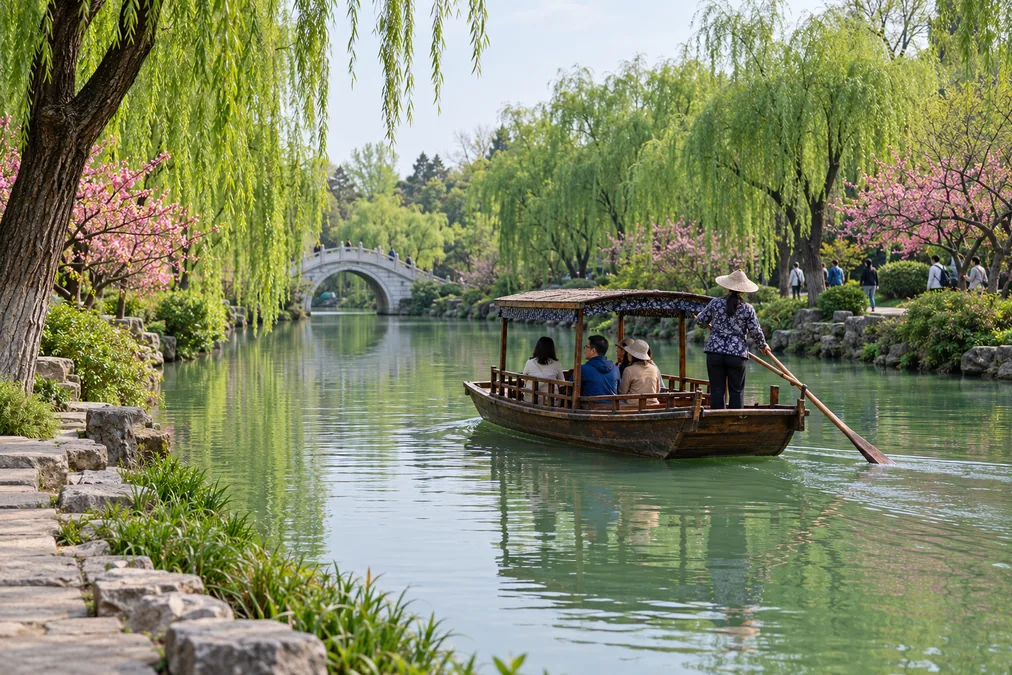
Slender West Lake (瘦西湖, Shòu Xīhú) is the reason most people come. It is not a wide open lake like Hangzhou's West Lake but a long, narrow waterway that bends through a large landscaped park, with willows on both banks, small islands and bridges. The two views everyone photographs are the Five Pavilion Bridge (五亭桥, Wǔtíng Qiáo), a stone bridge topped with five yellow-roofed pavilions, and the White Pagoda (白塔) beside it. Further north is the Twenty-Four Bridge (二十四桥), named after a famous Tang poem. The lake is part of the Grand Canal World Heritage listing.
Allow two and a half to three hours to walk it at an easy pace. The park has a main south gate and a north gate; enter at the south gate early, walk north along the water, and leave by the north gate, which puts you close to Daming Temple. Boats run on the lake, from small hand-rowed boats to larger tour boats, and are paid separately from the entry ticket — buy them at the docks inside the park and check the route before you pay, since some boats only make a loop and come back.
Tickets depend on the season. For 2026 the city set Slender West Lake at 100 yuan in peak season and 60 yuan in off-peak season, and on the 2025 schedule off-peak means January, November and December. On that schedule, November through January is the cheaper period. You can buy at the gate or online through the scenic area's official channels; check whether online booking accepts a passport when you buy. Opening hours are usually from early morning to early evening — check the time on the ticket page, as it shifts with the season.
Ge Garden (个园, Gè Yuán) is a salt merchant's garden from the Qing dynasty in the old city, a few minutes' walk from Dongguan Street. It is known for its bamboo — the character 个 looks like three bamboo leaves — and for its four rockeries, built from different stones to suggest spring, summer, autumn and winter. It is small; an hour is enough.
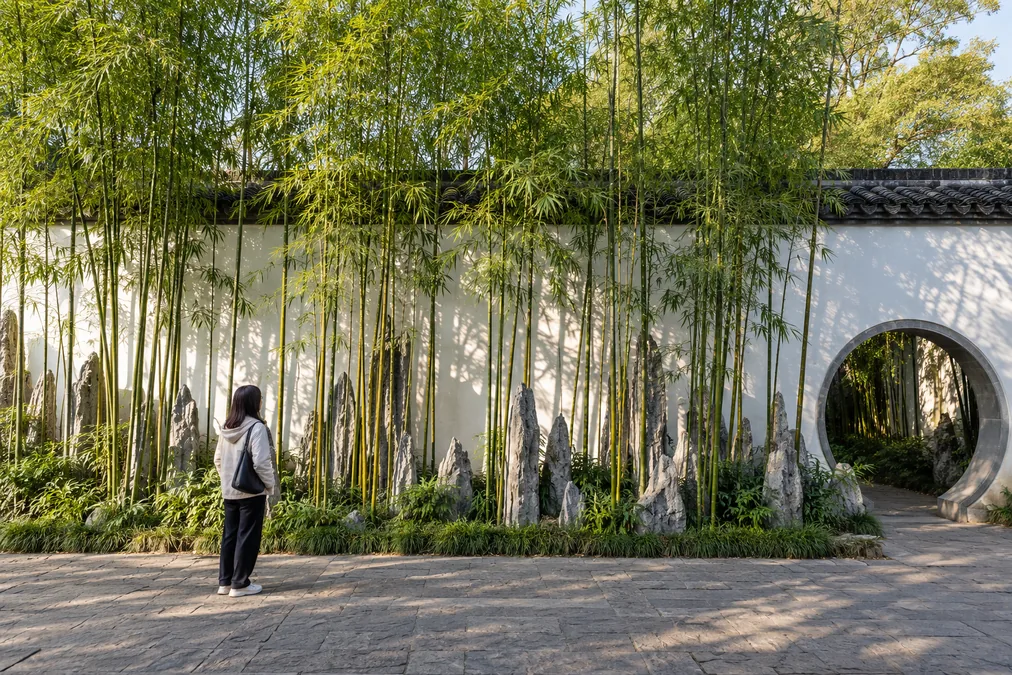
He Garden (何园, Hé Yuán), in the south-east of the old city, is a late-Qing mansion and garden. Its highlight is a two-storey covered walkway that wraps around the courtyards, so you can walk the whole garden on the upper level, and the house mixes Chinese and Western styles. Allow an hour to an hour and a half. If you only have time for one garden, choose Ge Garden for the bamboo and rockeries, or He Garden for the architecture.
Daming Temple (大明寺, Dàmíng Sì) sits on a low hill just north-west of Slender West Lake. It is a working Buddhist temple with a pagoda and halls, and it is known for the monk Jianzhen (鉴真, Jiànzhēn; Ganjin in Japanese), who served here before sailing to Japan in the Tang dynasty to teach Buddhism. The Jianzhen Memorial Hall inside the temple is the part most Japanese visitors come to see. One to one and a half hours is enough.
For 2025, Daming Temple, Ge Garden and He Garden each cost 48 yuan in peak season (February to October) and 30 yuan in off-peak season (January, November, December), and for 2026 the city capped state-run sights like these at the same 48 and 30 yuan. Online sellers and festival promotions often offer discounts, so check the price on the day. Half-price and free tickets are written around Chinese ID documents, so plan on paying full price with a passport and ask at the counter whether you qualify. The Yangzhou government's 2026 ticket notice (in Chinese) is the official reference.
| Sight | Ticket | Season / dates |
|---|---|---|
| Slender West Lake (daytime) | 2026: peak ¥100 / off-peak ¥60 | peak Feb–Oct, off-peak Jan, Nov, Dec (2025 schedule) |
| Daming Temple, Ge Garden, He Garden (each) | 2025: peak ¥48 / off-peak ¥30 · 2026: capped at ¥48 / ¥30 | peak Feb–Oct, off-peak Jan, Nov, Dec (2025 schedule) |
| Slender West Lake: “Erfen Mingyue Ye” night show | ¥120 | all year (2025 programme) |
| Ge Garden night show | ¥55 | Apr 18–Oct 8 (2025 programme) |
| He Garden night show | ¥55 | May 1–Oct 8 (2025 programme) |
| Slender West Lake (Baozhang Lake) evening boat | ¥60 | Jun 30–Aug 31 (2025 programme) |
Night shows. In 2025 Slender West Lake ran an evening show called "Erfen Mingyue Ye" (二分明月夜) all year at 120 yuan, Ge Garden and He Garden ran evening performances at 55 yuan each from spring to early October, and a summer evening boat ran on the lake from late June to the end of August at 60 yuan. These are last season's dates and prices; check the scenic areas' official accounts for the current schedule before you plan an evening around them.
💡 Tip: In 2026 Yangzhou is running free open days: 28 state-priced sights, including Slender West Lake, Ge Garden, He Garden and Daming Temple, each open free on one weekend a year, spread from February onward. Free weekends are also the most crowded, so check the list on the city government's site before you go — either to aim for one or to avoid it.
The Grand Canal and the old streets
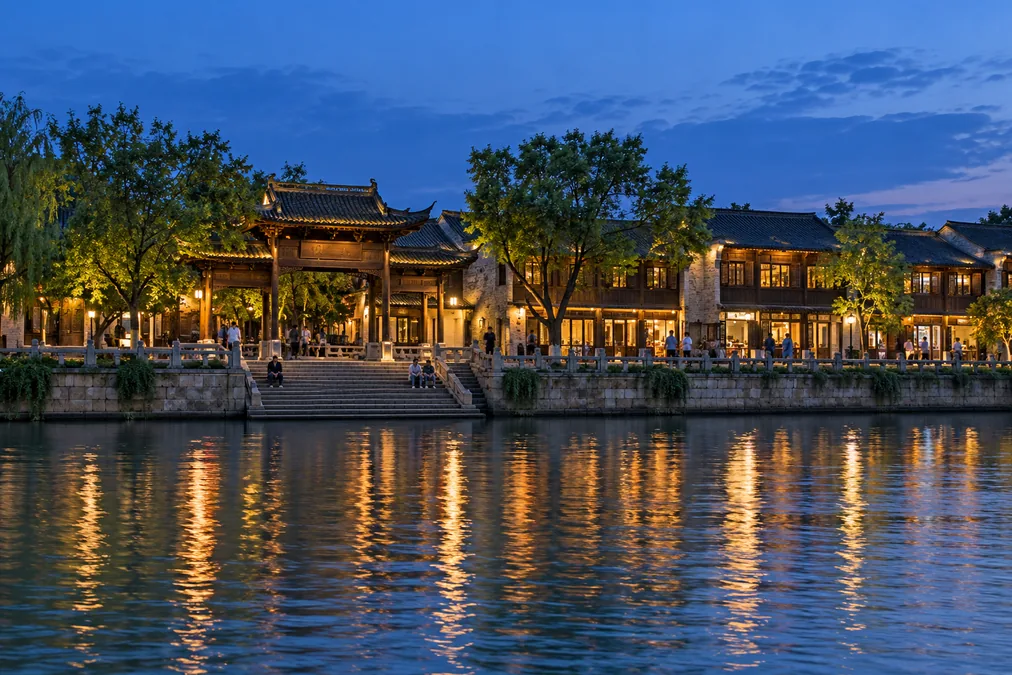
Yangzhou grew rich on the Grand Canal (大运河, Dà Yùnhé), the inland waterway that once carried grain and salt between south and north China. The China Grand Canal was inscribed on the World Heritage List on 22 June 2014, and the Yangzhou heritage points along the old canal include Slender West Lake, Tianning Temple (天宁寺) and sites linked to the salt merchants. The merchants' money is what built the gardens and the grand houses you see today, which is why the canal, the gardens and the food all belong to the same story. China's National Cultural Heritage Administration announced the listing at the time.
Dongguan Street (东关街, Dōngguān Jiē) is the old street to walk. It runs east through the old city to the Dongguan Ancient Ferry (东关古渡) on the canal, and it is lined with snack shops, tea houses, old merchant houses and souvenir stalls. It is touristy, especially at weekends, but it is the easiest way to see the old street pattern, and the side lanes off it are quieter. Ge Garden is right beside it, so the two fit into one afternoon. Come back after dark if you can: the street and the canal bank are lit, and it is cooler in summer.
Walking along the canal itself is free. A path follows the old canal around the east and south of the old city, past the ferry and on towards He Garden. Canal boat trips leave from docks in the old city; check the current times and prices at the dock or on the city tourism account.
The China Grand Canal Museum (中国大运河博物馆) is in Sanwan Park in the south of the city, a taxi ride from the old town. It tells the canal's story across all of China, and it is the best single place to understand why Yangzhou mattered. Big Chinese museums often need advance booking and close one day a week, so check its official account for booking and opening days before you go, and bring your passport.
If you have half a day more, the outer canal parks and Tianning Temple are worth a walk, but for a first visit Dongguan Street, the ferry and one stretch of canal path give you the feel of it.
Morning tea and Huaiyang food
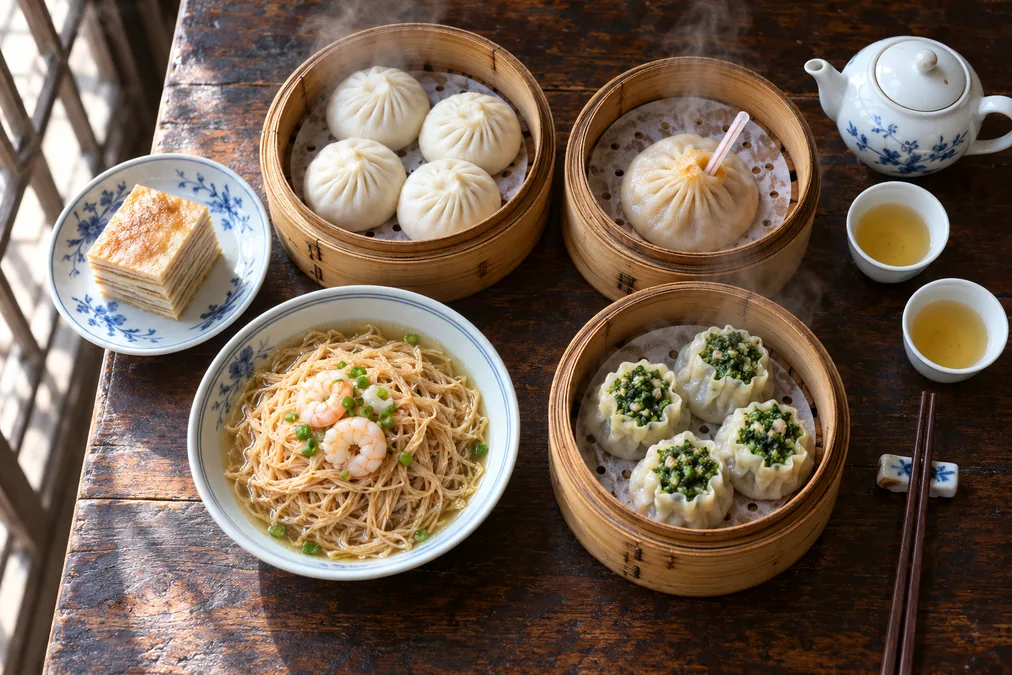
Morning tea (早茶, zǎochá) means a pot of tea and a table of buns, dumplings and small dishes, eaten slowly. Yangzhou was named a UNESCO Creative City of Gastronomy on 30 October 2019, and the morning tea is the part of that food culture visitors can try most easily. You can read the UNESCO announcement for the background.
Where to go. The best-known old names are Fuchun Teahouse (富春茶社, Fùchūn Cháshè), in the lanes of the old city, and Yechun (冶春), by the water near the south end of Slender West Lake; both have several branches. At Fuchun, try the house tea, Kuilongzhu (魁龙珠), a blend made for the teahouse. Smaller local places across the city serve the same dishes with shorter queues and simpler rooms; if a place is full of local families at 7 a.m., it is a good sign.
When to go. Early. Morning tea is a breakfast meal: most places open early in the morning, and the well-known teahouses fill up from about 8 a.m. at weekends and on holidays. Arriving soon after opening means you get a table and the steamed buns come fresh. Opening times vary by branch, so check them in your map app the night before. By late morning some dishes may have sold out.
What to order.
- Three-diced buns (三丁包, sāndīng bāo) — steamed buns filled with diced chicken, pork and bamboo shoot. The classic order.
- Crab-roe soup dumplings (蟹黄汤包, xièhuáng tāngbāo) — big dumplings full of hot broth, often drunk through a straw. Seasonal and pricier; let them cool a little first.
- Jade shaomai (翡翠烧卖, fěicuì shāomài) — open-topped dumplings with a bright green filling of greens.
- Thousand-layer cake (千层油糕, qiāncéng yóugāo) — a sweet, layered steamed cake.
- Braised dried tofu shreds (大煮干丝, dà zhǔ gānsī) — very fine strips of tofu in a rich broth; a Huaiyang classic that shows off knife skills.
Ordering is usually from a paper or picture menu, or by scanning a QR code at the table. If you read no Chinese, a camera translation app works well on these menus — see how to order food with zero Chinese.
Huaiyang cuisine (淮扬菜, Huáiyáng cài) is the cooking style of this region, and it is mild: light sauces, careful knife work, a little sweetness, little chilli. It is a good change if you have been eating spicy food elsewhere in China. For lunch or dinner, look for:
- Lion's head meatballs (狮子头, shīzitóu) — large, soft pork meatballs, usually braised or stewed in broth.
- Yangzhou fried rice (扬州炒饭, Yángzhōu chǎofàn) — the dish that gave its name to the fried rice served in Chinese restaurants worldwide, with egg, shrimp, ham and vegetables. In Yangzhou the grains are separate and the flavour is clean.
- Braised dried tofu shreds again, which appears at dinner as well as morning tea.
For how Huaiyang cooking fits next to Cantonese, Sichuan and the rest, see the guide to Chinese cuisine by region. Prices vary a lot between old-name restaurants and neighbourhood places, and many have pictures on the menu, so check before ordering if you are on a budget.
Getting around Yangzhou
Yangzhou has no metro. The old city is compact and flat enough to walk between Dongguan Street, Ge Garden, He Garden and the canal, but Slender West Lake, Daming Temple, the Grand Canal Museum and both railway stations are further out. For those, use taxis or ride-hailing: DiDi works with a foreign card and shows an estimated fare before you confirm, and drivers do not need you to speak Chinese if you set the destination in the app. City buses also reach the main sights and are cheap; most riders pay by phone, so check the payment sign by the bus door and keep a little cash as a backup.
Adding Zhenjiang
Zhenjiang (镇江, Zhènjiāng) sits just across the Yangtze River from Yangzhou and makes an easy half-day or one-day add-on. About 30 trains run from Yangzhou East to Zhenjiang Station on the sample day, from 07:22 to 22:00, taking about 30 minutes, with second class at roughly 30–33 yuan depending on the train; the old Yangzhou Station has no direct trains to Zhenjiang. About 31 trains run back the other way; both directions are in the train table above. The usual sights are Jinshan Temple (金山寺) on its hill and Xijindu (西津渡), an old ferry street with buildings from several dynasties; check their tickets and hours on the official accounts before you go. Zhenjiang is also famous for its black vinegar (镇江香醋). Because Zhenjiang Station is on the main Shanghai–Nanjing line, you can continue from there to Nanjing or Shanghai instead of going back to Yangzhou.
A one-day and a two-day plan
One day (from Nanjing, or as a stop between Nanjing and Shanghai)
- Morning: take an early train to Yangzhou East and a taxi straight to the south gate of Slender West Lake. Walk the lake north to the Five Pavilion Bridge and the White Pagoda, then out of the north gate.
- Late morning: Daming Temple, a short walk or taxi from the north gate.
- Lunch: a Huaiyang lunch, or a late morning-tea style meal at one of the teahouses by the canal near the lake.
- Afternoon: taxi to the old city for Ge Garden, then walk Dongguan Street to the Dongguan Ancient Ferry.
- Evening: dinner in the old city (lion's head, fried rice), then a taxi to Yangzhou East for a train back. Book the return when you book your outbound ticket and check the last train then, not on the day; if you would rather book both legs in English with a foreign card, Trip.com sells the same train tickets.
Two days
- Day 1: arrive by late morning, check in in the old city, and spend the afternoon on Ge Garden and Dongguan Street. After dark, walk the canal by the ancient ferry, or book an evening show if one is running.
- Day 2: start with morning tea soon after opening. Then Slender West Lake while it is still quiet, Daming Temple after the north gate, and in the afternoon either He Garden or the Grand Canal Museum. Leave from Yangzhou East in the evening, or cross to Zhenjiang for the night and continue from there.
For an overnight, stay in or near the old city around Dongguan Street, Wenchang Road and the canal: you can walk to Ge Garden, the old streets and the teahouses, and a taxi to the lake is short. Compare hotels in the old city on Booking.com. Hotels must register foreign guests, so book a place that can process a passport — see hotel booking and registration rules.
Fitting Yangzhou into a longer trip. Yangzhou pairs most naturally with Nanjing, the old capital, where two or three days cover Purple Mountain, the museums and the city wall; Yangzhou then works as a day trip or the first night heading east. Wuxi, on the shore of Lake Tai, is the next stop along the line towards Shanghai, with lakeside parks and an old canal district of its own. If you like the gardens here, Suzhou has the most famous classical gardens in China, and the Jiangnan water towns route links Suzhou, the canal towns and Hangzhou.
Frequently asked questions
Can I visit Yangzhou as a day trip from Nanjing?
Yes, and it is the most common way to do it. On the sample day the fastest train from Nanjing Station to Yangzhou East takes 46 minutes, and from Nanjing South the first train leaves at 06:16 and the fastest takes 58 minutes. Take a train before 8 a.m., see Slender West Lake, Daming Temple, Ge Garden and Dongguan Street, have dinner, and go back in the evening. Book your return at the same time as your outbound ticket and check the last train on 12306, because evening trains back to Nanjing can sell out on weekends and holidays.
What is the difference between Yangzhou East and Yangzhou Station?
Yangzhou East (扬州东站) is the high-speed station, formerly called Yangzhou South, and it gets almost all fast trains from Shanghai and Nanjing; Yangzhou Station (扬州站) is the older station, served mainly by C-prefix intercity trains from Nanjing Station. From Nanjing Station either works, and the intercity to Yangzhou Station is cheaper. From Shanghai, or to continue to Zhenjiang, use Yangzhou East. Both are outside the old city, so you need a taxi either way.
Where and when should I have morning tea in Yangzhou?
Go early, soon after the teahouse opens, and on a weekday if you can — the famous places fill up from about 8 a.m. at weekends. Fuchun Teahouse (富春茶社) in the old city and Yechun (冶春) by the water near Slender West Lake are the best-known names, and neighbourhood teahouses serve the same three-diced buns, soup dumplings and tofu shreds with shorter queues. Check the opening time of the branch you choose in your map app the night before, and order a pot of tea with your buns.
In short: give Yangzhou one full day from Nanjing or two days as an overnight, book trains to Yangzhou East, walk Slender West Lake early, add Ge Garden and Dongguan Street, and plan your morning around tea. Check the season before you buy tickets: on the 2025 schedule, November to January is the cheaper off-peak period.
Last updated: October 2026
Fact-checked sources
- Official China Railway 12306 7 pages
- Official National Cultural Heritage Administration
- Official Yangzhou Municipal Government 2 pages
- Official UNESCO
- Official Jiangsu Meteorological Service
- Official Nanjing Municipal Government
- Official China Meteorological Administration
- Official Jiangsu Provincial Department of Transportation 2 pages
Show 4 more sources
- Yangzhou News (yznews.com.cn)
- Official Chinese embassies and consulates
- Official National Immigration Administration
- Official Yangzhou Development and Reform Commission 2 pages
Last verified: 2026-10-25
Read in other languages
Last train times for 10 Chinese metro systems
Every line and station, checked by hand — the same data behind our offline route planner.
Get the WaysChina App
Offline guides, currency converter, essential phrases, and more — all in your pocket.

Related Articles
Wuxi Travel Guide: Lake Tai, Lingshan Buddha and Which Station to Use
How many days Wuxi needs, Wuxi Station or Wuxi East, Yuantouzhu and the Lingshan Buddha on Lake Tai, the Grand Canal...

Fujian Tulou Guide: Nanjing County or Yongding, Tickets and How to Get There from Xiamen
Fujian's World Heritage tulou from Xiamen: how to choose between Nanjing County and Yongding, official ticket...
Fuzhou Travel Guide: Three Lanes and Seven Alleys, Getting Around, Food and Mount Wuyi Trains
One to two days in Fuzhou: Fuzhou Station or Fuzhou South, what Sanfang Qixiang charges for, the free Fujian Museum,...

Quanzhou Travel Guide: World Heritage Temples, Day Trip from Xiamen and What to Eat
One or two days in Quanzhou: which of its three stations to book from Xiamen, what the 22 World Heritage sites are,...