
This article contains affiliate links. If you make a purchase through these links, we may earn a small commission at no extra cost to you. This helps support our work in creating free travel guides.
The classic Chinese Silk Road follows the old caravan corridor west from Xi'an, the ancient capital where the route began, out through the Hexi Corridor (河西走廊, Héxī Zǒuláng) in Gansu province to Dunhuang and its desert caves. The full stretch covers roughly 1,800km, and the modern version is far easier than the camel version: high-speed trains link most of it, and the scenery shifts from loess plateau to grassland to rainbow-striped hills to sand dunes within a few days.
This guide lays out a 7-8 day route through Xi'an, Lanzhou, Zhangye, and Dunhuang, with the transport connections that tie them together, realistic costs, and notes on how to stretch or shorten the trip. Spring (March-May) and autumn (September-November) are the best windows. Summer gets hot in the desert and crowded at the caves; winter is cold and quiet but the dunes and Danxia hills still look striking under clear skies.
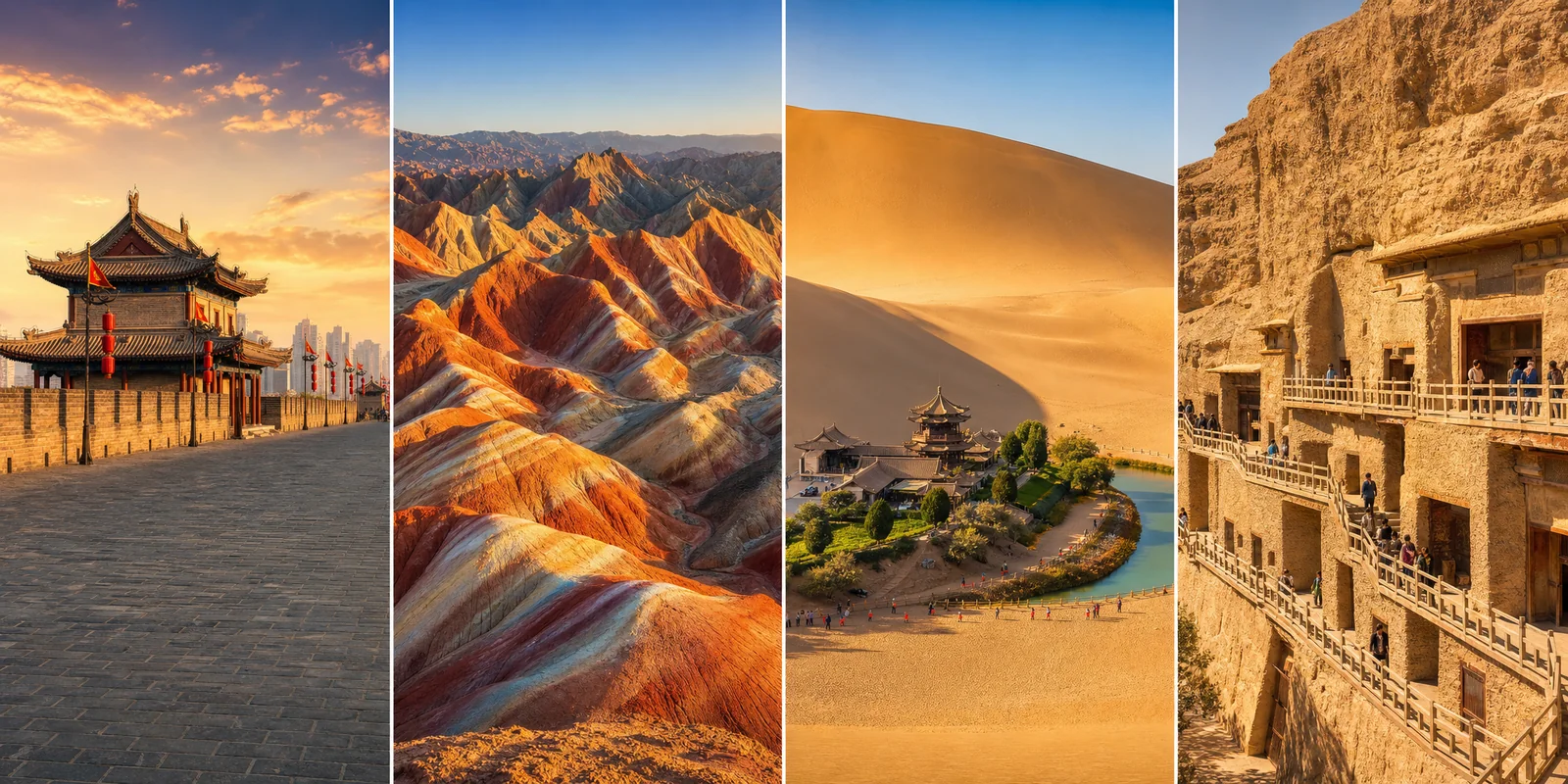
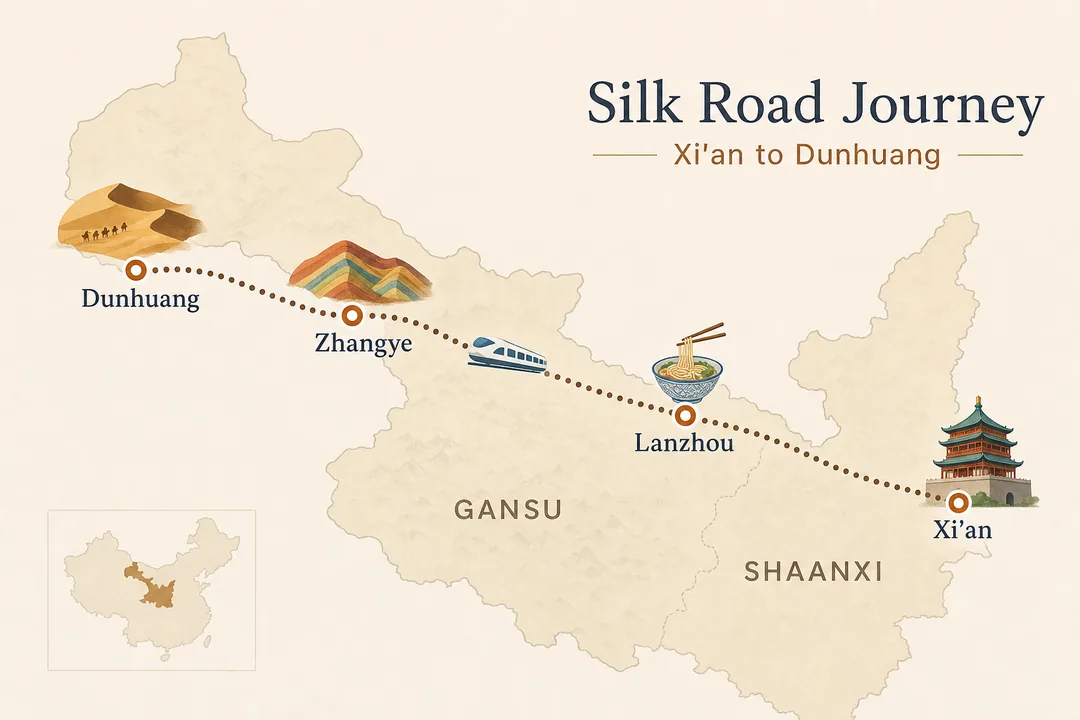
Route Overview
Here's the shape of the trip at a glance. Distances are real, times reflect current high-speed rail and flights, and the suggested nights are what most travelers find comfortable.
| Stop | Nights | Why stop here | Get there by |
|---|---|---|---|
| Xi'an | 2 | Terracotta Army, city walls, Muslim Quarter, the eastern start of the Silk Road | Fly into XIY or arrive by high-speed train |
| Lanzhou | 1 | Yellow River city, hand-pulled beef noodles, gateway to the Hexi Corridor | Bullet train from Xi'an (~3h) |
| Zhangye | 1-2 | Rainbow Danxia landforms, Giant Buddha Temple | Bullet train from Lanzhou (~2h) |
| Dunhuang | 2-3 | Mogao Caves, Mingsha sand dunes, Crescent Lake, Yumen Pass | Train + transfer, or fly (DNH) |
Total: 7 nights if you keep it tight, 8 if you add a second night in Zhangye or Dunhuang. The whole thing runs west to east logistically — you finish at Dunhuang, which has its own airport with direct flights to Xi'an, Lanzhou, and Beijing, so you don't have to backtrack.
Day 1-2: Xi'an
Xi'an (西安) was the imperial capital under several dynasties and the eastern terminus of the Silk Road. Two full days cover the essentials without rushing.
Day 1: Terracotta Army and city center
Spend the morning at the Terracotta Army (兵马俑, Bīngmǎyǒng), about an hour east of the city. Go early — it opens around 8:30am and gets packed by mid-morning. Pit 1 is the famous one with rows of life-size soldiers; budget two to three hours for all three pits and the museum. Getting there is easy by public bus (Line 5 / 306 from near Xi'an Railway Station) or a Didi ride-hailing car.
Back in the city, walk or cycle the City Wall (城墙, Chéngqiáng) in the late afternoon — it's a complete 14km loop and you can rent bikes on top. End the day in the Muslim Quarter (回民街, Huímínjiē), the historic Hui community district packed with food stalls: roujiamo (a stuffed flatbread often called a Chinese hamburger), hand-pulled noodles, and lamb skewers.
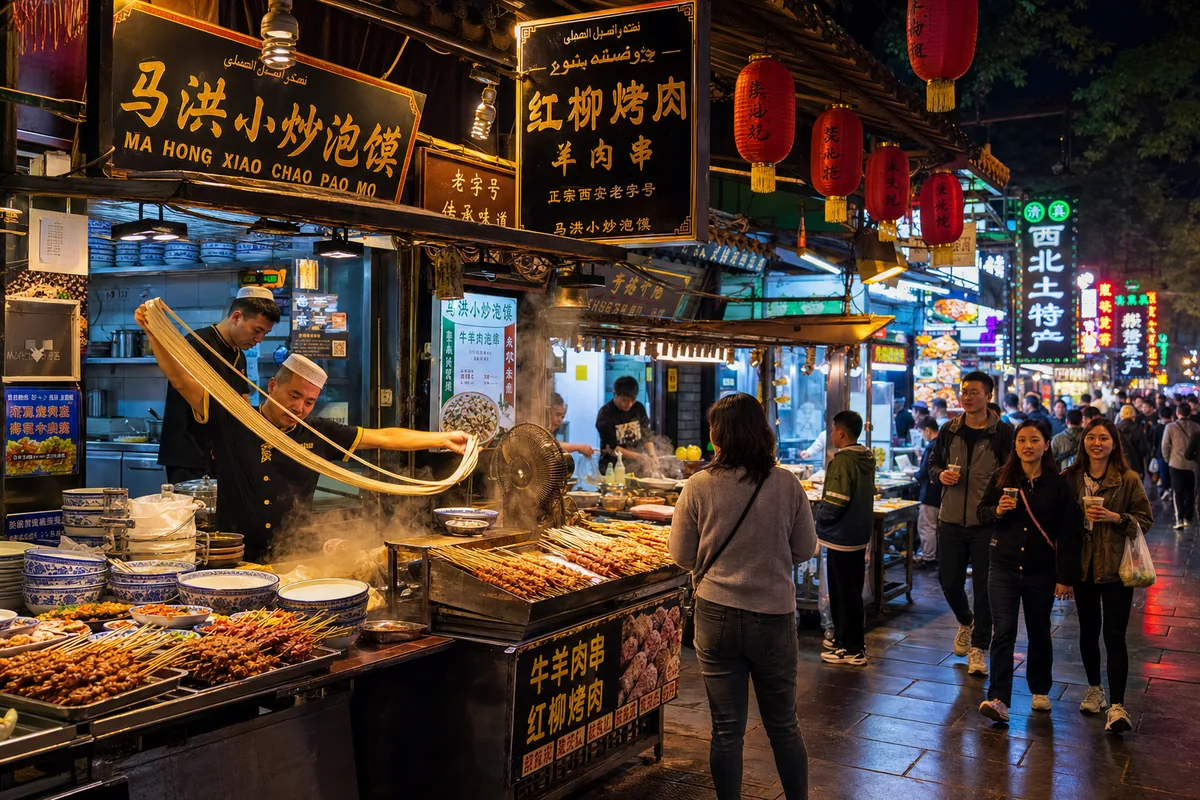
Day 2: History and the Silk Road context
Start at the Shaanxi History Museum (free, but reserve a timed ticket online a day or two ahead — it sells out). It puts the whole region in context. Then climb the Big Wild Goose Pagoda (大雁塔, Dàyàntǎ), built to house Buddhist scriptures the monk Xuanzang brought back from India along the Silk Road. If you have energy, the Bell Tower and Drum Tower in the center are worth a quick look.
For a deeper look at the city, including the food scene and a tighter sightseeing plan, see the Xi'an Complete Guide and the 2-Day Xi'an Itinerary.
Where to stay in Xi'an
Stay inside or near the City Wall (the Bell Tower area) for walkable access to the center and metro. Mid-range hotels here run ¥250-450 per night; hostels and budget rooms start around ¥80-150. You'll find a wide range of options on Booking Com Hotel, and booking near a metro station saves a lot of taxi time.
Day 3: Lanzhou
Take a morning high-speed train from Xi'an North to Lanzhou West (about 3 hours). Lanzhou (兰州) is the capital of Gansu, strung along the Yellow River, and it's the practical hinge of the Hexi Corridor.
One night is enough. The main draws are the riverfront — walk along the Yellow River (黄河, Huánghé), see the Zhongshan Bridge (the first permanent bridge over the river, built in the early 1900s), and the Mother River sculpture. Then there's the food. Lanzhou is the home of beef noodle soup (兰州牛肉面, Lánzhōu niúròumiàn), hand-pulled noodles in clear beef broth with chili oil, radish, and cilantro. Locals eat it for breakfast; the good shops sell out by early afternoon.
If you have an extra half-day, the Gansu Provincial Museum holds the famous bronze "Flying Horse of Wuwei," a Silk Road-era artifact. For more on the city, see the Lanzhou Complete Guide.
Day 4-5: Zhangye
A morning bullet train from Lanzhou West to Zhangye West takes about 2 hours. Zhangye (张掖) is the highlight of the corridor for landscape.
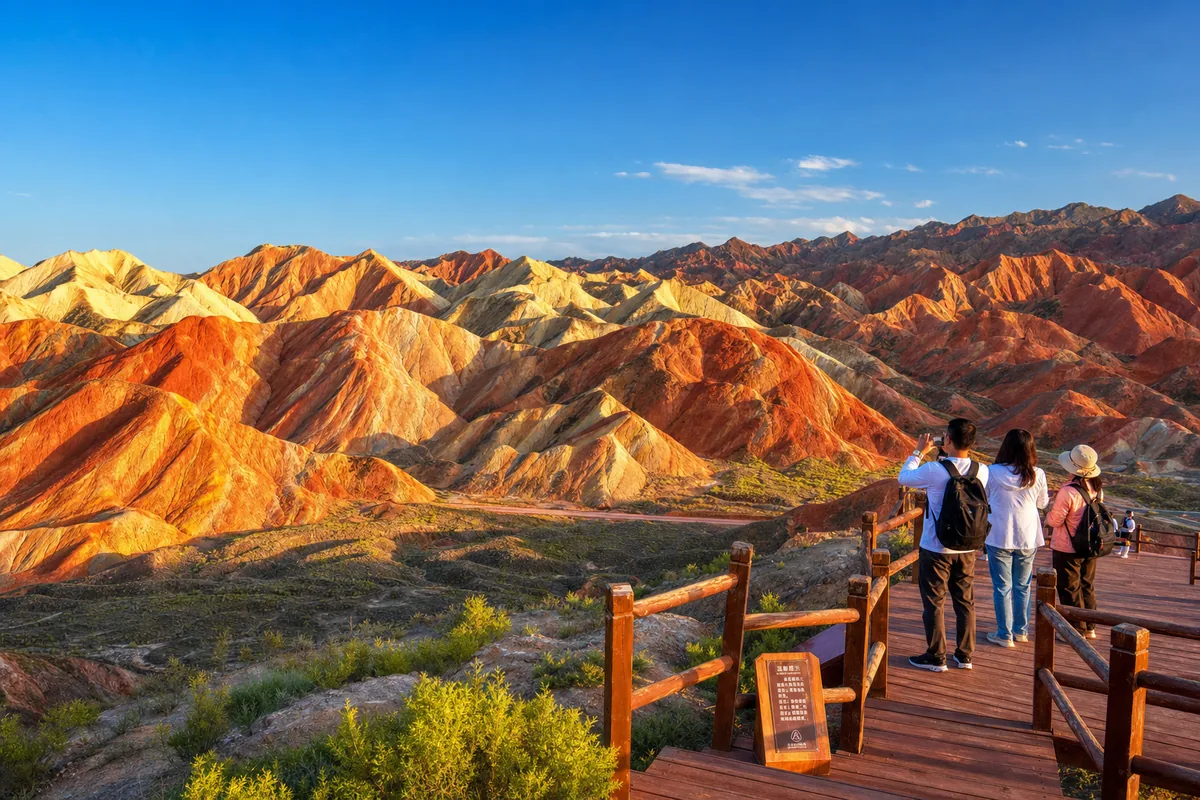
The Rainbow Danxia landforms
The Zhangye Danxia (张掖丹霞, Zhāngyè Dānxiá) is a stretch of hills banded in red, orange, yellow, and cream — layers of mineral-rich sandstone tilted and eroded over millions of years. The official scenic area has a shuttle bus that stops at four viewing platforms. Go in late afternoon: the low sun deepens the colors, and platform 4 is the classic sunset spot. Entry is around ¥55 plus ¥20 for the shuttle.
The site is about 40 minutes from Zhangye city by car. Many travelers visit independently with a Didi or local taxi, but a guided half-day tour handles the transport and timing for you — worth considering if you want to hit the light right without juggling logistics. You can compare options on Klook.
Other Zhangye stops
In town, the Giant Buddha Temple (大佛寺, Dàfó Sì) houses a 35-meter reclining Buddha, the largest indoor clay reclining Buddha in China, dating to the Western Xia period. If you have a second day, the Binggou Danxia (a separate, more dramatic canyon area near the rainbow hills) is worth it.
For more detail on visiting and timing, see the Zhangye Danxia Guide. One night works if you only want the rainbow hills; add a second for Binggou and a slower pace.
Day 6-7: Dunhuang
This is the leg where you decide between train and plane. From Zhangye, a bullet train to Liuyuan South (the railhead for Dunhuang) takes about 2.5-3 hours, followed by a roughly 1.5-hour drive or shuttle into Dunhuang — figure on half a day door to door. Alternatively, there are flights into Dunhuang's small airport (DNH) from Lanzhou and Xi'an if you'd rather skip a stop or save time on the return.
Dunhuang (敦煌) sits on the edge of the Gobi, and it's the payoff of the whole route. Give it two nights minimum, three if you want the outlying desert passes.
Mogao Caves
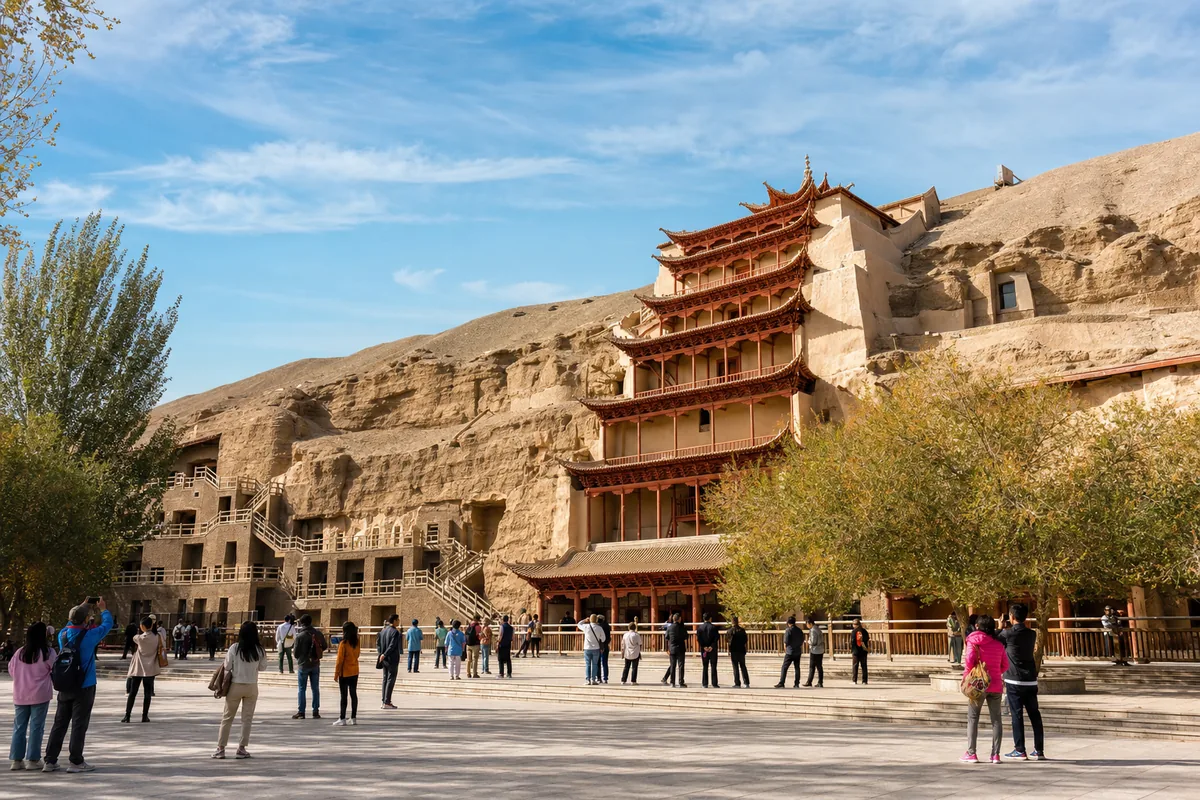
The Mogao Caves (莫高窟, Mògāo Kū) are the reason most people come — a complex of nearly 500 caves carved into a cliff over a thousand years, filled with Buddhist murals and statues. It's a UNESCO World Heritage site, and visits are tightly controlled to protect the art. You book a timed ticket in advance, watch two films at the visitor center, then take a shuttle to the caves where a guide takes your group through about eight caves (you don't choose which). Photography inside is forbidden.
You can read about the conservation and history directly from the Dunhuang Academy, which manages the site. Book through the official Mogao Caves ticketing system well ahead in peak season — slots are capped daily. Tickets run around ¥238 for the full visit.
Mingsha Dunes and Crescent Lake
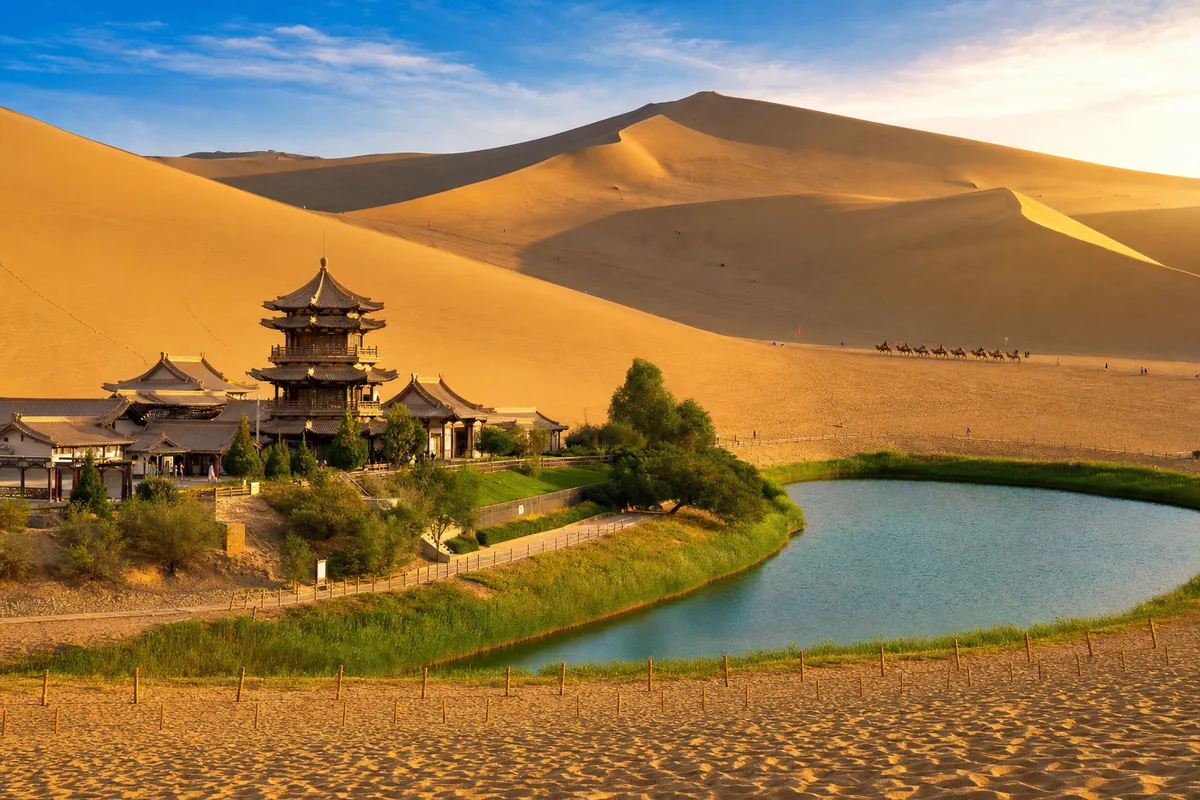
Just outside town, the Singing Sand Dunes (鸣沙山, Míngshā Shān) rise hundreds of meters, and tucked among them is Crescent Lake (月牙泉, Yuèyáquán), a spring-fed pool shaped like a crescent that has somehow survived in the desert for centuries. Go in the late afternoon, climb a dune for sunset, and ride a camel if you like (it's touristy but the setting is genuine). Entry is around ¥110. Bring shoe covers or rent them — sand gets into everything.
Day 7: Desert passes (optional)
With a third day, head out to the Yumen Pass (玉门关, Yùménguān) and Yangguan Pass — the western frontier gates of the Han empire, where the Silk Road split into northern and southern routes — plus the eroded Yardang landforms (a wind-carved "ghost city" of rock formations) further out. This is a full-day trip into open desert, best done with a hired driver or a tour since the sites are spread far apart with nothing in between.
For everything Dunhuang in one place, including the night market and how to organize the desert day, see the Dunhuang & Silk Road Guide.
Where to stay in Dunhuang
The town is small and walkable. Stay near the night market and Mingsha Mountain road for easy access to food and the dunes. Mid-range hotels run ¥200-400; there are desert-camp options near the dunes for more money. Compare rooms on Agoda Hotel.
Transport: How the Connections Work
The backbone of this route is the Lanzhou-Xinjiang high-speed line, which opened the corridor up enormously. Here's the practical chain.
| Leg | Mode | Time | Approx. fare (2nd class) |
|---|---|---|---|
| Xi'an → Lanzhou | High-speed train (G/D) | ~3h | ¥170-230 |
| Lanzhou → Zhangye | Bullet train | ~2h | ¥110-150 |
| Zhangye → Liuyuan South | Bullet train | ~2.5-3h | ¥160-230 |
| Liuyuan South → Dunhuang | Shuttle/taxi | ~1.5h | ¥30-100 |
| Dunhuang → Xi'an / Lanzhou | Flight (DNH) | ~2h / 1h15 | ¥600-1,200 |
A few things worth knowing about train travel here. You book with your passport, and you'll need it to collect or scan through the gate. Stations are large and the security and ticket-check process takes time, so arrive 45-60 minutes early. Foreign passport holders can sometimes use the e-ticket gates directly now, but if the automated gate rejects your passport, there's always a staffed lane.
You can book the whole rail chain in advance through the official China Railway 12306 site or app, though the interface can be clunky for foreign cards. Many travelers find it simpler to book through Trip Com Train, which handles foreign payment cards and sends a clear booking confirmation in English. For the full process, our guide to booking train tickets walks through both options.
Should you fly any of it?
The trains are scenic and reliable, and the corridor really is best seen at ground level — you watch the landscape change. But the Dunhuang return leg is where flying saves the most time. Flying Dunhuang back to Xi'an or onward to Beijing avoids the Liuyuan transfer and a long backtrack. Many travelers do the route west by train and fly out from Dunhuang.
Budget Reference
Per-person estimates for the 7-8 day route, excluding international flights to China. Costs are in Chinese yuan (¥); convert at roughly ¥7 to US$1.
| Category | Budget | Mid-range |
|---|---|---|
| Accommodation (7 nights) | ¥700-1,200 | ¥1,800-3,000 |
| Intercity transport | ¥700-900 (all train) | ¥1,200-1,800 (train + 1 flight) |
| Attraction tickets | ¥500-650 | ¥500-650 |
| Food | ¥400-700 | ¥800-1,400 |
| Local transport / tours | ¥300-500 | ¥800-1,500 |
| Total (approx.) | ¥2,600-3,950 | ¥5,100-8,350 |
The big variables are whether you fly the Dunhuang leg and how many guided tours you take for the Danxia hills and the desert passes (those sites are hard to reach without a car). Attraction tickets are fairly fixed and add up — Mogao alone is ¥238.
Adjusting the Route
Short on time (5-6 days): Drop the Lanzhou overnight — pass through with a noodle lunch on a longer train day — and cut Zhangye to a single afternoon. Spend the saved time in Dunhuang, which deserves it.
Want more depth (10+ days): Add Jiayuguan between Zhangye and Dunhuang for the western end of the Great Wall and its restored Ming fortress. You could also extend east before the trip and pair this with a broader China loop — see our 10-Day China Trip Plan for ideas on connecting Xi'an to Beijing or Shanghai.
Prefer not to handle logistics: The desert sites and Danxia hills are the parts that benefit most from a guide and driver. Some travelers book the whole corridor as a package rather than piecing together transfers; operators like China Highlights run Silk Road tours that bundle the trains, hotels, and the harder-to-reach sites. If you want a turnkey version, that's a reasonable route.
If this is your first trip to China, you might also want the broader context in our First Time China Itinerary before committing to a northwest-only route.
Final Thoughts
The Xi'an-to-Dunhuang corridor is one of China's most rewarding regional routes precisely because each stop is distinct: imperial history in Xi'an, river-city food in Lanzhou, the painted hills of Zhangye, and the desert caves and dunes of Dunhuang. Seven nights covers it comfortably; eight gives you breathing room. Build the trip around train connections, book Mogao Caves and any peak-season flights early, and consider flying out of Dunhuang to skip the backtrack. Travel in spring or autumn for the best light and temperatures.
Your next steps: lock your dates, reserve Mogao Caves and the Shaanxi History Museum the moment your plans are firm, and set up mobile payments before you fly. Then the route mostly runs itself.
Last updated: June 2026
Read in other languages
Last train times for 10 Chinese metro systems
Every line and station, checked by hand — the same data behind our offline route planner.
Get the WaysChina App
Offline guides, currency converter, essential phrases, and more — all in your pocket.

Related Articles
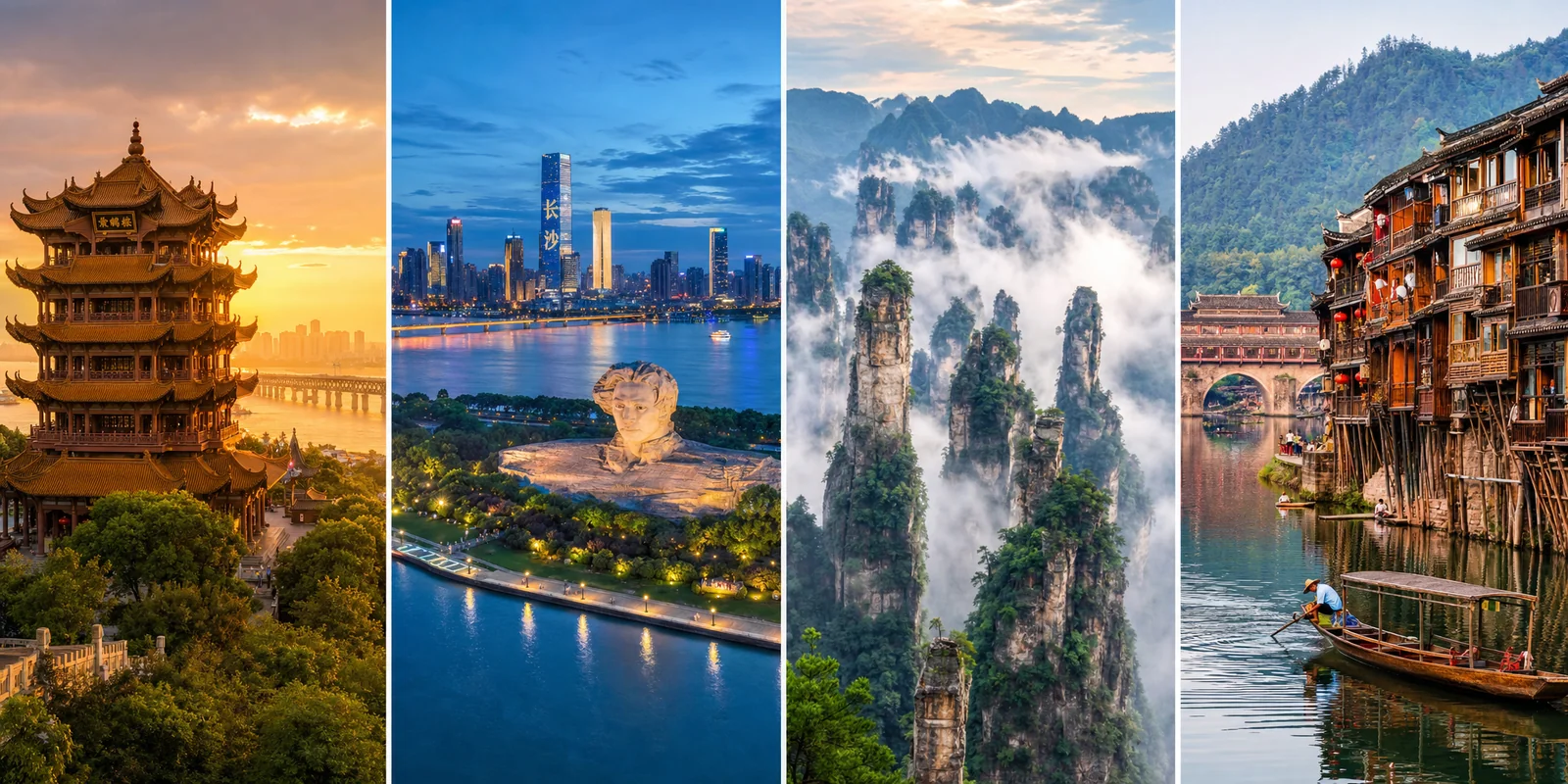
Central China Route: Wuhan-Changsha-Zhangjiajie
A practical 7-8 day Central China itinerary linking Wuhan, Changsha, Zhangjiajie, and Fenghuang by high-speed rail,...

Northeast China Route: Harbin-Changbaishan-Dalian
A 7-8 day route through Northeast China linking Harbin, Changbaishan, and Dalian, with separate winter and summer...

Jiangnan Water Towns Route: Shanghai, Suzhou, Wuzhen and Hangzhou in 5 to 7 Days
Shanghai → Suzhou → a night in Wuzhen or Xitang → Hangzhou: the order, nights per stop, which water town to pick,...
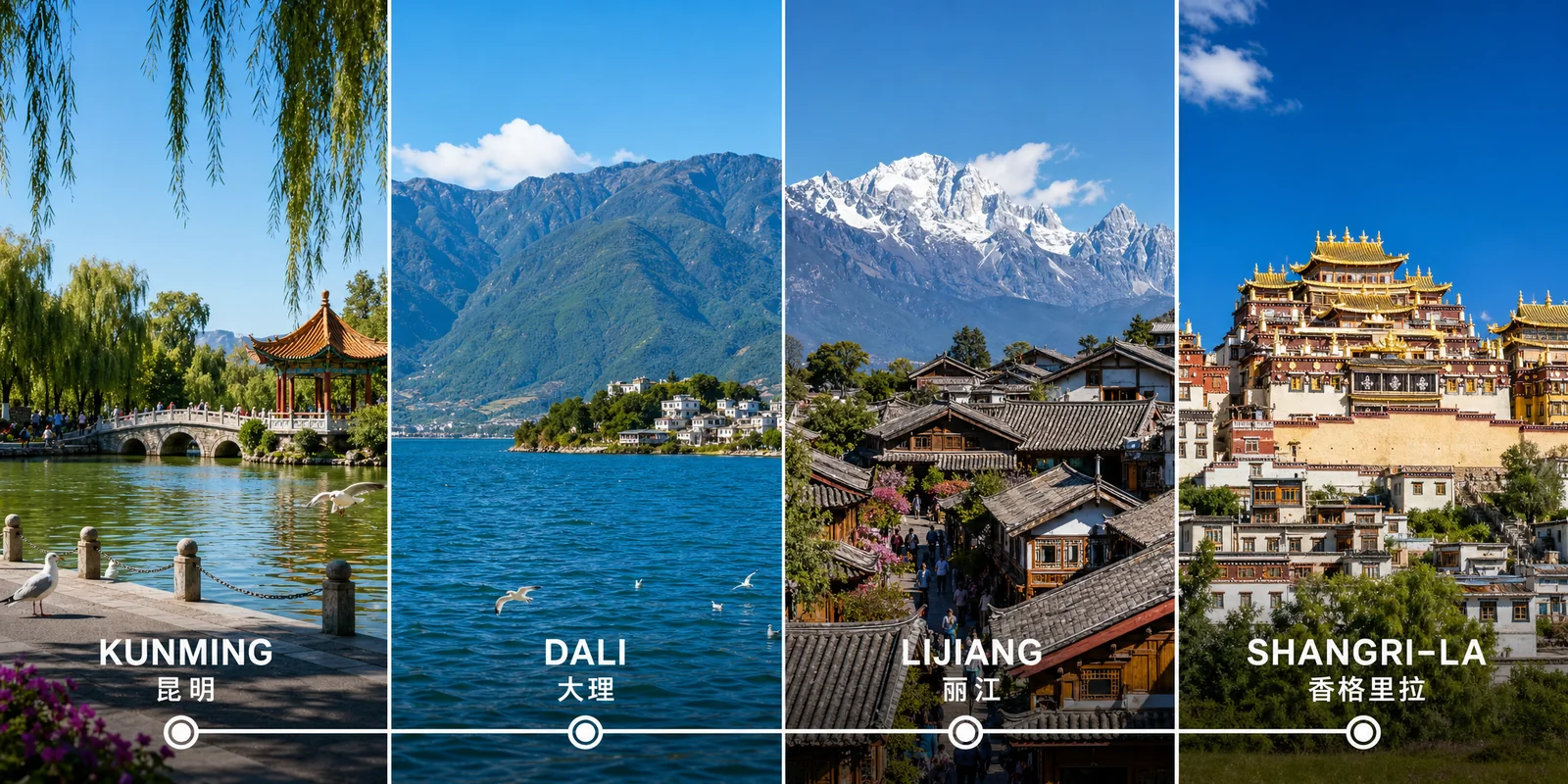
Yunnan Circuit: Kunming-Dali-Lijiang-Shangri-La
A practical 7-10 day Yunnan itinerary covering Kunming, Dali, Lijiang, and Shangri-La — with daily plans, transport...