

This article contains affiliate links. If you make a purchase through these links, we may earn a small commission at no extra cost to you. This helps support our work in creating free travel guides.
The Fujian Tulou (福建土楼, tǔlóu, "earth buildings") are huge round and square family homes with thick rammed-earth walls in the hills of southwest Fujian. Forty-six of them have been a UNESCO World Heritage Site since 2008, listed as six clusters plus four single buildings in Yongding, Nanjing County and Hua'an.
Most visitors choose one of two areas: Nanjing County (Fujian), for the Tianluokeng cluster, Yunshuiyao village and Hekeng, or Yongding, for the Hongkeng cluster with Zhencheng Lou and the Gaobei cluster with Chengqi Lou. From Xiamen, one area fits into a long day trip; both areas need a night in between. Each cluster sells its own ticket, and the official list prices are in the ticket section below. The fastest scheduled train from Xiamen North to Nanjing station takes 33 minutes, but the last stretch from the station into the hills is by road, and that part needs planning.
Fujian Tulou in Short: What They Are, Which Area, One Day or Two
A tulou is a fortified village in one building. The outer wall is rammed earth, often several storeys high, with small windows near the top. Inside, wooden balconies run around an open courtyard, and each family traditionally had a vertical slice of rooms from the ground-floor kitchen up to the bedrooms. Most were built by Hakka (客家, Kèjiā) families who moved into these hills, and some by Minnan (闽南, Mǐnnán, the Hokkien-speaking people of coastal south Fujian). The listed buildings date from the 15th to the 20th century and are spread over more than 120 km of hill country. Fujian has thousands more that are not on the World Heritage list: the province counts 3,754 confirmed tulou in total.
These are not empty museums. More than 2,000 people still live in the 46 World Heritage buildings, and they run over 300 shops and stalls inside them. Expect laundry on the balconies, and a tea or souvenir stall in the doorway.
The tulou are one of five World Heritage Sites in Fujian, alongside Mount Wuyi, Gulangyu in Xiamen, Taining and Quanzhou. Most travelers come from Xiamen, so read our Xiamen and Fujian coast guide for the city itself.
Nanjing County or Yongding
Pick Nanjing County (Fujian) if you have one day and want the classic view. Tianluokeng's five buildings on a hillside are the picture on most tulou postcards, Yunshuiyao adds a riverside village with old banyan trees, and the train from Xiamen is short. It is also the easier area to do without a tour.
Pick Yongding if you care more about what the buildings are like inside. Zhencheng Lou in the Hongkeng cluster has one of the most decorated interiors you can walk into, and Chengqi Lou in Gaobei is a huge round building you can walk right into. Getting there takes longer: the train goes to Longyan, then you drive into the hills.
A note on the name: Nanjing County (南靖, Nánjìng) in Fujian is spelled the same in English as Nanjing (南京), the big city in Jiangsu province. When you search for trains, hotels or tours, check the Chinese characters and the province.
One day or overnight
One area is a fine day trip from Xiamen if you start on an early train and have a driver waiting. Seeing both areas in one day means most of the day in a car and only short stops, so we don't recommend it. If you want both, or you want the tulou without the day-tour crowds, sleep one night in or near a tulou (see the overnight section below).
Nanjing County, Yongding and Hua'an: What You See in Each
The World Heritage listing names the parts exactly. In Yongding: the Chuxi, Hongkeng and Gaobei clusters plus two single buildings, Yanxiang Lou and Zhenfu Lou. In Nanjing County: the Tianluokeng and Hekeng clusters plus Hegui Lou and Huaiyuan Lou. In Hua'an: the Dadi cluster. The Fujian provincial government's English page on Fujian's World Heritage sites gives a short official overview. On the ground, the buildings are sold as a handful of ticketed scenic areas, listed below.
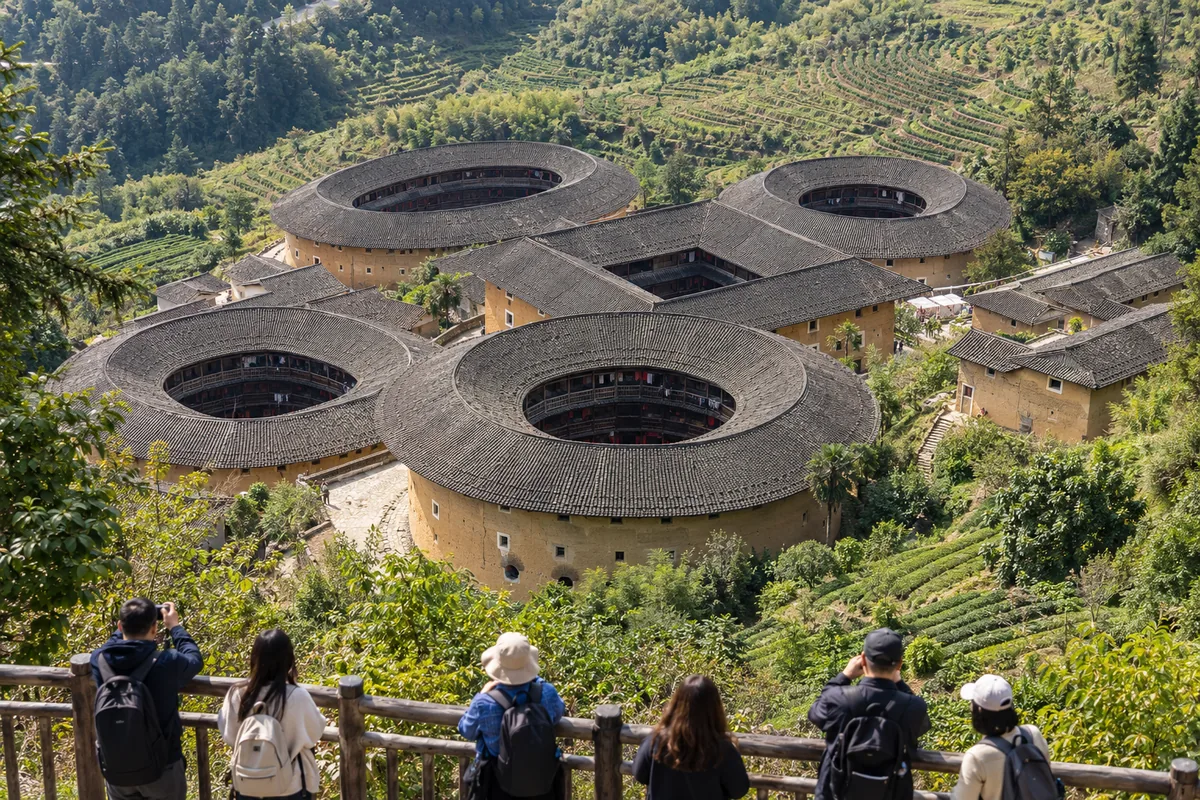
Nanjing County (Fujian)
- Tianluokeng (田螺坑, Tiánluókēng). Five large tulou, square and round, on a slope. Seen from above, people say it looks like "four dishes and a soup". The ticket also covers the upper and lower viewing platforms, Yuchang Lou (the "leaning tulou") and Taxia village. Go up to the top viewing platform first for the photo, then walk down into the buildings.
- Yunshuiyao (云水谣, Yúnshuǐyáo, "cloud and water ballad"). An old village along a stream, with an ancient path, a film set and several tulou. Two World Heritage buildings are inside this ticket rather than sold separately: Hegui Lou (和贵楼), a tall square building, and Huaiyuan Lou (怀远楼), a well-kept round one. This is the best place in Nanjing County to have lunch and the easiest place to stay overnight.
- Hekeng (河坑, Hékēng). A valley with more than ten tulou close together, quieter than Tianluokeng and cheaper to enter. Good if you have extra time and want fewer people.
Yongding
- Hongkeng (洪坑, Hóngkēng), sold as the "Tulou Folk Culture Village". A village along a stream with many tulou you can enter on one ticket, including Zhencheng Lou, Fuyu Lou, Kuiju Lou and Rusheng Lou. Zhencheng Lou (振成楼) is often called the "Prince of Tulou": it mixes Chinese and Western building styles and has fine wall paintings inside. If you only enter one tulou in Yongding, make it this one.
- Gaobei (高北, Gāoběi). The cluster around Chengqi Lou (承启楼), a huge round building with rings of rooms inside rings, plus Shize Lou, Wuyun Lou and Qiaofu Lou on the same ticket. It is close to Hongkeng and sold with it as a combo ticket.
- Chuxi (初溪, Chūxī). A World Heritage cluster in a narrow valley with terraced fields. It sees fewer tour groups than Hongkeng. Check the ticket price with your driver or at the gate.
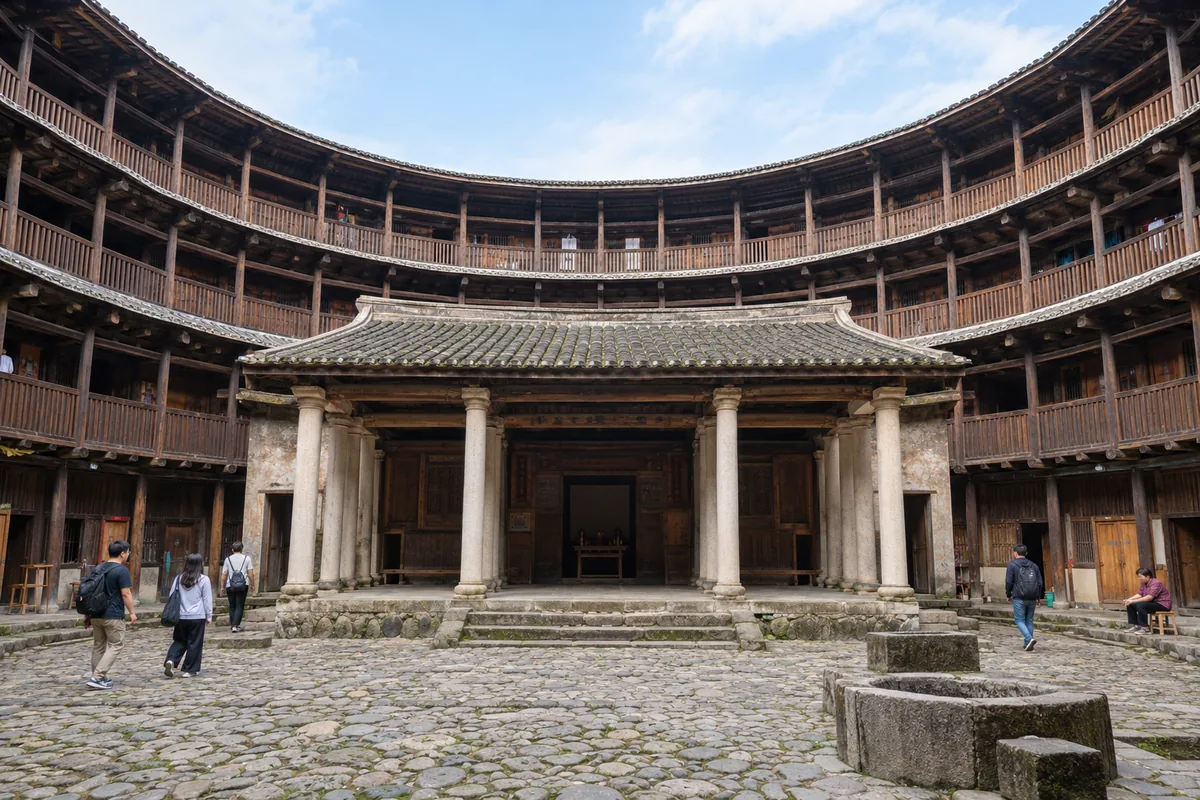
Hua'an
Hua'an's Dadi cluster has three World Heritage buildings: Eryi Lou (二宜楼), Nanyang Lou and Dongyang Lou. Eryi Lou is known for its decoration — 226 wall paintings, 228 painted panels and 349 wood carvings — but to protect it, visitors are no longer allowed upstairs to see them up close, and photos are shown in the main hall instead (2023 report). Hua'an sits apart from the other two areas and gets few foreign visitors. Go if you have already seen Nanjing County or Yongding and want something quieter; check the current ticket price and visiting rules locally.
Plan to arrive in the morning and confirm closing times with your driver or guesthouse.
Tickets: Official Prices and What Each Ticket Covers
Each scenic area has its own ticket, set by the Fujian provincial price authority. The prices below are the official list prices from the 2020 price documents for Nanjing County and Yongding. They are a ceiling, not a fixed price: the price you pay online or on the day can be lower, so compare before you buy.
| Area | Ticket | Price | What it covers |
|---|---|---|---|
| Nanjing County | Tianluokeng | 90 ¥ | The five Tianluokeng tulou (Buyun, Zhenchang, Ruiyun, Hechang and Wenchang Lou), upper and lower viewing platforms, Yuchang Lou (the leaning tulou), Taxia Village, Deyuan Hall |
| Nanjing County | Yunshuiyao | 90 ¥ | Hegui Lou, Huaiyuan Lou, the ancient path, the film set, etc. |
| Nanjing County | Hekeng | 40 ¥ | More than ten tulou, including Chaoyong, Yangzhao and Yongsheng Lou |
| Nanjing County | Scenic-area shuttle buses | 15 ¥ per line | Tianluokeng line and Yunshuiyao line, each a loop from the visitor centre; optional, sold separately from admission |
| Yongding | Hongkeng (Tulou Folk Culture Village) | 90 ¥ | Zhencheng Lou, Fuyu Lou, Kuiju Lou, Rusheng Lou, Guangyu Lou, other Hongkeng tulou, Tianhou Temple |
| Yongding | Gaobei | 50 ¥ | Chengqi Lou, Shize Lou, Wuyun Lou, Qiaofu Lou |
| Yongding | Hongkeng + Gaobei combo | 98 ¥ | Both Hongkeng and Gaobei, valid for 2 days; single tickets are still sold |
| Yongding | Hongkeng sightseeing shuttle | 20 ¥ full loop (5 or 10 ¥ per section) | Loop from the new visitor centre around Hongkeng; optional, sold separately from admission |
What this means for planning:
- Nanjing County day: Tianluokeng plus Yunshuiyao is the usual pair, and the two tickets add up to 180 yuan at list price. Add Hekeng if you have time.
- Yongding day: buy the Hongkeng + Gaobei combo. At 98 yuan it is cheaper than the two single tickets, and it stays valid for two days, so it also works if you sleep in Yongding. You are free to buy single tickets instead; the combo is optional.
- Shuttle buses inside the scenic areas are optional and sold separately from admission: in Nanjing County the Tianluokeng line and the Yunshuiyao line each cost 15 yuan for the full loop, and the Hongkeng loop in Yongding is 20 yuan. If you have a car with driver, you usually don't need them.
Discounts. Fujian's rules give free entry to people aged 70 and over and to children aged 6 or under (or up to 1.2 m tall), and half price to ages 6–18, students and ages 60–69 — but foreign passport holders may not qualify, so ask at the ticket office and check whether your passport is accepted for these discounts. Across China, many sites limit age discounts to Chinese ID holders, while some accept foreigners, so confirm before you count on it.
Buying tickets. Carry your passport. You can normally buy tickets at the visitor centre on the day. Some tour companies and online platforms sell tickets in advance; check that the seller accepts a foreign passport before you pay. If you book a tour or a driver, ask whether tickets are included.
How to Get to the Tulou from Xiamen
There is no "Tulou station". Getting there is two steps: a train from Xiamen to the nearest station, then a road transfer into the hills. Trains are easy. The road part is where you need a plan.
The train figures below come from the 12306 timetable (China's official railway booking system) for one sample day, 5 November 2026. Counts and fares vary by day and by train, so treat them as a guide and check the actual times when you book.
| Route | Trains that day | First–last departure | Journey time | Sample fares: 2nd / 1st class |
|---|---|---|---|---|
| Xiamen North / Xiamen Station → Longyan | 47 (D 28 · G 11 · K 5 · C 2 · Z 1); 37 from Xiamen North, 10 from Xiamen Station | 06:45–22:27 | fastest 1 h (G2372, from Xiamen North); conventional K974: about 2 h | ¥47.5–57 / ¥76–91; K974: hard seat ¥23.5 |
| Xiamen North / Xiamen Station → Nanjing County | 16 (D 12 · G 4); 10 from Xiamen North, 6 from Xiamen Station | 07:05–20:09 | from Xiamen North: 33–48 min (fastest: G5075); from Xiamen Station: 48–55 min | 2nd Xiamen North ¥25.5–29.5, Xiamen Station ¥32.5–33.5; 1st ¥41–53 |
| Xiamen North → Yongding | 1 (K230) | 17:26 (arrives 21:02) | 3 h 36 min | hard seat ¥32.5 · hard sleeper ¥78.5 |
| Fuzhou Station / Fuzhou South → Longyan | 33 (D 26 · G 5 · C 2), from either station | 06:23–21:00 | fastest 2 h 15 min (G5071, from Fuzhou South) · typically 2 h 20 min–3 h 20 min | ¥136.5–167 / ¥217.5–268 |
Step 1: the train
- For Nanjing County: Xiamen to Nanjing station (南靖站). About 16 trains are scheduled that day, leaving between 07:05 and 20:09; from Xiamen North the trip takes 33–48 minutes, from Xiamen Station on the island about 48–55 minutes, and second class costs 25.5–33.5 yuan depending on the train. Nanjing station is near the county town, not next to the tulou.
- For Yongding: Xiamen to Longyan (龙岩站). About 47 trains are scheduled that day between 06:45 and 22:27; fast trains take a little over an hour to an hour and a half (the quickest one hour), and second class costs 47.5–57 yuan. Longyan is a city; the Yongding tulou are a drive away.
- Not Yongding station. Yongding (永定) station has one slow evening train from Xiamen North, which in the sample timetable leaves at 17:26 and takes 3 hours 36 minutes. It doesn't work for a tulou visit; use Longyan.
- From Fuzhou: about 33 trains are scheduled that day from Fuzhou and Fuzhou South to Longyan, taking 2 hours 15 minutes at the fastest and usually 2 hours 20 minutes to 3 hours 20 minutes, with second class at 136.5–167 yuan. If you are coming from Fuzhou, see our Fuzhou guide.
Xiamen North (厦门北) is on the mainland side and has most of the fast trains; Xiamen Station (厦门站) is on the island. Our high-speed train guide explains train types and seats, and how to book train tickets covers buying with a foreign passport. You can also book through Trip.com, which takes foreign cards. Weekend and holiday mornings sell out first, so book the outbound and return trains together.
Step 2: from the station to the tulou
This is the weak link. From either station you still have a long drive on winding mountain roads to the main clusters — ask your driver how long to allow, as it depends on which cluster you start at. Public buses into the tulou area are irregular, so most visitors use one of these options:
- Car with driver (most reliable). Book a driver for the whole day who meets you at Nanjing or Longyan station, drives between the clusters and takes you back for your return train. Your hotel in Xiamen or your tulou guesthouse can usually arrange one. Agree the route, the stops, the waiting time and whether the price includes fuel and parking before you set off. A ride-hailing car from the station can work for the way in (see our DiDi guide), but finding one for the way back from a mountain village is much harder.
- Day tour from Xiamen. The simplest option if you don't want to arrange anything: transport, tickets and usually lunch in one booking. The trade-off is a fixed schedule, a long road trip each way and time at shops. You can compare tulou day tours from Xiamen on Klook; check which clusters are included before you book, because "tulou tour" can mean Nanjing County or Yongding.
- Tourist bus from Zhangzhou old town (check first). Zhangzhou's transport bureau launched a tourist bus from Zhangzhou old town via Nanjing bus station to the Nanjing tulou scenic area on 1 October 2025, on a trial "for one year", taking about 3 hours one way with a full fare of 20 yuan. That trial period has ended; check whether it is still running before you plan around it. It starts in Zhangzhou city, not in Xiamen and not at Nanjing train station.
- Rural buses in Yongding (check first). In 2023 Yongding district turned its tulou-area rural buses into city buses: route 856 ran from Yongding bus station via Hongkeng, and route 822 via Chuxi, as a two-year scheme from June 2023. That scheme has also passed its end date, so check whether these routes still run. They start in Yongding town, not at Longyan train station, so you would still need to get from Longyan to Yongding first.
- Direct coaches from Xiamen. A Xiamen–Nanjing tulou tourist coach with combined coach and entry tickets was launched in 2019. Many Xiamen tour sellers now offer similar coaches; check the current timetable, fare and what is included with the seller.
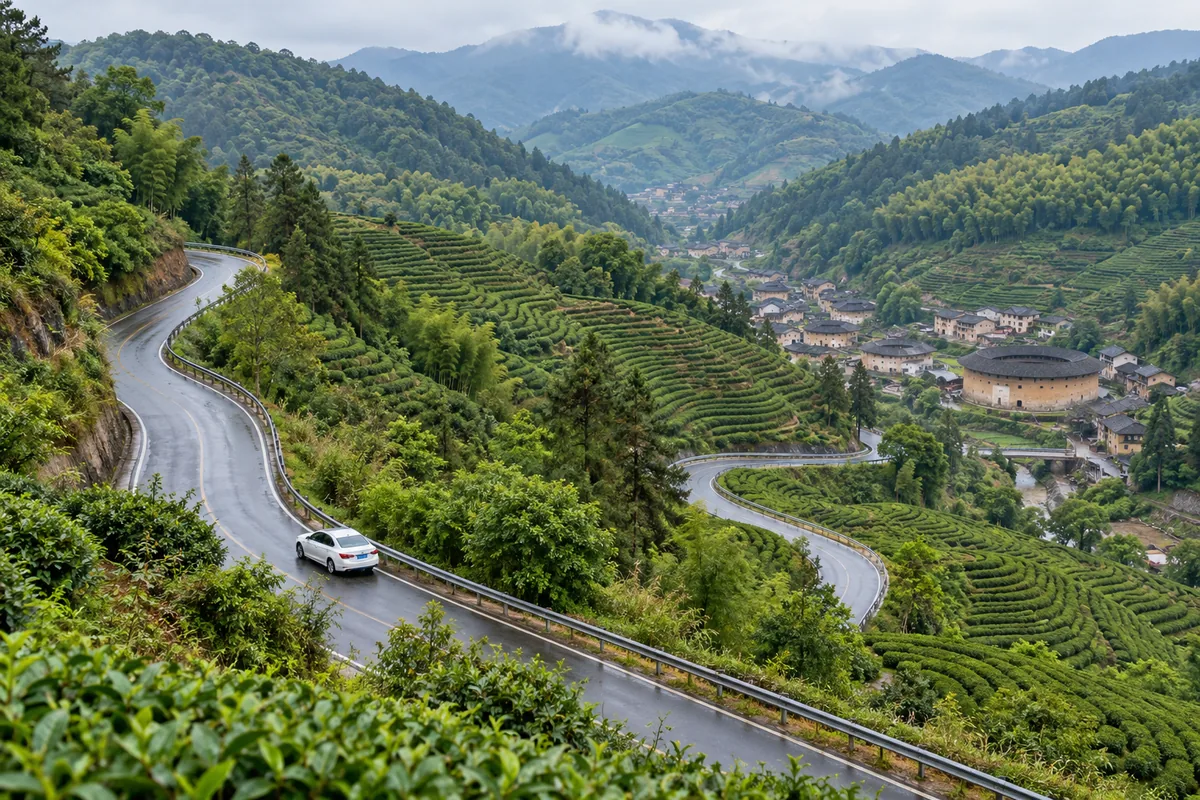
💡 Tip: Write the names of the clusters you want in Chinese on your phone (田螺坑, 云水谣, 洪坑, 高北) and show them to your driver. Pinyin names on their own are easy to mix up, especially Nanjing County and the city of Nanjing.
Staying Overnight in a Tulou
A night in the tulou area is the best way to see the buildings without day-tour crowds. In the evening the groups leave, the courtyards go quiet and families cook outside; early in the morning you often get mist in the valley and the place mostly to yourself. Yunshuiyao's village, Guanyang (官洋), alone has about 120 homestays and small farm restaurants, more than 90% of them run by local villagers, and Hongkeng village in Yongding also has guesthouses.
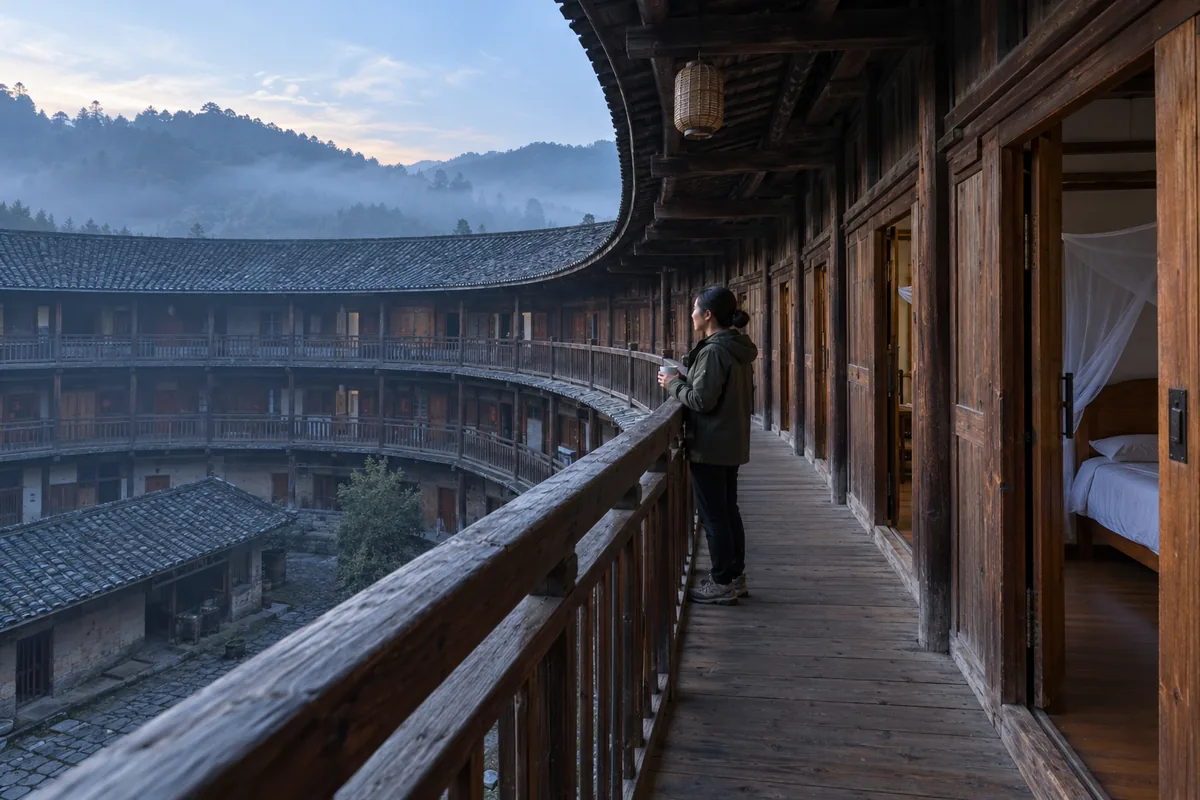
You have two kinds of places to stay:
- A room inside a real tulou. The memorable option. Rooms are small and simple, walls are thin, the wooden floors creak, and the bathroom may be shared and down the corridor. Hot water can be limited, and in warm months mosquitoes come with the open courtyard, so bring repellent. If you are a light sleeper, bring earplugs.
- A guesthouse built next to the tulou. Newer, with private bathrooms and air conditioning, often with a view of the round buildings. A good choice for families and anyone who wants to sleep well.
Registration matters. Chinese law says that when a foreigner stays in a hotel, the hotel registers the stay with the police; if you stay anywhere else, you or your host must register with the local police within 24 hours. Small village guesthouses are not always set up to register foreign passports, so before you pay, message the guesthouse and confirm that it can accept and register a foreign guest. Our guide to booking hotels and registration rules explains what to ask, and types of accommodation covers guesthouses in general. You can search tulou guesthouses on Booking.com and check recent reviews that mention foreign guests.
Practical points: bring cash as well as your phone for small purchases, a torch for dark stairs and courtyards at night, and snacks — village restaurants can close early once the day visitors leave.
Visiting Etiquette
Most World Heritage tulou are still homes for the families who own them. Treat the courtyard like a shared front yard: open shops and halls are fine to enter, but closed doors, kitchens and upper-floor rooms are private unless someone invites you in. Ask before you photograph people up close, and keep drones and loud groups out of the courtyards. Stallholders inside the buildings sell tea, dried foods and souvenirs; a polite "no, thank you" is enough, and nobody minds if you just look. Some residents will offer to show you their rooms for a small fee — agree the amount first if you want to go.
When to Go
Spring and autumn are the most comfortable months for walking between buildings and villages. Southern China's rainy season usually runs from May to October, and heavy rain makes the mountain roads slower and the viewing platforms misty. Typhoons that hit Xiamen peak in August, but landfalls near Xiamen have been recorded from May to early December, so if a typhoon warning is out, postpone the day trip — heavy rain can bring landslides and road closures in the hills. Avoid Chinese public holidays if you can: during the 2025 National Day and Mid-Autumn holiday, the Yongding tulou received 284,100 visits. Our Golden Week survival guide lists the busy dates.
One-Day and Two-Day Plans
One day from Xiamen: Nanjing County
- Take an early train from Xiamen North to Nanjing station; in the sample timetable the first one leaves at 07:05. Your driver meets you outside.
- Tianluokeng first: the top viewing platform, then down into the five buildings and Yuchang Lou.
- Lunch in Yunshuiyao, then walk or take the scenic-area shuttle to Huaiyuan Lou and Hegui Lou.
- Hekeng if you still have energy, otherwise straight back to Nanjing station.
- Take an evening train back to Xiamen. Book it in advance and check the return times in 12306, leaving at least an hour of buffer for the drive.
One day from Xiamen: Yongding
- Early train from Xiamen North to Longyan; in the sample timetable the first train leaves at 06:45. Meet your driver at the station.
- Hongkeng: Zhencheng Lou first, then a walk along the stream to the other buildings on the same ticket.
- Gaobei and Chengqi Lou in the afternoon on the combo ticket.
- Back to Longyan for an evening train. This day is longer on the road than the Nanjing County day.
Two days: both areas
- Day 1: Xiamen to Nanjing station, Tianluokeng and Yunshuiyao, overnight in Yunshuiyao or near Tianluokeng.
- Day 2: drive to Yongding with the same driver, Hongkeng and Gaobei, then to Longyan for a train. Agree the two-day route and price with the driver in advance, since you finish at a different station from where you started.
From Longyan you can return to Xiamen, head to Fuzhou, or continue west toward Guangdong; check 12306 for trains on your date. If you have more days on the coast, add Quanzhou, an easy trip from Xiamen.
FAQ
Should I visit the Nanjing County tulou or the Yongding tulou?
For a first visit with one day, Nanjing County (Fujian): the train from Xiamen North is short (the fastest scheduled train takes 33 minutes), and you get the famous Tianluokeng view plus the riverside village of Yunshuiyao. Choose Yongding if interiors matter more to you than views: Zhencheng Lou and Chengqi Lou are the most impressive buildings to walk into, and the 98-yuan combo covers both clusters over two days.
Can I visit the tulou on my own without a tour?
Yes. The trains are easy to book yourself, and tickets are sold at the scenic areas. The hard part is the road from the station to the clusters: the trial bus routes from Zhangzhou and in Yongding have passed their trial periods, so check whether they are still running before you rely on them. The reliable independent option is a train plus a car with driver booked for the day, which your hotel or guesthouse can arrange.
Is one day enough for the tulou?
One day is enough for one area — Nanjing County or Yongding — if you take an early train and have a driver ready at the station. It is not enough for both areas without spending most of the day in the car. For both, or for a slower visit, spend one night in a tulou guesthouse.
In short: choose Nanjing County for the classic view and an easier day, or Yongding for the best interiors; take the train to Nanjing or Longyan, not Yongding station; book a driver for the road into the hills; and stay overnight if you want both areas. Before you go, book your trains, arrange your driver, and confirm that your guesthouse can register a foreign passport. For the rest of your Fujian trip, start with our Xiamen and Fujian guide.
Last updated: October 2026
Fact-checked sources
- Official National Cultural Heritage Administration
- Official Fujian Department of Culture and Tourism 2 pages
- Official Fujian Provincial Government 6 pages
- Official China Railway 12306 8 pages
- Official Quanzhou Municipal Government
- Official Fujian Development and Reform Commission 3 pages
- Official bmy.com.cn
- Official wuhouci.net.cn
Show 9 more sources
- Official tangparadise.cn
- Official drc.xizang.gov.cn
- Official hqpalaceglobal.com
- Official Zhangzhou Municipal Government 2 pages
- Official Yongding District Government (Longyan)
- Official Shanghai Municipal Government
- Official China Meteorological Administration
- Official locpg.gov.cn
- Official Xiamen Municipal Government
Last verified: 2026-10-23
Read in other languages
Last train times for 10 Chinese metro systems
Every line and station, checked by hand — the same data behind our offline route planner.
Get the WaysChina App
Offline guides, currency converter, essential phrases, and more — all in your pocket.

Related Articles

Yangzhou Travel Guide: Slender West Lake, Morning Tea and a Day Trip from Nanjing
How many days Yangzhou needs, Yangzhou East or Yangzhou Station, Slender West Lake and garden tickets by season, the...

Wuxi Travel Guide: Lake Tai, Lingshan Buddha and Which Station to Use
How many days Wuxi needs, Wuxi Station or Wuxi East, Yuantouzhu and the Lingshan Buddha on Lake Tai, the Grand Canal...
Fuzhou Travel Guide: Three Lanes and Seven Alleys, Getting Around, Food and Mount Wuyi Trains
One to two days in Fuzhou: Fuzhou Station or Fuzhou South, what Sanfang Qixiang charges for, the free Fujian Museum,...

Quanzhou Travel Guide: World Heritage Temples, Day Trip from Xiamen and What to Eat
One or two days in Quanzhou: which of its three stations to book from Xiamen, what the 22 World Heritage sites are,...