
This article contains affiliate links. If you make a purchase through these links, we may earn a small commission at no extra cost to you. This helps support our work in creating free travel guides.
Wuxi (无锡, Wúxī) needs one full day for its two big sights or two days to add the old town, the Grand Canal and a pottery side trip — and it works as a day trip from Shanghai, because the fastest trains from Shanghai Hongqiao reach Wuxi East in 25 minutes. The two headline sights are Yuantouzhu (鼋头渚), a lakeside park on Lake Tai (太湖, Tàihú) famous for cherry blossom, and the Lingshan Grand Buddha (灵山大佛), a giant bronze Buddha in a temple complex further along the shore. They sit on different stretches of the lake, outside the city centre, so treat each as a half-day. For trains, Wuxi Station is the central one with the most departures, and Wuxi East is the stop on the Beijing–Shanghai high-speed line. Book Wuxi Station by default, and Wuxi East if its train time suits you better.
How many days Wuxi needs, and when to go
One day is enough for Yuantouzhu in the morning and either Lingshan or the canal quarter in the afternoon. Two days is the comfortable version: Lake Tai one day, and the old town, Huishan and the canal the next — or swap day two for Yixing (宜兴), the teapot town in Wuxi's south. Three days only makes sense if you want both Lingshan and Yixing, or if you are using Wuxi as a cheaper base between Suzhou and Nanjing.
It helps to know what kind of place Wuxi is before you come. It is a big, modern industrial city, not a preserved old town like Suzhou's centre. What draws visitors is the edge of the city: the northern shore of Lake Tai, one of China's largest freshwater lakes, with parks, islands and temples along it, and the Grand Canal (大运河, Dà Yùnhé), which runs through the south of town past a stretch of old houses and stone bridges. Expect to spend some time getting between sights; the good parts are spread out.
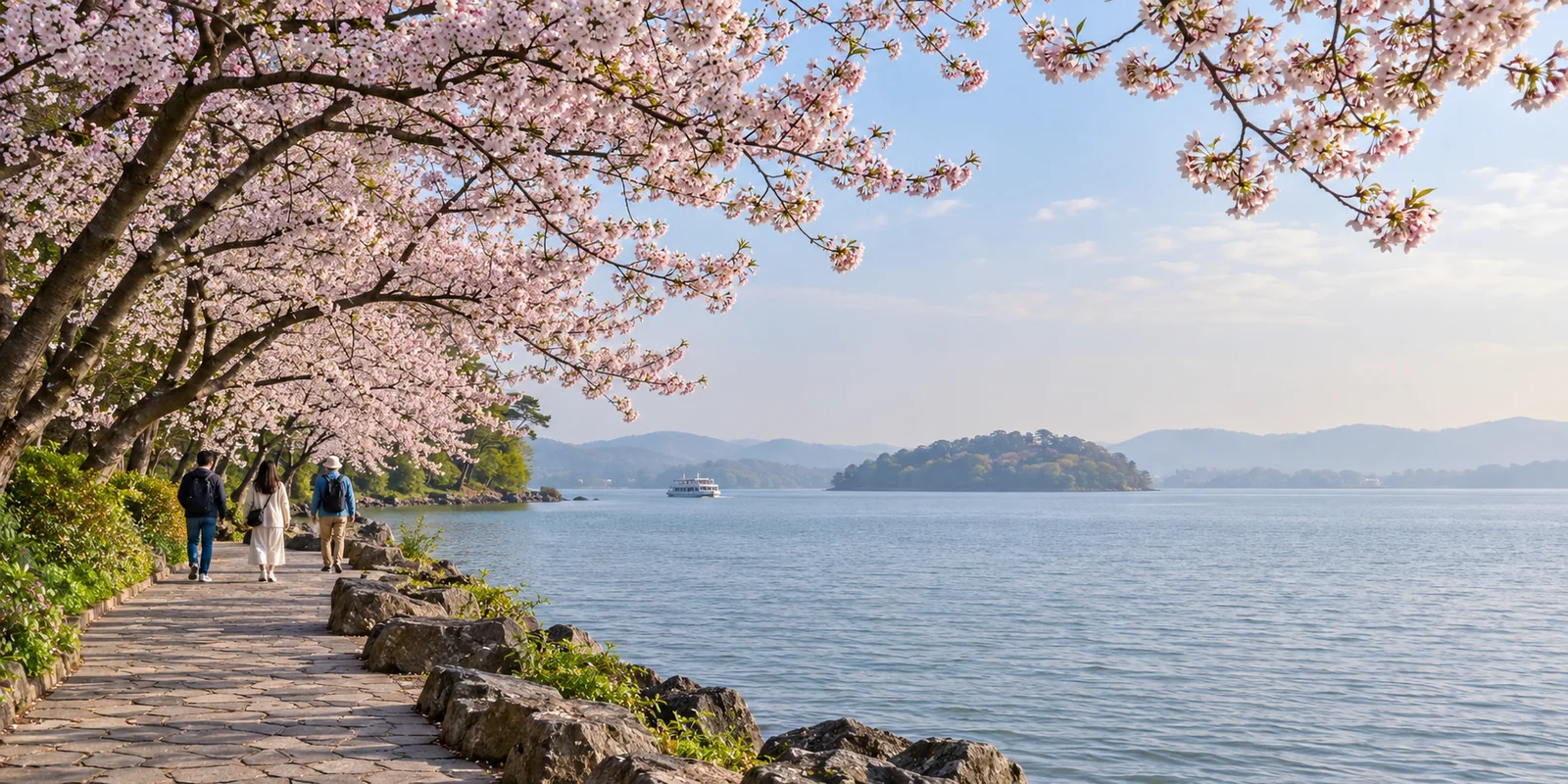
The climate is the Yangtze delta pattern. Wuxi's long-term average temperature is about 16°C, July is the hottest month and January the coldest. Jiangsu's plum rain season (梅雨, méiyǔ), a stretch of humid, often wet weather, normally starts around 19 June and ends around 13 July. That leaves spring and autumn as the easy months. Spring has the extra pull of the cherry blossom at Yuantouzhu: in 2026 the festival ran from 1 March to 15 April, with early, mid-season and late varieties flowering from late February to mid-April, and next spring's dates are announced around late February, so check them before you book. Late March and the weekends in particular are crowded, so go on a weekday if you can. October and November are mild and quieter, apart from the National Day holiday in early October. For the wider spring picture, see spring travel in China.
On distances, think in train minutes. Shanghai is a short hop (from 25 minutes to Wuxi East), Suzhou is around 15 minutes away by the frequent trains to Wuxi Station, and Nanjing is under an hour on the fastest trains. That is why most people visit Wuxi as part of a Shanghai–Suzhou–Nanjing run rather than as a separate trip.
Getting to Wuxi: Wuxi Station, Wuxi East or Huishan
Wuxi has three railway stations, and picking the right one saves you a long ride across town.
- Wuxi Station (无锡站, "Wuxi" in booking apps) is the old central station. It has the most trains — high-speed G and D trains plus slower K, Z and T trains — from Shanghai, Suzhou and Nanjing. Bus K1 to Yuantouzhu leaves from its north square, and it is the closest station to the city centre and the canal quarter.
- Wuxi East (无锡东, Wúxī Dōng) is on the Beijing–Shanghai high-speed line and only G trains stop there. It is outside the centre, so add a metro or taxi ride to wherever you are going. It is useful when its train time suits you, or if you are coming from Beijing.
- Huishan (惠山站) has very few trains — only a handful a day from Shanghai, Suzhou or Nanjing. Do not confuse it with Huishan Ancient Town; the station is not the easy way to reach the old town.
The figures below come from one sample travel day on 12306, China Railway's official booking site: Thursday 5 November 2026. Train counts, times and fares on your date may differ, so check 12306 when you book. Fares are second class.
From Shanghai. Use Shanghai Hongqiao if you can. About 49 G trains are scheduled from Hongqiao to Wuxi East that day; the fastest takes 25 minutes and most take around 35, with second-class seats at about 47–59 yuan depending on the train. Hongqiao also has about 51 trains to Wuxi Station, the fastest in 39 minutes, at about 47–69 yuan. Shanghai Railway Station has the most trains to Wuxi Station — about 99 — but around a quarter of them are slow conventional trains, so look at the journey time before you pick one; the quick ones take under an hour and cost about 44–66 yuan.
From Suzhou. This is close to a turn-up-and-go service. About 158 trains run from Suzhou Station to Wuxi Station, most taking around 15 minutes, at about 16–23 yuan in second class. From Suzhou North, about 29 G trains reach Wuxi East in around 10 minutes. Match the station to where you are staying in Suzhou; the Suzhou guide explains which Suzhou station is which.
From Nanjing. Nanjing South has about 71 trains to Wuxi East (fastest 39 minutes, most around 51, about 77–97 yuan) and about 57 to Wuxi Station (fastest 55 minutes, about 68–102 yuan). Nanjing Railway Station has about 75 trains to Wuxi Station, but roughly half are slow conventional trains, so the typical trip is much longer than the fastest 51 minutes. If you are already near Nanjing South, use it.
| Route | Trains that day | First–last departure | Journey time | Sample fares: 2nd / 1st class |
|---|---|---|---|---|
| Shanghai Hongqiao → Wuxi East | 49 (G 49) | 06:09–19:47 | fastest 25 min (G740) · typically 35 min | ¥47–59 / ¥79–93 |
| Shanghai Hongqiao → Wuxi Station | 51 (G 40 · D 11) | 06:12–21:42 | fastest 39 min (G7112) · typically 50 min | ¥47–69 / ¥74–111 |
| Shanghai Station → Wuxi Station | 99 (G 64 · K 17 · D 8 · Z 7 · T 2 · other 1); most trains of any Shanghai → Wuxi station pair | 05:45–23:40 | fastest 39 min (D952) · typically 53 min; about a quarter are conventional trains | ¥44–66 / ¥72–100; night sleeper D288: 2nd class ¥27 |
| Suzhou Station → Wuxi Station | 158 (G 96 · K 28 · D 22 · Z 7 · T 4 · other 1) | 00:30–23:39 | fastest 14 min (G2784) · typically 15 min | ¥16–23 / ¥25–37 |
| Suzhou North → Wuxi East | 29 (G 29) | 06:34–20:23 | fastest 10 min (G1970) | ¥13–14 / ¥21–24 |
| Nanjing South → Wuxi East | 71 (G 71) | 06:32–22:16 | fastest 39 min (G75) · typically 51 min | ¥77–97 / ¥129–164 |
| Nanjing South → Wuxi Station | 57 (G 46 · D 11) | 06:32–21:34 | fastest 55 min (G7217) · typically 1 h 11 min | ¥68–102 / ¥109–163 |
| Nanjing Station → Wuxi Station | 75 (G 29 · K 25 · Z 9 · D 6 · T 5 · other 1) | 00:08–22:24 | fastest 51 min (G7109) · typically 1 h 31 min; about half are conventional K/Z/T trains | ¥82–96 / ¥131–154; night sleeper D111 / D181: 2nd class ¥32–34 |
Train tickets in China are tied to your passport. If this is your first train trip in China, the high-speed train guide covers booking and seat classes, and how to navigate a Chinese train station covers the passport lane, security and finding your platform.
By air. Wuxi's airport is Sunan Shuofang International Airport (苏南硕放国际机场, code WUX), shared with Suzhou. The city's transport bureau lists 11 international and regional routes restored in recent years, including Tokyo, Osaka, Seoul, Hong Kong, Singapore and Bangkok, but not every route flies every season, so check current flights with the airline. Wuxi Metro Line 3 runs to the airport, and Suzhou–Wuxi Bus Line 1 connects it to a rail station in Suzhou's New District. If you fly into Shanghai instead, the simplest route is usually a train from Shanghai Hongqiao; the Shanghai airports guide explains how to get from Pudong or Hongqiao airport to the railway station.
240-hour visa-free transit. Sunan Shuofang is one of Jiangsu's four ports for the 240-hour visa-free transit policy, together with Nanjing Lukou and Yangzhou Taizhou airports and Lianyungang seaport, and the permitted stay area covers the whole of Jiangsu, with travel allowed into the other permitted provinces such as Shanghai. If you enter through Shanghai under the policy, a side trip to Wuxi is inside the rules. Whether you qualify, and what onward ticket you need, is explained in the 240-hour visa-free transit guide.
Lake Tai: Yuantouzhu and Lingshan
These are the two reasons most visitors come to Wuxi. If you only have time for one, pick Yuantouzhu in cherry blossom season and Lingshan the rest of the year, or simply choose by interest: Yuantouzhu is a lakeside park with gardens, viewpoints and an island; Lingshan is a Buddhist complex built around a giant statue.
Yuantouzhu (鼋头渚)
Yuantouzhu, "turtle head islet", is a headland on the northern shore of Lake Tai, named for a rock that looks like a turtle's head pushing into the water. The park covers the headland and the hills behind it, with lakeside paths, old villas and pavilions, gardens planted with cherry trees, and a ferry out to Taihu Fairy Island (太湖仙岛), a small island with temples and viewpoints. On a clear day the lake looks more like a sea from the shore.
The adult ticket is 90 yuan on the park's published price list, which dates from a 2018 pricing document, so check the current price at the gate or online; it includes the return ferry to Taihu Fairy Island. The park also promotes half-price days around festivals, and online sellers often discount, so compare before you pay. There is a 45-yuan discount ticket for children aged 6 to 18, students and visitors aged 60 to 69, and entry is free for children under 6 or under 1.4 metres and for visitors aged 70 and over. These rules are written for Chinese ID cards and it is not stated whether a foreign passport qualifies, so confirm at the ticket window.
The city's English portal gives opening hours of 08:00 to 16:30. The park sometimes closes temporarily for events such as races, so check the notices on the Yuantouzhu official website the day before you go. Arrive close to opening; tour groups arrive mid-morning, and in blossom season the queues build early.
The park is large and hilly, and a full loop on foot is a long day. Inside, you pay separately for transport. The park's price board, uploaded in November 2024, lists the sightseeing cart Line 1 at 25 yuan one way or 40 yuan return, the full highlights cart loop at 60 yuan, the in-park bus at 5 yuan, a lake boat tour at 50 yuan and a sculling boat at 30 yuan; the park's text page shows a lower figure for the highlights loop, so check the board at the gate. Most people walk the lakeside part, take the included ferry to the island, and use a cart for the hilly stretch back.
In cherry blossom season, the park adds evening viewing sessions. The times and whether they cost extra are announced each season on the park's official channels — check before you plan an evening there.
Getting there. Bus K1 runs from the north square of Wuxi Station to the main Chongshan Gate (充山大门) from 5:30 to 18:20, and bus K87 runs from the station to the Dushan Gate (犊山大门) from 7:20 to 17:00; a taxi from the city centre to the park is about 15 kilometres. "Railway station" on these bus signs means Wuxi Station, not Wuxi East. If you arrive at Wuxi East, a taxi or DiDi straight to the park gate is the simplest option.
Lingshan Grand Buddha (灵山大佛) and Nianhua Bay (拈花湾)
The Lingshan Scenic Area (灵山胜境, Língshān Shèngjìng) is a modern Buddhist complex on the lake shore with 27 sights laid out along an axis from the entrance gate to the Grand Buddha. The three you come for are the Grand Buddha itself, a bronze standing figure you can climb to the base of; the Nine Dragons Bathing the Buddha (九龙灌浴), a large fountain show in which a giant lotus opens to reveal a statue of the infant Buddha; and the Brahma Palace (灵山梵宫, Fàngōng), an ornate hall full of carving, glass and gold. It is a big, busy, very polished place — closer to a religious theme park than a quiet temple — and most people find the scale worth seeing once.
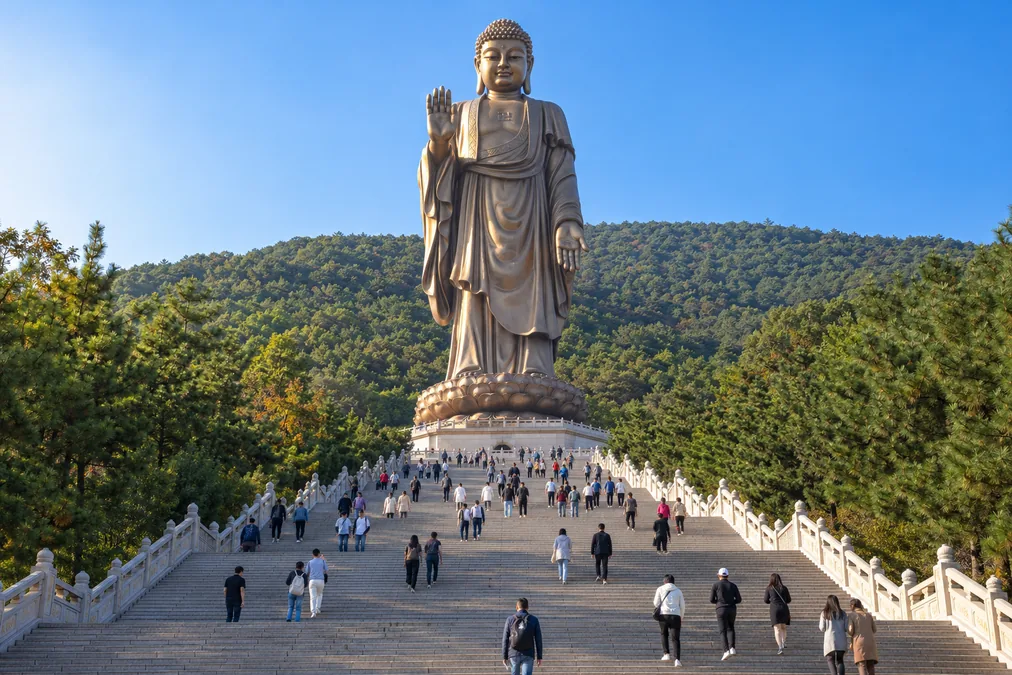
The list price is 210 yuan, according to the Wuxi government's English tourism page, with opening hours of 7:00 to 17:30 in the summer period and 7:30 to 17:00 the rest of the year. In 2026 the park ran several festival promotions with much lower prices that had to be booked online at least one day ahead, and online sellers often price below the gate, so check online before you buy at the window. If you want to book in English, Lingshan tickets are sold on Trip.com; compare the price there with the park's own channels.
The fountain show runs at set times through the day. The schedule is posted at the entrance and on the park's official account; check it as soon as you arrive and plan the rest of your walk around it. Allow three to four hours for the main axis, the show and the Brahma Palace.
Near Lingshan is Nianhua Bay (拈花湾, Niānhuā Wān), a Zen-themed resort village of wooden lanes, ponds and teahouses that most people visit for its evening lights. It is a separate ticket. Prices and evening hours change by season, so confirm them on Nianhua Bay's official account before you go. It pairs naturally with an afternoon at Lingshan if you stay for dinner and take a taxi back to the city.
Getting there. Lingshan is further from the centre than Yuantouzhu. A taxi or DiDi from the city is the straightforward option; check the current bus route in a map app if you prefer public transport, and arrange your ride back before dark if you stay for Nianhua Bay.
| Sight | Ticket | Hours |
|---|---|---|
| Yuantouzhu | adult ¥90, return ferry to Taihu Fairy Island included (price set in 2018) · reduced ¥45: ages 6–18, students, ages 60–69 · free: under 6 or under 1.4 m, 70 and over Concessions are written for Chinese ID; whether a passport qualifies is not stated, so ask at the ticket office. | 08:00–16:30 · may close temporarily for events (check the park’s notices) |
| Yuantouzhu: carts and boats inside the park | cart Line 1 ¥25 one way / ¥40 return · highlights cart loop ¥60 · in-park bus ¥5 · lake boat tour ¥50 · sculling boat ¥30 · ferry ¥10 if bought on its own (park price board, Nov 2024) | — |
| Yuantouzhu: cherry blossom season | — | 2026 festival: Mar 1–Apr 15 · blooms from late Feb to mid-Apr (early, mid and late varieties) · evening viewing sessions, times announced each season |
| Buses to Yuantouzhu | — | K1: Wuxi Station (north square, not Wuxi East) → Chongshan Gate (充山大门, main gate), 05:30–18:20 K87: Wuxi Station → Dushan Gate (犊山大门), 07:20–17:00 taxi from the city centre: about 15 km |
| Lingshan Scenic Area (Grand Buddha) | list price ¥210; online and festival prices are often lower (promotional tickets must be booked online at least 1 day ahead) | 07:00–17:30 (summer period) / 07:30–17:00 (rest of year) |
Old towns and the Grand Canal
Wuxi's older side is in three places: Huishan Ancient Town at the foot of Huishan hill in the west, the canal quarter around Nanchang Street and Qingming Bridge in the south, and Dangkou, a separate water town out in the eastern suburbs. Huishan and the canal quarter fit together in one day; Dangkou is a half-day trip of its own.
Huishan Ancient Town (惠山古镇) and Jichang Garden (寄畅园)
Huishan Ancient Town is a cluster of old ancestral halls along streets and a canal under Huishan hill. The streets themselves are free to walk. The paid area — the historic halls zone plus Xihui Park (锡惠公园) on the hillside — costs 70 yuan and includes Jichang Garden, a Ming-dynasty garden famous for borrowing the view of the hill and the pagoda behind it; a few halls and small museums inside charge extra. Opening hours in the summer period are 7:00 to 17:00 on weekdays and to 17:30 at weekends, and in the rest of the year 7:00 to 16:30 on weekdays and to 17:00 at weekends.
If you have seen Suzhou's gardens, Jichang Garden is smaller and quieter, and the reason to come is the setting: the pond, the hill and the pagoda line up in a way the city gardens cannot. Huishan is also the home of Huishan clay figurines (惠山泥人), small painted clay dolls sold in shops along the old streets. Allow two to three hours for the halls, the garden and a walk up into the park.
Nanchang Street (南长街) and Qingming Bridge (清名桥) on the Grand Canal
The Qingming Bridge Ancient Canal Scenic Area — the stretch of the Grand Canal along Nanchang Street — is free to enter and open all day, while some museums, former residences and the canal boats inside charge separately. The old houses back onto the canal, Qingming Bridge is a high stone arch over it, and the street on the bank is lined with cafés, bars and snack shops. It is at its best in the evening, when the lanterns are lit and the bridges are reflected in the water.
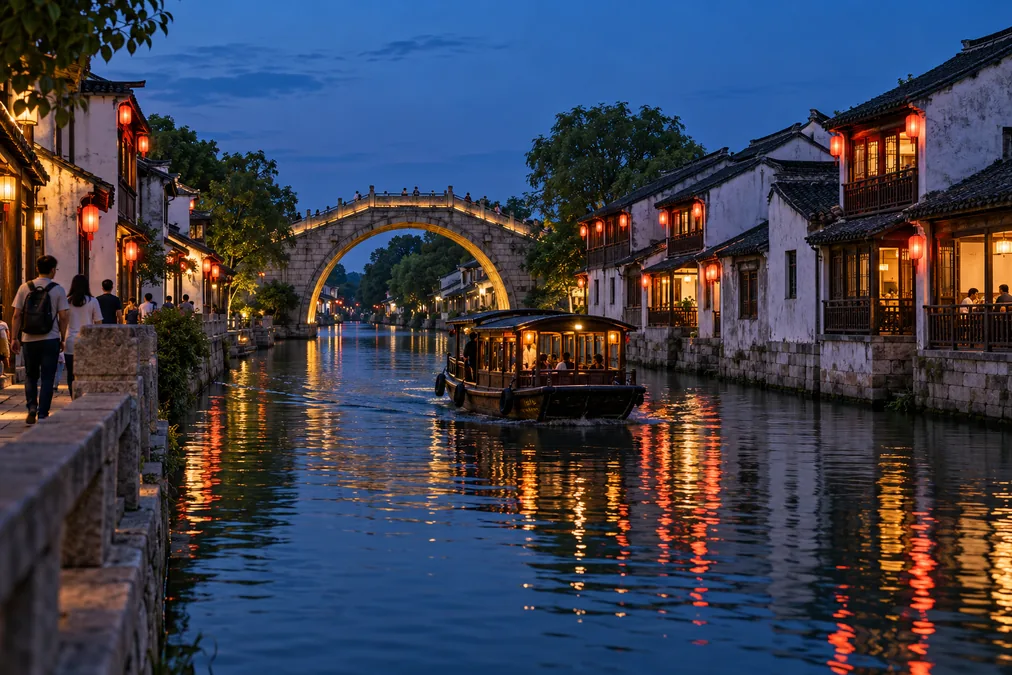
Boats run along this stretch of canal, including daytime cruises and an evening light-show cruise called "今夜梁宵" (Jīnyè Liáng Xiāo; Liangxi is an old name for Wuxi). The prices on record are an old 2018 government list and 2026 promotional prices, neither of which is today's regular fare, so check the price board at the pier. A short cruise at dusk is the best way to see the canal quarter if you have only one evening.
Dangkou Ancient Town (荡口古镇)
Dangkou is a canal town in the Xishan district east of the city, free to enter and open all day, with some sights inside, such as the Hua family charitable estate (华氏义庄), that may be sold as separate tickets — check at the entrance. It is quieter and less built-up than the famous water towns near Shanghai, which is the main reason to go; it is also well outside the centre, so plan on a taxi or DiDi. If you want a choice of water towns across the region, the Jiangnan water towns route compares the main ones.
Three Kingdoms City and Water Margin City (三国城·水浒城)
On the Lake Tai shore, CCTV's Wuxi film base has two large sets built for TV series of the classic novels Romance of the Three Kingdoms and Water Margin: walled cities, palaces and ships, with horseback and stage shows through the day. It opens 8:00 to 18:30, and the combined ticket is about 150–195 yuan — two official sources give different prices, so check on the day. It appeals most if you know the stories or are travelling with children; otherwise Yuantouzhu is the better use of a Lake Tai half-day.
| Sight | Ticket | Hours |
|---|---|---|
| Huishan Ancient Town and Jichang Garden | ¥70: historic halls area + Xihui Park, Jichang Garden included; a few halls and small museums charge extra; the old streets are free | summer period: weekdays 07:00–17:00, weekends 07:00–17:30 · rest of year: weekdays 07:00–16:30, weekends 07:00–17:00 |
| Nanchang Street and Qingming Bridge (Grand Canal) | Free; some museums, former residences and the canal boats charge separately | Open all day |
| Grand Canal boats (Qingming Bridge) | No current regular fare is published. On record: 2018 government list ¥60 (canal tour) / ¥100 (with land sights); May 19–24, 2026 promotion ¥84 (daytime canal boat) / ¥153 (evening light-show cruise “今夜梁宵”, Jinye Liang Xiao). Check the board at the pier | — |
| Dangkou Ancient Town | Free; some sights inside, such as the Hua family charitable estate, may be ticketed separately | Open all day |
| Three Kingdoms City and Water Margin City | combined ticket about ¥150–195: two official sources give different prices, so check on the day | 08:00–18:30 |
Yixing: zisha teapots and the Bamboo Sea
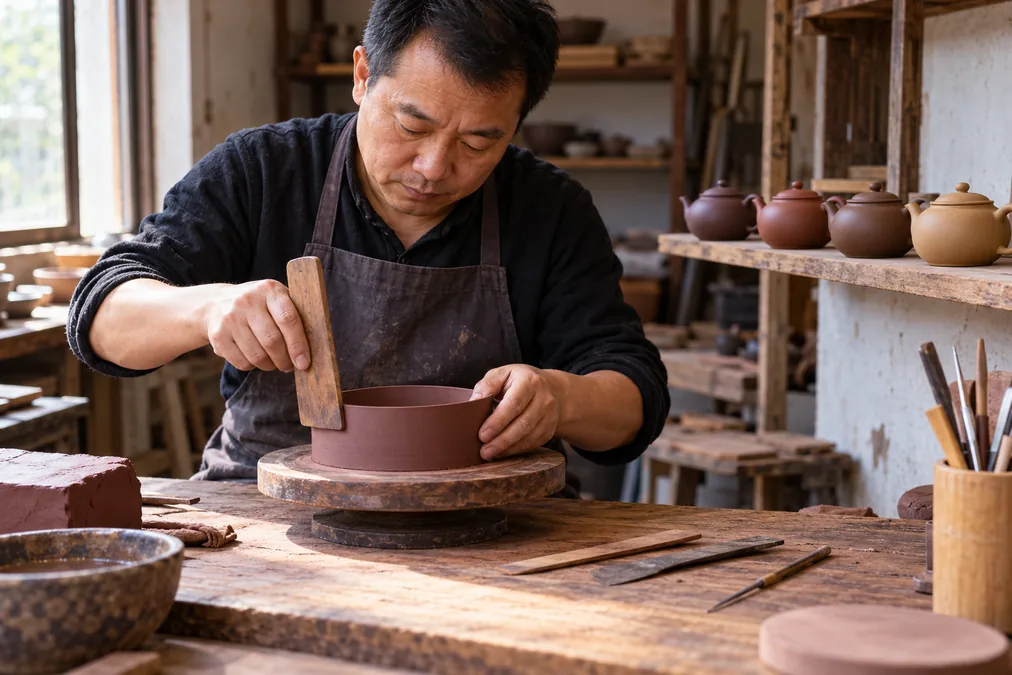
Yixing (宜兴, Yíxīng) is a county-level city in Wuxi's south, near the western shore of Lake Tai, and the home of zisha (紫砂, zǐshā) "purple clay" teapots. The Yixing zisha pottery-making technique was listed as national intangible cultural heritage in 2006, and it comes from Dingshu town (丁蜀镇, Dīngshǔ). If you drink tea or want a teapot that was actually made in Yixing, it is worth a day. If you are not interested in pottery, skip it and give the time to Lake Tai. For background on Chinese tea and how zisha pots are used, see the Chinese tea ceremony guide.
Getting there is the catch. On the 12306 sample day there is no direct train between any Wuxi station and Yixing, in either direction. By rail, Yixing is linked to Nanjing and, less often, to Shanghai:
- From Nanjing South, about 63 direct trains run to Yixing Station, the fastest in 33 minutes, at about 46–65 yuan in second class.
- From Shanghai, there are only 4 direct trains, all in the morning: one from Shanghai Hongqiao at 08:20 and three from Shanghai South, taking 1 hour 7 minutes to 1 hour 48 minutes, at about 98–112 yuan.
- Back to Shanghai, also 4 trains: three to Shanghai South and the last one to Shanghai Hongqiao at 19:15. Book that return before you go.
From Wuxi city you go by road. A taxi or DiDi is the simplest way; long-distance coaches also run from Wuxi to Yixing, so check current departures at the bus station or in a map app. Note that Yixing Station is in the town centre, and Dingshu, the Bamboo Sea and the caves are all further out, so you need a car on the Yixing end too. Hiring a car and driver for the day from Wuxi is the least stressful way to see several sights.
What to see. In Dingshu, the China Yixing Ceramics Museum (中国宜兴陶瓷博物馆) costs 5 yuan, opens 8:30 to 16:30, and is closed on Monday mornings except on public holidays (check the museum's notice before a Monday visit). Around it are streets of workshops and shops; the old kiln and pottery street area is where you can watch potters at work and buy pots, from cheap souvenir pieces to signed work by named masters. Buy from a shop that will tell you who made the pot and what clay it is, and be cautious with very cheap "zisha" — it is often not.
Further south in the hills, the Yixing Bamboo Sea (竹海) costs 78 yuan on the city's list and opens 8:00 to 16:30. It is a large bamboo forest with walking trails and a lake, cool and green in summer. The Shanjuan Cave (善卷洞), Zhanggong Cave (张公洞) and Taozu Shengjing (陶祖圣境, a scenic area dedicated to the legendary founder of Yixing pottery) are each 110 yuan; the two caves open 8:00 to 16:30 and Taozu Shengjing to 17:00. If you only have time for one, pick by what is nearest your route; your driver will know which is quickest to reach. With a car, Dingshu plus either the Bamboo Sea or one cave makes a full day.
| Route | Trains that day | Departures | Journey time | Sample fares: 2nd / 1st class |
|---|---|---|---|---|
| Shanghai → Yixing | 4 (C 4) | from Shanghai Hongqiao: 08:20 (C3603) from Shanghai South: 09:22 / 11:46 / 13:26 C3003 also stops at Shanghai Songjiang 09:47 | 1 h 07 min–1 h 48 min · Shanghai Hongqiao: 1 h 14 min | ¥98–112 / ¥148–170 |
| Yixing → Shanghai | 4 (C 4) | to Shanghai South: 07:11 / 14:54 / 17:03 to Shanghai Hongqiao: 19:15 (C3601) | Shanghai South: 1 h 13 min–1 h 35 min · Shanghai Hongqiao: 1 h 29 min | ¥96–105 / ¥153–167 |
| Nanjing South → Yixing | 63 (G 57 · C 4 · D 2) | 06:28–21:16 | fastest 33 min (G223) · median about 41 min | ¥46–65 / ¥74–107 |
| Wuxi (all stations) ⇄ Yixing | 0 | No direct train in either direction from Wuxi, Wuxi East or Huishan; by rail you have to change trains | ||
| Sight | Ticket | Hours |
|---|---|---|
| China Yixing Ceramics Museum (Dingshu) | ¥5 | 08:30–16:30 · closed Monday mornings (open on public holidays) |
| Yixing Bamboo Sea | ¥78 on the city’s list (the gate price may be about ¥80) | 08:00–16:30 |
| Shanjuan Cave | ¥110 | 08:00–16:30 |
| Zhanggong Cave | — | 08:00–16:30 |
| Taozu Shengjing | ¥110 | 08:00–17:00 |
What to eat in Wuxi
Wuxi food is Jiangnan cooking with a sweet streak — more sugar than in Shanghai, and soy-braised dishes with a glossy, dark sauce. You will not need a special restaurant to eat well here; the canal quarter, Huishan Ancient Town and the old-brand restaurants in the centre all serve the local classics.
- Wuxi sauced spare ribs (无锡酱排骨, jiàng páigǔ). The city government calls them Wuxi's most representative traditional dish, and one of its "three treasures" alongside Huishan clay figurines and water-fried gluten puffs. The ribs are braised until the meat falls off the bone, in a dark, sweet soy sauce. Order them at least once.
- Gluten puffs (油面筋, yóu miànjīn). Light, hollow balls of fried wheat gluten, usually stuffed with minced pork and simmered in broth. They soak up the sauce, and they are on most local menus.
- Wuxi xiaolongbao (无锡小笼, xiǎolóng). Soup dumplings like Shanghai's, but with a sweeter filling. In autumn and winter look for the crab-roe version (蟹粉小笼, xièfěn xiǎolóng).
- The "three whites of Lake Tai" (太湖三白, Tàihú sān bái): whitebait (银鱼), white fish (白鱼) and white shrimp (白虾) from the lake. Lakeside restaurants near Yuantouzhu and on the way to Lingshan serve them steamed or stir-fried, often with eggs in the case of whitebait. It is the dish to have on a Lake Tai day.
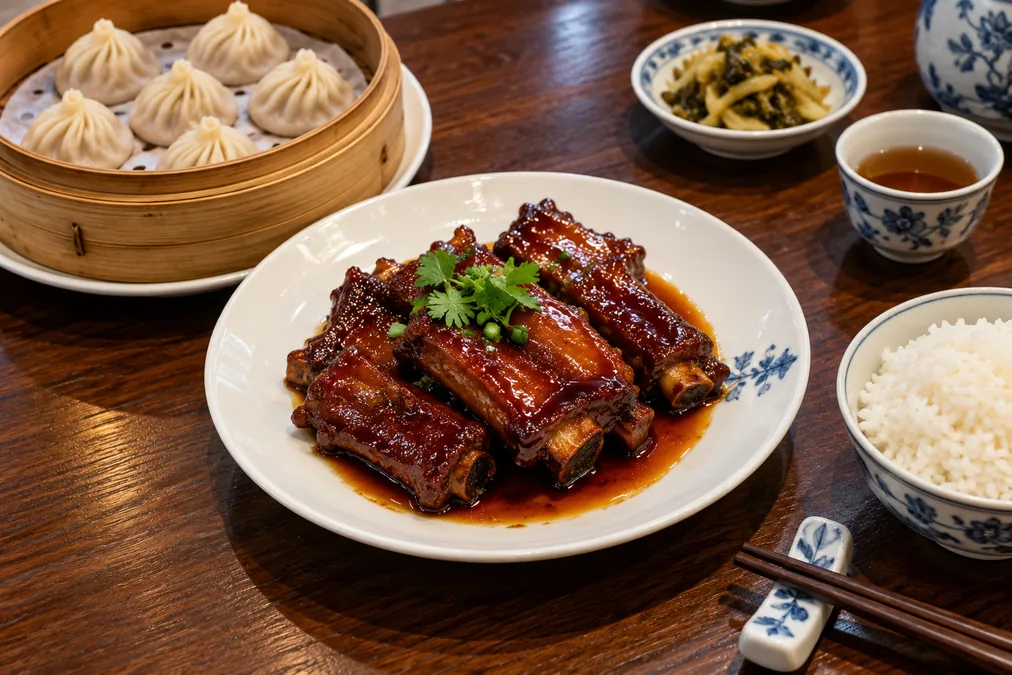
If you cannot read the menu, most restaurants have picture menus or ordering by QR code; the guide to ordering food with zero Chinese covers the practical side.
Getting around Wuxi
Wuxi is spread out, and you will use a mix of metro, bus and taxi. The metro covers the centre and the main stations, buses K1 and K87 cover Yuantouzhu, and taxis or DiDi fill the gaps to Lingshan, Dangkou and Yixing.
Metro. At the end of 2024 Wuxi Metro ran five lines — Lines 1 and 2, the first phases of Lines 3 and 4, and the S1 line to Jiangyin — with more under construction. Line 3 runs to Sunan Shuofang airport. Use a map app to plan routes, since new sections open from time to time; the China metro guide explains how ticket machines and gates work in any city.
Paying for the metro. The dependable way in is a single ticket bought at a station service counter: Wuxi Metro says its station POS machines have been enabled to take foreign cards, which most likely means paying by card at the counter rather than tapping a card at the gate — confirm at the counter when you first use it. For anything the metro does not cover, taxis and DiDi (below) are the fallback. The local QR code for metro and buses is in the Lingxi app (灵锡, Língxī), which needs real-name verification before you can use it. It is not officially stated whether a foreign passport can complete that verification. Whether the Alipay transit code works on Wuxi Metro is not officially stated, so check inside Alipay before you rely on it; the guide to using international cards in China covers the payment side in general.
Taxis and DiDi. The current taxi fare is 10 yuan for the first 3 kilometres and 1.9 yuan per kilometre after that; a price hearing on 5 November 2026 is considering a change to the fare system, so the metered fare may change after that date — check the sticker in the cab. Taxis are the practical choice for Lingshan, Dangkou and any trip with luggage. DiDi works in Wuxi like everywhere else in China and saves you explaining the destination; the DiDi guide covers setting it up with a foreign card.
Distances. The city centre to Yuantouzhu is about 15 kilometres. Lingshan is further out along the lake. Yixing is a separate city to the southwest, a long drive away. Do not plan Yuantouzhu, Lingshan and the canal on the same afternoon.
A 1–2 day Wuxi itinerary
Day trip from Shanghai (one day). Take an early train from Shanghai Hongqiao. If your train goes to Wuxi Station, walk to the north square and take bus K1 to Yuantouzhu; if it goes to Wuxi East, take a taxi or DiDi to the park. Spend the morning at Yuantouzhu: lakeside path, ferry to Taihu Fairy Island, a cart back. Have lunch near the park — try the three whites of Lake Tai. In the afternoon, either go on to Lingshan by taxi (and accept a later return) or head back into town for Huishan Ancient Town. Finish with dinner and an evening walk along Nanchang Street and Qingming Bridge, then take a train back to Shanghai from Wuxi Station. Trains back run into the evening; check the last convenient departure on 12306 before you set out and book it. A day trip is very doable; it just means choosing two of the three areas, not all three.
Two days.
- Day 1 — Lake Tai. Yuantouzhu in the morning, Lingshan in the afternoon, and Nianhua Bay for the evening lights if it is running. Taxi back to your hotel.
- Day 2 — old Wuxi. Huishan Ancient Town and Jichang Garden in the morning, the city centre for sauced spare ribs at lunch, and the canal quarter in the late afternoon with a boat at dusk. Or swap the day for Yixing: hire a car, see Dingshu and the ceramics museum, then the Bamboo Sea or Shanjuan Cave.
If you stay the night, the area around Wuxi Station is convenient for trains and the Yuantouzhu bus, and Nanchang Street is the nicer place to be in the evening; you can compare hotels in both on Trip.com.
Linking Wuxi into a longer trip. Wuxi sits between Suzhou and Nanjing on the same line, so it is easy to slot in. From Shanghai, go Shanghai → Suzhou → Wuxi → Nanjing, a night or two in each; the day trips from Shanghai guide compares Wuxi-style day trips with Suzhou, Hangzhou and the water towns. Nanjing, under an hour away, needs two or three days for its museums, Purple Mountain and the city wall — see the Nanjing guide. Yangzhou, with its Slender West Lake, gardens and morning tea, is a good next stop north of the Yangtze, usually reached from Nanjing — see the Yangzhou guide.
In short: give Wuxi one day for Lake Tai or two days to add the old town and canal. Book Wuxi Station by default, and Wuxi East if its train time suits you better. Go in spring for the cherry blossom or in autumn for mild weather. Check Yuantouzhu's notices and Lingshan's online price before you go. And if you want Yixing teapots, plan it as a separate day by car, or come in by train from Nanjing South.
Frequently asked questions
Should I go to Wuxi Station or Wuxi East?
Wuxi Station by default, and Wuxi East if its train time suits you better. Wuxi Station is the central station with the most trains from Shanghai, Suzhou and Nanjing, and bus K1 to Yuantouzhu leaves from its north square. Wuxi East is on the Beijing–Shanghai high-speed line, where only G trains stop, and it is outside the centre. If you do book Wuxi East — the fastest trains from Shanghai Hongqiao take 25 minutes — but add a taxi or metro ride at the Wuxi end. Avoid Huishan Station unless your hotel is next to it; it has very few trains.
Can I visit Wuxi as a day trip from Shanghai?
Yes. On the 5 November 2026 sample day about 49 trains run from Shanghai Hongqiao to Wuxi East, the fastest in 25 minutes, and about 51 more go to Wuxi Station. That is enough for Yuantouzhu in the morning and Huishan or the canal quarter in the afternoon. Doing Yuantouzhu and Lingshan in one day is possible but rushed, because both are on the lake outside the centre. Check the last train back on 12306 before you leave Shanghai and book it in advance on weekends and holidays.
When do the cherry blossoms bloom at Yuantouzhu?
From late February to mid-April, because the park has early, mid-season and late varieties; in 2026 the official cherry blossom festival ran from 1 March to 15 April, with evening viewing sessions, and next spring's festival dates are announced around late February, so check them before you book. Late March is typically the busiest time. Go on a weekday and arrive at opening time, and check the park's notices for evening viewing times.
Last updated: October 2026
Fact-checked sources
- Official China Railway 12306 12 pages
- Official Wuxi Development and Reform Commission 3 pages
- Official China Meteorological Administration
- Official Wuxi Municipal Government 8 pages
- Official Taihu Yuantouzhu Scenic Area 4 pages
- Official Wuxi Transport Bureau
- Official Chinese embassies and consulates
- Official National Immigration Administration
Show 1 more sources
- Official Wuxi Municipal Publicity Department
Last verified: 2026-10-25
Read in other languages
Last train times for 10 Chinese metro systems
Every line and station, checked by hand — the same data behind our offline route planner.
Get the WaysChina App
Offline guides, currency converter, essential phrases, and more — all in your pocket.

Related Articles

Yangzhou Travel Guide: Slender West Lake, Morning Tea and a Day Trip from Nanjing
How many days Yangzhou needs, Yangzhou East or Yangzhou Station, Slender West Lake and garden tickets by season, the...

Fujian Tulou Guide: Nanjing County or Yongding, Tickets and How to Get There from Xiamen
Fujian's World Heritage tulou from Xiamen: how to choose between Nanjing County and Yongding, official ticket...
Fuzhou Travel Guide: Three Lanes and Seven Alleys, Getting Around, Food and Mount Wuyi Trains
One to two days in Fuzhou: Fuzhou Station or Fuzhou South, what Sanfang Qixiang charges for, the free Fujian Museum,...

Quanzhou Travel Guide: World Heritage Temples, Day Trip from Xiamen and What to Eat
One or two days in Quanzhou: which of its three stations to book from Xiamen, what the 22 World Heritage sites are,...