

This article contains affiliate links. If you make a purchase through these links, we may earn a small commission at no extra cost to you. This helps support our work in creating free travel guides.
Quanzhou (泉州, Quánzhōu) is a port city on the Fujian coast between Xiamen and Fuzhou, and it is worth one full day, or two if you also want the sites outside the centre. In 2021 UNESCO listed "Quanzhou: Emporium of the World in Song-Yuan China" as a World Heritage site made up of 22 separate component sites — it is these 22 places that are listed, not the whole old town. From Xiamen North station the trains take about 17 to 32 minutes, depending on which of the three main stations serving Quanzhou you choose. Most of the heritage sites cost nothing to enter: of the 22, only Qingyuan Mountain (where the Laojun Rock statue is) and Qingjing Mosque charge a ticket.
Below: what the World Heritage listing covers, which station to book, what to see in the old town and beyond it, what to eat, and a one-day and two-day plan.
Is Quanzhou worth it, and how many days?
Yes, if you like old temples, religious history or the story of the sea trade. From the 10th to the 14th century Quanzhou was one of the main ports linking China with Southeast Asia and beyond. Traders from many places settled here, and you can still see it: a Buddhist temple, a mosque, a temple to the sea goddess Mazu and a Confucian temple all stand within walking distance of each other in the old town. It is a working city, not a theme park. People burn incense in the temples, eat breakfast at plastic tables and ride scooters through the lanes, and that ordinary daily life is a big part of the visit.
How long to stay:
- One day covers the old town: Kaiyuan Temple, West Street, Qingjing Mosque, Guanyue Temple, the Confucian Temple and Tianhou Temple. This works well as a day trip from Xiamen.
- Two days lets you add the places you need a car for: the flower-crown fishing village of Xunpu, the Laojun Rock statue on Qingyuan Mountain, and Luoyang Bridge. With two days, sleep in the old town so you can walk West Street in the evening.
Quanzhou sits between Xiamen and Fuzhou on the same coast. Xiamen is the closer of the two, and Fuzhou is under an hour away on the fastest trains from Quanzhou South, so Quanzhou fits easily into a Xiamen–Fuzhou trip by rail. For Xiamen itself, see our Xiamen and Fujian coast guide.
When to go. Quanzhou has a warm, humid subtropical monsoon climate, with yearly average temperatures of about 19.5 to 22 °C and no snow in winter. October to December and March to May are the most comfortable months for walking all day; summer is hot and sticky. Typhoons hit this coast too: just down the coast at Xiamen, the city's weather records show August as the peak month, but typhoons have made landfall there as early as May and as late as early December. If a storm is forecast, trains and outdoor sites can be disrupted, so keep a spare day. China's national holidays, above all the October Golden Week, fill the old town with domestic tourists; see our Golden Week survival guide if your dates overlap.
What the World Heritage listing is
The official name is "Quanzhou: Emporium of the World in Song-Yuan China" (泉州:宋元中国的世界海洋商贸中心). It was added to the World Heritage List on 25 July 2021 at the 44th session of the World Heritage Committee, held in Fuzhou. The listing has 22 sites and their settings, which together show how Quanzhou worked as a port city for the trade networks of East and Southeast Asia in the 10th to 14th centuries. It is one of Fujian's five World Heritage sites; the others are Mount Wuyi, the Fujian Tulou, Gulangyu (Kulangsu) and Taining, which is part of China Danxia. The Quanzhou city government's World Heritage announcement (in Chinese) has the full background.
The 22 sites are spread out, and that is the most useful thing to understand before you plan. They are temples, a mosque, Islamic tombs, stone statues, bridges, docks, pagodas, kiln sites, an iron-smelting site and the ruins of old government offices. Roughly, they fall into three groups:
- In the old town, on foot: Kaiyuan Temple, Qingjing Mosque, Tianhou Temple and the Confucian Temple and School (泉州文庙及学宫) are the ones with buildings to visit. Nearby are excavated ruins on the list, such as the Deji Gate site and the Maritime Trade Office site, which are short stops rather than full visits.
- Around the city, Qingyuan Mountain scenic area: the Laojun Rock statue, the "praying for wind" inscriptions at Jiuri Mountain and the Islamic Tombs all belong to the Qingyuan Mountain scenic area, which has separate parts around the city: Laojun Rock on the northern edge, Jiuri Mountain to the west and the Islamic Tombs to the east.
- Further out: the kiln sites in Dehua, the iron-smelting site in Anxi, the Cizao kiln site, Anping Bridge and Cao'an in Jinjiang, and the Liusheng and Wanshou pagodas near Shishi are all well outside the old city. The rest, including Luoyang Bridge and the old docks, are around the edges of the city and the bay.
For a first visit, the old-town group plus one or two sites on the edge of town is plenty. The far-flung kiln and iron sites are for people with a strong interest in archaeology and a driver for the day.
Getting to Quanzhou: which station to book
Three main stations serve Quanzhou, and booking the wrong one can add a long road transfer to your day:
- Quanzhou (泉州站) is on the older Fuzhou–Xiamen railway and is the most convenient of the three for the city centre and the old town.
- Quanzhou South (泉州南) is on the newer Fuzhou–Xiamen high-speed line. The city's own answer to residents is that it is far from the central city.
- Quanzhou East (泉州东) opened in October 2023 on the same high-speed line, out in the Taishang Investment Zone. It is not connected by rail to Quanzhou station.
Our advice: if you are going to the old town, book to Quanzhou (泉州), even though the train takes about a quarter of an hour longer. The saving on the train to Quanzhou South or East is usually lost again in the taxi ride into town. When you search, check the station name carefully, because ticket apps show all three under "Quanzhou".
From Xiamen
The train figures below come from the timetable on 12306, China's official railway booking system, for Thursday 5 November 2026. Timetables change, so treat the counts as a guide, not a fixed schedule.
- Xiamen North → Quanzhou: about 78 trains are scheduled that day, mostly D-class, leaving between 07:08 and 21:35. The fastest takes 26 minutes and a typical one about 32 minutes; second-class seats cost 27 to 29 yuan, depending on the train.
- Xiamen North → Quanzhou South: about 45 trains, nearly all G-class, most taking 17 to 19 minutes, with second class at 29 yuan. Quick on the train, but then you have the longer ride into town.
- Xiamen (the station on Xiamen Island) → Quanzhou: about 20 trains, taking 45 to 55 minutes because they have to leave the island first; second class on train D6204 costs 38 yuan.
Xiamen North (厦门北) is on the mainland side, away from Xiamen Island, while Xiamen Station (厦门站) is on the island itself. If your hotel is on the island, compare the time it takes you to reach Xiamen North with the slower but closer trains from Xiamen Station. For most people, Xiamen North has far more trains and is the better choice.
| Route | Trains that day | First–last departure | Journey time | Sample fares: 2nd / 1st class |
|---|---|---|---|---|
| Xiamen North → Quanzhou Station | 78 (D 71 · G 5 · C 2) | 07:08–21:35 | fastest 26 min (D3234) · typically 26–32 min | ¥27–29 / ¥43–45 |
| Xiamen North → Quanzhou South | 45 (G 44 · C 1) | 07:18–22:11 | fastest 17 min · typically 17–19 min | ¥29 / ¥46 |
| Xiamen North → Quanzhou East | 13 (G 13) | 06:53–22:11 | fastest 23 min | ¥53 (2nd class) |
| Xiamen Station → Quanzhou Station | 20 (D 18 · C 1 · G 1) | 06:44–20:05 | fastest 45 min · typically 45–55 min | ¥38 / ¥61 |
| Xiamen Station → Quanzhou South | 9 (G 8 · C 1) | 06:55–20:33 | fastest 43 min | – |
| Xiamen North → Fuzhou South | 94 (D 53 · G 40 · C 1) | 06:53–22:11 | fastest 56 min (G5108) | ¥77–126 / ¥123–202 |
| Xiamen North → Fuzhou Station | 70 (G 47 · D 21 · C 2) | 06:53–21:08 | fastest 1 h 06 min (G3022) · typically 1 h 30 min | ¥149 / ¥238 |
| Xiamen Station → Fuzhou South | 15 | – | fastest 1 h 29 min | – |
| Xiamen Station → Fuzhou Station | 22 | – | fastest 1 h 35 min | – |
From Fuzhou
Trains run all day between the two cities. On that day's timetable, about 58 trains run from Quanzhou station to Fuzhou South, the fastest taking 54 minutes, with second class at 55 yuan on train D686; about 27 G-class trains run from Quanzhou South to Fuzhou South, the fastest taking 43 minutes, with second class at 94 yuan. The same rule applies: Quanzhou station is the one for the old town. Our Fuzhou guide covers Fuzhou's two stations.
Booking and boarding
You can buy tickets with your passport on the official 12306 website and app, and at the station you go through the staffed lane, because passports cannot be read by the automatic gates. The full walk-through is in how to book train tickets with a foreign passport, and our high-speed train guide explains G, D and C trains and the seat classes. For finding your way around a station, see train station navigation. The official 12306 notice on accepted ID lists the foreign passport.
By air
Quanzhou Jinjiang International Airport (泉州晋江国际机场) is south of the city and serves mainly domestic routes, with only a handful of international and regional destinations. Most overseas visitors fly into Xiamen and take the train. From Jinjiang airport, a taxi or DiDi is the simplest way into the old town; check the fare estimate in the app before you go.
From the station to the old town
From Quanzhou station, a taxi or DiDi to Kaiyuan Temple or West Street is a short ride. From Quanzhou South or Quanzhou East it is a much longer ride, so allow extra time. City buses link the stations too, but routes change and stop names are in Chinese, so for a short visit a car is easier. Our DiDi guide explains how to book a ride in English with a foreign card.
What to see in the old town
The old town is the reason to come, and it is compact enough to walk. The main sights cost nothing except Qingjing Mosque, which charges a small ticket. Opening times run from early morning to late afternoon, so start early and plan to be finished by about 5 pm. The prices and hours in the table come from local government listings; if a ticket seller or app shows a different price, the price at the gate is the one that applies on the day.
| Sight | Ticket | Opening hours |
|---|---|---|
| Kaiyuan Temple | Free | 06:30–17:30 · allow about 60 min |
| Quanzhou Bay Ancient Ship Exhibition Hall (inside Kaiyuan Temple) | — | Tue–Sun 09:00–17:30 · closed Mondays and on the 26th day of each lunar month |
| Qingjing Mosque | 3 ¥ | 08:00–17:30 |
| Confucian Temple | Free | 08:00–17:30 · allow about 45 min |
| Tianhou Temple | Free | 08:00–17:30 |
| Quanzhou Maritime Museum (Donghu Street site) | — | ⚠ Temporarily closed for renovation since Oct 12, 2026; reopening expected mid-November 2026, date to be announced by the museum (the Ancient Ship hall stays open) · Tue–Sun 09:00–17:30 (last entry 17:00) · public holidays 09:00–19:00 (last entry 18:30) · closed Mondays |
| Quanzhou Museum | Free | 09:00–17:00 |
| Other World Heritage sites | Free: of the 22 sites, only Qingyuan Mountain (Laojun Rock) and Qingjing Mosque charge | Vary by site · Qingyuan Mountain (Laojun Rock): free evening visits; check the daytime ticket at the gate |
Kaiyuan Temple (开元寺)
Kaiyuan Temple is the biggest and best-known sight in Quanzhou, and the place to start. It is free, open 6:30 to 17:30, and a visit takes about an hour; the address is 176 West Street. The temple is famous for its two stone pagodas, the East Pagoda and the West Pagoda (东西塔), which stand on either side of the main courtyard and are covered in carved figures. The main hall is still a working Buddhist hall, with monks and local worshippers. Come early in the morning and you will share it mostly with them. Because it is an active temple, opening times can change during religious festivals; check the temple's notices if you visit on a festival day.
Inside the temple grounds is the Quanzhou Bay Ancient Ship Exhibition Hall (泉州湾古船陈列馆), which shows the remains of a Song-dynasty sea-going ship. It is part of the Maritime Museum and opens Tuesday to Sunday, 9:00 to 17:30, with last entry at 17:00; it also closes on the 26th day of each month in the Chinese lunar calendar. That lunar date moves around in the Western calendar, so check a lunar calendar app if your visit is close to it.
West Street (西街) and the Bell Tower (钟楼)
West Street runs east from Kaiyuan Temple to the Bell Tower, where it meets Zhongshan Road. It is the old town's main walking street: snack shops, tea shops, small cafés and old houses. Around the Bell Tower, Zhongshan Road is lined with qilou (骑楼, arcade buildings), two- and three-storey shophouses with a covered walkway at street level that keeps the sun and rain off. West Street is busiest in the late afternoon and evening, which makes it a good place to finish the day.
Qingjing Mosque (清净寺)
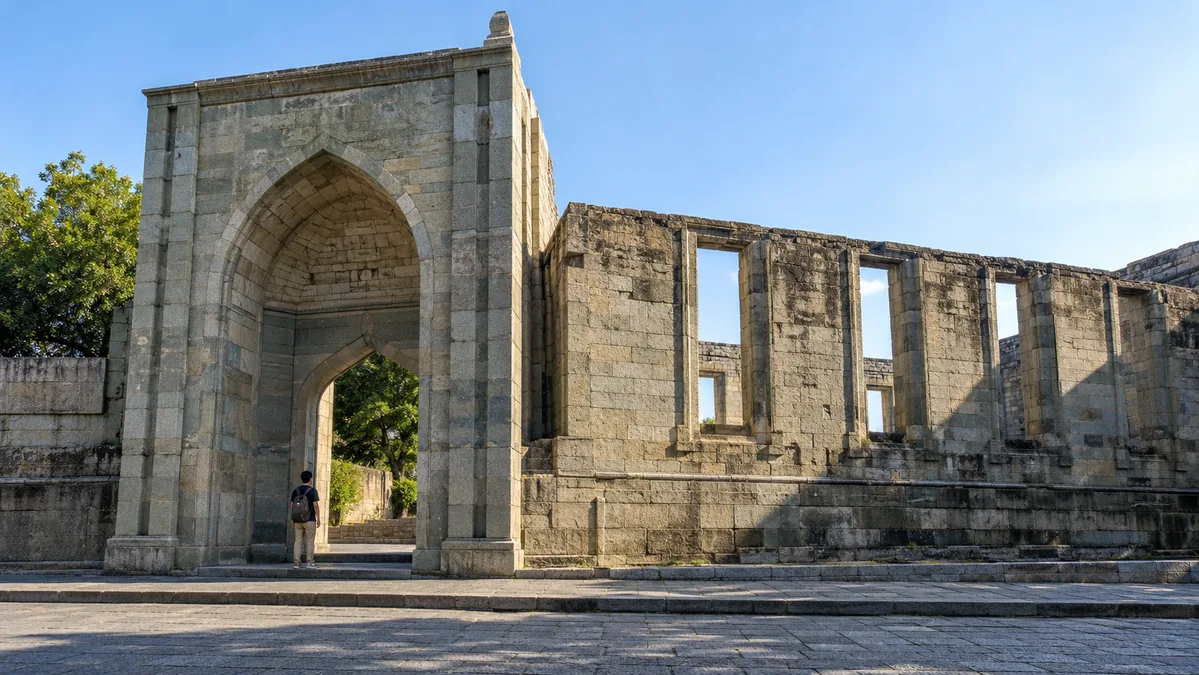
Qingjing Mosque is on Tumen Street (涂门街), a short walk south-east of the Bell Tower. It is one of the two paid sites on the World Heritage list, with a ticket of 3 yuan and hours of 8:00 to 17:30. The main thing to see is the tall granite gateway and the roofless stone walls of the old prayer hall, built in a style you will not see in Chinese temples. It is a reminder of the Arab and Persian traders who lived in Quanzhou. Dress modestly here (shoulders and knees covered). If you are looking for halal food on your trip, our halal food in China guide explains how to find it.
Guanyue Temple (关岳庙)
Right next to the mosque on Tumen Street is Guanyue Temple, a busy folk temple to Guan Yu and Yue Fei, two heroes of Chinese history who are worshipped as protectors. It is not one of the 22 World Heritage sites, but it is one of the liveliest places in the old town: thick incense smoke, people asking the gods questions by throwing divination blocks, and offerings piled on the altars. Go in daylight and confirm the hours locally. Watch quietly, keep your camera away from people praying, and you will be welcome.
The Confucian Temple (府文庙)
The Quanzhou Confucian Temple, listed as the Confucian Temple and School, is a short walk from Tumen Street. It is free, open 8:00 to 17:30, and needs about 45 minutes. It is quieter than the temples around it: a large hall, courtyards and old trees. The square in front is where local people gather in the evening.
Tianhou Temple (天后宫)
Tianhou Temple, in the south of the old town, is dedicated to Mazu, the sea goddess that fishermen and sailors along this coast pray to. It is free and open 8:00 to 17:30. The ruins of Deji Gate, the old city's southern gate and another of the World Heritage sites, are right next to it, so see the two together.
Quanzhou Maritime Museum (泉州海外交通史博物馆)
The Maritime Museum explains Quanzhou's sea trade, with ship models, carved gravestones of foreign traders and objects from the trade routes. Its main site is on Donghu Street (东湖街), east of the old town, and normally opens Tuesday to Sunday, 9:00 to 17:30, with last entry at 17:00 and longer hours on public holidays.
Check the museum's website or WeChat account for entry rules before you go.
Quanzhou Museum (泉州市博物馆)
The city museum is on Beiqing East Road on the north side of West Lake park, a short taxi ride north of the old town. It is free and open 9:00 to 17:00. Check its website for closing days before you go. It is a good choice for a rainy afternoon, or for an overview of the city's history before you walk the old town.
Outside the old town: heritage sites and Xunpu village
These places need a taxi or DiDi from the old town. Pick one or two; trying to see all of them in a day means spending most of it in a car.
Laojun Rock and Qingyuan Mountain (老君岩, 清源山)
Qingyuan Mountain National Scenic Area, on the northern edge of the city, is Quanzhou's only 5A-rated scenic area (China's top tourist rating). It holds seven Song- and Yuan-dynasty stone carvings and more than 600 inscriptions cut into the rock. The best known is Laojun Rock, a huge seated stone figure of Laozi, the founder of Taoism, carved from a single boulder. It is the closest outer site to the old town and the one to choose if you only have time for one. Qingyuan Mountain is one of only two World Heritage sites in Quanzhou that charge for entry; check the current daytime ticket price and hours at the gate or on the scenic area's official account. In 2024 the city also opened free evening visits with the statue lit up at night; confirm locally whether the evening opening is running when you visit.
Jiuri Mountain (九日山)
Jiuri Mountain, west of the city, has stone inscriptions recording ceremonies where officials prayed for good winds for the trading ships, and it is part of the wider Qingyuan Mountain scenic area. It is a quiet hillside walk among carved rocks; confirm the hours locally before you make the trip.
Luoyang Bridge (洛阳桥)
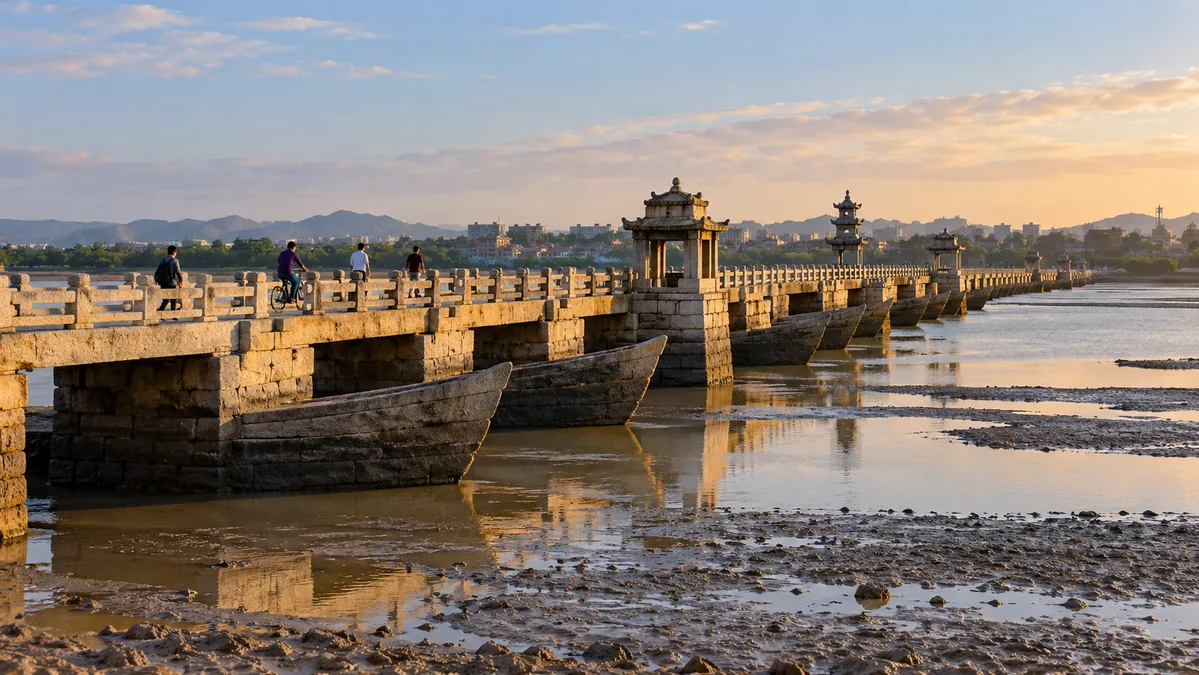
Luoyang Bridge is a long, low stone bridge across the Luoyang River estuary, north-east of the city, and one of the 22 heritage sites. You can walk across it among local people out for a stroll. It is most pleasant in the late afternoon. Combine it with Xunpu or Qingyuan Mountain on a two-day trip, and confirm opening times locally.
Liusheng Pagoda and Cao'an (六胜塔, 草庵), further out
Liusheng Pagoda is a stone pagoda on the bay near Shishi that once guided ships into port, and Cao'an is a small hillside shrine in Jinjiang with a carved stone statue of the Manichaean "Buddha of Light" (摩尼光佛) — both are on the heritage list. They are far from the old town and from each other. Go only if you have a car for the day and a strong interest, and confirm opening times locally first.
Xunpu village and the flower crowns (蟳埔)
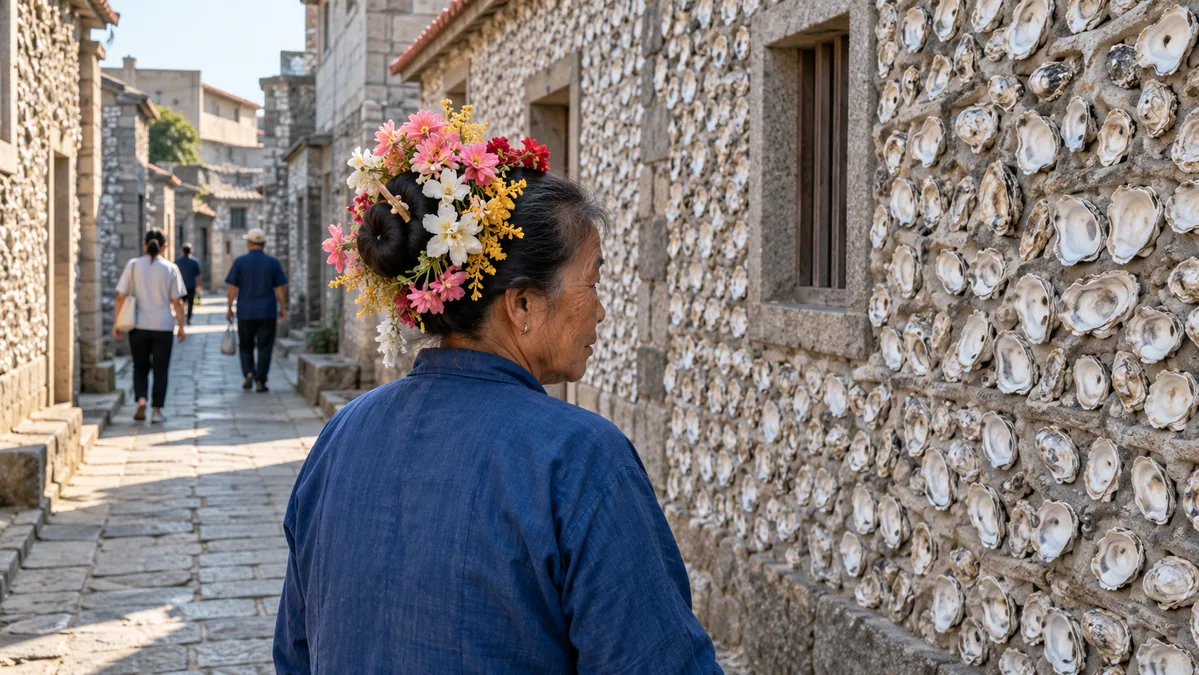
Xunpu is an old fishing community in Donghai, Fengze District, at the mouth of Quanzhou Bay. Xunpu women's customs, best known for the zanhuawei (簪花围, "hairpin flower circle") flower-crown headdress, were added to China's national list of intangible cultural heritage in 2008. In recent years the flower crown has also become a popular dress-up experience for visitors: by April 2024 the number of flower-crown photo studios in the village had grown from a dozen or so to 310, and a group standard was introduced that sets rules for staff, venues, service steps and pricing.
Take a taxi or DiDi from the old town and allow half a day. Get there in the morning, before the crowds and the heat. Studios offer packages that may include the flower crown, traditional clothes, make-up and photos; agree the total price and exactly what is included before you sit down. Even if you don't dress up, the lanes of oyster-shell houses (蚵壳厝, walls built with oyster shells set into them) and the morning seafood stalls are worth a walk.
What to eat in Quanzhou
Quanzhou food is Minnan (southern Fujian) cooking: lots of seafood, light broths, and snacks you eat at a counter or a small table. These are the dishes to look for. Small snack shops are cheap, and you pay by QR code or cash at the counter.
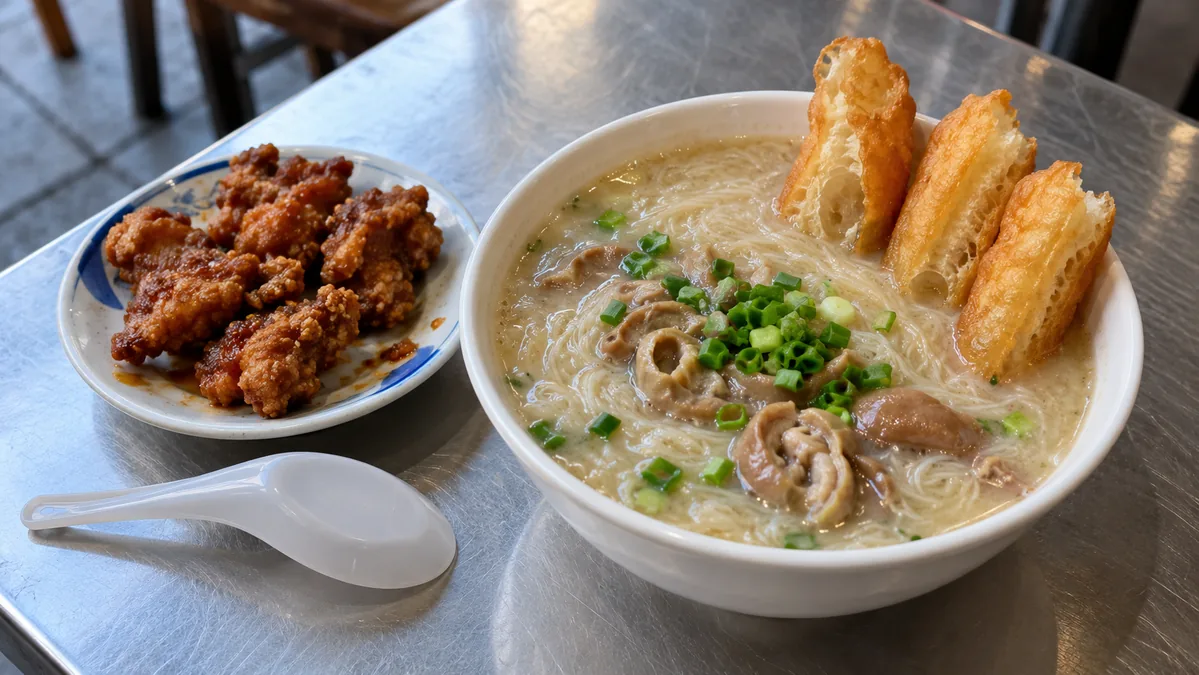
- Mianxian hu (面线糊, "thin noodle paste") — very fine wheat noodles (misua) cooked in a thick, savoury seafood broth until it is like a porridge. It is the classic Quanzhou breakfast. You choose add-ons such as fried dough sticks, pork intestines, duck blood, prawns or vinegar pork.
- Beef soup (牛肉羹, niurou geng) — small pieces of beef in a thick, slightly peppery soup, often eaten with rice. Beef shops are a Quanzhou habit, and this is one of the most popular lunches.
- Popiah (润饼, run bing) — a thin, soft wrapper rolled around stir-fried vegetables, egg, peanut powder and seaweed, like a fresh spring roll. It is especially common around the Qingming festival in spring.
- Tusun dong (土笋冻, "earth bamboo-shoot jelly") — small cold jellies made from a sea worm (sipunculid) gathered from the mud flats; it is boiled until the natural gelatine sets into a jelly. Served with vinegar, garlic and chilli. It sounds strange and tastes clean and mild; try one.
- Ginger duck (姜母鸭, jiangmu ya) — duck cooked slowly with a lot of old ginger and sesame oil in a clay pot. It is a warming dish, best on a cool evening and best shared.
For a sit-down meal, the Michelin Guide has had a Fujian edition since the first one was launched in December 2024, recommending restaurants in Fuzhou, Xiamen and Quanzhou. For how Minnan food fits into China's wider cooking traditions, see our guide to Chinese cuisine by region.
Getting around Quanzhou
Quanzhou has no metro in service. An intercity rail line linking Quanzhou, Xiamen and Zhangzhou was still at the construction-tender stage as of mid-2026. There is no metro to plan around. In the old town, walk: Kaiyuan Temple, West Street, Tumen Street and Tianhou Temple are all within walking range, though a full loop is a long day on foot. For the stations, the city museum and anything outside the old town, use a taxi or DiDi. City buses exist, but for a short visit they are slower and harder to use without Chinese.
A one-day and a two-day plan
One day (day trip from Xiamen)
- Morning train: leave Xiamen North around 8 am for Quanzhou station (泉州), then take a taxi to Kaiyuan Temple. On the 5 November 2026 timetable, the first train on this route leaves at 07:08.
- Kaiyuan Temple and the Ancient Ship hall: one to one and a half hours. The ship hall is closed on Mondays and on the 26th day of the lunar month.
- West Street to the Bell Tower: walk east, stopping for mianxian hu or beef soup for lunch.
- Tumen Street: Qingjing Mosque, Guanyue Temple and the Confucian Temple, all close together.
- Tianhou Temple and Deji Gate: walk south in the late afternoon; arrive before the 17:30 closing time.
- Evening: dinner around West Street, then a taxi to Quanzhou station.
Buy your return ticket when you buy the outward one, and check the time of the last train back to Xiamen in 12306 when you book; on weekends and holidays the popular evening trains can sell out. If the official app gives you trouble, you can also book Chinese train tickets in English through Trip.com, which takes foreign cards.
Two days
- Day 1: the old town as above, staying overnight near West Street.
- Day 2: Xunpu in the morning, then Laojun Rock on Qingyuan Mountain or Luoyang Bridge in the afternoon. If it rains, swap one for the Quanzhou Museum. Take an evening train back to Xiamen, or on to Fuzhou.
Quanzhou also works as a stop on a longer Fujian route: Xiamen, then Quanzhou, then Fuzhou by train, with the tulou (round earth houses) as a separate trip from Xiamen. See our Fujian tulou guide for that.
FAQ
Can I visit Quanzhou as a day trip from Xiamen?
Yes, and it is the most common way people visit. Trains from Xiamen North to Quanzhou station take about half an hour, and the 12306 timetable for 5 November 2026 schedules about 78 of them, leaving between 07:08 and 21:35. A day gives you Kaiyuan Temple, West Street, Qingjing Mosque, Guanyue Temple, the Confucian Temple and Tianhou Temple. The outer sites, such as Xunpu, Laojun Rock and Luoyang Bridge, need a second day or a very long one.
Where are Quanzhou's World Heritage sites?
The listing has 22 sites spread across the city and nearby counties, not one single area. Kaiyuan Temple, Qingjing Mosque, Tianhou Temple, the Confucian Temple and some ruins are in the old town and easy to walk between. Laojun Rock, Jiuri Mountain and the Islamic Tombs belong to the Qingyuan Mountain scenic area, which has separate parts around the city: Laojun Rock to the north, Jiuri Mountain to the west and the Islamic Tombs to the east. The kilns, the iron site, Anping Bridge, Cao'an and the two pagodas near Shishi are much further out and need a car.
Does Quanzhou have a metro?
No. Quanzhou has no metro in service; a Quanzhou–Xiamen–Zhangzhou intercity line was still at the construction-tender stage as of mid-2026. Get around the old town on foot and use a taxi or DiDi for anything further.
Etiquette, where to stay and paying
Temples and the mosque. Most sights in the old town are working places of worship. Dress modestly, especially at Qingjing Mosque; walk around people who are praying rather than in front of them; don't touch offerings on the altars; and ask before photographing anyone up close. Taking photos of buildings is normally fine.
Where to stay. Stay in the old town, near West Street or Zhongshan Road, so you can walk to the sights early in the morning and in the evening. Hotels near Quanzhou South or East only make sense if you arrive late and leave early by high-speed train. You can compare old-town hotels on Booking.com; check that the hotel accepts foreign guests, which is explained in our guide to booking hotels and registration rules.
Paying and emergencies. Small shops and snack stalls take QR-code payments; set up Alipay with your foreign card before you arrive (see how to use Alipay with foreign cards), and carry some cash as a backup. Keep the national numbers from our emergency contacts guide on your phone.
Next step: pick your date, check the trains from Xiamen North to Quanzhou station in 12306, and plan Kaiyuan Temple for the morning.
Last updated: October 2026
Fact-checked sources
- Official National Cultural Heritage Administration
- Official Quanzhou Municipal Government 6 pages
- Official Fujian Provincial Government 4 pages
- Official China Railway 12306 9 pages
- Official Fujian Department of Culture and Tourism
- Official Xiamen Municipal Government 6 pages
- Official Quanzhou World Heritage (official site)
- Official Jinjiang Municipal Government
Show 2 more sources
- Official Quanzhou Maritime Museum 2 pages
- Official Quanzhou Museum
Last verified: 2026-10-23
Read in other languages
Last train times for 10 Chinese metro systems
Every line and station, checked by hand — the same data behind our offline route planner.
Get the WaysChina App
Offline guides, currency converter, essential phrases, and more — all in your pocket.

Related Articles

Yangzhou Travel Guide: Slender West Lake, Morning Tea and a Day Trip from Nanjing
How many days Yangzhou needs, Yangzhou East or Yangzhou Station, Slender West Lake and garden tickets by season, the...
Wuxi Travel Guide: Lake Tai, Lingshan Buddha and Which Station to Use
How many days Wuxi needs, Wuxi Station or Wuxi East, Yuantouzhu and the Lingshan Buddha on Lake Tai, the Grand Canal...

Fujian Tulou Guide: Nanjing County or Yongding, Tickets and How to Get There from Xiamen
Fujian's World Heritage tulou from Xiamen: how to choose between Nanjing County and Yongding, official ticket...
Fuzhou Travel Guide: Three Lanes and Seven Alleys, Getting Around, Food and Mount Wuyi Trains
One to two days in Fuzhou: Fuzhou Station or Fuzhou South, what Sanfang Qixiang charges for, the free Fujian Museum,...