
This article contains affiliate links. If you make a purchase through these links, we may earn a small commission at no extra cost to you. This helps support our work in creating free travel guides.
Fuzhou (福州, Fúzhōu), the capital of Fujian province, needs one to two days. The core is Sanfang Qixiang (三坊七巷, Sānfāng Qīxiàng, "Three Lanes and Seven Alleys"), a historic district of old walled houses in the city centre: most visitors walk the lanes and pay only for the houses they go into, and the combo ticket for the paid houses has cost 70 yuan since 19 May 2025. The Fujian Museum is free for its permanent galleries and needs no booking. Fuzhou is also the usual gateway to Mount Wuyi: on the 12306 timetable for 5 November 2026, the fastest train from Fuzhou Station to Wuyishan North takes 70 minutes and the fastest from Fuzhou South about an hour and a half. From the airport, the Binhai Express (滨海快线) metro line runs into the city. Below: which of the two railway stations to use, what to see and what it costs, how to pay on the metro, what to eat, and how to plan one to three days.
How many days Fuzhou needs, and when to go
Give Fuzhou one full day if you are passing through, two if you want the city at an easy pace. Day one covers Sanfang Qixiang and the Lin Zexu Memorial Hall in the morning, the Fujian Museum and West Lake Park in the afternoon, and an evening in the Shangxiahang old trading quarter. Day two is Mount Gu (鼓山, Gǔ Shān) and its temple in the morning, then Yantai Hill or a hot-spring bath in the afternoon. A third day is best used for the train to Mount Wuyi, which most people treat as a separate two-night trip. The full plan is in the itinerary section below.
Fuzhou is a working provincial capital, not a resort. It is green and humid, with banyan trees along many streets — locals call it Rongcheng (榕城, "Banyan City") — and its old quarters sit between modern office towers. Most visitors use it as the first or last stop of a Fujian loop: Fuzhou, Mount Wuyi, then south to Quanzhou and Xiamen.
The climate is subtropical. The city's official figures give an average yearly temperature of 19.7°C, with January, the coolest month, averaging 10.6°C and August, the hottest, 28.8°C, and about 1,349 mm of rain a year. Locally, March to June is called spring, July to September summer, October and November autumn, and December to February winter — but by the weather office's standard Fuzhou has no climatological winter at all. October and November are the most comfortable months for walking. July to September is hot and sticky, and it is also typhoon season on this coast, so check the forecast in the days before you travel; a typhoon can cancel trains and flights at short notice. If you come in early October, the national Golden Week holiday fills the lanes and the trains — see our Golden Week survival guide.
Getting to Fuzhou: the airport and the two railway stations
Fuzhou Changle International Airport
The airport is in Changle, well east of the centre. The rail link is the Binhai Express, which runs between the airport and Fuzhou Railway Station; a single ticket from Fuzhou Railway Station to the airport costs 17 yuan. There are three kinds of train on the same line. One direct train a day leaves Fuzhou Railway Station at 05:55 and reaches the airport in about 30 minutes; from 06:00 a semi-express leaves every hour on the hour, stopping only at Dongmen, Sanchajie, Difengjiang and Dashuju; all other trains stop at every station, about every 7.5 minutes. In practice you will take whichever train comes first, or wait for the hourly semi-express if it is due soon.
At the airport end, leave the metro station by Exit B, cross the road on the covered walkway and enter the terminal at Door 12 — about 150 metres, a 6–8 minute walk. The Fuzhou city government's airport transfer guide (in Chinese) shows the route with photos. Last-train times differ by line, so check them at the station or in your map app if your flight lands late. Airport buses and taxis also serve the city; ask at the arrivals information desk for the current bus routes. The table below sets the Fuzhou airport link next to Xiamen's airports, which matters if you fly into one city and out of the other. Xiamen's Gaoqi airport is planned to close when the new Xiang'an airport opens, which is planned for the end of 2026, so check which Xiamen airport your flight uses.
| Airport | Into town | Good to know |
|---|---|---|
| Xiamen Gaoqi (until Xiang'an opens) | No metro. Airport Express bus, BRT (boarded at T4), city buses, taxis | Airport Express counters: T3 arrivals opposite Gate 9; T4 arrivals at Gate 7 and opposite Gate 3; open 05:30–23:00. Taxis queue on the arrivals level; taxis for Quanzhou, Shishi and Zhangzhou wait at the West car park, about 120 m west of T3 domestic arrivals. The airport does not list fares — check at the counter |
| Xiamen Xiang'an (new airport) | Planned to open at the end of 2026; Gaoqi closes at the same time | No switch date announced as of Oct 23, 2026. If you fly around the turn of the year, check which Xiamen airport your booking names. Metro Line 4's Xiang'an Airport station is not open yet |
| Fuzhou Changle | Binhai Express (metro) to Fuzhou Railway Station, ¥17 one way | Direct train: one a day, 05:55 from Fuzhou Railway Station, about 30 min · Limited-stop trains every hour on the hour from 06:00, stopping only at Dongmen, Sanchajie, Difengjiang and Dashuju · All other trains stop at every station, about every 7.5 min |
Visa-free transit
Fuzhou Changle is one of five Fujian ports where eligible travellers can enter under China's 240-hour visa-free transit policy, and the whole of Fujian province counts as the permitted area. The policy depends on your nationality and on holding an onward ticket to a third country, so check the current rules in our 240-hour visa-free transit guide before you book.
Fuzhou Station or Fuzhou South
Fuzhou has two main railway stations, and many trains stop at only one of them. Fuzhou Railway Station (福州站) is on the north side of the city centre and is the starting point of the Binhai Express to the airport. Fuzhou South (福州南站) is across the Min River in the southern Cangshan district. Metro Line 1 links both stations through Dongjiekou in the centre — check the route and journey time in your map app, because the ride from Fuzhou South to the old town is long.
Here is how the trains divide on the 12306 (national railway booking system) timetable for 5 November 2026:
- From Xiamen: both stations work. From Xiamen North to Fuzhou South about 94 trains are scheduled, the fastest takes 56 minutes and most take around an hour and a half, and second class costs 77–126 yuan depending on the train and route. From Xiamen North to Fuzhou Station about 70 trains are scheduled, the fastest taking 1 hour 6 minutes. Pick the station nearer your hotel.
- From Quanzhou: most trains go to Fuzhou South. About 58 trains are scheduled from Quanzhou Station to Fuzhou South and about 27 from Quanzhou South to Fuzhou South, the fastest taking 43 minutes; there are also trains to Fuzhou Station, and second class costs 48–103 yuan depending on the train and station pair.
- From Shanghai Hongqiao: Fuzhou Station has the fast trains. About 9 trains are scheduled from Shanghai Hongqiao to Fuzhou Station, the fastest taking 3 hours 40 minutes; about 13 go to Fuzhou South, mostly slower D trains of around 6 hours, and second class costs 364–431 yuan depending on the train.
- To Mount Wuyi: Fuzhou Station has more and faster trains — about 22 are scheduled to Wuyishan North, against 14 from Fuzhou South.
Timetables change with each seasonal adjustment, so treat these numbers as a guide to the pattern and check the actual trains for your date. The table below has the Fuzhou routes side by side.
| Route | Trains that day | First–last departure | Journey time | Sample fares: 2nd / 1st class |
|---|---|---|---|---|
| Quanzhou Station → Fuzhou South | 58 (D 53 · G 4 · C 1) | 07:36–22:09 | fastest 54 min | ¥55 (2nd class) |
| Quanzhou South → Fuzhou South | 27 | – | fastest 43 min | ¥94 (2nd class) |
| Quanzhou South → Fuzhou Station | 37 | – | fastest 59 min | ¥103 (2nd class) |
| Quanzhou East → Fuzhou South | 9 | – | fastest 38 min | ¥48 (2nd class) |
| Quanzhou Station → Fuzhou Station | 22 | – | fastest 1 h 13 min | – |
| Shanghai Hongqiao → Fuzhou Station | 9 (G 7 · D 2) | 06:20–16:06 | fastest 3 h 40 min (G257) · typically 3 h 40 min–6 h 30 min | ¥364–431 / ¥579–703 |
| Shanghai Hongqiao → Fuzhou South | 13 (D 10 · G 3) | 07:32–14:43 | fastest 4 h 58 min | ¥379 (2nd class) |
| Fuzhou Station → Wuyishan North | 22 (G 21 · D 1) | 07:55–20:16 | fastest 1 h 10 min · typically 1 h 10 min–1 h 40 min | ¥119.5–128.5 / ¥201–215 |
| Fuzhou South → Wuyishan North | 14 | 07:40–19:58 | fastest 1 h 29 min | ¥128.5 (2nd class) |
| Fuzhou Station / Fuzhou South → Nanping City | 58: 40 from Fuzhou Station, 18 from Fuzhou South | – | fastest 55 min | ¥103.5–111.5 (2nd class) |
Train tickets are sold under your real name, and the 12306 app and website accept a foreign passport as ID. You can book on the 12306 English website; our guide on how to book train tickets walks through it. With a passport you go through the staffed gate at the station rather than the automatic ones. For station layout and boarding, see train station navigation, and for train types and seat classes, the high-speed train guide.
What to see in Fuzhou
Sanfang Qixiang (Three Lanes and Seven Alleys)
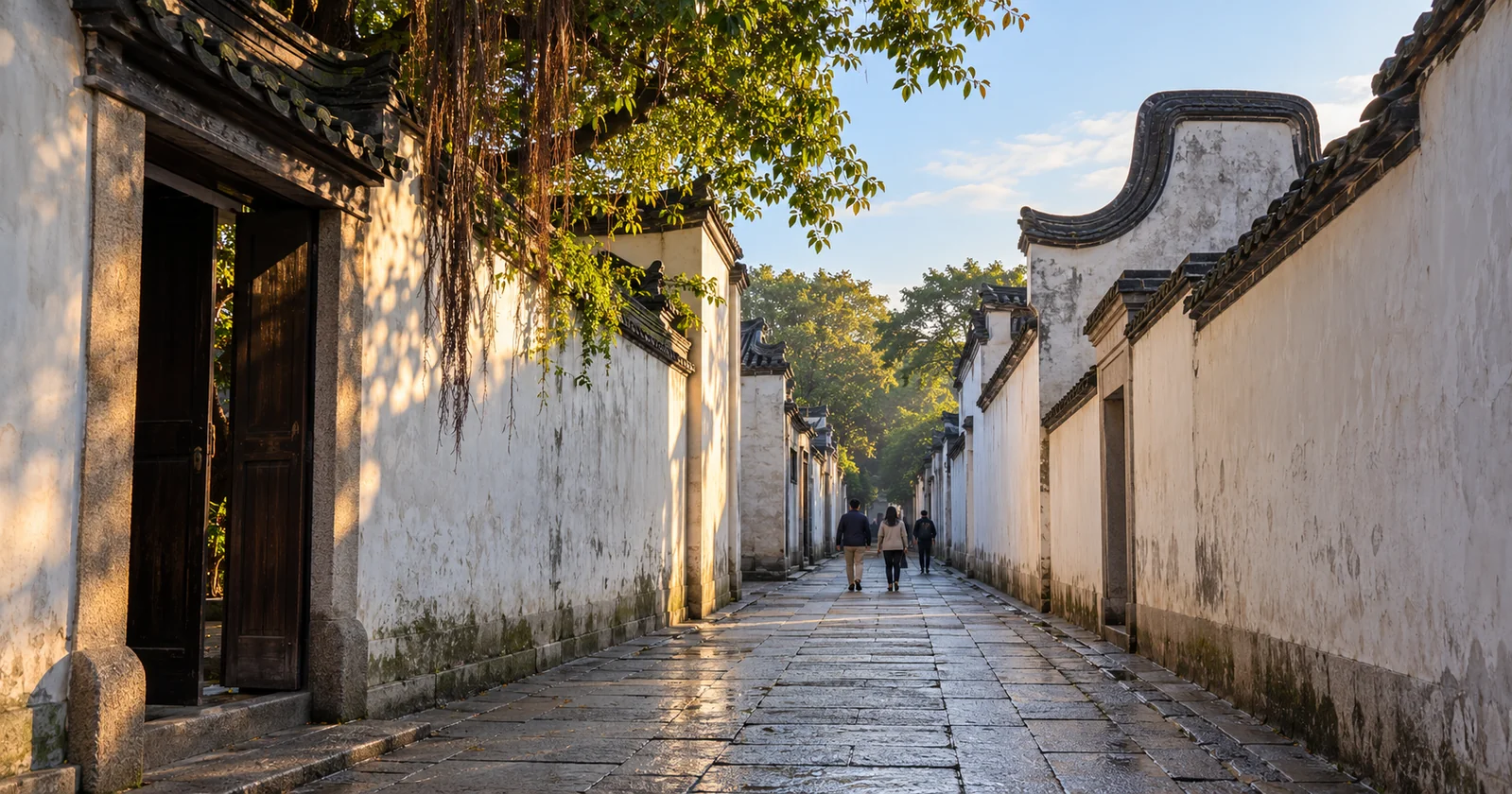
This is the reason most travellers stop in Fuzhou. The district keeps about 270 old houses and 159 protected buildings, nine of them national-level heritage sites; it was placed on China's tentative list for World Heritage in 2013 and is rated a national 5A scenic area. The layout is easy to follow: Nanhou Street (南后街) runs north–south down the middle, with the three lanes (坊, fāng) to the west and the seven alleys (巷, xiàng) to the east. The houses hide behind high white walls with curved "horse-head" gable ends, and many belonged to scholars and officials. The Fujian provincial government's English page on Sanfang Qixiang has a short background.
Walking the lanes is how most visitors see the district, and they pay only for the individual houses they enter — check at the entrance of each house if you are unsure. The paid houses were repriced on 19 May 2025: the combo ticket dropped from 90 to 70 yuan, the Little Yellow House (小黄楼) and the Shuixie Stage (水榭戏台, an old private opera stage over a pond) cost 20 yuan each, and several other houses became free, including the Lin Congyi residence and the Xie family ancestral hall. The combo and the single tickets are optional, and sellers are not allowed to bundle them. These are the official list prices; compare with the price on booking platforms.
Our advice: if you only want the atmosphere, walk the lanes, step into the free houses and skip the combo. If you like old interiors, gardens and stage buildings, note that the 70-yuan combo only saves money if you enter all five paid houses; for two or three, buy single tickets. Go early in the morning or after dark — the lanes are lit in the evening and Nanhou Street becomes a long snack street.
The Lin Zexu Memorial Hall (林则徐纪念馆), at 16 Aomen Road on the edge of the district, is free all year; it includes the birthplace, former home and ancestral hall of Lin Zexu, the Qing official remembered for his campaign against the opium trade, plus an anti-drug exhibition. Check the opening hours at the gate; give it an hour.
| Sight | Ticket | Hours and entry |
|---|---|---|
| Sanfang Qixiang: combo ticket (paid houses) | 70 ¥, covers all 5 paid houses | Optional: single tickets are also sold, and sellers may not bundle them |
| Sanfang Qixiang: single houses | Little Yellow House 20 ¥ · Shuixie Stage 20 ¥ · Yan Fu’s Former Residence 15 ¥ · Liu Family Compound 15 ¥ · Guo Baiyin’s Former Residence 10 ¥ | — |
| Sanfang Qixiang: free houses | Free: Lin Congyi Residence, Xie Family Ancestral Hall, Liu Qixian Residence, Wang Qi Residence, Yan Family Flower Hall, You Family House | — |
| Lin Zexu Memorial Hall | Free all year (birthplace, former residence and ancestral hall of Lin Zexu) | — |
| Mount Gu cable car | Adult 70 ¥ return / 50 ¥ one way · children 1.25–1.4 m 35 ¥ return / 25 ¥ one way · under 1.25 m free | — |
| Mount Gu Eighteen Sights park | 10 ¥ · students 5 ¥ · annual pass 20 ¥ | — |
| Fujian Museum | Permanent galleries free · some special exhibitions charge separately | Tue–Fri 09:00–18:00 (last entry 17:30) · weekends and public holidays 09:00–20:00 (last entry 19:30) · closed Mondays except public holidays · no booking needed |
Shangxiahang (上下杭)
A short walk south of the centre towards the Min River, Shangxiahang is the old commercial district: it was once Fuzhou's trading centre and the heart of Fujian's merchant culture, and is sometimes called the city's "museum of traditional commerce". It is quieter than Sanfang Qixiang, with restored merchant halls, cafés and small shops. It works best as an evening walk after the lanes.
Mount Gu (Gushan) and Yongquan Temple
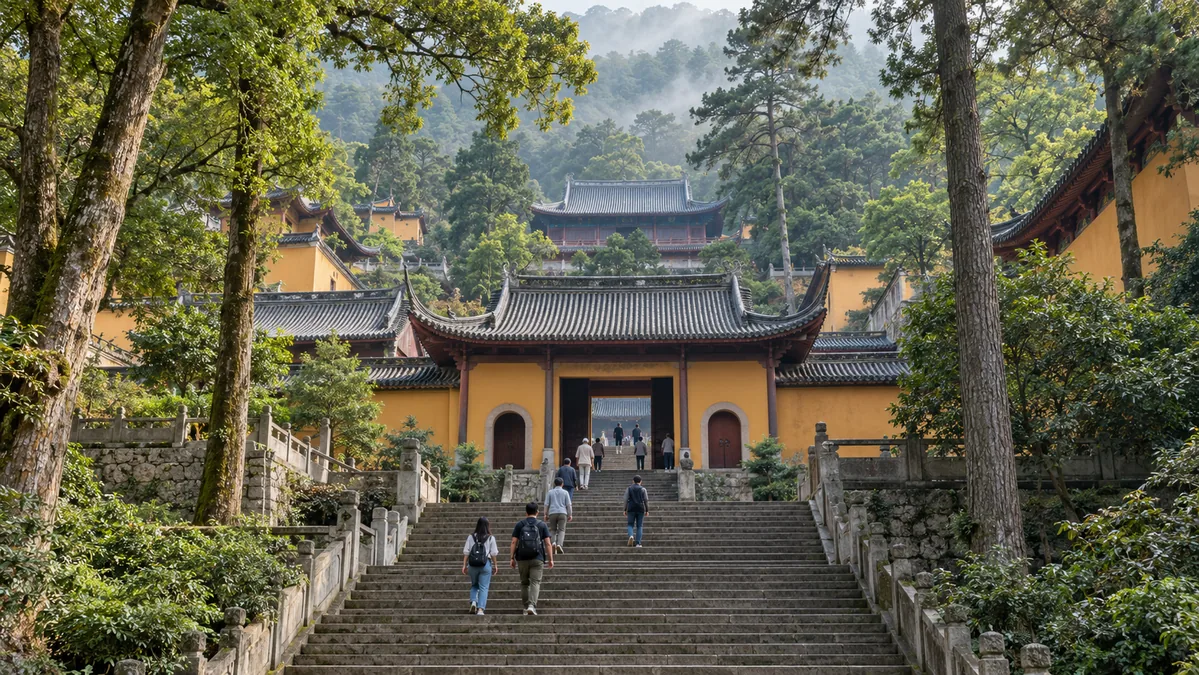
Mount Gu rises on the eastern edge of the city, and Yongquan Temple (涌泉寺, Yǒngquán Sì, "Gushing Spring Temple") sits on its slopes. You have two ways to do it. Walking up and around the main sights takes about 3–5 hours; using the cable car and the scenic-area shuttle cuts the core visit to about 2–3 hours. The cable car costs 70 yuan return or 50 yuan one way for adults, and children under 1.25 metres ride free. The separate Eighteen Sights park (鼓山十八景), a trail of rock carvings and viewpoints, charges 10 yuan. Check at the gate whether the temple charges entry.
Bus 170 runs from Fuzhou Railway Station straight to the Gushan scenic area; a taxi or DiDi from the centre is simpler if you are short of time. On public holidays and during Golden Week, the scenic area advises booking entry and cable-car tickets ahead online, and bookings can sell out. On other days you can usually buy on the spot. Go up by cable car in the morning, walk down past the temple, and you are back in town by early afternoon.
Fujian Museum and West Lake Park
The Fujian Museum (福建博物院) sits beside West Lake Park (西湖公园) north-west of the centre, and the two make an easy half-day. The museum opens Tuesday to Friday 9:00–18:00 (last entry 17:30) and on weekends and public holidays 9:00–20:00 (last entry 19:30); it closes on Mondays except public holidays. You do not need to book. The permanent galleries are free, and some special exhibitions charge a separate fee. Bring your passport anyway, as Chinese museums often check ID at the door. Special exhibitions can change the hours, so check the museum's notices if you go on a Monday or a holiday.
West Lake Park is an old city park with a lake, bridges and pavilions; it is a pleasant place to sit before or after the museum. Check the hours on the day if you plan to go early or late.
Yantai Hill (烟台山)
South of the Min River, Yantai Hill is the old foreign quarter, with old consulate buildings, churches and villas, many now used as cafés and shops. It suits the afternoon of a second day. Opening hours vary by building, so check each one on the day.
Jasmine tea
Fuzhou is regarded as the birthplace of jasmine tea, and its jasmine scenting craft is part of the traditional Chinese tea-making techniques that UNESCO listed as intangible cultural heritage in 2022. Many tea shops in and around the old lanes will let you taste before you buy. For background on how tea is served, see our Chinese tea ceremony guide.
Hot springs
Fuzhou was named "China's Hot Spring Capital" on 29 December 2010, the first provincial capital to get the title, and the hot-spring zone covers 1,055 square kilometres across most of the urban districts. The local bathing custom, called xǐ tāng (洗汤, "washing in the hot water"), is on Fuzhou's list of municipal intangible cultural heritage. In practice that means many hotels and bathhouses in the city use hot-spring water. If a soak matters to you, look for "hot spring" (温泉, wēnquán) in the hotel description when you book, and check whether the pool is mixed or separated by gender.
What to eat in Fuzhou
Fuzhou food is lighter and sweeter than most Chinese cooking, built around seafood, broth and a bit of red rice wine. These are the dishes worth ordering:
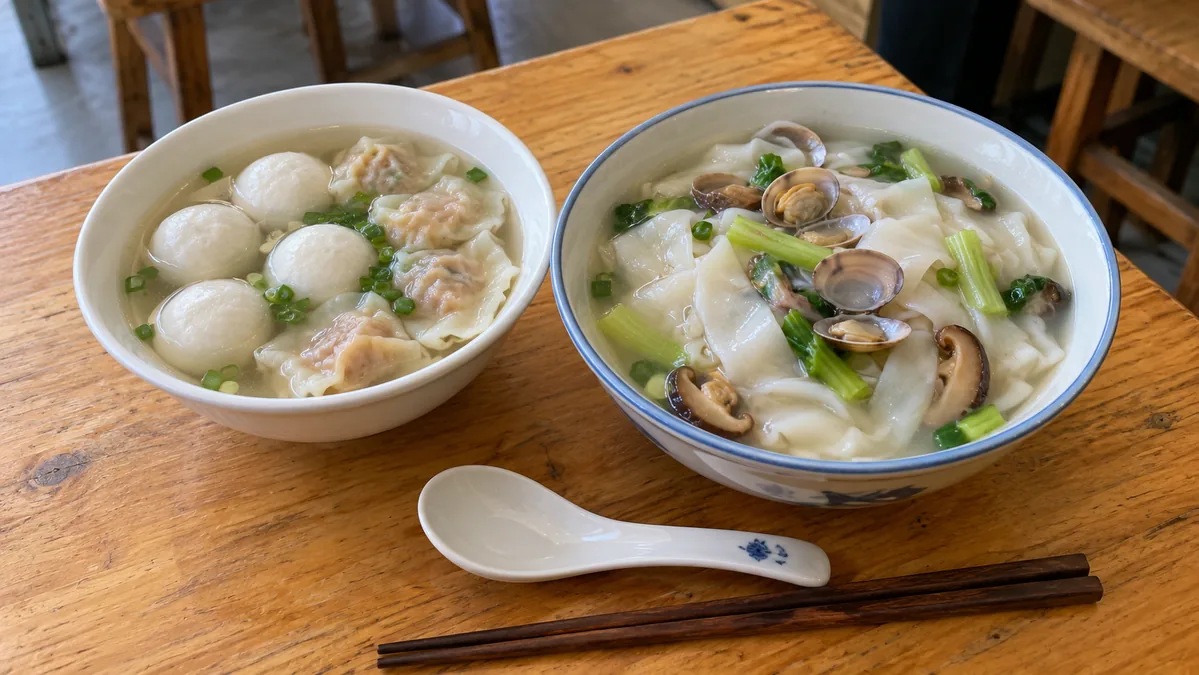
- Fish balls (鱼丸, yúwán): fish paste wrapped around a small pork filling, served in clear soup. Breakfast and snack food, sold all over the old town.
- Rouyan (肉燕, ròuyàn, "meat swallow"): small wontons whose wrapper is made from pounded pork and starch rather than flour. Often served in the same bowl as fish balls.
- Guobian (锅边糊, guōbiānhú, "wok-edge soup"): a rice batter poured around the edge of a hot wok, scraped into a seafood and vegetable broth. The classic local breakfast.
- Lychee pork (荔枝肉, lìzhī ròu): sweet-and-sour fried pork cut so it curls into balls that look like lychees. There is no lychee in it.
- Buddha Jumps Over the Wall (佛跳墙, fó tiào qiáng): a slow-cooked soup of seafood, meats and mushrooms. The dish was created at the Juchunyuan (聚春园) restaurant in Fuzhou, and Juchunyuan's way of making it was added to China's national intangible cultural heritage list in June 2008. It is a banquet dish and expensive; restaurants usually sell it by the individual pot, so check the price on the menu before you order.
Nanhou Street in Sanfang Qixiang and the lanes around it are the easiest places to try the snacks. For a sit-down meal, Fujian has had its own Michelin Guide since the first edition was launched in Xiamen in December 2024, covering restaurants in Fuzhou, Xiamen and Quanzhou. For how Fujian cooking compares with the rest of the country, see our guide to Chinese cuisine by region.
Getting around Fuzhou
The metro is the easiest way to move between the stations, the centre and the airport. Since the Binhai Express opened on 29 September 2025, Fuzhou has run six metro lines — Lines 1, 2, 4, 5 and 6 plus the Binhai Express — with more than 200 kilometres of track; from 2 February 2026 the first trains on Lines 1, 2, 4, 5 and 6 leave at 06:00. Last trains differ by line, so check the time in the station if you are out late.
To pay, use Alipay. Foreign visitors can download Alipay, link a foreign Visa, Mastercard, JCB, Diners Club or Discover card, and open the Fuzhou transit QR code to scan through the gates on both the metro and city buses. Set this up before you arrive — see how to use Alipay with foreign cards. Station ticket machines can also sell single tickets; whether a given machine or gate accepts a foreign card directly varies, so keep Alipay as your main method and ask at the service counter if something does not work.
| City | Lines | How to pay |
|---|---|---|
| Xiamen | Lines 1, 2 and 3: regular service, fares charged · Lines 4 and 6: free public trial since Sep 16, 2026 — gates open; pass the security check, no card needed · Line 4: Jimei Software Park North – Qianwu, 08:00–20:00, every 14 min 45 s; Xiang'an Airport station not open · Line 6: Jiaojiang Road – Huaqiao University, incl. the Jiaomei extension in Zhangzhou, 06:00–23:00, every 5 min 30 s at peak, 9 min 50 s off-peak · Check whether fares have started | Xiamen Transport Code (厦门交通码) in Alipay, with overseas payment since July 2024; foreign nationals can apply. One code for the metro, BRT, city buses and residents' ferry routes — not the Gulangyu tourist ferries, which need their own ticket. Tapping a foreign bank card at the gates: no official confirmation, so use the code |
| Fuzhou | 6 lines: 1, 2, 4, 5, 6 and the Binhai Express (airport line), over 200 km. First trains 06:00 since Feb 2, 2026 (Binhai Express direct train 05:55). Last trains vary by line — check in the station | Alipay: link a foreign Visa, Mastercard, JCB, Diners Club or Discover card, open the Fuzhou transit QR code and scan at metro gates and on city buses. Tapping a foreign card at the gates: no official confirmation |
Taxis are easy to find, and DiDi works well for places farther from a metro station. Show the driver the destination in Chinese characters. Our DiDi guide explains how to set it up in English with a foreign card.
Onward from Fuzhou: Mount Wuyi, Pingtan, Quanzhou and Xiamen
Mount Wuyi (武夷山)
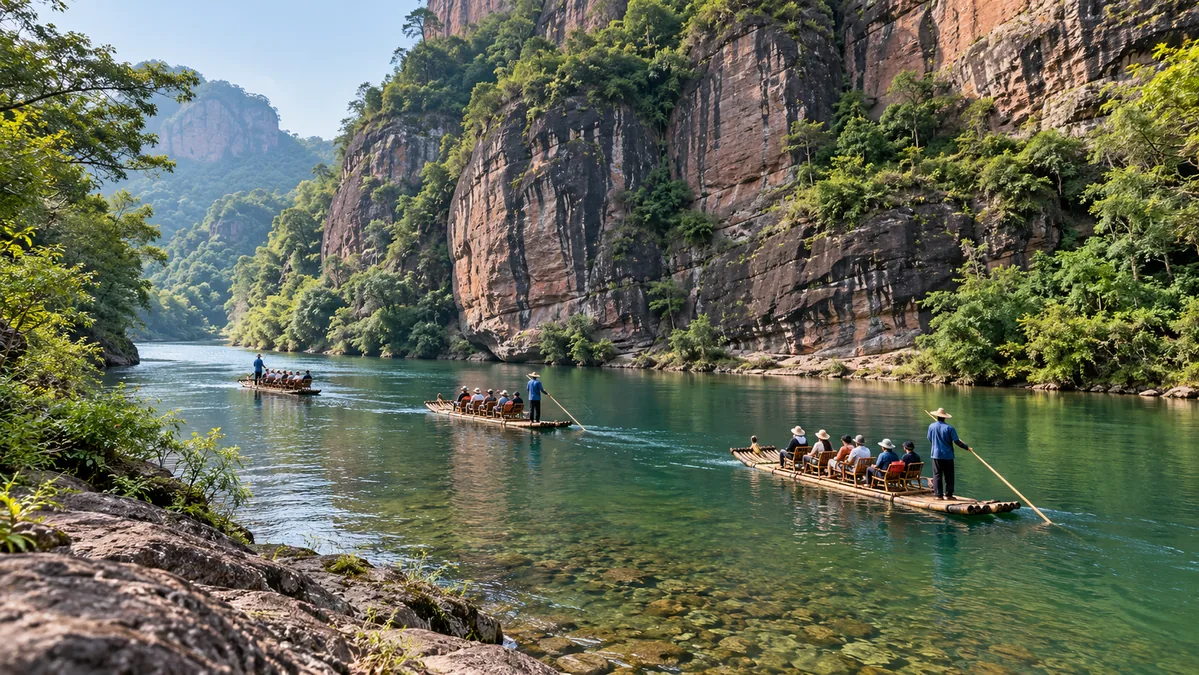
Mount Wuyi is the main reason many travellers come through Fuzhou. It has been on UNESCO's World Heritage list since December 1999 for both its culture and its nature, and is known for the Nine-Bend Stream, which you float down on bamboo rafts, and for its rock tea.
Trains for Mount Wuyi stop at Wuyishan North (武夷山北) — older guides may say Wuyishan East; on 12306, book to Wuyishan North. On that day's timetable, about 22 trains are scheduled from Fuzhou Station to Wuyishan North between 07:55 and 20:16, the fastest taking 1 hour 10 minutes and most around 1 hour 20; about 14 leave from Fuzhou South, the fastest taking 1 hour 29 minutes; second class costs 119.5–128.5 yuan depending on the train. So start from Fuzhou Station if you can. You can book on 12306 or through Trip.com, which has an English interface and takes foreign cards. From Wuyishan North to the scenic area, take a taxi or DiDi, or ask at the station for the current bus.
The main scenic area is free to enter for all of 2026, as it also was in 2024 and 2025; the free entry does not cover the sightseeing bus or the bamboo raft. Entry is with valid ID, so carry your passport and confirm at the visitor centre how passport holders enter. At 2024 prices, the sightseeing bus is 70 yuan for one day, 85 for two and 95 for three, with unlimited rides, and the Nine-Bend Stream bamboo raft is 130 yuan per person. Book the raft as early as you can for weekends and holidays, and check the current booking channel before you go. Plan two nights at Mount Wuyi: one day for the raft and the Tianyou Peak area, one for the tea gardens and the other peaks.
| Ticket | Price | Notes |
|---|---|---|
| Main scenic area entry | Free in 2026 | Also free in 2024 and 2025. Show valid ID — carry your passport. Sightseeing bus and bamboo raft not included |
| Sightseeing bus | 1 day ¥70 · 2 days ¥85 · 3 days ¥95 | Unlimited rides within the validity period |
| Nine-Bend Stream bamboo raft | ¥130 per person | — |
Pingtan (平潭)
Pingtan is an island south-east of Fuzhou known for its beaches, wind-carved rocks and, on some summer nights, glowing plankton in the sea. It is a domestic beach trip more than a first-visit highlight; if you want to go, check the current train and bus options from Fuzhou before you plan around it.
Quanzhou, Xiamen and the tulou
Going south, Quanzhou is under an hour from Fuzhou South on the fastest trains — see our Quanzhou guide for the World Heritage sites and which Quanzhou station to use. Xiamen is about an hour from Fuzhou South on the fastest trains, and the Xiamen and Fujian coast guide covers Gulangyu and the rest of the coast. For the round earthen houses, Longyan is the nearest city with fast trains to the Yongding tulou. Trains from Fuzhou and Fuzhou South to Longyan take mostly 2 hours 20 minutes to 3 hours 20 minutes, the fastest 2 hours 15 minutes, and second class costs 136.5–167 yuan depending on the train; most people find it easier to visit from Xiamen. Our Fujian tulou guide compares the clusters and how to reach them.
Fuzhou itineraries: one to three days
One day. Morning: Sanfang Qixiang, starting at Nanhou Street before the crowds, then the Lin Zexu Memorial Hall. Lunch: fish balls and guobian in the lanes. Afternoon: the Fujian Museum and West Lake Park (not on a Monday). Evening: walk to Shangxiahang for dinner.
Two days. Day 1 as above. Day 2: Mount Gu in the morning — cable car up, walk down past Yongquan Temple — then an afternoon on Yantai Hill or in a hot-spring bath, and a Buddha Jumps Over the Wall dinner if you want the splurge.
Three days. Use the third day to take the train to Mount Wuyi and start a two-night stay there. If you are staying in Fuzhou instead, spend it slowly: tea tasting in the old lanes and Shangxiahang by daylight.
Fuzhou as the start of a Fujian loop. A route that works well for a week to ten days: arrive in Fuzhou (by air, or from Shanghai by train to Fuzhou Station) and spend two days → train to Wuyishan North and stay two nights → back to Fuzhou → train south to Quanzhou for one or two days → Xiamen for two or three days, with a day trip to the tulou. You can also run it the other way and fly out of Fuzhou. If you enter on 240-hour visa-free transit, the whole loop stays inside Fujian, which is a permitted area; keep the loop within the 240 hours and leave China for a third country, and check the current rules before you book.
Frequently asked questions
Do you need a ticket for Sanfang Qixiang (Three Lanes and Seven Alleys)?
Most visitors walk the lanes and pay only for the houses they enter — check at each house's entrance. The paid houses have a combo ticket of 70 yuan, or you can buy single-house tickets of 10–20 yuan — the combo only saves money if you enter all five paid houses; several houses, including the Lin Congyi residence and the Xie family ancestral hall, are free. The Lin Zexu Memorial Hall next to the district is free all year.
Should I use Fuzhou Station or Fuzhou South?
Use Fuzhou Station for fast trains from Shanghai Hongqiao, for Mount Wuyi and for the Binhai Express to the airport. Use Fuzhou South for most trains from Quanzhou and for the widest choice of trains from Xiamen. Between Xiamen and Fuzhou, both stations have frequent trains, so choose the one closer to your hotel. Always check which station is printed on your ticket.
How do I get from Fuzhou to Mount Wuyi?
Take a high-speed train to Wuyishan North; on the 12306 timetable for 5 November 2026 the fastest from Fuzhou Station takes 1 hour 10 minutes, with about 22 departures scheduled from Fuzhou Station and 14 from Fuzhou South. Older guides may say Wuyishan East; on 12306, book to Wuyishan North. From Wuyishan North, take a taxi or DiDi to the scenic area, where entry is free in 2026 and the sightseeing bus and bamboo raft are paid separately.
Where to stay, paying, and emergencies
Where to stay. Stay near Sanfang Qixiang or Dongjiekou (东街口): you can walk to the lanes and the snack streets, and Dongjiekou has its own metro station. A hotel near Fuzhou South only makes sense for a very early train. Compare options around Sanfang Qixiang on Booking.com. Every hotel registers your passport at check-in; see booking hotels and registration rules.
Paying. Alipay or WeChat Pay with a linked foreign card covers the metro, restaurants and most shops; carry some cash as a backup. Our guide to using international cards in China covers the setup.
Emergencies. Save the national emergency numbers and your embassy's contacts before you travel — see emergency contacts in China and embassy contacts to find which consulate covers Fujian for your country.
Last updated: October 2026
Fact-checked sources
- Official Fuzhou Municipal Government 16 pages
- Official Fujian Department of Culture and Tourism 3 pages
- Official China Railway 12306 14 pages
- Official CNINFO (listed-company disclosures)
- Official National Immigration Administration 3 pages
- Official Chinese embassies and consulates
- Official Fujian Provincial Government 8 pages
- Official Sanfang Qixiang Scenic Area
Show 6 more sources
- Official Xiamen Municipal Government
- Fujian Daily
- People's Daily Online
- Official Xiamen Gaoqi International Airport 2 pages
- Xiamen Daily (xmnn.cn)
- Official Fujian Department of Transport
Last verified: 2026-10-23
Read in other languages
Last train times for 10 Chinese metro systems
Every line and station, checked by hand — the same data behind our offline route planner.
Get the WaysChina App
Offline guides, currency converter, essential phrases, and more — all in your pocket.

Related Articles

Yangzhou Travel Guide: Slender West Lake, Morning Tea and a Day Trip from Nanjing
How many days Yangzhou needs, Yangzhou East or Yangzhou Station, Slender West Lake and garden tickets by season, the...
Wuxi Travel Guide: Lake Tai, Lingshan Buddha and Which Station to Use
How many days Wuxi needs, Wuxi Station or Wuxi East, Yuantouzhu and the Lingshan Buddha on Lake Tai, the Grand Canal...

Fujian Tulou Guide: Nanjing County or Yongding, Tickets and How to Get There from Xiamen
Fujian's World Heritage tulou from Xiamen: how to choose between Nanjing County and Yongding, official ticket...

Quanzhou Travel Guide: World Heritage Temples, Day Trip from Xiamen and What to Eat
One or two days in Quanzhou: which of its three stations to book from Xiamen, what the 22 World Heritage sites are,...